time, my how the time flies by
when you’re living a life in love
and giving your love your life
in time
I’m certain I heard it once before
in an old song or movie score
lovers don’t feel the time
slip by
my dear, please know
as the years come and go
I’ll be here to show
how my love will only grow
’cause we’re in the time of our
lives, my love
our time, my love
rhymes, poets write words in time
rhythms play out in lines
for lovers to read supine
in time
my dear, please know
as the years come and go
I’ll be here to show
how my love will only grow
’cause we’re in the time of our
lives, my love
our time, my love
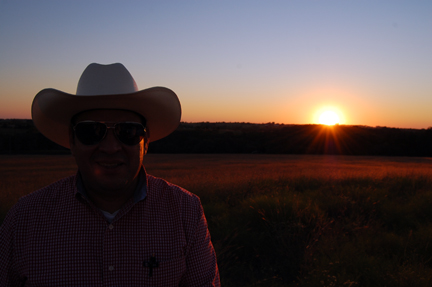
Above: “Anyone who says we can’t feed the world is talking b… s…,” said Glen Boudreaux yesterday. What a great family and what interesting folks! I was fascinated by what he had to say and his take on humane, wholesome farming and “pasture-based” ranching.
There’s so much to tell since the last post… a couple of truly outstanding meals and more than one exceptional bottle of wine. But all that will have to wait.
Yesterday, I had a fascinating conversation with the gentleman above, Glen Boudreaux, who (together with his lovely wife Honi, pronounced honey) has owned and managed a ranch in beautiful Brenham, Texas for more than 20 years — the Jolie Vue Farms. Glen and Honi hosted a farm-to-table dinner last night and I covered the event for one of my clients (one of the underwriters). You can see my post (together with some of my git’ fiddle picking) here.
Above: Mustard greens and blue corn grits, sourced locally and prepared by chef Paul Lewis who came in from Houston for the event.
Glen advocates a no-nonsense approach to farming and is a proponent of humane and wholesome, “pasture-based” ranching. Over the last two decades, he has revived a ranch that had been devastated by cotton farming and left to the weeds. Merely by encouraging and enabling the revival of native grasses, he is literally able to raise twice as many cattle per acre as the Texas department of agriculture believes possible. And he is convinced that his philosophy — if embraced by the world — would allow the global farming community to stamp out hunger. And frankly, when you shake this man’s hand and he looks you in the eye with a warmth and humanity not uncommon in the Texas farmland, you believe him.
Above: More than 200 persons sat down for dinner together at one continuous table last night. The event was organized by artist Jim Denevan and his company Outstanding in the Field.
Among the more fascinating topics of conversation with Glen: the parallels he sees between Jewish dietary law and his approach to ranching and butchering (the butchering, he explains, is as important as the farming and he carefully and “mercilessly” screens his clients, he told me); he loathes anyone who uses the word “natural” or “organic” in their packaging or labeling (see this fantastic post on his blog, What’s it all mean? Natural terminology can be confusing…); his admiration for “sissy” (Joel’s word) and “rebel” (Glen’s word) farmer Joel Salatin (check out this video I found this morning).
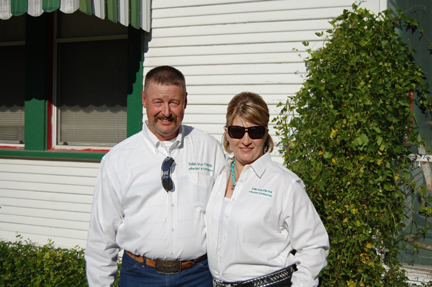
Above: Tracie P and I really loved this couple, Clay and Julia Theeck, who help the Boudreaux family manage their ranch. You wouldn’t think that it’s fascinating to hear someone talk about native grass until you talk to Clay and Julia. Their knowledge of the local plant life is incredible. Clay and Glen haven’t done anything to treat the soil on the Jolie Vue ranch. All they do is help the native grasses flourish.
Glen and Honi sell most of their cattle and pigs to locally based individuals who want to feed their children wholesome food. They also sell to the occasional restaurant, like Cullen’s in Houston, who also underwrote the dinner.
Ultimately, they believe that their livestock should be happy, that happy pigs and cattle make for the healthiest nutrition. Although chef Lewis may have had something to do with the delicious factor yesterday, it was the materia prima that played the starring role.
Above: “Jews may not have believed in the afterlife the way that we do,” said Glen. “But when you read [the dietary laws in] the Old Testament, you can tell that they were doing what they were doing because they knew that it was the right thing to do on earth.”
My life in Texas continues to inspire me on many levels. This state — this Republic! — is home to a wide spectrum of folks, from the love-happy, guitar-strumming, pot-toking hippies of our beloved Austin to the generous-of-spirit, G-d-fearing, gun-toting ranchers of the immensely beautiful plains. Somehow, beyond the stereo- and archetypes, no matter the gulf of difference between them, there seem to be a humanity and a gentleness that pervade their willfully shared ethos.
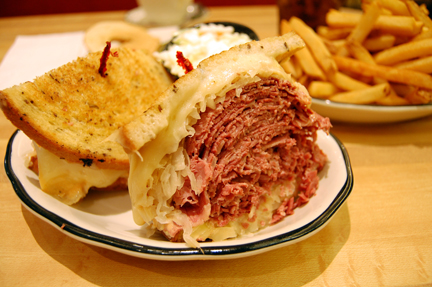
My first job in New York City (back in 1997) was nearly kitty-corner to Reuben’s Restaurant on Madison Avenue. So I feel confident when I say, I know from a Reuben sandwich… And as cousin Marty remarked to me last night, I come from a long line of fressers…
Yesterday, I couldn’t resist a Reuben at the wonderful Kenny and Ziggy’s Deli in Houston. I love this place. It’s as good as New York (and sometimes better!).
Usually, I get the white fish salad appetizer but yesterday I was in the mood for something a little more substantial (how’s that for understatement?).
I do wish Ziggy wouldn’t pile so much meat on the sandwich (I removed about half of what you see in the photo). But, man, was it good…
There’s lots more to tell about good stuff (amazing, really) that we ate and drank while in Houston but Tracie P are about to say goodbye to cousins Joanne and Marty and make our way over to Brenham, Texas where we’re attending a dinner for 200 persons on the Jolie Vue farm.
Above: Houston Greek Festival director Gus Economides, media coordinator Dana Kantalis, and Boutari sales manager Patrick Bennett. Both Gus and Dana told me that their respective families have been involved in the festival, now in its 44th year (!), for three generations. Great folks, GREAT festival.
I have to admit: I was skeptical. When my clients over at BoutariWines.com asked me to cover the Houston Greek Festival for their blog, I imagined one of those stereotypical affairs, like one I attended over the summer in Austin dubiously titled “Italian Festival,” where the raison d’être was that of profiting through the sale of booth space to vendors and not that of celebrating a community and a culture (Tracie P and I were so disappointed.)
Above: All of the food at the Houston Greek festival is prepared by volunteers. The recipes are decided upon by community committees, mostly community matriarchs, Dana told me). No commercial vendors have a presence there.
To my wonderful surprise, I found that this is an entirely homespun, homegrown, grassroots, and community-based festival intended to celebrate Greek culture and cuisine and to benefit the Annunciation Greek Orthodox Cathedral in Houston and its youth programs. EVERY volunteer (and I mean EVERYONE) told me that this is a family affair, with participation handed down from generation to generation (in many cases, the volunteers were fourth generation).
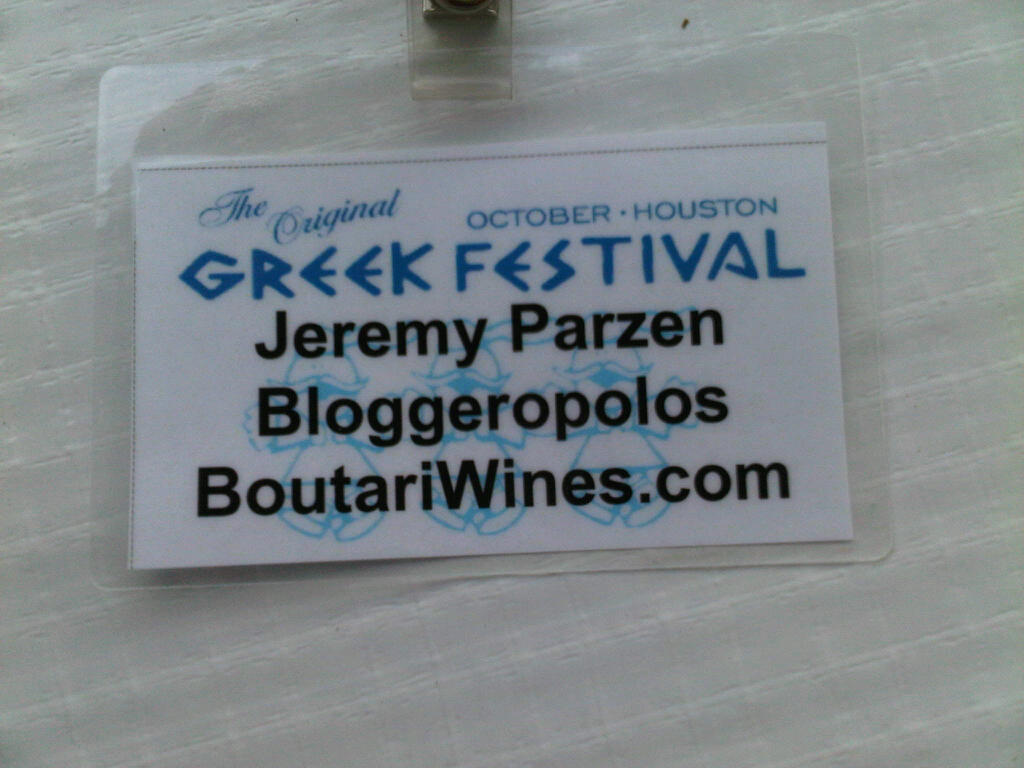
Above: In my capacity as Bloggeropolos (the non-Greek volunteers Hellenize their names for their laminates), I got to taste a lot of great food. The ingredients were fresh and wholesome and man, were they tasty! I’ve never experienced such good food at a large festival. Very cool stuff.
I’ll be heading back this afternoon to the festival with Tracie P, who’s joining me shortly. And we’re doing other fun food and wine stuff while in Houston and on our way back to Austin tomorrow. In the meantime, check out the slideshow I created from my photos yesterday.
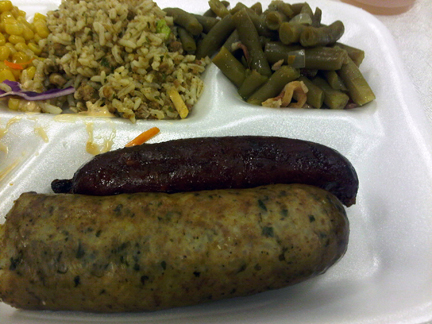
At my count, about 150 folks filed into the meeting hall at the Wesley United Methodist Church in Orange, Texas for a luncheon and celebration of Melvin following his beautiful memorial led by Rev. B. The lunch included delicious tender brisket by Melvin’s bbq team, creamy chicken spaghetti, Cajun boudin, and smoked sausage, and all the fixings.
Last night after Tracie P and I got to Orange, Texas, we shared an ice-cold bottle of Lone Star beer from the six-pack that Melvin Croaker gave me back at Xmas to welcome me to Texas and to the folds of the Croaker and Branch families.
Lone Star beer never tasted better.
“It’s not Melvin’s first rodeo,” said Rev. B, fondly remembering how Melvin competed in professional bbq competitions at the Houston rodeo and elsewhere.
Rev. B will be speaking at the memorial service this morning.
The first comes from Francesco Scipione Maffei’s history of Verona, Verona Illustrata (parte prima) (Verona, Jacopo Vallarsi e Pierantonio Berno, 1732).
N.B.: for brevity’s sake, I’ve refrained from glossing the historical figures mentioned here. Where possible, I’ve included relevant links. On another occasion, I’ll translate more from Maffei’s wonderful book.
In discussing the historically significant agricultural products of greater Verona, Maffei devotes ample space to the wines, citing mentions in Cassiodorus and in various Roman decrees. Two wines, he writes, were highly coveted by the Romans: one white and one red. He translates (into Italian) Cassidorus’s description of a vinification process for a wine that resembles today’s Recioto di Soave (no surprise here). But a discrepancy in the nomenclature leads him to make the following observation:
But perhaps [the wine described below] had another name in antiquity, because Pliny omits it. And it seems that [Roman jurist] Ulpian meant something else when he referred to Acinaticum or Acineum in a law.
Select grapes are stored until December. They are then gently pressed in the great cold [of winter]. The must is stored for a long while without starting fermentation and before laying a hand on it or drinking it.
[Ancient documents] show that this wine, although red and not white, was the very same wine that we praise today by calling it Santo [holy].
It is also produced in greater Brescia, from here to the Chiesi river.
[translation mine]
I believe that this may be the earliest known reference to “Vin Santo” in print (1732). Whether it is or not, it demonstrates that the citizens of the Venetian Republic produced a wine known popularly as “[Vin] Santo.” The fact that it’s mentioned in 1732 reveals that it was popular long before then.
Above: The grapes are laid out to dry on mats called cannicci in Italian.
The second fascinating discovery comes in the form of La teoria e la pratica della Viticultura e della enologia [Theory and Practice of Viticulture and Enology] by Egidio Pollacci (Milano, Fatelli Dumolard, 1883). I’ll let the text speak for itself:
Vin-santo. — The grapes used to make this wine vary from place to place because the same grape varieties, when cultivated in different regions, naturally deliver fruit of varying character. As a result, grapes good for Vin-santo in one place are difficult to use in other places. In Tuscany, for example, the grapes best suited for Vin-santo are Tribbiano [sic], Canaiolo bianco, and San Colombano. (1)
(1) Vin-santo di Caluso, which is famous especially in Piedmont, is prepared using grape varieties known locally as Erbaluce and Bonarda. But in other parts of Piedmont, other grapes are used. …
[translation mine]
In other texts I’ve uncovered, there is clear evidence that the production of Vin Santo was wildly popular in Tuscany by the end of the 19th century. The fact that Pollacci uses Tuscany as an example is indicative of this phenomenon. But what’s important here is the fact that he describes how different grapes are used in different regions, thus revealing that Vin Santo was popular in other parts of Italy as well. The production of Vin Santo in Piedmont was evidently significant enough in the late 19th century that Pollacci (who was from Pistoia) felt compelled to mention it here.
Above: Specially sized oak casks, called caratelli, are used for the long-term aging of Vin Santo.
I wish I had more time to devote to the many interesting texts I’ve “unearthed” recently and Maffei alone would merit his own monographic blog! Alas, it’s time to pay some bills around here… More later… and THANKS SO MUCH FOR READING!
Anyone who knows me via my blog knows that I am a bibliophile. I love books. All sorts of books. And there is a very special section of our library devoted to food and wine books.
While I can always find a way to justify my splurges on books Italianate in nature, books devoted to the cult of fine French wine are a true luxury in our home.
That’s just one of the reasons why a gift given to me yesterday by my clients Lisa and Stan Duchman has all the more meaning.
Stan recently attended a private tasting with Mr. Allen Meadows and had him inscribe the book personally.
Does anyone remember who called me “Dr. J’ so famously for the first time?
Words cannot express my thrill at receiving this truly excellent gift! Thank you, Lisa and Stan, Tracie P and I LOVE IT!
Here’s another post from my recent trip to Italy during the second and third weeks of September, 2010. I’m slowly making my way through Tuscany, then the Veneto, and then Friuli. Thanks for reading!
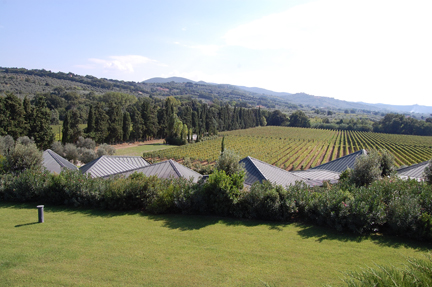
Above: Gaja’s Ca’ Marcanda winery “sinks” into the landscape.
Gaia Gaja drives fast. I could barely keep up with her… she in her Audi Quattro station wagon, me in my Renault Clio rental! After we finished our tasting and tour at her family’s Pieve di Santa Restituta property (a fascinating visit), we drove in tandem toward the coast, where we ate lunch in San Vincenzo at a restaurant that I highly recommend, if not for the food then for the cast of characters who await you). In the wake of our Fellinian repast, we headed from San Vincenzo toward Castagneto Carducci and her family’s Ca’ Marcanda winery.
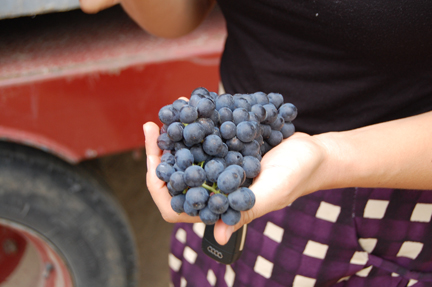
Above: We stopped to chat with the vineyard manager whose team was picking Syrah that day (Monday, September 13).
I’ve visited some impressive wineries in my time as an observer of Italian wine and the people who grow and produce it (Soldera is at the top of that list, of course, and I’ll be posting on my incredible visit to Zidarich toward the end of this series). But Gaja’s Ca’ Marcanda stands apart, a winery sui generis.
As a rule, winemakers design their wineries and winemaking facilities with functionality as their guide. Aesthetics are no afterthought but beauty is trumped by the business of making wine, the nuts and bolts, as it were, of presses, vats, casks, bottling lines, etc.
When Angelo Gaja conceived the Ca’ Marcanda facility, he turned this notion on its head: the germ was an aesthetic ideal and the functionality and process of wine came in its wake.
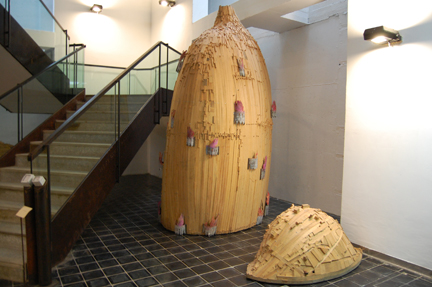
Above: Everywhere you turn in the winery, you find objets d’art, like these movable wood sculptures by Astigiano artist Sergio Omedé.
As we toured her family’s winery together, I noticed that everyone we met — from the receptionist to enologist Guido Rivella — had a smile on their face, a bounce in their step, and a kind word to share even in the industrious hum of their daily toil. This place — this enotopia (how’s that for a neologism!) — is so violently beautiful to look at, with something interesting to gaze upon at every corner. It’s no wonder the staff enjoys showing up for work every day.
Above: One of the many sculptures in terracotta by architect Giovanni Bo (Gaja’s longtime collaborator).
It occurred to me that Gaja’s Ca’ Marcanda property, the third in the Gaja tripytch, is the fulfillment of an Oedipal cycle.
In Piedmont, Gaja inherited a winery built by his father. In Piedmont, Gaja the winemaker is the fourth generation in one of Europe’s most venerable winemaking legacies. In Piedmont, Gaja has always pushed the envelope of the appellation regulations and tradition but he never works outside of them.
In Montalcino, Gaja bought what may be the oldest continuously operating estate in the appellation, with a church that dates back to the 7th century C.E. There, too, he is bound by strict appellation regulations and an entrenched however youthful enologic tradition. There, he is painstakingly restoring the beautiful house of worship and making wines that do not attempt to redefine the place but rather sing the notes of Sangiovese to the tune of Gaja elegance.
In Bolgheri, Gaja built a winery from scratch, on an estate that never produced fine wine until he arrived. Here, he was free to express his creativity, quite literally and figuratively, in an appellation where the rules have yet to be written (all of the Ca’ Marcanda wines are Toscana IGT). Gaja’s own ars poetica was the only chain to bind him and like a great poet, he has created his own language, a brave and new idiolect. Truly fascinating…
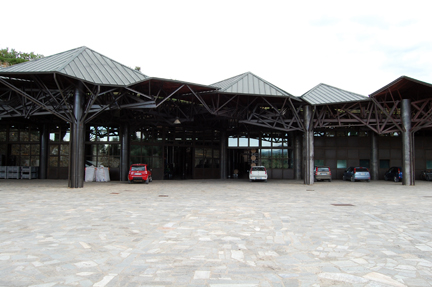
Above: I regret that ability as photographer do not do justice to this amazing working space. That’s winery as seen from the backside. It’s virtually invisible to the outside world.
When Gaia showed me the main floor of the winery, where vinification, aging, and bottling take place in one open space, I noticed that the bottling line was enclosed in acrylic. Her father wanted one open space for the main room of the winery, she said, and so he had to devise an enclosure to ensure the hygienic integrity of the bottling line. Here, aesthetics once again had trumped functionality. I asked Gaia if her father had patented the system. No, she said. Why would he?
Come with me
And you’ll be
In a world of
Pure imagination
Take a look
And you’ll see
Into your imagination
We’ll begin
With a spin
Traveling in
The world of my creation
What we’ll see
Will defy
Explanation
There is no
Life I know
To compare with
Pure imagination
Living there
You’ll be free
If you truly
Wish to be







 The first comes from



 Do Bianchi