Maybe it’s the way she grates her cheese… Tracie P’s pastitsio, so good!

Just had to share these images of dishes that Tracie P made for us over the weekend, my first back at home from a trip too long…

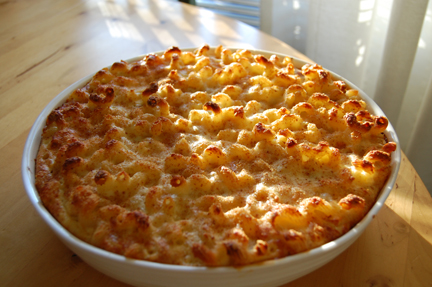
That’s her pastitsio… unlike the Italians, the Greeks use egg in their béchamel, giving the crust of Tracie P’s pastitsio a custard-like texture… unbelievably good…

And last night, speckled butter beans that she had bought fresh and then froze, cooked with bacon and served with her homemade cornbread, made in her grandmother’s cast-iron skillet.

Watching our friend Edoardo Ballerini on Boardwalk Empire last night, munching on cornbread and sipping some 2008 Laurent Tribut Chablis, I felt criminally good…

Maybe its the way she grates her cheese,
Or just the freckles on her knees.
Maybe its the scallions. Maybe she’s Italian.

—Michael Franks, “Eggplant,” The Art of Tea, 1975

BREAKTHROUGH in my Vinsanto vs Vin Santo research!

Above: During my graduate years, I spent many hours at the Biblioteca Nazionale Marciana in Venice working on my dissertation on Petrarch and Bembo and early transcriptions of Petrarch Italian poems.

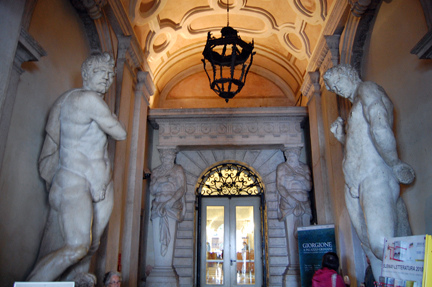
Between the two working legs of my recent trip to Italy, I had just two days free over a weekend, when I could do whatever I wanted to do. What did I do? I went to a library, of course! And not just any library: I spent a truly sinful and decadently fulfilling morning of quiet study in the Biblioteca Nazionale Marciana in Venice (that’s the entrance above), one of my favorite places in the world (where I conducted much of my research for my doctoral thesis back in the day).

In all honesty, I didn’t find what I was looking for that day but I did find a few clues that led me to what I believe is definitive proof that the Greek wine Vinsanto gets its name not from the Vin Santo of Italy but rather from the toponym Santorini, the island where it is made. (Here’s the link to my original post on the origins of the two enonyms.)

Above: My beloved Petrarch (1304-1374, subject of my doctoral thesis) bequeathed his library to the Biblioteca Marciana (named after the patron saint of Venice, St. Mark). A bust of Petrarch surveys the main reading room.

My research that day led me to the discovery of a fascinating 19th-century journal entitled, New Remedies, an illustrated monthly trade journal of Materia Medica, Pharmacy and Therpeutics (New York, William Wood, 1880).

In it (volume 9, page 6), I found the following passage (boldface mine):

    Greek Wines.

    Greece, and particularly the islands of the Archipelago, produce a great variety of excellent wines, which have lately attracted the attention of eminent therapeutists in Europe. The most favored island is Santorino, the ancient Thera or Kalliste, being the most southern island of the group of the Cyclades, and belonging to Greece. A variety of wines are produced there, both red and white. The best red wine is called Santorin (or Santo, Vino di Baccho), representing a dry fine-tasting claret, with an approach to port. Another fine (white) wine is called Vino di Notte (night wine). There are two varieties of this, one named Kalliste, being stronger and richer; the other, called Elia, somewhat weaker, but both possessing a fine bouquet and equal to the best French wines, particularly for table use. The “king” of Greek wines, however, is the Vino santo, likewise produced in Santorino, occurring in two varieties: dark-red and amber colored. This wine is sweet, rich, very dry, and has a strong stimulating aroma.

Note how the author (Xaver Landerer, a professor of botany at Athens) refers to a wine called “Santo” and he refers to the island as “Santorino” (and not Santorini). Note also how he calls the sweet wine “Vino Santo” and not Vinsanto or Vin Santo (where the o of vino has been naturally elided by the inherent system of Italian prosody).

Together with the above document, I found numerous others from the same era that refer to a “Vino Santo” or “Santo” from “Santorino,” the common name for Santorini in the late 19th century.

I also discovered the following information, which I have translated from the Italian, from the “Summary of previously unreported statistics from the Island of Santorino, sent to the Royal Academy of Science of Turin by Count Giuseppe de Cigalla,” published in the Memorie della Reale Accademia delle Scienze di Torino (proceedings of the Royal Academy of Turin, serie 2, tomo 7, Torino, Stamperia Reale, 1845).

    Vineyards produce the [island’s] principal crops, with more than 50 varieties of known vine types. [68]

    [In 1841 Santorini produced] Vino santo 2,350 barrels, 1,922 hectoliters, value 63,168 Italian lire [68]

    The only product exported from Santorino worth mention is wine. The quanity exported in 73,120 barrels (59,797 hectoliters) was nearly in 1841 but it generally does not exceed on average 45-50,000 barrels per year (from 36 to 40 thousand hectoliters), correspondent to the amount of consumed in Russia. [70]

Evidently, Vinsanto from Santorini was widely popular in Russia, where it was consumed as a tonic (I found other texts that spoke of the wine’s popularity in Russia).

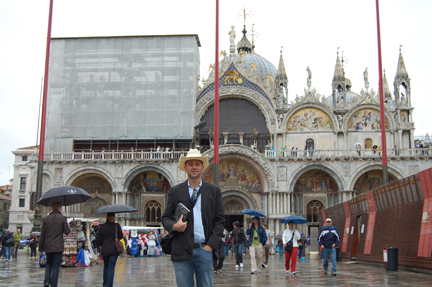
Above: My good friend and college roommate Steve Muench accompanied me that day and took this photo. A good Texan cowboy hat comes in handy in the Venetian rain!

Why do I do this? And why do I travel to Venice from Padua on a rainy Saturday morning only to spend 3 hours inside a library? As my friend Andy P likes to say, I am a self-proclaimed lover of Italian wine and a moonlighting Italian wine historiographer.

Even better news (for Italian wine geeks out there): I have also discovered what may be the earliest document (early 1700s) to make reference to Italian Vin Santo and the process employed to produce it. Ultimately, I believe that Vin Santo has its origins in the Veneto rather than Tuscany and you’ll see why when I post my findings later this week…

If you made this far into the post, thanks for reading! Stay tuned…

We’ll miss you, Melvin… Rest in peace…

It fills Tracie P and me with great sadness to share the news that good friend to the B family, one of the nicest folks I’ve ever met, Melvin Croaker, left this world last night to pass to another.

Rev. B wrote a heartfelt eulogy for Melvin here.

It was on Xmas eve of 2009 that Melvin gave me my cowboy hat and a six-pack of Lonestar beer to welcome me to Texas and to the fold of the Branch and Croaker extended families.

As Melvin’s illness progressed, he spent a lot of time at home looking at Facebook. And in a way that may have not been possible a few years ago, he and I got to know each other by “following” each other — commenting and “liking” each others notes and posts.

I’ve worn that hat proudly in the Texas Hill Country, picking grapes (above).

I’ve worn that hat proudly in California

I wore that hat proudly in Italy, where I found out that a good cowboy hat comes in handy when you least expect it.

It was just the other day, posting from Sant’Angelo in Colle in Tuscany, that I wrote: “Wherever I lay my hat these days, I am reminded that Texas is my home (for MELVIN CROAKER).”

We’ll miss you very much, Melvin. Thanks, again, for my hat. I plan to put it to good use…

Fusion: Cos Cerasuolo di Vittoria and smoked Texas ribeye

Last night was a night of fusions and no one was taking sides at Trio at the Four Seasons (Austin).

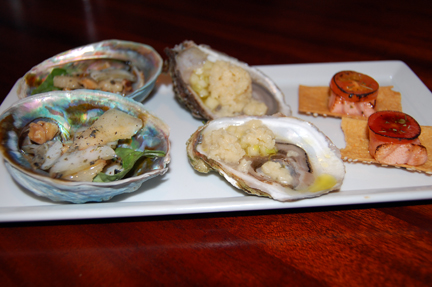
The first was Washington state abalone, oysters, and salmon, paired with Prosecco. Chef Todd was cooking for a Washington state wine event in one of the event spaces at the Four Seasons hotel and he sent down some of the pairings to our table at the restaurant downstairs where a friend and client had asked us to join him with a Prosecco producer.

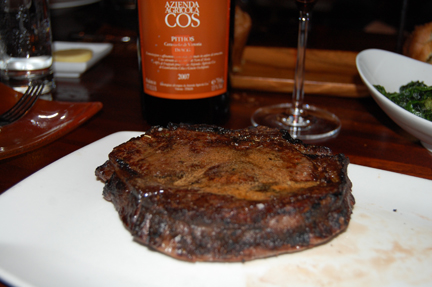
Perhaps the most extraordinary fusion came in the guise of a Texas smoked rib-eye paired with the Cos Cerasuolo di Vittoria. The Frappato character was powerful in the bottling we unstopped yesterday evening and the match between the bright fruit and the smokiness and fattiness of the beef was delicious.

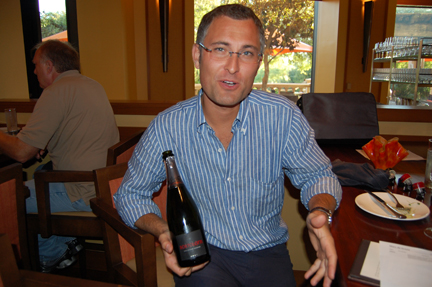
But the most intriguing fusion came with a smile and rimless glasses. Daniele d’Anna, the current generation of the Bortolotti family of Prosecco producers. Daniele is the product of a “mixed” marriage: his father is Neapolitan and his mother Veneta. I’ve never met anyone like him: he can switch between a thick Veneto accent (familiar to me) to Neapolitan (familiar to Tracie P) on the turn of a dime. I was curious to ask him about what it’s like to live in a Veneto now dominated by the Lega Nord, the xenophobe Separatist movement.

The Lega Nord wants to secede from the Italian republic and form its own country, severing ties with central and southern Italy. Let’s just say that the Lega doesn’t look so favorably on southern Italians, their customs, mores, and life rhythms. The image from the left is taken from a bizarre Lega campaign that I saw when I was in Italy recently. “They suffered immigration,” it says. “Now they live on reservations. Think about it.” Pretty scary, huh?

I liked Daniele very much and he struck me as a highly educated, cosmopolitan, and enlightened fellow. I doubt he shares the xenophobic sentiments of his Leghisti brethren. He made an interesting point: anyone who wants to get something done in Italian politics today, he observed, needs to take sides. His girlfriend, he told me, joined the Lega so that she could run for mayor of her small town in the Veneto, Asolo (one of my FAVORITE and one of the most beautiful and historically rich places in the world). Does she share the Lega’s racist platform? No, Daniele said. She just joined the Lega as a means to an end, he explained. Do they talk about politics when she comes over to the parentals’s for dinner? No, he said with a smile, they don’t. The 31-year-old woman won the election by the way and now serves as Asolo’s mayor.

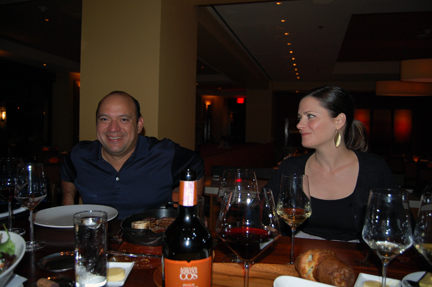
Only in Austin can a Salvadoreño (my friend and client Julio, above, left), a Methodist (Tracie P), a Jew (that’s me), and a Trevisan walk into a bar and order a Texas smoked rib-eye with a wine aged in amphora from Sicily. Sounds like a joke, but I’m here to tell you, people: it ain’t!

Buon weekend, ya’ll!

There’ll be more posts from my recent Italy trip coming up next week. Stay tuned…

The world according to Soldera

Above: Gianfranco Soldera, legendary, enigmatic, and paradigmatic winemaker, a Trevisan farmer turned Milanese industrialist turned Montalcinese winemaker.

Anyone who’s ever had the good fortune to be invited to visit Gianfranco Soldera’s estate, Case Basse, in the southwestern subzone of the Brunello appellation will surely share my impression that his winery, vineyards, and contiguous botanical garden come together to form what is undeniably one of the most impressive estates in the world.

When he began looking for an estate to purchase in the early 1970s, the Piedmontese wouldn’t sell him a decent plot of land, he told me the other day when we visited. So he decided to to buy a parcel in Montalcino on the advice of a friend who had told him you could pick up a piece of land there for a boccon di pan, a mouthful of bread, in those days.

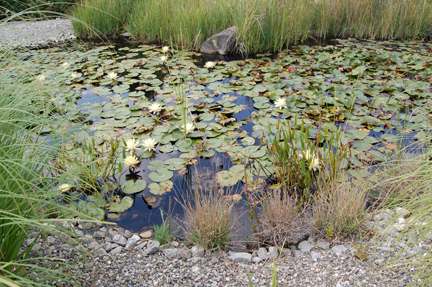
Above: The botanical gardens at Soldera’s Case Basse include a swamp (to create a maritime influence) and a white flower garden (to encourage nighttime pollination). “Ah, the white flower garden,” remembered wistfully my friend Dr. Lawrence O, the other day when he spied my visit on Facebook. Lawrence has visited there, of course.

When you talk to winemakers in Langa (Piedmont), many of the current generation still look to Soldera as a doktorvater (like Beppe Rinaldi, who told me that he often seeks advice and guidance from Soldera when the elder visits Barolo).

In many ways, it’s as if Soldera, when faced with the fact that he couldn’t make wine in Piedmont where he so obstinately desired to do so, decided to construct his own microclimate within the Brunello macroclimate. As he explains very openly, the remarkable botanical garden on his property (manicured by his wife) creates a unique ecological balance of plant and swamp life, including the “white flower garden,” so famous among wine insiders, intended to encourage pollination at night because the bright peddles attract the insects in darkness.

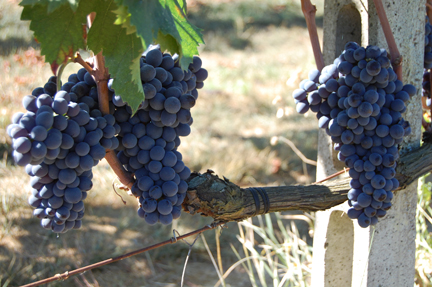
Above: “You find no vineyards with larger berries nor smaller clusters,” said Soldera proudly of his fruit. The attention to detail in his vineyard management is truly stunning.

Soldera has famously stated that he makes “natural wine.” Whether or not that’s the case is something I’ll leave that to the experts in the thorny field. He does seem to meet all the card-carrying members’s requirements: manual vineyard management, no chemicals in the vineyards, ambient yeasts in the cellar, no temperature control, lowest possible sulfuring. While I was in his presence a few weeks ago, he scolded one very famous winemaker in absentia for using cement vats for vinification, noting that wood is the natural vessel for winemaking. He also scolded another very famous winemaker for suggesting that it was okay to use a starter yeast when he had trouble initiating fermentation in his cellar.

But is it natural, I wonder, to build a botanical garden using mountains of manure (however organically prepared) in a place abandoned by sharecroppers because nothing would grow there anymore? I’ve leave that one to the exegetic forces of the rebbes and erstwhile Talmudic scholars in our field.

One thing we can all seem to agree on is that his wines are among the best in the world (and accordingly priced). I had the good fortune to taste the 2008 (extremely good) and 2006 (exceptional vintage, one of the best I’ve ever tasted) out of cask with him in the cellar. And at dinner we drank the 2003: an infamously and remarkably difficult vintage for any winemaker in Italy yet a harvest for which Soldera delivered lip-smacking acidity and gorgeously nuanced fruit aromas and flavors in his Sangiovese. These wines are simply life-changing, mind-blowing, awe-inspiring… It’s true…

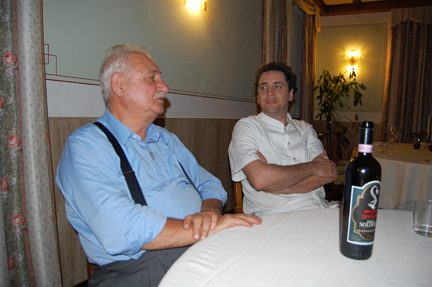
Above: Soldera with Roberto Rossi, chef/owner of Il Silene, arguably the best restaurant in southern Tuscany. The drive up to Seggiano is worth it if only to taste Roberto’s olive oil. The food and service were amazing.

Anyone who’s ever had the good fortune to be invited to visit Gianfranco Soldera’s estate, Case Basse, will tell you that Soldera keeps no secrets and he liberally shares his often salty opinions with those whom have been invited for an audience. (You’ll be surprised to find out that he has a website.)

Our conversation spanned many generations of Italian winemaking the other day when I visited him and you can imagine the controversial topics we covered. But the thing that stuck with me was what he said when I asked him what he saw for the future of winemaking in Italy.

“Commercial winemaking has come to an end in Italy,” he said referring to the recent Brunello controversy and rumors that the historic Barbi estate has plans to sell its property to Italian wine behemoth Zonin. “The nature of Italy cannot support industrial farming and commercial winemaking has run its course historically,” he told me. However many grains of salt there may be in the world according to Soldera, there’s certainly a grain of truth in this morsel of wisdom.

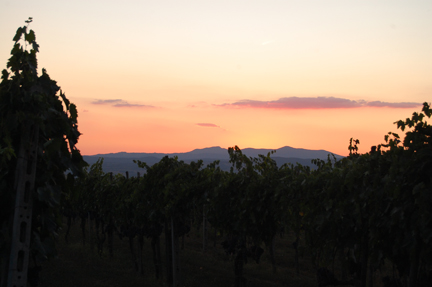
Above: Sunset at the Case Basse estate.

Another winemaker told me the same thing later on in my trip. Stay tuned to find out which one…

The new vintages of López de Heredia have arrived in the Groovers Paradise!

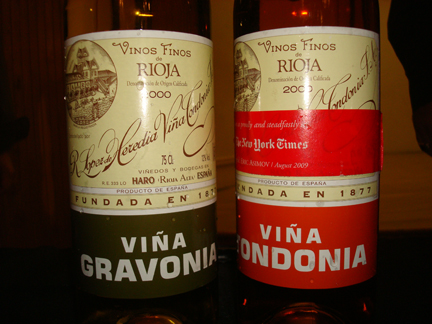
Making the rounds of yesterday’s trade tastings in the Groover’s Paradise (aka Austin, Texas), I was extremely fortunate to get to taste the current releases from one of our favorite wineries in the world, López de Heredia, Viña Gravonia blanco and Viña Tondonia rosado 2000. Ten-year-old white and rosé wines. I was impressed by how bright the fruit is in these bottlings, unusual (to tell the truth) for this house, where savory and salty notes always seem to dominate. Can’t wait to crack these with Tracie P, ideally over some ceviche and tacos al pastor at Fonda San Miguel.

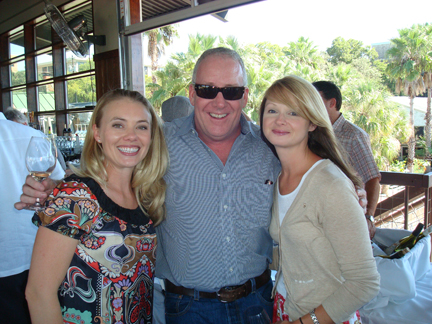
It was great to catch up with everyone after being away for so long, like wine professionals April Collins, Jeff Courington, and Lolly Thompson.

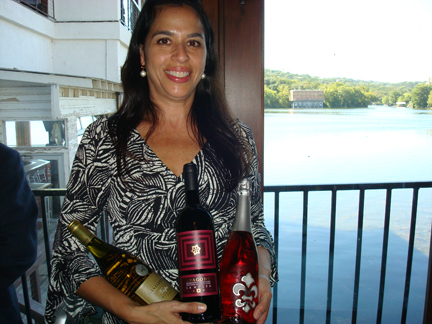
Wine broker extraordinaire Susana Partida was rocking the Bastianich.

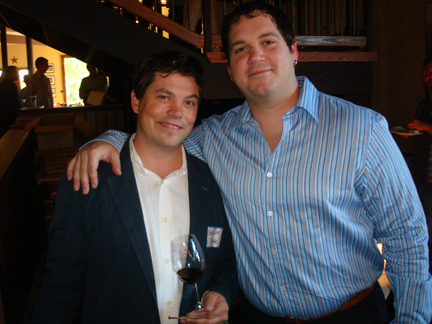
When I see these two dudes, Craig Collins and Mark Sayre, I always “smile like a fool,” as my friend Thompson likes to say.

Rob was in fine Forman: SO MANY killer Italian wines in his book (Inama, Marchesi di Gresy, Selvapiana, Tenuta Sant’Antonio) from Dalla Terra.

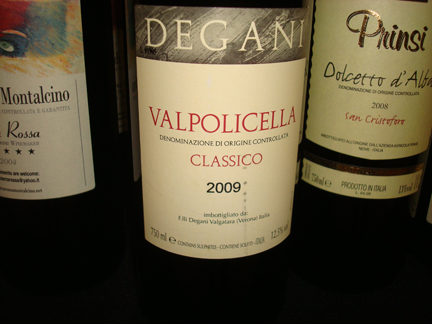
This Valpolicella from Degani is a welcomed new arrival in my Groover’s Paradise. It was fresh and bright, juicy and delicious, the way I like it. And it should weigh in well under $20 retail according to importer Enotec.

How does the song go, Flaco?

the guacamole queen is there
oh Lawd she’ll really curl your hair.
enchiladas and BBQ
oh baby whatch gonna do
come over here beside me
tell me baby how you been
I get through laying it on you
well you know that I’m back again

Groover’s Paradise
Groover’s Paradise
Groover’s Paradise

It’s good to be back…

Tracie P’s pici

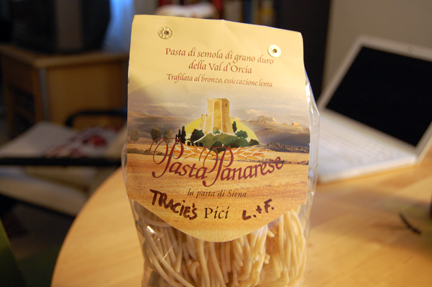
In the wake of a comment on this blog by Tracie P (while I was in Tuscany) sharing her yen for some Tuscan pici (long noodles made with only flour and water), my good friend Federico aka Fred (export director for one of my favorite Montalcino wineries, Le Presi) appeared one day with two bags of dried pici by Panarese for me to take home.

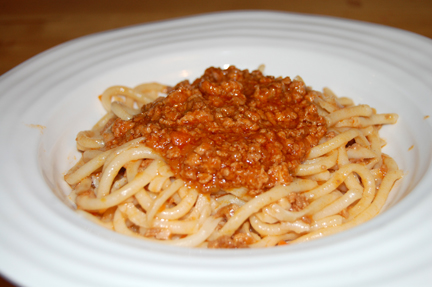
Last night for dinner, Tracie P defrosted some of her excellent ragù and used it to dress a few nidi (nests) of the pici (also called pinci).

On the back of the label, the only ingredients listed are durum wheat flour and water. There’s something about pici, even when dried (and not freshly rolled out), that makes them ideal for meat sauces (or mushrooms). For all of their humility, the purity of the saltless flour and the texture of the noodles create a sublime pairing with the richness of the sauce. Simply delicious. We paired with a grapey, bretty, easygoing Valle Reale Montepulciano d’Abruzzo that was remarkably fresh and bouncy for an 06. A perfect Tuesday night dinner, catching up on the TV shows we missed (Tracie P sacrificed herself and did NOT watch the season finales of True Blood and Mad Men so that we could watch them together… THAT’S how much she loves me, she says).

How did I manage to get the pasta back without any breakage?

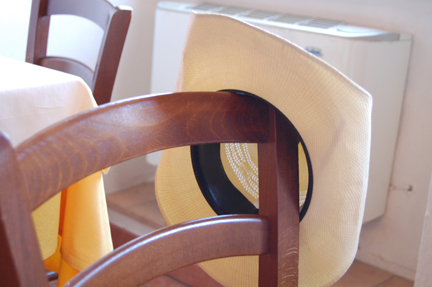
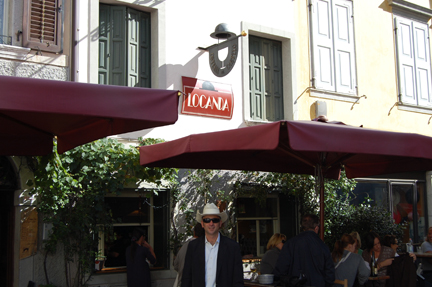
I used my cowboy hat, of course! I packed the bags of noodles on either side of the “crown” of the hat in my carry-on. It worked like a charm! That’s me, btw, above, outside the famous Osteria al Cappello in Udine, where hundreds of hats (cappelli) hang from the ceiling. (Photo by Joe Campanale.) The owner asked me if I’d give her my hat for her restaurant. “Un bel cappello,” she said. “A fine hat.”

“Naw,” I told her. “This hat will be riding home with the San Diego Kid back to Austin.” I’ll post more on the AMAZING MEAL I had at Osteria al Cappello in an upcoming post.

In the meantime, we’re sending lots of love to Pam and Melvin Croaker today. Melvin, you may remember, gave me my cowboy hat late last year.

Prosciutto bloggers unite!

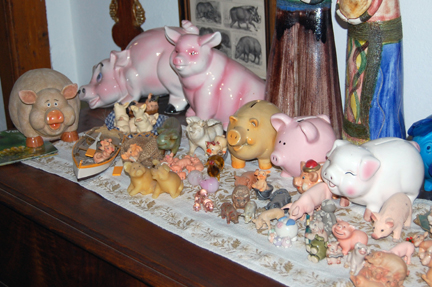
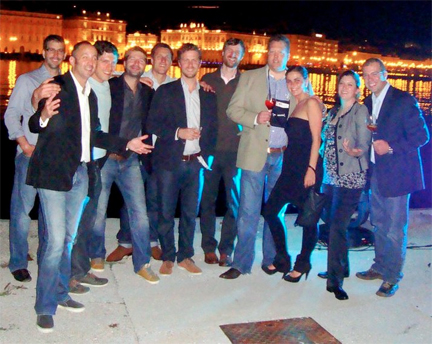
Just had to share this link and send some blog love over to the Prosciuttificio D’Osvaldo in Cormòns (Friuli). That’s a photo I snapped of the D’Osvaldo collection of pigs the other day when I visited with the Ponca 10 (below, later that evening on the Gulf of Trieste). I’ll be posting about D’Osvaldo and what I learned, saw, and tasted there in a few weeks (but first Tuscany and the Veneto!). Stay tuned…

How do you like those jazz hands? ;-)

Gaja’s Santa Restituta restoration project fascinated me

This is the first in a series of posts culled from my recent trip to Tuscany, the Veneto, and Friuli. While on the road, I was only able to post short snippets and highlights from my visits. Starting today, and in the weeks that follow (as time permits), I’ll be posting in-depth accounts of my conversations with winemakers and restaurateurs and what I tasted. Thanks for reading…
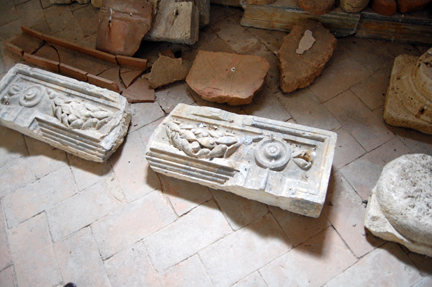
Above: Can you imagine my delight when I got to tour the Pieve di Santa Restituta restoration site in Tavernelle (Montalcino) a few weeks ago? The white bassi rilievi (bas-reliefs) are possible indications of the presence of a Romanic church on this site, i.e., a pagan temple that was converted and consecrated as a Catholic church in the Middle Ages.

When I tasted with Gaia Gaja back in the spring of this year in Chicago, one of the things I was most curious about was her family’s restoration of the Pieve di Santa Restituta and the church of the parish (pieve) in the Orcia River Valley, where her family makes Brunello di Montalcino.

I first visited the Orcia River Valley in Tuscany (perhaps the most photogenic and photographed swath of this beautiful land) in 1989 and have been fascinated ever since by the medieval hilltop towns and the rich ancient religious traditions that thrive here, like the Abbey of Sant’Antimo (in Castelnuovo) or the Madonna di Vitaleta (in San Quirico).
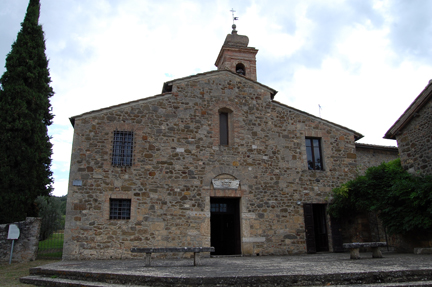
Above: The medieval façade of the Chiesa di Santa Restituta.

The pieve and church of Santa Restituta are particularly remarkable because the site represents an entirely unique and anomalous tradition in the context of the Orcia River Valley: the church is the only one in Tuscany devoted to Santa Restituta, the patron saint of Ischia, the island off the coast of Naples, where Tracie P lived for nearly 5 years before we met.

Since Gaia (the fifth-generation winemaker in one of Itay’s most famous winemaking families) first told me about the church and her family’s restoration project, I’ve also been absorbed by the powerful legend of Santa Restituta. During my recent visit with her in Tuscany, she very generously photocopied an essay entitled “Una madre vegliarda: la Pieve di Santa Restituta (Montalcino)” (“An Old Mother: the Parish of Santa Restituta”)* and published in 1978 in Arezzo by a gentleman named Angelo Tafi, who spent the better part of the second half of the twentieth century documenting the many small parishes that dot the Tuscan countryside. On the plane ride home from Europe, I devoured this wonderful piece of writing, so generously given to me by Gaia.
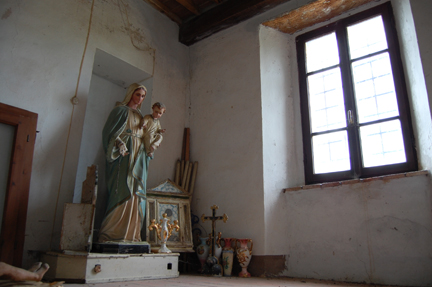
Above: Many of the relics currently being cataloged in the restoration process date are from the nineteenth century, when this parish was populated by a vibrant community of sharecroppers.

St. Restituta was born in Africa during the rule of Diocletian (284 to 305). She is believed to be one of the Martyrs of Abitina (modern-day Tunisia). When she refused to worship Jupiter, the Romans ordered that she be covered in tar and burned on a boat. Miraculously, her captors’s vessel caught fire and her boat drifted away before they could set it ablaze.

Most scholars believe that her relics were brought to Naples by African Christians who fled persecution in the sixth century. Today, the Cathedral of Naples now stands where the Church of Santa Restituta was established at that time. Ultimately, the relics were transferred to the village of Lacco Ameno on the island of Ischia where a church devoted to her still stands.
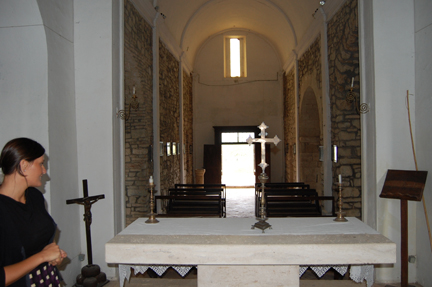
Above: I don’t know if she planned to do so, but Gaia’s handsome outfit was reminiscent of a nun’s habit that day. The parish and the church have a truly magical aura about them.

Her feast is celebrated in May on the island, where the legend is re-enacted each year in a colorful and widely popular pageant. In the contemporary version of her story, her boat finds its way to the bay of San Montano in Lacco Ameno, where her body is discovered by Lucina, a local matron, who proclaims that a virgin has been delivered by the hand of God. Her cult on the island is so powerful that many families still name their daughters Restituta (as Tracie P can attest!).

No one really knows why the church in Tavernelle was devoted to Santa Restituta, although — as Tafi demonstrates — it’s unlikely that there is a relation to Latium’s homonymous Santa Restituta di Sora. The site was a well established state-owned farming community in Roman times and it’s possible that Neapolitan merchants settled there in the late Middle Ages: anyone who knows the coastal road from Fiumicino airport in Rome to Sant’Angelo in Colle (the southern outpost of Montalcino) will immediately recognize the strategic location of the Pieve di Santa Restituta with relation to Naples.

I simply cannot convey the electric sensation of touring this beautiful property. A team of artisans buzzed around us, delicately chipping away at a stuccoed wall to reveal the classic brown limestone of the Orcia Rivery Valley underneath.
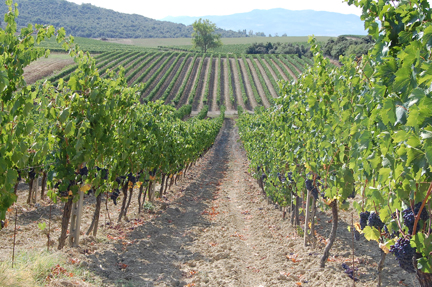
Above: Tafi’s research shows that the Sugarille vineyards were already devoted to the cultivation of grapes by the fifteenth century.

In his research, Tafi discovered that certain parcels were already devoted to viticulture by the fifteenth century. Today, Gaja uses those same growning sites for its flagship Brunello, the vineyard-designated Brunello Sugarille (the vineyard of the cork trees, sugheri in Italian).

Gaja’s vineyards lie adjacent to those of Soldera (who, together with his wines, will be the subject of an upcoming post). Many consider these historic growing sites to be among the best in the appellation. My guess is that centuries of sharecropping ultimately depleted the soil’s nutrients, making the white and brown earth ideal for the cultivation of fine wine grapes (but more on that later).
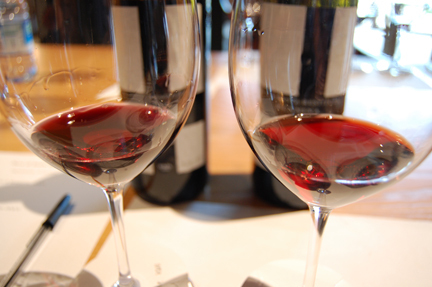
Above: Gaia poured me a flight of wines that spanned 1996 through 2008.

Of course, I was also there to taste Gaia’s family’s wines and I will not conceal that I was thoroughly impressed by the 2008 Brunello Sugarille (single vineyard) and the 2006 Brunello Rennina (which is sourced from three different vineyards on the estate). As you can see from the color in the image above, the wines were bright and transparent, and I found them to be excellent expressions of Sangiovese Grosso and the Brunello appellation. The red fruit was balanced by good acidity and powerful tannin (still very youthful in the case of the Sugarille) and there was none of the woodiness that I’ve found in earlier vintages of this wine. Here, in this most western subzone, elegance and purity trump the earthier expressions of Sangiovese that you find in the central, southwest, and southeast areas.

In my limited experience with Gaja’s bottlings of Brunello (since I can hardly afford them), I’ve seen an evolution (and I think that Gaia would agree) bringing them more into line with the classic profile of great Brunello. I thought the most recent vintages were great.

But, most of all, I was impressed by this fascinating restoration project, adding yet another destination to the many sites on my list of places to take Tracie P the next time we’re there. Truly exciting stuff for geeks like me!

*The reference to the madre vegliarda is culled from the great nineteenth-century Italian poet Giosué Carducci’s poem “La chiesa di Polenta” (“The Church of Polenta”). The title alone is worthy of a stand-alone blog post but it will have to wait.

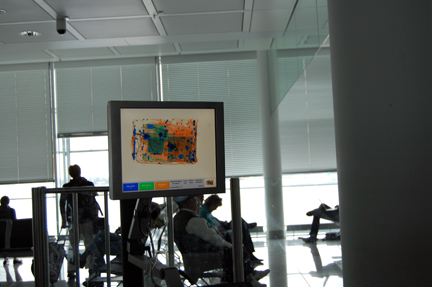
Security cam photo

Just had to post this photo, taken by an airport security agent using my camera on Sunday morning in Munich, Germany before I boarded for Washington, D.C.

When I went through security, he very courteously asked me if he could take a photo, using my camera. Yes, of course, I said. And so he proceeded to remove the camera from its pouch, its cap from the lens, and then he pointed and shot. The above photo is the result of his effort.

Isn’t it interesting to look at? Isn’t it fascinating to contemplate the semiotic implications of the composition and those posed by a gaze that cares only to see through the signifier but not to see the signified?

Needless to say, I was waived on through the check point with flying colors.