Yesterday, in one of the most tumultuous moments of its history (between the general discontent of its people, the governmental crisis, and the situation in Libya, its historical client state), Italy celebrated 150 years of Unity.
My friend Simona, author of the excellent Italian gastronomy blog Briciole, published this FANTASTIC post including the video above. I highly recommend it: she’s composed a beautifully woven timeline for Italy’s last (and first) 150 years as a united country and she’s translated a number of the quotes from the video above (you’ll find quotes by a number of historical figures that have appeared here on my blog).
Chapeau bas, Simona!
Above: The Italian Alps, as seen from the vineyards of my friendGiampaolo Venica, September 2010.
My friend Simone, a young and gifted wine professional from Lucca, wrote me to remind me this morning of a poem dear to both of us and as vibrant and topical as it was when Petrarch wrote it (probably) during the siege of Parma in 1344-45 (the fact it was composed in Parma will not be lost on those who fear and loathe the rise of the Italian Separatist Party). It’s one of Petrarch’s most moving political poems and I spent hours and hours pouring over every line, every syllable, and every scansion as I prepared my dissertation on Petrarchan prosody. I’ve scanned and reproduced the Robert Durling prose translation below (Petrarch’s Lyric Poems, Harvard, 1976), which I also highly recommend to you.
On our recent trip to Italy, every time Tracie P and I gazed at the Alps, I couldn’t help but think of the lines (see the fifth stanza below), Nature provided well for our safety/when she put the shield of the Alps/between us and the Teutonic rage.
The incipit of the song is immensely powerful and could not be more a propos today — whether in the sphere of Italian politics or viticulture.
Italia mia, ben che’l parlar sia indarno
a le piaghe mortali
My Italy, although speech does not aid
those immortal wounds
The song’s congedo is even more moving… Your divided wills are spoling the loveliest part of the world.
I didn’t get to taste every wine at the Dressner magical mystery roadshow yesterday in Los Angeles, but I did devote ample time to Luca Roagna’s wet-dream flight of his family’s crus (above). The 05s were showing nicely but the 04 Barbaresco Pajé was INSANE, with bright acidity, wonderful wild berry notes and the earthy tones that define Barbaresco when vinified by one of the great ultratraditional houses of the appellation (IMHO). Killer wine.
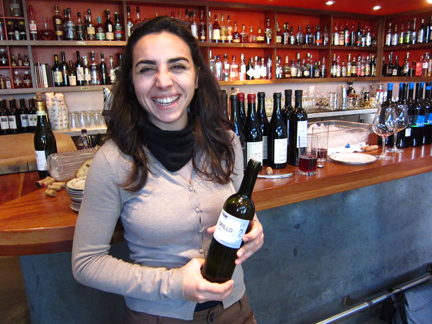
I was also geeked to taste Arianna Occhipinti’s new “négociant” project: Arianna (above) has begun supervising growing practices and vinification for other growers. The 2010 Tamì Grillo was awesome, salty and crunchy and delicious, with bright, bright acidity, remarkable for
Sicily where winemakers have trouble obtaining acidity in their wines. Very groovy.
Many more LA stories to come but now I gotta get my butt back to Texas for some rock ‘n’ roll!
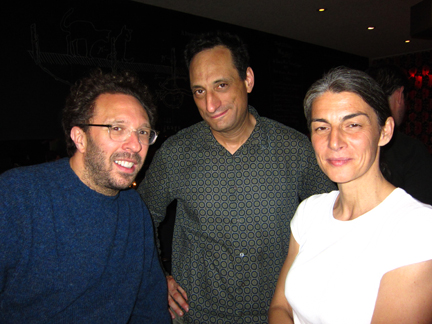
When Lou (center) wrote “Examine and fondle real winemakers tonight at Lou!” yesterday on his blog, brother Anthony (left) and I were intrigued. Within minutes, we had devised a plan to crash the Dressner pre-Oscar Italian party in Hollywood.
It took a little coaxing but I finally managed to get Lou to step out from behind the bar for this photo op with Elisabetta Foradori (right), who only recently joined the Dressner Impeccable Academy of Natural Wines, Arts, and Sciences (she also appeared, you may remember, in the debut episode of the Italian Grape Name Pronunciation Project).
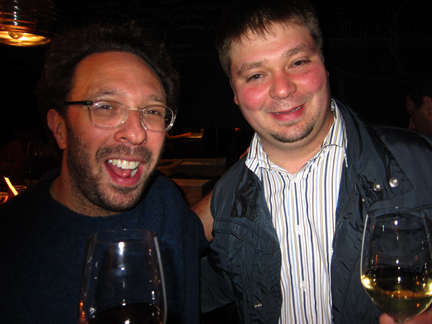
I was completely stoked to see Saša Radikon (right). Sasha is such a cool dude and his family’s wines entirely rock my world.
I also got a chance to talk to Alessandra Bera and Francesca Padovani, both of whom make fantastic wines (in Canelli, Piedmont and Sant’Angelo in Colle, Montalcino, Tuscany, respectively).
For many of them, it was a first trip to Los Angeles. I’m so thrilled to see these wines and winemakers here and it was WONDERFUL to hear Italian spoken last night at my favorite wine bar in the world, Lou on Vine.
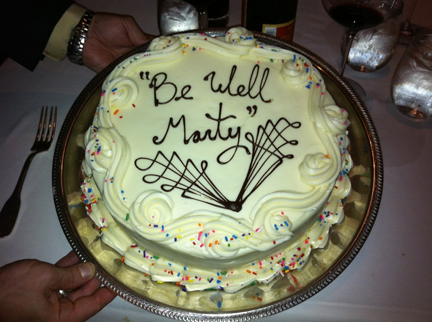
Cousin Marty, whom we love very much, is beginning his cancer treatment today. (Donna Vallone baked him that cake on Saturday, when Marty went to Tony’s for one of his “pre-chemo me” dinners, as he likes to call them.)
In his honor, I’m devoting today’s post to cancer awareness by asking you to check out the “Blue Cure” campaign authored by my colleague and friend Gabe Canales (below).
Gabe, one of the top publicists and marketers in the country, was diagnosed with prostate cancer in his mid-thirties and he’s now leading a campaign to raise awareness of the disease among young men. Check out his site here.
Today’s post is also devoted to the victims of the recent tragedy in Japan (I’m currently working on a benefit concert to be held later this month in Austin at Vino Vino — more on that later this week).
@Marty Tracie P and I and the whole family are thinking of you and sending you lots of love today.
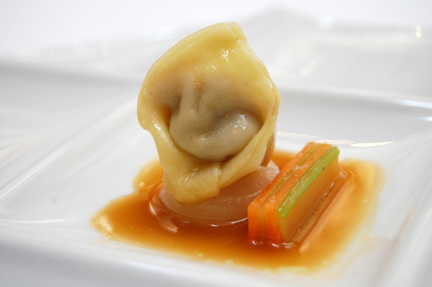
Above: Sometimes a tortellino is just a tortellino. Other times, a tortellino can be downright concupiscent.
Posting in a hurry today as I board a plane for Los Angeles where I’m working on a wine list for a new Italian restaurant there — a project I’m really excited about (more on that later).
In the meantime, I just had to share the above food porn, snapped recently at Tony’s in Houston. Tony, the Tony’s team, and I have been having a lot of fun with Tony’s blog.
And I’m thrilled to announce that they have asked me to teach a series of classes on Italian wine at Caffè Bello, the outfit’s location in “the Montrose,” Houston’s überhipster, artsy neighborhood.
Of all the Italian winemakers I know of (personally or virtually), Marilena Barbera is probably the most active on social media. When I asked people to contribute to the Italian Grape Name Pronunciation Project, she was among the first to submit recordings. Here are her recordings of some Italian grape names. Thanks for reading, listening, and “speaking” Italian grape names! :-)
A friend (and immensely gifted food blogger) in Houston, Chris, recently asked me about the origins of the inscription above. He took the photo in the Abruzzo countryside (his photostream here). The lines (in bold below) come from one of the great “songs” of 19th-century Italian poet Giacomo Leopardi, “Night-Song Of A Wandering Shepherd of Asia.” We don’t read a lot of Leopardi today but in 1888 the editors of the Encyclopaedia Britannica called this poem “one of the highest flights of modern lyric poetry.” Leopardi’s “style and melody,” they noted, “are unsurpassed.” In the poem, the “wandering shepherd” questions the moon about the “why” of life. (The stanza below is an excerpt and you can read the entire piece, in an excellent translation, here; read the poem in Italian here.)
The last years of my life have been the richest so far and I am blessed in the wealth of love I have found in Tracie P and my friends and family and the treasure of experiences we enjoy through enogastronomy and music these days. But the frailty of our human condition — whether the tragedy in Japan or a loved one facing a serious health crisis — often makes me rise early from our bed (as Tracie P slumbers, like today) and as I gaze over the internet through the computer screen (the moon to my shepherd?), I cannot help but ask “why?” Just like my nephew Oscar asks his grandmother Judy, why does the moon go away every night?
The opening lines of the poem echo Oscar’s quaestio:
Why are you there, Moon, in the sky? Tell me
why you are there, silent Moon.
You rise at night, and go
contemplating deserts: then you set.
Buona lettura…
Yet you, lovely, eternal wanderer,
so pensive, perhaps you understand
this earthly life,
this suffering, the sighs that exist:
what this dying is, this last
fading of our features,
the vanishing from earth, the losing
all familiar, loving company.
And you must understand
the ‘why’ of things, and view the fruits
of morning, evening,
silence, endless passing time.
You know (you must) at what sweet love
of hers the springtime smiles,
the use of heat, and whom the winter
benefits with frost.
You know a thousand things, reveal
a thousand things still hidden from a simple shepherd.
Often as I gaze at you
hanging so silently, above the empty plain
that the sky confines with its far circuit:
or see you steadily
follow me and my flock:
or when I look at the stars blazing in the sky,
musing I say to myself:
‘What are these sparks,
this infinite air, this deep
infinite clarity? What does this
vast solitude mean? And what am I?’
So I question. About these
magnificent, immeasurable mansions,
and their innumerable family:
and the steady urge, the endless motion
of all celestial and earthly things,
circling without rest,
always returning to their starting place:
I can’t imagine
their use or fruit. But you, deathless maiden,
I’m sure, know everything.
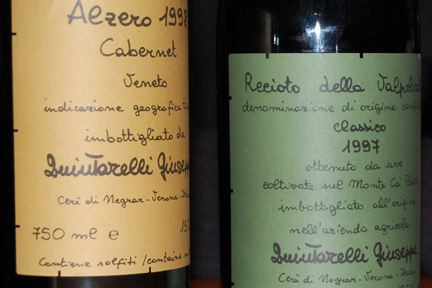
This post is not about the amazing wines we tasted a few weeks ago in the cellar of Giuseppe Quintarelli. No, it’s not about the 1998 Alzero (pronounced AHL-tzeh-roh, btw, and not ahl-TZEH-roh).* No, it’s not about the 2000 Amarone della Valpolicella Classico Riserva (yes, the first riserva ever produced at Quintarelli, with 10 years as opposed to 8 years in cask before bottling). No, it’s not about the 1997 Recioto della Valpolicella, one of the best wines I have ever tasted in my life.
The 2000 Amarone della Valpolicella Selezione Giuseppe Quintarelli is the winery’s first-ever reserve wine. Note that the bottle is numbered by hand.
No, this post is about the genuine, sincere hospitality of one of the world’s greatest winemakers. Don’t believe what anyone else tells you (and industry insiders know the person I’m referring to here): it’s not impossible to visit Quintarelli… in fact, it’s encouraged by the winery.
“‘The gates of the winery must always be open… always…,'” said Luca Fedrigo, quoting Bepi Quintarelli. Luca worked side-by-side with Bepi for 10 years and he kindly accompanied me, Tracie P, and Alfonso that day. “Once, when Bepi went to Rome to see the Pope — and he rarely traveled — he gave me the keys to the winery and told me to never leave, not even for a minute,” said Luca. “‘The winery must always be open to anyone who arrives and you must always be there to welcome visitors.'”
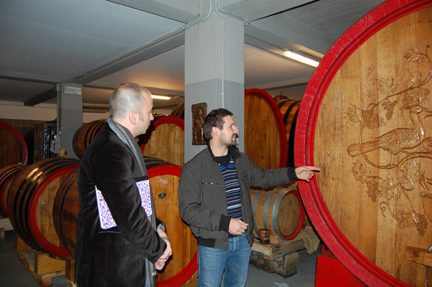
Above: Note the size of this 40-year-old cask, the centerpiece of the aging cellar. And note the thickness of the cask’s walls.
In fact, said the twenty-something Bocconi graduate Francesco Grigoli (Bepi’s grandson, the son of Bepi’s daughter Fiorenza, who has returned to the winery now that his grandfather is incapacitated and who led our tasting that day), “we are happy to receive visitors for tastings” (although an appointment is kindly advised).
Despite what Quintarelli’s legendary U.S. importer and his leading U.S. retailer tell people (and you know which “wine merchant” I’m talking about here, too), the winery is not a cloistered sanctum sanctorum “off-limits” to the plebeian among us.
Above: It was amazing to tour the cellar with Luca, who worked side-by-side with Bepi from the time he was 17 years old until 27. In this photo, he was explaining to me the significance of the peacock on the winery’s largest cask. “Bepi is a deeply religious man,” he said. In antiquity, the peacock was a symbol of immortality and the Paleo-Christians adopted it as a symbol of Christ.
While appointments and interviews may have posed challenges for the non-Italophone among us, I have spoken to and interviewed Bepi by telephone on many occasions and I have arranged visits for many of my friends and colleagues. That’s not to say that a visit to Quintarelli is something that should be contemplated lightheartedly. It’s one of the greatest wineries in the world and it’s one of the last great wineries — and the greatest winery — of the Valpolicella where traditional Valpolicella wines are still produced. The wines are prohibitively expensive (although less so in Italy than the U.S. where the purveyors of Quintarelli have ensured that the wines are accessible only to the entitled among us). Wine professionals and wine collectors: If you love the wines of Quintarelli, don’t be shy to request an appointment. Francesco speaks impeccable English, btw.
Above: One of the most remarkable tastings I’ve ever experienced. You don’t spit at Quintarelli!
It’s true that Quintarelli’s wines are not for everyone. As I’ve noted, they’re expensive and they’re made in a style that doesn’t appeal to folks unfamiliar with the unique wines of the Valpolicella.
But however unattainable as they may be for many of us (they are certainly prohibitively expensive for Tracie P and me), it’s important to remember that Bepi Quintarelli is first and foremost a farmer and winemaker. Not an elitist but rather a deeply religious man who loves to laugh and loves to share his knowledge and experience. His health has deteriorated rapidly over the last few years but I can still remember the laughter on the other side of the Atlantic when I would call him from New York to interview him for whatever publication I was working/writing for at the time. He could never get over the fact that I spoke Italian with such a strong Paduan accent.
Today, the young Francesco, together with the family, is leading the winery forward. These are warm, genuine, and hospitable people.
After all, wine is nothing without the people who grow and vinify it and the people whose lives are nourished by drinking it. Thanks for reading.
* àlzero (pronunced AHL-tzeh-roh), àlzere, and àrzare in Veneto dialect are akin to the Italian argine meaning embankment. The name derives from the topography of the growing site where the wine is raised, 40% Cabernet Franc, 40% Cabernet Sauvignon, and 20% Merlot, said Francesco Grigoli, vinified using the same drying techniques as for the winery’s Amarone.
Above: At Cooper’s in Llano, Texas, the carver places your meat directly on the tray, to be wrapped in butcher paper later when they weigh it in. He dipped my pork loin in the sauce, saying that the sauce wouldn’t add any weight to it. He recommended adding sauce to the brisket later because the sauce would increase the weight (and cost), he said (and implied). Go figure!
Since I moved to Texas, many of my friends love to send me messages recounting their experiences with “Texas-style BBQ” (Comrade Howard and BrooklynGuy, I’m thinking of ya’ll here).
Well, I’m here to tell you that here in Texas, we don’t call it “Texas-style BBQ” or even “Texas BBQ.” We just call it “BBQ.” (Actually, some Texans just call it “food.”)
Above: Perhaps because of the distance from major cities and the fact that Llano is no longer a major transportation hub, the original Cooper’s feels like a truly homespun affair, free from the tidy marketese that adorns its web presence and satellite locations. Real deal food. The brisket melted in my mouth and the pork loin was tender and juicy. The sides were good… the beans, probably the best I’ve had so far.
On Monday night, I finally made it up to the legendary Cooper’s Pit BBQ in Llano, Texas, one of the most if not the most picturesque Texas Hill Country town I’ve visited (a veritable western movie set, really). I had spent the afternoon in Brady, Texas, the literal “heart” of Texas, as they call it. (Believe it or not, I’ve been asked to create some social media for a hunting compound up that way. Super nice folks, btw.)
As I drove past Cooper’s at around 1:30 p.m., it was still packed with the local lunchtime crowd. By the time I stopped in Llano on my way back around 7, the dinner crowd had already thinned, but even on a Monday night you could see that the place had been slammed as the staff was cleaning up most of the picnic tables inside. BBQ is always best, in my experience, when it’s prepared and served in large volume.
Comrade Howard and BrooklynGuy: when are ya’ll gonna get your asses to Texas for some real BBQ?
if that ain’t ‘Country’, I’ll kiss your ass.
If that ain’t ‘Country’, it’ll hair-lip the Pope.
If that ain’t ‘Country’, it’s a damn good joke.
I’ve seen the Grand Ol’ Opry, and I’ve met Johnny Cash.
If that ain’t ‘Country’, I’ll kiss your ass.











 Do Bianchi