Rustico Pugliese, where have you been all my life?

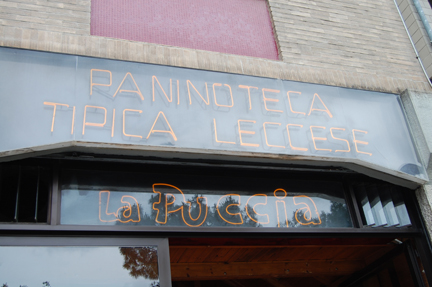
Folks in Lecce don’t sit down for dinner until about 9 p.m. and so Paolo and I popped into one of his favorite downtown bars and had a little merendina.

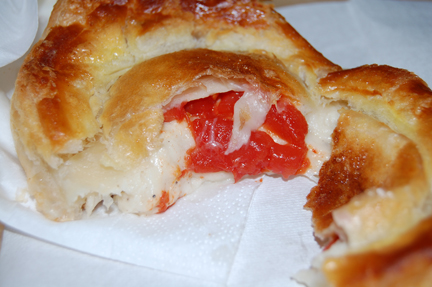
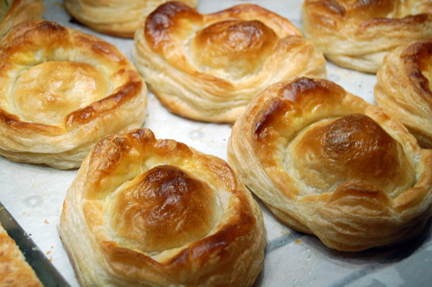
The rustico (above) is a savory pastry dough stuffed with — get this — mozzarella, béchamel, and cherry tomatoes… Unbelievable…

Rustico, where have you been all my life???!!!

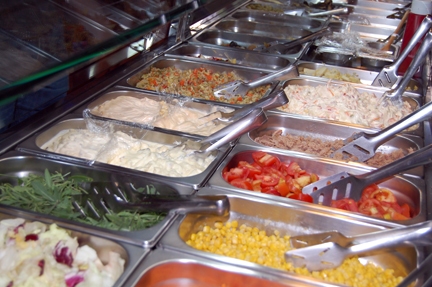
Puccia toppings

Yesterday afternoon Paolo and I returned to the scene of my puccia crime to snap this photo of the crazy varieties of toppings you can use. I don’t think I can’t eat enough pucce!

Early report from Puglia: my first puccia! But not my last…

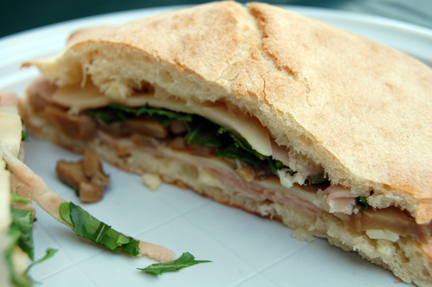
Landed safely in Bari today from Munich together with the German women’s national basketball team (I was one of the shortest people on the plane). Paolo generously came to pick me up and we headed down to downtown Lecce where we stopped for a puccia, the classic and ubiquitous stuffed flatbread of Puglia, one of its “fast foods.”

I wasn’t as ambitious as Paolo in the stuffings I selected (prosciutto, cheese, mushrooms, and arugula). He had his with tuna, prosciutto (yes, tuna and prosciutto!), and insalata russa (vegetable and mayonnaise salad). When I asked him about the unusual combination of salt-cured pork and olive oil-cured tuna, he said, “that’s the whole point of the puccia! You have to mix everything in the puccia!”

The quality of the bread here — even at an urban “fast food” joint like this one — just blows me away.

I wish I had been more ambitious in my fillings… but I know this first puccia won’t be my last!

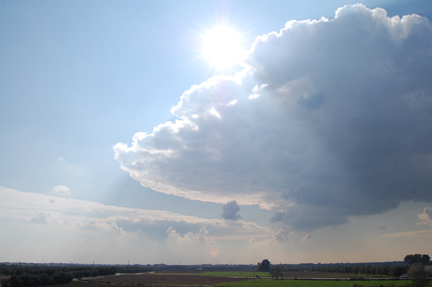
Heading to Big Sky country…

Today, I’m on my way to Apulia where I’ll be catching up with some old friends and making new ones and tasting scores and scores of wines at the Radici Wines festival…

See you on the other side!

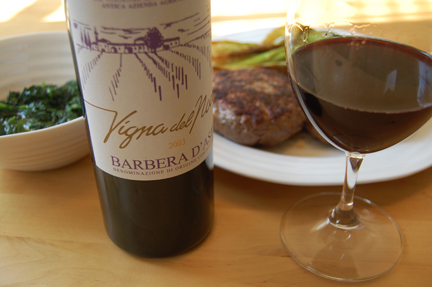
03 Trinchero Barbera and burgers for Memorial Day

Natural winemaker Trinchero (Asti, Piedmont) has always been one of my favorite producers of Barbera. The 1996 Barbera d’Asti [single-vineyard] Vigna del Noce ranks up there with the greatest bottlings of Barbera I have ever tasted.

And so when I spied a bottle of the 2003 Vigna del Noce at the Houston Wine Merchant, I couldn’t resist picking it up — despite the fact that 2003 was a notoriously difficult vintage because of the extremely hot summer.

Tracie P and I finally opened it over the Memorial Day holiday and paired with some griddle-fired beef sirloin burgers.

The wine — vinified with native yeast and raised in traditional large casks — was hot in the glass, with a lot of alcohol for this house (due, undoubtedly, to the nature of the vintage). But it still had that bright, bright acidity that you find in old-school Barbera. The black fruit and berry flavors were chewy and rich and once the alcohol blew off, I thoroughly enjoyed the wine with my burger.

The wine wasn’t perfect: I found the alcohol out of balance with the fruit and acidity. And it probably should have been opened a few years ago.

But as we Piedmontophiles drink the last of the 03s lying around, I couldn’t help but admire this wine for being true to its place and its vintage.

Sometimes a wine is great… for not being so great…

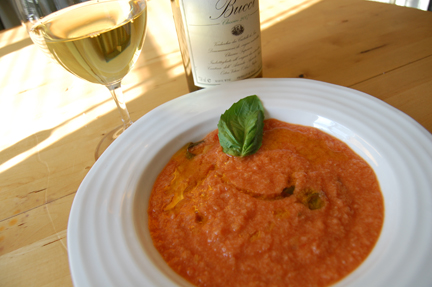
Pappa col Pomodoro, my recipe

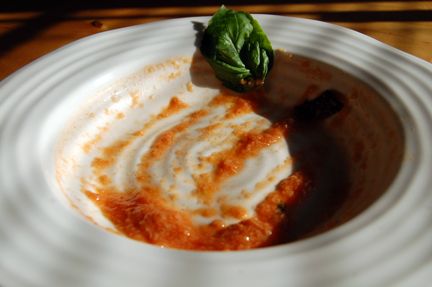
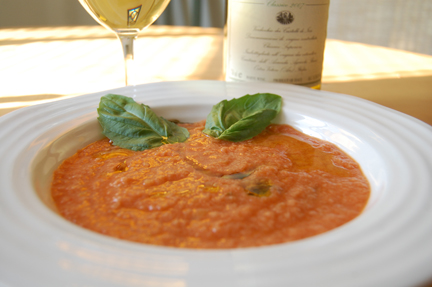
Pappa col Pomodoro on a summer eve with a glass of slightly tired and utterly delicious 2007 Bucci Verdicchio was just right.

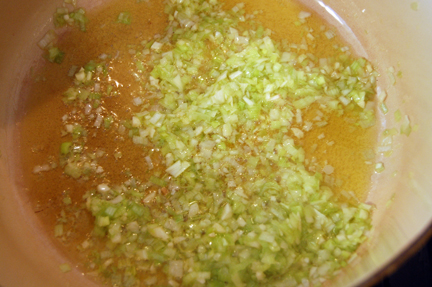
I carefully washed and finely chopped the stalks of two leeks. And then I sautéed them in San Giuliano extra-virgin olive oil from Alghero (my favorite commercial olive oil) with two cloves garlic, peeled and minced.

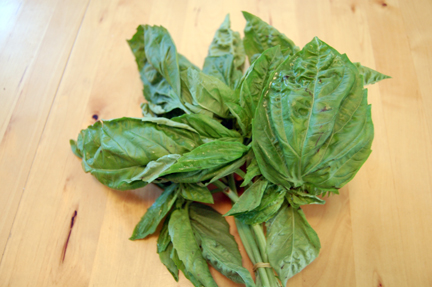
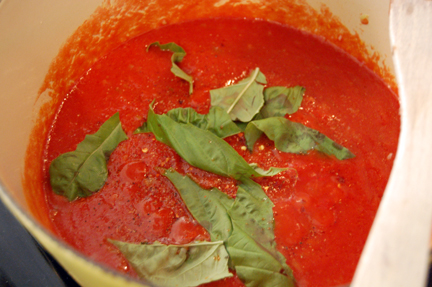
And then added one jar of puréed tomato (making sure that the only ingredients were salt and tomato), seasoned with salt, pepper, and chili flakes, and then added a generous amount of freshly torn basil.

“Texas basil.” (Yes, I know, everything is bigger in Texas.)

Then I added stock and cooked the soup for about thirty minutes over medium heat and removed.

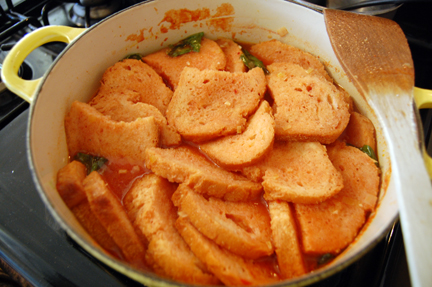
Then I added the 4-day-old stale bread. It’s important to let the bread soak in the soup for at least 30 minutes. I used a immersion blender to purée the bread after it had sopped up all the soup (in the olden days, I used to use a vegetable mill but, I gotta say, the immersion blender was awesome).

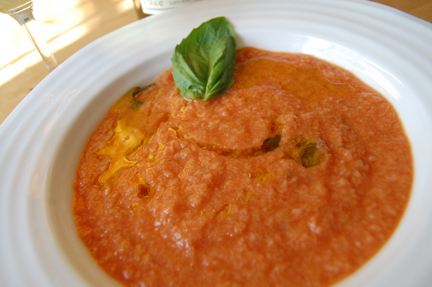
I served the Pappa room temperature, drizzled with olive oil and garnished with a basil leaf.

That’s how we make Pappa col Pomodoro at our house. :-)

Freisa: Italian grape name and appellation pronunciation project

CLICK HERE FOR ALL EPISODES

Not only is Freisa — the tannic, long-lived grape from Asti — one of Italy’s most commonly mispronounced, it’s also one of its most misunderstood. In the period that followed the second world war, the fame of Freisa (like that of Barbera del Monferrato) was eclipsed by Nebbiolo from Barbaresco and Barolo. But there was a time — not so long ago — that Freisa was one of Piedmont’s (Lombardy’s and the Veneto’s) most important varieties.

Freisa “is one of Piedmont’s most important and oldest grape varieties and it was widely planted in other parts of Northern Italy (Lombardy and the Veneto) for a long time,” write the editors of Vitigini d’Italia (Grape Varieties of Italy, Bologna, Calderini, 2006, the “bible” of Italian grapes). Although there are mentions in official documents as early as the 16th century, high praise of Freisa was delivered by 18th-century ampelographer [Conte Giuseppe] Nuvolone[-Pergamo of Turin] who called it a “top quality red grape.”

I had the opportunity to taste a lot of fantastic Freisa when I attended Barbera Meeting 2010 in Asti and when Chiara Martinotti of Cascina Gilli (whom I know solely through social media) offered to contribute a video for this project, I was thrilled.

When vinified in a traditional style, Freisa can render a tannic, rich wine, with a wide range of earthy tones balanced by black fruit. When you visit some of the old-school producers in Barolo (like Vajra, for example), you’ll find that they also bottle some Freisa — a homage to another era before the supreme reign of Nebbiolo.

Thanks, again, to everyone for speaking Italian grapes! I’m so glad that so many folks are enjoying and making use of the Italian Grape Name and Pronunciation Project. Tomorrow I leave for Apulia where I’ll be attending the Radici Wines festival: I’ll use the opportunity to focus on the grapes of southern Italy.

Pappa col Pomodoro, Wertmüller, Rota, Pavone, and REVOLUTION!

Last night, on a happy quiet Saturday evening at home, I used the leftover stale bread from Paolo’s birthday party to make one of my favorite summertime dishes, Pappa col Pomodoro — the famous tomato bread soup of Tuscany.

And what a wondrous dish this workaday dish is! A text that can be deconstructed linguistically, literarily, ideologically, and gastronomically in so many delicious ways — including the Marxist reading in the video above.

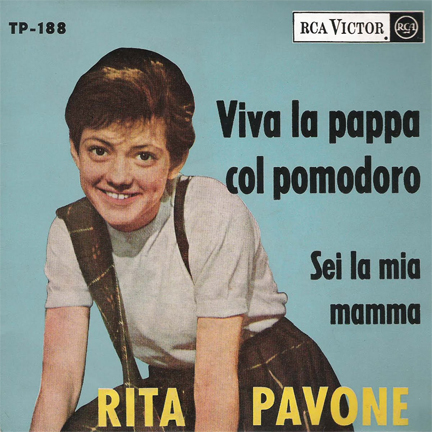
Piddling around the internets on a lazy Sunday morning (after scrambling some eggs the way Tracie P likes them and before diving into my Sunday workload), I came across this fantastic video of 60s Italian pel di carota (carrot top) Rita Pavone, the great Italian director Lina Wertmüller (the first woman to be nominated for a Best Director Oscar), and the Italian composer Nino Rota (considered by some the greatest film composer of all time).

But what’s truly remarkable about this clip — above and beyond the fact that it was created by three of the greatest names in Italian film and music — is the Marxist and Leninist rhetoric of the song lyrics, Pavone’s Bolshevik costume and choreography, and the set inspired by the Russian revolution.

I’ve translated the lyrics for you:

    Long live Pappa
    Col Pomodoro
    Love live Pappa
    It’s a masterpiece
    Long live Pappa
    Col Pomodoro

    The history of the past
    Has finally taught us
    That a hungry people
    Will make a revolution
    That’s the reason we the hungry
    Have battled
    And so buon appetito
    Let’s eat!

    A belly that grumbles
    Is the cause of the conspiracy
    It’s the cause of the struggle
    Down with the boss!
    The soup’s on!
    And so we’ll all sing
    No sooner said than done, we want
    Pappa with Pomodoro

There’s no doubt that the performance resonated with Tuscan audiences of the era, when Tuscany was one of the strongholds of the Italian Communist Party and — together with Emilia-Romagna — home to the largest Communist Party outside of the Soviet Union and China.

Berlusconi’s Italy is so ugly these days (did anyone follow the reaction to Berlusconi’s gaffe during his meeting with Obama during the G-8 gathering this week?). We often forget that there was a time in Italy not so long ago when a simple dish — one of its most proletarian — was inspiration for art and ideology by some of Italy’s greatest artists.

The village of Parzen (Parzeń)

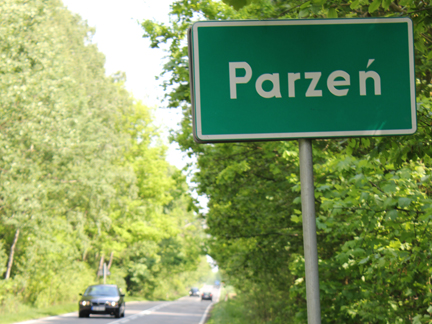
The most remarkable thing happened last weekend: my friend and Polish blogging colleague Andrzej Daszkiewicz — wine writer and author of a number of Polish-language wine blogs — snapped some photos as he passed through the village of Parzeń and sent them to me.
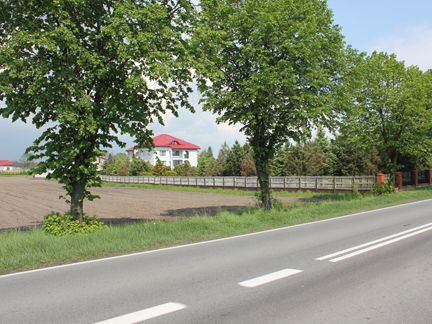
Like many Jews of Eastern European descent, my surname comes from a toponym, in this case Parzen, which at one time was most likely home to a shtetl. The name Parzen came to our family after my biological paternal grandfather died and my paternal grandmother married Rabbi Maurice Parzen in South Bend, IN. The Rabbi, who passed away when I was still a child, is survived by my great uncle Manny Parzen, his youngest brother, famous in his own right for his research in the field of statistics. The Parzens were from Lodz (Łódź) and they came to the U.S. in the first decade of the last century.
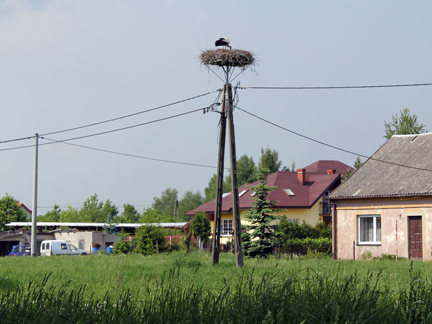
Here’s what Andrzej — to whom I am eternally grateful — had to report:

    Two older houses there have their roofs covered with asbestos, which used to be very popular (because very cheap) material for that. Now it’s almost gone, but in some places you can still see it, as here.

    This village is located at one of the roads I could take driving from Warsaw, where I live now, to Toruń, where I used to live and drink wine and still have many wine drinking friends. We had a friend’s birthday party on Friday, and on Saturday I took that road driving back to Warsaw (usually I take a bit faster, but much less scenic one)…

    It is a small village now, with several rather isolated farms and no typical village center, no church (at least I could not see any). Two neighboring villages are much bigger, more typical ones. It is so small that there is no speed limit stricter than the regular highway one (around 55 mph).

    Parzeń is about 15 km from a quite big (for Polish standards at least) city Płock, and around 120 km from Warsaw.
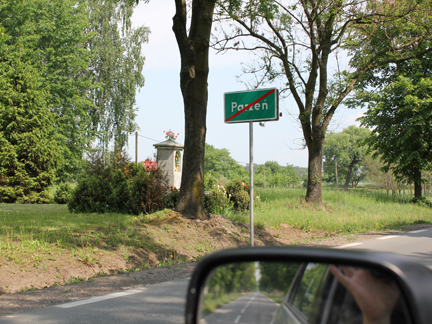
Just this morning, Tracie P said to me, after she finished a business call, “Well, I’ve certainly gotten used to my new last name.” It’s incredible to think that our family name — the name our children will have — comes from so far away from Austin, Texas.

A heartfelt thanks, once again, to Andrzej for the fraternity and the friendship, and this wonderful virtual window into the origins of our family.

The secret to my guacamole recipe and best wine pairing?

Tracie P and I both do a lot of cooking at home and each of us has her/his respective pièces de ré·sis·tance (she fries, I grill; she boils the pasta, I simmer the rice, etc.). And while she is by far the more skilled in the kitchen (ubi major minor cessat), I can say with confidence that my guacamole has gained traction at our dinner parties as having — how can I say? — that je ne sais quoi.

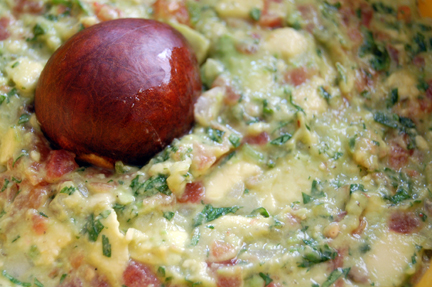
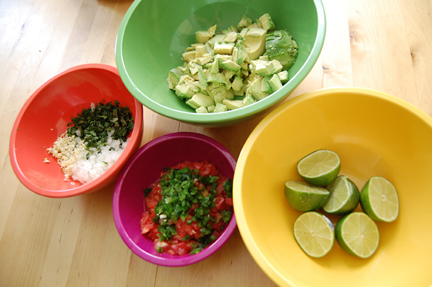
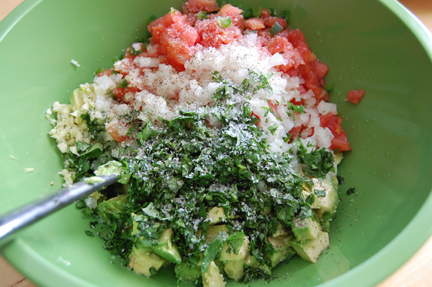
My secret? I peel and seed the tomatoes before I dice them. Then I place them in a colander, lightly salt them, and let them purge their water. The other trick is no secret to anyone who knows good guacamole: buy your avocados while still unripened, place them in a brown paper bag, and then give them a couple of days to ripen slowly on your kitchen countertop (or other cool place, away from direct sunlight).

Otherwise, the rest is simple: a handful of finely chopped cilantro, a teaspoon of minced garlic, a tablespoon of minced white onion, 2 diced tomatoes (peeled, seeded, and purged as per above), 3-4 ripe avocados (as per above), 2 seeded and diced jalapeños, salt and pepper to taste, chili flakes to taste, and freshly squeezed lime juice to taste.

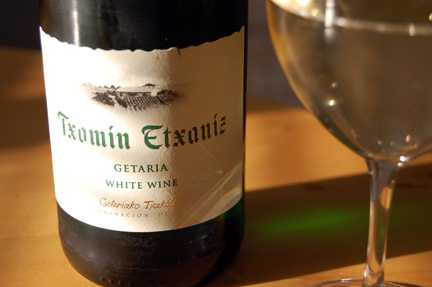
The perfect pairing for guacamole?

I think I’ve found it and I wrote about it today over at the Houston Press

Happy Friday and Happy Memorial Day, yall! Enjoy the “ponte” (“bridge”), as they say in Italian, the three-day weekend! And as our good friend Melvin Croaker would say, please remember our troops!