Quintarelli effect & a secret of Ripasso revealed (Nicola Ferrari’s Monte Santoccio)

“Wealth is determined not by how much money you have but by how you manage your time… One of my goals is to offer my clients traditional wines at reasonable prices.”

This was how young winemaker Nicola Ferrari, founder and owner of Monte Santoccio in Valpolicella, described the ethos of his wines and his approach to winemaking when he and I tasted his wines together in the Veneto a few weeks ago.

Nicola is the second Valpolicella producer to emerge from the Quintarelli bottega. The first was Luca Fedrigo of L’Arco (see my thread on Luca and Quintarelli here).

Both spent the greater part of their formative winemaking years working side-by-side with Quintarelli, while Valpolicella master “Bepi” (as he was known affectionately to all) was at the peak of his career (Quintarelli succumbed to a long battle with Parkinson’s disease in January of this year).

It’s unusual to hear a young Italian winemaker describe her/his wines in such socially conscious and ideologically aware tones. And it may be even more surprising to some in the light of the fact that Quintarelli’s wines are among the most expensive on the market today, accessible only a small subset of wine lovers who have the means to afford them.

But Nicola (like his counterpart Luca) is no ordinary Italian winemaker: he’s a member of a dwindling number of producers who have been anointed by the “greatest generation” in Italian wine — the “masters” who oversaw the Italian wine renaissance of the last three decades (I’m thinking of Dante Scaglione, Maria Teresa Mascarello, Augusto Cappellano, not necessarily in that order).
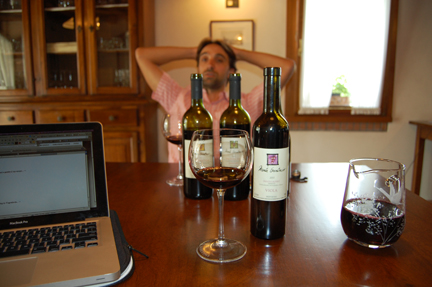
I loved the wines, across the board: old-school, large-cask aged Valpolicella, Valpolicella Ripasso, and Amarone, perhaps not as finely focused at Quintarelli from the 1990s and early 2000s but gorgeous and brilliant, with a nervy (if sometimes unruly) acidity that will serve the wine well in the cellar.

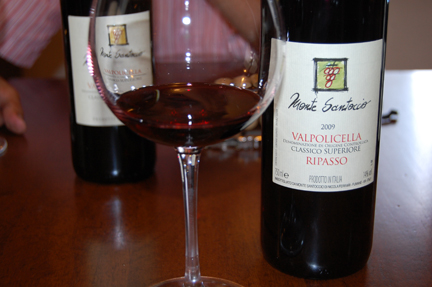
And Nicola is true to his word: according to WineSearcher results, you can find his Valpolicella Superiore Ripasso for just $25 at Wine House in LA (and the Amarone for $62; thank you, Lance Montalto!).

The stunner for me was the ripasso.

“The secret that Bepi taught me,” said Nicola, “was to age the wines on the Amarone lees for an extended period of time. Most [commercial] producers use short aging times. As a result, they get extremely bright fruit in the wine. By using longer aging on the lees, the lees actually start to reabsorb the tannin and some of the fruit. That’s the secret to the elegance in Quintarelli’s Valpolicella.”

But Quintarelli doesn’t write “ripasso” on his label, I pointed out.

“He never wrote ripasso but he always used ripasso for his Valpolicella,” Nicola told me.

Nicola studied education and community activism at the University of Verona before he turned to winemaking and our conversation spanned from his favorite memories of Quintarelli to his first experience with the writings of Primo Levi (one of my favorite Italian authors).

I couldn’t help but think of the enormous disconnect between the way Quintarelli’s legacy is perceived in the U.S. and the way that young people view him “on the ground” in the Veneto. Regardless of the elitist ethos projected on to Quintarelli by his north American purveyors, he is still considered a populist winemaker in the Veneto and is only spoken of in adoring and affectionate terms.

Perhaps by (direct) osmosis, Nicola’s managed to capture some of that soulfulness in the bottle…
Why Antonio Galloni matters now more than ever

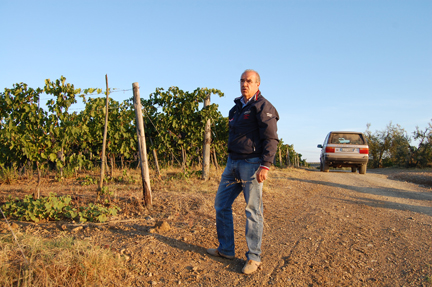
Antonio Galloni (left; image via Corriere.it) has been on my mind the last few days.

In part because I turn to his writing repeatedly for his observations on vintage characteristics and site typicity. In part because his extreme and truly supreme knowledge of Italian wine inspire me. In part because the genuine and unmitigated exhilaration of his Twitter feed reminds me every day why I love what he does and what I do for a living. And in part because the Citizen Kane of wine blogging took a very cheap — and despicably hypocritical — shot at Antonio this week.

Unmentionable wine blogger — who will remain nameless here lest we drive more traffic to his petty hissing — accused Antonio of conflict of interest in an upcoming tasting he’s leading. My feeling is that even if there were a conflict of interest (and there is not), who cares and who could possibly be hurt by a vertical tasting of Solaia (even though I personally don’t care for the brand)?

In a recent where-are-the-snows-of-yesteryear post on his blog, self-described “old fart” wine writer (and all-around jolly fellow whom I enjoy and respect immensely) Tom Maresca bemoans the current generation of wine writers, winemakers, and wine sellers (cfr. the ballade des dames des temps jadis).

“There are no more Luigi Veronellis or Giorgio Grais,” he writes (ignoring the fact that there is still a very healthy Giorgio Grai), “no Edoardo Valentinos, and all too soon there will be no more Franco Biondi-Santis. Pioneers like Renato Ratti and Giacomo Bologna are long gone, as are retailers as passionate and devoted as the still-lamented Lou Iacucci – that is now a rare breed indeed.”

I can’t fault Tom for his Jeremiad: as north Americans have discovered fine wine over the last three decades, the wine business has become big business and the larger-than-life, “greatest generation,” selfless figures that he refers to are being replaced by the Zonins, Antinoris, and Lucio Mastroberardinos of this new and brave world.

And that’s why Antonio Galloni matters more than ever.

A Berklee-educated jazz musician, a Milan-trained tenor, a successful finance executive, and — in my view — the leading expert on Italian wine today, Antonio is a true renaissance man for a new chapter in the history of wine connoisseurship. (Few remember, btw, that Voltaire made his fortune in finance before turning to philosophy.)

The culture of wine writing has shifted dramatically in the last ten years and I believe that Antonio’s model of superbly informed writing balanced by his business acumen (expressed through the many high-end consumer tastings that he leads throughout the country every year) represents the new generation of Anglophone vinography.

When House and Garden closed wine writer Jay McInerney’s legendary $75K expense account in 2007, the move represented the end of an era. At the time, there were scores of wine writers making a living purely by writing and not “monetizing” their intellectual property. Today, you can count their number on one hand.

Even our good friend Alice Feiring has begun to monetize her career following the example of Jancis Robinson and Robert Parker, Jr. (and I highly recommend her soon-to-be-published Natural wine newsletter and Kickstarter campaign to you; I’m a subscriber).

Just like the world needs Alice, so the world needs Antonio. And I thank goodness for both of them. Let’s not blame them for monetizing their intellectual property. Let’s praise them for following a brave new path in a brave new world…

Brunello pres moves to allow emergency irrigation

Brunello growers and bottlers association president Fabrizio Bindocci (above) is appealing to the Italian agriculture ministry to reinterpret current appellation regulations and allow emergency irrigation without revising legislation.

As I wrote on Friday for the Houston Press, one thing was achingly apparent during our recent two-week trip from northernmost Italy to the tip of the heel of the boot, traveling through ten of Italy’s twenty regions: prolonged heat and drought have seriously impacted growers and winemakers over the last decade and their acceptance of climate change is no longer subject of debate but rather resignation in the face of an unavoidable truth.

Last week, Angelo Gaja issued the following statement:

    Climate change — marked by prolonged summer heat and drought — is the cause for the sharp drop in Italy’s grape production for 2012. It was also the reason behind the light vintages of 2007, 2008, 2009, and 2011.

    Now, as a result, another scarce year adds to the lack of wine from previous vintages lying in Italian cellars. In the space of just a few short years, we have shifted from a situation in which Italy perennially produced a surplus of wine to the current shortage.

And on Wednesday, Fabrizio Bindocci, president of the Brunello growers and bottlers association (Consorzio del Vino Brunello di Montalcino) wrote that “To make great wines, one needs healthy grapes at the right point of ripening. For this reason, we are passing through the vineyards of Sangiovese harvesting, selecting the bunches that have suffered the heat, and leaving still the whole grape bunches to ripen. [The 2012 vintage] is surely not an easy vintage, with a reduction of production not yet predictable but surely of 20%.”

Off the record, among the score of growers and winemakers I talked to over the last two weeks, many compared 2012 to the disastrous annus horribilis 2003, when unrelenting heat and drought decimated Sangiovese vineyards in Montalcino, the first in a series of warm-hot vintages that have challenged growers and producers of fine wines.

In Montalcino, the situation is aggravated by the fact that emergency irrigation — irrigazione di soccorso — is not prescribed by appellation regulations.

Above: For growers with ideal vineyard sites, like Laura Brunelli (Podernovi-Le Chiuse di Sotto [Montalcino]), the quality of fruit is excellent. The problem is that there will be less of it in 2012 (as for Bindocci’s Il Poggione). Even Laura conceded that she would have irrigated this year in certain spots if the appellation allowed it.

In the light of the warming trend, Fabrizio has been lobbying for many years (since 2003) to change the appellation regulations and allow for emergency irrigation.

When I met with him a week ago Saturday, he told me that he is currently preparing a request for “clarification” from the Italian agriculture ministry.

Apparently, the appellation regulations make no mention of emergency irrigation (or whether it is allowed or not).

“In another time,” he told me, “irrigation wasn’t included in the appellation because it could have been used to inflate yields. That’s not an issue today: our members consistently deliver yields far below the maximum requirements, which are already low. So the question is no longer quantity but rather quality. By allowing irrigation in vintages like this, we could help to raise quality for the entire appellation.”

Bindocci’s move, if successful, would also eliminate potential bureaucratic delays and headaches: now that EU technocrats in Brussels have to rubberstamp any changes to appellation regulations issued by Rome, a whole new layer of red tape has been added to the process.

“If the minister declares that, according to the letter of the law, irrigation is legal because it is not referenced in the regulations, we could potentially begin right away,” although the Italian government summer recess, which just ended, would seem to preclude that possibility at this point.

A deux ex machina from the Italian government would also resolve another set of local and political issues for the growers association (and these are my words, not Fabrizio’s).

“No one wants to be the first,” said one grower, “to irrigate without the government’s authorization. Theoretically, they could try to since the appellation doesn’t state whether it’s allowed or not. But no one wants to be the first.”

Sparkling Verduzzo & seafood grill @ Do Fogheri (arrivederci, Venezia)

What an incredible trip it’s been, in so many ways. But most of all because it was Georgia P’s first (and it was our first as parents).

We spent our last night in Venice at an airport hotel.

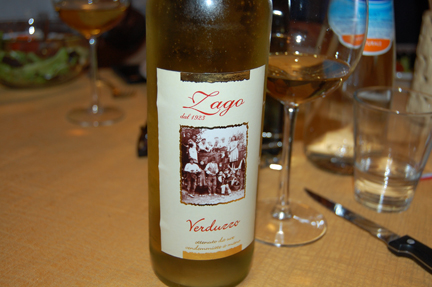
I didn’t expect much for the trattoria across the street, Do Fogheri (the two hearths, one outside for summer, one inside for winter). But we were pleasantly surprised to find that it was a locals-only place, with fantastic grilled fish and wonderful 11.5% alcohol sparkling Verduzzo — old school, all the way. We loved it. And it was the perfect meal for our last night in Italy… arrivederci, Venezia, my old friend, arrivederci Italia…

Of course, we’re happy to be heading back to Texas after two weeks on the road. Georgia P has had a great time and we’re blessed with a baby who loves to sleep in the car.

One of my best friends ever and my roommate from my first year at the university of Padua (1987), Steve, came out to meet Georgia P and join us for dinner (he lives with his family in nearby Padua). It was great to see him and share the joy of Georgia P’s smiles and laughter (and her love for bigoli al ragù).

I’ll be taking a break from blogging for the next days and will see you on Tuesday after the first day of the Jewish new year.

Thanks for following along, everyone, and sharing this unforgettable trip with us. I have so much to tell about the winemakers we spoke to and the new wines we discovered.

In the meantime, may G-d bless you and may your new year be filled with health, sweetness, and happiness.

L’shanah tovah, yall. See you in a few days…

Lacrima di Morro d’Alba, finger-licking good

Tracie P, Georgia P, and I are in Maiolati Spontini (Province of Ancona), a small village in the heart of Verdicchio country and just a stone’s throw up the road from Morro d’Alba.

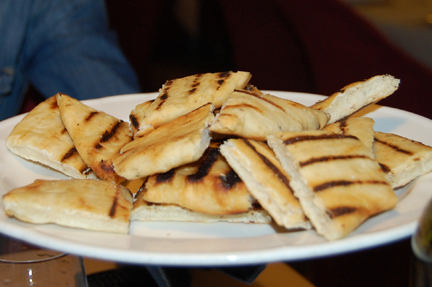
On the final leg of our trip, we stayed last night at the humble but sturdy and friendly Hotel La Torre, where we found refuge from the heavy rain and filled our bellies with warm crescia (above), the half-baked and then grill-fired flat bread, a standby of the Marches (Le Marche) and Umbria.

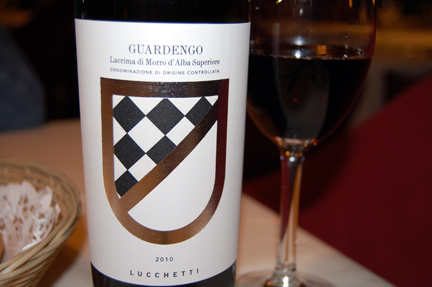
The olive oil-based dish was a perfect pairing for a wonderfully juicy 2010 Lacrima di Morro d’Alba by Lucchetti. A classic expression of this grape, poppy with acidity and fruit, light in body but delightfully chewy.

The bottle — the winery’s upper-tier Guardegno label — was more than reasonably priced and recommended to me by the proprietor, who told me — as she winced at the thought of it — that she doesn’t allow barriqued wines on her list.

We LOVED this wine. And I’m happy to report that it’s available in the U.S. (in at least a handful of states).

We have just one more meeting and tasting before we head to Venice this evening and back to Texas tomorrow.

It’s been an incredible trip for us, the first with our daughter, who taught us that mozzarella and paccheri ai frutti di mare (and pasta in general) are among her favorite foods.

Thanks to everyone for following along with us and sharing the joy of our trip.

Angelo Gaja’s 2012 vintage notes

Above: Monforte, late July 2012. Photo by my excellent friend David Berry Green, who graciously shared this with me on the spur of the moment.

Angelo Gaja winemaker, Angelo Gaja entrepreneur, Angelo Gaja larger-than-life wine personality, Angelo Gaja writer…

Most don’t think of him as a great writer but he is. In part because of his insights and experiences. In part because of his style and performance (as the Italians say).

Sadly, his “papal bulls” (as I like to call them) are often poorly translated.

And so, once again, I’ve taken it upon myself to translate his most recent notes on the 2012 vintage in Italy (below, sent to me in the original by one of his media outlets). I think you’ll be as interested as I was to read what he had to say.

In the original Italian, he uses a word — farlocco (translated here as easy mark) — a term that most Italians first heard when they read Pasolini’s Ragazzi di vita (published in Italian romanaccio [Roman street dialect] in 1955). Gaja probably first heard it as a youngster in the inflection ferloch in Piedmont, where the term most likely originated, meaning loud mouth. I could devote an entire post to this lemma and its epistemological implications…

In the meantime, I’d like to give the floor to messer Gaja…

*****

A Weatherglass for the 2012 Vintage

Climate change — marked by prolonged summer heat and drought — is the cause for the sharp drop in Italy’s grape production for 2012. It was also the reason behind the light vintages of 2007, 2008, 2009, and 2011.

Now, as a result, another scarce year adds to the lack of wine from previous vintages lying in Italian cellars. In the space of just a few short years, we have shifted from a situation in which Italy perennially produced a surplus of wine to the current shortage.

The shower of vintage forecasts that begin in late July have been rendered an easy mark by climate change. This is because the heat and drought now last for the entire month of August, the period when the grapes are formed, drying them to the point of a berry-wrinkling phenomenon. This condition causes a consistent loss of weight that eludes the hurried predictions.

Wine production in Italy is tightly regulated. The surface area planted to vine cannot be increased. In order to plant a new vineyard, you must grub up an existing one and it must be equal in size.

Wine is a natural product. Its quantities are determined by climatic conditions and the sky is the vineyard’s ceiling. It’s not like producing steel, glass, bricks, or plastic in a well-sheltered factory. And this concept often eludes the world of finance and those who follow the economic bottom line of the wine industry.

There are those who fear that Italian wine will not be able to keep up and that it will not produce enough to satisfy domestic demand while maintaining the export levels that Italian winemakers have worked so hard to achieve. In the last six months, a slow in exports has given us reason to reflect.

But this shouldn’t be cause for worry because the loss is concentrated in bulk wine, much of which was being sold at slashed prices. It’s better that this wine remain in Italy so as to fuel the production of box wine. The average price of exported Italian wine per liter is still one of the lowest in the world, widely outpaced by not just France but also surpassed by the U.S., New Zealand, Chile, and Argentina.

It’s right to be proud of the wines that are produced in Italy. But less so when the wines are sold at highly discounted prices. If supply of Italian wine goes down and demand grows or remains the same, it’s inevitable that the prices will go up.

Grape prices are already strained and wine wholesale prices will soon be strained as well. They haven’t changed for ten years! The retail price of wines under 3 Euros, which represent 70% of sales by Italian distributors, will also begin to go up.

But it’s also possible that higher grape and wine wholesale prices will be good for the wine trade by prompting producers to improve quality, to work to create greater demand in mid-to-low price points, and to become better salepeople.

Climate change has also sparked a generational shift among grape growers. In the Italian regions most affected by the heat, growers are asking that currently prohibited emergency irrigation now be allowed, even for appellation wines. Growers also need to learn how to better protect their vineyards from the evaporation of humidity in the soil.

Certain vine diseases, once believed to have been contained, are now returning and there is an urgent need to use less pesticide in viticulture. The knowledge acquired in the past needs to be rapidly integrated with current research, technology, and the grower’s own capacity for observation. This transition is our greatest cause for concern.

—Angelo Gaja
September 7, 2012

First bite: @MyLifeItalian eats fave e cicorie & makes a wish (TY @PaoloCantele)

When you visit Le Zie in Lecce for the first time, owner Carla Perrone insists that you let her feed you your first bite of fave e cicorie (favas and green chicory), a classic dish of Puglia.

And as she feeds it to you, she asks you to esprimere un desiderio… to make a wish…

I visited this wonderful restaurant for the first time in June 2011 and made a wish. It came true: I couldn’t wish for anything more than Georgia P and Tracie P.

I can only wonder what Tracie P wished for. She won’t tell… ;)

Thanks again, Paolo, for lunch at one of our favorite restaurants in the world!

Casanova di Neri supermarket Brunello in Lecce

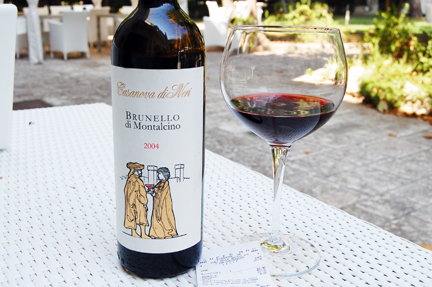
It’s hard to believe, I know: tasting notes for Casanova di Neri 2004 Brunello di Montalcino DOCG on Do Bianchi.

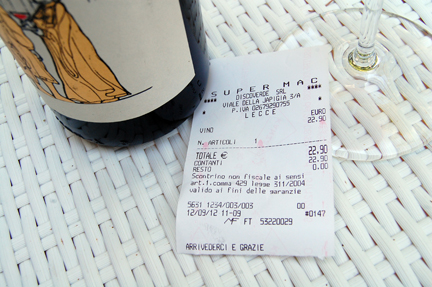
But when I saw this bottle at a downtown Lecce supermarket for Euro 22.90 (see receipt below), I couldn’t resist the temptation to pick it up (that’s $29.51 based on today’s exchange rate).

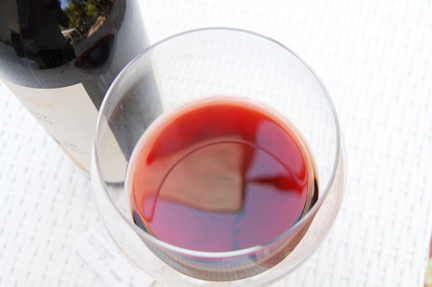
I opened and tasted the wine today before lunch and I have to say that it’s pretty good. Lighter in body than Giacomo Neri’s U.S.-bound Brunello, with bright fruit and some wood tannin on the finish. If it weren’t for the wood, I’d even say it was more than pretty good.

I’m guessing that this wine is akin to his “white label,” as it is called in the states.

On Winesearcher, I see Casanova di Neri for as low as $40. But never this low. Who knew it was a supermarket wine in Italy?

I plan to taste it tonight with pucce for dinner (on our first night in Lecce, we had an early dinner of grilled vegetables at a rosticceria and last night we had take-out pizza in our B&B; tonight is puccia night and generally we’ve either been eating very early or back at our hotel).

In an hour or so, we’re heading to one of Lecce’s culinary landmarks for lunch, Le Zie. I can’t wait!

Paccheri ai frutti di mare on the Ionian (TY 4 rec @PaoloCantele)

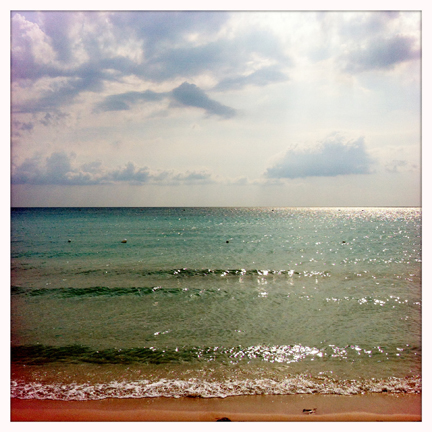
On Paolo’s recommendation, we headed to Porto Cesareo for lunch today. We wanted beach chairs, umbrella, and a restaurant right on the sea and he pointed us to the west coast of the Salento peninsula to Bacino Grande.

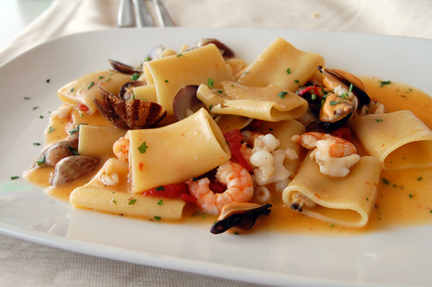
The paccheri ai frutti di mare were one of the best things we’ve eaten on the entire trip. The key to a dish like this is for the jus of the seafood to be absorbed by the pasta. The sauce had just the right consistency and texture and gave the pasta a wonderful savory character, with just a touch of sweetness from the tomato. Superb…

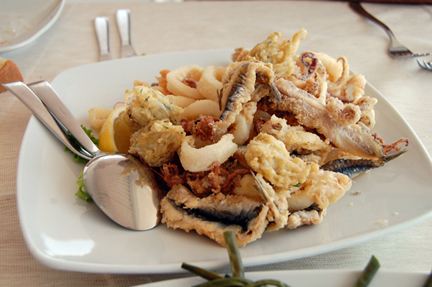
The frittura di paranza: a paranza is a wooden fisherman’s boat used for coastal fishing. This dish is akin to a “captain’s platter” fry. This, also, was over the top good.

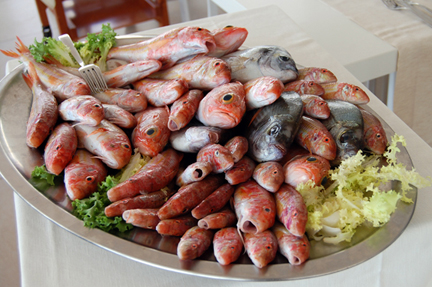
It doesn’t really get any fresher than this. I really loved the place, even though the staff was a little bit grouchy.

Georgia P LOVED the paccheri and she had a blast dipping her toes into the warm water of the Ionian. I love how Italians rejoice when you bring a baby into a restaurant and no one ever gives you a dirty look. We are having SO MUCH fun on this trip… She is our joy…

Basilicata’s scorched and rare earth

After arriving in Melfi on Sunday night, Tracie P, Georgia P, and I took one of the most amazing road trips of our lives: starting Tuesday morning from Melfi, we drove to Venosa to visit Aglianico del Vulture vineyards; then through the vast endless wheat fields of the Basilicata plains; on to Gravina in Puglia (where we stopped to nurse) and then to Gioia del Colle (Puglia), where we took the autostrada and then superstrada through Taranto, over to Brindisi, arriving in Lecce around 5 p.m.

I have much to say about the experience and what we saw. But the most amazing thing was the color of the earth: as Tracie P put it, striations of black, gold, red, brown, green… The Aglianico grapes are at full ripeness and I imagine the growers will be picking soon.

Much more to write and many more photos to post… but now it’s time to take the ladies to the beach… :)