
I just had to share this video of Georgia P who LOVES her some burrata… That’s her Swiss Airlines bib, btw… Buon weekend, yall!
Angelo Gaja’s vintage notes 1958-2011
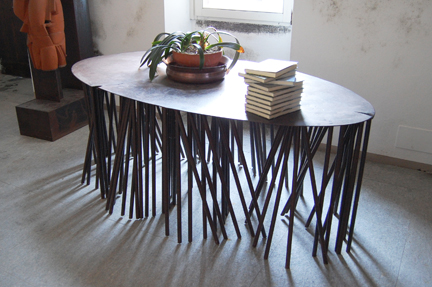
Above: Each one of the Gaja wineries is also home to an art collection. I snapped the above image in the foyer of the Piedmont cellar the last time I tasted there.
The following post recently came to my attention: Angelo Gaja’s vintage notes 1958-2011, anecdotes, insights, and reflections (many in hindsight).
I can’t conceal that I found it to be a fascinating document and I wanted to share it here.
my contributions to La Cucina Italiana’s wine issue @LCI_Magazine
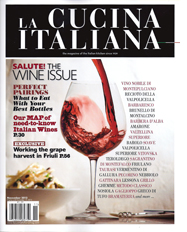 There are two publications that you will find in nearly every culinarily-aware Italian home.
One is late-nineteenth-century masterwork La scienza in cucina e l’arte di mangiare bene (The Science of Cooking and the Art of Eating Well) by Pellegrino Artusi.
The other is La Cucina Italiana, the historic “National Geographic” of Italian gastronomy, founded in and continuously published since 1929, renowned today for its high editorial standards and superb photography, and widely viewed as a leading authority on Italian cuisine today.
When you visit an Italian home, there’s a high probability that you’ll find a dog-eared and well worn edition of Artusi (because the recipes are as relevant today as they were when he published the landmark tome) and a complete vertical of La Cucina Italiana, lined up the same way that we collect and display National Geographic here in the States.
You can imagine how thrilled I was when wine and spirits editor Ian Wolff contacted me earlier this year and asked me to write an “Italian 101” for this year’s “wine issue.”
And of course, I’m thrilled that my byline appears next to those of Robert Camuto (who profiles Elisabetta Foradori), Anthony Giglio (who checks in with top Italian wine professionals in the U.S.), and Ian (who delivers a great firsthand reportage of harvest in Carso).
You’ll also find glosses from some of my favorite people in the business, like the inimitable Steve Wildy who works with Vetri in Philadelphia.
The issue literally overflows with on-the-ground information and resources (including maps, links, and myriad tasting notes).
It’s a great issue and I highly recommend it to you.
Chapeau bas, Ian, for a job superbly done and an issue of the magazine that is sure to be a reference in the homes of myriad Italian wine lovers!
A chat with Denman Moody, the Advanced Oenophile

Being a wine writer does have its perks. One of them is the access granted to otherwise out-of-bounds destinations.
Last night found me, a guest of one of the members, at the Westwood Country Club in Austin for a guided tasting and pairing by one of Houston’s wine icons, Denman Moody (above).
The affable and approachable Moody and his lovely wife Marijo were in town to present his recently self-published guide to the wines of the world, The Advanced Oenophile. And I won’t conceal that I was thrilled to get the chance to brush shoulders with them.
In the few minutes I managed to corner him and glean a few nuggets from a lifetime in the rare circles of fine wine collecting, I asked him how he’s seen the American palate evolve since he first began collecting.
“No one in their 30s drank wine” until a few decades ago, he told me.
“All the wine bars that were opened in the 1980s failed,” he said, “because young people didn’t drink wine.”
“If you went to steakhouse, people ordered a Scotch or a martini before dinner and then they sat down and ate their meal and that was it.”
What changed it all? He surprised me with his answer.
“Lambrusco,” he said. “Lambrusco, [Gallo’s] Hearty Burgundy, and Blue Nun,” brands introduced to Americans in the 1970s. “Those were the wines that first introduced Americans to wine drinking.” Later it was the explosion of “Italian restaurants and French restaurants that first gave young people access to wine.”
I remembered an acidified and highly sulfured Frascati that I drank in a chichi restaurant on Cañon Drive in Beverly Hills in the 1980s when I was a freshman at U.C.L.A. in the 1980s. I also remembered my grandfather who always drank a Scotch (just one) before dinner at his favorite steakhouse. Denman was right on…
I haven’t had a chance to dig into his book but leafing through it, I find that it’s teeming with juicy anecdotes from a career of tasting with the wine world’s brightest and best.
Chapeau bas, monsieur Moody, for the new book, for the graciousness with a disheveled wine writer, and for sharing your lifetime in wine with us.
Click here for an excellent profile of Denman by my Houston Press colleague Carla Soriano.
first Alba truffles of the year @TonyVallone
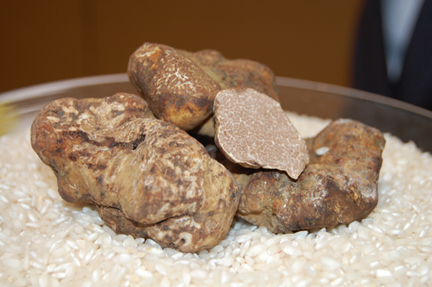
I snapped this photo today at lunch at Tony’s in Houston, the first Alba truffles I’ve seen this year.
Tony — my friend and client — talked about how the truffles are arriving early this year because of drought conditions over the summer in Italy.
There is no food in the world with a greater aura. (Does anyone get my Latin paronomasia?)
tagliatelle ai funghi porcini & a note from Francesco Bonfio

In my post yesterday for the Houston Press, I recounted the last time I was served a bottle of wine that was technically correct but nonetheless off:
- I was in Siena, Italy, the last time this happened to me (about a year ago). My colleague Francesco — the president of the Italian wine shop association — and I ordered a bottle by one of my all-time favorite producers of Chianti Classic, an icon in the field, Castell’in Villa.
The vintage was 1995, a great one for the appellation. As we ate our delicious tagliatelle ai funghi porcini, we realized that the wine had simply lost its life. It was good. It just wasn’t what it could have been (and he and I had tasted it many times before). Something about it was just off.
When the restaurateur noticed that we had left three quarters of the bottle on the table, he immediately offered to open something else for us. We thanked him but declined. One glass of wine was enough that evening, however mediocre.
Francesco bought dinner that night and while I didn’t see the bill, I’m sure that the proprietor didn’t include the cost of the bottle of wine. Next time I’m in Siena, I wouldn’t be surprised if Francesco and I go back to the same place. He eats there at least once a week.
In my view, this is a great parable about restaurant-going. The economics of fine dining are as much about relationships and human interaction as they are about good food, wine, and service. A bad bottle of 1995 Castell’in Villa? Lupus in fabula…
The Francesco in question was my good friend Francesco Bonfio, owner of the excellent Enoteca Piccolomini in Siena and president of the Italian wine shop association, Vinarius.
He encountered technical difficulties as he attempted to leave a comment on the Houston Press site and so he asked me to post it for him (don’t mind his “formal” tone; it’s part of his schtick):
- Sir,
Thank you for mentioning that occasion. Let me underline one aspect: it is true that the owners of the restaurant know me, and it is true that they did not charge for that bottle. It is also true and I may guarantee to you that they do this all the time because they have this policy with anybody dining at their restaurant. It is also true that this is possible ONLY when the people who dine AND the restaurants owner do know the object of discussion. That bottle was an “unhappy bottle” not a bad bottle and this difference can be found only if both sides know that wine. Consequently it is different if the bottle is sent back just because the customer simply does not like that type of wine. By the way the restaurant was Enoteca I Terzi.
I wanted to share it with you here and I wanted to share the wonderful tagliatelle ai funghi porcini that we were served that night (above). The dinner took place last year in October, the time of year when the porcini are in season.
Thanks, everyone, for all the comments and RTs of the post over on the Twitter. And thanks, again, Francesco for dinner and the wine: even when it’s off, a bottle of Castell’in Villa is always memorable!
thoughts on how [not] to send back a bottle you don’t like

An Aglianico del Vulture that blew me away: Musto Carmelitano

Above: Elisabetta Musto Carmelitano is making some of the best Aglianico del Vulture wine that I’ve ever tasted.
Every once in a while you come across a wine that just makes you stop in your tracks. Stop the world and let me off: I need to spend some time with this wine, you say to yourself.
That’s what happened to me when I first tasted the wines of Musto Carmelitano a few months ago in Los Angeles.
The importer had been hounding me about natural this and natural that, biodynamic this and biodynamic that. But when I tasted the wine I remembered some sage advice that a sommelier once shared with me: don’t trust the story, trust the wine.
This wine is THAT good. Who cares what made it that wine?
In our quest to create the largest selection of Aglianico del Vulture at Sotto in Los Angeles (where I curate the wine list), this is just one of the myriad wines that have come across our tasting table (there are more available in the U.S. than you would imagine). And it lept to the top of our list…

Above: Grapes harvested by Elisabetta this week in Vulture, image shared with me by the importer, former Italian pro baseball leaguer Justin Gallen.
When Tracie P tasted the wine for the first time — the Pian del Moro, from Elisabetta family’s oldest vineyards — her reaction was “wow, there’s a lot going on in that wine.”
Dark red and black fruit, dark black earth, and an resilient “nervy” acidity that holds the wine in balance.
Of all the Aglianico del Vulture I’ve tasted lately — and I’ve tasted a lot in the wake of our visit to Vulture — Elisabetta’s is perhaps the one that most greatly captures that “unbearable lightness” (as I like to call it), that unlikely combination of power and ethereal elegance, muscularity and grace in the glass.
I love this wine.

There will be many other labels that we’ll be featuring at the restaurant this fall and I’m thrilled about all of them. But this is one of my favorites.
Served, by the glass and by the bottle, a casa Parzen.
Causing trouble again @EatingOurWords: How to send back a bottle of wine #ShitStorm
From the department of “I can already hear the massive shit storm brewing”…
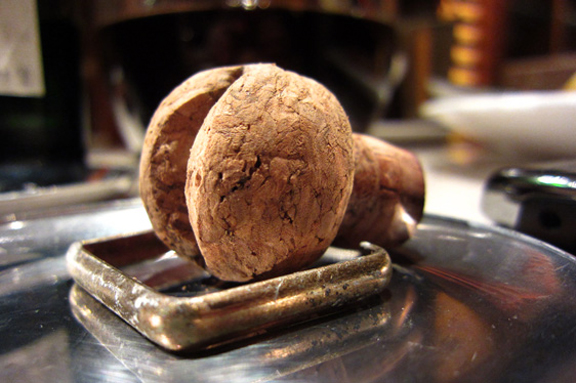
From my post today for the Houston Press…
A few months ago, when I was dining with family in a Houston restaurant (that shall remain unnamed), I ordered a bottle of Dolcetto, one of the classic food-friendly grapes of Piedmont, in northwestern Italy.
The server disappeared and swiftly returned with the bottle I had asked for. And presumably because I had asked for the wine list and had ordered the bottle of wine, he poured the first sip — the tasting sip — for me.
I swirled the wine in the glass, smelled it, smelled it again, and said matter-of-factly, “this is great. Thank you very much.”
And then he did something that transgressed the inherent social compact that exists between waiter and guest.
“Sir, taste the wine,” he said.
“The wine is fine,” I said politely, “please go ahead and pour it for our table.”
“Sir,” he insisted, “taste the wine.”
I looked at him incredulously.
“Sir, the other night, I had a customer who smelled the wine and said it was okay. But then, after he tasted the wine, he sent it back. So I have to ask that you taste the wine.”
When in Rome, I thought, do as the Romans do. And so I tasted the wine.
“It’s really great. I really like it. And it’s going to be great with our meal, I’m sure.”
Satisfied that the wine’s fitness had now been unquestionably verified and reaffirmed, he smiled and poured the wine.
This episode reminded me of how uncomfortable most people are when they are asked to determine the fitness of a bottle of wine at a restaurant.
my lasagne alla bolognese for @MyLifeItalian’s birthday
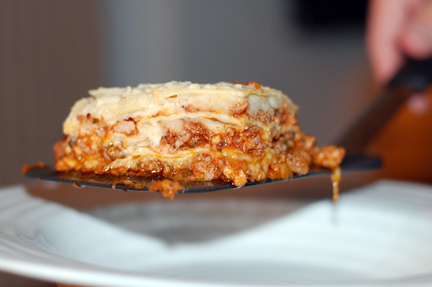
For her birthday dinner this year, Tracie P requested lasagne alla bolognese, one of my pièces de résistance in the kitchen.
In my experience, lasagne alla bolognese are best prepared over the course of two days: the key is to make the ragù the day before (classic soffritto, equal parts ground pork and lean beef, one sausage link crumbled, tomato purée, white wine, chicken stock, salt and pepper to taste, a bay leaf, and a dash of chili flakes, simmered slowly for a few hours after the meat has browned well and been deglazed with the wine).
I cover the ragù and reserve it over night in the oven (there’s no need to refrigerate it since it will be reheated after you assemble the lasagne).
Making the lasagne isn’t as challenging as it seems: all you need is a food processor and a pasta rolling machine. (There’s a great recipe for making pasta sheets in Cesare Casella’s Italian Cooking Essentials for Dummies.)
Once you’ve rolled out and trimmed the lasagne, you layer them (in a oven-ready casserole dish that’s been greased with butter), alternating between ragù (the first), béchamel (second), and freshly grated Parmigiano Reggiano (third, topped with a layer of pasta).
For my béchamel, I always use a tablespoon of white wine and a tablespoon of chicken stock, two subtle ingredients that give the sauce great nuance in my experience. And the Parmigiano Reggiano must be freshly grated, a sine qua non to great lasagne alla bolognese.
The combination of the rich flavors and textures is one of the supreme expression of Italian gastronomy and well worth the time and effort it takes to make this dish. We paired with a bottle of 2010 Langhe Nebbiolo by Produttori del Barbaresco. (The classic pairing would be Lambrusco, of course.)

Georgia P is still not ready for the fattiness of lasagne alla bolognese but she did get to have some pappardelle that I made from the trimmings. We tossed them in a pat of butter and topped them with a dust of Parmigiano Reggiano. She loved them…
We’ve had such a wonderful year, with too many blessings to count.
Thanks for reading and buona domenica, yall!
 Do Bianchi