Italian wine fair highlights so far

Posting in a hurry as I rush to drive back down to Verona today for my last day at the Italian wine fairs.

It’s remarkable to think about how many wines I’ve tasted over the last two days… with one more day to go.

Here are some highlights from Vinitaly and Vini Veri, in no particular order or hierarchy.

best marzemino

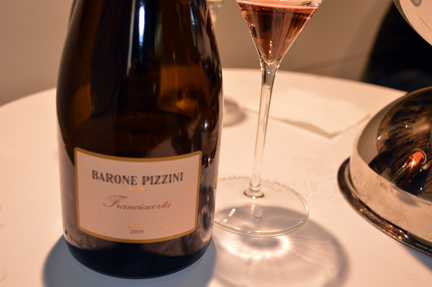
barone pizzini rose

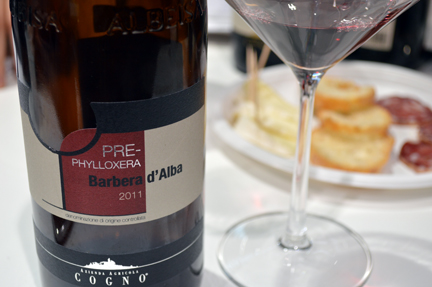
cogno barbera

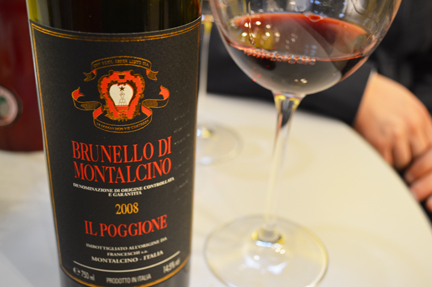
poggione brunello

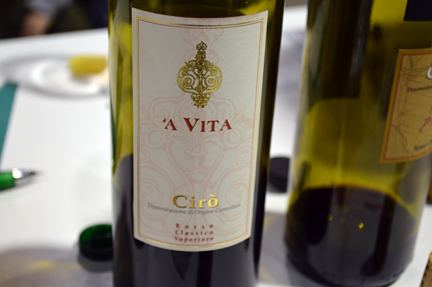
a vita ciro

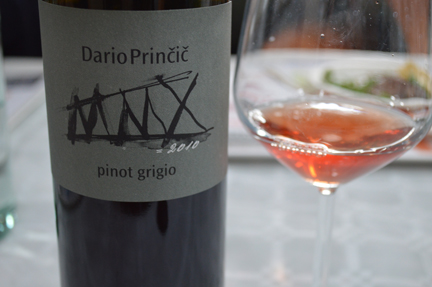
pinot grigio pink

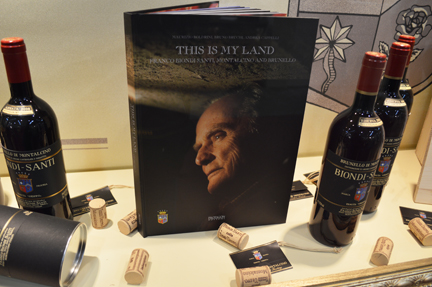
Franco Biondi Santi, for whom the bell tolls

franco biondi santi

Era ‘l giorno ch’al sol si scoloraro
per la pietà del suo Fattore i rai

It was the day the sun’s ray had turned pale
with pity for the suffering of his Maker

(Rerum vulgarium fragmenta 3, translation by Mark Musa)

I couldn’t help but be reminded of these lines by Petrarch yesterday when I heard the news that Franco Biondi Santi had passed away.

(See this translation of a statement issued by the Brunello bottlers association, including notes from Consortium President Fabrizio Bindocci. It was Fabrizio’s son Alessandro who shared the news with me when I sat down to taste with him in the Tuscany pavilion at Vinitaly.)

Just like the Good Friday that Petrarch recalls in his songbook, it was as if the rays of the sun had grown pale over the wine fair yesterday, as winemakers and fair-goers whispered to one another in hushed tones, did you hear the news that Biondi Santi died?

I never met Franco Biondi Santi in person but I did interview him once by phone.

Of all the winemakers I’ve ever had the chance to interact with, he was perhaps the one most free from the chains of megalomania and most guided by intellect and passionate focus.

A few weeks after our conversation, I received a package sent from the winery. It didn’t contain samples or a vanity folio.

Instead, he had sent an autographed academic offprint of his most recent research on the DNA of his prized Brunello. I still have it, filed in my library next to signed offprints from the many professors of philology and paleography who aided me throughout my academic career.

According to media reports today, he was ninety-one years at the age of his passing.

While his involvement in the winemaking at the legendary Tenuta il Greppo was probably very limited in recent years, his legacy as the caretaker of Brunello’s origins, steadfast defender of its integrity, and producer of one of the world’s greatest wines cannot be underestimated.

Since the Brunello inquest of 2008, the appellation has been dogged by a series of regrettable and often avoidable controversies. (Most recently, one of its most high-profile producers sparred publicly with the Brunello bottlers association in an ugly display of hubris.)

With Biondi Santi’s passing, Montalcino loses an unimpeachable patriarch, whose stewardship and leadership will be missed as sorely as his impeccable style and humanity.

I took the photo above at the Biondi Santi stand yesterday in the Tuscan pavilion in Vinitaly.

Today, the shadow cast by his passing will surely dim the glitz of the trade fair as it reminds us that the Italian wine world continues to navigate and negotiate uncharted waters.

O lovers of Brunello, do no send to know for whom the bell tolls. It tolls for thee…

franco biondi santi has died tells me @brunellomaker

I am very sad to report that franco biondi santi has passed away. I just arrived at my appointment with alessandro bindocci who shared this sad news. An era has ended. More on this asap.

Giacosa 99 Barbaresco (classic) white label

giacosa 99 white label barbaresco

Friends might writhe with envy if they knew how much I paid yesterday for a three-bottle lot of 1999 (classic) Barbaresco Giacosa white label.

I bought the bottles at a restaurant here in Proseccoland after I spied them on the list.

As the wine opened up, an initial brightness gave way to darker fruit and bigger tannin. The first bottle, we all agreed, although vibrant and fresh, showed more maturity, while the second had many years ahead of it. The sommelier had assured me that he bought his allocation on release and that it had remained cellared impeccably since. I was surprised by the bottle variation and thrilled, as always, by the wine.

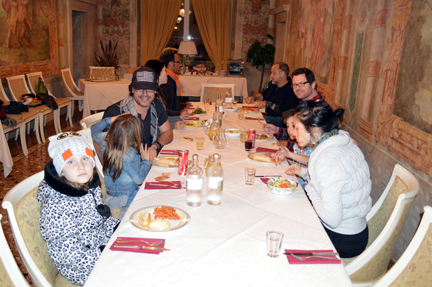
family dinner

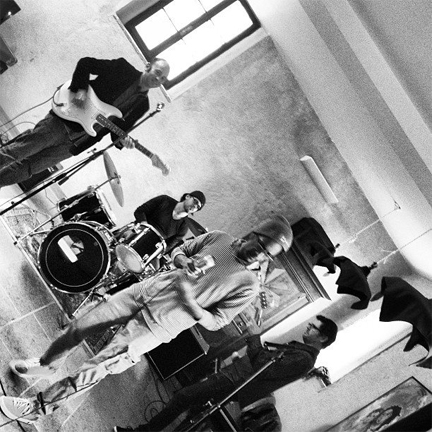
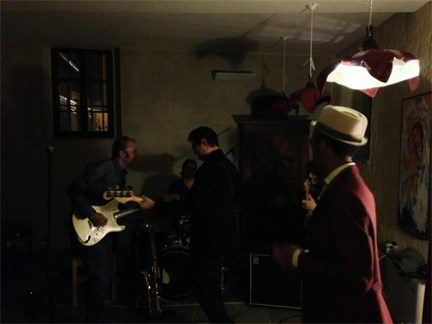
Super fun to be here with my band and our families.

That’s the main dining room at the villa.

Show tonight and tomorrow at 10!

Gregoletto, from sharecropper to biodynamic farmer

gregoletto prosecco

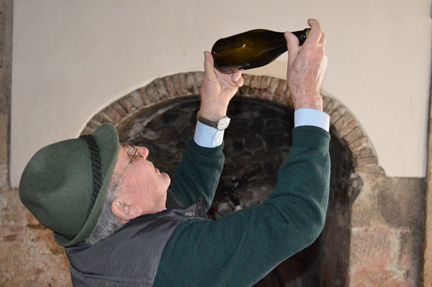
The only winery visit I’ve made this week was to Gregoletto, one of the oldest producers of commercial Prosecco.

That’s Luigi Gregoletto, above, now in his mid-80s.

Amazing to hear him talk about a time when Prosecco was only planted where wheat and other grain wouldn’t grow (now planted on every square inch of the the lucrative vineyard real estate of Proseccoland).

Also incredible to hear him recall the 1950s when he traveled the Veneto in his little Bianchina, selling his wine door-to-door.

More… much more to come…

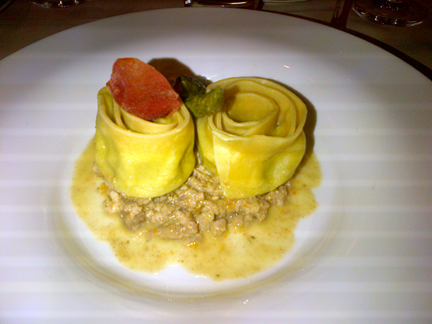
Pappardelle in forma di rosa

pappardelle veneto

Great lunch today at Gigetto in Miane (Proseccoland, province of Treviso), amazing wine cellar, and great conversation with sommelier Roberto Pieri.

The pappardelle sat atop a light “white” ragù and where garnished with asparagus.

Luciano Benetton was sitting at the table next to us.

“The shield of the Alps between us and the Teutonic rage”

dolomite alps treviso

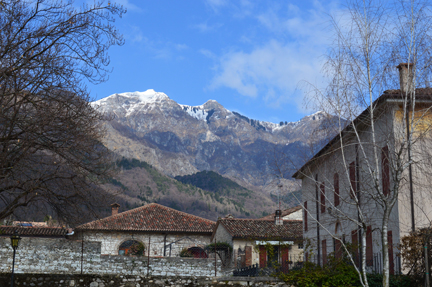
That’s the view, above, that greets us every morning when we leave our apartment at the Villa Marcello Marinelli in Cison di Valmarino (province of Treviso).

In the shadow of such rich natural beauty, I can’t help but be reminded of the following lines from Canzone 128 of Petrarch’s songbook, Italia mia, ben che’l parlar sia indarno a le piaghe mortali (My Italy, although speech does not aid those immortal wounds):

    Ben provide Natura al nostro stato,
    quando de l’Alpi schermo
    pose fra noi et la tedesca rabbia;
    ma ‘l desir cieco, e ‘ncontr’al suo ben fermo,
    s’è poi tanto ingegnato,
    ch’al corpo sano à procurato scabbia.

    Nature provided well for our safety when she put the shield of the Alps between us and the Teutonic rage; but our blind desire, strong against our own good, has contrived to make this healthy body sick.

    (Translation by Robert Durling.)

dolomite alps

We’ve been having a great time here at the villa and the band has begun to arrive (we’ll be performing on Friday and Saturday nights).

But my old and very good friend Renato Dal Piva, the villa’s manager, and I have also had some heavy heart-to-heart chats about what it’s like to live and work in Italy these days.

Yesterday, The New York Times reported that “Unemployment in Euro Zone Reaches a Record 12%” (in October 2012, the paper reported that “Unemployment in Euro Zone at Record High” [at 11.4 percent]).

Petrarch’s verses were composed in the mid-fourteenth century. They scan as though they, too, were written yesterday…

Proseccoland, our favorite restaurant: Osteria al Cacciatore

baby girl italy

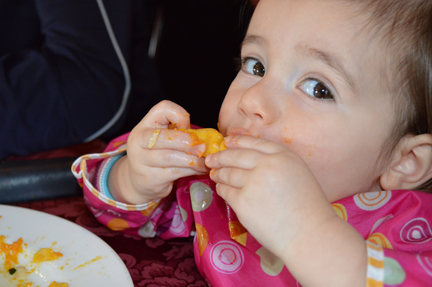
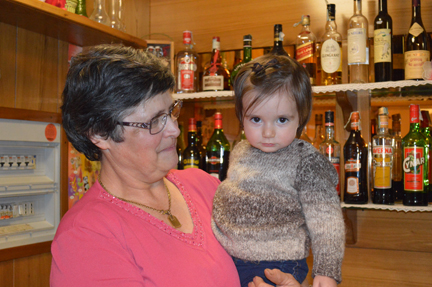
Above: Georgia P was the star of the dining room last night at the Osteria al Cacciatore.

The Italian expression alla cacciatora is actually a relatively ancient one.

Many would have you believe that it denotes as per the hunter’s custom.
wine caraffe

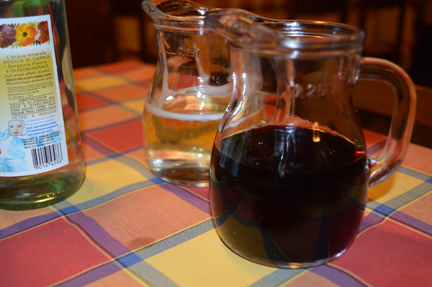
Above: 1/4 liter of gently sparkling white, most likely Verdiso; 1/4 liter of red, mostly likely Raboso, traditional table wines in the province of Treviso.

In fact, it means roughly or coarsely [dressed] (it begins to appear in Italian as an adverbial phrase by the mid-eighteenth century).

There’s no doubt that it comes from the word caccia meaning hunt (from the Latin capere, to seize), akin to the English chase.
antipasti affettati

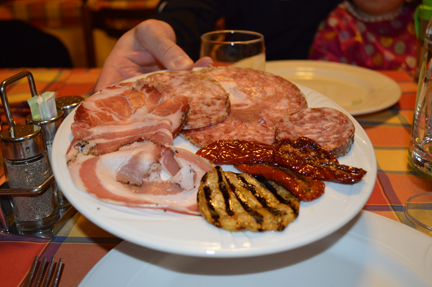
Above: Housemade salumi, so rich in flavor (and fat) but not overbearing on the palate.

But when Artusi canonized the recipe pollo alla cacciatora (chicken stewed with red wine and tomatoes) toward the end of the nineteenth century, he surely perceived the meaning of its designation as roughly dressed (and not in the style of the hunter; like a hunter is a more apt translation).
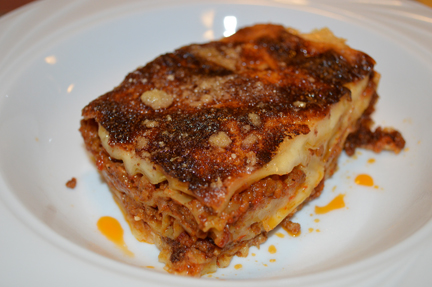
pasticcio

Above: The pasticcio (layered pasta and ragù pie) was one of the dishes I most looked forward to. It didn’t disappoint.

When you make your way to the Osteria al Cacciatore in the village of Zuel di Qua (literally, the hill over here, as opposed to the Zuel di Là, the hill over there, in the township of Cison di Valmarino in the heart of Proseccoland), there’s just a small sign to alert you the presence of a restaurant in the house on the side of the wine country road. You’d think it were just a private home if not for the cars parked outside.
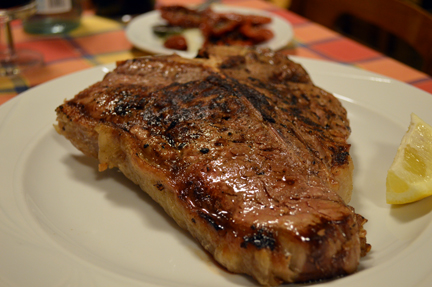
best steak italy

Above: Tracie P craved steak last night. Beef in the Veneto is excellent and the meat had a wonderful sweetness that balanced its savory char.

There’s no menu. And there’s no wine list.

Owner Maria Gusatto’s daughter simply comes over to the table and asks what would you like tonight?
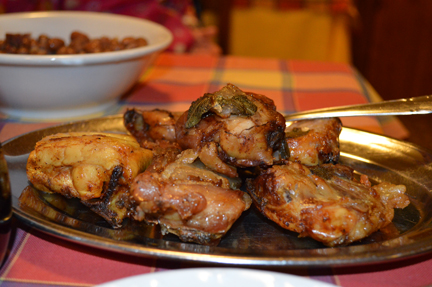
skewered rabbit

Above: Spit-roasted rabbit and chicken. This was my splurge meal of the trip. The sage leaves were seared into the skin of the rabbit and the bones were so juicy you could crunch them between your teeth.

Georgia P put on quite a floor show: she’s just begun walking and insisted on marching around the restaurant like a drunken sailor.

When I apologized to one lovely older couple for the nuisance, the lady said, non sono i piccoli che danno fastidio… sono i grandi (it’s not the little ones that are bothersome… it’s the big ones).
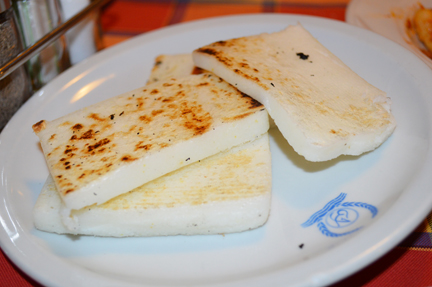
white polenta

Above: The white polenta was so tender and light but firm to the bite.

The chef added: when they’re little you wish you could eat them up… when they grow up, you regret not having eaten them.

Osteria al Cacciatore is the type of place where people speak in proverbs.
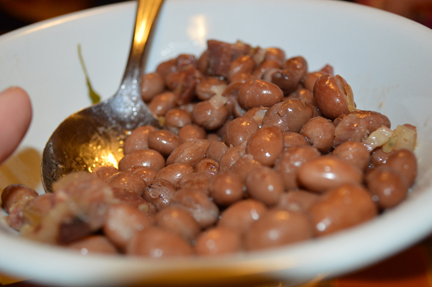
beans veneto

Above: The beans are cooked gently with white onions. We had to take them away from Georgia P… she couldn’t stop eating them and neither could we.

Our bill? €51.

I handed Mrs. Gusatto a 50-Euro bill and a 1-Euro coin. She said, “50 Euros are plenty. May I offer you a coffee or a digestif?”

Thanks, again, to Riccardo Zanotto, who first brought us here. I can’t recommend it highly enough…