Back to natural Vinos Ambiz gets me back in the groove

vinos ambiz

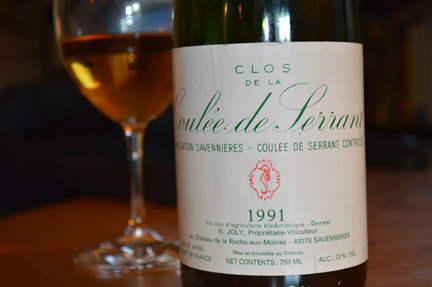
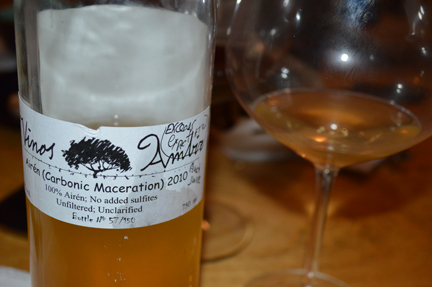
Just in case you were concerned that I had lost my way among the rich folk back in the big New York City, I’m happy to report that I found my way from James Suckling’s Wednesday night tasting in midtown to Alice’s place downtown where I recharged my sanity drinking some crunchy wine from Vinos Ambiz in Spain.

The folks there are an “organic vineyard, winery and natural wine company. We practice sustainable viticulture, and make natural, authentic, good quality wines that express the terroir. We improve the fertility of the soil, don’t use chemicals or additives and we recycle our bottles.”

The Suckling tasting was impressive but the carbonic maceration Airén, unfiltered, unclarified, and with no added sulfites by Vinos Ambiz — let’s just say — was a little more my speed.

pickled herring salad blau gans

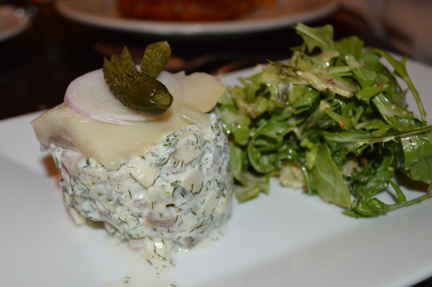
And just to remind myself what I love about the borough of Man-atan, I met Brooklyn Guy the next day for lunch at the Blaue Gans in Tribeca where I thoroughly enjoyed the pickled herring salad.

The service there may not be what it once was at this Teutonic casual, but the food is always great, the wine list tidy and solid, the beers appropriately bitter, and I love the Zabriskie Point poster in the toilet (worth a visit to the head by any means).

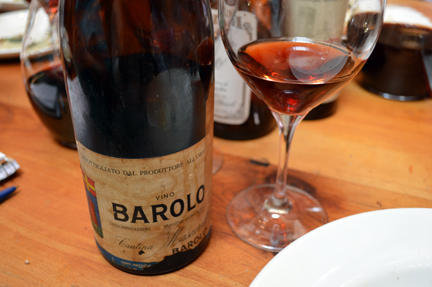
My short visit to New York is about to come to an end but not before I go taste a buttload of old Nebbiolo (you are not going to believe the sick flight of wines that await me at lunch). Stay tuned…

In praise of James Suckling & 07 Giacosa Rocche del Falletto Red Label

james suckling

Last night in Manhattan, wine writer James Suckling spoke from the pulpit of St. Bartholomew’s Episcopal church at his Great Wines of Italy event.

I can’t say that his taste in wine always aligns with mine but I will say that the event he orchestrated and hosted was remarkable not only for its breadth and ambition but also for the marquee names that gathered for the two-day affair.

Bruna Giacosa, Giacomo Neri, Francesca Planeta, and Marco Caprai were just some of the celebrity Italian winemakers who came to New York to pour and talk about their wines. And there were many others…

st barts cathedral new york

I was in town to pour and speak about the wines of friend who couldn’t be there.

As a lover of Italian wines, I can only offer my greatest praise for James and this landmark event. The model is, of course, the Wine Spectator New York Wine Experience. And there are other annual NYC events, like the Gambero Rosso guide presentation, where scores of top Italian winemakers show their wines.

But, to my knowledge, there’s never been such an ambitious high-end, consumer event devoted exclusively to Italian wine: it cost roughly $200 to attend last night’s event and tickets to tonight’s dinner are $275.

I was also really impressed by the guests’ level of wine knowledge and many grilled me about vintage characteristics and growing sites.

Chapeau bas, James. The tasting set a new and higher bar for Italian wine in this country. An event like this would have been unimaginable in 1998, the year that the Italian wine renaissance began to take shape in this country.

rocche falletto

Bruno Giacosa 2007 Barolo Le Rocche del Falletto (red label) was the wine I was most thrilled by, poured by Bruna herself!

Wow, what a wine… no one can rival the elegance that Bruno Giacosa achieves in his Barolo. And where so many 2007s are dominated by the power of their tannin (in part due to the odd winterless vintage in Langa), his already shows gorgeous balance (even at this early stage of its evolution).

I had tasted the wine at the winery back in 2010 when Bruno hadn’t yet decided whether he would make a red label for this designation. Tracie P and I were on our honeymoon and we tasted the Rocche del Falletto out of cask.

Here are my notes from that tasting.

The other highlight was hearing Isabel Suckling, James’ daughter, rehearse for the performance she will give at tonight’s event.

She’s a truly electric performer and I’m looking forward to her main event at tonight’s dinner.

More New York Stories to come… Stay tuned…

The little Italian wine importer who could

From the department of “who said that Texas was flyover country?”…

David Weitzenhoffer

What a week Wednesday last week Wednesday was!

In the course of twenty-four hours on the ground in Texas, I ate lunch with my buddy Ray (as in Isle, executive wine editor for Food & Wine), tasted with a Master Sommelier and one of my favorite Valpolicella producers, photographed the owner of Tenuta Sette Ponti for a client, and had dinner with one of the Italian wine importers I admire most, David Weitzenhoffer (above), owner of A.I. Selections, “the little Italian wine importer who could” (more on that later).

When I first moved to Texas, my friends in New York and California used to ask me alarmedly, what will you drink there? I even heard a few call it “flyover country.”

Nearly five years later, I’m happy to report that I’ve been drinking well, in part thanks to David’s superb portfolio which is now available in Texas (I’ll post my notes from the excellent tasting David organized for me as soon as I can catch my breath).

Today, I head back to New York for one last and thankfully short trip before Baby P 2013 arrives in July.

I’ll be pouring wine at some fancy tastings and I’ll be attending a few incredible tastings myself while in the city. In the meantime, I’m missing Franco Bernabei and my friend Anthony Giglio who are both visiting Texas this week (did someone say flyover?).

Here’s a taste of what I’ll be pining for while in New York… see you on the other side…

Andreotti dies & blows a last kiss from the 20th century

andreotti

Andreotti (right) with Nixon in 1973. Image via the Wiki.

“The great winemakers,” said my client Silvano “die during harvest or during Vinitaly,” Italy’s annual trade gathering in Verona where we were meeting.

He was referring to the passing of Franco Biondi Santi, whose death — at 91 years — cast a long shadow over the fair when the news broke on the first day of the event.

And so is the case with Italian politics.

Today, Italy has new Pope, a new prime minister (elected last week), a new president (also recently elected), and Giulio Andreotti, the seven-time prime minister who defined politics in Italy and reshaped the country’s political and economic legacies in the twentieth century, has died at 94 years of age.

When I traveled to Italy for the second time, to spend the 1989-90 scholastic year at the university in Padua, Andreotti was in his last term as premier.

In every way, he represented everything that my leftist Italian counterparts and friends abhorred: he was the face of Italy’s right wing, considered by many a torch-bearer of fascism, a censor (who once repudiated De Sica for the fim Umberto D.), a mafia-tainted and wily politician who was implicated in the assassination of his friend and political rival, Aldo Moro, not to mention the murder of a journalist who had become a nuisance to him.

umberto d

Above: Andreotti chastised director Vittorio De Sica for his iconic film Umberto D.

In 1993, during his mafia-association trials, authorities revealed that they had obtained a photograph of Andreotti shaking hands with mafioso Vincenzo Pernice at a private ceremony in a church in Rome. There was also an account that he had exchanged a kiss with Salvatore Riina, the boss of bosses at the time.

I’ll never forget how Professor Branca — one of my mentors and a staunch supporter of Andreotti’s Christian Democrats, a rightist in an academic world dominated by the left — finally conceded that Andreotti was as crooked as the figures with whom he’d been linked.

“Si è fatto fotografare con quel mafioso,” he said to me and my dissertation advisor, another one of his protégés. “He allowed himself to be photographed with that mafioso.”

There was no denying that Andreotti was a criminal, not even for Vittore Branca.

Italy’s current generation faces enormous challenges — economic, political, and cultural. Some would even go as far to say that the current financial crisis is one of the greatest crises Italians have faced in the history of the Italian republic (born after the second world war).

In the light of recent events, it’s as if Andreotti’s death were a congedo, a coda to his twentieth-century legacy. It’s as if he were saying, I don’t know where you’re going but don’t forget that I’m the one who got you here…

Great Aglianico not diminished by Shakespearean betrayal (it’s not D’Angelo without Donato @SottoLA)

donato dangelo

Above: Winemaker Donato D’Angelo and his wife Filena Ruppi at Vinitaly 2013.

Last summer, as Rory Harrington and I were preparing what we believe was the largest offering of Aglianico del Vulture by-the-glass in the U.S. (for our fall 2012 list at Sotto in Los Angeles where we co-curate the wine program), one of our favorite wine salespeople brought in an Aglianico del Vulture that reported “D’Angelo” on the label.

“I know the wine in the bottle,” I told him, “but I’m terribly sorry that we can’t sell it here at Sotto.”

“But you love the wine!” he protested. “Why can’t you carry it?”

“Because this wine was stolen out from under the people who made it,” I said.

And then I recounted the story of how Donato D’Angelo’s winery and brand was wrested away from him by his crooked sister-in-law and her children.

When Donato’s brother and partner in the winery died prematurely a few years ago, his clan used its majority ownership to force Donato and his wife Filena out of the picture, even though Donato was the founder and winemaker and even though he single-handedly revived the Aglianico del Vulture appellation after returning to Basilicata from Conegliano where he studied enology as a young man.

best aglianico vulture

Above: I am very pleased to share the news that we now offer Donato D’Angelo by the glass and by the bottle at Sotto.

It’s one of those sad Italian stories of a family fractured by greed, deceit, and betrayal.

The good news is that Donato and Filena have launched a new label, “Donato D’Angelo,” and the wines are now imported to the U.S.

We had to special order them for California and Sotto is the only venue on the west coast where they are available.

And I am extremely proud to share these wines with our guests.

There are many expressions of Aglianico del Vulture that I love: Carbone and Musto Carmelitano are among my favorites and have both appeared on our list at the restaurant.

But Donato’s wines achieve an unrivaled elegance and delicacy.

I first met Donato and Filena in New York in 2005 and I have followed the wines ever since. And when I tasted with them at Vinitaly this year and stuck my nose into the “Donato D’Angelo” signature wine, I was thrilled to find that unmistakable floral note that he so masterfully attains.

As far as I am concerned, no Aglianico del Vulture is “D’Angelo” unless it’s “Donato D’Angelo.”

I’m currently on paternity leave from my monthly visits to Sotto (I’ll be back again in September once we’ve settled into life with our new baby, due in July). But if you happen to dine with us, please ask Rory to pour you a taste.

Buon weekend, yall…

A wonderful Ripasso & Amarone resource

tenuta sant antonio valpolicella

Above: Winemaker Armando Castagnedi (right) of Tenuta Sant’Antonio, one of my favorite Valpolicella producers, was in Austin, Texas yesterday. That’s him tasting with top Austin sommelier Mark Sayre.

I always try to make myself available when Italian winemakers come to town and I was happy to carve out an hour of my day yesterday to taste and chat with Armando Castagnedi of Tenuta Sant’Antonio, who was in town “working the market” as they say in the wine trade.

When we met, he gave me a wonderful little book on how Ripasso is made and I wanted to share it here on the blog. So I called up the winery this morning and asked the export director Elena Verzini to send it to me in electronic format. She also sent me their Amarone book.

Click here for the Ripasso book and here for the Amarone book.

Both have great illustrations and solid English translations explaining the process behind these wines — unique in the panorama of European winemaking and among my favorites.

Click here for my Vinitaly tasting notes from my Tenuta Sant’Antonio visit.

Italian government allows emergency irrigation where not specified in appellation regulations

fabrizio bindocci

Above: Consorzio del Vino Brunello di Montalcino president Fabrizio Bindocci.

Back in September 2012, I reported on Brunello consortium president Fabrizio Bindocci’s quest to ease restrictions on emergency irrigation in Montalcino.

When we met and tasted in the days leading up to harvest, he told me that he had sent a request to the Italian agriculture ministry asking them to clarify a technical point. If no restriction on emergency irrigation is mentioned in appellation regulations, he inquired, can it be allowed in extreme situations (even though it’s not prescribed in the appellation regulations)?

Click here for the background.

Today, Laura Gray, author of Il Palazzone blog in Montalcino, reports that “We just received word via the Brunello Consortium that the Ministry for Agriculture published a circular (number 6858 – 19 April 2013) clarifying that irrigazione di soccorso (emergency irrigation) is permitted for DOCG, DOC and IGT wines when this is not mentioned in their disciplinaries.”

Click here for her post “An end to obligatory dry farming for Brunello.”

As Laura points out, “we have all noticed the rise in temperatures and so this new possibility of intervention is welcome news in Montalcino.”

Please TONE DOWN the perfume, ladies & gents (de la merde s’il vous plaît!)

perfume wine headache

The sky was partly cloudy yesterday, the temperature in the mid 70s, and there was gentle rain as I rolled into Houston from Austin on a early spring evening around 6 p.m.

It was a perfect storm: between the mild heat, the intense humidity, and the heavy Texas pollen, there was no way that I was going to avoid a major allergy attack.

By the time I managed to find a seat at one of my favorite Houston by-the-glass wine programs (which will remain nameless in order to protect the innocent), tears were literally rolling down both sides of my face and I had already retired one of the cloth handkerchiefs that I carry with me (these days, I make sure to have two on hand at any given moment).

It was nothing that a crisp, cool glass of Roter Veltliner, with a wonderful spearmint note, and a steaming bowl of Nova Scotia mussels couldn’t clear up in a matter of minutes.

Until…

An attractive, middle-aged woman joined a party sitting to my left, taking the seat in between me and her friends at the crowded bar.

The fragrance she was wearing was SO aggressive that it dominated even the marine aromas of the mollusks. And my lovely Roter Veltliner, with its gentle herbaceous nose, was sent adrift in a sea of chemically induced “honeysuckle.”

It was as if her fragrance were shouting SHOUTING at me.

I later discovered, feigning that my wife “might enjoy her perfume,” that the lady in question had just applied — and very generously, I may add — a lotion from Bath and Body Works, not an item “you can find on the shelves,” I was informed, but a special order item for which you must “be in the know.”

I’ve never been one to curb personal freedoms but is intense perfume or fragrance really necessary when you visit a fine dining venue?

The city of Houston still allows outdoor smoking areas in restaurants.

My thought would be to abolish the cigarette ghettos and banish the heavily perfumed to their own section outside.

As the French lover once exclaimed, after being trapped in the perfume cabinet for a week hiding from a jealous husband, de la merde s’il vous plaît!