Sergio Esposito acquires Biondi-Santi library in $5 million purchase (the blue chipization of wine)

sergio esposito italian wine

Esposito’s Italian Wine Merchants on 16th St. in Manhattan. Image via Google Places.

According to a press release issued last week by PRWeb, Italian wine merchant Sergio Esposito has purchased the Biondi-Santi library for $5 million.

The “7,000-bottle” archive stretches back to 1945.

A wine industry observer, who spoke to Esposito about the acquisition, told me that the winery’s owner Jacopo Biondi-Santi was facing financial pressures in the wake of business investments gone awry.

Jacopo is the son of Brunello patriarch and patrician Franco Biondi-Santi, who died less than two months ago at age 91.

The sale of the wine is significant because it is “the largest vertical collection sale in history of ‘blue chip’ Italian wines.” It also represents Esposito’s latest move in his quest to amass a behemoth-sized collection of investment-worthy Italian wines.

Esposito is the director of the Bottle Asset Funds, “a $50 million investment fund” founded in 2008 that invests in “‘blue chip’ wines in inefficient markets.”
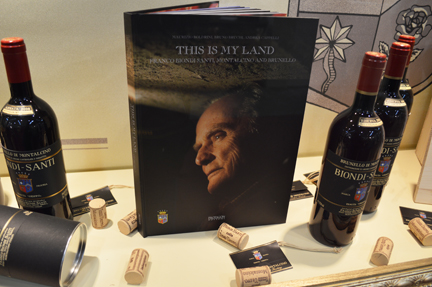
franco biondi santi

Above: Brunello patriarch and patrician Franco Biondi-Santi died in early April 2013.

I worked as the media director at Esposito’s Italian Wine Merchants in Manhattan when it was still co-owned by celebrity chef Mario Batali and celebrity restaurateur Joe Bastianich, who pulled no punches in his brutal account of their business dealings.

In my view of the Italian wine world, the acquisition marks yet another milestone in the big-businessization of Italian wine.

Is that a good thing?

In the New Testament “Parable of the Talents,” the master praises his servants for investing well. No one can fault Esposito and his group of investment bankers for wanting to augment their business and increase their earnings.

But the moment a bottle of wine — the fruit of the vine — becomes a “blue chip,” it ceases to be an expression of a place and of the persons who tended that vine. It’s no longer the child of tradition and culture but a mere object to be traded among the world’s elite.

It’s the ultimate reification of agriculture. And the moment that we forget where that bottle comes from, we lose sight of the humanity that produced it. In that estrangement, we lose sight of ourselves.

eddy murphy trading places

Image via The Escapist.

What it means to be a Texan & remembering Melvin on Memorial Day

melvin croaker

Above: Melvin (above, right) taught me a lot about what it means to be a Texan.

Especially when I revisit the North American coasts where I used to reside, friends often ask me, so how do you like living in Texas?

When I tell them that I love living here, they sometimes respond with skepticism.

But you live in Austin! I love Austin. But that’s not really Texas.

To that, I answer quoting my cousin Jonathan Levy, a professor at Princeton and a native Houstonian.

“What a lot of people don’t realize,” he likes to say, “is that a lot of what they like about Austin is actually Texan.”

Great music? Texan.*

Barbecue? Texan.

Tex Mex? Texan.

Politeness, dignity, consideration, and humanity in personal interaction? Texan.

Continue reading

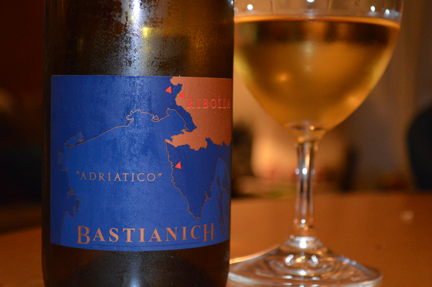
Ribolla just plain Ribolla & cafeteria penne al pomodoro

bastianich adriatico

My goodness! Tracie P and I have almost four cases of wine stacked up in our samples corner!

That’s not a bad thing: I’m always game to taste wines I’m unfamiliar with and always geeked to taste new vintages of wines that I know and follow.

Luckily for us, the Texas summer is already here and it’s too hot to ship wine. And we have plenty of bottles that I need to sort through and taste in coming months.

The other night we opened the Bastianich Adriatico Ribolla, sent to us by my friend Wayne who works as the Bastianich “special ops” man in Friuli.

Continue reading

White asparagus penne & @CanteleWines Negroamaro Rosato

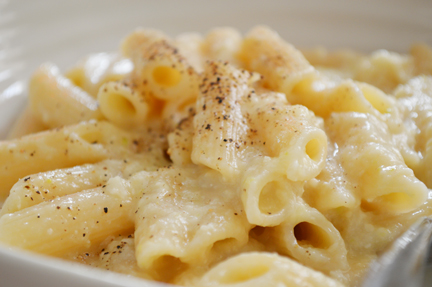
penne white asparagus

Now that we’re rolling into the last few months of our second pregnancy, I’ve begun cooking dinner nearly every night so that Tracie P can rest at the end of her day.

The star of last night’s dinner was penne with white asparagus (above).

I peeled, trimmed, washed, and steamed a bunch of beautiful white asparagus until tender and then puréed the stalks and tips with about a quarter cup of white wine (I added the wine while the asparagus was still piping hot so that the alcohol would evaporate).

Then I folded in some freshly grated Parmigiano Reggiano and an eighth of a cup of milk.

Before folding in the Rustichella d’Abruzzo (our house brand) penne, I added some of the pasta’s cooking water to the purée.

As Tracie P likes to say, one of the greatest feelings in the world is when your daughter enjoys eating something you cooked for her. Georgia P INHALED it. :)

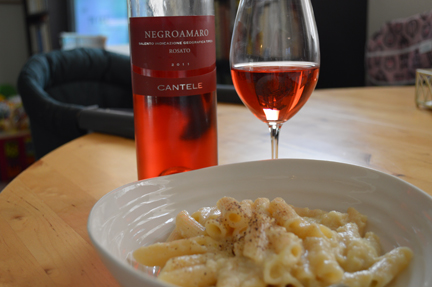
best negroamaro rosato

Tracie P (who has a glass of wine a couple nights a week) and I paired with one of our all-time favorite Apulian wines, our good friend and client Paolo Cantele’s 2011 Rosato from Negroamaro.

The wine had actually been open since the night before but hadn’t lost any of its freshness or zing. And its balance of delicate tannin and fruit was a superb complement the sweet asparagus and salty Parmgiano Reggiano.

If I do say so myself, it couldn’t have been a better pairing.

Paolo and became fast friends back in 2009 when we first met and I’ve been giving him and his family a hand with their English-language media for about two years now.

This year, we launched a new blog devoted to their presence in the U.S. market, CanteleUSA.com.

Check out my post today for their blog on “Why Italians drink more rosé than you’d think”.

Baby P 2013 update (seven weeks to go)

tracie eight months pregnant

We’re almost there… just another seven weeks or so to go until Baby P 2013 comes into this world. She’s been so active in Tracie P’s belly that sometimes we feel like she’s already here!

I’m certainly not the one who does the heavy lifting at our house these days: Tracie P is such a great mother and a mother-to-be (again), diligently regulating her diet so that she can maximize nutrition in these last months when it becomes challenging for expecting mothers to consume all the calories she needs.

In seven weeks or so, the world is going to change for little Georgia P, now seventeen months old. She really doesn’t know what’s about to happen but she loves to kiss and blow raspberries on her mommy’s pancione.

After my trip to NYC a few weeks ago, I’m officially grounded for the duration and it’s been wonderful to take over more of the shopping and cooking duties (and it’s SO great not to have to travel).

We’re so excited for Georgia P to have a little sister but we’ve also been enjoying these last months as a family of three, with our lives centered on a precious, beautiful, sweet little girl, who’s always ready to share a kiss, a hug, and a smile.

They are my tender grapes. And as tough as it can be to get up at 3 a.m. to change a diaper or soothe a teething toddler, my life has never been so rich… I love them so much…

Thanks to everyone for the notes of support and the thoughts and wishes! They mean so much to us. Thanks for sharing our joy…

Rufina as spoken by Federico Giuntini A. Masseti

The latest installment of the ongoing Italian Grape Name and Appellation Pronunciation Project.

One of the greatest lacunae of the Italian Grape Name and Appellation Pronunciation Project has been the appellation name Rufina, pronounced ROO-fee-nah, with stress on the first syllable.

It’s a tough one for non-Italophones in part because they are accustomed to the stress falling the penultimate (as opposed to antepenultimate) syllable of most Italian words.

But it’s also challenging because many confuse it with the Chianti Classico producer Ruffino (roof-FEE-noh).

While there are a handful of Chianti Classico producers that I follow and collect, I believe that the greatest Chianti comes from the village of Rufina, where higher altitudes make for greater acidity and freshness in the wines. If you ever get a chance to visit the village, you’ll see how your ears pop as you drive up the winding road that leads to its center.

At this year’s Vinitaly, I asked Federico Giuntini A. Masseti, a Rufina native and managing director at one of my all-time favorite producers, Selvapiana, to pronounce Rufina for my camera.

Check out this excellent profile of the winery from the Dalla Terra website.

And please click here to view my thread of posts devoted to this special winery, one of Italy’s gifts to the world.

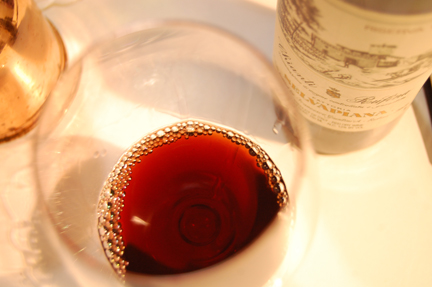
selvapiana 93

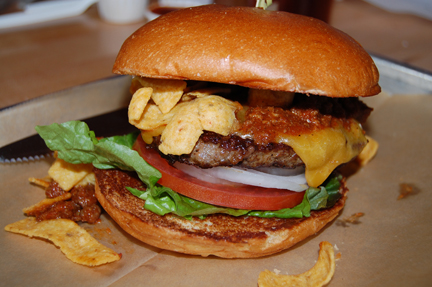
frito pie burger @HopDoddy #ATX #PregnancyCravings

From the department of “daddy is allowed to have pregnancy cravings too”…

frito pie hamburger

The frito pie burger at HopDoddy “burger bar” in Austin, Texas. Super fun stuff…

Thoughts & prayers for Oklahoma sisters & brothers

The news of the Oklahoma tornado weighed heavily on Tracie P and me last night as we made dinner for Georgia P.

Our thoughts and prayers are for our Oklahoma sisters and brothers today…

Solaris: disease-resistant hybrids make waves in Italy @CorriereDiVini @terrauomocielo

werner mornadell

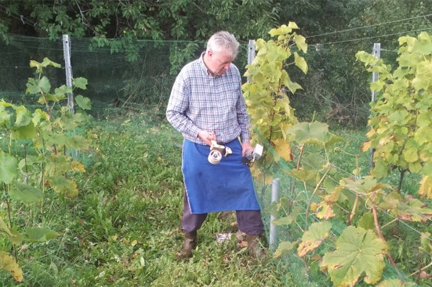
Above: Werner Morandell netting his vineyards in the Mendel Pass (image via his Facebook).

As Giovanni notes today on his excellent blog Terra Uomo Cielo, this is the time of year when grape growers treat their vineyards with sulfur and copper to reduce the risk of fungal diseases, chiefly oidium and perenospora.

At the sound of the tractors’ motors revving up on their way to the vineyard, he is reminded that “not only do the products used to safeguard the fruit pollute. So does the movement of the tractors” belching out diesel aromas more offensive to Giovanni, he writes, than the smell of the sulfur.

There is at least one grape grower in Italy who believes he has found a chemical-free solution to fungal disease: Werner Monrandell (above), winemaker in German-speaking South Tyrol, where his “super-organic” vineyards have no need of sulfur or copper treatments thanks to disease-resistant hybrids he has been developing since 1993, Solaris and Bronner.

The latter is named after the researcher who developed it. The former, evidently, after the 1961 novel and 1972 film.

According to a post by Corriere della Sera wine writer Luciano Ferraro, published on Saturday, the dried-grape Bronner is already available for sale in Italy and the Solaris, while not commercially available, has been offered to Italian sommeliers and viticultural research institutes where it is being studied.

Morandell is one of roughly fifteen grape growers, mostly from Trentino-Alto Adige but also Piedmont and Veneto, who are working together on this project.

“Every year in Europe,” say Morandell in an interview with Luciano, “72,000 tonnes of poison (pesticides, fungicides, insecticides, herbicides, etc.) are scattered on the fruit crop. Roughly 70% of those are employed in viticulture and they leave a residue on the grapes. It’s time to stop this [practice] because it’s possible to make fabulous wines even without chemical treatments to combat oidium and peronospora.”

Some winemakers remain skeptical, like Giovanni, who recently became a grape grower himself.

“I wonder if Solaris will have the same results if it’s planted elsewhere,” he writes.