
I’ve just learned via Intravino that pioneering natural winemaker Stanko Radikon has died. Our thoughts and prayers go out to his family. His work in the vineyard and cellar shaped and informed a generation of winemakers.
Upcoming tastings and events (and a photo of Roger Waters!)
From the department of “daddy’s got to pay the bills” or “nice work if you can get it”…
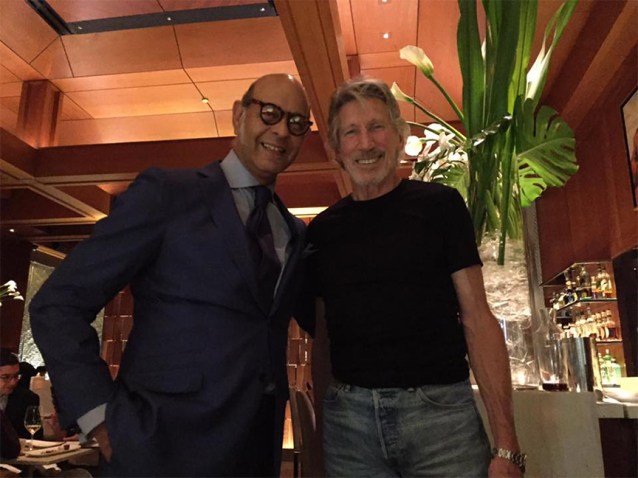 Above: my good friend and client Dino Tantawi and his buddy Roger Waters in New York City (image via the Vignaioli Facebook).
Monday, September 12 – Nostrana, Portland (Oregon)
The lovely folks at Nostrana in Portland have put together a fabulous Franciacorta-inspired and informed tasting menu to follow our Franciacorta Real Story tasting on Monday. It’s $95 per person including wine pairings and it features their famous prawn ravioli (sounds awesome if you ask me).
“Everyone needs to drink more sparkling wine,” they wrote in their newsletter yesterday. “As devoted Italophiles, we suggest Franciacorta.”
I can’t wait to check out their restaurant. They are some of the nicest and coolest people I’ve ever dealt with in our business. Please join me if you’re in town on Monday. I’ll be pouring and chatting with guests all evening. And my walk-around tasting starts at 6 p.m. (free).
Tuesday, September 13 – Vignaioli Selection, New York City
My good friend and client Dino Tantawi (pictured above with his buddy — no joke — Roger Waters) is holding his 17th annual portfolio tasting at Cork Buzz.
I’m not going to be there but if you happen to be in town, I highly recommend it to you.
I knew Dino way-back-when he founded his importing company Vignaioli Selection in 1999 and I had already been living in the city for a few years.
Dino is the coolest cat and his book includes so many iconic Italian wines as well as Italian hometown favorites like Hilberg Pasquero (Piedmont) who have yet to be discovered by greater America.
I’ve been blogging for Dino since the spring of this year and I just love working with him. Shine on you crazy diamond!
Wednesday, October 5 – Ciao Bello, Houston
My friend and client Tony Vallone will be hosting the next event in his Italian Regional Italian Cuisine series, featuring Maremma this time around.
I’ll never forget the first time I had lunch with Tony and cousin uncle Marty nearly 7 years ago and Tony quizzed me on my knowledge of Italian cuisine by serving me classic dishes and asking me to identify and describe them.
One of the dishes was gnudi, the “naked” Tuscan ravioli that they serve along the coast there.
I haven’t seen the final menu but I know it will be a show-stopper. I’ll be there talking about the wines and visiting with guests. Please join us if you are in town ($95 with generously poured wine pairings).
Monday, October 17 – Franciacorta Real Story, Las Vegas
I’ll be holding the second-to-last tasting in my Franciacorta Real Story campaign (now in its second year) at Ferraro’s in Las Vegas.
My work with the Franciacorta Consortium has taken me across the U.S. over the last two years and it’s been an amazing experience connecting with all kinds of different wine lovers and watching them discover Franciacorta and its wines.
Thanks again to the incomparable Jaime Smith for connecting me with Gino Ferraro!
Thursday, October 20 – Sunday, October 23 – Boulder Burgundy Festival
I’ll be attending and blogging from the 6th annual Boulder Burgundy Festival (image below via the BBF blog), hosted by the Boulder Wine Merchant and festival founder Brett Zimmerman MS.
This year’s featured guests are Jancis Robinson MW and Étienne de Montille. And as in years past, top sommeliers from all over the country will be flying in to pour and mingle.
I’m really looking forward to it and hope you can join me…
Buon weekend a tutti! Have a great weekend, everyone!

Breaking news: Nebbiolo power brokers agree to create Piemonte Nebbiolo DOC
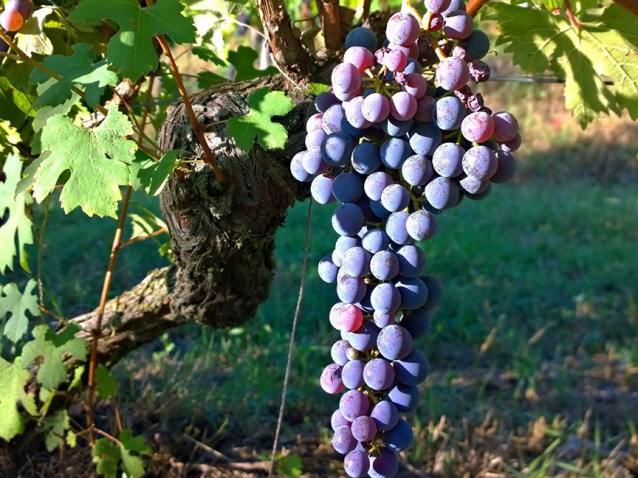 Above: Nebbiolo grapes ripening this week in an appellation that lies outside the hallowed Langhe Hills. If approved, new Piedmont appellation regulations would allow growers across the region to label their Nebbiolo as “Piemonte Nebbiolo DOC.” Currently, only growers in select townships can use the grape name in labeling.
According to a person familiar with their discussions, the Barolo-Barbaresco-Alba-Langhe-Dogliani Consortium and the Barbera d’Asti-Wines of Monferrato Consortium have agreed this week to move forward with the creation of a Piemonte Nebbiolo DOC.
The person spoke on condition of anonymity because details of the agreement have not yet been made public.
After the Asti-Monferrato Consortium circulated proposed language for a new Piemonte Nebbiolo DOC among its members in August, vice presidents of the Barolo-Barbaresco-Alba-Langhe-Dogliani Consortium Pietro Ratti and Aldo Vacca publicly shared their opposition.
“It’s obvious that the big producers have caught a whiff of a good bargain,” said Vacca in an interview published in La Stampa on August 24. “But if the goal is that of releasing great quantities of low-priced wines into the market, we run the risk of compromising the entire of balance of Nebbiolo” produced in Piedmont.
Current Barolo-Barbaresco-Alba-Langhe-Dogliani Consortium president Orlando Pecchenino and his predecessor Pietro Ratti had to concede their efforts to block creation of the new DOC had no foundation, said the person familiar with their discussions.
When the proposed language for the new DOC became public last month, many industry observers, including leading Italian wine writers, predicted that a Piemonte Nebbiolo DOC would cloud consumers’ perceptions of Nebbiolo. They fear that its creation could lead to overly aggressive expansion of Nebbiolo plantings in the region and subsequent degradation of the Nebbiolo “brand.”
Such an appellation “is simply unacceptable and depressing for a grape variety like Nebbiolo,” wrote Slow Wine Guide editor Giarcarlo Gariglio.
Other trade observers pointed out that the proposed language mirrored existing appellation regulations that already allow certain Piemonte DOC growers to write Nebbiolo on the labels of their wines even though they use grapes from vineyards outside the hallowed Langhe Hills, considered by many to be Nebbiolo’s spiritual home.
Others contended that a grape variety and its name cannot be claimed exclusively by a single appellation or group of associated appellations.
“International law does not allow for the simple name of a cultivar to be reserved and protected by an exclusive geographic designation,” wrote legal expert and professor Michele Antonio Fino, director of the Master in Italian Wine Culture at the University of Gastronomic Sciences in Pollenzo (Piedmont).
Portland tasting Monday 9/12 expands to include dinner menu pairings
 I mean, just look at this photo I lifted from the Nostrana Facebook this afternoon! What Italian enogastronome wouldn’t want to go to that restaurant???!!!
That dude is wearing a t-shirt that says “I heart Teroldego!”
I love it!
Response to our Monday, September 12 Franciacorta Real Tasting at Nostrana in Portland, Oregon has been so robust that the lovely folks at the restaurant have decided to create a micro-pairing menu for guests who dine with them that evening. A handful of the wines I’ll be pouring will be available by-the-glass and I’ll be visiting with guests throughout dinner service. Details to follow.
The 6:00 p.m. tasting is looking pretty full at this point. So if we can’t fit you in then, please come for dinner following and let’s taste together!
Franciacorta Real Story Tasting
Nostrana
on the patio
FREE
Monday, September 12
6:00 p.m.
1401 SE Morrison St.
Portland OR 97214
(503) 234-2427
Google map
Ron Washam’s satyr: sexuality, satire, and self-projection in 21st-century wine blogging
From the department of ostentatio genitalium… id est, NSFW…
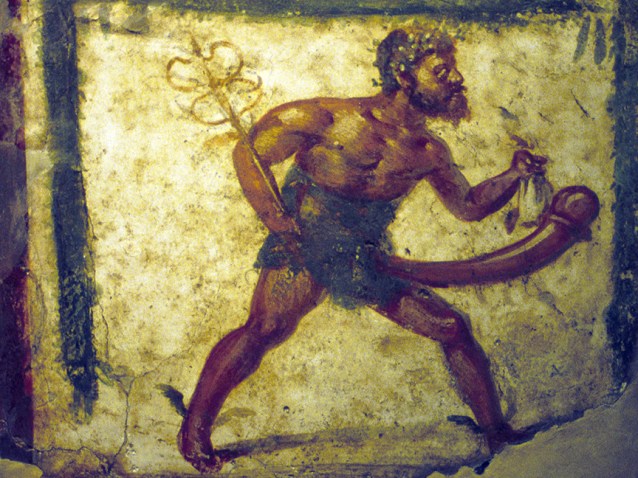 Above: an ithyphallic satyr as depicted in a Roman mosaic in Naples (image via Tyler Bell’s Flickr Creative Commons).
Ithyphallophobia or ithyphallophilia? It’s hard to put your finger on it. Before you can, you have to get it up.
It’s only natural that the Hosemaster of Wine would resort to puerile sexual violence in a pseudo-satire of Alice Feiring, his debut piece for Robert Parkerization, Jr.’s venerated Wine Advocate. It’s behind a paywall that keeps “free for all,” I’ve been told, even the hoi polloi out. Read it if you must. Just be sure to don a doily doused in eau de toilette.
And it’s only logical that he would have no better arrow from his quill to loose… or to release, as it were.
As he wrote in his peppy post announcing his new brave collaboration, “nothing is more deadly to a satirist than becoming part of the establishment.” In the wake of Washam’s self-castration and the fulfillment of his Oedipal reversal, the now blinded however once beloved satirist now found himself in a conundrum: whom to attack when the platform whence he casts his missiles is that of the king?
Pietro Aretino, arguably the greatest of all satirists, self-fashioned himself the flagellum prinicipi (literally the flagellator [the scourge] of princes, for those like Washam who arrived tardy to Latin class). And as the whipper of kings taught us, satire has no balls (pardon the pun) when it resides in rich men’s halls. By virtue of its very nature, its vice is that used to squeeze the powerful and lustful, not the meek and just.
He’s parodied Alice, her writing, and advocacy before (5 or 6 times now? I’ve lost count). But when those feathers were launched from his Heraldsburg treehouse, they were lithe “as vines among the trees.” Today, they are as lugubrious as the masthead from which they were cast.
I can’t say that I was a follower or lover of his writing in the past. But respect and honor were due to the man for the outsider role of flagellator that he played so well in the enoblogosphere. I mean that most sincerely.
To attack Alice from Parker’s mansion on the hill, with crude sexual innuendo no less, is by no hand of a man. It’s from the palm of a puer.
Below: caps off to you, Ron! Cheers! It’s all in good pun… (image via Wikipedia Commons).
On Charlie Hebdo’s tasteless satire of the Amatriciana for Amatrice campaign
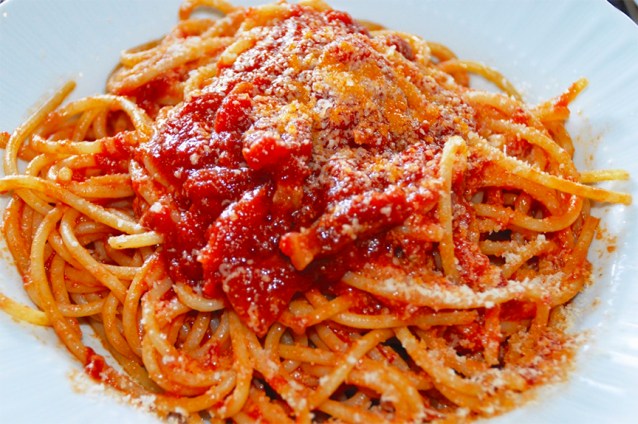 Above: a photograph of a dish of Amatriciana via the popular Rome-based food blog Puntarella Rossa. See its editors’ post (in Italian) for just a partial list of the many Italian restaurateurs and food producers who are raising money for victims of the August 24 earthquake in central Italy.
Across Italy, across the U.S., and even across France, restaurateurs are raising money for victims of the August 24 earthquake in central Italy by donating proceeds from every dish of Amatriciana served (see the Austin American-Statesman coverage of Austinite participation). The township of Amatrice was one of the hardest hit and its world-famous dish has become a rallying cry for relief efforts.
Late last week and over the weekend, after the French weekly magazine Charlie Hebdo published a satire of the grassroots Amatriciana for Amatrice campaign, a lot of friends and readers have asked me about the cartoon in question (you can view it here).
Beyond the natural indignation, more than one person revealed that she/he didn’t fully understand the quote-unquote humor in it.
“Earthquake Italian style,” reads the top caption. A reference to the many “Italian style” comic films of the 1960s and 70s (like “Divorce Italian Style”).
Below the leading caption, there are three figures, each with their own caption.
The first is a bloodied man. “Penne with tomato sauce,” reads the caption.
The second is a woman who appears to be burned, with her hair standing up as if it had been singed. “Baked penne,” reads the caption.
The last image depicts earthquake victims and crumbled buildings layered on one another. “Lasagne.”
The cartoon plays to commonplace French attitudes that France’s transalpine cousins are rustics and that their cuisine is unsophisticated.
For insight into why the editors would publish such an atrocious send-up, I reached out to one of my dearest friends, a Parisian woman who went to high school with the daughter of one of the higher-profile contributors to the magazine.
The magazine’s readership is very small, she told me. “We only ever pay attention to it when they make fun of something we really care about,” she said.
“And they make fun of everyone,” she noted, emphasizing everyone.
It’s not hard to imagine how Italians have reacted to the caricature. Over the weekend, I read countless news reports and social media posts by writers and social media users who expressed their dismay.
I wrote to a good friend in Italy who pointed me to a Facebook post by journalist and television executive Enrico Mentana, who wrote (translation mine):
- I’m sorry but this is what Charlie Hebdo is! When you said “Je suis Charlie,” you were expressing solidarity with people who have always published similar cartoons. They have profaned everything and everyone. The caricatures of Mohammed had the same effect on most Muslims that the cartoon about the earthquake has provoked in us. It was forty years ago that [Charlie Hebdo contributor Georges] Wolinski, one of the victims of the January 2015 terrorist attack, taught his Italian colleagues that satire could be ugly, dirty, and mean. Should we break off our relations with France after we marched in their defense? All we need to do is to say that it disgusts us. And we should do so without being self-righteous.
The vignette may be tasteless. But the dish is as tasty as ever.
Here’s a link to my post on different channels for donating to relief efforts.
Taste with me: Portland (9/12), Las Vegas (10/17), Atlanta (November TBD)
Happy end of summer, everyone! Please come out and taste with me this fall!
 My Franciacorta Real Story Tour 2016 is winding down with three events in three different cities, each a wine destination in its own right.
The response to my events over the last 18 months has been nothing short of wonderful. But no city has responded with as much gusto as Portland, Oregon, a city believed by many tradesfolk to be the number-one destination for Italian wine in the U.S.
Heartfelt thanks to the lovely people at Nostrana for making this happen (Monday, September 12) and please stay tuned for updates on Las Vegas (October 17) and Atlanta (November, date to be determined).
A note to distributors and suppliers: please feel free to contact me if you’d to show your Franciacorta wines at any of my tastings. As long as the producer is an active consortium member (nearly all those imported to the U.S. are) and is a participant in the CMO promotion for north American, I would love to show the wines. The more the merrier!
RSVP is not required but encouraged so we can get a headcount. Please email me at jparzen@gmail.com to let me know you’ll be joining us. Thanks!
Franciacorta Real Story Tasting
Nostrana
on the patio
FREE
Monday, September 12
6:00 p.m.
1401 SE Morrison St.
Portland OR 97214
(503) 234-2427
Google map
Image via GoodFreePhotos.
Is Nebbiolo the new Pinot Grigio? Two controversial proposals for new Italian appellation rules
 Above: Nebbiolo grapes in Piedmont.
Italian wine writers and bloggers have been up in arms this week and last over two controversial proposals for major changes in appellation rules.
The first, which is to be voted on today by growers, is the creation of a new Pinot Grigio delle Venezie DOC modeled after the current Delle Venezie IGT, which includes wines grown in regions of Friuli-Venezia Giulia, Veneto, and Trentino-Alto Adige.
If approved, the new appellation would allow growers to produce Pinot Grigio with yields of up to 21.6 metric tons per hectare “in good vintages.” That’s more than 9.6 U.S. tons per acre, a high yield by any measure. (To put this figure in perspective, “the U.S. has one of the highest national average yields, at 6.5 tons/acre,” according to the Oxford Companion to Wine.)
“Before [the creation of] this new appellation that applies to all three regions,” said Luciano Moretto, president of the Pramaggiore Wine Exhibition, earlier this year, “every region had its own [Pinot Grigio]. This will change everything. With this single mode of production, we can really take off in certain markets. I’m thinking of the United States, Russia, and China, nations where we need to compete with many behemoth producers and where counterfeits cause damage to us. This will be a source of considerable profit.”
In an op-ed published on Friday, the editors of the Slow Wine Guide wrote: “Who is the winner in this case? Industrial agriculture: producers of chemical fertilizers, fungicides, herbicides, etc. Because [with the creation of this DOC] vineyards will be transformed into assembly lines, where everything is pumped and everything needs to be perfectly clean, without even the smallest trace of disease.”
Today’s vote comes on the heels of another controversial proposal for changes in the Piemonte DOC. In a draft of new appellation rules circulated this month among members of the Asti Monferrato Consortium, the authors call for the creation of a Piemonte Nebbiolo DOC that would give growers greater freedom in using the word Nebbiolo in labeling wines grown across the region (and not just in Langhe and Roero).
If approved, these would include, among other categories: wines made from only 85 percent Nebbiolo grapes; rosé from Nebbiolo; and even sweet and sparkling wines. (Source: Slow Wine.)
Piedmont’s Regional Commission will consider the proposed changes in an assembly in September.
Pointing to the creation of the Prosecco DOC in 2009, some industry observers fear that the creation of a Piemonte Nebbiolo DOC as proposed by the Asti Monferrato Consortium would lead to overly aggressive expansion of Nebbiolo plantings in the region and subsequent degradation of the Nebbiolo “brand.”
“We oppose this request,” said Produttori del Barbaresco cooperative director Aldo Vacca in an interview published by La Stampa last week. “Langhe Nebbiolo is the appellation that has seen the biggest growth in the entire region. It’s obvious that the big producers have caught a whiff of a good bargain. But if the goal is that of releasing great quantities of low-priced wines into the market, we run the risk of compromising the entire of balance of Nebbiolo” produced in Piedmont.
His concern was echoed by that of Pietro Ratti of Renato Ratti, a legacy producer of Barolo.
“Nobody wants to stop people from growing a successful variety like Nebbiolo,” he told La Stampa, “But it’s one thing to plant a grape variety and another to manage an appellation. Today, there’s no denying that the Piemonte appellation represents a second-tier category while Nebbiolo is a first-class wine. It’s a delicate issue because it affects the economy, the region, and consumer perceptions.”
The power of food as history and memory…
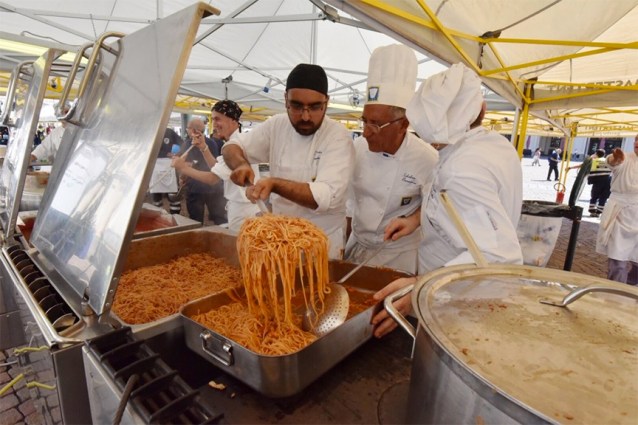 Above: over the weekend in Turin, 7,000 servings of Amatriciana raised nearly €50,000 for victims of last week’s earthquake in central Italy (image via the popular Italian food blog Scatti di Gusto).
A couple of Italian food blogs (here and here) have posted about celebrity chef Antonino Cannavacciuolo’s op-ed on the front page of La Repubblica today.
There’s no link available online to non-subscribers but I wanted to post an excerpted translation of the piece. Like my Italian colleagues, I was moved by Cannavacciuolo’s take on the power of food and the way Amatriciana has become a symbol of recovery and hope in the wake of last week’s tragedy.
“Disasters destroy communities and they also destroy their symbols,” he wrote.
- They cause schools, hospitals, hotels, and churches to crumble. And once again, the earthquake that struck central Italy seems to have destroyed almost everything.
- But one symbol, however seemingly simple, has been spared: food.
- Today, Amatriciana, a dish that takes its name from one of the towns struck by the seismic event, sends a very powerful message.
- We all know that food is part of our daily lives. But it’s not just nourishment. It’s also history and memory.
- And that’s exactly what Amatriciana is: a simple dish of the people that carries forward the history of those who created it and the traditions of an ancient rural cuisine.
I was also really moved by my friend (and neo-Houstonian) Jeff Kralik’s post today, “Headed to Italy with a Heavy Heart.”
Before he left for a trip to Italy yesterday, he made his family an Amatriciana, which his sons devoured “with aplomb.”
Jeff’s planning to give blood during his stay.
As banal as it may sound to some, the legacy of a place and people lives on through an otherwise simple dish made from the humblest of ingredients. It’s the power of food as history and memory to inspire us…
Amatriciana for Amatrice: Slow Food founder calls for restaurateurs and diners across the world to support Amatrice in year-long campaign
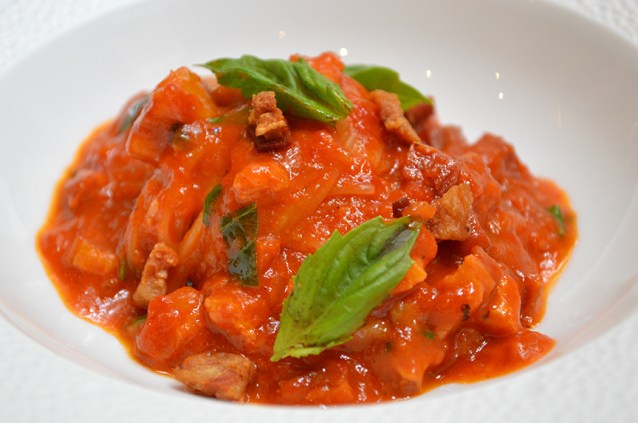 Above: my friend and client Tony Vallone’s Amatriciana here in Houston.
In Italy yesterday, Slow Food founder Carlo Petrini proposed that “every restaurant in the world” serve Amatriciana for the next 12 months and donate €2 for every dish served directly to the Amatrice municipal government (see bank info below).
The village of Amatrice (AH-mah-TREE-cheh), known for its production of salumi and its celebrated Pasta all’Amatriciana (ah-MAH-tree-CHEE’AH-nah, long noodles dressed with tomato sauce and sautéed guanciale, cured pig’s jowl), was virtually destroyed in this week’s devastating earthquake in central Italy.
Petrini’s proposal, “A Future for Amatrice,” is a long-term fundraising initiative intended to provide sustained aid to Amatrice and its residents even after the “emotional wave of the moment has passed,” he wrote in a statement released to mainstream and social media.
Here in Houston, my friend and client Tony Vallone was already a step ahead of Petrini: yesterday, he began setting aside $2 for every dish of Amatriciana he serves (above) to be donated to Italian Red Cross relief efforts.
Ammado is the official micro-donation for the Italian Red Cross: here’s the link to donate.
You can also donate through the Italy-America Chamber of Commerce Texas (another client of mine). The Chamber is taking donations through PayPal and will donate funds collected to Italian Government relief efforts.
And if you want to send money directly to the Amatrice municipal government, here’s the bank code provided by Petrini in his statement: IT28M0832773470000000006000.
The destruction of Amatrice and a string of picturesque hilltop villages in this week’s catastrophe is a tragic loss for the Italian people and the world at large.
See the op-ed published this week by political commentator Beppe Severgnini in the New York Times.
“And in the space of just one summer’s night,” he writes, “Amatrice is all but gone.”


