Taste with Alicia Lini and me Wednesday @VinologyHouston

It seems like a lifetime ago… It was back in 2006, while I was still living and working in New York, that I helped to bring Alicia Lini’s wonderful Lambrusco to the U.S.

I couldn’t be more thrilled to share the news that her family’s wines are FINALLY available in Texas.

She’s one of my best friends in the wine business and I’ve been giving her a hand as she expands her brand’s presence in the states.

On Wednesday night, she and I will be pouring three of her family’s wines at Vinology (one of my favorite wine bars) in Houston. Please join us.

In other news…

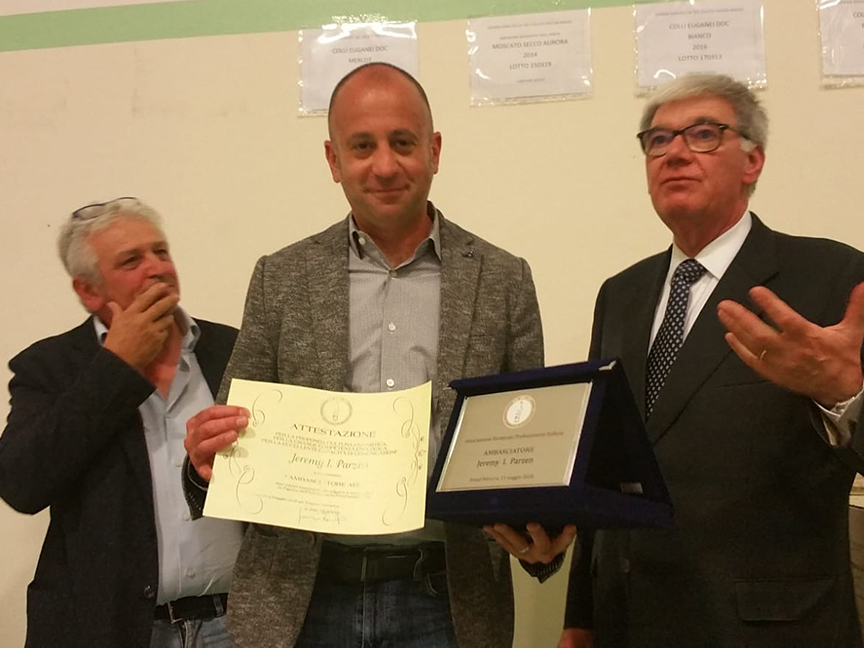
It’s enough to make a Jewish mother proud: last night the Italian Association of Wine Shop Professionals made me one of its official ambassadors. The title came as a complete surprise to me but it couldn’t have arrived in a more ideal setting — the Euganean Hills, my special place in Italy.

More on that later. But I’m about to head out for a very special evening in Milan with my dissertation advisor, the Milanese poet Luigi Ballerini. I’ve been looking forward to this evening for many months and there couldn’t be a better way to end this truly amazing trip to Italy…

Thanks for being here and hope to see you on Wednesday in Houston!

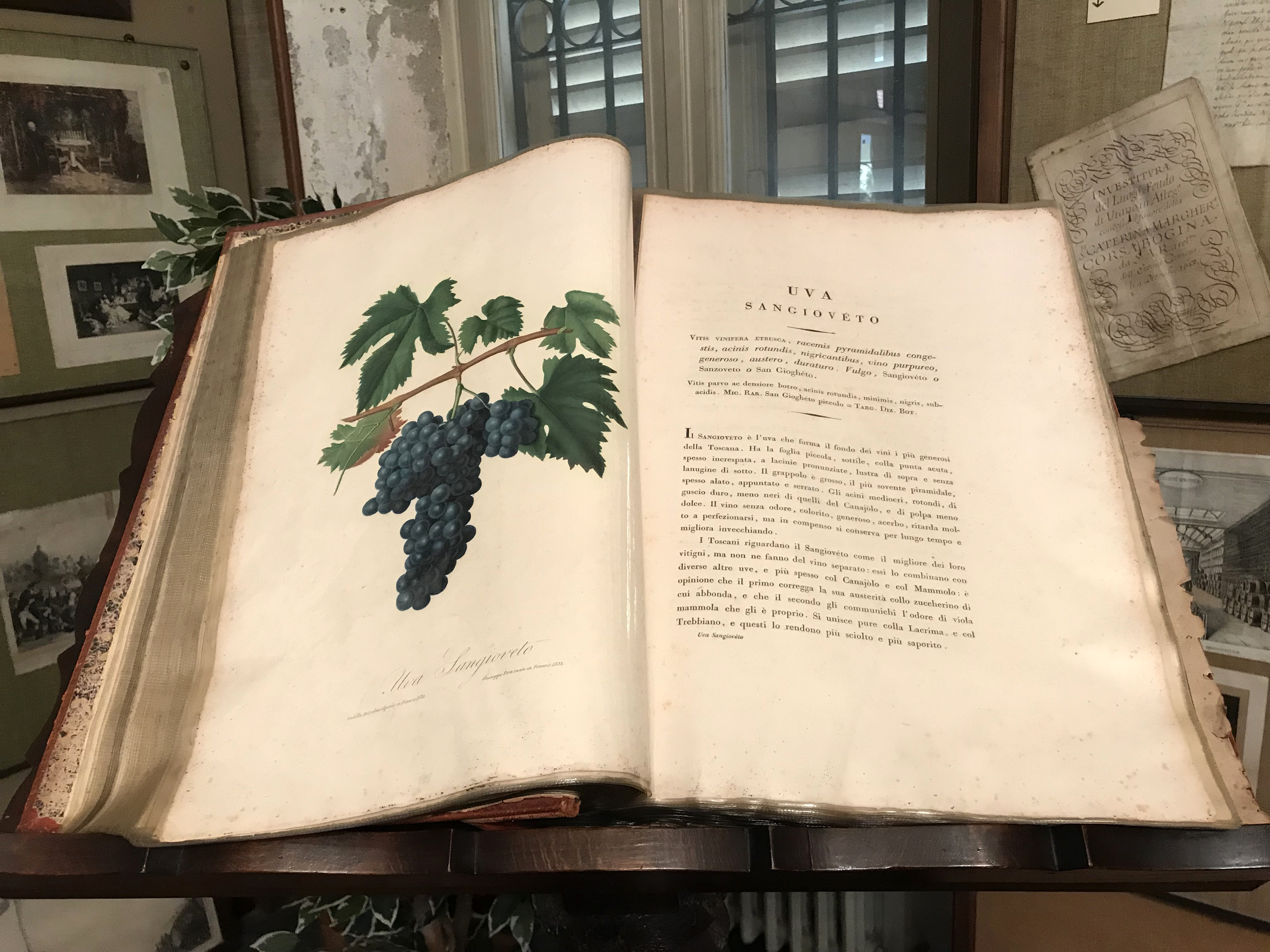
An editio princeps of Gallesio’s Pomona! Enough to make me swoon…

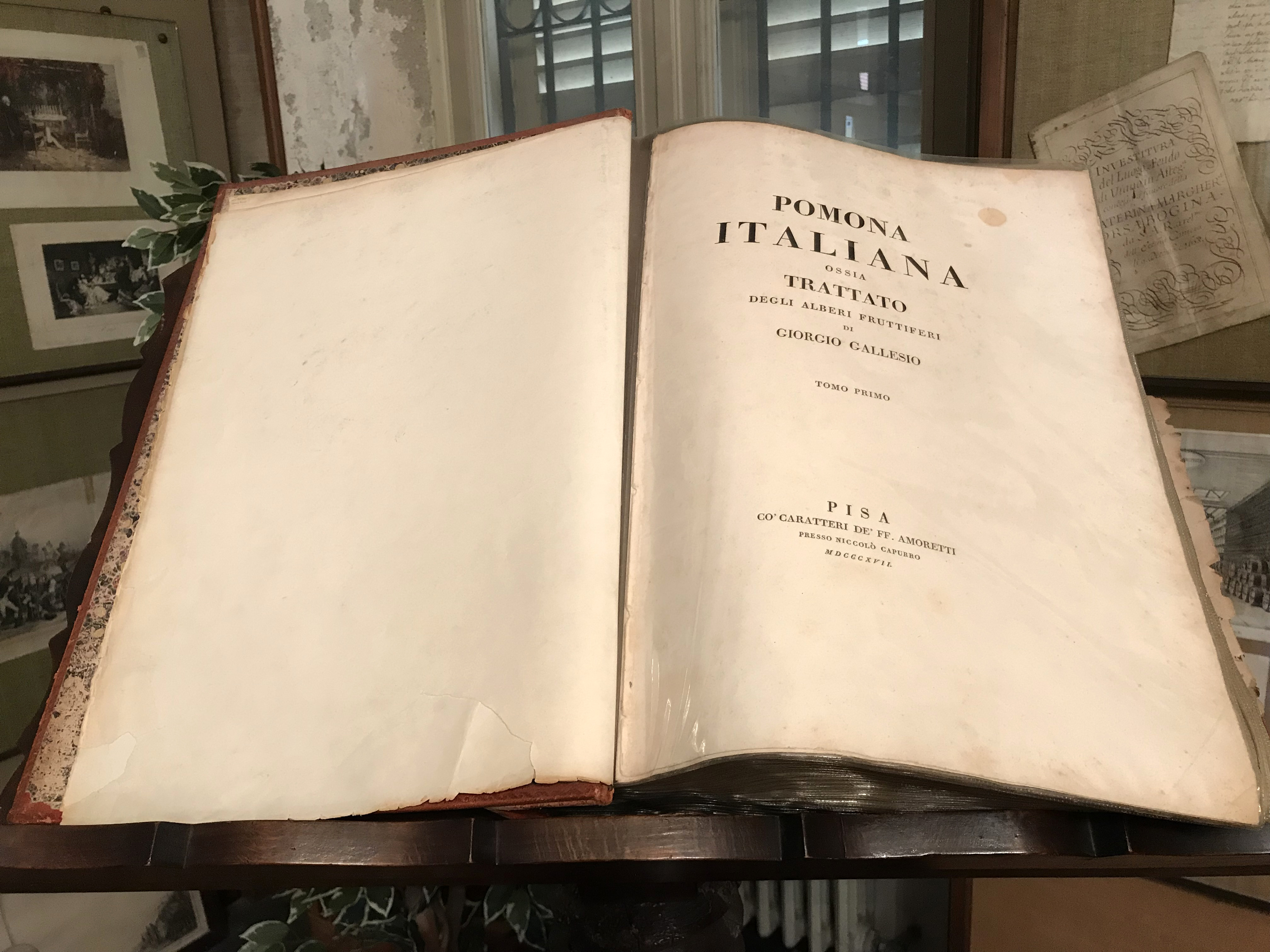
Between libraries in the U.S., England, and Italy, there are roughly 10 extant copies of the first volume of Giorgio Gallesio’s Pomona italiana (Italian Pomology), published in Pisa in 1817. There are another couple of copies to be found in German libraries, at least according to WorldCat.org (a go-to online bibliographic resource). Of course, there are also an unknown number of exemplars in private collections.

The landmark work of 19th-century botany is more properly known as Pomona italiana ossia trattato degli alberi fruttiferi contenente la descrizione delle migliori varietà dei frutti coltivati in Italia (Italian Pomology or Survey of [Treatise on] Fruit Trees, including descriptions of the best varieties of fruit grown in Italy), its complete title. And while the entry devoted to the fig tree is arguably the most famous and the most widely reproduced (including numerous modern reproductions and transcriptions), the volume devoted to grapes — the first in the series — is extremely rare.

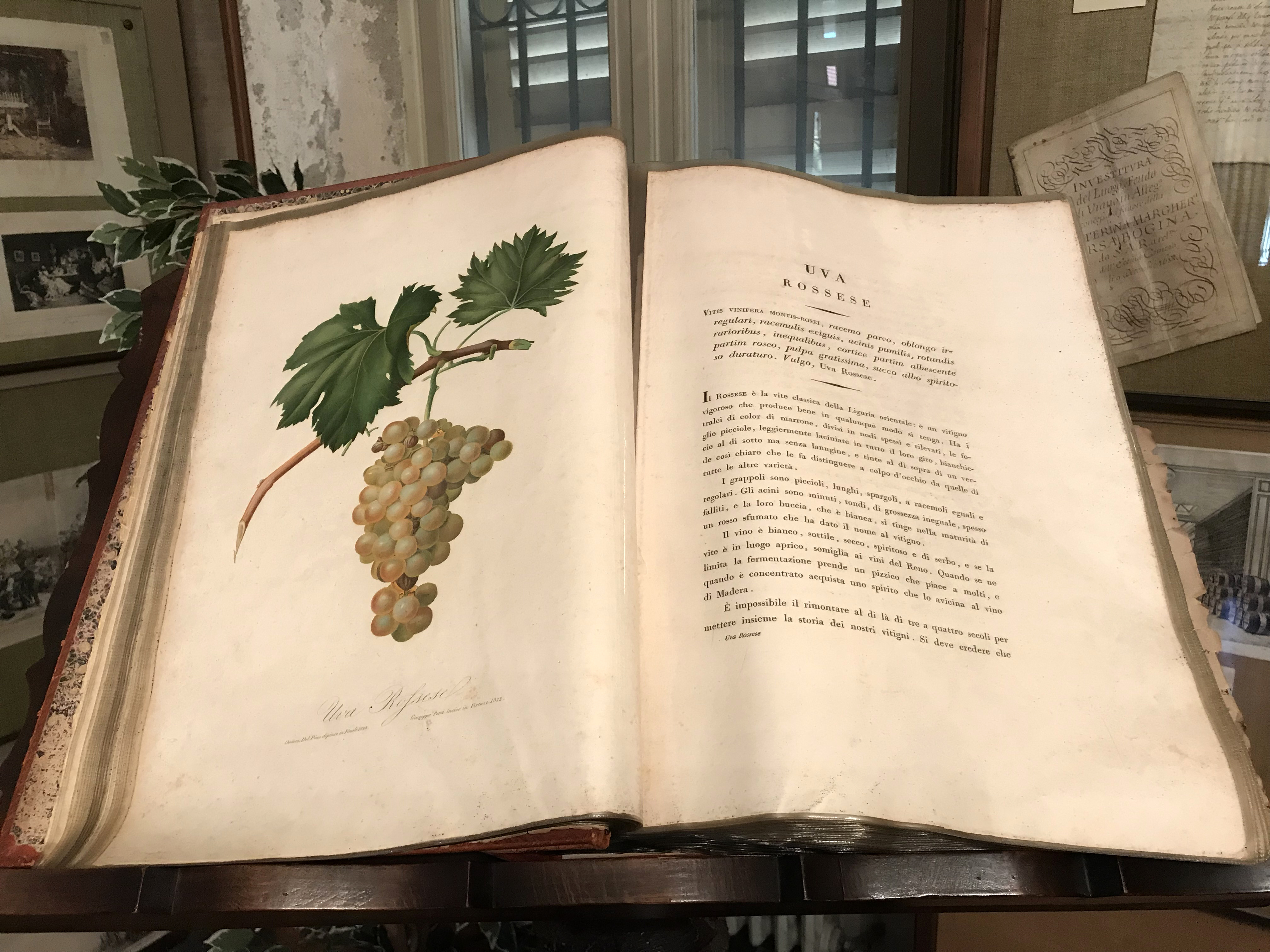
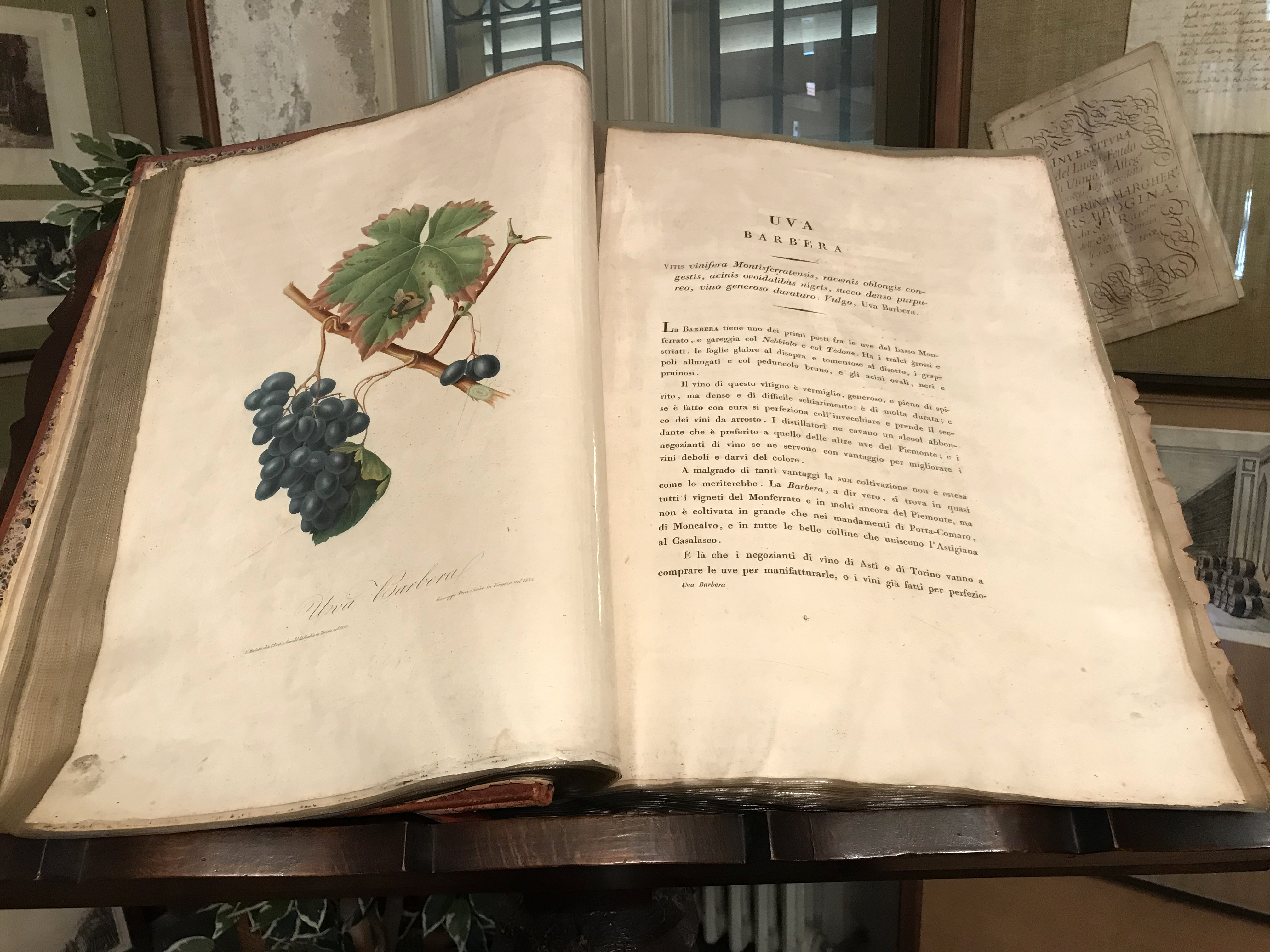
Earlier this week, thanks to my work with the Monferrato Growers Association, I had the immense pleasure of viewing a privately owned copy of the first volume at the Bersano winery museum in Nizza.

In other time in my life, I used to spend my days in dusty libraries in Italy, England, and New York, leafing through medieval manuscripts and early printed books. The Vatican, the Marciana (Venice), the Laurenziana (Florence), the Bishop’s Seminary in Padua, the Morgan (New York), the British Library (London, my favorite!), the Ahmanson-Murphy and the Getty (Los Angeles)… o man, those were some rich and happy days, when old old words, often hand-written, leapt off the page and spoke to me. I miss them.

Here are some shots from my all-too-short visit. Click images for high-resolution versions. Note the rare white Rossese, above!

Heartfelt thanks to the folks at the Monferrato consortium and at Bersano: sometimes a boy just gets lucky! I can’t wait to get back.

Brunellogate 10 years gone: Montalcino is stronger than ever

Above: Montalcino’s breathtaking beauty is rivaled only by its extraordinary confluence of culture, history, and tradition — and its enviable economic model.

When I translated this op-ed for Fattoria dei Barbi owner Stefano Cinelli Colombini this week (I manage and contribute to the estate’s blog), I couldn’t help but be blown away by the power of his observations (not to mention his wry humor).

“Wherever great wines are produced in Italy — Montalcino, Langhe, or Valpolicella — the same old litany of grievances [is] repeated again and again,” he observes.

“The show is over and all that’s left for us ‘locals’ to do is cry: Our villages aren’t what they used to be; a wine shop stands where you used to be able to buy underwear; everything is so expensive and you can’t even find a parking spot. We’ve sold our souls and our towns are filled with SUVs and the jerks who drive them.”

But he’d rather drive an extra mile or two for his underwear and zucchini, he writes:

    Our villages are wealthy and vibrant. And they offer many opportunities for our young people. Who are we to complain about not being able to find a good head of lettuce or a pair of underwear?
    A “real” community is a community that has developed its own social, economic, and cultural model for living… It’s a community that offers a sustainable future to its young people. And that’s what we are.

As he points out in the piece, rare are the communities where a natural disposition for fine wine growing is combined with robust culture, rich history, and deep-seated tradition. Montalcino, he notes, is one of those uncommon examples where a model for sustained prosperity has emerged thanks to a confluence of shared vision and viticultural inclination.

Such a community, he notes, “also needs to know how to preserve its identity and how to rise up again after a crisis. Because sooner or later, the other shoe will drop.”

As I read and translated that line, it occurred to me: 10 years have just passed since news of the “Brunello scandal” broke on the floor of Vinitaly, the annual Italian wine trade fair in Verona, in the spring of 2008.

Today, I can’t imagine an Italian wine industry observer who wouldn’t concur that Montalcino and perception of its wines among consumers and trade members are stronger than ever.

I recently launched a Brunello program at a restaurant where I consult in Los Angeles: after a string of highly rated vintages, it’s the only Italian wine “brand” that seems to sell itself. Our offering is arguably more esoteric than most of our competitors’ and few of our guests recognize the estates we carry. But that hasn’t hampered sales by any means. All it takes is the mention of “Brunello”… And in the three months since we debuted the selection, not one — not a single one — of the diners has mentioned the controversy.

“If I need to drive a couple of extra miles to buy some zucchini,” writes Stefano, “that’s fine with me. You can keep your radishes. I’ll take the Brunello instead.”

Sommelier, sommelier! I’ll have what he’s having!

Back on campus @UniSG and back in Barbera (debunking the “Louis Oudart” canard)

When professor Michele Fino, director of the master’s programs at the University of Gastronomic Sciences (the Slow Food university in Piedmont, above), asked me to deliver his department’s matricula lecture this term, I couldn’t have been more thrilled or honored.

This morning, I led the first of 12 three-hour seminars for the assembled group of master’s students: “Food writing from Maestro Martino to #MeToo: the arc of Marxist alienation in modern gastronomy.”

Needless to say, the first recipe we discussed was for pizza dough cinnamon rolls.

(Saturday marks the 200th anniversary of Marx’s birthday, btw.)

Teaching is always such a rewarding experience for me and we have an awesome group of genuinely motivated and thoroughly talented philomaths — a very international crowd this year. It’s a drag to be away from home but the students and our rich confabulations really make it worthwhile.

In other news…

My Name Is Barbera, a collaborative blog published by the Barbera d’Asti growers association, shared my most recent post for the group this morning: “When Barbera Saved the (Wine) World.”

The deeper I dig into my research into Barbera and its legacy, the more I realize that we would be (and should be) drinking Barbera today instead of Merlot… that is, had things played out differently. There’s no doubt in my mind: the grape variety was positioned to become the red grape of the world — par excellence.

I’ve discovered compelling evidence of its widespread popularity in the landmark Ampélographie universelle (1841) by Alexandre-Pierre Odart.

The French ampelographer (who existed) shouldn’t be confused with the canard Louis Oudart: despite the lack of any evidence whatsoever, many wine writers — Italian and American — continue to propagate the erroneous nugget that “Oudart” was summoned by Barolo grower Camillo Cavour (the noted Italian statesman and architect of Italy’s unification) because the latter hoped he would teach the Langhetti how to make proper wine.

Will the real Odart please stand up? He was much more interested in Barbera than in Nebbiolo.

Please check out my post: I think you’ll find my discoveries as fascinating as I do (and there’s a bottle of Barbera in it for anyone who can prove me wrong!).

In other other news…

I’m really loving Renaissance Woman: The Life of Vittoria Colonna (Farrar, Straus and Giroux, April 2018) by Ramie Targoff. I picked it up to read on the plane and haven’t been able to put it down.

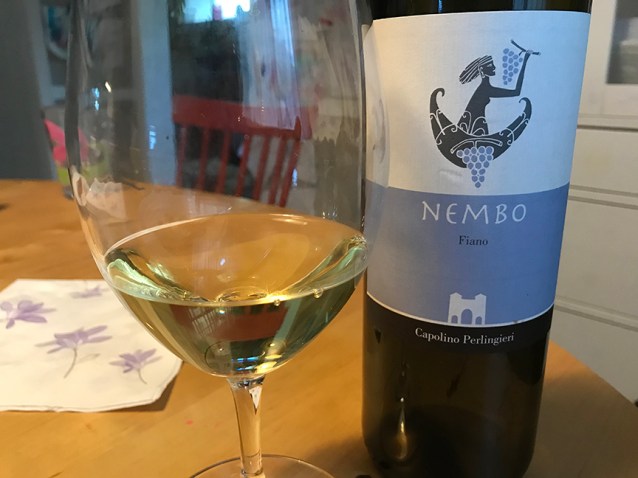
Fiano by Capolino Perlingieri, one of the best white wines from Italy anywhere I’ve tasted this year…

It may compromise my professional reputation to reveal that this extraordinary wine was paired with ketchup- and mustard-slathered Hebrew Nationals last night. But after the Parzen children had achieved a familial milestone yesterday, they had been promised “hot dog and fries” night. And a paternal promise is an inabrogable pledge.

Capolino Perlingieri wines from Sannio (Campania) first came to my attention six or so years ago in California where a couple of wine lists still bear my signature. The Falanghina was, hands down, one of the most compelling expressions of that grape variety available in the market at the time.

Today, it’s thrilling to see the wines finally land in Texas and exhilarating to see the gusto employed by local wine barkers in hawking them.

Weighing in at gorgeously balanced 12 percent alcohol, the 2013 Sannio Fiano Nembo — yes, 2013 — crooned like a Parthenopean soprano in my glass, with notes of melon and apple, a hint of gentle citrus, and a Freudian red thread of minerality that seems to run through all of this young wineries bottlings.

A warm volcanic thanks is owed to importer Oliver McCrum for bringing this wine to my home and adoptive states. Check out his excellent, thoughtful profile of the estate and its wines here.

In other news…

You may have noticed that things are little bit quiet on the Italic peninsula this week. That’s because Italians celebrated Liberation Day on Wednesday of this week and on Tuesday of next week they will observe International Workers’ Day. Between the two national holidays (and with many wine professionals exhausted by a flurry of trade fairs last week), many offices are closed for the septimal.

The former marks the day Italians cast off the abominable yoke of Fascism and Nazism. The latter was established by the historic Socialist and Communists parties of the world to champion the proletariat and a vision of world piece.

Mais où sont les neiges d’antan?

Slow Wine: Deborah Parker Wong named senior editor for California guide (2019)

The 2018 Slow Wine Guide to the Wines of California featured 70 producers. Next year’s edition will include twice that number.

As coverage of Californian wine expands, the editorial team is growing as well: I couldn’t be more thrilled to share the news that California wine writer and educator Deborah Parker Wong has been named Senior Editor for the 2019 guide.

About Deborah:

Veteran wine writer Deborah Parker Wong is Global Wine Editor for SOMM Journal, Tasting Panel and Clever Root magazines where she reports on the wine and spirits industries with an emphasis on trends. As a Wine & Spirit Education Trust Approved Program Provider she offers Level 2 and Level 3 WSET certifications to students in the United States and she teaches as an adjunct professor in the Wine Studies department at Santa Rosa Junior College. She is the co-author of 1000 Great Everyday Wines (Dorling Kindersley 2011). In addition to writing and speaking about wine, Deborah judges wine competitions and scores wine for Planet Grape Wine Review.

Related: Slow Wine: Michael Alberty named senior editor for new Oregon guide (2019).

Nerello Mascalese vinegar from Etna is sexy (but Ancellotta pudding from Emilia is sexier)

Another cool thing about this year’s Vinitaly was the expanded food component.

I spent most of my time at the fair tasting wines and meeting with winemakers and grape growers. But I also managed to break away and hit up the Sol&Agrifood pavilion where Italian producers where joined by counterparts from Morocco, Iran, Greece, and many other international entries.

One highlight was a vinegar made from a blend of Nerello Mascalese wine- and cooked-must vinegars by Romano, an Etna-based olive oil producer. Their oils were extraordinary as well. But the vinegar, produced for Romano by Acetaia Guerzoni in Modena province, really blew me away with its balance of acidity, sweetness, and nutty flavors.

Wine professionals spend so much time parsing over the nuances of fermented grape must. But relatively little attention or energy are devoted to one of the grape’s ultimate expressions — vinegar. Like wine, vinegar can achieve greatness when produced expertly and thoughtfully (and patiently).

Why do we spend excessive amounts of money on wine at dinner in a fancy restaurant and then dress our salads with industrially produced crap? (Similarly, we serve grass-fed slow-smoked $21-per-pound brisket on hydrogenated-oil white bread. What’s the point? as an Italian food colleague asked me the other day.)

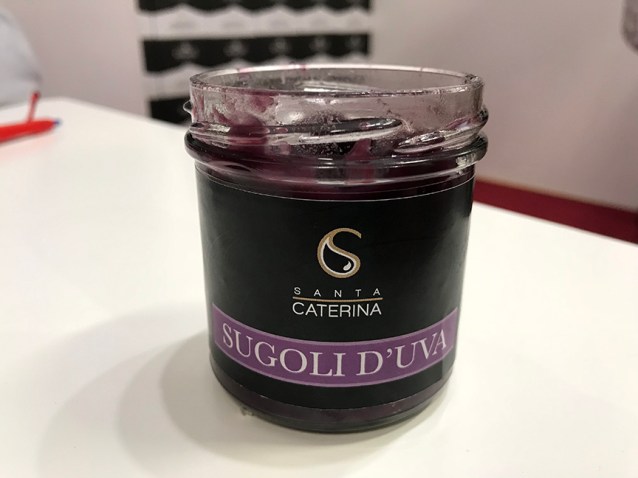
Another compelling taste came in the form of Sugoli d’Uva, a grape pudding obtained by thickening Ancellotta grape must with flour.

It’s a nearly forgotten traditional dish from Emilia where it was typically produced during the grape harvest. It represents yet another way to capture the essence of the vine and prolong its utility and deliciousness.

Older Emilians still remember grandma making the pudding in the fall when the grapes were picked. I was thrilled to see that my friends at Acetaia Guerzoni have revived it.

You eat it with a spoon by itself, they said. But many across the internets suggest serving it with crumbly Torta Sbrisolona. Either way, I don’t think you can go wrong with this dangerously moreish sweet!

Coming away from this tasting, I thought about how important it is to remember that viticulture is part of larger agricultural and nutritional system. To focus solely on wine would be to eclipse so much flavor from your world! [Wine and] food for thought…

Legal cannabis in Italy: a clarification and a confession

The first time I smoked cannabis in Italy it was in 1987 at a Peter Gabriel concert at the (Roman) Arena in Verona (a great venue for rock shows; I saw the “So” tour, one of the many times I saw him perform in my late teens and early 20s). I was 20 years old.

Back then, even small amounts of cannabis were illegal in Italy. Although I never heard of anyone getting arrested for possession or for smoking in public, my stoner peers made it abundantly clear that we risked arrest and possibly jail if we were caught by authorities.

At the same time, pot smoking was ubiquitous among young people: in the dorm where I lived in Padua and at rock shows I attended, my fellows weren’t shy about consuming cannabis — by any means.

After I started chatting with some of the concert-goers and explained my weedless predicament, they generously shared their terra cotta chillum. Back then, you couldn’t find “bud” (what is known in contemporary cannabis parlance as “flower”) in Italy. You could only find hash (a cannabis derivative), which users mixed with tobacco before consuming.

The concert was awesome… And I learned that pot culture in Italy and Europe in general was very much alive, rich, and vibrant.

In Saturday’s online New York Times, one of the paper’s Italy correspondents, Elisabetta Povoledo, published a piece titled “Cannabis Flowers Are Legal in Italy. You Just Can’t Eat or Smoke Them.” In her article, she describes Italy’s nascent legal cannabis trade. I highly recommend it to you.

She writes:

    Italy’s cannabis mania, as it has been called, exploded after a December 2016 law regulating hemp production went into effect, a series of norms meant to help revive a crop that was once widely cultivated in the country. In the 1940s, Italy was said to be the world’s second-biggest producer of industrial cannabis, after the Soviet Union…
    The law was created for farmers growing industrial hemp, which has commercial uses like food, fabrics, clothing, biofuel, construction material and animal feed, but has minute levels of a psychoactive compound. But it did not regulate the use of cannabis flowers, also known as buds, and an entire economy emerged from the legislative void.

The marketplace for cannabis flowers, as she notes, has “exploded” in Italy since January 2017 when it became legal to sell flowers (buds) with less than 0.6 percent THC content (THC, or tetrahydrocannabinol, is the component that makes users feel “stoned”).

Elisabetta actually reports that the flowers can have only up to 0.2 percent. The 0.2 percent limit applies to legal edibles, oils (like CBD oil), and infusions (teas). But as long as they are sold exclusively for “ornamental use,” the flowers can have up to 0.6. (This is due to a legal loophole in the law that absolves growers from responsibility for how their products are used as long as said products are not sold for consumption; read bullet point 7 and following gloss in this link from the Italian Senate website.)

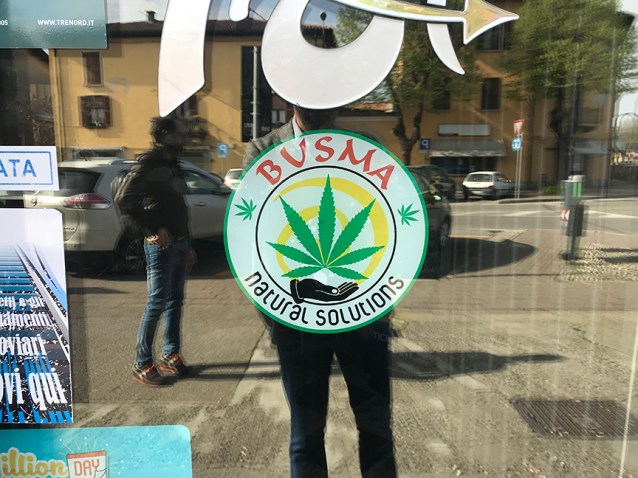
I photographed the window sticker above at the Rovato train station, a small-town stop in Lombardy, last week. The station tobacconist, like countless others across the country, sells “cannabis flowers” (infiorescenze di canapa) for “technical use” (uso tecnico). The labels state clearly that “combustion is forbidden.”

Whether it’s 0.2 or 0.6 percent THC content is besides the point. At those levels, the THC is imperceptible and the effect is purely analgesic (i.e., relaxing and therapeutic but not hallucinogenic and not a “high”). The average THC content for recreational cannabis in the U.S. is around 18 percent. And some flowers can have up to 30 percent. (I speak from personal experience.)

But the big takeaway here is that Italian cannabis growers have positioned themselves on the forefront of the growing cannabis culture in Europe.

In my three decades of traveling to Italy and interacting with Italians, I’ve found that pot doesn’t have the same stigma that it has here in the U.S. (thank you, Richard Nixon!). It’s not socially unacceptable like it is in certain circles in our country. And no one, at least in my experience, is shunned or dismissed as intellectually inferior because of it.

The U.S. is the hands-down world leader when it comes to progressive cannabis regulation. California, my home state, is the most populous in the nation and recreational cannabis became legal there this year. Even in regressive and “reliably red Texas, cannabis entrepreneurs expect some green soon,” wrote the editors of the Dallas Morning News last month.

Italy’s not far behind. And I can also tell you from personal experience that many grape growers are planning to launch legal cannabis production this year. Stay tuned…

Vinitaly: why the fair matters now more than ever…

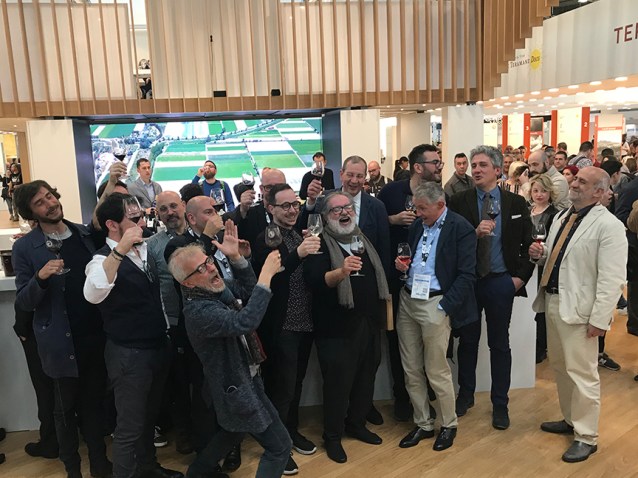
Above: many of Italy’s best wine writers and bloggers gather each year at the Intravino party at Vinitaly, the annual Italian wine trade fair in Verona. Intravino is Italy’s most popular wine blog and one of the few platforms where readers enjoy a broad spectrum of voices.

There really wasn’t much to complain about this year at Vinitaly, Italy’s largest wine trade fair, held each spring in Verona.

The weather was nearly perfect. The wifi worked (for the most part). Even on the Monday of the fair, typically its busiest, it didn’t feel overly crowded. Only one drunken consumer tripped over me. I never had to wait in line for a bathroom.

And the fair organizers even have a nifty new app that allows users to look up exhibitors, view of map of the fair ground, and track their own location on their phones. How cool is that?

Above: this week’s fair marked the 52 years since the first gathering. Vinitaly remains unrivaled for its scope and size.

I missed the fair last year because it coincided with the Passover (one of the most important holidays in Judaism). There was no way I was going the Seder with my mother (she’s in her 80s).

But back again this year, I was pleasantly surprised to see that the organizers have made good on their promise to address some of the fairgoers’ perennial grievances: long lines for unclean bathrooms; spotty at best wifi and frequently disrupted cellular service; too many consumers crowding the pavilions and making it all the more challenging for professionals to maintain their schedules; saturated parking, etc… Those issues persist but to a lesser degree thanks to genuine efforts by the organizers. (Thank you, Verona Fiere! We really appreciate it!)

All in all, gauging from the three of four days I attended, it was a great fair.
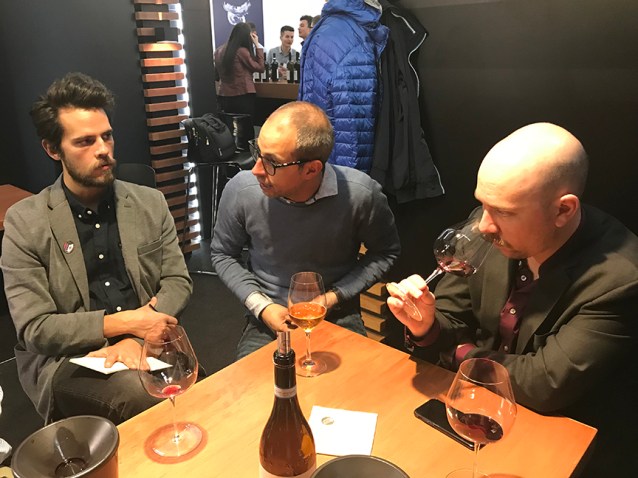
Above: I spent a lot of my time at the fair with two young wine professionals from Los Angeles, Skylar Hughes (left) and Theo Greenly (right). Gianluca Colombo (center) was one of the many winemakers who tasted with us.

Beyond the many super wines I tasted, the thing that thrilled me the most about this year’s event was the opportunity to taste with a couple of first-timers (above), my colleagues from Los Angeles who were attending thanks to a trip sponsored by the Italian Trade Commission.

Back at home in America where the three of us work together, consolidation of import and distribution channels is rapidly reshaping the fine wine landscape in alarming ways. As the big-kid companies continue to absorb or displace the small independent players, often through unchecked predatory business practices, the variety of wines available to U.S. wine professionals seems to grow more and more narrow.

I’m not talking about “wine persons” working in progressive markets like San Francisco or New York. I’m thinking of people who work in places like Austin, Chicago, Las Vegas, or Miami where the top players in distribution increasingly drive the market. Even in Los Angeles (where I do some consulting on a couple of wine lists), I see the small distributors struggling day-to-day to stay alive while the biggies show up with fat expense accounts and deep discounts.

As consolidation continues to whittle away at the field of wine available across the U.S., I am increasingly concerned that many young wine professionals are missing out on the Italian wine’s bigger picture, where people, culture and tradition — Italian people, culture, and tradition — make the difference.

It was wonderful to see my California fellows having so much fun at the fair as we bounced gleefully across the grounds together: tasting at Abruzzo’s regional stand; tasting at the Vivit (natural) and Bio (organic) pavilions; tasting with winemakers whose wines don’t make it to their market; tasting with winemakers they’ve never even heard of because their reps have never mentioned them; tasting wherever the hell they wanted to and without anyone pressuring them to buy.

Especially since Vinitaly’s organizers incorporated the newer Vivit and Bio pavilions into the fair a few years ago, the gathering represents an unrivaled opportunity for young Italian-wine-focused professionals to expand their knowledge, hone their chops, and make new and lasting connections and friendships that will transcend the monolithic “three-tier system” back in America.

Now that they have one Vinitaly under their belts, I hope they’ll branch out and attend the many wonderful unaffiliated specialized fairs that take place the same week. But I am so glad that they started here, at Vinitaly, the truly “big picture” of Italian wine today.

Thanks, Vinitaly, for a really great one (my fourteenth).

“What would Soave have been without him?” On the eve of Vinitaly, Italian wine mourns the loss of Leonildo Pieropan…

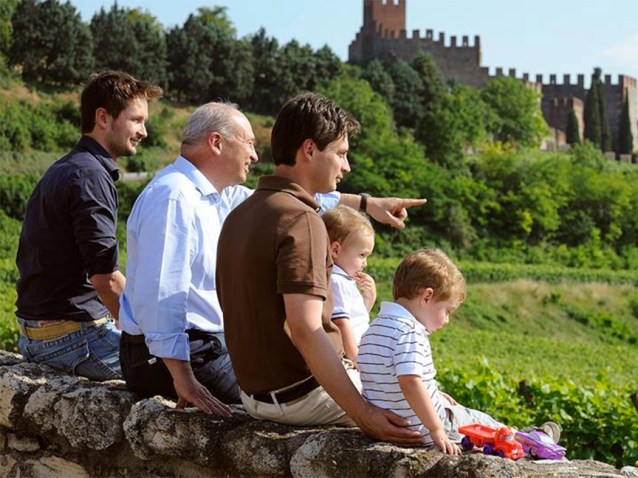
Above: Legacy producer Leonildo Pieropan with his two sons and grandchildren in an udated photo (image via the Slow Wine blog).

News of Leonildo Pieropan’s passing swept across the world of Italian wine this weekend.

On the eve of Vinitaly (the annual wine trade fair in Verona), remembrances of the Italian wine legend and pioneer poured out over the internet. Not only was Pieropan the architect of Soave’s great revival, he was also one of the founders of FIVI, the Italian Federation of Independent Grape Growers, a now powerful advocacy group. His wines have shaped the palates of a generation of Italian wine lovers, including mine.

Don’t miss Ian D’Agata’s wonderful post, published yesterday on Vinous, “In Memory of Leonildo Pieropan.”

And here’s a remembrance by Slow Wine editor-in-chief Giancarlo Gariglio (excerpted translation mine):

Everyone knew Leonildo Pieropan as Nino. He was a pillar of Italian viticulture. He was one of those rare, singular winemakers who embody their appellations.

What would have Soave been without him? It would have been a much poorer appellation. And not just because of his legendary wines. His wines were captivating in their youth. And as they aged, they made decades seem like mere months. But Nino was also able to inspire other producers to follow his vision of what the appellation could be.