Boulder Burgundy Festival delivers delicious surprises and Burgundy’s new star rising, Cellier aux Moines.

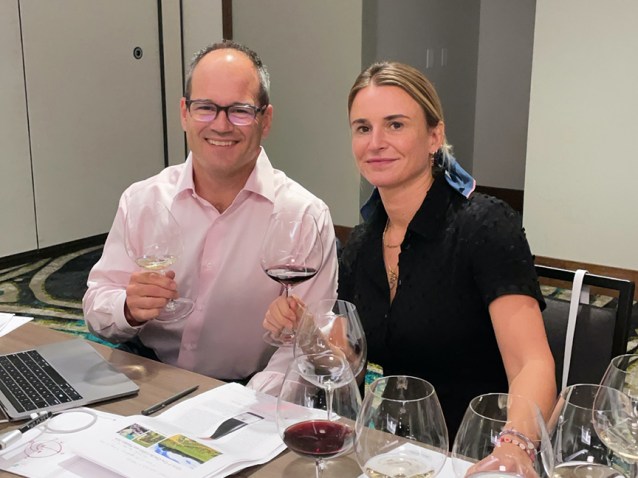
Above, from left: Brett Zimmerman, founder of the Boulder Burgundy Festival, and Margot Pascal, one of the owners of Domaine du Cellier aux Moines, one of Burgundy’s oldest wineries and youngest rising stars.

Me to legendary sommelier and wine educator Jay Fletcher: “Hey, Jay! When’s the last time you tasted a flight of six Aligoté?”

Jay to me: “Never!”

Our seemingly banal exchange gives you a sense of how remarkable this year’s Boulder Burgundy Festival was.

Disclosure: the Boulder Burgundy Festival has employed me as a media consultant for more than a decade.

Remarkable because it included the gathering’s first in-person events since the 2019 festival.

Remarkable because wine writer (and my dear friend) Alice Feiring flew in to present a flight of six different expressions of Aligoté, many of which are produced in diminutive amounts and were painstakingly sourced by festival founder Brett Zimmerman.

Remarkable because the brand-spanking-new Coravin sparkling wine preservation system had its in-person debut on the first day of the festival (a wine tool that many agreed is going to be a game-changer for restaurants).

Remarkable because Margot Pascal, co-owner of one of Burgundy’s oldest estates and one of its youngest rising stars, presented two flights of her family’s wines, including a showstopper Givry monopole and two wines made from Chardonnay and Chardonnay Musqué, a rare clone that wowed the roughly 30 collectors and wine professionals who had gathered to taste at the festival’s Sunday seminar.
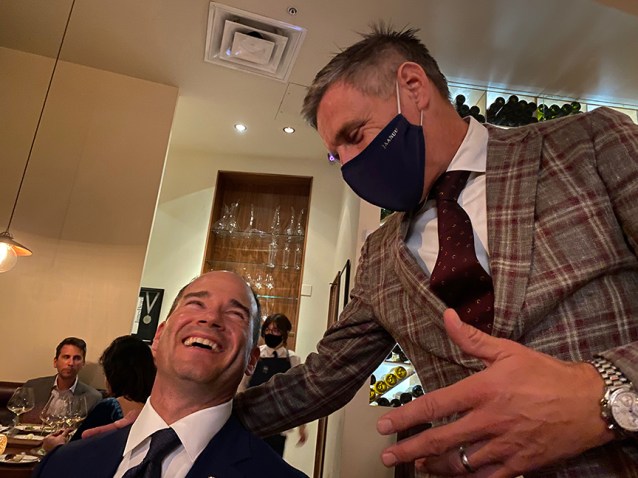
Above: Brett Zimmerman and Bobby Stuckey, co-owner of Frasca Food and Wine where the event’s marquee dinner was held on Saturday night.

Tasting with Margot, at both her Sunday seminar and the Saturday night marquee dinner at Frasca, was one of the wine highlights of my year.

As Brett pointed out at the Sunday event, her wines are relatively new to the U.S. market and are already highly allocated. We were extremely fortunate to get to taste her family’s bottlings, all raised on her family’s estate, where wine has been continuously made for more than nine centuries.

They purchased the historic but then run-down farm in 2004 and have spent the last decade and a half restoring the iconic property and reviving the grape growing and winemaking there. The farm is organic certified and Margot’s family has employed biodynamic farming practices there for at least four years.

These wines are soon going to be impossibly hard to come by, Brett noted.

And if her Givry premier cru and Givry Clos Pascal monopole weren’t enough to bring the crowd to its feet, Margot’s Montagny Les Combes premier cru, made from Chardonnay and Chardonnay Musqué, would have been a showstopper on its own. It comes from some forgotten rows of the latter clone that Margot’s family discovered when they took over the property.

When’s the last time you tasted two vintages of Montagny Les Combes side-by-side? When’s the last time you tasted a Chardonnay Musqué? Yeah, that’s what I thought.
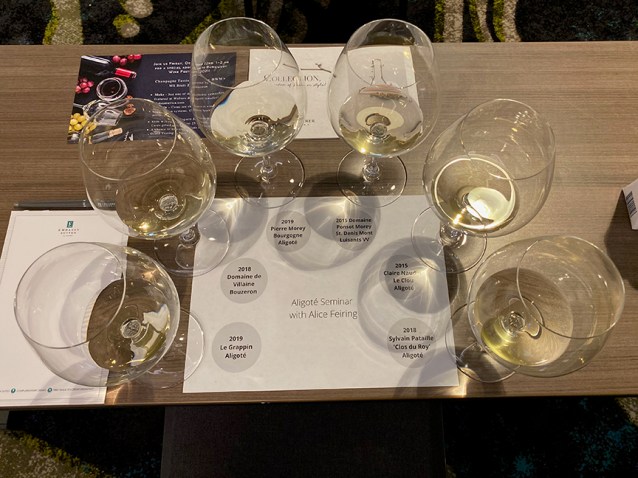
Above: when’s the last time you tasted six different Aligoté in one sitting? If the answer is “yes,” please stop reading this post!

And if Margot’s flights weren’t enough to bring the house down (they did just that on Saturday night at Frasca, which turns into a French restaurant once a year for the festival), the flight of Aligoté presented by Alice was as utterly eye-opening as it was wholly delicious.

Alice, as the delighted group of tasters learned, has spent a lot of time on the ground in Burgundy tasting and researching Aligoté, a white grape often overlooked because of Chardonnay’s lucrative dominance.

“I love an underdog,” she said.

There was also a moving tribute to her close friend Becky Wasserman, for whom we all raised the first glass of wine that morning. We learned that there will be a tribute bottling of Aligoté produced to honor her legacy, career, and behemoth influence in the wine world. It will be made from vines planted in Becky’s birth year. “She loved Aligoté,” said Alice. “She loved an underdog.”

Gauging from the ooos and aahs emanating from the tasters, the flight seemed to thrill the room with its astounding range of aromas, flavors, and textures. More than one taster, including some top wine professionals who were in attendance, remarked on how these wines over-delivered.

And Alice gave a benchmark talk about her experiences with the wines and the people who make them.

The word remarkable was uttered more than once.

Above: Bobby presents the back of the house at Frasca on the night of the marquee dinner featuring Margot’s wines.

But maybe the most extraordinary thing about the festival was the fact that for most, it was the first in-person wine event they had attended since 2020. Last year’s festival was held entirely online. And it wasn’t clear if an in-person festival was going to be possible this year. What a blessing it was to be there: seeing cherished friends and colleagues after so much time apart was a deeply emotional experience for many, me included.

My heartfelt thanks goes out to Brett, the Boulder Wine Merchant crew, and the greater Boulder wine community for hosting Tracie and me this year. What an incredible experience.
A bollito of my dreams at a favorite restaurant in Emilia.

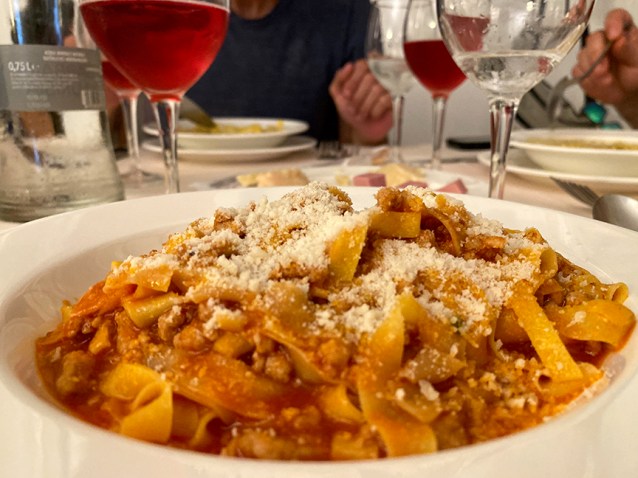
Above: in Reggio Emilia, they don’t call it “tagliatelle alla bolognese.” They just call it “tagliatelle al ragù.” It’s a subtle but meaningful distinction.
One of the things that people don’t realize about gastronomy in Emilia — the land of Prosciutto di Parma, Culatello, and Parmigiano Reggiano where there are more pigs and Ferraris per capita than anywhere else in the world — is that you have to venture outside of its capital city Bologna to find the best food.

Another crucial element that many people miss is that for great bollito misto, you have to head west from Bologna toward Modena and Reggio Emilia. That’s the true spiritual homeland of bollito misto.

What is bollito misto? It’s meats that have been slowly simmered together. It’s typically made in different parts of northern Italy. But in Modena and Reggio Emilia zampone is used instead of cotechino sausage to give the dish its decadent character.

What is zampone? Meaning literally hoof, zampone (the sausage) is a pig’s trotter that has been filled with head cheese. It’s considered one of Italy’s greatest delicacies (and it’s one of my favorite things in the world to eat!).
Continue reading

Taste with Alice Feiring (and me) at the Boulder Burgundy Festival 10/22.

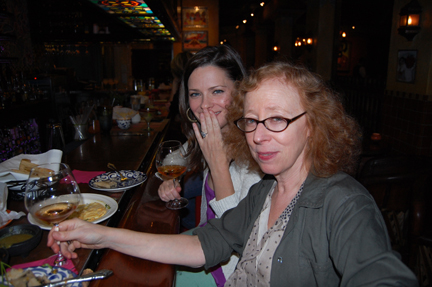
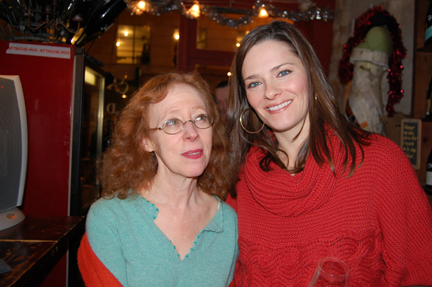
Above: Alice (right) and Tracie in Paris in 2009. (Errata corrige: the photo was actually taken at Fonda San Miguel in 2010 when Alice came to see us in Austin; the photo below is from the France trip.)

One of the most rewarding things about my teaching gig at the Slow Food University of Gastronomic Sciences in Piedmont has been watching my students’ eyes light up as they discover the work of Alice Feiring. Year after year, it’s happened every time we crack open her first book, The Battle for Wine and Love or How I Saved the World from Parkerization (Harcourt 2008).

Teaching her first book over the course of the last six years has revealed how well the work has aged. At the time of its hardback release, her pioneering approach to wine writing was viewed by some as heretical and irrelevant to the wine discourse and dialectic. But more than 13 years later, it has proved to be a guiding and shining light to a new generation of wine writers who have eagerly embraced her style — and her wisdom.

Above: another shot from our super fun visit in Paris while I was on tour with Nous Non Plus and Tracie and I had just started dating.

Not only did she introduce a highly personal and even intimate, some would say, model of wine writing. (Her book could have been gleaned from the New Yorker “personal history” rubric.) But she also provoked — like a tirage — a closer look at wine’s intrinsic moral and ethical valence. She was certainly not the first to ask not only whether a wine was good or bad in terms of its quality and reflection of tradition. But she was among the first to inspire wine lovers to consider whether a wine was good or evil.

Evil is a strong word but it applies here, in my view. Her conviction and ideals often inspired a quasi-bellicose tone in her diegesis. After all, her debut book, the one that put her on the wine world map, was called “Battle” (to this day, her shorthand for the tome is “Battle”).

No high-profile wine writer before her had brought such a May 1968 sensibility to the world of enography. In many ways, she is the Susan Sontag of her generation: someone whom the critical theorist and activist would have said lives their life true to their ideals.

I couldn’t be more thrilled that Alice will be presenting an Aligoté seminar and tasting this year at the Boulder Burgundy Festival on Friday, October 22. I’m not a panelist or presenter at the festival but I’ll be returning to Colorado again this year as the festival’s in-house blogger and media consultant, a gig that I’ve been doing for nearly 10 years now.

Click here for details. And if you do make it out to hers or any of the other events, I’ll look forward to tasting with you!

War in Prosecco? New York Times, give me a break!

Elephantem ex musca facere…

Astonishing and astonishingly sensational were the first words that came to mind after reading Jason Horowitz’s story for the New York Times late last week, “A Battle of the Bubbles: War Comes to the Prosecco Hills” (October 1, 2021).

Clickbait was the other.

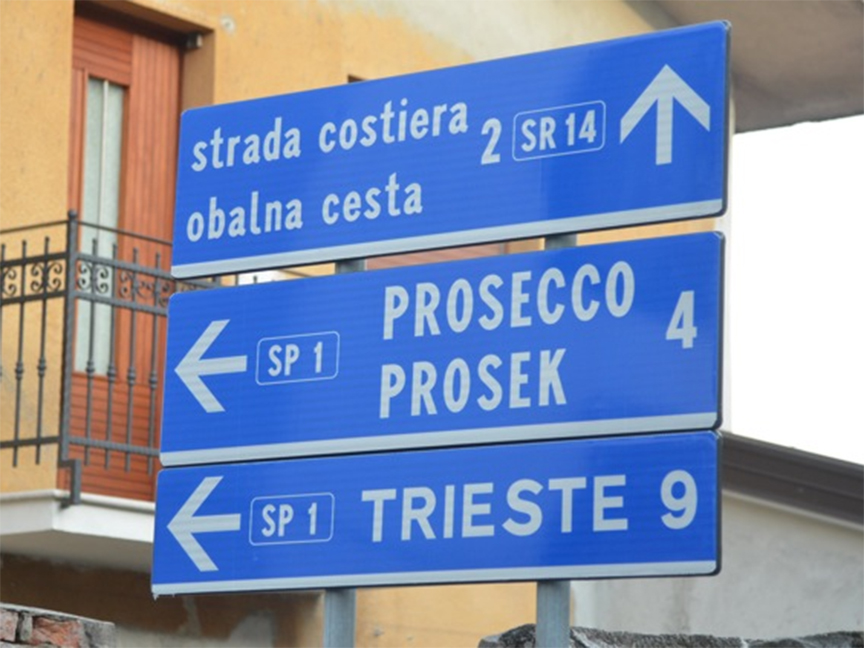
Yes, it’s true that last month the EU agreed to hear Croatia’s case that its winemakers should be allowed to label their Prošek, a dried-grape wine made in extremely small quantities, as an officially recognized appellation.

The issue has been fermenting (excuse the pun) since July of this year. But the EU’s nod to let the case move forward has unleashed a river of “the sky is on fire” posts across the internets.

Although the Italians and the Prosecchisti would have preferred that the EU decline to hear the case, there is still little chance that the Croatians will prevail.

As top Italian wine trade observer Maurizio Gily noted earlier this year, the Italians began exporting Prosecco many decades ago, long before anyone was trying to ship Prošek abroad. This entitles them to the trademark in the market.

What is more likely to happen is that the EU will strike a deal similar to the one the Italians obtained when the lost their case to the Hungarians back in 2009. At issue was the supposed confusion between wines labeled as (and made from) Tocai in Friuli and the Hungarians’ claim to the trademark for the homonymous wine Tokaji. The Italians lost. As a result, wines labeled as Tocai can only be sold in Italy. In order to ship their wines abroad, the Friulians changed the grape name to Friulano.

And guest what? Sales actually grew after the change!

Prosecco growers, producers, and bottlers (and remember, bottlers are the biggest players here, not the growers or the producers), have had to contend with “Italian sounding” imitators for years now. The worst offenders are arguably the Australians who make tank-method wines from Glera (the main grape used in Prosecco in Italy) and label and sell them as Prosecco in Australia.

The Prosecchisti can’t do anything about it (although they have tried) because EU has no binding agreement with Australian regarding trademark protections for wine and food products. (To this day, btw, Californians still label and sell wines as “Champagne,” “Lambrusco,” and even “Brunello.”)

In the light of the above, it’s hardly a “war” or “battle” going on in Proseccoland. It’s just EU bureaucracy winding its way through the block’s byzantine legal process.

It’s also remarkable that Horowitz, a writer I otherwise admire greatly, only got quotes from a few of the (not so) major players (none of whom have a big footprint in the U.S. where his readers live). Where was Nino Franco? Where was Matteo Lunelli and Bisol? Where was Mionetto? It seems that he only spoke to a few bottlers. Where was Santa Margherita? Where was Cupcake, for that matter?

And what about the myriad family growers and family grower/winemakers? Where was their voice?

As for his claim that there is a serious discussion about creating a new name for Prosecco, I can only say, give me a break. That’s simply not going to happen, at least not in our lifetime.

I have so much to tell from my recent trip to Italy (just got back last night). Stay tuned for that. But thank you for letting me get that off my chest in the meantime!

Top image via the Gambero Rosso forum

A Nebbiolo by a lesser god (and checking in with Slow Food USA).

Here in Piedmont where I’ve been teaching at Slow Food U this week, people drink red wine. When you talk to the old timers, they’ll tell you that in their day, there was no white wine to drink here. No Timorasso, no Anascetta, and maybe just a little Arneis (that no one really cared about back then). Just Barbera, Dolcetto, and the occasional Nebbiolo.

So it was only natural that Slow Wine guide editor-in-chief, a Piedmontese through and through, would order a bottle of red wine when he, his wonderful family, and I sat down for an aperitivo at everyone’s favorite natural wine bar Zero in the town of Bra where most of the students live and where I stay in hotel during my teaching gig.

His selection was a Roero Rosso by progressive grower and producer Alberto Oggero, a 100-percent Nebbiolo he calls “SANDRO D’PINDETA.”

Drinking this deliciously fresh wine and noshing on salumi and cheeses, I couldn’t help but think of how Roero Nebbiolo is a category (nearly) entirely ignored by my American colleagues. Even as Alto Piemonte producers and their Nebbiolo have become the new stars of the überhipster American wine scene, it remains immensely challenging to find wines like these — Nebbiolo by a lesser god, as it were — in our market. Historically there have been one or maybe two producers of Roero-grown Nebbiolo that have made inroads in the U.S. But the category was never wholly embraced. It’s time to rethink that, in my opinion.

The wine was gorgeous, with classically sweet tannins, a hallmark of great Nebbiolo. Not prohibitively priced and ready to drink right out of the bottle, it only got better as we three adults finished it. What a great wine and value.

It was wonderful to see Giancarlo and his family (they have two daughters just like Tracie and me and the girls enjoyed visiting with them immensely we we were all here in 2018).

Back in 2016, he asked me to give him a hand in launching the Slow Wine Guide USA. For three years, he and I traveled throughout California and Oregon. We started with 70 California producers. And that number had tripled by the time, three years later, that I retired as the U.S. coordinator.

Today, he told me, they have greatly expanded their California and Oregon coverage and have added other states as well. I couldn’t be more proud to have been part of the launch. And while I don’t envy him all the headaches and heartaches that come with editing a guide, I miss our epic trips and tastings.

He said that while the Slow Wine tour was cancelled this fall (for reasons we all know too well), he plans to bring the winemakers to the U.S. in early 2022, including a stop in Austin. I’m looking forward to taking him out to a favorite barbecue and a night at the Continental Club where we first really connected when I took him to see a Dale Watson concert.

Grande Giancarlo! I’m so glad we’re friends and I’m so proud to have been a part of the Slow Wine launch in the U.S.

Exploring another passion: Italian cinema. Dinner and an Italian Movie with me in Houston, Wednesday 10/13.

Even though our family was as stressed and frightened as any other during the lockdowns this year and last, my work leading virtual wine dinners at Roma restaurant in Houston turned out to be one of the most compelling and rewarding experiences of my career. Especially in the early months, those events were the only way we could keep the restaurant running and feed our families — including my own. And they were also a medium by which we could stay connected with friends and fellow Italian food and wine lovers.

Hearing people tell me, repeatedly, that the events were “what kept us sane” during the peak months of the health crisis has given me a renewed sense of purpose in my life’s enogastronomic mission. Food and wine, we reaffirmed, has a unique power to nourish and heal.

But those dinners and the wines we selected for them were also what led Roma’s owner Shanon Scott to appoint me as the restaurant’s wine director in the late spring of this year.

We began work in May and by June we were already producing a mix of in-person and virtual events for our guests. Since that time, we’ve also introduced a new virtual/in-person hybrid event that people can join from home or at the restaurant. And we even had a winemaker from Italy join via Zoom (there are more events like this in the works).

But on Wednesday, October 13, we are going to launch an entirely new format: “Dinner and an Italian Movie.”

I first studied Italian cinema at U.C.L.A. as an undergraduate with Marga Cottino-Jones, one of the leading American-based scholars of Italian film at the time. Later during my years as a graduate student there, I was selected to be the Italian department’s representative at a now landmark seminar and series of lectures on and screenings of Pasolini’s cinematic oeuvre. The professor was Geoffrey Nowell-Smith, who, among other things, was a translator of Antonio Gramsci’s “prison letters.” He had also met Pasolini and interviewed him in his home in Rome (in EUR).

I was hooked.

By the end of my years as a teaching associate, I had also begun teaching Italian cinema in the undergrad program. Those were the years that Scorsese was involved in building U.C.L.A.’s film archive. It was a genuine renaissance of Italian film studies and Italian winemakers visited regularly. I’ll never forget getting to shake Michelangelo Antonioni’s hand at the first screening in a retrospective of his entire filmography.

Years after I filed my dissertation (on Medieval and Renaissance transcriptions of Italian poetry), Princeton University Press would publish my English-language translation of The History of Italian Cinema by leading Italian cinema scholar Gian Piero Brunetta.

So, I think it’s fair to say that I know a little bit about Italian film.

On Wednesday, October 13, my interest in and passion for Italian cinema and Italian food and wine will collide when we host “Dinner and an Italian Movie” night at the restaurant. For this first event, we’ll be screening Federico Fellini’s 1973 classic, “Amarcord.” As you can imagine, I have a lot to say about Fellini and this wonderful movie. But you’ll have to join us that evening at Roma to find out what! I hope you will.

See details here. And thanks for your continued support.

Heading back to Italy tonight after a Parzen brothers reunion near the Canadian border (and an IMPORTANT NOTE about pre-flight covid testing).

Last Friday found all three of the Parzen brothers in Plattsburgh, New York, about an hour south of Montreal, for a long weekend family reunion. That’s Micah (left) and Tad in the photo above, snapped on the ferry that crosses Lake Champlain and delivers its passengers to Vermont.

Our father Zane, 88 years old, has lived there for many years now. It’s not the easiest place in the world to get to but it is beautiful.

I leave for Italy from the east coast tonight from New York City. I’ll be teaching at the Slow Food University of Gastronomic Sciences this week and next.

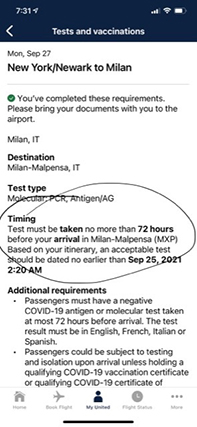
Because Italy now requires U.S. travelers to show both a CDC proof of vaccination card and a negative covid test, I had to schedule a swab while I was on the ground in upstate New York. And getting a rapid antigen test was essential because wait times for the molecular test these days can be long.

It was my understanding that you had to schedule a test no sooner than 72 hours before your flight. But when I began uploading my documents to my airline’s “travel-ready center,” I realized that you actually need to take the test 72 hours before your scheduled arrival (not the schedule departure).

Luckily for me, I was able to find an antigen test at an independent pharmacy and everything aligned.

But it’s something to keep in mind when you’re prepping for travel to Italy or other destinations in Europe.

Dagan Ministero’s room where it happened. Revisiting Terroir SF, a natural wine icon.

De naturali vinorum historia…

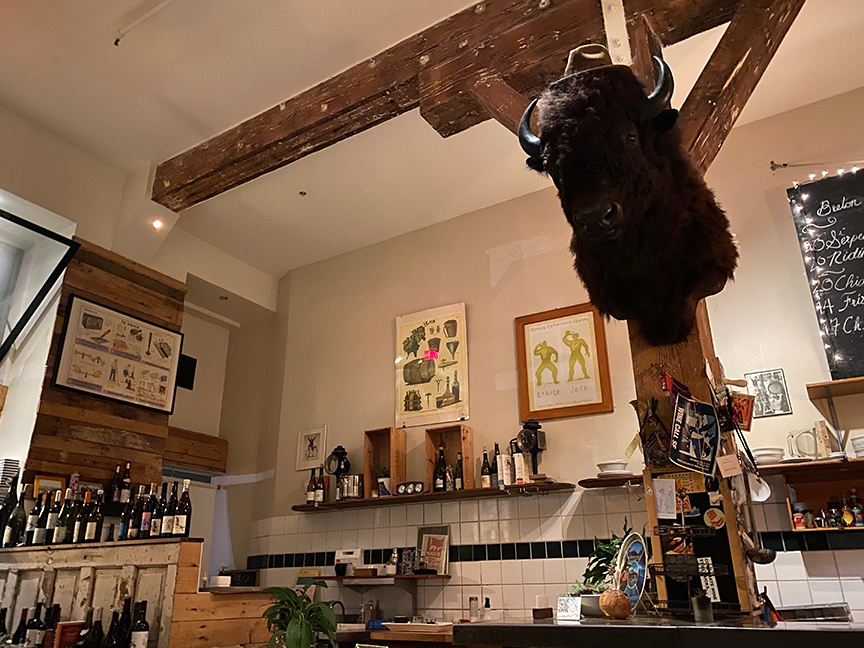
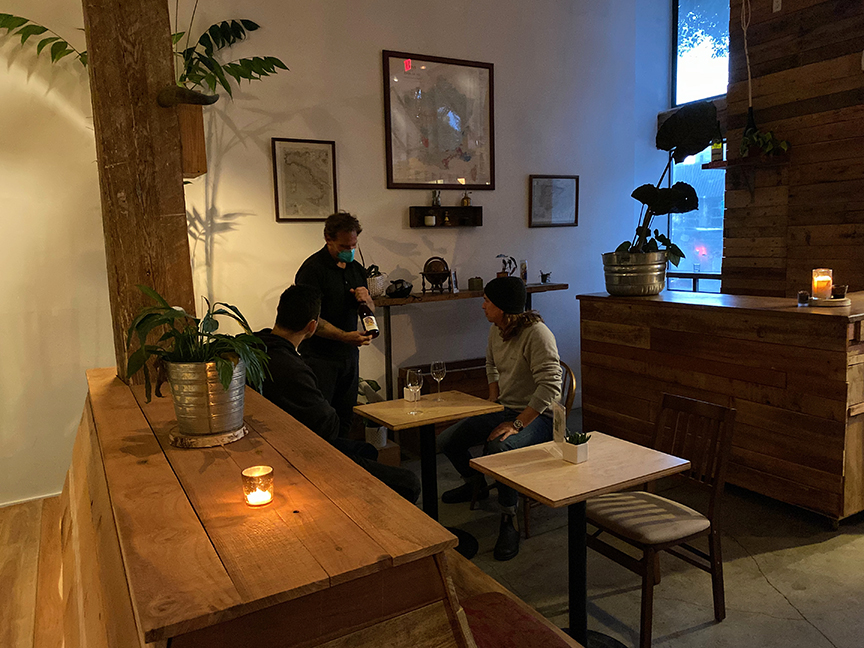
My mind teemed with memories as the doors swung open and let me into Terroir Natural Wine Bar on Folsom in San Francisco’s SoMa neighborhood like an old western gunslingers’ saloon.

The time Tracie and I watched one of the owners chase down a thief who stole two bottles in front of our very eyes. They got the bottles back.

The time my band was playing Café du Nord and we turned Joachim Cooder onto Muscadet. He was our drummer at the time and he loved it.

The countless times that the soldiers of the new wine, the natural wine, gathered there to banter, debate, and deliberate over the new language and new world that they were simultaneously discovering and forging.

It would be hard to overestimate the role that Terroir in San Francisco played in the nascent natural wine movement. Like its counterpart in New York, The Ten Bells, it was pioneer, progenitor, and in a certain sense an ante litteram avatar of the new natural wine culture.

Looking back to 2007 when Terroir opened, when people were just beginning to wrap their minds around natural wine, it’s clear that the venue and its cast of characters — including some of the wine world’s proto-bloggers, and you know whom I’m talking about — populated an early outpost of natural wine’s fourth estate.

At the time, no one beyond a small circle of the intelligentsia had even heard the pairing of “natural” and “wine.”

It’s incredible to think that a word that we once uttered audaciously as a challenge to the wine firmament is now part of the workaday parlance of broader viti-culture and commerce. Terroir was the setting — the context — for the text. Although the words had been uttered however sparingly before that time, Terroir was at once locus and locution for some of its earliest enunciations.

But Terroir didn’t just provide the proscenium for some of natural wine’s proto-dialectic.

It was also a super fun bar to hang out in and a wondrous meta (in the ancient Roman sense) for the wine-curious. Vinyl spun on the jukebox as eno-hipsters streamed in and out. And the wines… oh the wines! There was always something macerated and/or oxidative (back then it wasn’t so easy to find those wines). And the conversation was as high-pitched as it was catholic (with a small c).

And even though one of the things that made it sexy was the slight sense of danger that you always felt there, owed in part to the hyper-urban environment where it is located, it was also a safe and welcoming space for those who wanted to expand their wine knowledge and experience.

Today, as the natural wine world has revealed its sharpest elbows, Terroir was a place where even a wine neophyte like a drummer in a faux French rock band could hang out and let it all hang out.

I was so fortunate to get to sit down with my old friend Dagan Ministero, Terroir owner and founder, last week for what I can only describe as a pseudo-séance.

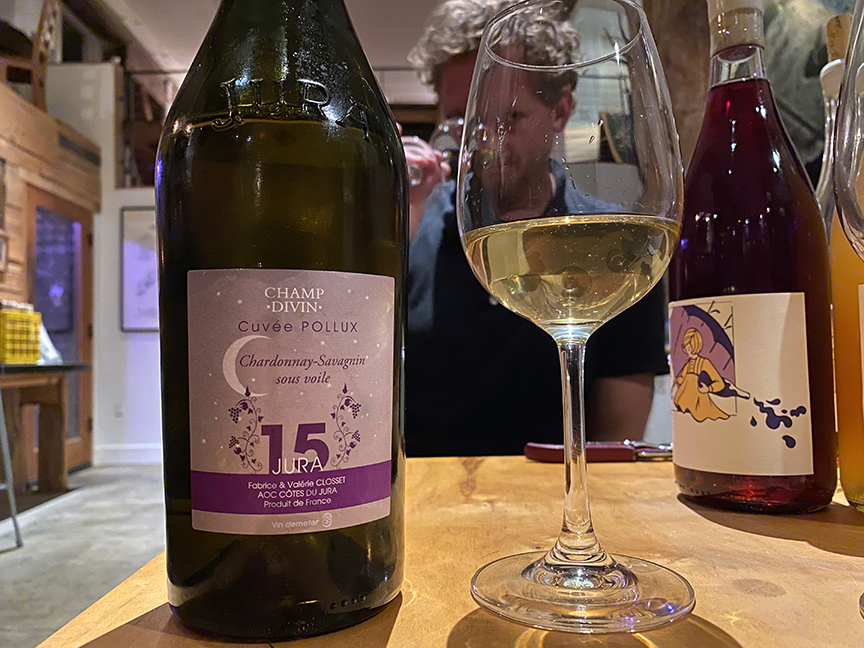
We talked at length about the many luminaries of natural wine who have sat in his chairs over the years. We parsed the evolution of the language of natural wine in the 14 years that have passed since I first sat there. And we tasted… we tasted and tasted and tasted… just like the old days.

Revisiting after so many years and after the lockdowns, this space still had the same mystical, magical effect on me that it did when I first visited in 2008 (my band was still extremely active then and SF was one of our top cities in terms of our draw). And the wines were funky, cloudy, and great…

Chapeau bas to Dagan who has remained one of America’s essential hosts, soothsayers, and sorcerers. Natural wine — and wine in general — could more humans like him.

Italians can’t come to the U.S. So we’re bringing them to you via Zoom. Taste with me in Houston next week.

best lambruscoDespite our hopes that Italian winemakers would be able to join us in the U.S. this fall, Europeans are still banned from coming to the U.S. by the Biden administration. They can come here if they quarantine in certain countries for two weeks before arriving. But they can’t come directly from the EU.

When I was in Italy teaching at Slow Food U. in August, my Italian counterparts were optimistically expecting the ban to be lifted. Slow Wine had its tour planned for the U.S. in October, editor-in-chief Giancarlo Gariglio told me over dinner at his house. Villa Sandi’s export director Flavio Geretto, another good friend, was gearing up for the Gambero Rosso tastings also scheduled for October (he was even planning on bringing his son to attend a concert in Houston!).

Italian winemakers had hoped to boost sales with in situ visits during the last and historically most lucrative quarter of the calendar year (“OND” or Octobero-November-December, as it is known in the trade). But all plans and hopes have been dashed by the continued prohibition.

And that’s why we’re bringing the Italians to you.

Next Wednesday in Houston, I’ll be hosting a hybrid virtual/in-person wine dinner with one of my dearest and closest friends, Alicia Lini. She will be joining our group of guests in the dining room at Roma restaurant, where I write the wine list, via Zoom. And other guests will be also be joining via Zoom from their own dining rooms (they will pick up the food and wine beforehand).

For those interested in attending, see the menu and details here. Roma’s kitchen is doing a wonderful seafood — yes, seafood! — menu to pair with Alicia’s white, rosé, and red Lambrusco. It’s going to be super fun. I hope you can join us. Thanks for your support and buon weekend.

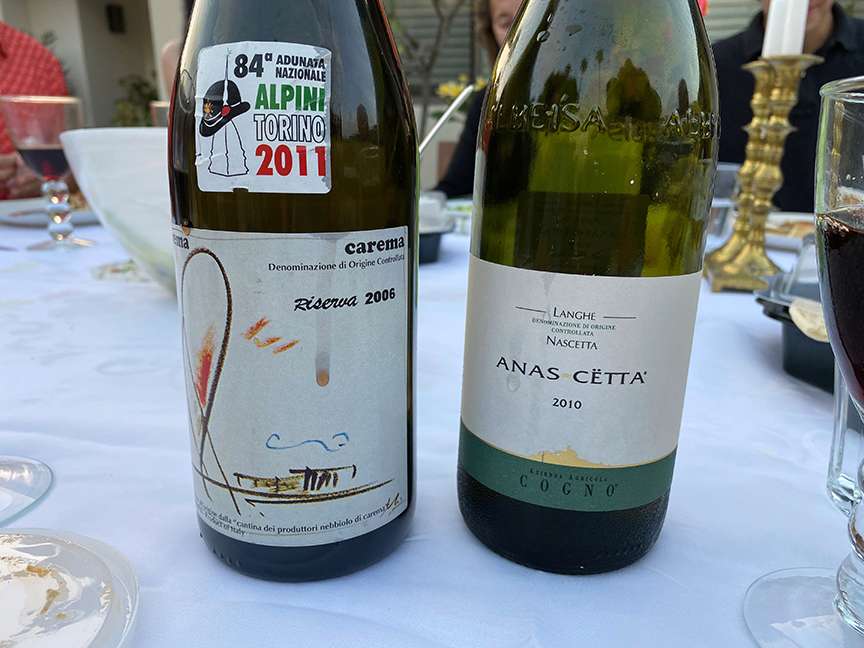
2010 Anas-cëtta and 2006 Carema Riserva. What we drank for Erev Rosh Hashanah.

When I spoke to my mom the day of Erev Rosh Hashanah on my way home to La Jolla from the San Diego airport on Monday, I asked her to pick a couple of bottles from the mini-cellar I keep at her house. She opens the wines for her friends when they visit and we enjoy them at family get-togethers.

For the new year this year, she picked a 2006 Carema Riserva from Produttori di Carema and a 2010 “Anas-Cëtta” (Nascetta) by Cogno. Not bad, right?

Back in 2010 when I led a group of bloggers on a tour of Monferrato and Langhe wineries, Walter Fissore of Cogno opened a 2001 Anas-Cëtta for us. It was one of his first vintages of the then newly revived Piedmontese white grape variety. Everyone on our trip was so impressed with the wine, including me, that I bought a six-pack of the 2010 when I got back stateside.

This wine, aged in my storage locker in San Diego for 10 years (!), was incredibly fresh, with rich vibrant fruit on the mouth. I was totally blown away by how good it was. We had opened another bottle this summer when Tracie, the girls, and I were visiting my mom. It was good but this bottle was better. It blows me away how a roughly $25 bottle of white wine can perform like this. Chapeau bas to Walter who had the vision to get behind this grape and make some truly outstanding wines. I really enjoyed this and it went great with the classic middle eastern spread my sister-in-law and brother dialed in for dinner.

As a rule I never — almost never — accept gifted wine when I’m touring Italian wine country. The winemakers nearly ALWAYS want to give you a bottle when you visit. If I took a bottle each time I tasted with a producer, I reckon, there’s no way I could take all the wine back home with me. But when then Produttori di Carema president Viviano Gassino offered this bottle of 2006 Carema Riserva, how could I say no?

Note the artist label and the Alpini Torino 84th convention sticker (the annual gathering of Italian Alpine soldiers where this mountain wine was served evidently). This wine was extraordinary, very youthful and powerful, with dark red underripe fruit and smooth but still evolving tannin. What a wine!

2006 is a maligned vintage in many ways. It is overshadowed by 2005, a vintage that American critics loved. And at the time of its release, at least one high-profile Langhe grower reclassified its crus because it feared that the fallout of the financial crisis was dampening sales of its higher-end wines. So many Nebbiolophile seem to have forgotten this wonderful vintage. Great wine.

As much as I was sorry to see these two bottles go, the pleasure of drinking them — with my mom and brother’s family no less — assuaged the heartbreak of saying goodbye. Isn’t that the fun of collecting wine?

Happy new year, everyone!