I Am Love (I Am Cinema) and good things we eat and drink

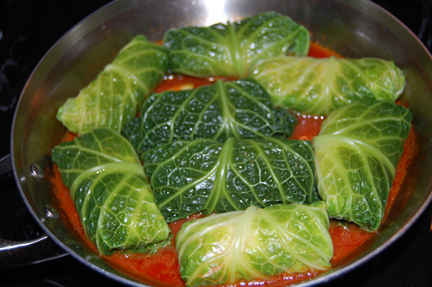
Above: Over the weekend, Tracie P made cabbage leaves stuffed with shredded pork and rice and then braised in puréed tomato. Delicious…

The same way some of my favorite wine bloggers share my passion for music, like McDuff and Eric the Red, many of my blogging colleagues share my passion for cinema, like Lyle and Tom. (They tell me I know a little about cinema and Italian cinema in particular.)

Over the weekend, Tracie P and I finally went to see I am Love, the (relatively) new (to American audiences) movie by director Luca Guadagnino. We both loved it and I highly recommend it (and I thank Comrades A and H for nudging us to see it!).
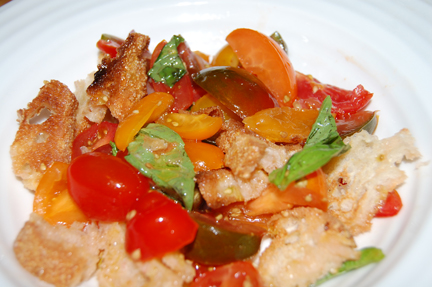
Above: Summertime means PANZANELLA chez Parzenella… so yummy…

There are plenty of insightful reviews of the movie but I wanted to make one (I feel) important point about it. So many reviewers have made reference to Guadagnino’s homage to Visconti in this work (and there is a Viscontian influence here, no doubt). But there are many other cinéaste and cinephilic references here.

I’m not the first to note that Pasolini’s Teorema is a patent model for this work, where chef Antonio is a parallel to Terrence Stamp’s character in the former.

But I may be the first to point out that Antonioni’s influence is also immensely felt here: the shots of Milan and in particular industrial Milan are clear references to Antonioni’s tetraology, L’Avventura, La Notte, L’Eclisse, and The Red Desert. And even more significantly, the characters’s sense of alienation and the “substitution” of one relationship for another in the search for elusive happiness owe much to Antonioni’s thoughtfully two-dimensional world.
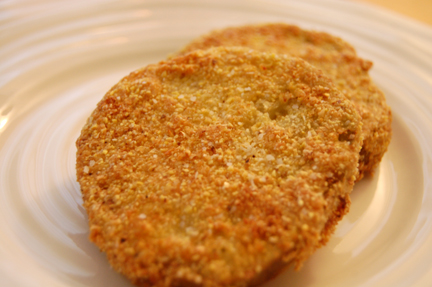
Above: Some southern girls knew how to make fried green tomatoes even before they went Hollywood! Gelatinous on the inside, crispy on the outside.

Most significantly, I Am Love is a film that is aware of being a film and being part of a great cinematic tradition: I am Cinema. The shots of industrial Milan and the textile factories, for example, evoked a genre of Italian nationalist documentary filmmaking that first emerged during fascism and reached its peak during the “economic miracle” of the 1960s. The use of Giacomo Giulio da Milano’s font Neon in the credits and captions was a sort of epicinematic allusion that paid homage to the grand tradition of Italian design at its peak in the 1930s (Neon was forged in 1935 at the Fonderia Nebiolo in Turin). Those same “happy years” of fascism saw the Recchi family expand their influence, power, and wealth (remember the conversation between Edoardo and his colleague?).
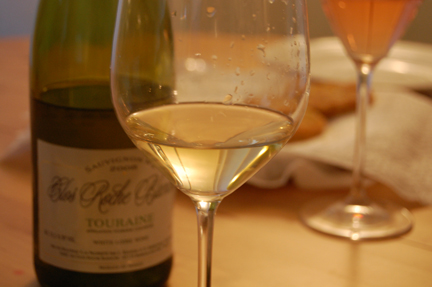
Above: The 2008 Sauvignon Blanc by Clos Roche Blanche is probably going to be my white wine of the summer. At under $20 (available at The Austin Wine Merchant, where we got it), this delicious wine paired stunningly (and affordably) well with the pork medallions that Tracie P served with shredded cabbage and homemade pear chutney. Really and truly one of those sublime pairings.

The overarching theme of Gaudagnino’s film and story is one that belongs steadfastly to Italian cinema, especially when viewed in its inherently Marxisant paradigm: the alienation of a sense of humanity through the reification of the body.

And, here, I am confident that Gaudagnino would agree with me: Antonio the proletarian chef, whose craft brings him into contact with an otherwise elitist and esoteric group (after he “beats” Edoardo in the race), becomes a conduit that allows the characters to “return to nature” using a Leopardian and ultimately Rousseauan lexicon.

The food porn sequence (where Emma eats a shrimp, how phallic is that?) and the farm-to-table sex sequence (a symphony of cross pollination) represent the triumph of nature over materialism.

After all, when the chef at some chichi lower Manhattan restaurant regales her/his patrons with tales of the farmhouse where she/he has sourced her/his heirloom cultivars of elderflowers used to infuse her/his coulis, is it not an extravagant (in the etymological sense of the word) attempt to cheat materialism for the sake of a false Mother nature?

I hope that Emma will find what she’s looking for in Antonio, but somehow I don’t think she will…

I am love, I am cinema, and I am a fried green tomato. Thanks for reading…

And buona visione, as they say…
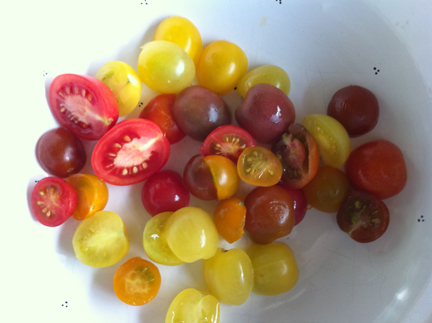
Best wine in Chicago and what Comrade H had for dinner

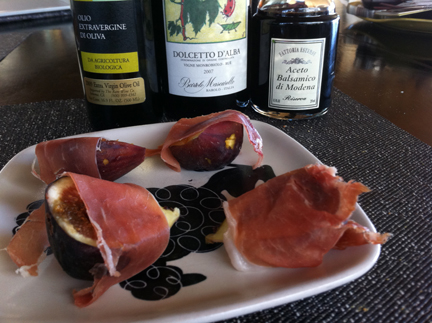
Comrade T recently wrote me asking for advice on where party members find good wine in Chicago. I reached out to Comrades N and L for their advice and here’s what they said (paired with Comrade H’s excellent dinner, including Comrade B’s Dolcetto).

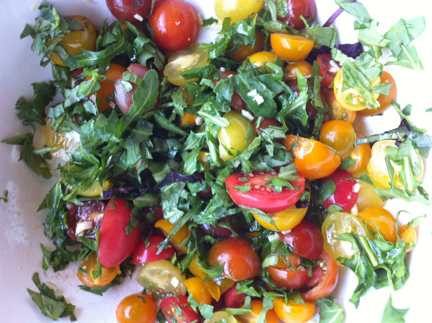
Start with the first good cherry tomatoes of the summer.

FROM COMRADE N

Comrade J, we’re always happy to aid the cause.

Webster’s and Rootstock are the most simpatico establishments in my view. Avec is also a good choice.

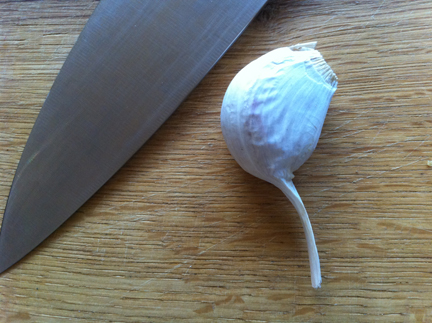
Good garlic.

If you really want top Italian wines (including properly aged), head to Spiaggia but be prepared to pay dearly for the privilege.

Comrade T, if you need recs for restaurants, shops or anything else in town, feel free to drop me a line.

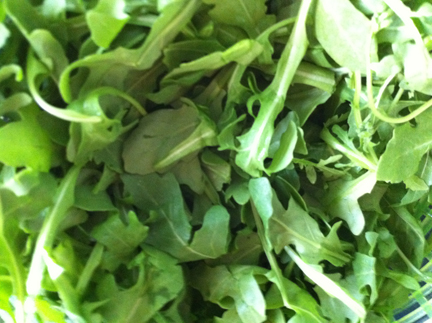
Wild arugula.

FROM COMRADE L

The two Comrade N mentioned are really it in terms of well thought out, conscientious lists. Again, Comrade N is right in that Spiaggia, while quite expensive, has a very well thought out list. And Alinea, too. This is just more of a beer town (and BYO which helps). That said some places do have nice lists. I just went to the Purple Pig the other week and was able to find a few things (they have some López de Heredia there).

Life is good.

Anyway, below is a list that I put together for someone a couple months ago. The only thing I’d add is the new Girl and the Goat that just opened by Stephanie who won Top Chef a couple seasons ago.

RESTAURANTS
http://www.longmanandeagle.com/
http://www.kumascorner.com/
http://thepurplepigchicago.com/
http://thepublicanrestaurant.com/
http://www.avecrestaurant.com/
http://www.thebristolchicago.com/
http://www.nightwoodrestaurant.com/
http://www.rickbayless.com/restaurants/xoco.html
http://bigstarchicago.com/
http://www.girlandthegoat.com/

COCKTAILS/BEER
http://www.whistlerchicago.com/
http://www.theviolethour.com/
http://www.maproom.com/
http://hopleaf.com/

And of course, good oil (sourced from Rare Wine Company), good wine (Comrade B’s Dolcetto), good vinegar…

WINE STORES/BARS
http://www.permanwine.com/
http://www.redandwhitechicago.com/
http://www.websterwinebar.com/
http://rootstockbar.com/

AVANTI POPOLO!

(and buon weekend, ya’ll!)

Chianti and Brunello, the brand names

Inspired by that Prince of Paronamasia, Thor, I was tempted to entitle this post, “Brand on the Run”… But have you ever known me to mince words?

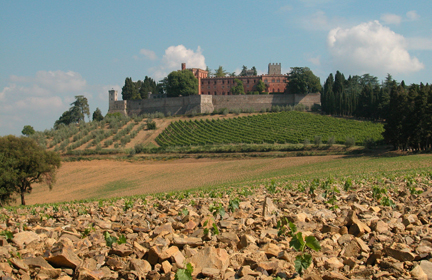
Above: The Castello di Brolio, site of the Ricasoli winery. The “Iron Baron” Ricasoli, winemaker and Italy’s second prime minister, re-branded Chianti in the late 19th century when he replanted his vineyards with Sangiovese. Would he recognize the wine his family makes today?

Reading Eric the Red’s brutally honest column on Chianti Classico yesterday, I couldn’t help but wonder out loud: would the “Iron Baron” Ricasoli, father of pre-industrial Chianti Classico, recognize the wines that his family makes today?

Even more chilling was the thought: in the light of Montalcino’s “vote for modernism,” as Ms. Robinson put it, is Brunello heading down the same path as Chianti Classico?

In other words, will we not recognize the wines that are going to be made there 20 or 30 years from now, leaving us as befuddled as Eric and his colleagues? “Of the 20 glasses before us,” wrote Eric, “many did not look like Chianti Classicos, the designation for Chiantis made in the Chianti region’s heartland in the hills of Tuscany. Or at least they did not look the way I expect a Chianti Classico to look.”

By the time Ricasoli was purchased by behemoth Seagram’s in the 1970s, Chianti had already achieved antonomastic status in the collective consciousness of the American consumer. In other words, it had become synonymous with “Italian wine.”

I cannot tell you how many times I come across the common misconception that Italians pair pizza with Chianti. The other day, a young Sicilian woman here in Austin told me that the traditional pairing for Parmigiano Reggiano was Chianti.

As the apologetic title of the column reveals (“Tasting Report: Chianti Classicos, So Dark and Oaky, but Still Recognizable”), the wines that Eric and colleagues tasted did not resemble the wines that they expected to uncork. In fact, “Many were densely colored and dark, almost impenetrable in their blackness.”

As rumors of corporate take-overs in Montalcino abound (reminiscent of the heady Seagram’s years), I fear I see a (literally) dark cloud in my wine horizon. To borrow a phrase, from Mel Brooks, “Let’s hope for the best…” You already know the next line…

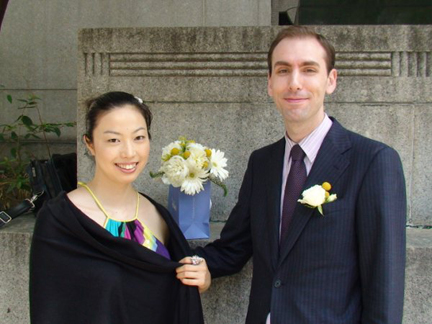
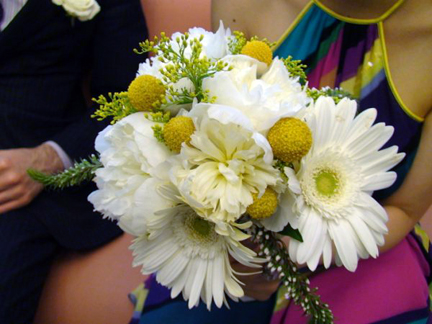
Mazel tov, Ayako and Levi!

Photos by BrooklynGuy.

This just in from one of the few people I know in this business who matches an extraordinary palate and professionalism with an unrivaled gentleness of spirit and mind.

“I thought I would pass along the news that, as it happens, Ayako and I were married yesterday down at the City Clerk’s office. She has decided to take the last name of Dalton.

It’s already been a day and she hasn’t mentioned anything about divorce yet, so I think we are off to a good start.”

Mazel tov, Ayako and Levi! Know that our thoughts and our well wishes are with you!

Veronelli’s handwriting, Bartolo Mascarello’s backward thinking, and the “triumph” of barrique

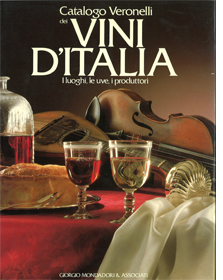
You may remember a post I did not long after I launched my blog on Luigi Veronelli as Poseidon and a Trident of New Oak (and Eric the Red’s subsequent post). In that post, I translated a passage from Luigi Veronelli’s landmark 1983 Catalog of the Wines of Italy.
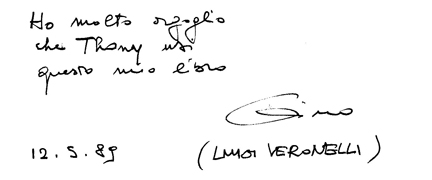
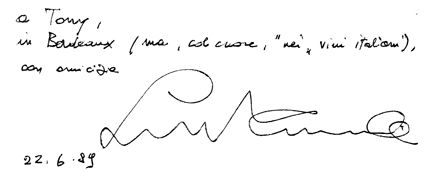
In my never-ending quest to apply the tools of textual bibliography* to wine writing, I chomped at the bit when I came across two subsequent editions of Veronelli’s almanac of Italian wine. After breaking away from the pack on a tour of the Tangley Oaks manor, where Terlato Wines International has its corporate offices, I found myself alone in the library: to my joyous surprise, when I opened the tomes to the title pages, I found Veronelli’s personal dedications to Tony Terlato.

I am very proud that Thony [sic] will use this book. Gino (LUIGI VERONELLI), May 12, 1989.

To Tony, in Bordeaux (but with my heart “in” Italian wine), with friendship, Luigi Veronelli, June, 22, 1989.

What a find! And what a wonderful document and example of handwriting! The “autograph” (or even better, the “idiograph”) as we call it in the study of textual bibliography reveals so much about the intentions of the author. In June of 1989, the renaissance of Italian wine in the U.S. had yet to take shape and both men played fundamental roles in the emergence of Italian wine as a fine wine category. The dedication in the second instance leads me to believe that the two men met in Bordeaux but their “hearts were in Italy.”

In Veronelli’s 1983 preface, he called the introduction of barrique aging a “provision” that “must not be delayed” in Italy. By 1986, only three short years later, he wrote of his dissatisfaction at the limited number of Italian wines he was able to include in the catalog due to space and time constraints. At the same rate, the increased number of wines “raised in barriques” marked his “triumph.”

He also writes of how he has lobbied for a single-vineyard (cru) system in Italy. He didn’t give his top rating (the Sun) to the “sublime” bottlers Bruno Giacosa or Beppe Colla in this catalog, he observes apologetically. But he did give it to Bartolo Mascarello, however reluctantly.

“Bartolo Mascarello,” he writes, [is an] “advocate of a theory that I’m forced, in his case, to accept: the best Barolo is composed by using different vineyard supplies.”

He also bemoans Violante Sobrero’s sale of his rows in Monprivato and Villero (to Mauro Mascarello?).

There’s so much more wonderful information to be culled from this bundle of sheets but that’s all I have time for today. In another lifetime, I hope to be employed by a royal court as a textual bibliographer of wine. In the meantime, I gotta make a living… thanks for reading!

* From the Bibliographical Society of America website: “Textual bibliography, the relationship between the printed text as we have it before us, and that text as conceived by its author. Handwriting is often difficult to decipher; compositors make occasional mistakes, and proofreaders sometimes fail to catch them; but (especially in the period before about 1800) we often have only the printed book itself to tell us what the author intended. Textual bibliography (sometimes called textual criticism) tries to provide us with the most accurate text of a writer’s work. The equipment of the textual bibliographer is both a profound knowledge of the work of the writer being edited (and of his or her period) and an equally profound knowledge of contemporary printing and publishing practices.”

The story behind Vajra’s Barolo Albe

Above: The good news is that it looks like Vajra’s wines will be coming to Texas soon.

So many questions, so little time…

When Mr. Franco Ziliani took Tracie P and me to taste with Aldo Vajra back in February at the winery, I neglected to ask Aldo what the “Albe” in his “Barolo Albe” denoted.

Luckily, we got a chance last week to sit down with Aldo’s son Giuseppe here in Austin. (I’d never met Giuseppe before but I felt like I knew him already: his face and his family were familiar to me, however virtually, through the excellent blog of David McDuff, whose palate and writing I admire immensely and whose taste in music and Nebbiolo are unsurpassed.)

The designation “Albe,” he explained, is simple: it’s the plural of the Italian alba, which in this context, means dawn.

“You see, our Barolo Albe is a traditional-style Barolo made from fruit sourced from three different vineyards,” Giuseppe told us, “Fossati, Le Coste, and La Volta. When the sun rises in the morning, it takes about 20 minutes for the sunlight [dawn] to reach each vineyard. So, there are three different albe [dawns].”

I’ve tasted the 2005 Barolo Albe by Vajra on three different occasions this year, and, man, it just keeps getting better and better. As much as I love their flagship Barolo — the single-vineyard Bricco delle Viole — it’s always the blended Barolo that keeps calling me back. At each occasion, I’ve found that signature freshness and drinkability that Vajra magically seems to capture in the bottle (a quality due, no doubt, to meticulous, gentle vineyard management and an honesty in the cellar).

@David, btw, would love to hear your recent notes on this wine.

Above: The Vajra family begin bottling the historic Baudana wines in 2009 with the 2005 vintage.

We also re-tasted the 2005 Barolo by Baudana, which the Vajra family began bottling for the iconic Langa family in 2009. I can’t say that I am a big fan of the 2005: its woody notes are a turn-off for me. Giuseppe did tell me that for the 2006 vintage, the barrique is toned down. And he added that we’ll see great things from these historic vineyards in vintages to follow (where he plays a greater role in the aging regimen).

As an indication of the greatness and potential of these historic vineyards in Serralunga (Baudana and Cerretta), Giuseppe also pointed to Mr. Franco Ziliani’s recent post on the 1982 Franco Fiorina Barolo, which was sourced in part from Baudana (I translated Mr. Ziliani’s post for VinoWire).

In all honesty, I’m not such a fan of the wine as it is right now. But I do believe that its future in the hands of Giuseppe and his father Aldo has immense potential to become one of the great icons of Langa. Stay tuned…

And let’s keep our fingers crossed that Vajra wines make it to Texas this fall! I don’t know how much longer Tracie P and I can survive without super-old-school Vajra Moscato d’Asti!

Thanks for reading!

Maybe it’s the way she grates her cheese: Tracie P’s rice balls

Maybe it’s the way she grates her cheese…

Above: When Tracie P asked me what I wanted for my Sunday night birthday dinner, I told her I would love her fantastic ragù. It was great as always, but she surprised me with RICE BALLS. Unbelievably good…

Whether its Faicco’s in the City or the Focacceria di Ferdinando in Brooklyn, Tracie P knows that I love me some Sicilian rice balls. On Sunday she made me one of my favorite dishes of hers, her ragù, but she surprised me with fried rice balls: stuffed with Brooklyn-style domestic mozzarella, using some leftover risotto alla parmigiana that I had made with Arborio earlier in the week for supper.

Or just the freckles on her knees…

Above: Did I mention that the GIRL CAN COOK?

She ALSO surprised me with a bottle of 2004 Sagrantino di Montefalco by Paolo Bea. This wine, at once extremely tannic and ethereal in the mouth, achieves that magic balance of simultaneous power and lightness in the mouth. It showed stunningly well last night and was such a great pairing for Tracie P’s stellar ragù alla bolognese (via Marcella Hazan).

Maybe it’s the scallions…

Above: Our favorite dried (pastasciutta) egg tagliatelle are made by Rustichella d’Abruzzo. Isn’t funny how Tracie P and I agree on the important things in life? ;-)

My good friend Charles Scicolone is not the only one “blessed” by his wife’s amazing cooking!

Maybe she’s Italian…

blueberry pie

Above: She also made me a DELICIOUS fresh blueberry crostata, a tradition for my birthday started by mama Judy.

My goodness, Tracie P, what a wonderful birthday week (I’ll have to hope my birthday falls in the middle of the week again next year!). I love you so… :-)

The lady sticks to me like white on rice…. She never cooks the same way twice…*

Above: We’ve been having so much fun with our new Polaroid 300 instant camera.

Rev. and Mrs. B and the B family gave me a power drill for my birthday over the weekend when we visited with them on Canyon Lake in the Texas Hill Country. We SO NEEDED it for our little home and the new library I’ve been setting up. :-)

Thanks, so much Rev. and Mrs. B and B family!

Birthdays used to be a nagging reminder of all the things I haven’t done yet in life. Now they remind me how lucky I am to be surrounded by wonderful folks who share such rich love and warm joy for living with me. Thanks again, also, to everyone for all the warm birthday wishes this week on Facebook, Twitter, and here at the blog… I’ve got so much to be thankful for this year… The words of support mean so much…

* “Eggplant” 1975 (same vintage as Tracie P!) by Michael Franks (my fellow La Jollan)

In other news…

Everyone in Italy is reading BrooklynGuy’s excellent post on old vintages of Vallana Spanna. Be sure to check out Alfonso’s comments to the post as well.

My first (and last) gulf oyster

Above: You had me at hello… The oven-roasted gulf oysters at Cochon in New Orleans, in February 2009.

Reading The New York Times this morning as I munched my quesadilla (topped with “casera” salsa by Herdez, which, btw, you must look for in a can as opposed to jar, because it just tastes SO much better), I found myself entirely mesmerized by the “domino effect of lives touched” described in this article and I couldn’t help but remember my first gulf oyster (above), masticated in New Orleans not long after I moved to Texas, back in February 2009.

Will it be my last?

Above: Before the BP oil spill, it was common to serve endless raw gulf oysters at crawfish boils and other summer gatherings. This year, it’s not.

Gulf oysters are in short supply these days in the wake of the oil spill and subsequent catastrophe but I trust and hope they will rebound. Check out the Times article. It’s fascinating… My favorite passage:

    And yes, the captain eats oysters. Using a short knife, he pops the seal of a just-harvested oyster with safecracker élan, makes a cut, and slurps the wild goop down.

Buon weekend, ya’ll!

The James Suckling era ends (and what we ate and drank for my birthday)

poggione

Above: We treated ourselves to a bottle of 2004 Il Poggione Brunello di Montalcino and porterhouse steak last night in celebration of my birthday. When we planned this classic Tuscan meal, I had no idea that my birthday would also deliver the news that James Suckling had left the Wine Spectator.

Yesterday, as we were preparing for birthday and Bastille Day celebrations chez Parzen, the following news arrived via email from a colleague and friend:

    James Suckling, who joined Wine Spectator in 1981 and has served as European bureau chief since 1988, has retired from the company.

    Suckling’s tasting responsibilities have been reassigned. The wines will be reviewed in our standard blind-tastings in the company’s New York office.

    Senior editor and tasting director Bruce Sanderson will oversee coverage of Italy. Sanderson, who has been with the magazine for 18 years, currently reviews the wines of Burgundy, Champagne and Germany.

fiorentina

Above: To make a proper “bistecca alla fiorentina” at our house, we season the porterhouse generously with kosher salt, rubbing the salt into the meat, and then we char the T-bone, with the steak upright.

Neither Tracie P nor I could ignore the uncanny coincidence that we had decided to open a bottle of 2004 Brunello di Montalcino by Il Poggione, a traditional-style wine made by a family who has vehemently and vociferously opposed the modernization of its appellation. There’s no two ways about it: during James Suckling’s tenure at the Wine Spectator, the scores he gave to modern-style Brunello — with Casanova di Neri as its poster child — helped to eclipse the sale of traditional-style wines, like those made by Il Poggione. (In all fairness, Suckling also gave good scores to Il Poggione but his historic preference for dark, concentrated, oaky Brunello with higher alcohol levels, indisputably skewed his evaluations toward modernism.)

fiorentina

Above: Then you cook the steak on either side, very quickly at high heat. By cooking the steak upright first, the meat “heats through” entirely.

Another layer of irony was cast upon the news and our Brunello by the fact that Mr. Franco Ziliani — at times Mr. Suckling’s detractor — had suspended publication on his wine blog Vino al Vino, the leading Italian-language wine blog, a few days earlier. (Mr. Ziliani’s relationship with Mr. Suckling is even referenced by the author of the Wiki entry on the Italian wine writer.) “A pause for reflection,” wrote Mr. Ziliani on Monday, a search for “clarity” in his life and for a sense of purpose for the blog, he explained. “To blog or not to blog,” he asked rhetorically.

fiorentina

Above: High heat is the key to searing and caramelizing the fat on the outside of the steak while leaving the meat in the center tender and nearly raw.

The two events are certainly unrelated but their confluence is rich with meaning. We often forget that that the current economic crisis has affected both the wine industry and the publishing industry. Hawking wine is no easy tasks these days (especially when it comes to high-end, luxury wine like Brunello) and hawking newspapers and magazine is even harder.

fiorentina

Above: Traditional style Brunello and steak, one of the great gastronomic pairings in the Western Canon. (Honestly, I wish I would have used a slightly shorter cooking time. I prefer my steak “black and blue,” charred on the outside, blood rare on the inside. But it was delicious nonetheless!)

While I’ve been a devoted fan of Mr. Ziliani’s blog since I first discovered his writing more than 5 years ago, I can’t say that I’ve been such an admirer of Mr. Suckling’s take on Italian wine. In fact, I think that Suckling historically ignored and omitted the great icons of Italian wine from the canon of the Spectator’s “top wines of the world” because he was looking for wines that appealed to his idiosyncratic sensibility without viewing them in a broader scope and without consideration for the wines that Italians consider to be indicative of their winemaking tradition. At the same rate, looking back on Suckling’s legacy (however skewed) as an arbiter of Italian wine, I feel compelled to acknowledge his contribution to the world’s awareness of the overarching greatness of Italian wines.

fiorentina

Above: Potatoes, spinach, grilled onions, and steak, all dressed simply with kosher salt and extra-virgin olive oil.

And so we raised a glass of 2004 Brunello di Montalcino by Il Poggione last night, to both Mr. Suckling and Mr. Ziliani, polar opposites in their approach to Italian wine, leading voices of antithetically positioned vinous philosophies. I hope and trust that both will continue to share their impressions and palates, using whatever media they see fit, with a world ever-thirsty for Italy’s unique wines.

A correction on white Musar and a Tracie P[olaroid] moment

Above: I met Serge Hochar, owner of Musar, a few years ago at a food and wine festival. Super nice guy and a lot of fun to be around. I’m not sure where he wrote or said this, but Georgios Hadjistylianou in Cyprus quotes him, “the harmony of nature is better than anything we could ever create. I believe it should be a priority to seek to drink what is ‘true’ rather than what is ‘good.'”

Reader Georgios Hadjistylianou in Cyprus was entirely right to write me, pointing out that Musar white is, in fact, made from Obeideh and Merwah, grapes indigenous to Mount Lebanon. (See a fact sheet on the wine here.)

He was writing me in reference to yesterday’s post on the super restaurant Marouch in Los Angeles. The restaurant listed the wine under “Chardonnay” but the other wine professionals with whom I dined were under the impression (as was I) that it was made from Sémillon.

Thanks, Georgios for the correction! :-) I can tell you — for certain — that the wine was delicious. ;-)

Obeideh and Merwah didn’t make it into Eric the Red’s (Eric the Green’s?) excellent post today on “a dozen obscure grapes that are the foundation of some wonderful wines and will reward intrepid explorers.” But I highly recomment both the wine (Musar) and Eric’s post to you.

In other news…

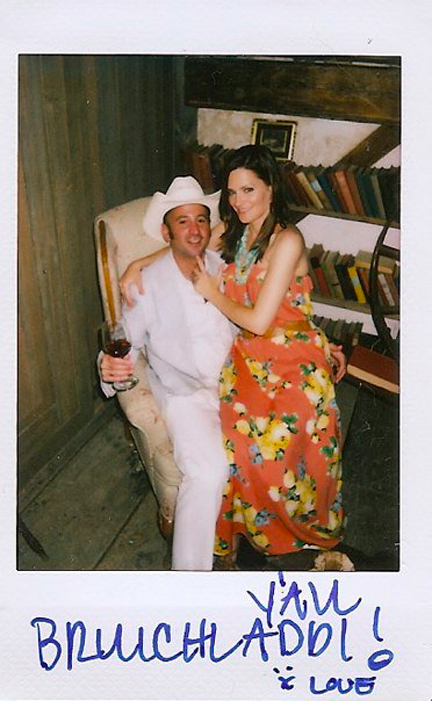
Couldn’t resist sharing this Polaroid moment from Kate and Dan’s wedding over the weekend. Among other fun activities, they had set up a Polaroid studio where you could take photos with some of the western artifacts lying around the Figueroa Mountain Farmhouse.

O my goodness, my Tracie P, you are the most mellifluous melody this singing cowboy has ever heard! I love you so! :-)