Old school eggplant “parm” with top Texas wine blogger

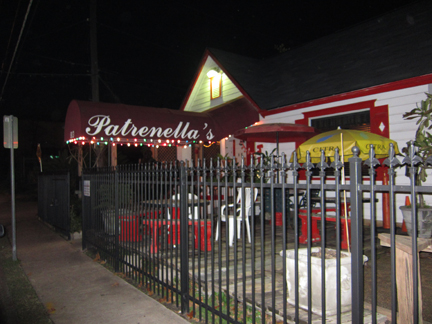
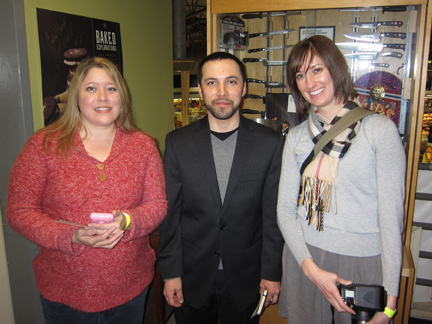
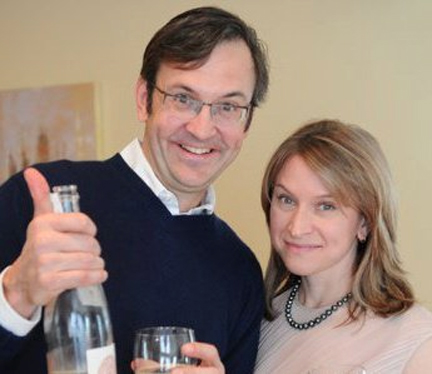
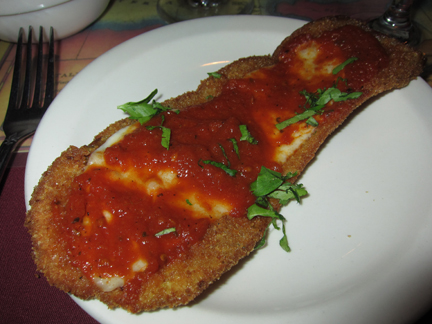
Managed to catch up last week with top Texas wine blogger Russ Kane and his delightful wife Delia for some old school eggplant “parmigiano” and a Texas vs. Italy vinous showdown at the legendary Patrenella’s in Houston.

Russ is a fascinating guy and his experience as a veteran technical writer in the energy industry gives him some interesting insights into the technical side of winemaking. And when it comes to the Texas wine industry, Russ is the MAN and his blog is the top resource in the field.

Patrenella’s is as old-school Italian American as they come, a kitschy Coppola movie set with all the classics of the gastronomic category. When I asked the waiter if they had spaghetti and meatballs, he rolled his eyes and said, “did you look at the menu?”

O yeah, and the showdown? Ubi major minor cessat: see Russ’s post here.

71 Gattinara Monsecco (Conte Ravizza), Lenny Bruce, and BrooklynGuy

One last “wines and the city,” killer wines I tasted last week in NYC…

Beyond the “farmed content” found on aggregate sties (which tries to get you to land on their pages in order to show you advertising), there’s not much info out there in the interwebs about the 1971 Gattinara Monsecco Conte Ravizza by Le Colline, Vercelli, which I got to taste last week thanks to the generosity of BrooklynGuy’s childhood friend Dan (who reminded me, in all the best ways, of my favorite Litvishe Jew, Lenny Bruce, and as it turns out, whose father represented Lenny Bruce is his legal battle against censorship! Incredible!).

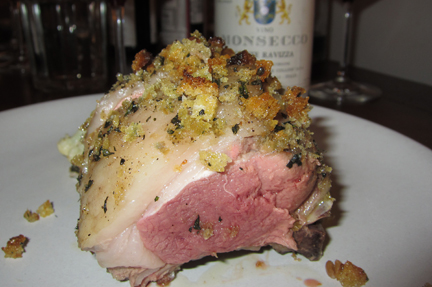
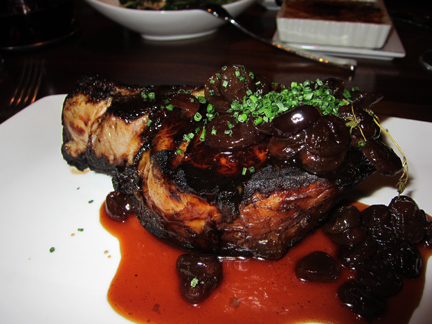
The bottle we shared (thanks to Dan, paired with BrooklynGuy’s stunning bread-crumb- and marjoram-encrusted rack of lamb, above) had a strip label on the front that reported: “selected and shipped by Neil Empson, Milan.” On the back, there was a round label that reported: “Acquired from a private cellar [by] Acker, Merrall, & Condit,” the famed rare wine broker of the Upper West Side of Manhattan.

In 1985, Sheldon Wasserman didn’t offer a tasting note for this wine in Italy’s Noble Red Wines, but he did write that “Luigi & Italo Nervi places 1971 among the worst vintages [for this appellation] and Travaglini puts it with the best! Antonio Rossi gave it three stars, Niederbacher, one. Obviously a controversial vintage. We never agreed with the three-star rating. Nevertheless, we find that all are too old now. At Le Colline they consider their ’71 Monsecco on a par with the ’64, so it should still be good.”

Dan mentioned that he had experienced some serious bottle variation in the lot he acquired but, man, this wine was off-the-charts good. Fresher than I would have expected on the nose (topped off? perhaps; the bottle was definitely reconditioned), with gentle berry fruit on the nose and on the palate, and wonderfully integrated tannin. I agreed with BrooklynGuy’s approach of not decanting this wine and opening it right before service (for the record, Dan had brought it over a few nights before and BrooklynGuy left it standing up right for more than 24 hours). Great wine…

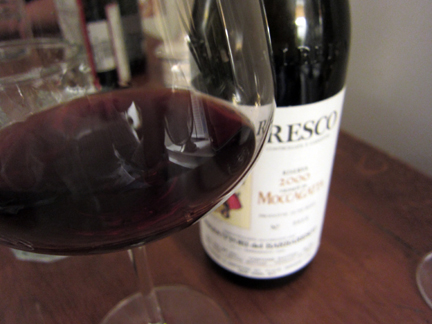
Before we got to the Gattinara, BrooklynGuy reached into his cellar for a 2000 Moccagatta by Produttori del Barbaresco, which paired superbly with a savory mushroom flan that he prepared for our Brooklyn repast. Frankly, I was surprised by how tannic this wine was, especially considering the fact that Moccagatta tends to come around earlier than some of the more powerful crus (like Montestefano or Rabajà). At 10 years out, it seems to be closing down but with a little aeration we coaxed out some bramble and red berry fruit balanced by the mushroom and earth that are Produttori del Barbaresco’s signature. Killer wine…

This last trip to NYC was an intense one: after heading back through the sludge to the city, Verena and I wrote one more song before calling it a night… Someday, if that nowhere song for nobody ever gets recorded, I’ll play it for BrooklynGuy.

I didn’t get to do a lot of socializing or fancy eating this time around. But I was really glad to connect with BrooklynGuy, who’s become a super good friend.

I remember a time, not so many years ago, when he and I first met in person, in San Diego. Life then for me was good but didn’t have the direction and purpose it has today. At a taco shop in La Jolla (where Tracie P and I would later hold the rehearsal dinner for our wedding some two years later), BrooklynGuy — with the wisdom of a rabbinic Lenny Bruce — reminded me gently of the goodness in me and pointed out confidently that I would find my path again. He probably didn’t realize then how much those words meant to me. I hope some day I can return the favor…

Sauvignon Bianco: the basics

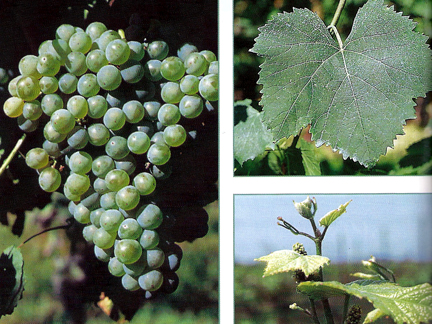
Although Sauvignon Bianco (Sauvignon Blanc) is not an indigenous variety of Friuli, it had to be included here because of its prevalence and popularity in the region. I rarely reach for international grape varieties cultivated in Italy, but when it comes Friulian Sauvignon Bianco, I can’t agree more with Master Sommelier Bobby Stuckey, who likes to call Sauvginon Bianco “Friuli’s secret weapon.”

The following post is my abridged translation of the entry on “Sauvignon Bianco” in Vitigni d’Italia, le varietà tradizionali per la produzione di vini moderni (Grape Varieties of Italy, the traditional varieties for the production of modern wines) by Antonio Calò et alia, Bologna, Calderini, 2006. This is the second in an educational series on the grape varieties of the Colli Orientali del Friuli, posted in conjunction with the COF 2011 aggregate blog.

Synonyms (documented and/or otherwise plausible): Bordeaux Bianco, Pellegrina, Piccabon, Spergolina, Blanc Fumè, Fumè, Surin, Fiè, Sauternes, Sylvaner Musqué, Muskat Sylvaner, Fegentraube, Savagnin Blanc, Savagnin Musqué.

Erroneous: Champagna, Champagne, Marzemina, Sciampagna, Sèmillon, Spergola, Spergolina Verde, Tocai Friulano.

Origins (Historical Notes): Sauvignon is cultivated in Bordeaux, particularly in the Sauternes. It probably came from this region to Italy, where it is has found suitable growing conditions in many areas and where its cultivation has been favored by growers. There is no doubt that the name Sauvignon originally meant “wild plant” (Bonnier e Levadoux, 1950). And indeed, its traits are similar to those found in the Lambrusca family. According to Molon (1906), its French origins are not certain, even though it has been cultivated in France since the 19th century. In France, two distinct types of Sauvignon are grown: Sauvignon Grosso, also known as Sauvignon Verde, and Sauvignon Piccolo, also known as Sauvignon Giallo. The only morphological differences between the two are in the fruit. The Verde or green-bunch biotype is Sauvignanasse, which is as widely planted in France as it is in Italy. In Friuli, it is called Tocai. There is also a pink or red clone of this variety, noted for its intense aroma and grown in warmer regions like Chile.

Environment and cultivation: Medium-low, dependable production. Slopes with dry conditions and stony soils are ideal for its cultivation. It thrives when pruning is not overly aggressive. Guyot and Cordone Speronato [i.e., cordon-trained, spur-pruned] are the recommended training systems for this variety. Because of its early ripening and hard-to-control acidity levels, temperate-cool climates are best for its cultivation where there is a higher synthesis of pyrazine and methoxypyrazine which are responsible for its elderberry and tomato leaf aromas.

Sensitivity to Disease and Other Issues: sensitive to peronospora, oidium, esca, very sensitive to botrytis and acid rot. It cannot tolerate spring freezes or hydric stress but has good tolerance for windy conditions.

Alcohol Content: 8.9-15%
pH: 2.6-3.6
Acidity: 3.9-9.3 grams per liter

Sauvignon Bianco makes a fine, food-friendly white wine, golden yellow in color with intense ripe fruit and floral aromas. Soft and velvety, lightly aromatic, warm, with good body, and delicate. Suitable for short-term aging. With the right conditions, it can be subjected to noble rot and late-harvested.

The variety is used exclusively for vinification. It is commonly grown in the Veneto, Trentino-Alto Adige, Friuli-Venezia Giulia, Emilia, and Lombardy. It is used in many DOCs, including: Alto Adige, Colli Berici, Colli Bolognesi, Garda, Oltrepò Pavese, Bagnoli, Breganze, Isonzo, Terlano, Colli Orientali del Friuli, Collio Goriziano, Trentino, Erice, Corti Benedettine del Padovano, Pomino.

Crazy good wines tasted in New York last week

Not necessary in chronological order…

The legacy of the canicular 2003 vintage in Europe continues to express itself in fascinating ways (the fallout of the Brunello controversy is probably the ugliest manifestation of the ripples it sent through the wine world). It was one of those challenging vintages when the honest and true made interesting wines nonetheless.

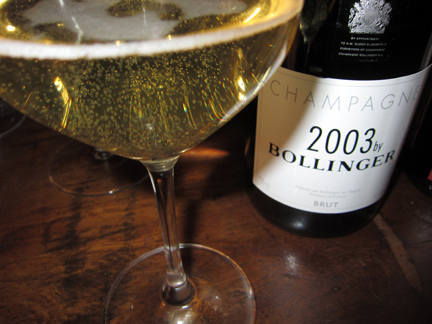
While in New York, a colleague gave me a sample bottle of the 2003 by Bollinger, an anomaly for a winery that only vintage dates its Grande Année releases.

Tracie P and I are huge fans of Bollinger and drink it every chance we get. This wine was most definitely not in the classic “yeasty” and “toasty” style that is the winery’s signature. I’m not sure what went into the assemblage but this wine was crisper and brighter than the traditional “Special Cuvée” and it drank beautifully.

I was told that the winemaker decided to release this “second label,” vintage-dated wine because the estate’s 03 crop was not destined for the classic bottling. (For the record, I always find that Champagne blended from different vintages tends to be more complex and interesting to my palate.)

An anomaly and a curiosity from one of our favorite estates, it made for a wonderful and refreshing aperitif at a good friend’s house.

Next up: 2002 Joly at Alice’s Restaurant.

Groovin’ to Radikon (FINALLY!) in Austin

Above: The rainy 2002 harvest was not a great one in northeastern Italy and so the Radikon family decided to bottle their entire crop that year in 500 ml bottles. Because they made so little wine, the unusual format (for them) allowed them to release a great number of bottles. I’ve tasted the wine a number of times now and it’s stunning — a great example of what a great winemaker can do in a challenging vintage.

Over the weekend, I took Tracie P out to dine at Austin’s newest “white table cloth” dining establishment, Congress, a swank and high-concept dining experience with a wildly ambitious menu (sure to be the hottest table to snag during the upcoming SXSW music festival when a tide of rock ‘n’ roll celebrity rolls over this central Texas town).

I was THRILLED to experience our friend June Rodil’s much anticipated list and OVERJOYED to find one of my favorite wines in the world: Radikon (the first time I’ve seen it here in Texas).

Above: “Wild Arugula, Artichoke Confit, Mozzarella, Holiday Grape Agro Dolce” at Congress. I wish folks would abandon the “truffled olive oil” mania around here. It’s one of the world’s greatest misunderstandings. But I have high hopes for high-concept dining in future at Congress.

Most people (including the Radikon family) point to Radikon as the winery that started the loosely knit orange wine movement in Italy when they began to ferment their Ribolla Gialla with skin contact in the 1990s. I tasted at Radikon back in September of last year and am a HUGE fan of these wines.

Above: A photo I shot of Radikon’s 2010 Ribolla Gialla, not long before harvest. Heavy rains in northeastern Italy during the fall don’t bode well for this vintage — in many ways, similar to the 2002 vintage. The fruit was beautiful (as you can see) but last-minute rains during the harvest ruined a lot of the crop.

I disagree entirely when people say that these wines aren’t for everyone. In fact, everyone SHOULD taste these wines so that they can begin to explore the magic of the place where they are made and the amazing people who make them — founders of the Natural wine movement in Italy and some of the most interesting people I’ve ever met in this business.

The 2002 Ribolla Gialla (in 500 ml bottle) was brown and crunchy and salty, with bright acidity and loads and loads of ripe and dried apricot and peach flavors… utterly delicious. What a thrill to see these wines on a list (at a fair price, btw) in a town that — ready or not — needs to learn what great Natural wine can be. Chapeau bas, June!

We drank the Radikon after dinner, with the chef’s cheese selection. With dinner, we ordered this 1999 (!) Mersault by one of my favorite Burgundy houses, Grivault. Normally, a wine like this would be out of our range but June has it at a more than reasonable price on her list (a reflection of her pricing strategy, sharing good deals she receives with her clientele). Lots of wonderful savory flavors in this wine, which has had more than a decade to evolve (and has many years ahead of it)… RUN DON’T WALK…

According to The Wall Street Journal, “the Brookings Institution recently found the capital of Texas to be the country’s most popular destination for the 25-34 demographic.”

I’m glad to say that we also have some kick-ass wines and kick-ass sommeliers ready to turn on all the hipsters arriving daily in the Groover’s Paradise!

Vote for my sommelier

Above: Team blogger from left, “facilitweeter” Kay Marley-Dilworth, sommelier Jason Huerta, and photographer Aimee Wenske.

Contests are not really my thing. But when Austin food and wine patroness and lovely lady Diane Dixon asked me to participate in her food and wine pairing competition, “Wine Ride,” last Sunday, how could I say no?

Diane has done wonderful things for the Austin food and wine community and her events are always fun affairs where young food and wine professionals get to taste together and compare notes.

I was assigned to write a post about Dallas sommelier Jason Huerta. You can vote for him here and you can vote for my post here.

No matter what the outcome, the winners are the young food and wine professionals of Texas. Chapeau bas, Diane!

Reactions to the Suckling & Gambero Rosso marriage

There were a lot of interesting reactions to yesterday’s news that James Suckling will join the editorial staff at Gambero Rosso. Some were… ahem, how can I say this? Mmmmm… visceral.

One of the more interesting observations came from Italy’s top wine blogger and a long-time critic of the Suckling approach to scoring, Mr. Franco Ziliani (above).

Franco pointed out, with a relative measure of irony, that:

    ‘Giacomino’ Suckling is the right man for the post-Cernilli era at Gambero Rosso.

    I also think that Mr. Cernilli (some years ago I invented a nickname for him: Robert Parker der Tufello – Tufello is a very popular area in the outskirts of Rome) could be the right man for Wine Spectator in the post-Suckling era.

    Why not? Suckling for Gambero Rosso and Cernilli for Wine Spectator and things will never change, absolute continuity in the mainstream (establishment) flow of information about Italian wines.

I also really liked what my virtual friend Andy Pasternak (above, with his wife JoAnn) had to say:

    We actually had a long discussion about this at dinner tonight and my lovely wife brought up a great point. Ten or twenty years ago, when wine drinkers had far fewer resources to learn about wine, magazines like Gambero Rosso and WS were way more important. With the advent of the interweb, and great [wine] blogs […], people have more resources to learn, read and figure out where to get wines that they like.

I think that both make excellent points.

A Sicilian prince once said: In order for everything to stay the same, everything must change.

Click here to read all the comments (warning: CONTAINS ADULT LANGUAGE).

Verduzzo Friulano Bianco: the basics

The following post is my abridged translation of the entry on “Verduzzo Friulano Bianco” in Vitigni d’Italia, le varietà tradizionali per la produzione di vini moderni (Grape Varieties of Italy, the traditional varieties for the production of modern wines) by Antonio Calò et alia, Bologna, Calderini, 2006. This is the second in an educational series on the grape varieties of the Colli Orientali del Friuli, posted in conjunction with the COF 2011 aggregate blog.

Synonyms (documented and/or otherwise plausible): Verduz, Verduzz, Verduzo, Verduza, Ramandolo.

Erroneous: Verdisio, Verduzzo trevigiano, Verduzzo di Motta.

Origins (Historical Notes): An ancient grape variety of Friuli, cited by Acerbi (1825) who notes that a grape called Verduz had been cultivated in Friuli in the province of Udine for more than 100 years. It is mentioned in the 1879 Bolletino Ampelografico (Ampelographic Bulletin) as one of the white grape varieties of Friuli. In 1939, Poggi noted a distinction between two types of Verduzzo, a “green” clone which has all but disappeared and a “yellow” clone which was probably derived from the former. Besides these two clones, there is another found in the Ramandolo area (province of Udine) called Verduzzo “raçsie” with semi-loose [semi spargolo] clusters.

Environment and cultivation: Verduzzo is not particularly difficult to grow. It likes hillside vineyards with good exposure, low fertility, and dry climate. Production for this grape is high and constant. Medium-open training systems and medium-long pruning are ideal for this grape variety. It tolerates hail better than most.

Sensitivity to Disease and Other Issues: light sensitivity to powdery mildew, sensitivity to moths, high tolerance to botrytis thanks to its thick skin.

Alcohol Content: 9-15%
pH: 2.5-3.5
Acidity: 5-10 grams per liter

Verduzzo Friulano Bianco produces a wine that is rich golden yellow with a pleasant vinous aroma, relatively tannic, full-bodied, sweet, fruity, with honey notes. Two types of wine can be obtained using this grape: a dry white wine and a sweet semi-viscous dessert wine (Ramandolo) following exposed drying on the vine or drying in an enclosure.

The variety is used exclusively for vinification. It is commonly blended with other grapes to obtain a finer, drier, and more delicate wine. It is grown primarily in the province of Udine but also in the provinces of Pordenone and Gorizia. It can be used in the production of the following DOCs: Colli Orientali del Friuli, Friuli Annia, Friuli Aquileia, Friuli Isonzo, Friuli Latisana, Lison-Pramaggiore, and Piave, and it can be utilized in a variety of ways.

We were better off when things were worse: James Suckling joins forces with Gambero Rosso

Above: James Suckling via his Facebook.

“We were better off when things were worse.” That’s what Italian wine blogger Antonio Tomacelli wrote today on Intravino describing his feelings about the news that James Suckling will be joining the editorial staff of the Gambero Rosso brand. (!!!)

Si stava meglio quando si stava peggio is one of those perennial Italian sayings, expressing the nostalgia (and consequent irony) for a time before the hegemony of capitalist consumerism fatally grasped the Italian people in its merciless grip (in the wake of the “economic miracle” of the 1960s when American culture and mores began to dominate the ethos of the Italian people).

There’s another expression in Italy that describes precisely my reaction to the news of Suckling’s new gig: non ho parole.

NE NUNTIUM NECARE!

Signor Tannino vi sono obbligato (two deceptively tannic wines)

Saturday night found Tracie P and me on a double-date at one of our favorite dinner spots in Austin, Trio at the Four Seasons, where Austin’s very own celeb sommelier Mark Sayre generously allows MOT (that’s members of the trade not members of the tribe for the Hebraically inclined among you) to bring their own wines.

I always point to Lettie’s article, “Corkage for Dummies,” as a great rule-of-thumb guide to the etiquette of corkage. I’d only add to it, that beyond bringing a bottle that’s not on the sommelier’s wine list, I always try to bring something that I think the sommelier will enjoy tasting — a bottle or label that might just surprise her/him.

On this occasion, we brought along two deceptively tannic wines: the 2006 Romangia Bianco by Dettori (Sardinia) and the 2009 Grignolino del Monferrato (above) by La Casaccia (Piedmont), two of our favorite wines from two of our favorite producers.

Thanks to what must be significant maceration time for the Vermentino (I’m still trying to get Dettori to send me some tech notes on this wine and will post as soon as they arrive), this wine is TANNIC with a capital T. In fact, it was MORE tannic than it was on at least two other occasions when we tasted it between the fall of 2010 and last Saturday. Crunchy and salty, with layers and layers of white and pitted fruit (dried, cooked, and gloriously ripe), it’s time IMHO to put the rest of my allocation down in the cellar to be revisited in a year or so. It’s such a great value for people like us who like to age white wine.

The Vermentino was FANTASTIC with the caramelized and dolce amaro flavors of chef Todd Duplechan’s pork belly, which he seasons with the same ingredients used to make Coke. (I know I’ve said it before but I’ll say it gladly again: in Texas, where pork belly is de rigueur at nearly any venue that caters to carnivores, I’ve found no one so far who does it as well as Todd does, with seasonal pickled vegetables and a flair that takes it from A to A+. Be sure to eat it when it’s still hot and the unctuous character of the fat sings like Tammi Terrell to the crispy crust of Marvin Gaye.)

Even chef Todd was surprised by how tannic the Grignolino was: “It’s so light in color,” he said when he came out from the kitchen to chat with our table, “I wasn’t expecting so much tannin.”

Very little Grignolino makes it to this country and honestly, I didn’t fully grasp what an amazing and powerfully tannic wine this grape could deliver until I visited the folks at La Casaccia. The first time Tracie P tasted it late last year, she looked up at me from the dinner table and asked plaintively, as if she were a Texan Oliver Twist, “can there be more Grignolino in our future?” The wine was sumptuous (not something you would expect from a wine so light in color) and delicious, with that characteristic rhubarb note that you find in classically vinified Grignolino. The wine was stunning with my Brooklyn-cut pork chop.

O Signor Tannino, vi sono obbligato!