Fat cat Cernilli leaves Gambero Rosso marking end (?) of an era

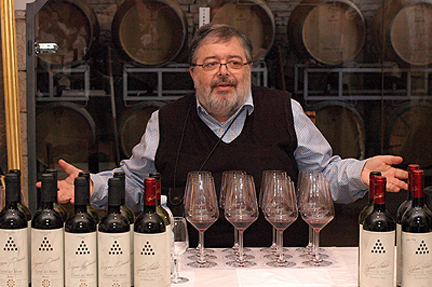
Above: Soon-to-be ex-editor of the Gambero Rosso Guide to the wines of Italy, Daniele Cernilli, as photographed by Christian Callec, who quotes Cernilli as asking “what is wrong with the use of new oak?”

Italy’s top wine blogger Mr. Franco Ziliani and I have posted the news over at VinoWire: Daniele Cernilli is stepping down as the editor-in-chief of the Gambero Rosso Guide to the Wines of Italy, the most influential rubric of Italian wines today (pun intended for the Italophone among you).

Rumors of his departure have circulated wildly in the Italian enoblogsphere for more than four weeks and while no one expects the editorial direction and ethos of the Gambero Rosso Guide to change for the better (actually, it will probably only get worse), the omega of his tenure there does mark the end of an era that saw the “international style” and international grape varieties dominate the worlds of commercial and fine winemaking in Italy.

I interviewed Daniele Cernilli in San Diego in 2008 when he came there to speak at the Gambero Rosso Road Show, traveling event. The event, originally scheduled for Las Vegas, was hastily detoured to San Diego that year. An insider told me that the sudden change of venue was due to the insistence of behemoth distributor Southern Wine and Spirits that Cernilli and his wife Marina Thompson present only wines distributed by Southern. Whether or not this is true (and I believe that it is), it does give you a sense of how Cernilli, his wife and publicist Thompson, and the Gambero Rosso Guide are perceived by observers of the Italian wine industry as a purely “pay-to-play” operation.

Here’s the video, directed by my childhood friend Charlie George and with music from Nous Non Plus:

Gnocchi and Barbera, a virtual pairing for someone we love

Anyone who follows along here at Do Bianchi knows how much we love cousin Marty (above) and what an important part of our lives he has become since I moved to Texas two years ago.

Marty and family have been facing some health issues lately and so it was a great thrill for me when he emailed late Saturday afternoon asking me to recommend a wine for dinner at Tony’s in Houston.

As I do often for many of my friends and family (who often ask us for virtual pairings; remember this very early one here?), I jumped online and took a look at the PDF version of Tony’s list: not knowing what Marty and co. would be eating, my “best bet” was a 2006 Barbara d’Alba by Prunotto.

I’m not such a fan of Prunotto and their modern-style bottlings of Nebbiolo (not exactly “my speed,” I like to say euphemistically), but when it comes to the winery’s entry-level labels like its Barbera d’Alba, you can almost always count on an honest wine, bright, with real acidity, balanced alcohol, and approachable prices. Barbera, the ultimate food-friendly grape in our book…

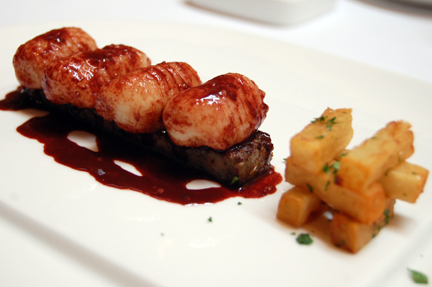
Marty paired with Tony’s Gnocchi over Foie Gras-Guinea Hen Sausage and Crispy Potatoes (which I happened to taste, thoroughly enjoy, and photograph on Friday when I was in town for my weekly chat with Tony).

Reports this morning reveal that the gnocchi were followed by a rib-eye! I guess he is feeling better! :-)

We’re just glad to hear that Marty — our family’s favorite bon vivant, gourmand, and fresser — is back on his feet and back at Tony’s, his favorite hang in the HTX. (HTX denotes Houston for all ya’ll who don’t speak Texan, btw.)

A Bialystock to our Bloom, we just don’t know what we’d do without him.

Buona domenica ya’ll!

Trainspotting a trend: British gastropub franchise in Austin? A culinary double-take at Haddington’s

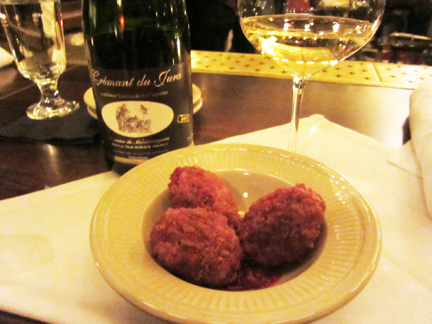
Above: The kitchen at the newly opened British gastropub Haddington’s in Austin still needs to work out the Kinks, Beatles, and Stones, but we really dug their more than reasonably priced sparkling wine list, including this Crémant du Jura by Montbourgeau (delicious) and a Gaston Chiquet Champagne Special Club (that will surely lure me back when in the mood/occasion for celebrating).

One of my magazine editors (for a food and wine pub I contribute to) likes to remind me that it “takes three examples” to constitute a bona fide trend. Between the Spotted Pig (technically and self-consciously “British and Italian”) in NYC, Jaynes Gastropub in San Diego (familiar to regular visitors here), and now Haddington’s in Austin, I think it’s safe to say that the second (third?) British wave has begun.

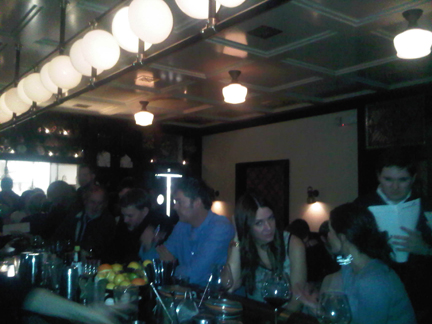
I did a culinary double-take when Tracie P and I arrived chez Haddington last night, not knowing — frankly — what to expect aside from the fact that the place is brand-spanking new and that Tracie P and I needed a great glass of wine after a Friday that was too long for both of us.

Tiled floor? Check. French windows? Check. Open kitchen (replete with stressed-out chefs)? Check. Monty Python-worthy relics and paraphernalia of the fallen British empire? Check. Hipster play list with emphasis on retro? Check. Gourmet-aspirant pub (read comfort) food? Checkmate (I had the Bibb Salad with blue cheese and pickled watermelon rind and the “Blue Burger”; Tracie P had a turkey and stuffing sandwich with cranberry relish).

Haddington’s was packed to the gills last night and although I think the kitchen is still working out some of the kinks that any new (and immediately popular) restaurant has to unravel, the impressive sparkling wine list will certainly bring us back. A stiff glass of Gérard Mugneret 08 Bourgogne Rouge was also nice with my main course.

2010 saw so many new restaurants open in Austin (which, according to most reports and eyeball witnesses continues to lead the country in its growth as a tourism destination) and the Austin food blogger community is thrilled (clearly) by this new edition (pun intended for Sam). I’m sure we’ll revisit Haddington’s but there’s only room for one British gastropub in our hearts… and her name is Jaynes…

Tocai Friulano: the story behind the EU decision to change the name

In her 1913 poem “Sacred Emily,” Gertrude Stein wrote famously that a rose is a rose is a rose.

The best English-language account (that I could find) of the EU litigation that led to Tocai’s name change was posted by DiWineTaste here.

The bullet points are as follows:

In 1993, Hungary filed a complaint with the EU, petitioning the legislative branch of the European government to block Italy from labeling wines as “Tocai.” The Hungarians’s complaint was based on a common precept of trademark law: the Hungarians were the first to use the name Tokaji (a toponym and enonym and homonym of the Friulians’s Tocai) in commerce.

A protracted legal battle ended with a 2005 EU decision that the Italians could use the designation “Tocai” only on bottles sold in Italy (and not abroad).

The decision went into effect in March 2007, so technically the 2007 vintage was the first to fall under the restrictions created by the ruling.

Surprisingly, as Mr. Franco Ziliani and I reported at VinoWire, sales of bottles labeled with the new designation “Friulano” increased in Germany and the U.S. after the new labeling restrictions went into effect.

Maybe Stein and Shakespeare were both wrong: What’s in a name? that which we call a rose Tocai / By any other name would smell as sweet sweeter!

Tocai Friulano Bianco: the basics

Above: “This is a 45-year-old Tocai Friulano vine that I have kept so that I could try to make a late harvest wine. We picked this vineyard in October. As you can see, there is some botrytis.” Sent to me this morning by my friend and Friulian winemaker Giampaolo Venica (Collio).

The following post is my abridged translation of the entry on “Tocai Friulano Bianco” in Vitigni d’Italia, le varietà tradizionali per la produzione di vini moderni (Grape Varieties of Italy, the traditional varieties for the production of modern wines) by Antonio Calò et alia, Bologna, Calderini, 2006. This is the first in an educational series on the grape varieties of the Colli Orientali del Friuli, posted in conjunction with the COF 2011 aggregate blog. Tomorrow, I’ll post an appendix to the present post on the EU litigation and resolution that led to the grape variety’s official name change (today, it can only be labeled as “Friulano” when shipped outside Italy’s borders).

Synonyms (documented and/or otherwise plausible): Cinquien, Malaga, Tocai bianco, Tocai italiano, Trebbianello, Blanc doux, Sauvignon à gros grains, Sauvignon de la Corrèze, Sauvignon vert, Sauvingonasse.

Erroneous: Sauvignon, Tocai, Tokai, Tokay, Tokaj, Furmint, Pinot grigio.

Origins (Historical Notes): grape variety cultivated in the Veneto and Friuli, principally in the provinces of Gorizia, Udine, and Venice. Professor Dalmasso was the first to propose the attributive Friulano to distinguish it from other possible synonyms. How it arrived in the Veneto is not known for certain. It’s possible that it was imported from Hungary (Perusini, 1935), although it bears no resemblance to the grape varieties of that region. According to documents cited by Dalmasso (1937), a grape called Tocai was cultivated in the Veneto as early as 1771. Tocai Friulano Bianco has recently been identified as Sauvignonasse, a variety that has all but disappeared in France but is widely cultivated in Chile (see Calò et alia, 1992).

Environment and cultivation: variety with high and constant production levels, susceptible to humidity but relatively tolerant of lack of water. It thrives in calcareous subsoils with median fertility and with training systems that offer greater exposure (Guyot, Casarsa, Cordone Speronato [i.e., cordon-trained, spur-pruned]).

Sensitivity to Disease and Other Issues: the bunches are particularly susceptible to rot, Esca, Peronospora, and powdery mildew. While the vines are not particularly sensitive to leafhoppers, they are sensitive to mites and moths.

Alcohol Content: 9.5-14.5%
pH: 2.8-3.8
Acidity: 4.30-7.40 grams per liter

Tocai Friulano Bianco produces a wine that is yellow and straw-yellow in color with greenish hints. Delicate, pleasant aroma, dry, fresh, softy, and velvety, typically with a slightly bitter note of almond and hay. It can be low in acidity and therefore is often blended with Ribolla.

The variety is used exclusively for vinification, for the production of wines intended for consumption within one year or with short aging times. The principal appellation for which Tocai Friulano Bianco is used are as follows: Bagnoli Bianco, Rosato e Spumante, Bianco di Custoza, Breganze Bianco, Colli Berini-Tocai Friulano, Colli Euganei Bianco, Colli Euganei-Tocai Friulano, Colli Euganie Fior d’Arancio, Gambellara, Garda Orientale Trebbianello, Lison Promaggiore-Tocai Friulano, Lugana, Piave-Tocai Friulano, Valdadige, Corti Benedettine del Padovano, Riviera del Brenta.

Translator’s Note: Oddly, Calò et alia omit the Colli Orientali del Friuli as one of the principal appellations where Tocai Friulano is used (an oversight?).

Merlot di Montalcino is almost here! Hurray! Not!

Nearly 3 years after the story of the Brunello controversy broke in the mainstream media, after millions of liters of wine have been declassified, after guilty pleas and plea agreements and guilty verdicts and fines and sentences that included jail time for some… tomorrow the Brunello producers association is expected to approve new verbiage that will allow for up to 15% of grapes other than Sangiovese to be used in Rosso di Montalcino.

Italy’s top wine blogger Mr. Franco Ziliani and I reported the new language today over at the English-language blog we co-edit VinoWire.

Is the change a lesser of two evils? Yes.

Is it a shame? Yes, it’s a shame. It’s a pity and it causes me sorrow.

The fact of the matter is that when you add an alpha grape like Cabernet Sauvignon or Merlot to a lighter-bodied grape like Sangiovese, the Cabernet Sauvignon or Merlot will mask the nature of the Sangiovese — even when the former are added in small quantities. Most of the Chianti Classico that makes it to the U.S. these days is made in this manner.

Remember the other day when I was talking about paesaggio come stato d’anima (landscape as state of soul/mind) in Italian new wave cinema?

Antonioni’s 1957 Il grido (The Outcry) is a great example of this and it’s how I feel right now. Buona visione…

Ubi Raveneau, ibi beati

In case your Latin is rusty, the title of this post means where there is Raveneau, there are happy, blessed folks.

I certainly feel blessed to have met and to know so many cool interesting folks through blogging, like la dérive, who also posted on the outstanding flight of wines we tasted together the other night in Chicago.

I thought the Raveneau was stunning, however tight and in need of aeration. And I loved how la dérive called the Zanna “pure bottled sunshine with deep, earthy, dark fruit notes; but not heavy in anyway, just comfortable in it’s own skin.”

Check out his super cool post here.

And in Friulian news…

I think it was love at first sight for Swedish wine blogger Billigt Vin when he met Rosa Bosco (above) in the Colli Orientali del Friuli last year.

Billigt Vin is another friend I’ve made (virtually) through wine-related social media and although I can’t really read his blog, we often trade notes on tastings and impressions of Italian wines and wineries.

Check out his post here.

My favorite line was: “Rosa Bosco might be a fan of Bach but this aroma is pure Mozart.” Great writing, great wine blogging.

The wonders of Montepulciano d’Abruzzo: 1998 Illuminati Zanna

In these heady days of single-vineyard Barolo and Barbaresco with designer labels, lieu-dit Brunello with astronomically impossible scores, and the coveted-by-conservative-elites and dreaded-by-liberal-populists Super Tuscans (if, in the course of my research for my upcoming Friuli trip, I come across the expression “Super Whites” one more time, I’m going to heave), we often forget an earlier chapter in the renaissance of Italian wines when grapes like Aglianico (ever tasted a 1968 Mastroberardino Taurasi?) and Montepulciano d’Abruzzo or Montepulciano Nero (1979 Pepe, anyone?) stood proudly side-by-side with their Tuscan and Piedmontese counterparts.

“Montepulciano d’Abruzzo,” wrote Burton Anderson in 1980 (Vino, p. 368), “ranks among the ten most prominent DOC wines of Italy.” (The appellation was among the earliest to receive DOC status, long before the DOCG-system was implemented, in 1967.) Two years later, in Italy’s Noble Red Wines, Sheldon and Pauline Wasserman infer (erroneously) that Montepulciano d’Abruzzo is a clone of Sangiovese Grosso and classify it as one of Italy’s three noble red grapes, together with Nebbiolo and Sangiovese (see the opening lines of chapters 13 and 14).

Last week, on a freezing night in the Goose Island neighborhood of Chicago, at a dingy BYOB Cuban joint called Habana Libre, I met up with three men I’d met over the internet, each bearing fantastic bottles of wine (mamas, don’t let your sons grow up to be wine bloggers!).

Phil, Nathan, and Lars and I got to know each other through wine-related social media (and Lars actually saw my French band play back in Detroit way too many moons ago). And this was the second time the de facto tasting group convened when I was in town. Many fantastic bottles were opened that night, including a brilliant Vouette et Sorbée NV Champagne Extra Brut Fidèle, an incredibly savory Willi Schaefer 2007 Graacher Himmelreich Riesling Kabinett, and a Raveneau 2000 Chablis Vaillons (!!!) — all thanks to my hosts.

But the wine that I can’t stop thinking about is the Illuminati 1998 Montepulicano d’Abruzzo DOC Zanna (above).

Phil had found a small and forgotten allocation of 98 Zanna at a local wine retailer and he wisely picked up as much as he could (at an obscenely low price). I’ve tasted a lot of Zanna in recent years and Alfonso made a point of taking me to meet and taste with his good friend winemaker Stefano Illuminati a few years ago at Vinitaly — great guys, both of them.

But, man, I’d never had the chance to taste a Zanna at 12 years out! This wine showed bright, youthful acidity (the secret to its longevity, no doubt) and rich layers of red stone fruit and crunchy, salty red earth. As I munched on my delicious stewed pork and my lightly breaded and fried flattened chicken breast, the aromas and flavors of this wine danced like wild beasts on my tongue, with sweaty horse and bramble notes, evoking, in my mind, an era when Abruzzo was one of the centers of the intellectual outdoorsman’s universe (did you know that King Frederick II of Swabia, emperor of the Holy Roman empire, named the the region’s capital “L’Aquila,” meaning the eagle, because of his love of the art of falconry?).

An unforgettable bottle of wine, thanks to these dudes. But then again, that’s what you get for making friends on the internet!

Phil, Nathan, and Lars: THANK YOU, THANK YOU! Alla prossima… (and ya’ll know what I’m talking about)…

Meatballs and Primitivo with my father Zane

The best advice anyone ever gave about blogging was “remember that all blogs are vanity blogs and always write what you feel.” Well, here goes…

“Everybody had their hands out. Everything was for the taking. And now it’s all over. And that’s the hardest part. Today, everything is different. There’s no action. I have to wait around like everyone else. Can’t even get decent food. Right after I got here, I ordered some spaghetti with marinara sauce and I got egg noodles and ketchup. I’m an average nobody. I get to live the rest of my life like a schnook.”

—Henry Hill, Good Fellas, 1990

Last Wednesday’s dinner with my father Zane at Giovanni’s in Munster, Indiana brought to mind the above passage uttered by Henry Hill in Scorsese’s Good Fellas (he had the Veal Piccata, I had the Spaghetti with Meatballs).

Those of you who have followed along here at Do Bianchi haven’t heard much about my father, Zane. In fact, you haven’t heard anything at all. He left the fold of our family when I was a teenager and, truth be told, none of us — my mother and my brothers — have ever entirely recovered from that fissure. The circumstances of that schism began to unfold when I was 11 years old (1978) and in many ways, my Italophilia was borne out of the fact that my closest Italian friends (most of whom were musicians that I met when I was around 19) helped me to see the “transgressions of the father” in a light (Pasolinian?) disparate from that which shines down from Mt. Soledad onto the sun-filled spelunks of the La Jolla Cove where I grew up.

Today, he lives in Highland, Indiana (not far from Munster), a “bedroom” community (as he likes to call it) of Chicago. After leaving our family, he lived in Phoenix, Arizona for many years, and then Israel, where he made the aliyah and continued to work in the defense industry (his second career). About twelve years ago, when he was convinced that he wouldn’t be arrested by the FBI for espionage (as he tells the story), he decided to return to the U.S. for his retirement.

In Italian new wave cinema of the 1960s and early 70s, directors like Antonioni created landscapes that reflected their characters’s stato d’anima (state of soul). The cold temperatures and intonations of grey that greeted me there (above) felt like they came from within me rather than from the environment around me.

Ultimately, Highland, Munster, Hammond, and Gary, Indiana are towns that could have been depicted in Bruce Springsteen’s Darkness on the Edge of Town (have you seen the recent documentary?). The main employers here are the steel mills and Giovanni’s is arguably the best place around.

Zane doesn’t care much for red wine but he did share a bottle of Primitivo by Cantele with me. It was one of the two bottles that spoke to me, together with Araldica’s Gavi by the glass (Giovanni’s has an impressive website, with its wine list available online).

A friend once wrote: as “the son of a psychiatrist, Dr. J. is capable of finessing virtually any situation with seamless ease.”

I don’t know if that’s true but like every other human being on this planet, I have one father. It wasn’t and never is an easy trip. It had been too long since I’d gone to visit him… but I’m glad that I did.

As I look back and reflect on my visit and use my blog — my web log, my journal, my diary — as a therapeutical tool, there’s one thing that has come into sharp focus in my psyche: sometimes a meatball is just a meatball.

Black-eyed peas and Champagne for New Year’s day

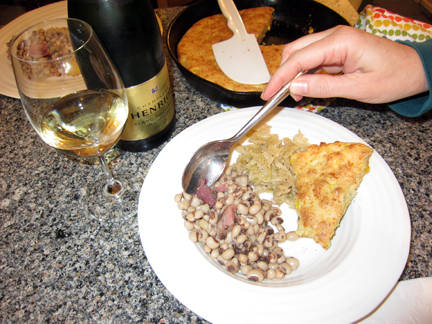
On New Year’s day, Tracie P cooked up some black-eyed peas with the ham bone reserved from the spiral ham Mrs. B had served on Christmas day. Her buttermilk cornbread (baked in her grandmother’s cast-iron skillet) was unbelievably delicious, especially when used to sop up the bean liquor (as it is called in the south, i.e., the beans’s cooking liquid). Neapolitan-style cabbage braised with onions gave the combined flavors just the right twang of sweet and sour.

And the perfect pairing for those creamy beans? Henriot NV Blanc Souverain, 100% Chardonnay. Ubi major, minor cessat: I am always one to agree with Ed McCarthy when notes that Chardonnay finds one of its greatest expressions in Champagne. This wine was an ideal pairing for the flavors of our New Year’s day meal: its acidity and white stone fruit flavors combined with its elegant fizziness were wonderfully refreshing against the richness of the cornbread, the dolce amaro of the cabbage, and the texture of the legumes.

Black-eyed peas for New Year’s is now a three-year-old tradition at our house and de rigueur in the south. I loved Jessica Harris’s NY Times op-ed on its origins as a New Year’s dish.

What did ya’ll eat on New Year’s day?