Prosecco, lies, and videotape: the real story behind the new wave Prosecco

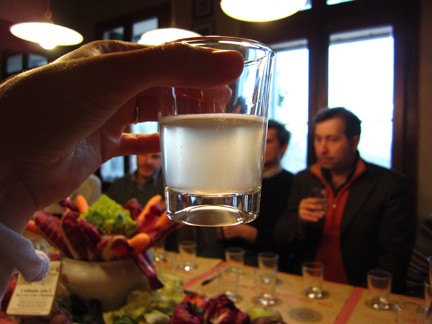
Above: Until the 1970s, before pressurized “autoclave” tanks were introduced into the appellation, most Prosecco was double-fermented in bottle “on its lees.” The resulting wine was gently sparkling, cloudy, and still had the “fondo” (sediment) in the bottom of the bottle. Even when I lived and worked in the Veneto in the 1990s, it was a lot easier to find Prosecco “col fondo” (with sediment) than it is today. The traditional glass for Prosecco is the one pictured above.

Alan Tardi is one of the great wine writers and restaurant professionals of our generation. I had the chance to meet him a few times when I lived and worked in New York and I’ve greatly appreciated and admired his work (especially this wonderful 2006 article on Asprinio).

But he gets it wrong in today’s New York Times article on Prosecco and its (relatively new) DOCG, “Prosecco Growers Act to Guard Its Pedigree.”

Maybe it was not Alan but his editor at the Dining section who hand-crafted the title (a “pedigree” for Prosecco?). But it was certainly Alan who wrote the oxymoron “sophisticated prosecco.”

The Italian wine writers scratched their head incredulously when then-agriculture minister and native of Treviso where Prosecco is made, Luca Zaia, effortlessly pushed through legislation creating the Prosecco DOCG.

Does a humble wine like Prosecco — and by its very nature, Prosecco should be a humble wine — deserve to be elevated to the status of wines like Barolo and Brunello di Montalcino? asked pundits like Italy’s top wine blogger, Franco Ziliani.

Yes, it’s true, as Alan notes, that the new DOCG (which went into effect in April 2010) gives the wines raised in Conegliano and Valdobbiadene a bureaucratic distinction that sets it apart from Prosecco grown in Friuli, Piedmont (yes, Piedmont), and Australia. But this DOCG was just one of many that were created before Common Market Organization reforms went into in 2009, shifting the power to create new designations from Rome to Brussels. It’s one of the many examples of political spoils that Zaia lavished on his hometown before his boss Berlusconi was forced out by the international community.

And yes, it’s true that the biggest names in commercial Prosecco — Adami and Ruggeri are among those that Alan tasted for the piece — are making “heirloom” vintage-dated and vineyard-designated wines, as well as low-sulfur and even lees-fermented wines.

But these products are the result of attempts by the Prosecco industrial complex to appeal to the hipster sommelier crowd.

In fact, excellent col fondo Prosecco has been produced for many years now by an ever expanding group of small growers (see this post on our col fondo tasting last year). This is the bona fide new wave of Prosecco.

Costadilà is one of those wines and has been available in the U.S. for a few years how. And Coste Piane, which has also been available here for many years, has been making and marketing true Prosecco for as long as anyone can remember. More recently, col fondo producer Bele Casel has shipped its wines to North American shores.
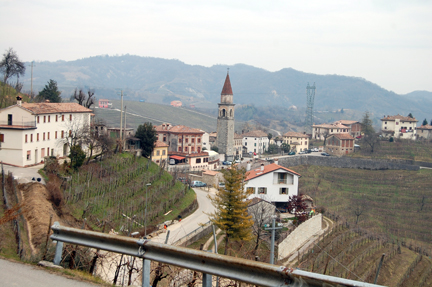
Above: The village of Rolle (not Passo Rolle, the mountain pass, btw) lies at the epicenter of the Prosecco appellation. Nearly equidistant from Conegliano and Valdobbiadene. Most locals would argue that Conegliano is where Prosecco was born as an appellation, even though Valdobbiadene has eclipsed its sister village.

And on a technical note, in Italian and Veneto dialect (including the dialect of Treviso), rive is the plural of riva, which does indeed denote hillside or slope (analogous to costa in Prosecco parlance). The rive system doesn’t denote a single growing site, as Alan implies: it denotes a series of slopes set apart for their topographical designation.

While I’m not a fan of Ruggeri, there’s nothing wrong with a glass of any of Adami’s wines. But they don’t represent real Prosecco. They are an expression of the consumerist hegemony that has choked my beloved trevigiano since the 1990s when Prosecco became a brand in the U.S.

I know I’m splitting hairs here and I remain Alan’s loyal admirer.

His oversights are harmless in the big (commercial) scheme of things and not nearly as bad as those in a Times piece this week in which Eric Pfanner ingenuously believes that a Paris wine shop owner is affected by Robert Parker’s “downgrade” of a 1998 Châteauneuf-du-Pape.

    I have no intention of second-guessing Mr. Parker, who has been tasting, and championing, the wines of Châteauneuf-du-Pape for decades. But the change in his score for the 1998 Beaucastel highlights the challenges of encapsulating something as complex, subtle and capricious as a fine wine in a single number.

The moment of truth has arrived: it’s high time that we begin questioning the wisdom of Robert Parker’s rating system! It’s enough to make you think that the editors at the Times Dining section only recently discovered bread and butter…

O, Eric the Red, where art thou? O, Solomon among wine writers!

Sexy girls and sommeliers: an Italian recipe for controversy

Anyone who has ever been to Italy (and especially anyone who’s ever watched an Italian primetime variety show) knows that sexy girls often appear there in the strangest places.
The models are called veline (a word that doesn’t come from velo or veil but rather the French vélin, akin to vellum, i.e. fine parchment obtained from calves’s skins; it was first used in its current meaning in the late 80s on the show Striscia la notizia where, by metonym, it was used to denote the models who presented cue cards, called veline in Italian editorial parlance, to the show’s stars).

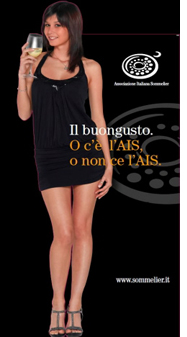
The Italian Sommelier Association’s (AIS) use of a velina (left) in one of its promotional campaigns stirred controversy late last year (December 27) when one of Italy’s top wine bloggers, Alessandro Morichetti, pointed out that the model is holding her glass incorrectly. The story was picked up on Monday of last week by Luciano Ferraro, a blogger for one of Italy’s leading newspapers, the Corriere della Sera. “The veline sommeliers have arrived,” he wrote.

Later in the day, in a post entitled “AIS, Good Taste, and Blow-Up Dolls,” Laura Rangoni, blogger for one of Italy’s leading glossy magazines, L’Espresso, wrote that she was offended by the campaign’s sexual and body-image implications, saying that she was going to cancel her membership in the body (no pun intended). The “good taste” of the association had sunk to new lows, she wrote, especially when the campaign centered around the slogan: good taste: either you have it or you don’t (playing on the assonance between the second personal singular of the verb avere, hai, and the association’s acronym AIS).

By Thursday, a spokesperson for the AIS issued a press release in which he reproached Morichetti for posting false information and Rangoni and Ferraro for alleged sloppy journalism.

It’s enough to drive you to drink!

Another AIS controversy unfolded late last year when the body ended its longstanding relationship with top Italian wine blogger Franco Ziliani, who, for more than three years, curated a recurring “WineWebNews” column for the association’s site, a monthly round up of wine blogging from Italy and around the world. It enjoyed a wide following in the Italian enoblogosphere, in part because it offered readers a view beyond Italy (Franco synopsized and translated salient quotes from English-language blogs). As southern Italian wine blogger Luciano Pignataro observed, the move came after the AIS hired ex-Gambero Rosso editor Daniele Cernilli as its head of marketing. (De gustibus non est disputandum.)

“An Aristotelian syllogism could be applicable in this case,” wrote Luciano. “Cernilli is named as director of marketing. Cernilli detests Franco Ziliani. Cernilli rubs out Franco Ziliani.”

Inspired by a tide of appeals from readers, Franco has relaunched the column on his own blog.

My goodness… It’s enough to drive you to drink… and blog…

The Saint of Sangiovese Gambelli

Yesterday, I received yet another round of remembrances of the great Giulio Gambelli (who passed away a few days ago), including one by my good friend Francesco Bonfio, president of Vinarius, the association of Italian wine shops.

    He was an exquisite, deeply humble person whose humility was rivaled only by his extraordinary knowledge of Montalcino and especially Chianti Classico. Every time I saw him at the presentations of new vintages he would whisper to me the names of two or three wines that I should taste. But he didn’t just say the name of the farm: he noted the vintage, category, and often the vineyard, specifying this one, yes and this one, no. And they were all his wines. But at the same time, being the great gentleman that he was, he would also point out wines from wineries that he had just tasted — wines, although not his own, that had piqued his interest. Honestly, I’d have to say that he was more apt to praise these than his own creations.

For all the bitter discord that inhabits Montalcino and Chianti Classic and the continuing acidic debate over the inclusion of international grape varieties in Montalcino and Chianti Classico, the hagiography of Gambelli has united the entire spectrum of Tuscan grape growers, winemakers, wine writers, and lovers.

If, in vita (in life), this man championed Sangiovese in purezza (in purity) as Tuscany’s greatest and ultimate vinous expression, let us hope that in morte (in death) his legacy will continue to inspire all of us to transcend our earthly weakness.

Sit tibi terra [tuscolana] levis Juli.

The world of Italian wine mourns Giulio Gambelli, the great maestro of Sangiovese

Sit tibi terra [tuscolana] levis Juli.

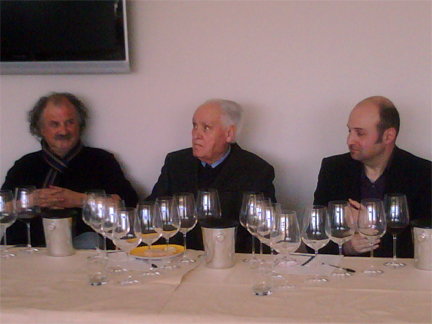
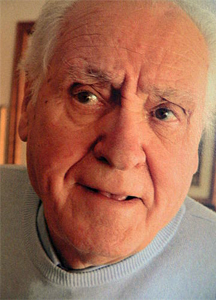
When Italy’s top wine blogger Franco Ziliani wrote me yesterday to share the news that the great Maestro of Sangiovese, Giulio Gambelli (left, photo by A. Pagliantini via Enoclub Siena) had left this world for another, the feeds were already overflowing with tributes for the man who shaped a generation of winemakers in Tuscany and helped to craft some of the world’s greatest wines (see below). As Tuscany continues to abandon the traditional-style Sangiovese (“translucent and profound” to borrow Aldo’s phrase) that he championed, it’s hard not to imagine that his passing will not be remembered as the end of an era…

I’ve translated a few passages below (with links to the orignal posts for Italophones).

A very sad new year for the world of Italian wine: Giulio Gambelli, 87, the great maestro of Sangiovese has died in Poggibonsi, Tuscany. Gambelli was not an enologist but rather a master taster and the world’s greatest expert on Sangiovese — the often challenging, supreme grape of Italy. He was a modest, unassuming person, wine’s humble servant, not an oversized personality but rather an anti-celebrity. To his friends, he was known affectionately as Bicchierino, the little glass.

—Franco Ziliani

He was the man who had taught all the producers in Montalcino how to make wine, not to mention a healthy slice of Chianti Classico. He was a (towering) piece of the history of the last 60 years in Tuscan winemaking. But if you told him so, he would start laughing and he would huff and puff, unamused because he didn’t want to carry the weight for something that he did out of pure passion and because he loved to do it.

—Carlo Macchi

For those who didn’t know him, the following are just some of the Sangiovese producers for whom he consulted: Montevertine, Poggio di Sotto, Soldera, Ormanni, Villa Rosa, Bibbiano, San Donatino…

Gambelli had taught winemaking to so many producers in Montalcino and Chianti Classico that the adjective gambelliano had come to denote true Sangiovese…

—Aldo Fiordelli

Decanter’s obit here.

Photo by Consumazione obbligatoria.

Poggio di Sotto 2006 Rosso di Montalcino

Since the arrival of Georgia P three weeks ago today, we’ve been cooking at home every night (no takeout a casa Parzen except for Christmas day, when we just had to have Chinese and Woody Allen) and drinking “everyday” wines that we love — entry-tier Santorini by Sigalas, Verdicchio by Bucci, Produttori del Barbaresco Langhe Nebbiolo, all ideal because they’ll last for a few days once opened).

Meals have been simple and wine hasn’t been a focus at our house lately but I did open a special bottle of wine for Alfonso when he and his SO Kim came to meet their putative granddaughter for the first time.

Together with Brunelli, Poggio di Sotto is one of the “younger” estates that has really carved out a name for itself as an indisputable icon of the appellation. And the bottle that we shared that night — from a good to great vintage, depending on the producer — was a true benchmark for Sangiovese: brilliant nervy acidity, technicolor fruit balanced by layered minerality, and a focus and precision that is uncommon among the sea of Brunello bottlers who came late to the game.

The wine isn’t cheap but it’s one of those wines that I wish every young wine professional in our country could taste: it is the apotheosis of what Sangiovese can and should be (as Alfonso pointed out in his excellent post yesterday). And perhaps more significantly, it’s an expression of what the variety can attain when it’s grown in the best sites and with the proper care.

The Poggio di Sotto farm lies in the southern subzone of the appellation, in the village of Castelnuovo dell’Abate. In the photo above, I’m looking south-southeast toward Mt. Amiata from the village. The Poggio di Sotto farm is about a three-minute drive east, with some of the highest south-and southeast-facing vineyards in the appellation (I’ve actually never visited the farm but I’ve driven by it a thousand times).

Poggio di Sotto was recently sold to pharmaceutical giant, northerner Claudio Tipa, whose Tuscan empire continues to grow. But from what I’ve seen with his other acquisitions of legacy wineries (like Grattamacco), Tipa seems to be committed to maintaining continuity. Let’s hope it’s the case: to lose these wines would be to lose an icon, a benchmark, and a piece of that “cultural patrimony” that some of us continue to hold dear…

For our vines have tender grapes…

HAPPY NEW YEAR, EVERYONE! :)

For lo, the winter is past,
The rain is over and gone.
The flowers appear on the earth;
The time of singing has come,
And the voice of the turtledove
Is heard in our land.

The fig tree puts forth her green figs,
And the vines with the tender grapes
Give a good smell.
Rise up, my love, my fair one,
And come away!

O my dove, in the clefts of the rock,
In the secret places of the cliff,
Let me see your face,
Let me hear your voice;
For your voice is sweet,
And your face is lovely.”

Catch us the foxes,
The little foxes that spoil the vines,
For our vines have tender grapes.

Song of Solomon

Best meals 2011: Le Logge (Siena)

Thanks again to my friends Marina and Francesco who treated me to this incredible dinner at Laura Brunelli’s Osteria Le Logge in October of this year…

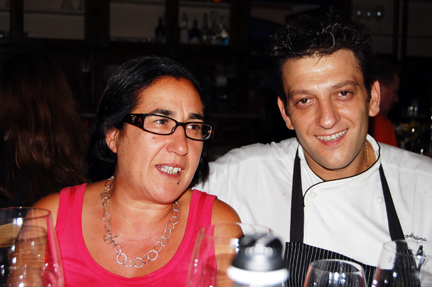
I’d eaten at Le Logge many years ago but not since the Brunelli family brought chef Nico Atrigna (right) to Siena from Campania in the mid-1990s. Laura Brunelli (left), whom I’d never met, also dined with us.

Parisi Slow-Cooked Egg with Dashi Broth, Licorice, Chives.

Note the intense yellow orange of the yolk. Parisi feeds his chickens goat milk to obtain the rich flavor and color. The best egg I’ve ever had, hands down. (See Katie Parla’s excellent post on Parisi.)

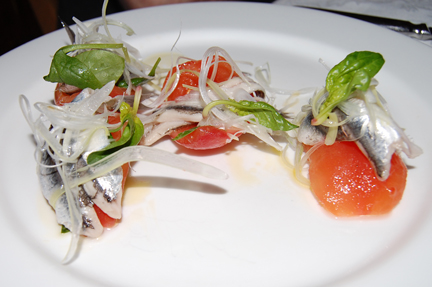
Marinated Anchovies with Tomato and Spring Onion.

Ricotta Pudding with Eggplant and Thyme Cream.

Ox Tongue with Cured Cinta Senese Shoulder Served over a Spinach Orzotto. (Cinta Senese is Siena’s heirloom striped pig, smaller in size than most hogs, making for ineffably delicate salt-cured pork.)

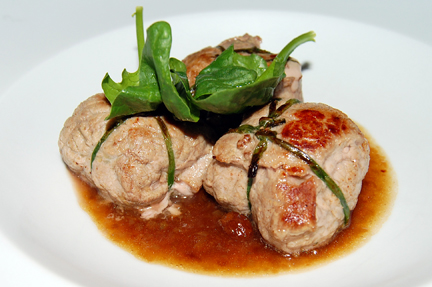
Veal Roulades Stuffed with Escarole and Pine Nuts Served over a Raisin and Onion Ragù.

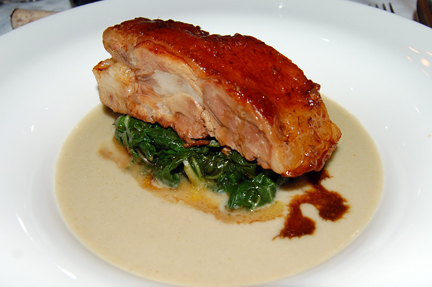
Lamb Confit with Dried Fava Bean and Swiss Chard Sauce.

What did we drink?

Except for the Gianni Brunelli 2004 Brunello di Montalcino, all of the wines from Thursday night’s dinner at Le Logge came from my generous friend Francesco’s cellar (see below).

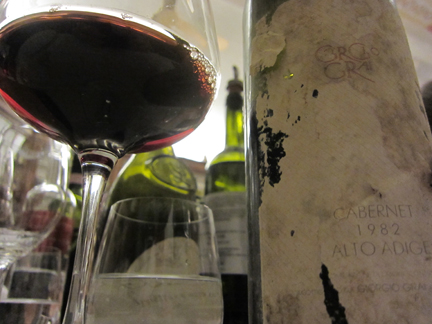
Giorgio Grai 1982 Alto Adige Cabernet

In nearly every region of Italy where I’ve tasted, I’ve met winemakers who cite Giorgio Grai as their mentors. I met the man once, many years ago, in New York at a tasting of his wines at Le Cirque. Now in his 80s, the tireless Italian master continues to consult and make wine (and drive race cars). Elegant, refined, polyglot, polymath… I think of him as the James Bond of Italian wine. Francesco called him from the table and we shared the immense sensorial and intellectual pleasure inspired by this wine, still very youthful in its development.

The acidity and freshness in this wine were brilliant and its focus and precision awe-inspiring. Ripe red fruit with notes of cinnamon and eastern spice and a gentle menthol note that emerged with aeration. Where other expressions of Cabernet Sauvignon make me yawn, this wine made me cry…

Baron de Ladoucette 1983 Pouilly-Fumé Baron de L

This wine was actually the opener but ubi major, minor cessat… I have to confess that I had never tasted Ladoucette: Francesco informed me that the winery’s Baron de L is considered one of the great (if not the greatest) expression of Pouilly-Fumé and Sauvignon Blanc. This wine shared its last breath of life with us, rewarding us with richness in mouthfeel and flavors of lemon custard and freshly baked pie crust and a gentle aromatic note of country herbs. With aeration, it started to wilt but its last gasps of vitality were thrilling.

Gianni Brunelli 2004 Brunello di Montalcino

When Francesco asked Laura Brunelli which vintage of her family’s wine we should drink, she and sommelier Mirko agreed that the 2004 is in a moment of grace. Its current openness shared that signature zinging acidity of Brunelli’s Sangiovese, with plum fruit and intense minerality and just a touch of savory (think carpaccio not filet mignon). Gorgeous wine that will probably close up again soon.

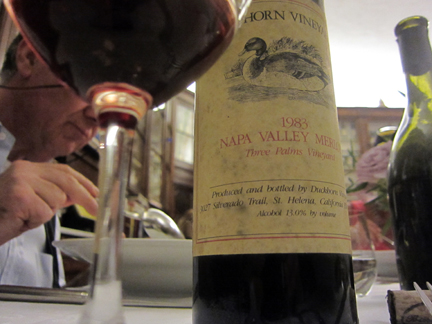
Duckhorn 1983 Napa Valley Merlot Three Palms

Francesco inherited his Americanophilia from his father, whose happy memories of the American liberation of Italy during the second world war, said Francesco, spurred his father to go west. Knowing that I’m from California, Francesco brought the Duckhorn as a homage to my origins. It surprised us with bright red fruit on the nose and honest acidity. But the dominance of wood in the mouth disappointed me. As balanced as it was otherwise, the wood sat on top of the wine, lacking cohesion with the other elements. Alas… America’s love affair with oaky wine always leaves me scratching my head…

I was so happy to meet Francesco and his lovely wife Marina back in June in Apulia, where he and I were both judges in a Southern Italian wine competition. Their familiar Paduan cadence brought back memories of my many years at the Università di Padova. Francesco is the president of Vinarius, the association of Italian wineshop owners. I enjoy Francesco’s company and conversation immensely and his tales of the late and great Italian wine importer Lou Iacucci had me on the edge of my seat. Here’s the link to his wine shop, just off the Piazza del Campo.

Best meals 2011: Frasca (Boulder)

Dinner at Frasca with Tracie P in September was one of the best meals of my life… for the food, for the wine, for the fun, and for the sheer joy of sharing it all with the woman I love…

When Tracie P and I talked about one last “babymoon” before the last trimester of our pregnancy (when she can’t fly anymore), she expressed her desire to dine at Frasca in Boulder. And so on Saturday, we headed for the Rocky Mountains and one of the best meals we’ve ever had.

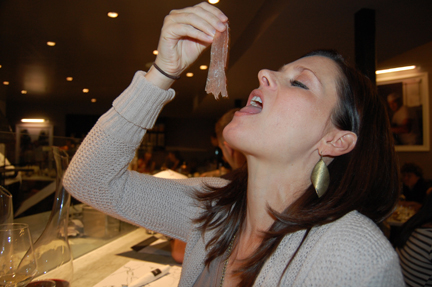
It’s so hard to get properly sliced prosciutto in this country and I have told Tracie P about Chef Lachlan Mackinnon-Patterson’s obsession with reconditioned vintage Berkel slicers and how their beveled blades make all the difference (it’s in the diffusion of the heat, Lachlan explained to me last year when we traveld in Friuli together). When our server asked us about what we wanted to eat, the first thing out of (and into) Tracie P’s mouth was: P-R-O-S-C-I-U-T-T-O!

Co-owner Master Sommelier Bobby Stuckey graciously offered to select the wines for us and it was only fitting that we start with 2010 Malvasia by Venica & Venica: Lachlan, he, and I tasted the wine together last September at the winery in Collio not long after it had been harvested. We loved the spice in this vintage of Malvasia by our good friend Giampaolo Venica.

Lachlan’s frico was off-the-charts good.

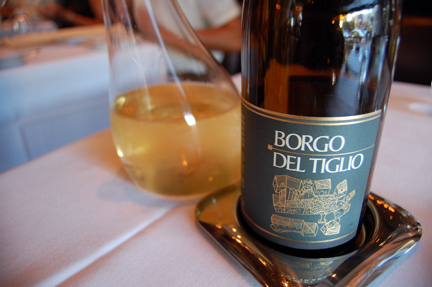
Bobby surprised us with this 09 lees-aged Sauvignon Blanc by Borgo del Tiglio, a winery I’d never tasted or seen in the U.S. I love the muscular style of Sauvignon Blanc embraced by certain Friulian producers. If ever there were an international grape variety to grow in Italy, it would be Sauvignon Blanc in Friuli, where winemakers can obtain sublime expressions of this aromatic grape. The 09 Tiglio had a crazy spearmint note on it and it was amazing to see this intense wine evolve over the course of the evening. (Note how Bobby decanted it for us.)

Lachlan’s cooking is a benchmark for Italian cuisine in the U.S. His gnocchi had that perfect balance of substance and lightness.

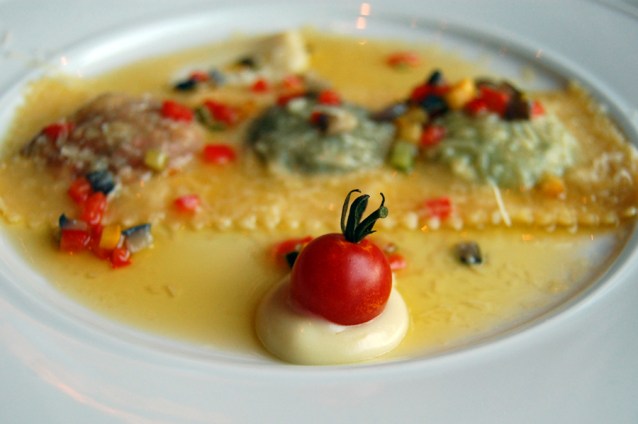
His ravioli were stuffed with a “deconstructed ratatouille,” in other words, all of the ingredients of the classic French dish, but prepared separately. Again, the quality of Lachlan’s pasta is a benchmark for Italian cuisine in the U.S. (Note the yellow color.)

1997 Schioppettino by Ronchi di Cialla was one of the most incredible wines we’ve drunk this year. Unbelievable minerality with this bright, fresh grapey note and under 13% alcohol. Simply incredible… It was gorgeous with Lachlan’s roast pork loin.

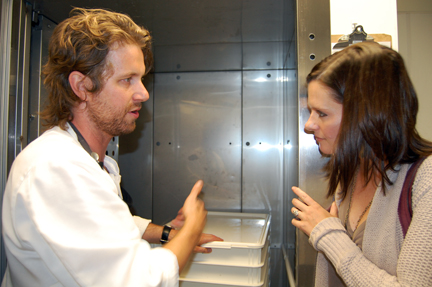
After dinner, Lachlan gave us a tour of the kitchen and revealed some of the secrets behind his Neapolitan pizza, served at their new pizzeria next door. Believe it or not, we actually went next door after our 3-hour dinner and ate again! I’ll post on the pizza later this week.

At certain point during our dinner, we were having so much fun that we were nearly overwhelmed by the joy of sharing food and together. Almost simultaneously, we looked into each other’s eyes and it was as if the same thought had just come to our minds at the same moment. I looked at Tracie P and told her I loved her and that it’s a miracle that we found each other: there’s no one else in the world that I could share an experience like this.

See that glimmer in her eye (as she enjoys a Sanbitter before dinner)? It makes me melt like prosciutto on her tongue…

IMHO, Frasca is the best Italian restaurant in the U.S. and you really can’t go wrong there. But it’s so much better if you go with someone you love…

There’s so much more to show and tell about our dinner in Boulder but it’ll just have to wait… Stay tuned and thanks for letting me share this special evening with you!