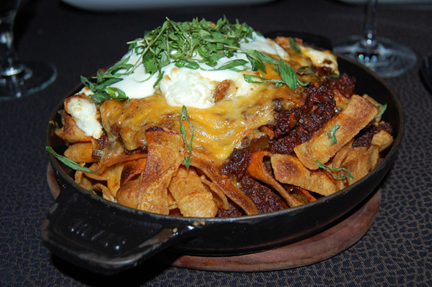
Blasphemous pizza pairing last night @SottoLA (Charles Scicolone would approve)

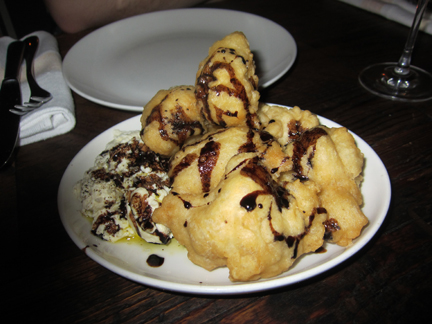
Had to start with the pittule (Pugliese fritters with vincotto and ricotta), paired with Donkey & Goat Sluicebox (pronounced PEE-too-leh, btw).

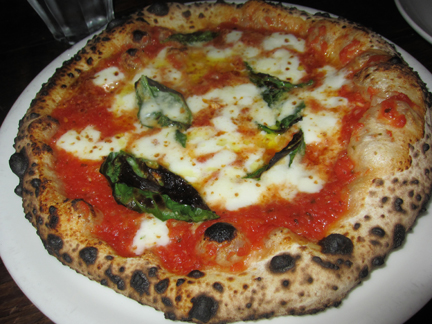
All things considered, I still think that pizzaiolo and chef Zach makes one of the best — if not the best — authentic Margherita in the U.S.

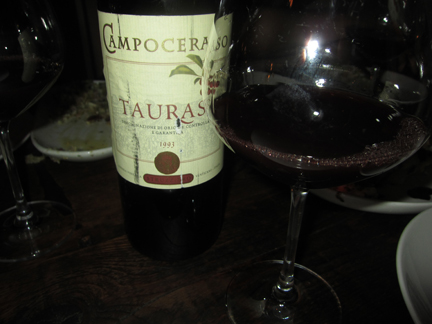
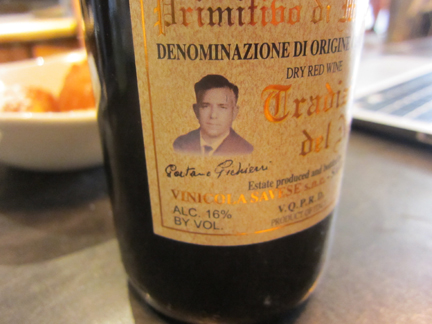
To celebrate the birthday of my good friend (and agent who just scored us the NN+ HBO Girls license) Michael, we opened a bottle of 1993 Struzziero Taurasi Campoceraso — unbelievable.

93 was a classic, balanced (as opposed to americana) vintage in Taurasi and is considered one of the greatest of the decade.

I was blown away by the bright acidity and brilliant fruit in this wine, tempered by the characteristic minerality and earthiness of botte-aged Aglianico. (The most hilarious tweet today, btw, by @JohnQBoxler: “I like big botti and i cannot lie.”)

Pizza and old Taurasi? Blasphemous!

Charles Sciolone would approve, no doubt.

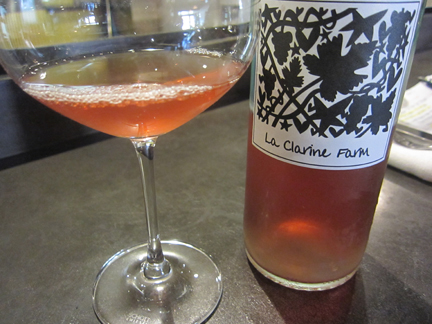
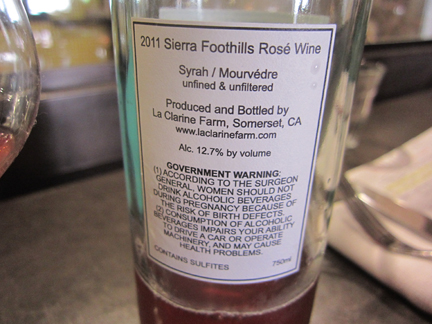
La Clarine Farm rosè: touch it, kiss it, smell it, drink it… it’s finally here (almost) @amyatwoodwine @lcfwino @SottoLA

From the department of “dreams do come true”…

Thanks to the coolest lady on the Los Angeles wine scene, Amy Atwood, of the 90 or so cases produced, we were able to score enough of Hank Beckmeyer’s off-the-charts good La Clarine Farm rosè for a by-the-glass campaign at Sotto (to be launched shortly).

Think: a judicious schmear of qunce jam and lightly salted crème fraîche on gently toasted crusty bread. I cannot wait for Tracie P to taste this wine. It’s salty and crunchy and utterly satisfying.

Domaine LA is the best retail outlet for Hank’s wines in the Southland and I was able to secure some for Do Bianchi Wine Selections (my wine club) for later this spring.

Taurasi, Italian Grape Name & Appellation Pronunciation Project @SottoLA

It was great to see the response yesterday to a new entry in the Italian Grape Name & Appellation Project. Thanks to everyone for all the retweets!

Since I’ll be heading to Los Angeles later this week to work the floor at Sotto (where I curate the wine list) on Thursday and Friday nights, I also wanted to post this entry (above) on Taurasi by one of my favorite producers, Struzziero.

Struzziero is old-school Taurasi all the way and we’ve featured a vertical of the wines — 92, 97, 01 — on our list since we first were able to secure an allocation last year.

I love the wines…

And I couldn’t resist making this “outtake” video of my “shoot” with Mario Struzziero at Vinitaly.

With true campano style, he added a short gloss using a word that has a particular meaning in Italian: peripezia or peripeteia (“In classical tragedy [and hence in other forms of drama, fiction, etc.]: a point in the plot at which a sudden reversal occurs. In extended use: a sudden or dramatic change; a crisis,” Oxford English Dictionary). It’s an ancient Greek word that is still used regularly in Italian today, especially in Rome and southward. In workaday language, it means simply mishaps or vicissitudes. But in this case, his usage has layered meanings… It’s one of the things I love about Italy and Italian language…

And I love his family’s wines…

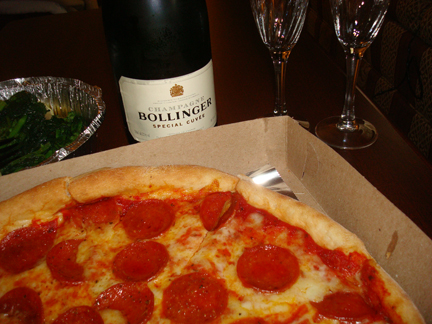
Pizza & Bollinger? Ummm… I think I told you so…

From the department of “ubi major minor cessat”…

Eric the Red writes today on the virtues of pairing pizza and, ahem, Champagne…

Bolly is one of his top picks.

Umm, where have I heard that before?

Our good friend Charles Scicolone (above) – with whom we have shared many a pizza and great wine — also gets a nice shout out in Eric’s piece…

McMalbec, my post today @EatingOurWords @HoustonPress

My editor asked me to write something about a wine from Argentina and so I just couldn’t help myself…

When my wife Tracie P and I pulled the synthetic cork out of a bottle of Terrazas de los Andes Altos del Plata Malbec on Saturday evening at a family function, we joked that we could write the tasting note without even sampling the contents: “Bright jammy fruit, with an intense blueberry note, aggressive but balanced alcohol, reluctant acidity but quaffable nonetheless, a crowd-pleaser for under $10.”

Let’s face it. Wines from Argentina are like McDonald’s. And that’s a good thing, people! No matter where you go, you know that a Big Mac will taste exactly like the Big Mac you enjoy (when hungover) at your corner franchise.

And like Mickey D’s secret sauce, the Argentine wine formula is a winner all over the world.

Click here for my post today for the Houston Press…

Lagrein: Italian Grape Name & Appelllation Pronunciation Project @EricAsimov

Eric the Red was right to “have a little fun with it” when he wrote me asking about the pronunciation of the Italian grape name Lagrein last year.

“FEW things are simple in northeastern Italy,” he wrote, “least of all lagrein, a red grape that can produce fresh, aromatic, highly seductive wines. Why, just last week, I asked a linguistically minded friend who is fluent in Italian for the proper pronunciation of lagrein. Here is his response, or part of it:”

    “Lagrein is a tough one,” he said, “in part because it’s pronounced using a Germanic, as opposed to an Italianate vowel system.” He went on to offer his preference, lah-GRAH’EEN, but allowed that lah-GRINE and lah-GREYE’NE (where greye rhymes with eye) were also acceptable. Well, linguists are nothing if not perfectionists. But even allowing for such hairsplitting, lagrein comes with ample grounds for confusion. It is grown primarily in Alto Adige, a region so far to the north in Alpine Italy that it practically touches Austria and Switzerland. There, the culture is more Tyrolean than Italian, and the first language is often German. Many wines from the region are labeled in both Italian and in German. Even the name of the region, Alto Adige, does not speak for itself; it is generally rendered bilingually with its German counterpart, Südtirol (South Tyrol, using the Germanic vowel system, of course).

Here’s the link to his profile of Lagrein and tasting panel notes.

When I headed to Italy at the end of March to attend the annual Italian wine trade fair, Lagrein was on the top of my list of new ampelonyms to capture for the Italian Grape Name and Appellation Pronunciation Project.

And so I made a beeline to the Franz Gojer stand — in my view, one of the greatest producers of Lagrein — and asked Franz’s son Florian to speak for my camera. While Florian is bilingual (and of course, we spoke in Italian), German is his first language. And as per what I told Eric above, Lagrein, linguistically speaking, is first and foremost Germanic.

Thanks for speaking Italian (grapes)!

Frito pie, meditations and contemplation…

There is perhaps no dish that inspires connoisseurship among Texans as much as Frito Pie.

Shrouded in mystique and lore, this mighty staple of rigorously authentic Texas gastronomy, speaks to the citizens of our state like no other in our culinary canon. By combining indigenous ingredients and formulas — Fritos, invented in San Antonio, and chili con carne, actually known simply as chili in our state, as one adoptive Texan learned dutifully when he made the mistake of calling “turkey chili” chili — this supremely Texan of victuals marries all the things we love best: Fat and spice.

Click to continue reading my post for the Houston Press today…

Guado al Tasso “tasted like ass” (bottle variation reveals)

Taking a break from posting about my trip to Italy to give a huge shout out to Texas wine legend (and now wine blogger) Bear Dalton, whom I met for the first time at a small Houston wine blogger summit that I organized last night at Tony’s Ciao Bello.

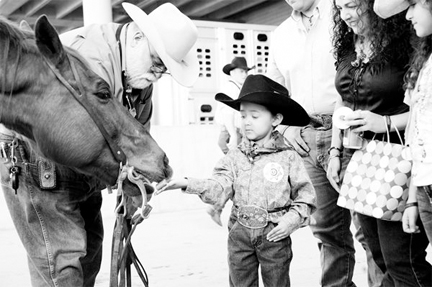
As you can see in the photo above, Bear is not only a wine dude (educator and industry veteran) but he’s also a cowboy (for real). And in true Texas fashion, he shoots from the hip.

On Easter Sunday, he posted these notes on his blog from tasting roughly 90 bottles of Guado al Tasso for the Houston Rodeo Champion Wine Auction Dinner.

    About 90 bottles of each. While I found only two technically flawed bottles (one of each wine, both suffering from TCA or “cork taint”), the exercise proved to be very interesting. In both wines, there was a LOT of bottle variation. The bottles ranged form sublime to, well, frankly earthy and a bit disappointing. While I wasn’t keeping formal score, I’d say that in both cases somewhat more than third of the bottles were lovely (which is to say better than expected), about a third were perfectly acceptable (about as expected but not so good-vibrant-alive as the “lovelies”) and somewhat less than a third were (in varying degrees) frankly earthy and even a bit funky (but not technically flawed in the sense of showing TCA, TBA, oxidation, etc.) but still drinkable and for the most part enjoyable. Some of my younger friends might say that the least desirable of these “tasted like ass”. Had I ordered either of these wines in a restaurant, I would have accepted (and likely drunk) all of them except the two corked bottles. However, if my only experience with the wines were the earthy/funky bottles (and none of the “acceptables” or “lovelies”), I might never have ordered them again. While the earthier bottles showed no obvious technical flaw, they were less good and did not justify their price.

Chapeau bas, Bear! Not only are you a Texas original but you are a righteous man! Few in our business would have the courage to publish such a painfully frank post and I admire you for it…
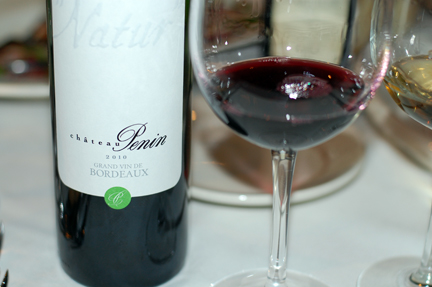
The wine blogger summit included myself, Bear, Wine Thoughts (one of my favorites), VineSleuth Uncorked (also a mommy and Bible blogger), and H-Town Chow Down (one of the leading food blogs in a city where food blogging is a highly competitive and often cut-throat affair).

Bear brought a bottle of zero-sulfur Bordeaux, the Château Penin above. I brought a bottle of COS Ramì, skin-contact Inzolia.
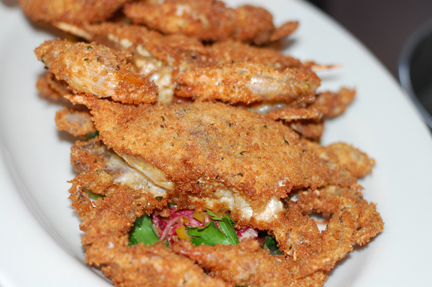
But it was Tony’s (in season, early this year) Gulf Coast soft shell crabs that stole the show…