Schioppettino, the next big thing? (history of its revival and fortune)

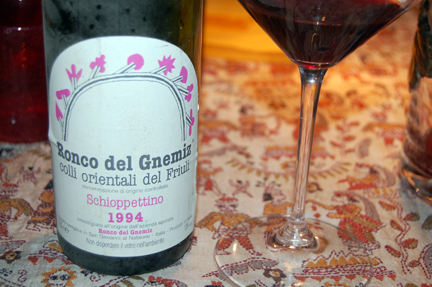
Above: The folks at Ronco del Gnemiz hosted a vertical tasting of Schioppettino — stretching back to to 1989 — for the COF2012 bloggers last week. The township of San Giovanni al Natisone (where their property is located) is not the historical epicenter of the variety. But when current owner Serena’s father bought the estate in the 1950s, there were Schioppettino vines growing there — an indication of its popularity in another era. They still make one botte (large cask) of Schioppettino every year.

Anglophones love to say Schioppettino (here’s the entry for Schioppettino in the Italian Grape Name and Appellation Pronunciation Project). Perhaps it’s because of the variety’s purported onomatopoeic properties: some speculate that the name derives from the fact that the thick-skinned grape pops in the mouth when you bite into it; others believe that commonly encountered secondary fermentation and the resulting fizziness gave rise to its name (an early printed mention — 1823 — of the ampelonym is Scopp, according to Calò et alia).

As for the majority of Italian grape names, we’ll probably never know the etymon. But this lacuna doesn’t diminish our pleasure in saying Schioppettino (try it).
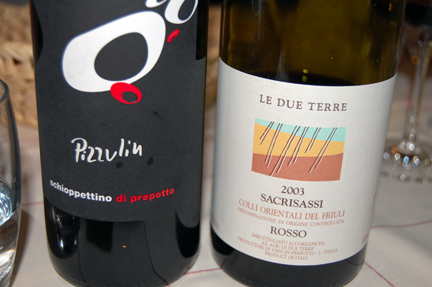
Above: In a tasting of roughly 15 Schioppettino producers from the township of Prepotto (the village where the grape is cultivated most famously), Pizzulin and Due Terre were standouts for me (the Due Terre entry was a blend of Schioppettino and Refosco). I also liked Petrussa and La Viarte. Here’s a link to a list of all the members of the Association of Prepotto Schioppettino Producers. The tasting was hosted by the Stanig winery in its restaurant/agriturismo and there is also an Enoteca dello Schioppettino worth visiting in Prepotto.

In many ways, Schioppettino and its revival in the late 1970s were precursors to the current renaissance of indigenous Italian grape varieties.

In 1976, the Rapuzzi family won the first-ever Nonino Prize — the Risit d’Âur or Golden Rootstock award — for its success in cultivating the forgotten grape. (Sadly, the wine they made from the 1975 vintage was never tasted because it was lost in the 1976 earthquake in Friuli, one of the many catastrophic events that shaped and defined the Friulian ethos in the twentieth century.)

In era when the great architects of the revival of “real wines,” Luigi Veronelli and Mario Soldati, were pioneering a new vinography that championed the indigenous over the international, Schioppettino was one of the earliest rallying cries. At the time, it was not authorized by the official “album” of government-sanctioned grape varieties and the Rapuzzi family risked a stiff fine and forced grubbing up. Lobbying by the Nonino family, combined with Veronelli’s patronage, helped to convince authorities to stand down. Today, the canonical rootstock for Schioppettino sold by the Rauscedo nursery is named “Rapuzzi”.
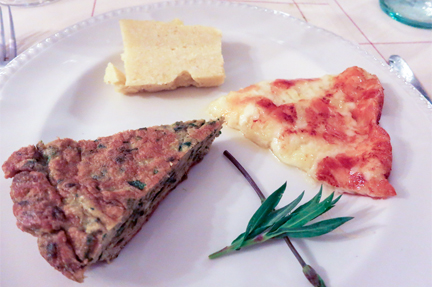
Above: In Prepotto, they pair Schioppettino with herb frittata, frico, and polenta. I think it could go with just about any type of comfort food. Photo by JC Reid.

Of all the tastings we attended in the Colli Orientali del Friuli last week, Schioppettino seemed to be the grape that excited the bloggers the most.

Was it because so little Schioppettino makes the Atlantic crossing?

Was it because the grape makes for juicy wines, with bright acidity and balanced alcohol?

Was it because of the grape’s signature spice, teetering somewhere between white pepper and cinnamon?

Maybe it’s because it’s just so fun to say Schioppettino…

Georgia P’s first Easter (man, am I glad to be reunited with my girls)

Every day while I was away in Italy, Georgia and Tracie P would send me a photo of them as soon as they woke up. Buon giorno, daddy was the subject line. It sure helped to assuage the loneliness that came with being away from them. But, man, there’s nothing like the real thing, baby…

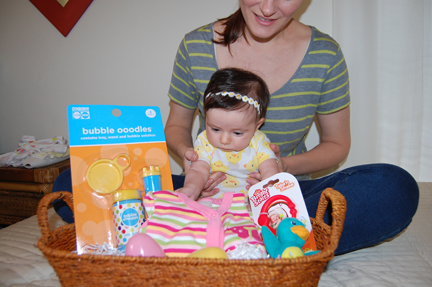
Yesterday, we celebrated Georgia P’s first Easter with an Easter basket.

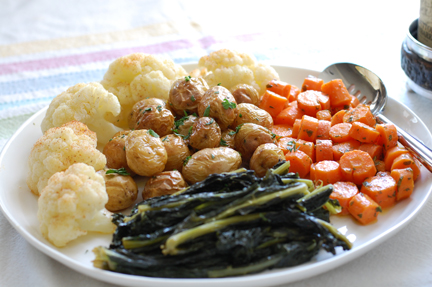
Dinner of steamed, roast, and sautéed vegetables…

and roast chicken for mommy and daddy…

paired with 2007 Produttori del Barbaresco classic Barbaresco…

and Irving Berlin’s 1948 Easter Parade, starring Fred Astaire and Judy Garland…

Man, is it good to be back home…

Hag Sameach – Buona Pasqua – Zissen Pesach – Happy Easter

This morning, Marina Zorzettig — our lovely den mamma and owner of the agriturismo Corte San Biagio where the COF2012 bloggers stayed — showed me these Easter eggs that her father made.

You wrap the eggs in dandelion flowers and the peel of yellow onions, she said, and then you wrap them again snugly in a dish towel before boiling.

Happy holiday, everyone… I’m heading home, where I belong…

I love you Tracie and Georgia P and can’t wait to hold you in my arms again…

Country roads, take me home…

Separatist and racist Umberto Bossi has resigned in disgrace!

Whether flipping off the Italian national anthem or using the lyrics to wipe his ass, whether spouting racist rhetoric or aligning his separatist party with the evil empire of Silvio Berlusconi, Umberto Bossi (left) has been the face of one of the ugliest chapters of contemporary Italian history.
I am not Italian but I have devoted my adult life to the study of Italian culture, literature, history, and gastronomy.

And it was with great pleasure that I toasted alla faccia di Bossi last night upon learning that he has resigned “amid a widening scandal of illegal party financing.” (Here’s the NY Times report.)

As much as I miss my family in this moment, after being away from our home for nearly two weeks, I am glad that I was in Italy on the day that he left office. And in these troubled times for Italy and Europe, it is my deepest hope that this episode marks a turning point in Italian politics and a turning of the tide of xenophobia that has gripped this nation in the last two decades.

Please join me tonight in raising a glass alla faccia di Bossi…

Pier Paolo Pasolini “Bunch of Grapes” (poem)

Photo via Pasolini.net.

I haven’t had time to perfect my translation but here’s an initial draft of the poem that I will be reciting tonight at the COF2012 press dinner. It’s one of Pasolini’s “forgotten” Friulian (language) poems (published posthumously in 1976) that didn’t make it into his songbook La meglio gioventù.

Bunch of Grapes

I dreamed that I was eating grapes
one berry at a time
from a plump green bunch,
a man’s entire destiny
his misfortunes
in those freshly picked grapes
as old as the world

in the dream, I’m the one eating
the grapes with a mouth
that laughs in despair, a pitiful sight,
because it’s been tricked
by the dark dream
and it must laugh as it chews
the infected berry

I crunch it between my teeth reluctantly
because when one dies, or eats,
shame will follow
as if I had scabies, I gobble down
its immobile grains
stuck in the glimmer
that descends on the dead

in the white, dry, limestone
glimmer that never dies,
I see Casarsa before me
and I am a child
in stockings and sweater that cover
my trembling flesh

the poor little, big house
with flies on its greased table
empty and tired,
its courtyard well
walkways and fields
are burning
in the blaze of the sun

wrought-iron beds in its rooms
white bedcovers that smell
of old fleas that died
in the time of my aunts and uncles
when poverty gnawed
even the branches of the fig-tree
in the sun-burnt garden

there, in the middle of it all, I,
a forgotten little featherless swallow,
felt the sin like the heat
and kept it under my scorching skin
as great as the world
that burned
in Casarsa

The Tagliamento, with its
asphalt road and green pastures
like the dried forests
and the yellow fields
of corn between the sea and the mountains:
everything burned in my childhood flesh,
an aching flame

Friuli, much needed rain this morning arrives

Much needed rain arrived in Friuli this moring.

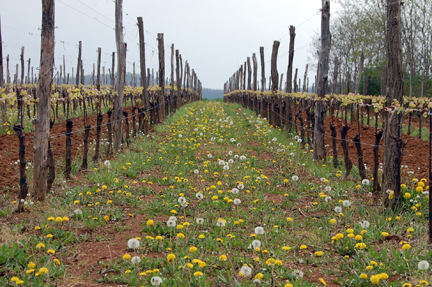
As you can see in the photo above, spring has come early to the region (and the rest of Italy) but the current drought here will stymie the vegetative cycle if sufficient water doesn’t arrive.

More will be needed but good news…

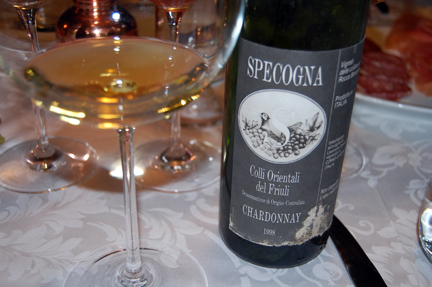
1998 Specogna Chardonnay INSANE #cof2012

Last night at Specogna.

I was completely floored by this wine, aged in large cask.

Acidity, nuanced fruit and minerality… One of the best, if not the best, wine of the trip so far. One of the best wines I’ve had this year and a wine that bespeaks Friuli’s immense potential to deliver world-class white wines.

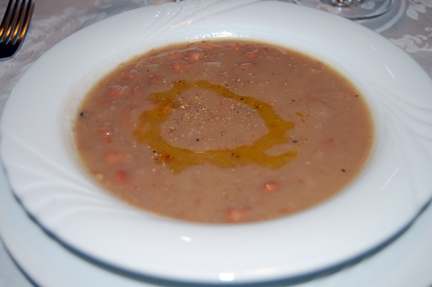
Brovada soup #cof2012

At Specogna last night…

I’d never had brovada in a soup…

In case you’ve never had it, brovada is a classic Friulian dish made from shredded turnips that have been macerated and partly fermented with grape skins.

The acidity of the grape juice gives the dish a wonderful tang. The soup was off-the-charts delicious.