Natural winemakers respond to Gambero Rosso

natural wine

Above: Frank Cornelissen, who produces wine on Mt. Etna, is one of the signatories of the following open letter. On Saturday, Italian journalist and wine industry observer Jacopo Cossater noted on his personal blog that the editors of the Gambero Rosso has managed to do what no one could until now: they have united the often discordant field of Natural winemakers in Italy.

On Friday, the popular Italian-language wine blog Intravino published the following “open letter” undersigned by a confederation of “natural” winemakers in response to a series of negative (and some would say blindly and wildly pompous, misinformed, and misguided) editorials on Natural wine published by the Gambero Rosso in its January issue (click the link for my excerpted translation).

The author of the Intravino post, Jacopo Cossater, notes that the editors of the Gambero Rosso have no intention of publishing the rebuttal.

I have translated the letter in its entirety below.

*****

Open Letter to the Gambero Rosso
February 1, 2013

Dear Sirs,

We write to you in the name of hundreds of wineries — both affiliated with appellation associations and consortiums and indepedent — that produce natural wine. We were dismayed to read the editorial by Eleonora Guerini (“The Natural Obsession”) and the observations by Bettane and Desseauve (“Have We Got Natural Wine For You!”) published in the January issue of your magazine.

To be honest, we have the distinct impression that you are not really up to speed with what has been happening, for years now, in the wine world. Your tout court accusation that “natural” winemakers produce only defective, oxidized, stinky wines is absurd. Your magazine regularly reviews and often rewards wines produced by wineries widely accepted as members of the natural wine orbit.

The technical part of your argument is wholly indefensible. What are the “new, ‘natural,’ and innovative” methods utilized to stabilize natural wines? Extended lees aging (a practice used for centuries, from Mt. Etna to the Loire Valley)? In Bettane and Desseauve’s article, the authors state that with natural vinification, “all of their grape varieties and terroirs end up resembling one another because the nasty native yeasts with which they are made — yeasts that greedily cannibalize the good yeasts if the vinifier allows them to do so — are the same yeasts that you find all over the planet”! From the implicit thesis of this singular affirmation, it would follow that a “selection” of yeasts — or rather, a small part of the entire population of the yeasts themselves — generates a “variety” with greater effects. You’ll have to excuse the irony, but this would mean that we need to eliminate all the black keys from the piano (those which have been “altered”) in order to compose more complex musical pieces…

And let’s not talk about the vineyards, where — as you yourself write — the will to greatly limit or entirely exclude herbicides, pesticides, and fertilizers is a simple act of common sense.

We are the first to acknowledge that there is no wine that is completely and exclusively “natural” and that wine is a product of culture, the fruit of interaction between man and nature. Perhaps the term “artisanal” is better suited to our ideas: wine should be the fruit of choices made by those who work in the vineyards and those who transform the grapes into wine.

But we also believe that it is sensible, even fundamental, to discuss the greater or lesser “naturalness” of a given wine because the law allows winemakers to add a daunting number of substances — dozens and dozens — to wine must. If it were possible to list additives to wine labels (or even the substances that a given producer decides not to use), everyone would have all the tools necessary to effectively evaluate whether or not a wine is natural.

But guess what? This is not allowed. And no one ever mentions it.

And yet, the more substances that are added, the less the wine is spontaneous and digestible. This is what’s happening today: many wine drinkers and lovers — perhaps tired of the “obssession with the best wine there is” and the “obsession with the best vintage of the century” — shift away from the most manipulated wines and move instead toward more spontaneous products that don’t give you a headache, wines easier to digest and more food friendly.
Continue reading →

Sincere wine in SF & the best show of the NN+ tour

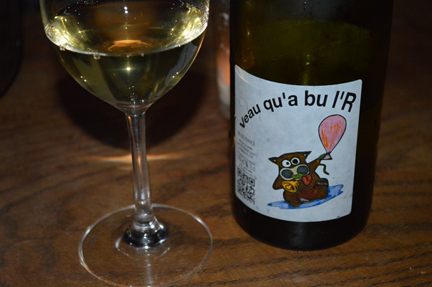
veau qu'a bu l'r

Honestly, I don’t get the joke or paronomasia behind the label of the Veau qu’a bu l’r (the calf who drank the r). Maybe it has something to do with the Israelites’ golden calf?

What I can tell you is that — at least according to the internets — is a carbonic maceration old-vine Marsanne from some folks in southern France who have a groovy winemaking operation called Domaine de l’Ancestra

michael housewright san francisco

Photo by my buddy Michael Housewright. Thanks, dude, for coming out to the show!

I can also tell you with certainty that it’s delicious: we drank it before the Nous Non Plus show on Friday in San Francisco at Terroir (not where we played but where we drank).

I gladly paid a mere $40 for it basing my selection solely on my trust of the wine merchants at Selection Massale, Cory Cartwright and Guilhaume Gerard, and their superlative palates and mission to bring Natural “sincere” wines to the U.S. from France (“sincere” is my new term for what used to be called “Natural” wine).

Great wine, great value.

bardot a go go

If you get to the party early enough, they’ll do your hair up go-go stye.

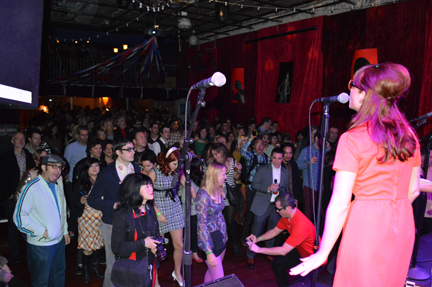
Our tour was so much freakin’ fun and the last night in SF at the Bardot a Go Go party was over the top.

joachim cooder

So much fun to play with Joachim Cooder on drums (right). He is so amazing, with such nuance and grooviness in his playing and personality.

nous non plus rick shaw

I’m super glad to be back at home with my girls but, man, there is something to be said for gettin’ yer ya-yas out.

Thanks to all who came out to rock out with us!

Buona domenica, yall! Happy Sunday…

A stunning Russian River Chardonnay from Lioco & chat with Kevin O’Connor

kevin o'connor

Above: A new American gothic? Kevin O’Connor from Lioco.

Conversation with Lioco’s Kevin O’Connor last night over dinner at Sotto (where I co-curate the wine list) in Los Angeles spanned the heady days of his tenure as wine director at Spago and his years prior in New York when the current renaissance began to explode.

It was truly moving to hear him speak of the legendary Los Angeles sommelier Michael Bonaccorsi, one of his mentors and a rising star on the U.S. wine scene when he succumbed to a heart attack at 43 in 2004.

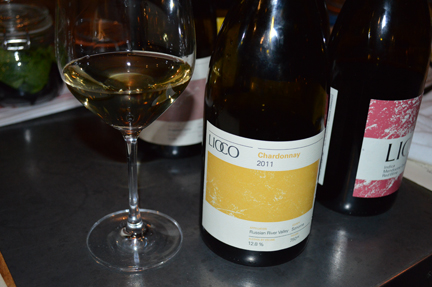
russian river chardonnay

We’ve worked with a lot of Kevin’s wines at Sotto since the restaurant opened. And while we included the winery’s entry-tier Chardonnay on our inaugural list, I had always found it to fall on the softer side of the Chardonnay spectrum.

After I tasted his 2011 vintage, we talked about the shift Lioco’s winemaker has made toward a more muscular and acidity-driven wine. He talked about how they are now balancing large-format cask fermentation with stainless steel and how all the wines continue to be aged in stainless steel (and some cement, he said).

I was blown away by his 2011 Russian River (one of the higher tier in the Chardonnay line). It was rich in the mouth but retained that lightness of body that I look for in fine wine and its acidity sang out over a rhythm of white and stone fruit.

A Russian River Valley Chardonnay that I loved? I bet you never thought you’d hear me say that!

Thank goodness for Liz Nicholson wine director @Maialino_NYC

liz nicholson maialino wine

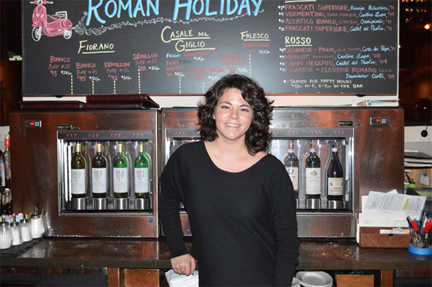
It’s no wonder that Eric the Red includes Maialino wine director Liz Nicholson (above) in the Times tasting panels devoted to Italian wine: she’s got one of the most ambitious Italian wine lists this country has seen in more than a decade. (The other Italophile wine professional he always includes is the inimitable Levi Dalton; check out his great post today in Eater on the evolution of the contemporary wine list.)

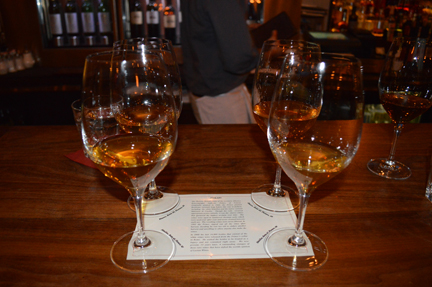
My last day in New York (earlier this month), I visited the bar at Maialino on Gramercy Park because I wanted to check out her new Fiorano (whites) tasting flight, reaching back to the 1988 vintage of the prince Buoncompagni’s Sémillon and costing only $50 for a half pour of four of the wines (check out Eric the Red’s post on the wines from way back in 2004).

Liz got the last allocation of these storied wines, which captured the imagination of the New York wine scene in the mid-2000s.

fiorano white wine

Oxidative, orange, and in some cases tending toward brown, these wines are not for everyone (and I had to ask the bartender to replace one of the younger wines because it had turned to Marsala).

I’m also not convinced that the Enomatic cruvinet is the best vessel to store these old, delicate wines.

But I love that Liz is sharing their last gasp with people like me, who have followed the wine with great interest since they first landed in NYC nearly ten years ago.

Her wine list has a great selection of Langa Nebbiolo and a good balance between traditional and modern styles.

But she also has a fantastic Franciacorta list, my favorite Lambrusco (Rinaldini), and all kinds of cool stuff (Dessimus by the glass, sparkling Valtellina by the glass, etc.).

It’s the kind of list that I love to just leaf through as I sip the 1992 Sémillon (which, in my tasting, showed best in the flight of the Fiorano).

Chapeau bas, Liz! I’m so looking forward to following your career and your lists to come!

Where the cheap wine is the best: dinner at NoMad NYC

olga raffault

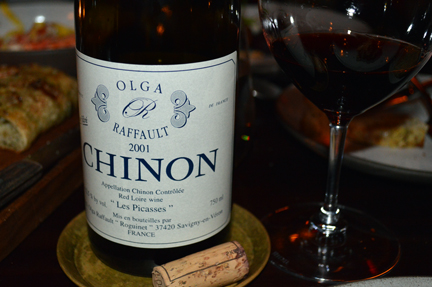
Above: Olga Raffault 2001 Chinon Les Picasses, one of my favorite wines and only $65 (yes!) at NoMad in NYC.

It was the night of two dinners.

“Order any wine you want,” said restaurateur Tony, my friend and client who was treating me to dinner.

We were at NoMad, a newish and very hot NYC restaurant that Tony’s chef Grant had recommended. We were eating our way through New York and Tony, who’s always overly generous with me when it comes to the wine selection, told me that “the sky’s the limit.”

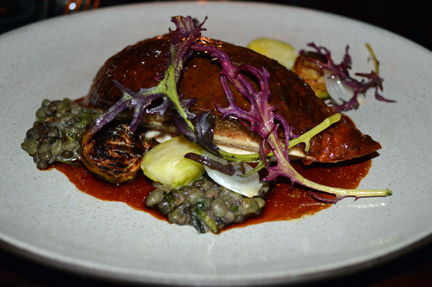
roast chicken nomad

Above: The famous roast chicken at NoMad, as presented before service.

The wine list at NoMad is phenomenal and the European selections are stuff of dreams for me (we started with Alfred Gratien rosé by the glass).

I was tempted to take Tony up on his offer. I believe that both Bartolo Mascarello 1997 Barolo at $375 or Produttori del Barbaresco 1970 Barbaresco (classic) at $400 would have drunk brilliantly (and look, I wasn’t going to do Giacomo Conterno 1971 Barolo Monfortino at $3,200, however much I would LOVE to drink that wine).

But I also knew we were going to be tasting at least half of the menu and so I craved something extremely food friendly that wouldn’t be overwhelmed by the myriad flavors.

Twelve years in its evolution, the 2001 Chinon Les Picasses at $65 (!!!) was ideal (the 1989 at $125 would have been great, too, but I wanted to go with a younger wine that would have the versatility to stand up to the flavors that were heading in my palate’s direction).

chicken plated

Above: The the roast chicken mise-en-place.

Schmuck! I hear you say.

I know, I know… After all, I do a great job for Tony and we’ve become close friends. Back home in Texas, he’s opened more than one bottle of Quintarelli 1990 Bandito and 1990 Recioto for me (among other crazy labels).

But the 2001 Picasses was just right for the speed of the evening and the truly perfect pairing for the restaurant’s famous roast chicken.

tony vallone houston

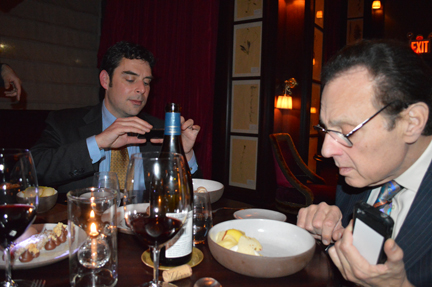
Above: Tony (right) uses his phone to take pictures of dishes he likes. Between Doug (left), Tony, and me, we were tweeting up a storm.

We were joined that evening by my new bromance Doug Cook (my fellow Italophile and oenophile and super cool and brilliant dude).

“Bring anyone you like to dinner,” Tony had said, his largesse rivaled only by the amount of fun we were having the two evenings we spent dining our way through the city.

We ended up staying to close the place and I had a blast chatting with the sommeliers about their list (they proudly showed me emptied bottles of old B. Masarello and Soldera that had been brought in by a mutual friend and one of the top Italian collectors in the city and they treated us to 1996 Oddero Barolo by the glass).

The best news is that that bottle of Produttori del Barbaresco 1970 Barbaresco Pora at $450 will probably still be there when I return east in the fall.

Paper or plastic no more in Austin (it’s all part of my rock ‘n’ roll fantasy)

Single-Use Carryout Bag Ordinance

Music to my ears: on March 1, 2013, the City of Austin will begin enforcing strict regulation of the use and distribution of plastic bags in super markets.

Here’s the city’s link with info on the new ban.

Here’s some recent local news coverage.

And here’s some background from The New York Times.

I hate am happy to say I told you so: when I go grocery shopping, I bring a plastic tub (above) that I drop into my shopping cart. And while I still use plastic bags for “wet” vegetables and fruit (spinach, lettuce, etc.) or loose farraginous vegetables (like green beans), I just drop my purchases back into the tub after checkout (often to the bewilderment of the young baggers). I’ve been doing this ever since I moved here more than four years ago.

Beginning March 1, super markets will no longer provide free plastic bags.

Chapeau bas, Austin City Council!

I’ve been obsessed with plastic (and trying to live without it) since I was child (that’s my self-image at six years old above).

Just one word: plastics. While no one knows for certain, our daily contact with plastic seems to affect our over-arching health (see this Times Op-Ed by a woman participating in a study of life without plastic).

But there’s no doubt whatsoever that the use of plastic shopping bags has a profound effect on the environmental health of our communities.

And just in from the department of “my rock ‘n’ roll fantasy”…

rock and roll fantasy

Merci bien! to everyone who came out to my band’s show on Saturday night in Austin. Super fun times… Great to have the band in the live music capital of the world.

We’re playing LA on Thurs. and SF on Fri. of this week.

Click here for show info.

Nous Non Plus (my band) in Austin tomorrow night FREE SHOW

celine dijon nous non plus

My Nous Non Plus bandmates Céline Dijon and Jean-Luc Retard landed in Austin last night and we made our way over to Vino Vino for some pork belly and Lapierre Beaujolais (as you can imagine, we are not a rock band that lives by fish tacos alone!).

Our 9 p.m. show at the Parish Underground tomorrow night (Sat. Feb. 9) is FREE.

So please come out and see how my other half lives (and my bleached blond hair).

Fernet Branca memories & a new favorite Barbera producer #NewYorkStories

This post is dedicated to the inimitable Levi Dalton, who nudged me to share these memories and recollections…

carussin winery

Above: I loved meeting and tasting with Luca (left) and Matteo Ferro of the Carussin winery at the Slow Wine/Vinitaly tasting last Monday in New York in the old Fernet Branca bottling building at 10 Desbrosses in Tribeca.

The bigger the city, the smaller the town… Who said that? I don’t remember. But the expression came to mind a week ago Monday when I arrived at 10 Desbrosses St. in Tribeca for the Slow Wine/Vinitaly jamboree.

The first New Yorker I bumped into was the inimitable Levi Dalton, one of the wine professionals and wine writers whom I admire most in this world. (Levi’s also one of the most knowledgeable Italian wine authorities working in the U.S. today; I high recommend his blog and podcast to you.)

He and I were both there to taste Italian wine but I couldn’t resist sharing my memories of that building with him.

The year was 2000 when I left my job as an editor and wine writer at La Cucina Italiana to launch my career as a freelance wine writer and my then nascent copywriting business.

My very first gig was writing “The Fernet Branca Newsletter.”

Until the 1980s, Fernet Branca was wildly popular in the U.S. And its popularity had spanned three generations of New Yorkers. By the 1930s, demand for Fernet Branca was so great that the Fratelli Branca opened a bottling facility at 10 Desbrosses St. in Tribeca (now the site of an events space that hosts, among other things, tastings like the one we were there to attend).

During Prohibition, Fernet Branca was sold in the U.S. as a medicine. We might think of Fernet Branca as a “recreational” digestif today. But to generations of Italians, Fernet Branca was a cure-all and a tonic. Ask east coast Italian-Americans who were born in the 1950s and they will tell you that their parents gave them Fernet Branca for breakfast when they were children (often served in espresso and/or with an egg yolk).

In the early 1980s, the FDA cracked down on Fernet Branca, noting that they were selling “medicine” at liquor stores. The Fratelli Branca were forced to close the facility.

barbera carussin

Above: The Ferro brothers Barbera was bright and fresh but it also had that unmistakable earthiness imparted by the unique tufo of Asti. Barbera d’Alba can be great but — in my experience — it rarely achieves the depth of Barbera d’Asti, where the wines are meatier and more savory. I loved their wines.

By the time I got there, the building had remained virtually closed for nearly two decades. The Carpano group (who had bought the Fernet Branca brand in the meantime) Fratelli Branca (which by that time had acquired a number of spirits brands, including the Carpano family of Vermouths) had decided to re-license the line of spirits as liquor and to relaunch the brand (inspired in part by the 1980s success of Jägermeister).

I had been contacted by the U.S. manager: he asked me to begin producing print and web media for the new project (back then, print media still trumped virtual media). And thus the Fernet Branca Newsletter was born (I still have some copies of it).

The first time he invited me to see the space, it was still covered in cobwebs. One floor housed large wood casks and bottling machines. One floor hosted a series of labyrinthic offices reminiscent of a film noir set.

But the top floor was a Frankestein laboratory, left virtually untouched for what must have been decades.

It was full of beakers and other distilling equipment and scores and scores of digestifs.

I later learned that during the heyday of Fernet Branca in the U.S., the Fratelli Branca were constantly testing and analyzing the overwhelming number of Fernet Branca counterfeits that regularly appeared in the market (if you visit food shops in places like Bensonhurst, for example, you’ll still find “Fernet” imitators on the shelves; the last time I saw one was at Trunzo on 18th Avenue).

desbrosses street

Above: The floor where the tasting was held was one the Fernet Branca anti-counterfeit command center. What a flood of memories when I walked in!

It was one of the most amazing sites I’ve ever seen. A graveyard of ancient digestifs. One of my greatest regrets is that I never took the time to document the space before Fratelli Branca closed it.

In the wake of the September 11, 2001 tragedy and the New York City restaurant scene depression that followed, Fratelli Branca abandoned the project and let all of the employees go. It was a tough time for everyone in New York, including me (I lived there from 1997 to 2007).

Of the course of my tenure as the editor of the Fernet Branca Newsletter, they brought me to Milan on two separate occasions to visit the corporate offices. It was a fascinating experience, especially in the light of how Fernet Branca was marketed and consumed in Italy and the U.S. over the last seventy years.

Today, few remember the old Fernet Branca building at 10 Desbrosses: when I first visited, a sign on the facade still read “Fernet Branca.” New York has changed a lot since then.

I’m glad to have lived and worked there when I did…

Thanks again, Levi, for the nudge!