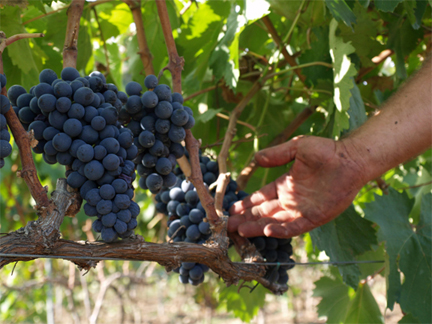
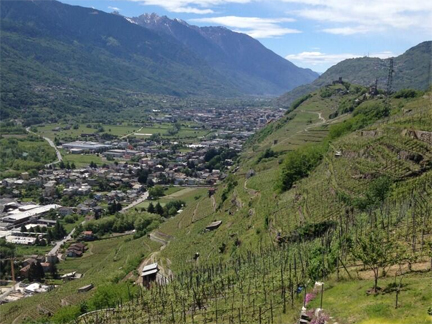
The new Texas wine scene is exploding. In fact, there is life beyond “Napa Cab.”

perfectly sliced prosciutto

Above: Prosciutto at the newly opened Camerata wine bar in Houston. FINALLY someone who can slice prosciutto correctly!

“It’s hard to complain these days,” wrote Austin wine collector and restaurateur Steven Dilley the other day in an email.

It seems like yesterday that many of us would moan and gripe about the wines we couldn’t get here in Texas.

But today, it’s as if a new sun has risen over the Lone Star State.

Master Sommelier candidate David Keck’s Camerata in Houston is my new favorite wine destination in the state. It’s a true wine salon where all the local wine hip folks are hanging out (it’s the place where I saw not just one but two copies of Wine Grapes being passed around).

And by day, it’s home to the newly formed Houston Sommelier Association (I wrote about the new group for the Houston Press here).

Super cool joint…

clos roche blanche austin

Above: Clos Roche Blanche by the glass on our friend Mark Sayre’s list at Trio at the Four Seasons in Austin. Hell yeah!

Back here in Austin, Tracie P and I had our first night out since the arrival of Lila Jane (now four weeks old; thanks again nanna and pawpaw!).

After we enjoyed a glass of Clos Roche Blanche at the Four Seasons (a wine that Alice turned me on to many years ago now, enabling my interest in and passion for Natural wine), we headed over to the newly opened Arro, where not just one but two Master Sommeliers — Craig Collins and Devon Broglie — write the list and work the floor.

I knew roughly half of the lots on the all French list but would have gladly tasted/opened anything: when you see such intelligence in a wine list, your trust level makes it easy to be led blindly. And that’s what we did.

saint damien cotes rhone

Above: Slightly chilled Grenache paired with roast chicken and steak frites was just right.

The wine I’m still thinking about this morning was the Saint Damien Côtes du Rhône. But Craig, who was working the floor last night, tasted us on so many great things.

There’s never been such a focused and brilliant list in Austin. It’s a list that makes a statement.

And along with Steven Dilley’s list at Bufalina (which we also loved), Craig and Devon’s program stands apart for its ability to thrill the finely tuned connoisseur and neophyte enthusiast alike.
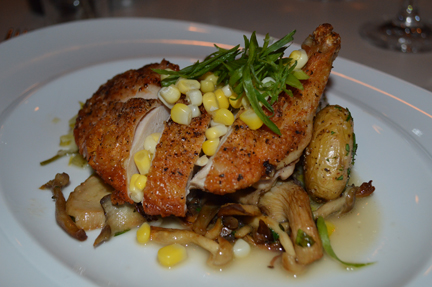
chef drew andrew curren

Above: Arro’s chef Andrew (Drew) Curren’s roast chicken was spot on last night.

Isn’t that what a wine list should do? Shouldn’t it forge a level of trust that it takes you outside of your comfort zone? That’s what it did for us and I just couldn’t resist a second glass of the Grenache.

When I moved here nearly five years ago to be with Tracie P, it seemed next to impossible to find a wine list that we could really dig into like the lists we’re seeing today.

Nearly every fine dining restaurant was dominated by “Napa Cab” (I still shudder every time someone says “Cab”) and Chardonnay, with the occasional Malbec thrown in the mix.

Mark Sayre at Trio at the Four Seasons in Austin still jokes about how I called him and “interviewed” him about his wine list when I was looking for a special place to take Tracie P for a romantic evening. At the time, Mark’s list and the list at Vino Vino (today, my client) were the only places Tracie P and I would drink wine in Austin. (Mark, a Master Sommelier candidate, is also writing the list at the excellent and überhip Lenoir, which we love as well, btw).

Today, there is just so much more groovy wine available to restaurant buyers and the new wave of Master Sommelier and Society of Wine Educators candidates has upped the performance level considerably (Scott Ota, also of Arro, recently won the “best sommelier in Texas” title at Texsom, the annual Texas sommelier conference).

None of this was even on the horizon when I first got here.

As Devon wrote to me the other day in a tweet, “we’ve come a long way, baby!”

David, Devon, Craig, Mark, Scott, Steven… We’re with you all the way…

Cotarella: “a harvest of ancient flavors” & dispatches from Vulture, Salento & Prosecco Country

dawn salento sunrise puglia

Above: Sunrise over the Salento Peninsula. Photo taken this morning by grape grower and winemaker Gianni Cantele.

“This weather has ancient flavors,” said famed Italian enologist Riccardo Cotarella (current president of the Association of Italian Enologists and Enotechnicians) in an interview with the Italian news agency ANSA.

“Like 30 or 40 years ago,” he added, there is “less heat” and there are “strong temperature variations” between day and night. “It can’t be but good for the vineyards. Now we need to watch the clouds and the sky. Hopefully, it won’t rain in coming days and it will be a perfect vintage.”

The interview was reported by Corriere della Sera wine writer Luciano Ferraro on the newspaper’s wine blog today (here’s a link to the ANSA English-language post; it doesn’t include the quote cited by Luciano).

Luciano’s post — his blog is a must-read for Italian wine trade observers — also includes quotes from grape growers and winemakers across Italy (Arianna Occhipinti among them). Although vintage forecasts can be a tight-rope act where wineries must balance marketing and realism, most are predicting a good-to-excellent harvest for 2013.

Harvest is coming later this year because of the cold temperatures and excessive rain of the spring. Those conditions delayed the vegetative process.

In Tuscany, some have predicted that harvest will come as late as October. And at least one, my friend Alessandro Bindocci at the Tenuta il Poggione, has compared the vintage to 1979.

My good friend Laura Gray also posts on weather conditions in Montalcino for the Il Palazzone blog. Check out this interesting comparison of rainfall in the 2012/13 vintages (prepared by the Biondi Santi winery).

The Cantele family, my friends and client, is enjoying classic harvest conditions in Puglia. Grape grower and winemaker Gianni Cantele even had time for a bike ride yesterday. “I have the best job in the world!” he writes.

My friend and client Luca Ferraro, who grows grapes and makes wine in Asolo (Prosecco DOCG), is anxious about forecasts of rain and hail.

“Welcome back from vacation!” he wrote today on his Facebook.

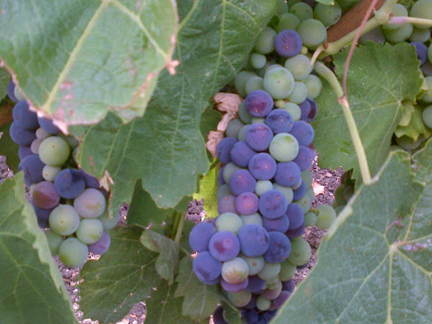
aglianico veraison

Above: Aglianico grapes in Vulture. Photo from last week.

Lastly, here’s a dispatch from my good friend Filena Ruppi who writes from the foothills of Mt. Vulture in Basilicata. She and her husband, winemaker Donato d’Angelo, don’t have a blog but the landing page of their website has a really cool slide show that gives you an idea of the growing conditions there. I love their wines.

    We are experiencing relatively warm temperatures as well as the providential rains of August: after the rain, a gentle north wind always blows. It’s ideal for Aglianico because the grape bunches are very closed and dense and otherwise, rain could bring attacks of rot.

    Some zones have been struck by hail but as you know, hail always strikes like “leopard spots” and this year we’ve emerged unscathed.

    There’s every reason to predict a good vintage but remember: we still have two months to go before harvest begins.

    Fingers crossed!

I’ll continue to digest and post harvest reports as they come in. Hold on to your seats!

And in the meantime, please check out Alfonso’s excellent post on the “social hierarchy” of grape varieties in Italy.

Life as a winemaker sure ain’t easy

dawn in the vineyard italy

Above: The workday begins at dawn for grape growers and winemakers.

As harvest in Italy begins, we are reminded by the harsh life of grape growers and winemakers.

Now, more than ever, the year’s work — and often the work of a lifetime, considering how long it takes for a vineyard to produce fine wine grapes — is on the line.

Their days begin at dawn and end long after the rest of us have finished dinner and settled in with our families for the night.

Today, I’ve posted translations for two of my clients, Bele Casel in the Veneto and Cantele in Puglia.

Up in the Veneto (northeastern Italy) grape grower and winemaker Luca Ferraro delivered a brutally honest post on the challenges he’s facing this year as he prepares for harvest (that’s a view from one of his vineyards above).

“After entire weeks of rain,” he writes (and I translate), “July has left us with problems of hydric stress.”

Down in the Salento peninsula (the southern tip of the heel of Italy’s boot), grape grower and winemaker Gianni Cantele’s harvest is already well underway. But a broken refrigerator and a repairman on vacation are just some of the problems he’s been having to deal with.

“Man, why oh why does everyone in Italy have to take their vacation in August!!!???” he writes in today’s dispatch.

I’ll continue to post updates from these and other wineries as they come up in the feed… Buona vendemmia! Happy harvest!

A new and extreme era of wine writing (and why it matters)

Buon ferragosto a tutti! Happy ferragosto, everyone!

bartolomeo bimbi

Above: “37 Grape Varieties” by Tuscan naturalist painter Bartolomeo Bimbi (1648-1729). The painting was commissioned by Cosimo III de’ Medici. The painting resides at the Medici Villa Poggio a Caiano and was part of a series of paintings commissioned by Cosimo III to document the agricultural products of Tuscany.

A wine writer, close to the source, gently nudged me yesterday, pointing out a lapsus calami in a few of my posts last week (here and here).

Botanist and grape geneticist José Vouillamoz and Master of Wine Julia Harding, she noted, were co-authors — not co-editors — of the landmark work in contemporary ampelography, Wine Grapes (New York, Ecco [HarperCollins] 2012).

Errata corrige! I wanted to be sure to right this lacuna and (I hope that the authors will forgive my absentmindedness and chalk it up to the sleep deprivation that comes with having a newborn and a toddler in the home).

I’ve already sung praises of their remarkable book. The work is a true godsend to oenophiliacs throughout the Anglophone world and beyond. And it marks a new era of wine writing, where a new scholarly benchmark in ampelography has been delivered.

The contemporary age of wine writing has its roots (excuse the paronomasia!) in Italy’s renewal of learning: Renaissance agronomists and naturalists, like Andrea Bacci (On the Natural History of Wines, 1595) and Giovan Vettorio Soderini (Treatise on the Cultivation of Vines, 1600), were pioneers.

Many overlook Agostino Gallo of Brescia and his Ten Days of True Agriculture and the Pleasures of the Country House, 1564. His extraordinary treatise — wildly popular in its day and revised as the Thirteen Days and then again as the Twenty Days — offers what is perhaps the earliest detailed description of vinification in the Renaissance era.

In 1685 Tuscan naturalist Francesco Redi gave us the wonderful and also highly popular Bacchus in Tuscany, a panegyric poem devoted to the wines of his homeland. It stands apart from the oenophilic verses of the Latin poets inasmuch as it combines Bacchanalia and ampelography.

The British were among the first wine [b]loggers.

Travel writers like Gilbert Burnet (1643-1715), Bishop of Salisbury, described wines and viticulture in seventeenth-century Italy (thanks to the advent of Google books, more than one wine blogger has found his reference to “natural wine,” an expression which denotes wine that has not been fortified).

Few remember A Survey of the great Dukes State of Tuscanie by Sir Robert Dallington (1605), wherein he describes Tuscany’s “diverse sorts of grapes” (see my post and transcription here; you might be surprised by what you find).

Today, oenography has taken extreme forms that no one would have imagined even fifteen years ago.

On the one hand, there are legions of “citizen” wine bloggers who post daily on their impressions of the wines they taste. They remind me of the sixteenth-century Petrarchists. At the time, Petrarch’s Italian poems were so popular that nearly everyone who could wield a pen wrote sonnets inspired by his work, from a courtesan in Venice (Veronica Franco) to Wyatt and Shakespeare. The ability to compose a Petrarchan sonnet was a gauge of one’s social grace, a phenomenon not dissimilar from the way we admire and praise one’s capacity to describe wine as an expression of social interaction.

On the other hand, new scientific tools — genetic and otherwise — have allowed the authors of Wine Grapes to bring a new standard of precision to the field. In our home, we consult the book nearly every day and like the Oxford English Dictionary or the Encyclopedia Britannica, it represents a supreme reference work, often delivering the last word on the many conundra that continue to plague ampelography.

Why have these oenographic extremes emerged? And why has so much attention — from the demotic to the erudite — been devoted to wine writing in the last fifteen years or so?

I believe it’s because wine represents one of the last agricultural products with such a deep and even quasi-spiritual connection to the land. In the globalized era, when we desperately seek authenticity in our nourishment, there are few foodstuffs that we can link so absolutely to the place where they were raised.

Wine offers us an escape from Marxist alienation and it aids us in soothing our longing, as Freud may have called it, to return to an organic state.

As I negotiate the epistemological implications of oenophilia, I can’t help but think of how lucky we are to live in this era of extreme wine writing. It’s a wonderful time to be alive and to taste…

Let the grape porn begin! Harvest starts in Southern Italy @CanteleWines

chardonnay southern italy

Above: Chardonnay grapes ready to be picked, from one of Cantele’s top growing sites in Salento, Puglia (Apulia). Southern Italy is generally the first to pick. But extended spring rain and cold temperature has delayed harvest throughout Italy this year.

For observers of the wine trade, this is one of the most exciting times of the year: the enoblogosphere and social media will overflow with images of ripe grapes and updates on the quality of the fruit and the harvest.

For grape growers and winemakers, this is a time for high anxiety: one rain or hail storm could ruin an entire year’s work.

And as my friend and client Gianni Cantele wrote on the CanteleUSA blog today, the little “elves” in the crushers and presses also can be a source of major problems.

There are a number of Italian winemakers who are posting about the 2013 harvest with nearly real-time updates.

Marilena Barbera at Cantine Barbera has vowed to post regularly on the harvest’s progression.

Alessandro Bindocci at the Tenuta Il Poggione in Montalcino has also been posting regular updates.

And I will be posting harvest updates for my clients Cantele, Barone Pizzini-Pievalta, and Bele Casel.

Yesterday, Barone Pizzini vineyard manager Pierluigi Donna noted that “Nature is making up for time lost during the cold and rain in the spring. We’ll be able to begin picking just after August 15. In other vintages, the grapes were already in the cellar by then.”

I’ve seen similar reports from other central and northern Italian wineries and I’ll be following along eagerly as more information comes in.

Do you know of a winery or grape grower who is documenting harvest 2013 through social media? If so, please let me know and I’ll include it in my roundups of harvest notes. Thanks!

And if you are a grape grower or winemaker and would like to send me your photos and notes, please do so!

Buona vendemmia! Happy harvest!

how to pronounce Xinomavro (and desperately seeking Zibibbo)

What a thrill to learn that the Greek Grape Name and Appellation Project was put to good use yesterday by the leading Italian wine blogger in the world today, Alfonso Cevola, who used the video above in his talk on Xinomavro at the annual Texas Sommelier Conference in Dallas (Texsom).

As the popularity of Greek wines and grapes like Assyrtiko and Xinomavro continues to explode in the U.S. (check out this brilliant post today by the hippest sommelier in America, the inimitable Levi Dalton), it’s remarkable how few know the correct pronunciation of Xinomavro.

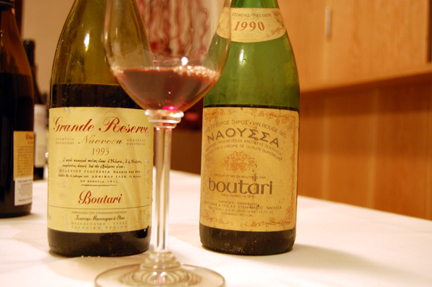
I’ll be the first to tell you that I, myself, didn’t know how to pronounce it until I traveled to Naoussa and got a lesson from Constantine Boutari himself (he’s the owner of the Boutari winery group)!

He is such a sweet man and when I asked him if I could film him “speaking” Xinomavro, he improvised — on the spur of the moment — the talk he gave me (to the surprise of everyone in the tasting room at Boutari’s Naoussa winery).

You can listen to all the pronunciations over at the Boutari blog (where I have been posting for three years now).

naoussa

The Italian Grape Name and Pronunciation Project continues to expand and I have new videos to post this week.

I am looking for a native speaker to do Zibibbo. On Friday, a reader wrote me with a query about its pronunciation, which is trickier than it would appear. I’ll explain when I have a video ready.

But in the meantime, does anyone have any suggestions or requests for wineries/winemakers whom I should approach? Please let me know in the comments.

I greatly appreciate it.

And one last thing on this busy Monday morning: be sure to check out Alfonso’s superb post this morning on “Breaking the Code of Silence on Italian Wine.”

Now it’s time to put my nose to the grindstone. Buon lavoro, yall! Have a productive work week!

G-d bless @JancisRobinson et alia

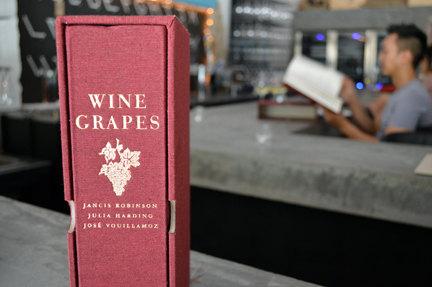
jancis robinson wine grapes

The most remarkable thing happened yesterday.

As I sat at the counter of a new Houston wine bar, the servers produced a copy of Jancis Robinson’s excellent Wine Grapes and began eagerly leafing through its beautifully illustrated folia and superb critical apparatus.

No, there’s nothing remarkable about that. In fact, I see it all the time these days.

Here’s the remarkable thing: a young couple, evidently regular guests, brought their own copy of the tome and proceeded to peruse its pages for insights into the wines they had in the glasses that lay before them (you can see the two gentlemen in the background of the image above).

Not just one exemplar in situ but two!

With unheimlich timing, Jancis, you and your brainiac team — Julia Harding and José Vouillamoz — have delivered a new Torah unto the nascent flock of youthful wine lovers in the English-speaking world.

Their thirst for wine knowledge is rivaled only by their want of drink. And you have rendered unto them a new testament.

And in an era where the digital image seems nearly always to trump the printed logos, you have achieved a nearly singular triumph: your gorgeously cloth-bound book and cloth-bound slipcase are practically ubiquitous among the wine-smitten (at least those whom I frequent).

At the Parzen residence, the volume is displayed handsomely and prominently in our oenographic library and I can’t remember a workaday when I didn’t consult it at least once.

Thank you, thank you, Jancis, Julia, and José, for this wonderful gift to those among us afflicted by oenophilia!

May G-d bless and keep you! Your work is a true mitzvah…

Robert Parker looks beyond Tuscany & Italy stands at a precipice

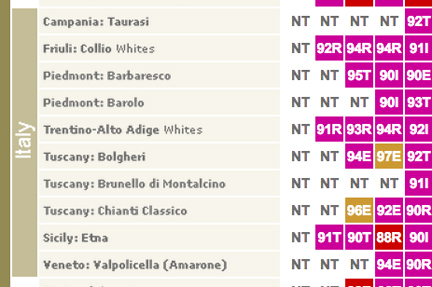
robert parker vintage charts

“For the first time, Piedmont and Tuscany won’t be the only regions to appear in the Italy column of the Wine Advocate vintage chart,” writes Italian enojournalist Luciano Ferraro this week on the Corriere della Sera wine blog (one of the highest-profile media platforms in Italian wine writing today).

“Beginning this year, Trentino-Alto Adige whites, Friuli wines, Veneto’s Amarone, Campania’s Taurasi, and Sicily’s Etna have been inserted,” reports Luciano.

News of this new vision for Robert Parker, Jr. comes in the form of an interview with the new Wine Advocate Italian editor, Monica Larner.

“The moment to tell the story of Italy’s other wonders has arrived,” says Monica. “Robert Parker agreed.”

You don’t need to be a subscriber to view the chart (here).

Italian wine and its relation with mainstream media still has a long way to go. But — there’s no doubt — this is a literally wonderful step in the right direction.

Chapeau bas, Monica!

Sadly, this good news comes along with some terribly unfortunate developments in Italy’s political scene.

umberto d

As loudly as I applaud former prime minister Silvio Berlusconi’s conviction on tax evasion by Italy’s highest court, I fear that the power imbalance caused by his tenuous political situation bodes badly for the country.

The “epic fail” of his People of Freedom party has considerably weakened the already fragile governing coalition.

On his Facebook, my good friend and client Paolo Cantele posted this quote from an editorial by Luca Ricolfi that appeared this week in the national daily La Stampa:

“If we are at this point today, it’s not because the judicial system has not allowed politicians to govern. It’s because of an entire class of politicians’ inability to govern… They have allowed judicial events to occupy an abnormally large space in our history.”

This dismal view of the current situation is echoed in a New York Times editorial that appeared two days ago, “It’s not just Silvio Berlusconi”:

“With such obvious weaknesses on both sides of the spectrum, the real winner of February’s elections was ‘none of the above.’ The patched-together government that finally emerged in April is an ungainly coalition with few achievements to its credit so far.”

I spent nearly a decade of my adult life living, studying, and working in Italy. And I continue to travel regularly there. So many of my closest friends live and work there. I have devoted my intellectual life to the study of Italian language, culture, and history, and more recently, to Italian enogastronomy.

My friends and their country are in my heart and in my prayers.

repubblica italiana

More @arpepe1860 from @ItalianWineGuy @WinechefPDX & @Jbastianich opens restaurant Italy

valtellina

Above: “@DoBianchi [the wines of Ar.Pe.Pe. are] beauties!” wrote Michael Garofala yesterday on the Twitter. “We’re very lucky in Pdx [Portland, Oregon] to have them. Valtellina’s also not such a bad place to visit.”

Yesterday’s post on Ar.pe.pe. generated a lot of positive response.

Michael Garofola aka @WineChefPDX, who works in Portland, posted this beautiful photo of the Valtellina (above).

And Alfonso aka @ItalianWineGuy reminded me of this excellent post on his vist to the Valtellina from 2007, including tasting notes for Ar.pe.pe. (highly recommended).

bastianich mozza aragone

Above: The news of Joe’s new restaurant in Italy nudged me to grab this bottle of his Mozza 2008 Aragone from my samples bin. A blend of Sangiovese with smaller amounts of Syrah, Alicante, and Carignan, the wine was fresh and the ripe red fruit was bright, balanced by wholesome earthiness. According to WineSearcher.com, it sells for under $35 in the U.S. market. Another gem of a wine from the great enologist Maurizio Castelli, it paired nicely with some chicken tacos.

Things are insanely busy these days at the home office, but I did manage to catch up on my Feedly reading yesterday.

I’m surprised that virtually no one in the U.S. has written about Joe Bastianich’s soon-to-be-launched new restaurant in Friuli, “Orsone” (the big bear), the name of farmhouse and vineyard where he sources fruit for one of his vineyard-designated wines in the Colli Orientali del Friuli.

I read about it on one of my favorite Italian-language food blogs, Dissapore (where you can also see a photo of the venue’s façade).

One of the things that fascinates me about Joe’s career is his reverse immigration. There are many Italian-American restaurateurs in the U.S. who own vineyards in Italy (as he does) but I don’t know of any who are megagalactic (to borrow an Italianism) television celebrities and restaurant-owners on the other side of the Atlantic.

It will be interesting to see what he does with it… And like any high-profile “restaurant man” (the title of his memoir, published while in his early 40s), I’m sure that Orsone will be the subject of intense scrutiny…

So much more to tell but I’ve got hungry mouths to feed. Thanks for reading. Stay tuned…