A song and a letter for Georgia for her fourth birthday

Dear Georgia,

Tomorrow is your fourth birthday. Happy birthday, sweet child!

You’ve asked for a “purple birthday party” because purple is your favorite color.

You love purple dresses and purple shoes. You also adore purple butterflies and your purple butterfly necklace.

And of course, your mommy is making you a purple birthday cake.

Your love of the color purple is just one of the many things that make you such a special person. Not red, not green, not yellow or blue but only purple will do for your special day.

Over the last twelve months, we’ve watched you grow from a toddler into a “big girl.” And as you’ve grown, you’ve started to talk more and more about the things that interest you. Astronauts, ballet, cooking, and music are just a handful of the things that you are curious about.

But the most wonderful thing we’ve watched over this last year is how much you care about the people in your life. The other day, you heard me cry out in pain after I stubbed my toe in the foyer of our home: you ran to me and said, “daddy, daddy, are you okay?” And you didn’t return to playing in the living room until you were convinced that I was alright.

You’re always looking out for your sister, Lila, whom you shower with affection. And the mothers of other children at your school often tell us how much their kids like you. I know that’s because you care about other people’s feelings, not to mention the fact that you are so much fun to play with.

Of all things about you that give us so much joy, it’s that empathy that makes me the most proud. Some day I hope to teach you about some of the things I love, like music, poetry, and art. But in the meantime, you’ve shown me that caring about the ones you love is the greatest gift you can give them. Not a day goes by that you don’t amaze me by what you teach me.

I wrote you a song this year for your birthday. It’s about how you get mad at me sometimes when I have to go away for work. As cross as you get, you always run to greet me and give me a hug when I come home from a business trip. It’s the best feeling in the world.

I love you sweet girl and I can’t wait to celebrate your birthday with you tomorrow.

Georgia Ann, please take my hand
And take a walk with me girl
Georgia Ann please understand
I want to talk with you girl

I’ve been gone for way too long
And I have missed your smiling face
I can’t stand to go another day
Without the thought of your embrace (put your arms around me)

Georgia Ann, please understand
I didn’t mean to make you feel this way
Georgia Ann, your wish is my command
But there’s something that I got to say

Hear me out and please don’t pout
I know that you didn’t want me to go
Let me sing and let me shout
Because I want the world to know (how he feels about you)

Georgia Ann, please understand
It’s been so hard to be away

I have traveled the whole wide world
But I can’t wait to get back to my sweet, sweet girl

I am so glad you’re my Georgia Ann
I am so glad that I’m a family man

Georgia Ann, I’ve been a lonely man
Since I said goodbye to mommy and you
I had to go away for my workadays
But you know that’s what daddy’s do

I want you know that I will always be here
To catch you if you fall
And when you need me for anything
All you got to do is call

Georgia Ann, please understand
There is something I’ve got to say

I have traveled the whole wide world
But I can’t wait to get back to my sweet, sweet girl

I am so glad you’re my Georgia Ann
I am so very glad to be your dad

jeremy parzen

Vitello tonnato and the mayonnaise conundrum

I’ve been blogging today about the epistemological implications of “vitello tonnato and the mayonnaise conundrum” for my client Tenuta Carretta

best vitello tonnato recipe piedmontAbove: vitello tonnato at Osteria More e Macine in La Morra (Piedmont) earlier this year. My bromance Giovanni always ribs me about how little I eat when he and I are on the road together. But his grin is always as wide as a mile when he sees me devour my vitello tonnato with gusto, religiously washing it down with some young Nebbiolo.

Although the dish is commonly made with mayonnaise today, most Italian gastronomic pundits maintain that true vitello tonnato should be mayonnaise-free. And they often point to Artusi’s mayonnaiseless recipe, first published toward the end of the nineteenth century, as the original recipe (La scienza in cucina e l’arte di mangiare bene [The Science of Cooking and the Art of Eating Well], 1891). This attribution is owed in no small part to the fact that Artusi’s cookery book became wildly popular toward by the end of his lifetime. And today, it’s rare not to find a dog-eared copy on the shelves in the homes of the typical Italian family who often uses it for everyday and festive cooking (I can attest to this from my own experience in Italian homes).

It’s important to note that Artusi also included a recipe for mayonnaise in his game-changing tome.

His recipe number “126” is for “salsa maionese” (“mayonnaise sauce”), which he recommends to accompany poached fish. (You can read an English-language translation here.)

So it’s clear that he was aware of the mayonnaise but did not include it in his recipe for vitello tonnato. This fact would seem to indicate, definitively, that the use of mayonnaise was introduced much later.

Click here to continue reading…

The fine art of slicing prosciutto, an acid test for any great Italian restaurant

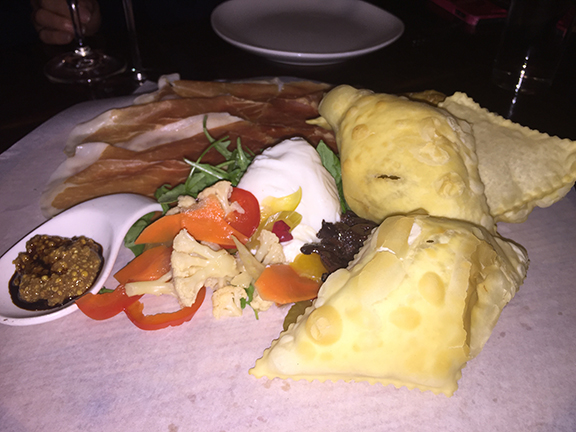
prosciutto gnocco frittoAbove: expertly sliced Prosciutto di Parma and gnocco fritto at the excellent Osteria La Spiga in Seattle.
Even as Italian cuisine continues to reign supreme over contemporary culinary hegemony, a gastronomic tragedy unfolds across this great of land of the United States of America: poorly sliced prosciutto.

Sadly, it happens every day and all too often in this country: an eager and hopeful gourmet or an overly optimistic gourmand orders Prosciutto di Parma or Prosciutto di San Daniele at a charcuterie counter or in a fine-dining establishment only to have her or his porcine dreams shattered when the ham arrives too thinly sliced and practically liquefied in a big gooey blob of otherwise pink and white deliciousness.

As the great anglophone chef Lachlan Mackinnon-Patterson, one of the most obsessive prosciutto slicers I have ever met on the north American continent, has explained to me, it all comes down to the breadth of the beveled rotary blade employed in the act.

When the blade is too narrow, it applies too much friction to the cured flesh and as a result of the recalescence, the pig thigh begins to melt.

This phenomenon is exacerbated by the speed at which the blade rotates. Electric slicers, he told me, revolve so rapidly that they also increase the friction and temperature applied to the rosy goodness.

That’s why he and his ilk use manual slicers with specially beveled blades like those found on the famous hand-operated Berkel slicers.

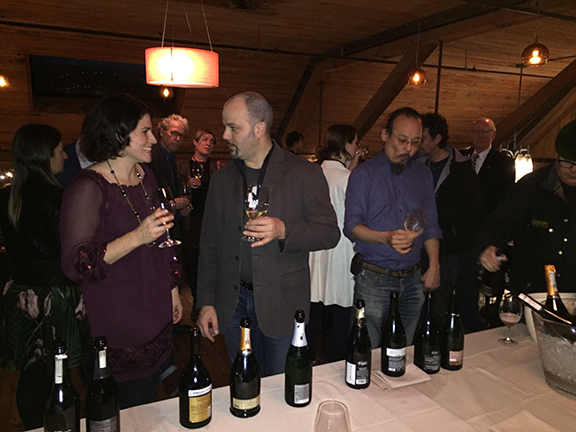
wine tasting seattleAbove: a great turnout for my Franciacorta tasting yesterday evening in Seattle, where wine culture seems to be rivaled only by coffee culture.
I was happy to discover that a Berkel slicer is used exclusively at the excellent Osteria La Spiga in Seattle, where I led a Franciacorta tasting yesterday evening for roughly 30 guests who were eager to taste and chat about the 11 wines I poured.

After the tasting, when I sat down for dinner with a few Seattle-based writers, the Prosciutto di Parma that arrived on our table was superbly sliced and melted in my mouth and not on the plate.

In my view of the epicurean world, prosciutto is a gold standard of food products and the expert handling thereof and therein is an acid test for a great Italian kitchen.

As the celebrated American artist Isaac Hayes once said (I can’t remember where), if a song doesn’t win you over with the first downbeat, it’s not a great one.

The same holds in the world of restaurateurship: if the opening dish isn’t perfectly executed, why bother moving on to the next?

I’m glad to report that I didn’t go prosciuttoless in Seattle, where I enjoyed a truly fantastic meal at La Spiga. I highly recommend it to you.

Heartfelt thanks to Ezra, Pietro, Cheryl, and the team at La Spiga for making my event so lovely. And similarly fervid thanks to Clive and Madeline for their camaraderie and companionship. It was a great night in Seattle.

Our first Nutcracker and the first night of Hanukkah, a magical day for the Parzen family

nutcracker houston ballet ticketsWe surprised our girls — Georgia P (left, who will be 4 on Saturday) and Lila Jane (2) — with orchestra seats to the Houston Ballet’s production of “The Nutcracker” yesterday.
I’m not sure what was more exciting for them: the moment the lights went down in the theater and the ballet itself or the dressing up and seeing all the other kids in the foyer, where our girls were treated to a fat chocolate chip cookie.

They genuinely seemed to enjoy the spectacle immensely and both were extremely well behaved (all things considered).

“The Nutcracker” isn’t exactly the most intellectually engaging ballet of all times. But dance is dance: narrative arc as conveyed through the beauty of human form is always compelling for me. After all, dance is arguably the most ancient and most powerful of the fine arts (all things considered).

The performance was great and we had a lovely time.

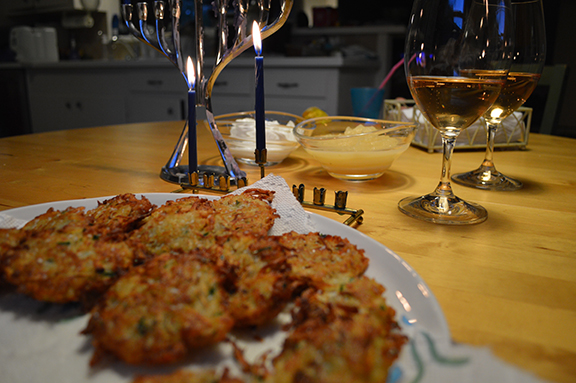
best latke recipeBy the time we got home, it was nearly time to begin lighting candles and making latkes.

Even in the wake of all the excitement of the matinée, the girls were enchanted by the candles and the funny song that their daddy sang as he lit them (the brucha or prayer).

Tracie P’s latkes, to which she added chopped flat-leaf parsley this year, were fantastic.

It’s been many, many years since my mother made potato pancakes for me and my brothers but those familiar aromas and flavors, combined with Mott’s apple sauce and sour cream, always evoke memories of my California childhood.

We served with a Franciacorta rosé that I happened to have lying around.

The pairing was brilliant, with the saltiness and ripe fruit of the wine working nicely against the salty, fatty, starchy patties.

Dry Riesling is my favorite pairing for latkes, in part because of the cultural and historic continuity in their enogastronomic marriage.

But the freshness and vibrancy of the Franciacorta (not to mention the restrained alcohol) really showed gorgeously with the dish. A truly winning combination.

This morning finds me at Bush airport on my way to Seattle where I’ll be leading the last of my Franciacorta consortium tastings for 2015 this afternoon.

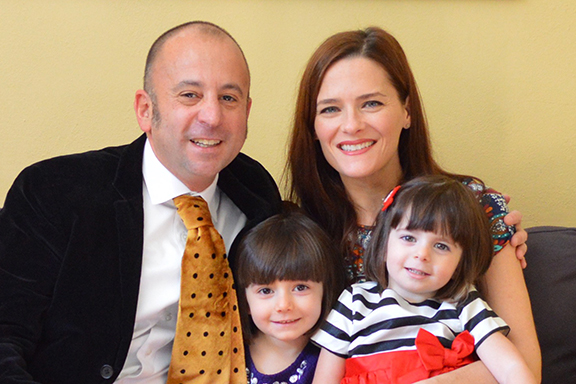
I’m looking forward to it but I’ll be counting the moments until I’ll be reunited with my girls (below, in a family selfie we snapped before leaving for the ballet yesterday).

Wish me speed!

jeremy parzen wine blog

Angelo Gaja: “Genetically modified vines will be Italian wine’s salvation.”

angelo gajaThe following is my translation of an open letter by Angelo Gaja (above) that was distributed to and reposted by countless Italian wine blogs and media outlets this week.

“Genetically modified vines will be Italian wine’s salvation.”

It’s time to break the taboo around genetically modified vines: they will be Italian wine’s salvation. Modifying plants with genes from the same species (cisgensis) is the only way to ensure a future for the great wines of Italy.

If researchers are not allowed to apply new genetic techniques in their work, our vineyards will have no future. I am well aware that cisgensis is considered a GMO (genetically modified organism) technique and to many, genetically modified organisms are an abomination. But when faced with enemies like peronospora, which dries the leaves and bunches, and oidium, which infects the plant’s green organs, we cannot stand idly by.

With the increase in temperature, good-quality vintages are more frequent. And this makes some winemakers happy.

But there’s also another side to the coin: the heat and the scarcity of rain bring old and new parasitic diseases; the vineyards suffer from extended periods without rainfall; and the grapes arrive at the winery too hot and still covered with antiparasitic agents that haven’t been washed away because of the lack of precipitation.

Our country must allow researchers to make use of new techniques.

The world of wine must avert the greatest danger: that of doing nothing!

Agricultural minister Maurizio Martina has announced a new willingness to consider cisgensis.

“It’s now more clear than ever,” he has stated, “that we have moved past the debate on the pros and cons of GMOs. We are ready to support an organic plan for research initiatives and legislative oversight that will regulate the most sustainable technologies and our nation’s top agricultural products.”

I’m referring to tools like “genome editing” and the “cisgenic approach” that can target genetic improvements without altering the characteristic production of an agricultural food system.

We have asked the European Union to engage in a definitive discussion of why these technologies are recognized differently from transgenic GMOs.

This is a match we should play side-by-side with agriculture and research firms.

Angelo Gaja

Foradori 2012 Teroldego, wow, what a wine!

foradori teroldegoOn Sunday night we hosted our Levy-Kelly cousins at our house for a spaghettata and a little post-Thanksgiving celebration.
The newest member of the mishpucha, Chiara, who’s from Viterbo, made some excellent meatballs for the occasion and we paired with a bottle of 2012 Teroldego by Foradori, a wine that really blew me away for its value and extreme quality and originality.

I actually drank the last glass in the bottle on Monday night and it was even better than than the previous evening: its vibrancy and electric fruit seemed even more present after a day of aeration.

It had that “nervousness,” as Italian like to describe the tension between the wine’s acidity and tannin.

Pretty hard to beat its value at $30 a pop in our market (about $25 in California).

In other news…

Just had to share this photo of Lila Jane, snapped this morning as she was helping her mother bake cookies. Not a bad gig being the daughter of a cookie lady, eh?

cookie monster

Franciacorta (in a plastic cup) for a southeast Texas Thanksgiving

TASTE FRANCIACORTA WITH ME IN SEATTLE ON MONDAY, DECEMBER 7.
CLICK HERE FOR DETAILS AND RSVP INFO (FREE TASTING).

what is the best wine to pair with thanksgivingOne of the things I’ve enjoyed the most about living in central and southeast Texas is how passionate people are about cookery and how devoted they are to family culinary traditions.
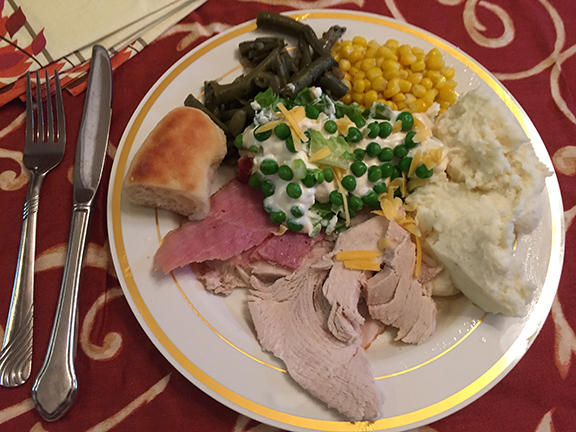
The Parzen family spent its holiday this year in Bridge City, a town that sits between Port Arthur, birthplace of Janis Joplin, and Orange, birthplace of Tracie P and the last city on Interstate 10 as you head east through Southeast Texas toward Louisiana (pronounced without the o around those parts).

That’s my Thanksgiving plate (above). And if you’re wondering about the peas and mayonnaise, that’s eight layer salad (not to be confused with seven or nine layer salad). My mother-in-law Mrs. B substitutes the traditional iceberg lettuce with romaine because she knows my preference for leafy greens.

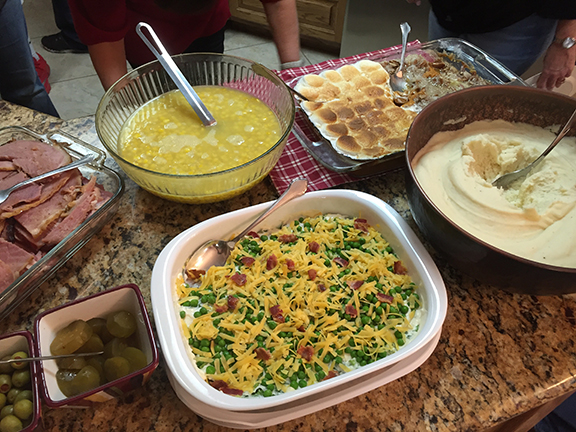
Those are some the sides (below): boiled corn, sweet potato pie topped with roast pecans and marshmallows, mashed potatoes, and the seven layer salad (foreground).

thanksgiving recipesHouston (two hours away by car) is probably the closest urban area where Franciacorta is available but I was happy to bring a few bottles from my private stash to share with the wine lovers.

Honestly, not everyone in southeast Texas likes to drink wine. Beer, “Crown” and Sprite, gin and tonic, and sweetened tea were the beverages of choice this year (and most years, for that matter). But everyone made a point of tasting “Jeremy’s wine,” if not for any other reason than hallmark southeast Texan politeness (another one of my favorite things about living in Texas, where, even when people may find my background exotic and generally don’t share my political views, they always treat me with great humanity).

Southeast Texans aren’t squeamish about day-drinking and we began opening bottles around 1 p.m. about an hour before the meal was served.

what is the best glass for champagneWhen you can’t be with the stemware you love, love the stemware you’re with.
With literally 20+ guests, not counting the ebb-and-flow visitors, and a tide of kids (bouncing off the walls from all the sugar they consume on a feast day), it really wouldn’t be advisable to break-out your best Riedel at a southeast Texas Thanksgiving.

Although it’s not ideal, the plastic cup, once rinsed with a drop or two of wine, is not a bad vessel for sparkling wine, which is served sufficiently chilled so as not to be affected by the heat imparted by your grasp (unless you intend to nurse your wine, which really doesn’t occur with any great frequency at a southeast Texas Thanksgiving).

I really liked the way that Franciacorta worked with the meal this year: it had just the right amount of freshness and depth to work well with the savory, sweet, and tart dishes (because the Franciacorta consortium is my client, and an extra-sensitive one at that, I’m not going to reveal which producer I poured, but suffice it to say that it’s a wine currently available in Texas at Spec’s).

The best thing was how the wine’s trademark sour quality just seemed to wrap itself around the myriad flavors of the Thanksgiving repast. Although the brut, extra brut, and nature (no dosage or “zero dosage”) are my favorites, even the wines with greater amounts of residual sugar will show this character.

As much as I love a great glass of Lambrusco with Thanksgiving, Franciacorta has emerged as my number-one Thanksgiving wine.

I’ll report more on pairing with classic southeast Texas holiday menus after Christmas, when we essentially eat the exact same meal in southeast Texas.

In the meantime, please allow me to share this photo of our girls (below), snapped at the Houston Museum of Natural Science on the Saturday of Thanksgiving weekend.

I can’t really put my finger on it but it really captures their spirit, verve, and sweetness. Just look at Lila Jane’s coy smile. The girls had a blast at Thanksgiving this year.

Thank you to everyone who shared, liked, and commented so graciously on my post yesterday on “My planned parenthood (with a lower case p).” I felt it was important to share in the light of what’s been happening in our country this year.

natural science museum houston hours

My planned parenthood (with a lowercase p)

In June of 1997, one month short of my 30th birthday and the month I completed my graduate studies in Italian at U.C.L.A., I began to experience moderate discomfort and noticeable swelling in my groin (I’ll leave the description of my symptoms at that; apologies for the TMI).

As a full-fellowship student, teaching associate, and research assistant at the Department of Italian, I had decent — however bureaucratically challenged — health insurance.

With my mind racing at a thousand miles an hour imagining all the worst-possible outcomes of my pathology, I hastily made an appointment at the student health clinic.

The student doctor who examined me was quick to diagnose me with Chlamydia, a sexually transmitted disease commonly found among sexually active university students.

She referred me to the school’s men’s health clinic.

But there was a problem: I wasn’t able to get an appointment at the clinic until after the end of the academic year and as a result I wouldn’t have been covered by my university health insurance at that point nor would I be eligible to access the service.

By mid-July, I had celebrated my 30th birthday and was rooming at my then single older brother’s house in La Jolla (in exchange for cooking and cleaning). Every day, I used public transportation to commute to the research library at U.C.S.D. where my goal was to complete my dissertation by summer’s end.

My symptoms hadn’t become markedly worse but they hadn’t gone away. With no income and little savings (typical of a grad student), I couldn’t afford the gap insurance (Cobra) for which I was eligible and I could scarcely afford the deductible payment that would have come with the temporary coverage.

And so I made an appointment at Planned Parenthood on Thomas Ave. in Pacific Beach.

The clinician there prescribed and supplied me with antibiotics at a nominal charge (around $25, if I remember correctly).

By the end of the summer, I filed my dissertation, received my Ph.D., and left California for New York City, where I had landed my first post-grad job (not in academia but in rolling stock; yes, trains, but that’s a story for another time).

My health insurance kicked in right away and with great celerity, I made an appointment to see a doctor in midtown who, after a brief physical examination, told me that, in fact, I didn’t have Chlamydia. I had a congenital hernia, he said. It wasn’t severe and wouldn’t affect my health in the short-term but it needed to be operated.

A month or so later, they operated on me at the New York University medical center and I recovered just fine. I didn’t have to pay a penny thanks to my coverage and just a few months later I had landed my first desk job as an editor at La cucina italiana (the English-language version of the Italian masthead).

Yesterday, when I read that one of the victims at the Planned Parenthood shooting on Friday in Colorado was a 29-year-old man, a veteran of the war in Iraq, the memory of my visit to Planned Parenthood in San Diego flooded my mind. I was the same age as him and like him, I was transitioning from one chapter of my life to another.

Today, as a 48-year-old father of two, an avid supporter of women’s reproductive rights and the right of access to reproductive health care, a resident of a state that has severely restricted those rights, and a supporter of stricter gun laws (who lives in a state where it will become legal to carry a handgun openly next month), I wonder what life will be like here for the microtexans (ages 2 and nearly 4) Tracie P and I are raising when they reach their teens.

Nearly a decade will pass before Tracie and I will be prompted to explain to our daughters what Planned Parenthood is and the role that it plays in civil society. But I hope that, should they need it, they will have access to affordable reproductive health care — even if they are financially challenged (something I don’t hope or foresee for them but a concern nonetheless).

Had the Affordable Care Act been in place when I was a graduate student, I may have never found myself visiting Planned Parenthood. But I’m sure glad that it was there for me when I needed it (although it turned out I didn’t really need it at all).

Had I had Chlamydia and had it gone untreated (because of a lack of access to reproductive health care), my fertility could have been impacted and it’s possible that I wouldn’t have been able to become a father.

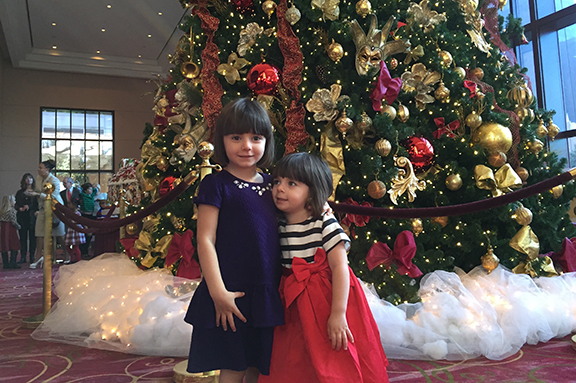
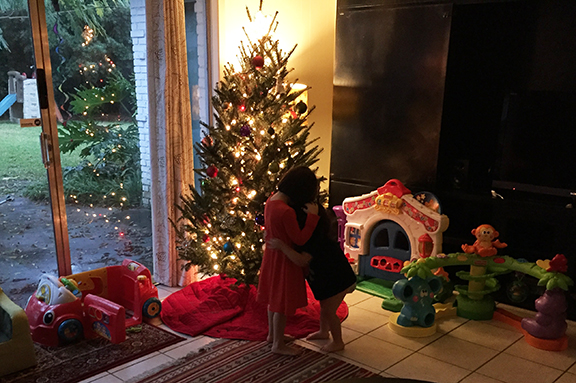
When we finished decorating our Christmas tree yesterday afternoon before hosting a family party for our cousins, Georgia P (our oldest) asked Lila Jane to give her hug and “do Christmas together.”

I can’t imagine life here — or anywhere — without them.

christmas tree decorations children

A miracle and a ray of hope from the land of Verdicchio this Thanksgiving

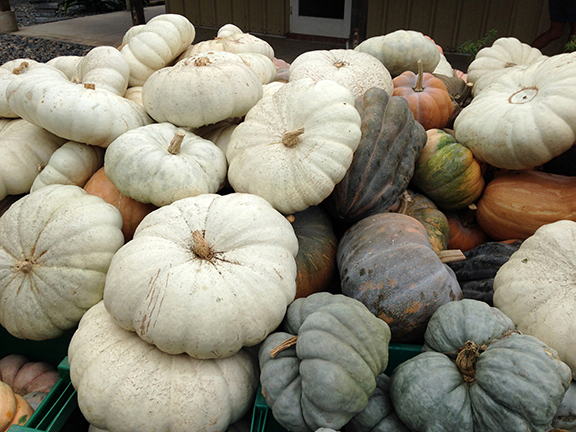
buy thanksgiving ornamental pumpkinsHere at home in Houston, we spend an inordinate amount time talking about butterflies, dinosaurs, and rocket ships. Thankfully, the little domestic bubble our microtexans (ages 2 and almost 4) inhabit is impermeable to the helter-skelter world outside.

I thank goodness for that: for as long as is humanly possible, Tracie P and I are determined to shelter our children from the blood-curdling news that seems to arrive from Europe, Africa, and the Middle East every day.

O tempora o mores! wrote Cicero during another tumultuous chapter of western civilization.

“Oh times, oh manners!” Edgar Allan Poe would translate the great Latin orator’s exasperation some two thousand years later, give or take a few.

What a time we live in! Where has our decency gone?

As the unspeakable atrocities of international terrorism drive political discourse in our country, there is talk of religion-based “registries” and a closing of our nation’s borders to humanity’s most downtrodden.

“The Statue of Liberty must be crying with shame,” quoted New York Times columnist Nicholas Kristof in his Saturday opinion, referring to a tweet from a reader.

Our children’s paternal great-great-grandparents were refugees who fled war and persecution, religious-based registries and closed borders in Europe. (You might be surprised by the refugees that Kristof alludes to in his piece.)

In Italy, the embrace of refugees from the Middle East and Africa has been hailed by some as a last hope for the financial well-being of the nation.

“They work, they have children, and they finance Europe,” wrote Maurizio Ricci (back in September, before the Paris attacks) for the RepubblicaBloomberg financial pages in a widely cited opinion piece. It’s estimated, he noted, that Europe will need 250 million immigrants by 2060 in order to sustain its civil society.

One of the reasons that immigrants will play such a vital role in the next generations of Italian life is that Italy has the lowest birthrate in the industrialized world today (according to ISTAT, Italy’s national institute of statistics).

Although there have been a few moderate spikes in population growth there in the last century (notably in the period that immediately followed the Second World War), Italy’s birthrate is the lowest it’s been in 150 years (according to a report published earlier this year).

Anecdotally, as someone who attended university in Italy in the late 1980s and early 1990s, I can tell you that few of my Italian friends from that period of my life have married and started families. Of the literally scores of my Italian middle-class, college-educated, and now nearly fifty-year-old counterparts with whom I regularly keep in touch (primarily through social media channels), hardly a third of them have children.

That’s not because I like being friends with childless peers. It’s because the socio-economic outlook for mid-life Italians (my peers) is so bleak that few have seen the point in making more Italians.

“Midway on our life’s journey, I found myself/In dark woods, the right road lost…,” wrote the poet (as translated by Pinsky).

In the light of this ongoing demographic trend, the news of a baby born Saturday in the land of Verdicchio (in the Marches, in Adriatic central Italy) was greeted by exclamations of joyous wonderment in the Parzen household.

Friends of ours, a couple (whom I won’t name here out of respect for their privacy) who faced fertility challenges, finally have the baby boy they had so patiently awaited and desired for so long.

They live in the country and grow grapes for wine and olives for oil without the use of chemicals or additives. They advocate for wholesome living and sustainable consumption. They count their carbon footprints down to the weight of the bottles they ship their wines in.

Their child has been born atop an atoll of idealism that sits amid a sea of uncertainly. As my mother-in-law would rightly say, he is a miracle… a precious miracle.

Their new son is just one of the things that I will be grateful for this Thanksgiving. Among my blessings, I will count him along with butterflies, dinosaurs, and rocket ships.

Happy Thanksgiving, everyone.

I’m taking the rest of the week off from blogging. See you next week!

Taste Franciacorta with me in SEATTLE Monday, December 7

do bianchi franciacortaIt’s official: I’ll be doing the last tasting of the 2015 Franciacorta Real Story campaign in Seattle on December 7 at Osteria La Spiga.

Details follow. The tasting is open to all free of charge.

But if you would like to attend, please shoot me an email (jparzen@gmail.com) so we can get a sense of how many people to expect.

FRANCIACORTA REAL STORY
TASTING AND SEMINAR
WITH JEREMY PARZEN, PH.D.

MONDAY, DECEMBER 7
4-6 P.M.
FREE
OSTERIA LA SPIGA
Capitol Hill
Seattle, Washington
Google map

Franciacorta is a place.

Franciacorta is an Italian wine appellation.

Franciacorta is a wine.

Franciacorta is a classic-method sparkling wine produced using Chardonnay, Pinot Noir, and Pinot Blanc in the foothills of the Alps in Brescia province, Italy (about an hour east of Milan by car). Since the 1960s, winemakers there have made some of Italy’s (and the world’s) most coveted sparkling wines thanks to the area’s unique growing conditions, including: the wide variety of morainic, limestone, and clay subsoils of the Franciacorta amphitheater; the maritime influence of Lake Iseo to the north (part of Italy’s beautiful Lake District); and the Alpine climate of their high-lying vineyards. Because Franciacorta growers are able to achieve greater ripeness than their counterparts in other sparkling wine regions and because they have a wider diversity of soil types, their wines stand apart from their transalpine cousins for their remarkable freshness, rich fruit character, and signature minerality (some would call it salinity).

These tastings have been really fun (this is the 6th and last tasting for 2015). They’ve been a great way to connect with wine professionals and lovers across the country. Thanks to everyone who’s come out to taste with me this year. It’s been a blast. I really appreciate your support and hope to see you in Seattle!