97 G. Mascarello Barolo Monprivato Ca’ d’ Morissio and great food at Tasting Kitchen LA

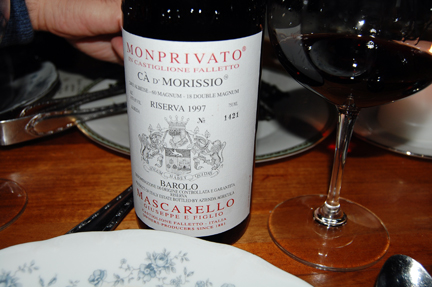
The Schachter factor was in high gear on Tuesday night at The Tasting Kitchen in Los Angeles. Good friend David Schachter reached deep in his cellar for a bottle he knew would thrill me (as it would anyone who knows the great wines of the world): Giuseppe Mascarello 1997 Barolo Monprivato Ca’ d’ Morissio, Mauro Mascarello’s top bottling, from one of the great if somewhat maligned vintages of the twentieth century.

The 1997 harvest was and remains a classic example of semiotician Harold Bloom’s “misunderstanding,” what he would have called the anxiety of influence (@Comrade Howard, I know it’s a stretch but I think you would agree!). Similar to what happened for 2000, many American wine writers (and you all know whom I’m talking about) praised the warm 1997 vintage for the fruit-forward, hot (read highly alcoholic) wines it delivered. In the view of most Piedmont producers, 97 was a good vintage… not a great one. Wines from this harvest, in their view, were not “classic” expressions of their territorio. They were good and sometimes great but not worthy of the hype that they attained in their trans-Atlantic crossing.
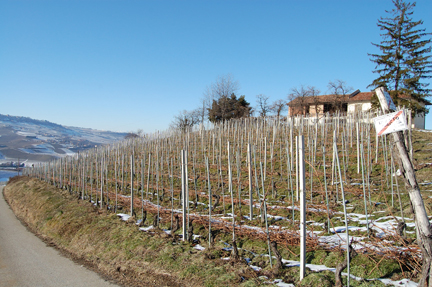
Winemaker Mauro Mascarello’s bottling of his Ca’ d’ Morissio vineyard (above, visited by me and Tracie P and top Italian wine blogger Mr. Franco Ziliani in February 2010) was an exception to this paradigm: thanks to the unique microclimate of this deservedly famous growing site (owing to exposure and elevation), Mauro is able to obtain Barolo benchmarks even in hotter vintages. In fact, to my knowledge, he was the only Barolo producer in the five core townships to produce his flagship single-vineyard wine Ca’ d’ Morissio for the extremely hot 2003 vintage (that’s the Ca’ d’ Morissio, “Maurizio’s house,” at the top of the hill, btw).
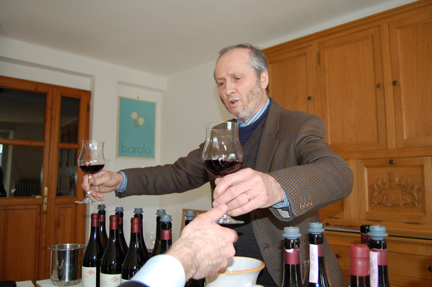
Mauro Mascarello is a remarkable man, a 19th-century man, a man whose spiritual integrity and wholesome warmth are expressed in his warm, sturdy handshake and personal manner. I’ve had the opportunity to meet and taste with him three times now (each thanks to Mr. Ziliani) and I am always as impressed by the man himself as I am by the incredible wines he produces. Many Barolo insiders point to his winery as the most recently canonized member in the pantheon of the truly great producers in the appellation.
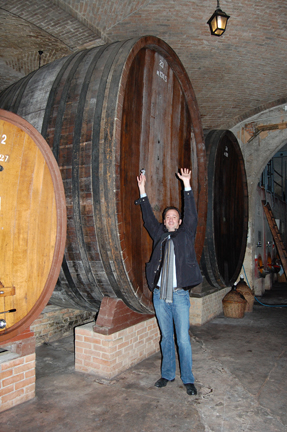
One of the hallmarks of traditional Barolo is large-cask aging: Tracie P snapped the above photo of me when we visited with Mr. Ziliani to show how large “large” is at Giuseppe Mascarello! Mauro’s father was in the lumber business and he built the cask in the photo as an experiment in dimension, said Mauro. (For a fantastic English-language profile of G. Mascarello, I highly recommend this excellent post by my blogging colleague Gregory dal Piaz who knows this winery and its wines perhaps better than anyone else in the U.S.)

I am very fortunate to have tasted a lot of fantastic wine this year (and many of the highlights have been in the last few weeks) but 97 G. Mascarello Barolo Monprivato Ca’ d’ Morissio? An astounding wine. Layers and layers of nuanced fruit and earth on the nose, with this fantastic black licorice, almost menthol note that is always a signature in wines from this vineyard. Rich tar and mushroom in the mouth, with harmonious red berry and red stone fruit. But it was the acidity, tongue-splitting acidity, as Tracie P would have said — even in the warm 1997 vintage! — that took this wine over the top. In Italian wine parlance, you often say that the acidity is a “backbone” that “supports” the flavors of the wine: this wine was the embodiment of this notion.

O, and the food at the Tasting Kitchen (yesterday named 4th best new restaurant in the U.S. by Alan Richman in GQ)?
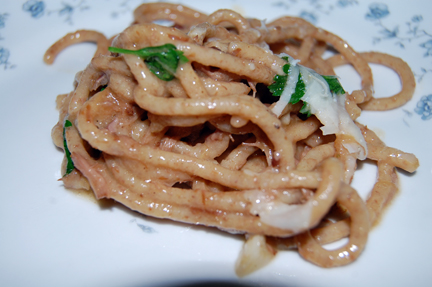
Buckwheat bigoli with lamb and anchovy ragù was my favorite.
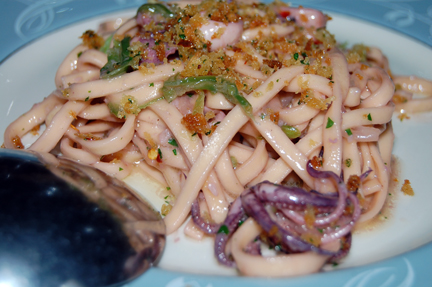
I also loved Chef Casey Lane’s unabashed use of heat in dishes like this tagliolini with baby squid (the fact that my WordPress spellcheck knows tagliolini is remarkable, no?). We spoke to Casey before our meal: he is a super cool, mellow guy (unusual for chefs of his caliber) and he’s from Texas! Awesome dude…
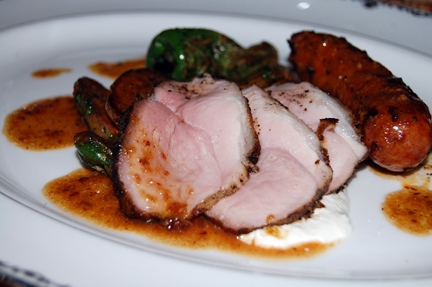
Housemade chorizo and roast pork loin were FANTASTIC with the Ca’ d’ Morissio.

Thanks again, David! And congrats, Casey! An amazing meal and an UNFORGETTABLE wine…
Sérgio Mendes favorite wine last night (with Sérgio!)

From the “I shit you not” department…

It was while Brother Anthony (as he has been duly dubbed by Comrade Howard) and I were doing a little wine bar hopping last night in LA that we bumped into bossa nova, jazz, and funk giants Sérgio Mendes and Gracinha Leporace. We literally saw Sérgio from the street through the window of Osteria Mozza (where we had just left the bar) and he insisted that we come back in and taste his wines (brother Anthony recently recorded with Sérgio, who was having dinner with Gracinha and their agent).

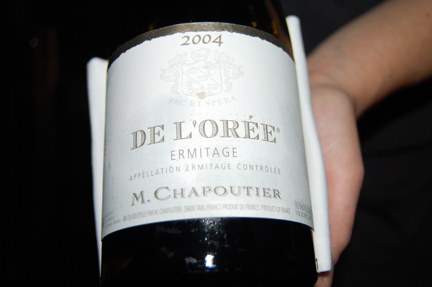
What’s it like to drink Chapoutier 2004 Ermitage [sic] De L’Orée with Sérgio? Unbelievably crunchy and salty and utterly delicious. Sérgio and his entourage were super cool and friendly and fun to hang out with (and he was geeked to see brother Anthony and had high praise for him). I love the white wines of Chapoutier and rarely get to drink them. It was such a thrill to taste such an amazing bottling with Sérgio! Thanks again, Sérgio!

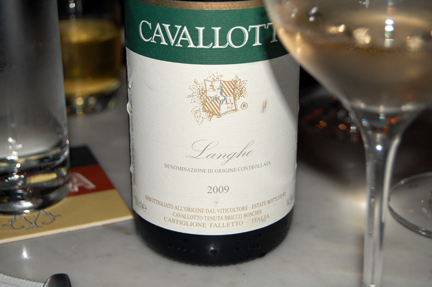
But the wine I can’t stop thinking about this foggy morning in LA (there’s a fog upon LA…) is the 2009 Langhe Bianco by Cavallotto, made from Pinot Nero. Not much of this wine is produced, said my fav LA sommelier and GM at Mozza David Rosoff.

I’ve had some great Langhe Bianco this year, notably from Vajra, Cogno, and Ettore Germano, but this wine simply floored me with its structure and nuance.

In keeping with our tradition of Holocaust humor (one of my all-time favorite posts here at Do Bianchi), I greeted David with a heil myself! I love David and one my new year’s resolutions for 2011 is to spend more time tasting with him. This guy deserves a medal for what he’s doing with Italian wine: his list is the top all-Italian carta dei vini, hands down, in the City of Angels.

Next we headed over to see more Jews at my favorite wine bar in the world, Lou on Vine. Lou is a true rebbe of natural wine and is another one of those folks I just wish Tracie P and I got to see more often.

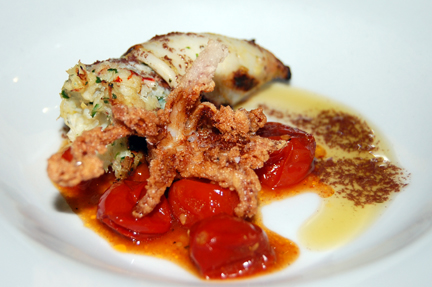
The squid (above) at the Monday night supper was brilliant.

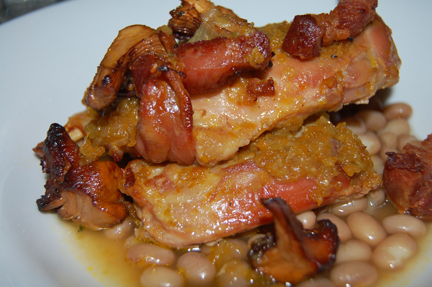
The rabbit was divine.

I just love everything about Lou on Vine.

How do you like my LA stories? It’s been a long time since I’ve posted in the “de urbe angelorum” category!

Wines I drank with Russian spies in LA at Marouch

Above: The 2000 Chateau Musar white (Sémillon) was FANTASTIC at Lebanese/Armenian restaurant Marouch in Los Angeles last night. At 10 years out, this wine is just coming into its own: oxidative and richly aromatic, with gorgeous nutty and stone fruit flavors.

Strained diplomatic relations between the two countries and the delicate nature of my mission as cultural attaché do not allow me to reveal the names of the persons with whom I dined last night. Let it suffice to say that they were all ethnic-Russian Jews who — at some point in their lives — have harbored sympathy for the Communist Party and/or own or have at one time owned a copy of Chairman Mao’s “Little Red Book.”

Above: Not to be missed at Marouch, the fried sardines. Serge, a wonderfully convivial host who came to this country more than 30 years ago, allows corkage in his fine establishment, which I cannot recommend enough.

Owner Serge Brady blew our communist party away with his superb cooking. I can’t believe I’ve almost reached 43 years of age without knowing about his restaurant. Amazing… While I was waiting for my friends, I sipped the Musar and noshed on turnips pickled in vinegar and red wine and cured olives. Perfection… simple and utterly undeniable and inconfutable perfection…

Above: My decoder ring was embedded in the Fattouch (Lebanese Salad).

Among other bottles opened last night, it was the Pascal Janvier 2009 Coteaux du Loir Rouge “Rosier,” made from Pineau d’Aunis, that captivated our senses more than any other. Some of my companions preferred it chilled, but espionage, my friends, is a dish best served température ambiante. Lip-smacking delicious wine. [PHOTO UNAVAILABLE FOR SECURITY REASONS!]

Above: Secret messages where imprinted in the Bastourma (Armenian Salami), which melted in your mouth after the for-your-tongue-only information was decoded.

But as if to prove the axiom that the signifier precedes the signified, it was another bottle brought by Comrade H, its contents now defunct, that contained the logogriphic dispatch with our orders.

Need I say more?

Get to Marouch AS QUICK AS YOU CAN!

In other news…

Readers of Do Bianchi have asked for it and here it is. A short video of The Grapes debut performance last week by the lovely Gross sisters (with whom I attended La Jolla High School). Enjoy!

Mountains of polenta and a sea of grappa: Los Angeles circa 1994

Late last year, when I was asked to contribute to a collection of essays dedicated to and inspired by my UCLA dissertation advisor, mentor, and friend, poet, scholar, gourmet, and gourmand, Luigi Ballerini (above), I decided to chronicle the Italian food scene in Los Angeles circa 1994. The Italian regional cuisine phenomenon had yet to explode in the U.S. but the City of the Angels was already awash in a sea of grappa: with Bloomian anxiety of influence, Angelino restaurateurs had embraced two of Italy’s most humble (however beloved) food stuffs — polenta and grappa — and anointed them as queen mother and queen (respectively) of Italian cuisine.

At the time, Luigi and I were working on a wonderful translation of his poetry that would become Cadence of a Neighboring Tribe. And Luigi was just beginning to shift his focus to gastronomy. Among many other articles, translations, and essays, our collaboration led to an English-language annotated edition of The Art of Cooking by fifteenth-century Italian celebrity chef Maestro Martino (UC Press 2005) — one of my most proud moments as a scholar and translator.

    Three of the most powerful and enduring memories of my years working closely with Luigi Ballerini involve food (and/or the lack thereof).

    The one is an image in his mind’s eye, a scene he often spoke of: Milan, 1945, the then five-year-old Ballerini watches a defiant Nazi soldier atop an armored car, part of a phalanx in retreat from the Lombard capital, leaving it an “open city”; the muscle-bound German bares his chest in the winter cold, as if impervious to pain even in the moment of ultimate defeat. The Nazis left behind a broken city and people, who had already known hunger for quite some time and would not know prosperity and plenty for many years to come. At five years old, Luigi knew hunger all too well.

Click here to download a PDF of the essay.

“La tovaglia che sazia: Luigi Ballerini the gastronome and his ‘tablecloth of plenty,'” by Jeremy Parzen, in Balleriniana, edited by Giuseppe Cavatorta and Elena Coda, Ravenna, Danilo Montanari Editore, 2010.

O, Luigi, you can be the king and you most certainly are in my cook book. But may we wear your crown?

Thanks for reading!

One of the best feelings in the world…

is when…

…you’re sitting at your computer writing, and all of a sudden, you start getting emails and texts from your friends in Los Angeles telling you that Anne Litt is playing your band on KCRW as part of her “best of 2009” show…

I’ll never forget the first time I heard my band on KCRW… a teenage dream come true… that thrill, wow, may be a small one to others, but it’ll always be one of the best feelings in the world to me… :-)

Thanks, ya’ll, for the kind words!

Facebook and oxidized stinky Fiano pair nicely

Above: Fiano d’Avellino grapes on the De Conciliis estate in Cilento (Campania, Italy).

Isn’t Facebook a trip? It gives us a view unto the personal lives and sometimes very intimate details of people whose lives would not ordinarily intersect with ours in the real-time world (as opposed to the virtual world). The vicissitudes we witness in this strange new medium are sometimes moving in ways — perhaps because of the degree of separation yet lack of alientation — unexpected and often welcome.

I had never met him, save for a phone interview I did with winemaker Bruno de Conciliis many years ago. After I tasted his 2004 Antece last year at Bacaro in Los Angeles, I looked for him on Facebook because I wanted to write him and tell him how much I liked this stinky, oxidized expression of Fiano d’Avellino, one of Campania’s most ancient grape varieties and one that has a enjoyed a renaissance in recent decades: it’s macerated with skin contact for 7 days, he wrote me, and, as he put it in a Facebook message, “we try for oxidation.” His approach is to “let what easily oxidizes oxidize. The rest is welcomed.” The resulting unfiltered wine (aged in large old-oak casks) is delightful, rich and aromatic, with some tannic structure. It’s a great example of natural wine. Bruno rightly calls it Antece or the ancients (akin to the Italian, antici; the penultimate syllable is the tonic): gauging from my knowledge of ancient winemaking (as described in Columella and Pliny), I believe that this wine is very similar to the wine produced in antiquity (and probably until the 18th century in Italy). (It reminds me of IWG’s excellent post, Interview with the Ancients.)

Bruno wrote that it’s his favorite wine he’s ever made and he sent me these photos. Facebook and wine seem to pair nicely together, don’t they?

In other news…

When is Brooklynguy gonna get a Facebook? Fugedaboudit.

Down and out in Beverly Hills (but still drinking well)

Above: chefs shop at the Cheese Store in Beverly Hills, arguably the top fromagerie in Los Angeles.

Last night found David Schachter and me at his place up Coldwater Canyon, drinking label-damaged 1996 Giacosa Barbaresco (David’s contribution) and munching charcuterie and cheese from the Cheese Store in Beverly Hills (I stopped in the flats on my way up).

Above: life’s too short not to drink well.

The Giacosa was a little cloudy and had begun to sherryize slightly (possibly because damaged?). This wine should have had many, many years ahead of it. But even in the twilight of its life, this powerful Barbaresco from one of the greatest and most classic vintages in recent memory showed admirably well.

I really liked the aged taleggio from the Cheese Shop but I was a little disappointed to find that the prosciutto and bresaola was a bit dry and not sliced as well as it could have been. But who’s complaining?

In other news…

Legendary Italian winemaker Giacomo Tachis weighs in on the appellation system debate. Read more here.

*****

This old town is filled with sin
It’ll swallow you in
If you’ve got some money to burn
Take it home right away
You’ve got three years to pay
And Satan is waiting his turn
The scientists say it’ll all wash away
But we don’t believe anymore
‘Cause we’ve got our recruits
In their green mohair suits
So please show your I.D. at the door

This old earthquake’s gonna
leave me in the poorhouse
It seems like this whole town’s insane
On the thirty-first floor your gold-plated door
Won’t keep out the Lord’s burning rain

— “Sin City,” Flying Burrito Brothers

The amazingly talented Mr. Lou on Vine

Above: he has my vote. No, that’s not Lou. That’s my comrade and co-conspirator in tasting Howard Rodman at Lou on Vine, my all-time favorite wine bar in the world — yes, in the whole wide world. Howard was just nominated for a Spirit Award for best screenplay (Savage Grace, 2007). Congratulations, Howard!

My travels are taking me away from Austin and back to California, where I’m going to work some holiday parties with my friends at Jaynes Gastropub in San Diego (I’ll be pouring on the floor there on Friday and Saturday nights, btw). During the week, I’ll head to LA to take care of some business and surely stop in to taste at my all-time favorite wine bar, Lou on Vine (at the corner of Melrose and Vine in Hollywood).

Above: Lou Amdur, nez extraordinaire and proprietor of the eponymously named Lou on Vine.

Lou’s menu features farm-to-table materia prima and his extensive by-the-glass list never fails to surprise and thrill me, whether with a biodynamic Pecorino from Abruzzo, a stinky Gamay from Beaujolais (Rachel Ray’s favorite, Lou claims wryly), or a grape that I’d never tasted, like Zierfandler from the Thermenregion.

Before I headed out to Austin a few weeks ago, Lou graciously let Howard and me pull the cork on Howard’s 1998 Cascina Francia by Giacomo Conterno, which showed beautifully. I’ve recently tasted the 97 (at Jaynes courtesy John Greer) and the 99 (courtesy David Schacter): while the 99 was still way too tight and the 97 began to open up nicely only after extended aeration, the 98 was simply singing in my opinion.

*****

got a pocket full of nickles
a pocket full of dimes
going back to Watts
drink a little wine
come on
baby don’t you want to go
going back to LA
sweetest place I know

— Johnny Otis Show

Un sabato da leoni (Big Saturday)

Does anyone remember the film Big Wednesday? Arguably, one of the greatest surf movies ever made. In Italian the title was translated as Un mercoledì da leoni, literally, a Wednesday for lions.

This weekend I had a Saturday for lions of sorts: I was invited to take part in a birthday celebration for a friend, an Angeleno wine collector.

Here’s a little photo essay and some notes and highlights: a window into a rarefied world of raw hamachi flown in from Tokyo, served as sashimi and tartare, dressed with colatura di alici (the juice of white anchovy), and paired with R.D. 1975 Dom Perignon and 1982 Krug; Nova Scotia lobster soufflé paired with Grand Cru white Burgundy; and creamy risotto and semolina gnocchi topped with shaved white truffles from Piedmont and old Nebbiolo — 13 dishes in all and a flight of 20 wines.

The celebrant’s mother, who lives in New York, hand-polished the family silver and had it sent it to him for the occasion.

In Los Angeles, it’s even harder than in NYC to get great truffles. These were among the best I’ve ever had, with aromatics comparable to those I’ve eaten in situ. Look at the size of that sucka!

Not every course was as photogenic as the garganelli but each dish (and only one serving was allowed per Bacchanalian) inspired orgasmic oohs and aahs among the all-male crowd. Chef Angelo Auriana’s ragù was ethereal and the pasta sublimely light yet firm and rich (my camera didn’t do justice to its egg-yolk color). But the risotto mantecato alla fonduta di cipolla bianca (onion fondue risotto) topped with shaved white truffles was my personal favorite.

My top wines (but, then again, I’m pretty predictable) were: Krug 1982, Lafon 1989 Mersault-Charmes, Giovannini Moresco 1979 Barbaresco, Robert Arnoux 1993 Romanée-Saint Vivant, Giacosa 1989 Santo Stefano Riserva, Giuseppe Rinaldi 1989 Barolo Riserva (magnum).

Some found this 1979 Barbaresco by Giovannini Moresco tired but I thought it was drinking great. The vineyard where the fruit for this wine was grown now belongs to another winemaker who blends Nebbiolo from this famed growing site with Merlot and Cabernet. Quel dommage! (If you don’t get the joke, click here.) This was the wine that intrigued me the most.

I was blown away by the youth and power of this 1989 Giacosa Barbaresco Santo Stefano Riserva. Barbaresco at its best — and this was one of the greatest expressions I’ve ever tasted — combines grace and strength. Diana never pleased her lover more…*

At the end of the night, I felt like Rubens’ Bacchus. It’s kinda like the old joke about the Rabbi, the Priest, and the ham sandwich: the 1992 Krug was one of the greatest wines I’ve ever tasted but I don’t need to drink it — well, at least not every day!

Click the image to read a label on the painting, which resides at the Hermitage. Note the color of the wine — white not red.

* Petrarch, RVF, madrigal 52 (translation by Mark Musa)

Diana never pleased her lover more,
when just by chance all of her naked body
he saw bathing within the chilly waters,

than did the simple mountain shepherdess
please me, the while she bathed the pretty veil
that holds her lovely blonde hair in the breeze.

So that even now in the hot sunlight she makes me
tremble all over with the chill of love.

A couple of posts worth reading…

David Schachter and I had our weekly powwow at Mozza last night, where we also tasted with general manager David Rosoff (above) — top sommelier and Italian wine guy in Los Angeles in my book. Man, I wish I could get my facial hair to look as good as his. He’s also a rocking drummer.

Today finds me simply too busy to keep posting my Brunello debate series and I promise to pick it up again on Friday.

In the meantime, check out this post by winemaker and wine blogger Craig Camp, who sets the record straight with James “Giacomino” Suckling. The 1997 and 2000 vintages in Piedmont (and Tuscany) are among the most overrated and misunderstood in this country (I mean, come on: is there such thing as a 100-point vintage?). Suckling should be commended, however, for keeping prices of 1999 and 2001 down. And Piedmont 1998? Drinking great right now.

Schachter brought a bottle of Il Cantante white, impossible to find in this country, and I have to say, one of the most impressive Sicilian whites I’ve ever tasted (made from Carricante, Minnella, Grecanico, and Moscato). Don’t let the rockstar label fool you: this is serious stuff.

I also liked Lyle Fass’ report “U.S. to bailout wine retailers.” Note his take on the 2000 Barolo and 2003 Brunello (both warm, atypical vintages).

We also drank a Conterno Cicala 1996 from Schachter’s cellar. I tasted this wine twice on release — once in NYC and later at the winery. I have to say that it did not show as well as I would have expected and the wood still dominated the wine unfortunately. This wine was touted by some — and they know who they are — to be one of the greatest releases of the decade. I’ve always enjoyed Aldo Conterno’s wines but at the end of the day, I think that traditionalism invariably trumps modernism, however muted that modernism may be (call me a passéist). But this post is about others’ rants, not mine! More on the Brunello debate on Friday…