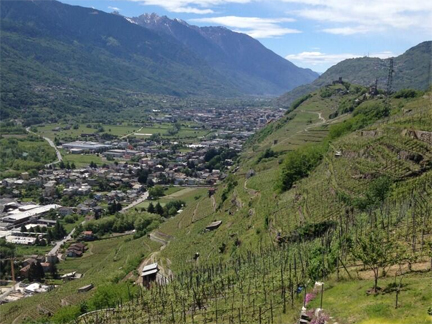
Above: “@DoBianchi [the wines of Ar.Pe.Pe. are] beauties!” wrote Michael Garofala yesterday on the Twitter. “We’re very lucky in Pdx [Portland, Oregon] to have them. Valtellina’s also not such a bad place to visit.”
Above: The news of Joe’s new restaurant in Italy nudged me to grab this bottle of his Mozza 2008 Aragone from my samples bin. A blend of Sangiovese with smaller amounts of Syrah, Alicante, and Carignan, the wine was fresh and the ripe red fruit was bright, balanced by wholesome earthiness. According to WineSearcher.com, it sells for under $35 in the U.S. market. Another gem of a wine from the great enologist Maurizio Castelli, it paired nicely with some chicken tacos.
Things are insanely busy these days at the home office, but I did manage to catch up on my Feedly reading yesterday.
I’m surprised that virtually no one in the U.S. has written about Joe Bastianich’s soon-to-be-launched new restaurant in Friuli, “Orsone” (the big bear), the name of farmhouse and vineyard where he sources fruit for one of his vineyard-designated wines in the Colli Orientali del Friuli.
One of the things that fascinates me about Joe’s career is his reverse immigration. There are many Italian-American restaurateurs in the U.S. who own vineyards in Italy (as he does) but I don’t know of any who are megagalactic (to borrow an Italianism) television celebrities and restaurant-owners on the other side of the Atlantic.
It will be interesting to see what he does with it… And like any high-profile “restaurant man” (the title of his memoir, published while in his early 40s), I’m sure that Orsone will be the subject of intense scrutiny…
So much more to tell but I’ve got hungry mouths to feed. Thanks for reading. Stay tuned…
“Entry to Eataly is forbidden to people like [Italian senior parliamentarian] Calderoli,” said the food emporium’s founder Oscar Farinetti to a radio interviewer this week in Italy, adding that the ban was “for hygienic reasons.”
At a political rally on Saturday in Treviglio (Lombardy province), Calderoli used a racial slur in reference to Italy’s first African-born minister, Italo-Congolese politician and opthamologist Cécile Kyenge.
Calderoli and his racist cohorts, suggests Farinetti in the interview, “shouldn’t just resign from politics… They should resign from the human race… They lack the conscience that distinguishes humans from chimpanzees.”
As an Italian wine and food historian and an observer of Italy’s wine and food trade, I applaud Farinetti for his “no racists allowed” policy.
His statements came in response to the interviewer’s question: As someone who works abroad, are you ever embarrassed by the attitudes of Italian politicians?
While many international ambassadors of Italian wine and food avoid the sticky, unsavory issues of politics and racial tensions in Italy today, Oscar Farinetti’s decisive stand on this issue — zero tolerance for the manifest racism expressed by Italy’s separatist movement leaders — deserves our attention and commands our respect.
Enogastronomy is one of the greatest expressions of the Italian soul — no matter what the political affiliation. As the highest-profile representative of Italian wine and food throughout the world, Farinetti’s example should be a model for us all.
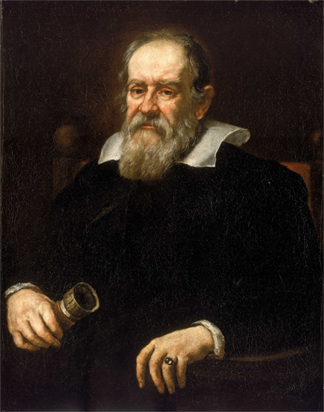
Above: Portrait of Galileo Galilei (1564-1642) by Justus Sustermans (1597-1681; image via the Wiki).
Reading the excellent Italian-language food and wine blog Porthos this morning, I was reminded by the authors of the famous and brilliantly topical lecture by U.S. physicist Richard Feynman, “The Universe in a Glass of Wine.”
“A poet once said,” it begins, “‘the whole universe is in a glass of wine.’ We will probably never know in what sense he said that, for poets do not write to be understood. But it is true that if we look in glass of wine closely enough we see the entire universe.”
(Today’s post on Porthos takes the form of a Socratic dialog on biodynamics and Natural wine and the interlocutors cite Feynman as an example of the powerful mythology of Nature as expressed through wine.)
Feynman doesn’t seem to know who the poet was. (And he notes — for comic effect but erroneously in my view — that poets “don’t write to be understood.”)
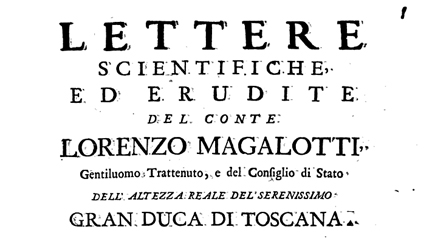
I believe that the imagery comes from a “scientific letter” by Italian philosopher Lorenzo Magalotti (1637-1712) who cites Galileo’s [attributed] maxim, wine is a compound [mixture] of moisture [humor] and light (il vino è un composto di umore e di luce).
Note that humor denoted moisture in seventeenth-century Europe (cfr. “1697 Dryden tr. Virgil Georgics i, ‘Redundant Humours thro’ the Pores expire,'” Oxford English Dictionary).
This celebrated observation of the physical world was transmitted anecdotally by Galileo’s student Raffaello Magiotti (1597-1656), who is quoted by Magalotti in the letter.
In the text (the fifth letter in the collection), he uses the maxim as a thesis in his dissertation on the nature of light. The grape and its transformation, he writes, are a perfect example of light’s ability to “penetrate a body.”
In Dante’s Commedia (Purg. 25, 76-78), the Latin poet Statius compares G-d’s creation of life to Nature’s transformation of moisture into wine by means of light:
E perché meno ammiri la parola
guarda il calor del sol che si fa vino,
giunto a l’omor che de la vite cola.
[And, that you may be less bewildered by my words,
consider the sun’s heat, which, blended with the moisture
pressed from the vine, turns into wine.]
(Some have translated Dante’s omor [umore] with the English sap but moisture is a more accurate translation, especially given the context.)
In the light of Dante’s popularity during Galileo’s time, it’s likely (guaranteed, really) that Galileo was familiar with these lines. Magalotti cites the Dantean verses as well in his letter.
So did a poet once say that you could see the whole universe in a glass of wine?
It’s possible but unlikely.
Did the poets, as far back as Statius, consider wine to be a substance that could reveal the nature of the universe? Yes, most definitely.
Like me (however small I am compared to those giants), they were negotiating the epistemological implications of oenophilia.
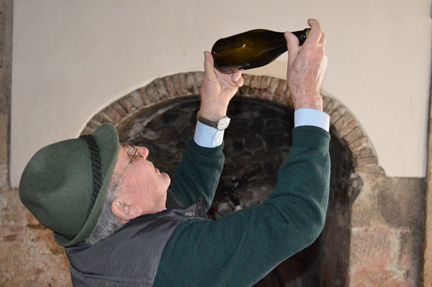
Looking back on my April 2013 visit to Prosecco legacy winemaker Luigi Gregoletto (above), I realized that I’m going to need to devote a series of posts to our fascinating conversation about pre-autoclave Prosecco, Prosecco Colfòndo, and his recent embrace of biodynamic farming practices.
But first, I’d like to share this video, shot the day of our visit.
In the film, he and I make a Dantean ascent to the villa where his parents — Proseccoland sharecroppers — were born.
Luigi was born a sharecropper in 1927, five years after Mussolini’s March on Rome.
As he explains in the video, he began to purchase land from the owners about twenty-five years ago.
Today, the hilltop that overlooks the owner’s villa is planted to his prized Verdiso, from which he makes his top wine. It’s a powerful metaphor for the arc of his life.
As we began our climb up the hill that leads to the villa, I was struck by how his family’s story is an Italian parable that spans Italy’s industrialization in the twentieth century to the rise of the proletariat in the years that followed the Second World War.
Sharecropping — a form of indentured servitude — was not officially abolished in Italy until the 1960s. Its prohibition was not implemented until the 1970s. And only in the 1980s did the Italian legislature set out parameters for the redistribution of land.
His truly inspirational story reveals so much about the evolution of Prosecco and the renaissance of Italian wine. And it tells us even more about Italy’s twentieth-century history.
I have a lot more to share about our visit, but in the meantime please have a look at the video. I hope you find the experience as moving as I did.
Above: We took Georgia P to Proseccoland for the first time in September 2012 when she was about nine months old. The grapes were still on the vines and about to be harvested. She loved playing in the vineyards and Tracie P and I felt good about it because the two vineyards we visted — Bele Casel and Zanotto — are both organically farmed.
On Friday of last week, a friend of ours from mainland Venice, Paola, alerted me to a report in Oggi Treviso (Treviso Today) about daycare mothers protesting the use of pesticides and herbicides in Proseccoland.
According to the author of the article, the local chapter of the WWF has helped them to organize an assembly (this coming Friday) to address their concerns about chemicals being sprayed in vineyards that lie adjacent to a preschool daycare center.
Above: During the “Prosecchissima” festival in the village of Miane in April of this year, the WWF Altamarca displayed signs calling for the abolition of chemical-based farming in the Prosecco DOCG appellation (source: PDQNews.it). The signs were removed by thieves.
But this morning, as I poked around the internets looking for more info about the situation “on the ground” in Proseccoland, I learned that similar protests, assemblies, and impassioned calls for a chemical-free Prosecco DOCG have been going on since 2011 when the WWF opened a local chapter, WWF Altamarca (no website).
I also discovered a video feed by European parliament deputy Andrea Zanoni, a Treviso resident and native, who has been documenting his battle with “big Prosecco” to curb the use of chemicals and to stop the deforesting of woods in the appellation.
Here’s a video from his YouTube page:
The video was shot in the township of Tarzo, not far from the preschool where mothers first raised concerns about pesticides being sprayed.
Like the WWF Altamarca, Zanoni has also called for a halt to helicopter spraying.
In another of his videos, he notes that restaurant-diners were recently affected by pesticide-spraying aircraft. Such spraying, he says, is only allowed in extreme cases and he believes that recent airborne spraying is in direct violation of EU regulation.
I first traveled to Proseccoland in 1989 (playing music) and I think it’s safe to say that no other Italian appellation has been transformed so radically by “big wine.”
The Prosecco boom of the last two and half decades and the ever growing demand for grapes are so enticing that chemical-farming and the clearing of land has become a way of life there.
I’ll be following these stories and will continue to report on them here and on the Bele Casel blog.
Please tweet or share this on Facebook if you feel so inclined.
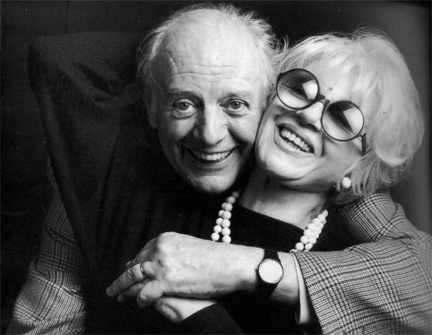
One of the most thrilling moments of my university years in Italy was seeing Franca Rame perform and meeting her and Dario Fo in Rome. They were in the lobby of the theater before the show and very graciously gave their autographs to a starstruck American student.
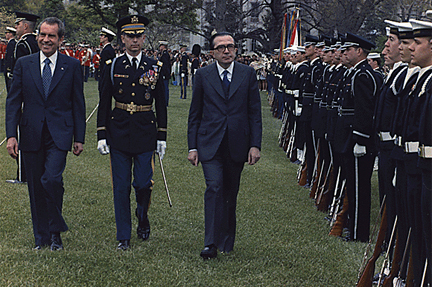
Andreotti (right) with Nixon in 1973. Image via the Wiki.
“The great winemakers,” said my client Silvano “die during harvest or during Vinitaly,” Italy’s annual trade gathering in Verona where we were meeting.
He was referring to the passing of Franco Biondi Santi, whose death — at 91 years — cast a long shadow over the fair when the news broke on the first day of the event.
And so is the case with Italian politics.
Today, Italy has new Pope, a new prime minister (elected last week), a new president (also recently elected), and Giulio Andreotti, the seven-time prime minister who defined politics in Italy and reshaped the country’s political and economic legacies in the twentieth century, has died at 94 years of age.
When I traveled to Italy for the second time, to spend the 1989-90 scholastic year at the university in Padua, Andreotti was in his last term as premier.
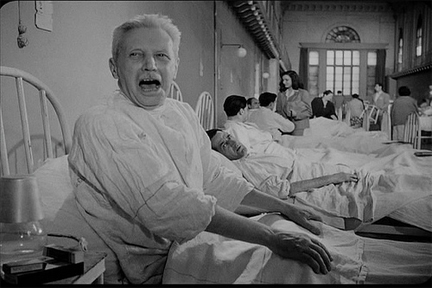
In every way, he represented everything that my leftist Italian counterparts and friends abhorred: he was the face of Italy’s right wing, considered by many a torch-bearer of fascism, a censor (who once repudiated De Sica for the fim Umberto D.), a mafia-tainted and wily politician who was implicated in the assassination of his friend and political rival, Aldo Moro, not to mention the murder of a journalist who had become a nuisance to him.
In 1993, during his mafia-association trials, authorities revealed that they had obtained a photograph of Andreotti shaking hands with mafioso Vincenzo Pernice at a private ceremony in a church in Rome. There was also an account that he had exchanged a kiss with Salvatore Riina, the boss of bosses at the time.
I’ll never forget how Professor Branca — one of my mentors and a staunch supporter of Andreotti’s Christian Democrats, a rightist in an academic world dominated by the left — finally conceded that Andreotti was as crooked as the figures with whom he’d been linked.
“Si è fatto fotografare con quel mafioso,” he said to me and my dissertation advisor, another one of his protégés. “He allowed himself to be photographed with that mafioso.”
There was no denying that Andreotti was a criminal, not even for Vittore Branca.
Italy’s current generation faces enormous challenges — economic, political, and cultural. Some would even go as far to say that the current financial crisis is one of the greatest crises Italians have faced in the history of the Italian republic (born after the second world war).
In the light of recent events, it’s as if Andreotti’s death were a congedo, a coda to his twentieth-century legacy. It’s as if he were saying, I don’t know where you’re going but don’t forget that I’m the one who got you here…
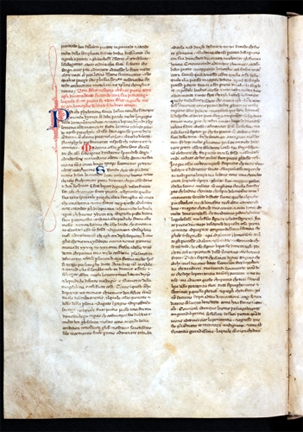
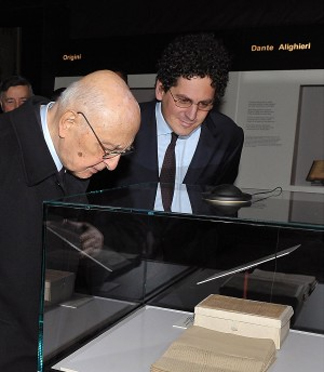
Above: Hamilton 90, the Boccaccio “autograph” manuscript, from the Staatsbibliothek in Berlin. Image via Quirinale.it.
In the world of rare books (a world I used to inhabit in my academic days, when I studied and wrote about Italian incunabula and humanist amanuenses), most “special collection” libraries observe the same protocol when two scholars request the same manuscript or codex on the same day: the librarians give the manuscript to neither.
One of the most notorious anecdotes from my days as a student of scribes was that of two illustrious Italian professors — one Italian, one American — who competed to discover the earliest autographed redaction of Boccaccio’s Decameron, in other words, his first “authorized” version of the work, transcribed in his own hand (a holy grail among philologists and paleographers like myself).
When the one professor discovered that the other was headed to the library in Berlin to request a viewing of the vellum, he raced to arrive before his colleague and he swiftly put in a request to view it as well. As a result, the librarians gave it to neither that day.
Ultimately, the one professor stole the manuscript, took it to Rome, had it x-rayed, and became the first to prove its connection to the fourteenth-century author. He replaced the manuscript before anyone noticed.
Not long after, the other professor killed himself.
That’s a true story.
There’s a saying in academics, the competition is so fierce and the enmity so ferocious because the stakes are so low.
One of the ugliest episodes in the history of oenography has been playing out over recent months, with Montalcino as its backdrop.
If you haven’t been following along, the Brunello consortium announced last week that it was expelling and suing one of its members for defamation. (Here’s a link to my post on the legal action; it includes links to my reporting of events that led up to the consortium’s move).
December 2012: Soldera’s winery is vandalized; six vintages purportedly destroyed.
December 2012: Consortium offers to donate wine to Soldera winery out of solidarity.
March 2013: Soldera accuses consortium of encouraging him to commit fraud when offering to donate wine; announces he’s leaving consortium; announces that he’s recovered a good quantity of wine and that he plans to sell it.
If GramsciPasolini Marx were alive today, he surely see the situation in Montalcino as a text-book example of his theories.
In the 1950s and 60s, Montalcino was still an agrarian economy, with a few patrician families — like Biondi Santi — who served as stewards of its production of fine wine.
In the late 1960s, “big wine” arrived: American-based Banfi set up shop, not to produce Brunello but rather to produce sweet sparkling wine (Moscadello di Montalcino).
In the 1970s, Soldera, a rich Milanese insurance broker, who was unable to acquire property in Piedmont, bought land in Montalcino and started to produce fine wine.
By the 1980s, Banfi had shifted to the production of Brunello and helped to make Montalcino as a brand in the U.S. through high volume and aggressive marketing.
There were many other players in this equation but these two more than any other reshaped the way Brunello was perceived beyond Montalcino’s borders. And in doing so, they changed the way that the Montalcinesi viewed themselves.
On the one hand, Banfi opened up the world’s largest markets to Brunello. In the 1960s, there were only a handful of Brunello bottlers. Today, there are more than 250.
On the other hand, Soldera transformed Brunello into an extreme luxury product, delivering bottles that fetched astronomical sums.
Along the way of this dichotomy, Montalcino passed from de facto feudalism to full-throttle capitalism.
And the tension that has come to a head here is, in many ways, a dialectic held taut by a battle between agrarian and capitalist values, with indigenous growers on the one side and outsider financial interests on the other.
Add to this mix that Soldera is generally considered a carpet-bagger (he is) and that his cantankerous personality and his unbridled egotism have won him few friends there. After years and years of acerbic commentary (public and private) from Soldera, it was only natural that a situation like this would arise (many in Montalcino predicted something like this in 2008, when it was rumored that Soldera had sent a letter to authorities igniting the Brunello adulteration scandal).
Let’s face it (and it’s high time that someone wrote this): when news broke that Soldera’s winery had been vandalized, many observers of the Italian wine world (myself included) couldn’t help but think, to borrow a phrase from Lennon, instant karma’s gonna get you.
Was the consortium right to sue him? It’s not for me to say or pass judgment.
Most on the ground in Montalcino believe that his “resignation” stunt in March was a means to let the world know that he had miraculously recovered wine to sell.
No one can know for certain. But the consortium and its members had to do something. If they didn’t, they’d be allowing the “broker from Treviso,” as the consortium’s lawyer has called him, to exploit their brand in the service of his own personal agenda (this is how many in Montalcino view the situation).
Does any of this matter? Maybe to Marxists like me. The bottom line is that the renewed controversy has only helped to keep Montalcino in the news. And as any public relations veteran will tell you, all news — even bad news — is good news when it comes to raising awareness of your brand.
These political acrobatics (as the New York Times has called recent developments) are remarkable: Letta, center left, has emerged as “bridge builder” from a seemingly intractable deadlock, with the support of the most vitriolic opponents on either side of the aisle.
Only in Italy, some have said, shaking their heads (myself included).
But it’s all part of our my fascination with Italy and the enigmas of its greatness.
In the words of the great Harry Lime, “in Italy, for thirty years under the Borgias, they had warfare, terror, murder and bloodshed, but they produced Michelangelo, Leonardo da Vinci and the Renaissance. In Switzerland, they had brotherly love, they had five hundred years of democracy and peace — and what did that produce? The cuckoo clock.”
My backlog of tasting notes, winemaker profiles, and food photography brims over from our recent trip to Italy.
But all I can think about this morning is Monday’s tragedy in Boston.
Maybe it’s because of the fact that, for the first time, I felt compelled to shield Georgia P from the news. She’s walking and talking up a storm these days. She certainly can’t understand what the newscasters say (and the media outlets have been conscientious about not showing graphic images from the tragedy; something, as parents of a toddler, we appreciate very much). But we felt compelled, nonetheless, to make sure that she wasn’t exposed to the reports.
I can’t help but be reminded of the 1980 Massacre in Bologna, when a terrorist attack killed “killed 85 people and wounded more than 200.” A bomb went off in the crowded Bologna train station, one of the busiest traffic hubs in Italy, and a new era of terror — one that came in the Years of Lead — had dawned.
In 1980, the year I was bar mitzvah, I was hardly aware of Italy or the Bologna Massacre. But when I traveled to Italy in 1987, the tragedy was still very fresh in the minds of the Italian students with whom I lived. The first time I took a train from Padua to Rome, my cohorts urged me to visit the station memorial when I changed trains: a part of the wall destroyed by the bomb is filled with glass instead of brick to remind travelers of how the explosion blast through the station.
The thing that set the event apart was that no one was certain who was behind the attack.
Note the subtitle in the headline above: due iptoesi: attentato o sciagura? (two hypotheses: attack or accident?).
Many in Italy remember the Bologna tragedy as the beginning of the so-called strategy of tension, whereby the anonymity of the architects of terror played into the hands of the terrorists. In other words, it didn’t matter who committed the act of terror. What mattered was that people were terrorized.
I wish speed upon the authorities as they try to uncover the authors of the despicable and cowardly attack of Monday. And may G-d bless the victims and their families. Our prayers and thoughts are with them.
In other news…
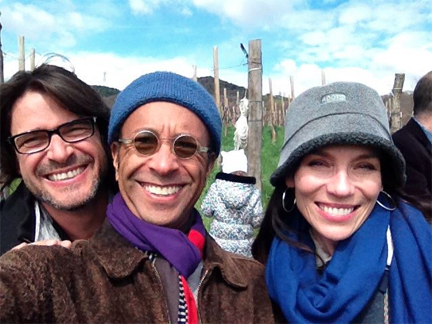
Above, from left: Friends Charlie George, Shawn Amos, and Shawn’s wife Marta in Luca’s vineyard a week ago Saturday.
Above: I took this photo of Angelo Gaja when I met with him in June 2012. He’s in his 70s and looks great. Angelo Gaja for president? Why not?
“The most important battles to fight,” once said traditionalist Barolo producer Teobaldo Cappellano, “are those which you know you cannot win.”
Surely there was a quixotic spirit behind this utterance (he was referring to the traditionalist opposition to Brunello’s inevitable slide into modernism).
But he was also embracing a notion — very Italian at its core — that taking a stand, even when a last and inconsequential stand, has an indisputable intrinsic value that may transcend the stakes in play (does anyone remember the Alamo?).
In the wake of two weeks that our family just spent in Italy (eating and drinking, playing music, and attending the wine fairs), one thing has become abundantly clear to me: Italians have their backs to the wall. The financial crisis, the Euro crisis, and the Italian frugal spirit have the Italian everyman everyperson in a chokehold.
Everywhere I went, winemakers and restaurateurs repeatedly began their discourse with the expression, con i tempi che corrono (in times like these). People simply aren’t spending the money that they used to. I watched one of the richest men in the Veneto sit down at one of the best restaurants in the province of Treviso and order an Euro 8 bottle of wine.
Extreme times call for extreme measures. It didn’t come as too much of a surprise when I received a press release last week from Vinarius, the association of Italian enoteca owners, in which the authors put forth Angelo Gaja as their candidate for President of the Republic.
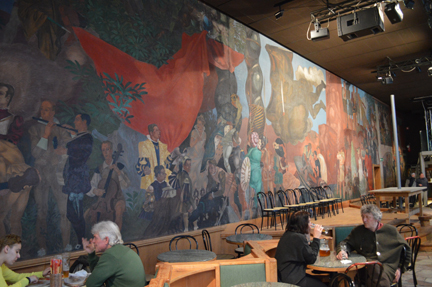
Above: While in Italy, we visited the beer garden where my band used to play in the 1990s before the Tangentopoli bribe scandal. The mural depicts Italian history through the fascist era, when the gesso was painted. Today, the main dining room is used for “lapdance” evenings (note the pole).
Italy has had pornstar politicians (most famously Staller) and today its “kingmaker” anti-establishment and anti-status-quo Five Star Movement party is headed by a comedian.
So why not a winemaker? After all, the role of President of the Republic (largely ceremonial and not to be confused with the executive Prime Minister or “President of the Council”) has been previously fulfilled by a winemaker (and iconic economist), Luigi Einaudi, Italy’s second president.
According to the president of Vinarius, Andrea Terraneo, who issued the press release last Thursday:
Gaja represents all Italians inasmuch as he is a citizen, a worker, and a symbol of excellence. He is a leader in the world of agriculture and in the view of Vinarius, his candidacy would be a true resource in an extremely complex economic moment…
[He] is by far one of the world’s best known Italian wine world personalities. He possesses extraordinary moral and empathetic characteristics and he has the charisma needed to perform such an important role.
While Italian politicians hardly seem to have taken notice, Italian wine industry observers have set about commenting the implications of a Gaja candidacy (just Google “Gaja” and “presidente” and you’ll find all the links, including posts that have appeared in some of the country’s leading wine blogs and mastheads).
However ceremonial the office, the President of the Republic is the only one who can dissolve parliament and call for new elections. (The current president, Napolitano, who is at the end of his seven-year term, cannot call for new elections because the Italian constitution forbids him from doing so in the last six months of his tenure.)
The austerity and financial crises are only exacerbated by the fact that Italy hasn’t had a government since February elections failed to produce a coalition (according to reports today, Berlusconi would be the next PM “by a hair” if the vote were held today).
And beyond the technical issues that the government-less nation faces, there is also the issue of morale in a Europe that increasingly looks to Italy as one of the sources of its financial ills (the Euro crisis was what forced Berlusconi out of power last year).
Gaja for president? It could only do the country good. The only problem, as Franco Ziliani noted the other day on his blog (one of the most popular and most controversial wine blogs in Italy), is why would anyone who is already King [of Barbaresco] accept a demotion to president?





 Do Bianchi

