Italy vs. Google

Above: The night we stayed in Bologna on our recent trip to Italy, my friends (some of whom I’ve known for more than 20 years), shared this Youtube video of Italian politician Francesco Rutelli butchering the English language. The video has been the subject of much ridicule and parody in Italy, a country with a rich history of biting satire that stretches back to the Renaissance and beyond. My friends said it was an example of their culturally and morally bankrupt government.

Between our re-entry into civilian life, our move into our new home, a ride-with with a rockstar winemaker in northern and eastern Texas, and the mountain of thank you cards that Tracie P and I have just begun to chip away at, an interesting news story slipped through my cracks this week: according to a story published on Wednesday by The New York Times, an Italian court convicted three Google executives for “violating Italian privacy laws.” (For more detailed background on the case, see also this Reuters post.) Many see the ruling as part of the Berlusconi government’s attempt to curb freedom on the internet and part of an over-arching plan to maintain control of public opinion through the cultural hegemony of television (as head of state and thus chief executive of public television and owner of the major privately-owned television channels, Berlusconi has a virtual monopoly on what is televised in Italy).

Above: To appreciate this parody of the Rutelli clip, you need hear the “interpreter’s” markedly Roman accent. The short film is indicative of Italians’s embrace of the internet as a viral medium for satire. And again, I can’t underline enough the centrality of satire in Italian culture. Just think of the pasquinades of 16th-century Rome — same idea, different medium.

If you’ve visited Italy in recent years, you know that connecting to the internet can be a daunting challenge there. At least one restaurateur explained I spoke to in 2008 said that this is because the Italian government holds the internet providers responsible for what their users and customers post on the internet. It’s simply not worth the hassle for restaurateurs, for example, to provide internet access to their customers (and this guy was an entirely hip and successful winemaker in German-speaking Italy, who has a sleek, contemporary restaurant in the Alps). When you can get online in Italy, some businesses (like hotels) ask you to sign a written document stating that you are fully liable for what you publish on the internet.

Above: A quick search on YouTube quickly rendered an example of the type of virally circulated clip that might bother Berlusconi.

Does any of this have any bearing on the world of wine? Yes, in my opinion, it does. Now, more than ever, Italian wineries need to use the internet as a medium for viral marketing of their products to English-speaking consumers. This is especially true right now when the enosphere is shifting radically to the internet as its preferred medium of communication.

Okay, time to get down off my soap box… If you made it this far into the post, thanks for reading!

Buona domenica a tutti…

Tuscan Rooms with Views

One of the highlights of our honeymoon was the Tenuta Il Poggione farm house where we stayed on our first two nights of our trip. The old farm house, located in the middle of the estate, surrounded by olive groves and vineyards, has seven guest rooms, all with air conditioning, heating, and kitchen. We stayed in the room called “Pero,” the pear tree.

farm house

This amazing olive tree is about 50 yards from the farm house. Il Poggione is one of my favorite wineries and I’ve been friends with the Bindocci family, who runs the estate, for many years now. Winemaker Fabrizio Bindocci told me that some of the trees in this grove are nearly 200 years old.

farm house

Can you see why I love her so much? :-)

farm house

This is the view from the farm house, looking northward. That’s Sant’Angelo in Colle (where we ate at Trattoria Il Pozzo).

farm house

That’s the view from the farm house looking south. There are few signs of modernity here. Just looking at this photo, the mimetic desire kicks in and I can still smell the dolce aere tosco, the sweet Tuscan air that Petrarch reminisced about and longed for in his Rerum vulgarium fragmenta, his Fragments of Vernacular Things (194.6).

farm house

The farm house seen from the south. The property also includes an Olympic-sized swimming pool (that was covered, of course, when we were there). The rooms are cozy and each one has a kitchen. I’m hoping that one of these days we can make a family trip there.

farm house

Even an amateur photographer like me feels like a Rembrandt in this immensely photogenic land. To get to the farmhouse, you have to drive about 10 minutes from the town of Sant’Angelo on a dirt road through woods, vineyards, and olive groves. And when you get there, you feel like you’re in a 19-century grand tour landscape… that’s some room with a view… I highly recommend it!

For more information and booking, email the estate at agriturismo@ilpoggione.it.

tracie parzen

Happy Friday, ya’ll!

Sunday poetry: a Parini among wine writers

Above: I took this photo of Franco a week ago, today, as Tracie P, he, and I sat in the Bruno Giacosa tasting room and tasted with Bruno Giacosa, on a beautiful winter morning in the hills of Langa.

Carneades! Who was he now?” famously asks Don Abbondio in the opening lines of chapter 8 of Lombard novelist, poet, and dramatist Alessandro Manzoni’s I promessi sposi (The Betrothed, first published 1827).

Some of you may ask the same of poet and moralist Giuseppe Parini (1729-1799), another literary great of Lombardy, the generation before Manzoni.

I’ve been thinking of Parini on this Valentine’s Day morning: the Enlightened (with a capital E) Lombard, author of erudite (at times pungent, at times hilarious) satire and master of Italian 19th-century prosody, reminds me of another Lombard writer, Franco Ziliani, a wine writer whose blog has inspired and informed my own, whose work ethic and ethical work have served as model for my own modest scribblings, and whose fraternal (and at times avuncular) friendship and collegiality have often guided me through the selva oscura, the dark wood (pun intended) of the world of Italian wine.

Anyone who’s been following my blog knows that Franco organized an extraordinary series of tastings for Tracie P and me (the sposi, no longer betrothed but already conjugated!) last Saturday and Sunday in Langa (they will be the subject of many posts in the next few weeks).

This morning, in Franco’s honor, I have translated a vinous stanza from Parini’s ode, “La laurea” (“The Diploma”).

    Quell’ospite è gentil, che tiene ascoso
    Ai molti bevitori
    Entro ai dogli paterni il vino annoso
    Frutto de’ suoi sudori;
    E liberale allora
    Sul desco il reca di bei fiori adorno,
    Quando i Lari di lui ridenti intorno
    Degno straniere onora:
    E versata in cristalli empie la stanza
    Insolita di Bacco alma fragranza.

    Noble is the host who keeps hidden
    from the many imbibers
    the old wine in his father’s puncheons,
    the fruit of his labors.
    Then, generously, he brings it
    to the dinner table, adorned with flowers,
    and as the Lares* smile upon him
    he honors the worthy stranger.
    And poured into crystal, Bacchus’s extraordinary,
    life-giving fragrance fills the room.

* The Roman household deities, hence, the household.

Jeremy Parzen

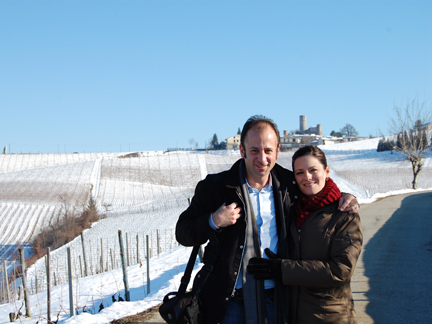
Above: Franco took this picture of us later that afternoon, as we drove around the vineyards of Barolo.

Thank you, again, Franco, for an unforgettable visit to Langa. You are a Parini among wine writers.

Noble is the host…

The smell of money guides the evolution of taste, part 2

barolo

Above: A collection of old large-format bottles at the Bartolo Mascarello winery. I took the photo when I visited and tasted with Maria Teresa Mascarello, Bartolo’s daughter, in April 2008. Those are aging casks in the winery’s cellar, below left.

I received a lot of positive feedback in the wake of my post the other day Bruno Giacosa and Bartolo Mascarello meet for the first time. Thank you to everyone who commented and wrote in for the encouragement and the kind words. And special thanks, again, to Franco, for bringing this wonderful piece of writing to our attention.

One of the most fascinating elements — among many — about the first installment was the note about the weather: 95° at the end of July. How did that heat spike affect the 1964 vintage?

Here’s the second and final installment of the translation of Francarlo Negro’s newsletter, “The Smell of Money Guides the Evolution of Taste.”

Buona lettura!

*****

barolo… The same was true of the Barbaresco [I’ve never heard of a B. Mascarello Barbaresco but evidently he was making Barbaresco at that time; thoughts?]

In the glass, the wine was clear, not dark red, but rather light red with gradations of garnet and an orange-rose rim.

In the mouth, the light flower gave way to the tannic freshness that enveloped the elegance of the wine, an austere but inviting sensation, cleansing the mouth and prompting you to take another sip. The elegance of the nose opened with a velvety impression, dry but never bitter in taste.

The 1961 Barbaresco that Bruno Giacosa had brought for the tasting was more evolved. But it showed characteristics similar to those of the Barolo, although with slightly different tonalities. Light impressions of field flowers, rounder on the palate, definitely more velvety and approachable.

Bruno and Bartolo discussed the fundamental roll of the land, of the surì [i.e., the best rows in top growing sites], the vines, and approaches to growing grapes — without abusing the vine, with asking too much of it.

Quality depended on the harvest. During those years, clear-cut differences were evident between one vintage and another. In more than 40 years since the birth of the Barolo and Barbaresco appellations, the wines have been declassified only once to rosso da tavola [red table wine], and that was no haphazard decision. The year was 1972, when excessive rain and incessant fog caused the grapes to rot.

Thirty years later, the 2002 harvest should have met the same fate. But technology and the interests of the large exporters weren’t about to let that happen. Millions of bottles containing low-quality wines were released on to the market bearing the name Barbaresco and Barolo DOCG.

barolo

Above: Historic aging casks for Nebbiolo, no longer in use, at the Fontanfredda winery, one of the original high-volume producers of Barolo, founded in the 19th-century by the first king of Italy, Victor Emmanuel II.

Subordination to “international” tastes clouds the identity of our wine.

The advent of international demand, which began in the early 1980s, has offered a historic opportunity to the great wines of Langa: to reach the tables of the greater western world, from Europe, to America, to Japan.

This demand is guided by American buyers who want Barolo and Barbaresco to change in order to adapt to the tastes and style of the market in that great country — that gluttonous, powerful, ignorant country.

The greater part of winemakers have adapted their cellars, as sales increase and profits soar. For the most part, the historic enologic culture of our land has been snubbed to make way for new technology in grape-growing, vinification, and aging. The score awarded by U.S. magazines determines the success or failure of sales.

A complex network of relationships has been created between large international merchants, consenting journalists, and willing enologists. A new genre of wine has been born. There are a few exceptions but most wineries have chosen to reshape the identity of the great wines of Langa. These changes have not come about through an exchange of ideas between the old and the new but rather between traditional and modern enology: the wines are the result of an irrational adaptation of enological standards, dominated by the major buying groups and by the multi-national network of the wine industry.

Vanilla, fruity Barolo and Barbaresco.

The “ideal” wine destined for export has changed completely. The color must be darker, as darkly colored as blood, the symbol of power, modeled after Cabernet Sauvignon, the benchmark grape variety for the international market.

Vanilla is desirable in the nose, as are extraneous spicy notes, the fruit of aging in small toasted casks, French barriques, used only if rigorously new, so that they will impart their own aromas and tannins as they corrupt the classic, original traits of our wines.

The taste should be marked by “fruitiness,” notes of ripe red fruit, with intense flavors, enticing and coating, sometimes jammy. When the harvest isn’t the best and the natural alcohol content is only 13%, winemakers resort to the Salasso method: when fermentation begins and the skins form the cap, a certain quantity of must is racked off from the bottom of the cask in order to achieve the desired intensity in color and flavor. The technology behind temperature-controlled concentrators allows the winemaker to avoid cooked-fruit flavors as they reduce the water content and increase the sugar content of the wine.

Fermentation and vinification techniques have undergone a transformation under the aegis of enologic innovation. It’s no secret that the consultation of a certain enologist with ties to the new network of international media and commercial interests is a prerequisite for a good score in the wine guides and the subsequently increased facility to sell the wine at a higher price. The end result is an atypical wine, in cahoots with grape varieties considered “international” because they are the preference of Americans and others unfamiliar with the culture of wine. The uniqueness of the monovarietal wine, made from Nebbiolo, has lost its distinct personality.

Certain media have embraced and supported this production-and-marketing operation: for many years the Gambero Rosso/Slow Food Guide to the Wines of Italy has punished traditional producers by denying them recognition among the Tre Bicchieri winners. Giacosa and Bartolo Mascarello are among those who have penalized. Their wines were considered to “rustic.”

—Francarlo Negro

Postscript

In recent years, regional authorities have allowed growers to plan new vines in growing sites where grape growing [for fine wine production] has never been suitable. Many of these sites have never been deforested nor used for cultivation of any kind since they face northward. These are sites where our elders wouldn’t have even thought of planting hazelnut trees: in 2008, production of Barolo and Barbaresco increased 50% with respect to production levels in 1999.

(translation by Do Bianchi, January, 2010)

Suckling and Soldera on the Tuscan wine scandals

case basse

Above: One of the great maestri of Brunello Gianfranco Soldera and I tasted his wines together in September 2008 at his winery Case Basse in Montalcino (before Tracie B convinced me to go back to my au naturel hair style!). Photo by Ben Shapiro.

In an hour-long documentary on the Orcia River Valley, recently aired on the national-television Sunday show Linea Verde (it’s worth watching the show, even if you don’t understand Italian, if only for the cinematic beauty of the Val d’Orcia), the presenter asked Brunello maestro Gianfranco Soldera to share his impressions of the recent controversy in Montalcino regarding producers who allegedly added disallowed grape varieties to their Brunello (which, by law, must be made with 100% Sangiovese grapes).

“Luckily,” Soldera said, “the [Italian] treasury, the magistrate, and the anti-adulteration department did a great job in their investigation and they found some big problems. Millions of liters of wine were declassified in order to protect consumers and those producers who have always used only Sangiovese, as required by law, because this is what needed to be done.” Even though the quantity of wine declassified was significant, he noted, “only a handful of wineries” were implicated in the investigation. (The segment on Soldera appears at the end of the show and it is the only occasion that I know where the general public has been allowed to view Soldera’s “secret garden.” Definitely worth viewing.)

wine spectator

Above: The clairvoyant Swami shared his wine predictions for 2010, including a real whopper for Tuscany.

A week or so earlier, one of America’s premier wine writers, a world-renowned expert on Italian wine, and a resident and champion of Tuscany and its wines, the inimitable James Suckling published his predictions for the year in wine 2010 on his blog, including, this ominous premonition for Tuscany: “Tuscany will be embroiled in another wine witch hunt with the magistrate of Siena along the lines of a similar debacle in Montalcino over the past two years.”

This morning, I couldn’t help but share Franco’s indignation at Suckling’s admittedly “less than earth-shattering” prediction, expressed in a post entitled, American Wine Writers: Luckily they’re not all like James Suckling.

However ugly the recent controversy in Tuscany, it “needed to be done,” as Soldera pointed out. Everyone I’ve spoken to there (except for those implicated in the investigation) seems to share Soldera’s opinion.

Of all the things to predict for Tuscany in 2010 (eclipsing the rest of Italy, btw), how about something like this?

1) The Val d’Orcia DOC will emerge as one of the coolest new expressions of Sangiovese.

2) Tastings of the 2007 harvest will reveal that Tuscany was blessed with one of the better vintages in recent memory.

3) The high-cost of barrique and the emerging trend against oak-laden, concentrated wines will lead more and more producers to make traditional-style wines using large-cask aging and less manipulation in the cellar.

4) Thanks to more flexibility in labeling, the recently implemented EU Common Market Organisation reforms will allow Tuscan producers to regionally “brand” their international-style wines without encroaching on the Brunello and Chianti de facto trademarks.

5) Tracie B and Jeremy P will win the lottery and finally be able to move into the Ripa d’Orcia castle as their “vacation home.” (There are some beautiful shots of the castle in the Linea Verde show, btw.)

Thanks for reading. Tracie B and I will soon be heading to Montalcino on our honeymoon, where we’ll have our “nose in a glass” and our “ears to the ground.” Stay tuned…

Zaia watch: Italy’s agriculture minister’s tenure much ado about nothing?

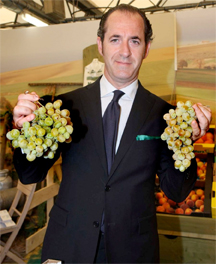
It’s already been a big week for Italy’s agriculture minister Luca Zaia, left (note the signature black tie and the green pocket square, both very powerful and provocative symbols for a public minister who’s role is to protect the best interests of the entire country).
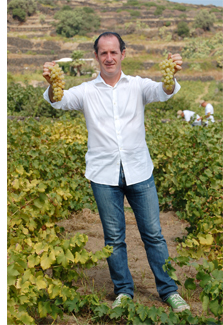
His recent and controversial call to arms, exhorting Italians to drink only Italian sparkling wine on New Year’s eve, has been the subject of a tide of chatter in the Italian blogosphere. I agree with Franco when he writes that the self-proclaimed prince of Prosecco is a servant to self-serving provincialism and his “despotic” exhortation reeks of the same self-serving italianità that prevailed in another era in his country when the trains ran on time.

Zaia was also the subject of a wonderfully satiric but ultimately poignant post by the Italian Wine Guy, “The Mark of Zaia.” IWG’s insights are invaluable here and his overview tracing the trajectory of Zaia’s meteoric rise is as frightening it is revelatory.

But the biggest news to arrive from Zaialandia this week was the breaking however much anticipated story that he has received the nomination from separatist, secessionist, racist, and xenophobic political party Lega Nord (Northern League) as its candidate for soon-to-be vacant governorship of the region of the Veneto. He even has a shiny new Facebook fan page for his candidacy.

As Franco pointed out in a recent post, the news is good and bad: on one level, many observers, including those of us who sell and promote Italian wine abroad, will be happy to see the Venetophilic pol leave a position he had no business occupying in the first place (I’ve been told that Zaia started his professional career as a nightclub bouncer); on another level, the news is bad since, in the light of the fact that Zaia will probably win the election and become governor of the Veneto, he will be the leader of one of Italy’s richest and most important wine-producing regions (home to some of Italy’s most important exported wines, namely, Prosecco and Amarone).

The news inevitably fills me with sadness. Ultimately, Zaia’s tenure as the steward of Italian agriculture and the Italian wine industry, was the product of political posturing and maneuvering. An ambitious and able politician, Zaia clearly had set his sights on higher political office and when Berlusconi appointed him agriculture minister, it was not because Zaia was the best man for the job but rather as a political payback to the Lega Nord for their support in Berlusconi’s 2008 bid to reattain the prime minister’s office.

Photo courtesy Alexnews.

Sadly — for Italy, Italians, Italian winemakers, and foreign lovers and promoters of Italian wines — Zaia has presided over one of the greatest crises in the history of contemporary Italian winemaking. And it was all much ado about nothing.

His frequently updated blog has never even made note of the recent news that a new adulteration scandal has surfaced in Tuscany.

In Lombardy, there’s a self-effacing, ironical joke that the intellectuals tell about the peoples of northern Italy, based on a folkloric paradox, probably uttered by an old man on the streets of Milan not so many years ago: Rasista mi? Ma se l’è lü che l’è negher! [You’re calling] me a racist? But he’s the one who’s black! (In an essay he published after Berlusconi’s famous gaffe calling Obama “tan” following the 2008 elections, Umberto Eco cites this phrase as an example of northern Italians lack of self-awareness.)

I can’t help but be saddened to think that the Veneto (my beloved Veneto!) will be governed by a racist, xenophobic man who has asked Italians to boycott Chinese restaurants, to avoid eating pineapple, and to open only Italian bubbles on New Year’s eve (Prosecco perhaps?), a man would almost certainly tell the above joke without the self-effacing irony.

But for him to achieve such self-awareness and to grasp its irony would be like the teapot calling the kettle black.

Stars fell on Toscana…

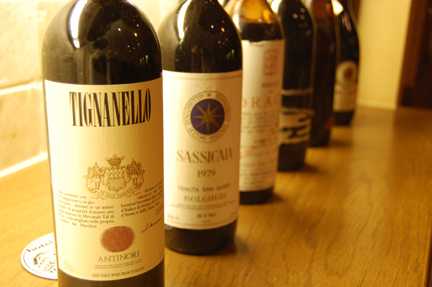
Above: The 1990 Tignanello was youthful and powerful and had a woody note on the nose that some folks like but a turn-off for me. The 1979 Sassicaia was unbelievably good and had that goudron, tarry note that you find in left-bank Bordeaux yet still tasted uniquely Tuscan — at least to me. Photos by Tracie B.

In what seems to me such an uncanny confluence of events, Tracie B and I had the wonderful opportunity to taste two truly iconic wines of Tuscany, from two (arguably) outstanding vintages, on Saturday night — 1990 Tignanello and 1979 Sassicaia. I say “uncanny” partly because there was a white elephant in the room: despite the festive nature of our get-together a casa di Alfonso, no one could ignore the news that broke in Chianti last week. Alfonso had graciously offered to open not just a few gems from his cellar, inspired in part by BrooklynGuy’s recent post on one of the wines he happened to have in his collection. But when he “stood the bottles upright” last week in anticipation, none of us imagined that Tuscan wine would once again find itself in crisis.

Above: Ace made one of his signature dishes, grilled eggplant layered with hard-boiled eggs and tomato sauce, topped with grated pecorino romano and the fired au gratin.

Eric’s exquisite post from last week added another layer of uncanniness to our fête. Tempus vincit omnia: the owner and curator of the Tignanello estate, the Antinori family and enologist Renzo Cotarella, recently told Eric that they plan to replant the legendary Fiorano estate near Rome, where its now defunct master, Prince Buoncompagni Ludovisi, purportedly once swore (as legend has it) that he had ripped out his vines so that his son-in-law, Piero Antinori, would never have the chance to bring modernity to the farm. Tempus vincit omnia.

Above: The 1994 Primitivo di Manduria by Savese was still a baby! It was such a wonderful treat to get to taste this wine with some age on it — a fantastic example of how traditionally made wine, even when made from a grape lacking tannic structure like Primitivo, can achieve ineffable nuance with age.

But like the grated pecorino romano that Ace used to finish his eggplant pie, a final layer of uncanniness was provided by the superb 1994 Primitivo di Manduria from Savese, which we paired with dried figs from Calabria. He stood the Primitivo upright after reading Franco’s wonderful post on his visit with Vittorio Pichierri at the Savese winery. Our “blend” of wines from Tuscany and Apulia seemed to unwittingly match the rumors that arrive these days via the internet from Etruria (I hope they’re untrue but I fear they are not).

Thanks again, Ace, for a truly unforgettable serata da leoni. It felt like stars fell on Toscana that night…

Sing these lyrics, substituting “Toscana” for “Alabama”…

We lived our little drama,
We kissed in a field of white,
And stars fell on Alabama,
Last night.

I can’t forget the glamour,
Your eyes held a tender light,
And stars fell on Alabama,
Last night

I never planned in my imagination,
A situation — so heavenly,
A fairy land where no one else could enter,
And in the center — just you and me.

My heart beat like a hammer,
My arms wound around you tight,
And stars fell on Alabama,
Last night.

An Italian wine walks into a bar…

austin wine merchant

Above: Yesterday, I tasted through the current releases of Fèlsina with my friends, from left, Craig Collins (who works for the winery’s distributor in Texas), John Roenigk (owner and manager of The Austin Wine Merchant), and Chiara Leonini, Fèlsina’s export manager. For the record, Fèlsina is pronounced FEHL-see-nah.

It’s a labor of love and it’s my self-appointed duty: I just spent the first hour of my day translating Franco’s editorial on the list of The Wine Spectator’s top 100 wines and the Italian showing in the list. You’ve heard me say it before: Franco (the “Giuseppe Baretti” of Italian wine) is a friend, a colleague, a mentor, a partner, and one of the wine writers whom I admire most. I encourage you to read what he has to say: here in America, where few read the Italian wine media, we are often unaware of how the Italians view us and our wine media and how our wine media generally ignores the wines and the styles of wine that Italians hold to be the best representation of their enology.

In another editorial published today, by a young wine blogger and marketing consultant based in Apulia, the author writes: “Just think that the first wine in the list is an American wine that costs $27 and the second is a Spanish wine that also costs $27. In order to pay the tidy sum of $110, you have to get to the eighth place in the list for a Tuscan wine that costs a hefty $110!”

Today, I’ll leave the editorializing and pontificating to others, but I do encourage you to put it in your pipe and smoke it, so to speak.

As it just so happens, yesterday I tasted with the export manager for a winery that landed the thirteenth position in the magazine’s list: Fèlsina, whose Fontalloro, a barriqued 100% Sangiovese that has long been a popular wine in the U.S.

“Some would call it a Super Tuscan,” said Chiara (above), “even though I don’t like that term.” And, in fact, the wine actually qualifies as a Chianti, even though the winery has chosen historically to declassify it, initially to vino da tavola status and now IGT (it was first released in 1983, she said, the same year as the first release of the winery’s “cru” Chianti Classico, Rancia).

I’m a bona fide fan of Fèlsina but my favorites are always their entry-level wines, made from 100% Sangiovese grapes, vinified in the traditional style, and aged in large old-oak casks that have been used over and over again. The wines generally cost under $25 and I highly recommend them. The 2006 harvest was a good vintage for these wines, 2007 a great vintage. (I also had fun trading notes with Chiara about our university days in Italy. She studied Chomsky and generative linguistics at Florence, around the same time I studied the history of the Italian language and prosody at Padua and the Scuola Normale in Pisa. We knew a lot of the same professors!)

I’ve spent enough time in front of the computer this morning and it’s time for me to head to Houston, where I’ll be speaking about and pouring Italian wine tonight. So I’ll leave the punch line up to you Italo Calvinos out there…

An Italian wine walks into a bar…

Mr. Zaia goes to Washington (and lets Montalcino down)

smith1

It’s seems like it was just yesterday that I was posting a sigh of relief that the U.S. Alcohol, Tobacco, Tax, and Trade Bureau (TTB) was lifting its requirement of Italian government certification for Brunello di Montalcino imported to this country. Nearly every Italian news agency and feed (ANSA, Yahoo.it, etc.) had reposted agricultural minister Luca Zaia’s press release in which he announced — with cocksure nonchalance, I may add — that the requirement had been lifted following his successful meeting in Washington with TTB bureau head John Manfreda. Even Brunello producers association director Patrizio Cencioni issued a release praising minister Zaia and thanking him for a job well done. (You can read all of the press releases here.)

But it seems that minister Zaia was a little too quick to sing his own praises.

Late yesterday afternoon, another post hit the feed as the Italians were already sleeping: the TTB issued a press release in which stated plainly and clearly that the agricultural minister had falsely represented the agreement negotiated in the minister’s meeting with Manfreda last week. Despite claims otherwise, states the document, Italian government certification is still required. And it will continue to be required, according to the document, until the Italian government presents the Siena prosecutor’s final report on the investigation (the so-called “Operation Mixed Wine” inquiry into the suspected adulteration of Brunello and other Tuscan wines).

smith2

I spoke this morning to Brunello producer Fabrizio Bindocci of Il Poggione in Sant’Angelo in Colle and he told me that he and Il Poggione’s owner Leopoldo Franceschi were left dumbstruck when they read the news of the TTB’s clarification. “Maybe Zaia met with the doorman, not the TTB administrator,” Fabrizio wondered out loud with classic Tuscan wit. (Fabrizio’s son Alessandro has posted the entire series of press releases at his blog Montalcino Report.) “We feel that certification should be required and it should continue to be required,” said Fabrizio, whose wine has been certified by an independent Norwegian risk management firm since 2003, long before the controversy began.

smith3

In his post this morning, Franco published an image of Walt Disney’s Pinocchio and asked: “Just for the sake of clarity, can somebody — in Montalcino, Rome, or Treviso — help us to understand what’s going on?” (Minister Zaia hails from Treviso.) And making reference to Zaia’s bid to become governor of the Veneto (his home region), Franco asks rhetorically, “is it so hard to understand that it’s not possible and it makes no sense to run an electoral campaign in the Veneto using the supposed great success obtained in the [minister’s] campaign in Montalcino?”

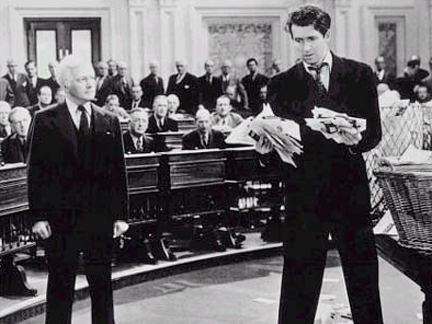
@Mr. Zaia you are no James Stewart: if you need an interpreter the next time you head to Washington, feel free to give me a call!

Looking back at Brunello

On Friday, Franco and I posted the news that the U.S. Alcohol, Tobacco, Tax, and Trade Bureau (TTB) has lifted the requirement of Italian government certification for Brunello di Montalcino imported to the U.S. The lift was agreed after Italian agricultural minister Luca Zaia met with bureau administrator John Manfreda last week.

I am happy to observe that despite the hail of the controversy (like the early-fall hail of 2008, that damaged but did not destroy the harvest; see above), Brunello and its producers — large and small — have emerged intact and healthy.

Looking back at the Brunello affair, in the glow of the Montalcino sunset, I am convinced of two things: that the controversy was a healthy wake-up call for producers (and that, ironically, it helped to raise positive awareness of the appellation abroad); and that, in many ways, it shed light on the importance and strength of the Italian appellation system.

At the same time, I believe the TTB’s response to the controversy was a trans-Atlantic misunderstanding: as the dearly departed Teobaldo Cappellano pointed out in the Brunello debate a year ago, the DOC/G system was created to protect the producers and the territory, not the consumer. And as much as I loath the thought of a Brunello producer “cutting” his Sangiovese with another grape variety, the transgression is a victimless crime as it relates to the consumer. If the consumer likes the wine and is satisfied with the perceived price-quality ratio, s/he is not molested by this misdeed.

The real victims were those producers who remained and continue to remain true to the territory and the territory itself. If unscrupulous enologists and calculating landowners did indeed adulterate their wines, and in doing so, co-opted and misappropriated an appellation tied to the land and the people who created it, therein lies the injury inflicted on their compatriots.

The saddest legacy of the Brunello controversy is the ill will it has created in the microcosm of Italian wine. On the same day that the Italian agricultural ministry issued a statement announcing the requirement for certification had been lifted, Franco (above, right; mentor, friend, and my partner in VinoWire) posted about a “cease and desist” letter he received from a lawyer representing a commercial winery. (For the record, Franco expunged any reference to the winery and wine in his post and I am merely speculating that the winery in question produces Brunello.) But the letter did not refer to something Franco had written: it referred to comments made by his readers! In one of the comments in question, a reader had made a remark about the unusual dark color of the wine by said winery. Has it really come to this? Do behemoth, commercial producers of Brunello really feel so threatened by a comment thread on a blog? Has it really come to this? Must a blogger feel threatened for merely allowing his readers to express their opinions in the comment thread of a blog?

Today, few who reside beyond Montalcino remember that Montalcino and its environs were one of the Germans’s last battlegrounds as they retreated in the face of the Allied advance in the last year of the Second World War. Even before the war, Montalcino and Tuscany were centers of the “red” resistance to fascist rule. Looking back on the whole Brunello affair, I was reminded of a little red book given to me by the mother of three brothers in Montalcino, whom I’ve known well since 1989. The locally published tome is by political activist, later partisan, and then local politician Carlo Sorbellini (above): Le mie memorie (My Memories). His descriptions of the years leading up to the war and the sacrifices made by him and his compatriot partisans during the German occupation are among the most humbly written and most moving narratives I have ever read. Many people shed their blood and gave their lives to protect this unique place: the same mountainous geography that made it a German stronghold also made it a great place to make fine wine after the war. And this Unesco-protected valley is among the most beautiful places in the world.

One thing I know to be true: I heart Brunello and I heart the people that lived, loved, and died to make it what it is today.