With Elda Felluga at the Abbazia di Rosazzo

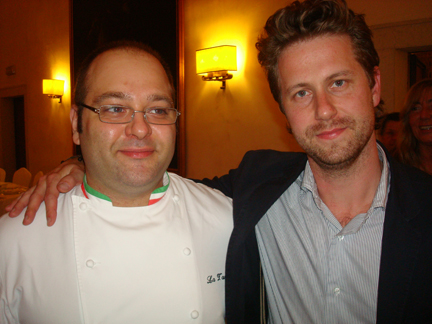
“Dream Team Friuli 2010” with Elda Felluga (Livio Felluga, to Bobby’s right in the center of the photo) at the Abbazia di Rosazzo in the Colli Orientali del Friuli.

Elda is an amazing, dynamic personality and I can’t wait to tell the truly epic story of her family and how they put the Colli Orientali del Friuli “on the map,” quite literally (and about the extremely special gift that Elda gave me).

What do you think about “Dream Team Friuli 2010” as the name of our group? Strappo, McDuff, Alfonso, suggestions please!

Friuli: the obligatory dignatory dinner

Simpatico Chef Andrea Gabin (left) of the famous Ristorante La Taverna posed for my camera with Chef Lachlan at last night’s obligatory dignatory dinner, regrettably a sine qua non of these government-sponsored trips, held at the picturesque Castello di Susans in Maiano (Udine).

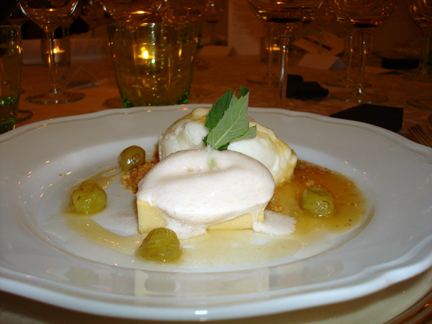
The food was surprisingly good for a dinner where more than 200 guests were seated, including all the fat cat pols who revel in their their Rolex and 12-ply cashmere habits at such functions. That’s Chef Gabin’s EXCELLENT “white chocolate sphere and white grape sorbet” paired with Bianco Tal Luc 2007 Friuli Isonzo by Lis Neris, one of my favorite wineries here.

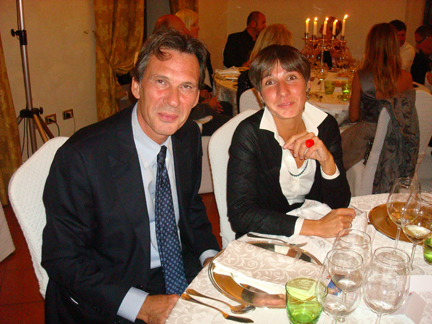
That’s Andrea Di Giovanni (left), director of the Friuli department for development and Francesca Ghersinich, program director for the MIB school of management, who was asked to address the large group of foreigners gathered for the event because of her command of the English language. They were very nice although completely disinterested in our group of top-flight American restaurant professionals (enogastronomic tourism does not seem to be a priority in this duly industrious region).

The one pleasant surprise of this otherwise entirely ennui-driven event was my discovery that young Friulians are wonderfully proud of the great 20th-century poet, cineaste, novelist, and essayist Pier Paolo Pasolini’s association with his native Friuli.

The cast of last night’s event certainly could have made a cameo in one of his films… I’ll let you ponder which one…

Coffee culture in Friuli

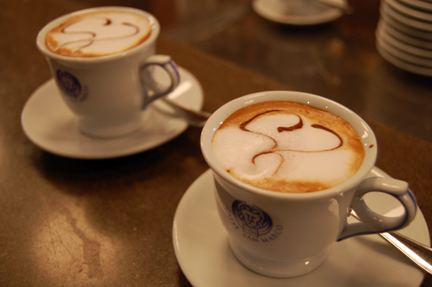
In Friuli, the default coffee service is caffé macchiato, i.e., an espresso with a spot of steamed milk, like this coffee that I had at the Caffè San Marco in Cividale del Friuli, where I stopped this morning on the way to my final destination.

One of my first major translations was the “Bottega del Caffè” (“The Coffee House”) by 18th-century Italian comediographer Carlo Goldoni, set in Venice with the then nascent European coffee culture as backdrop (New York, Marsilio, 1998).

Are you going to Scarbolo fair? First day in Friuli

Later today I hope to have the time to reveal why and how I’ve come to Friuli.

But before the official working leg of the trip begins, I wanted to take time out to catch up with my friend Wayne, who lives and works in Friuli as the sales and marketing director for the Bastianich winery here.

In a world where ego generally trumps humanity, Wayne is one of the rare and welcomed anomalies: a right guy, as one might have said a half-century ago, who just happens to work in the top tier of the food and wine industry. When he suggested we go meet winemaker Valter Scarbolo for dinner at his legendary restaurant La Frasca in Lauzacco (Udine), I couldn’t have been more thrilled.

Dinner began with Lorenzo d’Osvaldo’s superb prosciutto crudo and ossocollo and Valter’s housemade salame (above).

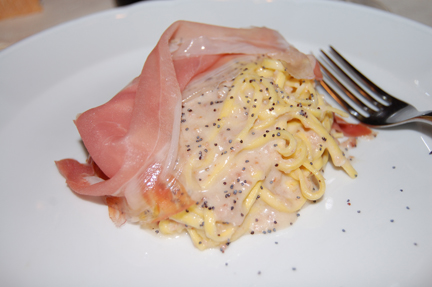
Next, di rigore, came tagliolini San Daniele.

This was followed by a dish that would have been met with wholehearted approval by any semiotician gourmand, Valter’s raviolo aperto, stuffed with montasio cheese and venison, topped with wild berries. (A bottle of sparkling Verduzzo for anyone who can place the exegetic pun I’ve made for this dish!)

As we were joined by Valter’s son Mattia who had arrived from his kick-boxing workout (and was evidently famished), the conversation turned to the current student housing crisis in Italy, soon to be faced by the young matricola.

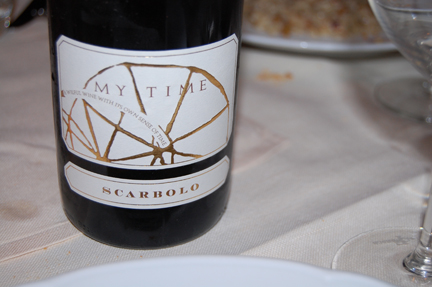
As we lingered over intensely aromatic formàdi frant (formaggio frantumato, literally splintered cheese, a classic farmer’s cheese of Friuli), the wine I kept going back to was Valter’s My Time, so-called because, despite the urgings of his enologist, he waits to bottle and releases this wine only when he feels it’s achieved its full potential. As it warmed up in the glass, this wine (made from Chardonnay, Sauvignon Blanc, and Tocai fermented in cask) was simply gorgeous, with nuanced fruit and noble structure, delightful with the pasta dishes, intriguing and intellectually stimulating with the cheese course.

Last night wasn’t a time for delving into the details of enogastronomic science: it was time for catching up with an old friend and making a new one.

When it comes your time to go to Scarbolo fair, please remember me to the one who lives there…

Stay tuned…

Tough times in Piedmont

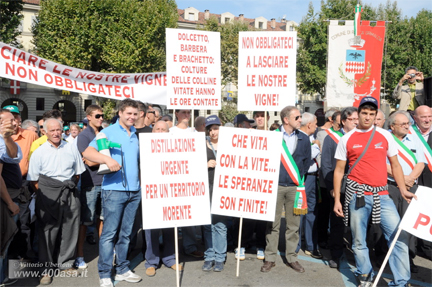
Above: In a protest mounted earlier this month in Asti, besieged Piedmont grape growers and winemakers pleaded for government aid (photo by 400AsaFoto.it).

I managed to carve out some time this morning to post over at VinoWire on recent developments in Piedmont for grape growers and winemakers affected by the global wine crisis.

On his excellent blog Sapori del Piemonte, Filippo Larganà has been providing some solid coverage of what’s happening on the ground there.

Strange hues of the Middle Ages

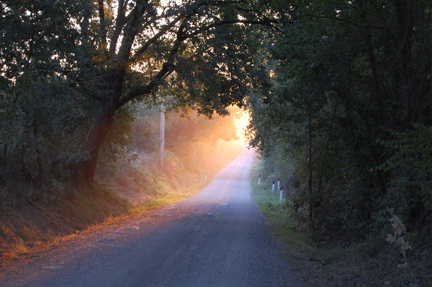
This morning, my last in Montalcino, I enjoyed a daybreak drive through the vineyards of Il Poggione with winemaker Fabrizio Bindocci as my guide (I’ve been staying at the estate’s farmhouse).

The vision above made me think of Dante, Inferno, 34, 132-33:

    Into that hidden passage my guide and I
    entered, to find again the world of light

I remembered my years as a grad student, often spent imagining the quality of light as perceived by humankind in the Middle Ages.

I remembered the famous passage from Burckhardt:

    In the Middle Ages both sides of human consciousness—that which was turned within as that which was turned without—lay dreaming or half awake beneath a common veil. The veil was woven of faith, illusion, and childish prepossession, through which the world and history were seen clad in strange hues.

And I realized that those strange hues often reveal truths lost on those inebriated by the glow of rationalism.

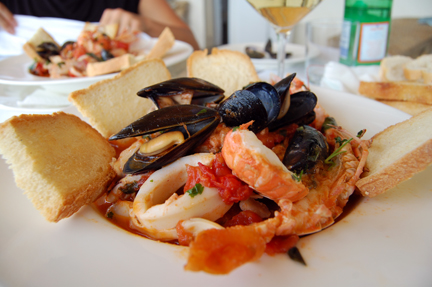
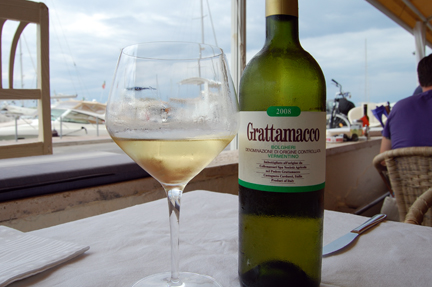
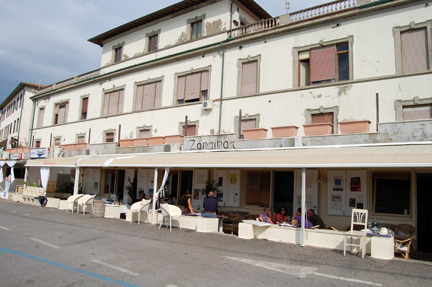
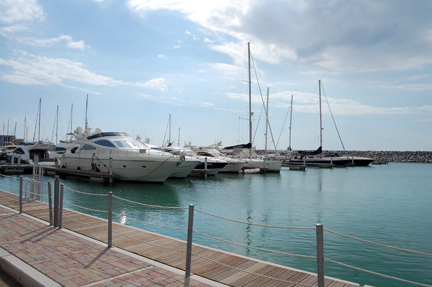
Fellini’s seaside repast (lunch at Zanzibar, San Vincenzo)

an oneiric state by the sea…

where fishermen returning from their catch…

rejoin with glitterati and revellers unfettered…

in a dream…

Zanzibar
Piazza Del Porto, 2
57027 San Vincenzo (Livorno)
0565 702927

[from the hypnerotomachia ieremiae]

Eataly and Vinitaly in New York

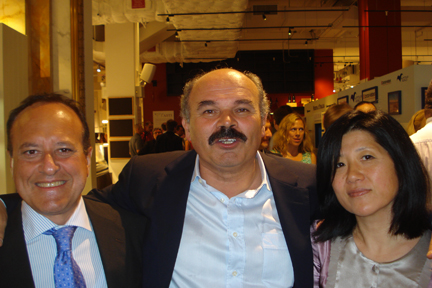
Above: Giovanni Mantovani (CEO VeronaFiere and Vinitaly), Oscar Farinetti (Italian retail, food, and wine tycoon, creator of Eataly), and Stevie Kim (senior adviser to Mr. Mantovani) yesterday at the opening of Bastianchi-Batali-Farinetti brainchild Eataly in New York.

Yesterday, mere moments after Mr. Franco Ziliani and I posted about the Italian agricultural minister’s claim that there is no crisis in the Italian wine industry, I spoke to Stevie Kim (above, right), senior adviser to Vinitaly’s CEO. She and her boss were attending the opening of the latest conquest in the ever-expanding Batali-Bastianich empire, Eataly, the “über-supermarket” conceived by retail tycoon Oscar Farinetti.

“As you know,” said Stevie, “production of Italian wines has increased dramatically in recent years and the Italian market is saturated. And so the international market has become more important for all producers.”

The Italian government, she told me, has asked her and her boss to “revamp” the Vinitaly road show, which has been coming to the U.S. for a decade (fyi Vinitaly is the top Italian wine industry annual trade fair, held each year in Verona in April). They plan to reconfigure the tasting this year, to be held at Eataly New York October 25, to accommodate trade and consumers.

“In the past, the presentation has been very fragmented. This year, we plan to restyle the tasting by transforming Eataly [New York] into Vinitaly,” said Stevie, who speaks impeccable Italian and has lived in Italy for more than 20 years. 50 producers will be attending this year’s road show, the maximum number Eataly New York can accommodate.

To Stevie I say, in bocca al lupo…

I’m not sure how I feel about Eataly (photo by Stevie). It seems to make more sense in New York than it does in Turin, where it started. It’s a sort of Disneyland for Italian food: a hyper-realistic food court, a recreation of an Italian food and wine street shopping scene. Surprisingly, in Piedmont, where “Italian food” is known simply as “food,” Eataly has been well received. At least, that’s my impression from talking to the Piedmontese. I’ve never visited Eataly, although Tracie P and I stopped once at the Eataly satellite on the road that leads from Alessandria to Asti.

There are Eataly franchises in Turin, Asti, Bologna, Milan, Tokyo, and now New York. Future expansion includes Genoa and Rome. Eataly enjoys the support of the SlowFood movement and its founder Carlo Petrini (however much the organization’s ethos would otherwise opposed globalization).

One thing you can say for certain about Eataly’s creator Mr. Farinetti: he’s no farniente!

Bricco, bric: origins of the word and why literature is so important to understanding Italian wine

bricco boschis

Above: A vineyard that produces one of my favorite wines, the Barolo Bricco Boschis by Cavallotto (photo taken in February on our honeymoon). Bricco Boschis means literally the “crag in/of the woods.” Note how the snow has melted at the very top of the crag. As the old (and young) folks in Langa will tell you, the best places to grow Nebbiolo for Barolo and Barbaresco are where the “snow melts first,” an indicator of ideal exposure to sun light.

While I haven’t had much time to work on my Italian Winery Designation Glossary, I did want to post my research on the vineyard designation term bricco and its origins (since so many people have written me asking me about its meaning and usage).

The best translation for the term bricco or bric is crag (“a steep or precipitous rugged rock,” Oxford English Dictionary, online edition), equivalent to the Italian dirupo.
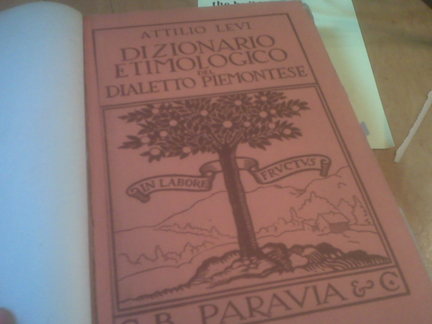
Above: I found this wonderful book at the New York Public Library.

Most etymologic dictionaries point to an unknown origin of the word but, while in NYC, I did find a wonderful (yet forgotten) fascist-era dictionary of Piedmontese dialect that reported the Provençal brich as the etymon.

But my most fascinating discovery was the eureka moment when I found one of the earliest known appearances of the term in print.

According to the Grande Dizionario della Lingua Italiana (the unabridged dictionary of the Italian language), the great 20th-century Piedmontese novelist and poet Cesare Pavese was probably the first to use it in a narrative, his masterwork no less, La luna e i falò (The Moon and the Bonfires), written in 1949 and first published a few months before his suicide in 1950.
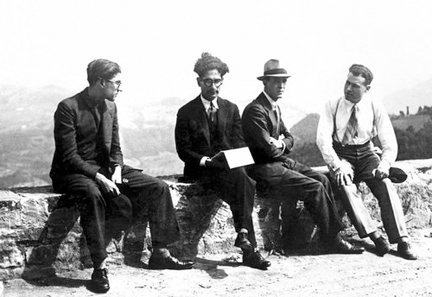
Above, from left: Cesare Pavese, Leone Ginzburg, Franco Antonicelli, and Augusto Frassinelli “in the 40s in the Langa hills.” (Source: Panorama.)

Here’s the passage (p. 30):

    fa un sole su questi bricchi, un riverbero di grillaia e di tufi che mi ero dimenticato.

As translated and published by R.W. Flint (a translator I admire greatly) in 2002:

    There’s a sun on these hills, a reflection from the dry soil and volcanic stone, that I’d forgotten.

It’s difficult for me to convey just how pregnant with signficance this line is, especially within the context of Pavese’s masterpiece. (See this synopsis of the novel and translation and profile of Pavese in The New York Review of Books.)

Flint renders an excellent translation of the line, perfectly aligned with the tone of the original and the translation as a whole. I like the way he has delivered grillaia into English: a grillaia is an ironic term that means literally a place where you’ll find only crickets (grilli), in other words, a barren or infertile place.

When the main character of the novel, Anguilla, returns from America after Italy’s Liberation from Fascism (but before the end of the Second World War), he is reminded of the barren nature of these hills — these infertile crags.

Let me offer an alternative, annotated translation:

    A sun beats down on these crags, reflecting off rocks fit only for crickets and the [nutrient-poor] volcanic soil — something I’d forgotten [while I was away in America, an Italian immigrant who fled fascism].

Is it not all the more remarkable that those very crags (bricchi) would ultimately deliver one of the greatest winemaking traditions of post-war Europe — Barolo and Barbaresco?

Post script: When I visited Langa in March 2010 with the Barbera 7, one of the wines that impressed me the most was the Lurëi by Il Falchetto in Santo Stefano Belbo, where Pavese was born in 1908.

Maginot lines in Montalcino

Above: Tracie P and I took this photo, facing southeast toward Mt. Amiata, in February on Strada Statale 64 (State Hwy 64) heading north from the village of Paganico toward Sant’Angelo in Colle on the south side of the Montalcino appellation. It’s just a matter of time before Asti-born Ezio Rivella will be making “Brunello” just northeast of there, in a partnership launched with Veneto behemoth Masi in 2007.

And so, just as the Germans flanked the Maginot Line, invaded Belgium and then France, Ezio Rivella — the self-proclaimed “prince of wine” — has been elected as the new president of the Brunello consortium. He has vowed not to change appellation regulations so that they would allow for international grapes, as he previously advocated. But the thought of an Piedmont-born enotechnician at the helm of an appellation situated in the heart of a UNESCO-protected territory sends shivers down the spines of many — myself included. It’s a dark, dark day in Montalcino.

Above: “Hunting forbidden.” Facing southeast, gazing out on Masi’s Bello Ovile vineyards. Taken in February 2010. Today the sun shines in the early summer heat but it’s a dark, dark day in Montalcino.

Chatting with a friend, a wine professional I admire very much, late last night, he pointed out that this battle was lost a long time ago: anyone familiar with European history and iconography is acquainted with the metaphor allegory of the Maginot Lines.

If you’re not tired of my posts on Montalcino and what has transpired there, please revisit this post on the Brunello debates where Rivella and the sorely missed Teobaldo “Baldo” Cappellano sparred over the future of Montalcino and the Brunello appellation.

I promise to write something fun and entertaining (to cheer myself up) tomorrow but today — the day after the commemoration of the founding of the Italian republic, freed from fascist tyranny — I plan to mourn. Sorry to be a bummer…