The ugly beauty of Italy

Happily and thankfully, I made it back to Austin last night (on my last two trips back from Europe, I was marooned in Newark). On the plane ride home, I collected some of the more beautiful images I captured with my camera on the trip. Thanks for reading!

Rain clouds spotted from the home of my friends Laura and Marco, Montalcino.

In the nearly 25 years that I’ve lived, studied, traveled, and worked in Italy, I’m always amazed by its awe-inspiring beauty and its often revolting ugliness.
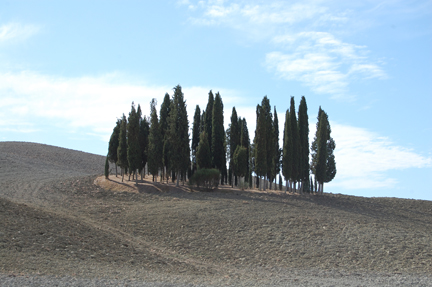
Cypress trees, between the villages of Torrenieri and San Quirico d’Orcia (Montalcino).

During my trip over the last two weeks, Berlusconi tried — as usual — to distract media attention from his political and legal problems by joking that he planned to rename his party Forza Gnocca, literally Go Pussy or Pussy Party (gnocca means knuckle in Italian and is used euphemistically to refer to the female anatomy). Politician Alessandra Mussolini said she thought it was a good idea, adding that it would bring people together.
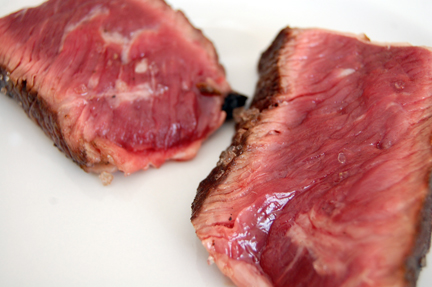
Bistecca fiorentina with my friends, father and son Fabrizio and Alessandro, Sant’Angelo in Colle (Montalcino).

After he failed to pass his budget (in what should have been a routine parliamentary vote), Berlusconi and his cabinet dodged a bullet when they survived a confidence vote. My friends in Italy say that he will continue to govern until 2012.

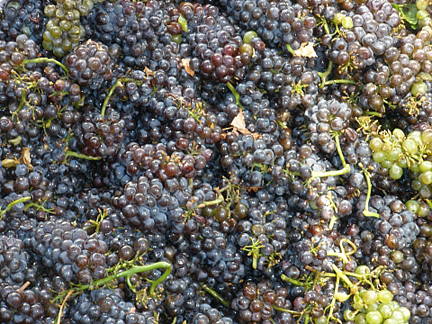
Gently botrytized Picolit grapes in Percoto.

Berlusconi didn’t need any help, however, finding media distractions: the so-called Black Blocs thrashed Rome in an otherwise peaceful demonstration by the Indignados. (Here’s the NY Times coverage.)
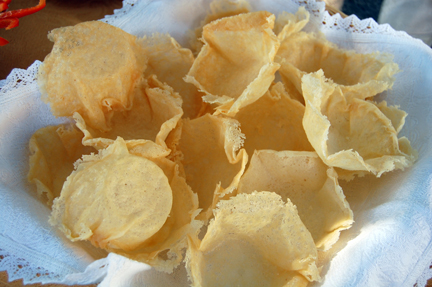
Frico served in the garden of Elisabetta’s home, Percoto.

But the thing that seemed so unreal — so unnatural, so far-fetched and unbelievable that I wondered if I was having a nightmare — was a television advertisement introducing a new sandwich at McDonald’s created by one of the greatest Italian chefs of all time and one of the architects of the 20th-century renaissance of Italian food, Gualtiero Marchesi.

Vintage bicycles in a show commemorating 50 years of the Brescia design firm Borsoni.

Blogger Massimo Bernardi called the move Marchesi’s “betrayal.” (See Massimo’s post for images of this tragedy.)

Distant Church Bells at the Monastery of Santa Giulia, Brescia.

But on the last day of the bloggers conference in Brescia, after I had ducked out of the last session to prepare my notes on the grand tasting for a talk I was supposed to give, I was stopped in my tracks by the Monastery of Santa Giulia set against a clear blue sky and the distant sound of church bells ringing.

And I remembered why the ceaseless beauty of this country has never lost its hold over me…

Thanks for reading!
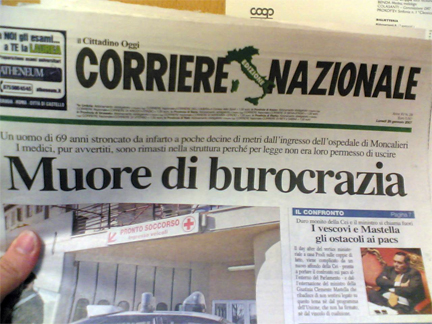
DOCG RIP: Death by Bureaucracy

And so it would seem that the Italian government has finally stopped handing out DOCGs to any and all who wish to participate in the age-old game of political spoils. But the news that Italian National Wine Committee has ended its despicable practice comes after scores and scores of wines have received the accolade while legions of other more deserving wines have been ignored and omitted.

Over the weekend, my writing partner in VinoWire, top Italian wine writer and blogger Franco Ziliani, and I posted an English translation of his editorial on the final nail in the coffin of the Italian DOC/G system.

And not only did Alfonso post an updated list of current DOCGs but he also wrote a stirring, lyrical, and unforgettable post about the five Italian regions that will never attain a DOCG, despite the nobility of their wines (this is a must-read post, truly brilliant).

The rush to create a tide of new DOCGs stemmed from the final phase (and year) of the EU’s Common Market Organisation reform. (See also this post on “riforma 164.”)

The power to create new denominations has now passed from Rome to Brussels but the reform allowed a “grandfathering” of previously decreed DOCGs. The crush of new DOCGs was the result of hundreds of wineries lobbying to attain the classification before the application deadline passed in 2009.

The Italian agricultural minister essentially rubber stamped every application.

To commemorate this momentous legislative landmark, Fedagri-Confcooperative (the Italian confederation of farmers and farming cooperatives) issued the following statement: “with these deliberations, the National Wine Committee has fulfilled its two-year task of reviewing and approving nearly 300 applications to change existing DOs [Protected Designations of Origin] and the accreditation of new IGTs, DOCs, and DOCGs.”

Never mind the fact that the Italian agriculture minister, Saverio Romano, (who oversees the committee and signs their recommendations into law) was appointed to his seat in the cabinet by Berlusconi so that he could avoid prosecution for organized crime association and corruption. (Over the course of his tenure, Berlusconi has shrewdly authored a series of laws that grant immunity to Italian politicians.)

And so with the baby and the bathwater: bureaucracy has skillfully annihilated any significance or impact that the DOCG system could have retained in a post-CMO-reform world.

As I prepare to head back to Italy for the European Wine Bloggers Conference (where Franco and I will both be speaking), it strikes me as one of the saddest forms of wine writing that I can imagine.

La Bunga Bunga c’est arrivée!

Et voilà! Our love letter to Berlusconi!

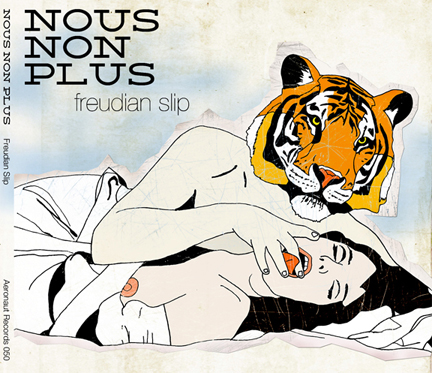
Please support the musique by downloading the first single from our new record Freudian Slip by clicking here (for Italian) or clicking here (for English).

Merlot di Montalcino: Italian Grape Name and Appellation Pronunciation Project

Ragazzi, siamo alla frutta…

“Merlot di Montalcino”

Starring Federico Marconi.

With a special appearance by Jeremy Parzen.

Directed by Edoardo Bianchi.

With music by Calvino di Maggio.

Montalcino fait accompli? New developments today…

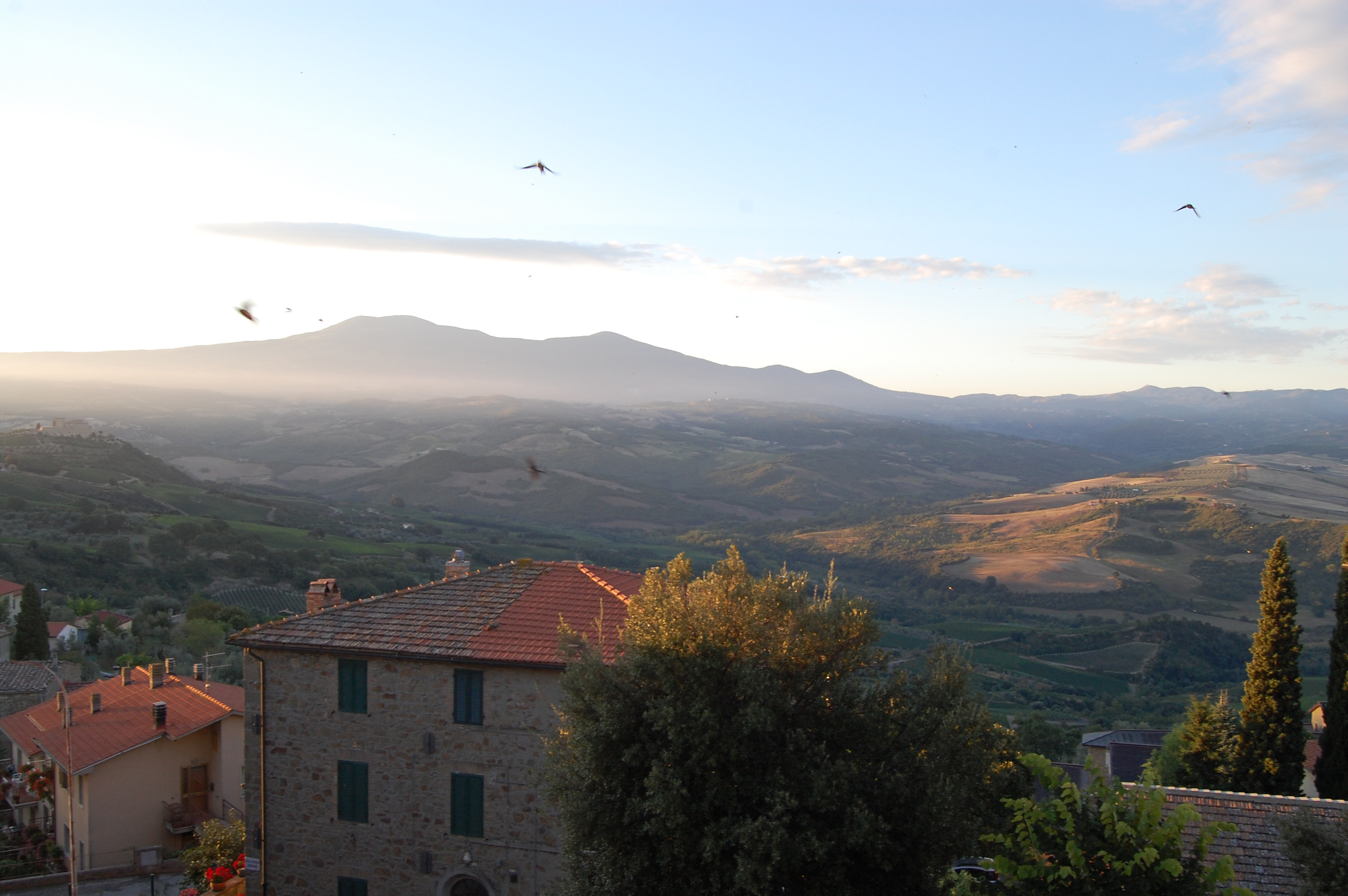
Above: Mt. Amiata as seen from Castelnuovo dell’Abate (Montalcino). I took this photograph in September 2010. Click the image for a high-resolution version of the image.

According to the chatter, it would appear that a change allowing international grape varieties in Rosso di Montalcino is a fait accompli.

Neither I nor Franco have access to the Consorzio del Vino Brunello di Montalcino charter. And so we are not privy to voting protocols.

But all words on the street indicate that the September 7 assembly of Brunello producers will be given two options to vote on: 1) Two categories of Rosso di Montalcino, including one that allows for international grape varieties; or 2) Three categories, including one that allows for international grape varieties. The option not to change the appellation regulations is not on the table, evidently. It’s also not clear what type of consensus the technical council of the consortium needs to achieve in order to pass the changes through.

Regardless of consortium president Ezio Rivella’s sprezzatura, one thing is abundantly clear: the big business interests here — Masi (Rivella’s partner), Frescobaldi, Antinori, Banfi, Zonin (?) — are going to push this change through one way or another, come hell or high water.

I cannot help but be reminded of what I heard Teobaldo “Baldo” Cappellano say in the Brunello Debate of October 2008: sometimes the battles you know you will not win are the ones you must fight for most passionately.

The only voice of reason coming from Montalcino these days seems to emanate from my friends at Il Poggione, who have stayed above the fray, avoiding any commentary on what’s happening there and containing their observations to their blog’s harvest report series.

Yesterday, they posted a detailed report on the heat spike of August. And they suggest that the problem may not be one of whether or not to add international grape varieties to the Montalcino brand wines. Emergency irrigation, they write, could help growers to produce healthier Sangiovese in hot years like 2003 and 2011:

    We believe that in the future it will be indispensable to insert in the appellation some technical parameters like emergency irrigation, a practice that would allow growers to overcome these periods unharmed, even if limited by the great heat.

It’s possible that Rivella’s urgency in modifying the appellation may be due to the fact that, as Francesco Illy pointed out, “Grapes that were ripening have been dried up in quantities that vary between 5-50% depending on the zone and the age of the vines.”

In any case, it was inevitable that the big business actors were going to push this through.

It all makes me very, very, very sad.

Yesterday, I posted an English translation of a moving vignette written by my good friend Paolo Cantele on his family’s winery’s blog.

His grandparents, post-war wine merchants, he wrote, wouldn’t recognize the Italy for which they had sacrificed so much to build.

Ain’t it the truth?

If all goes according to plan, Wednesday, September 7, will be a dark day in Montalcino’s history.

Es muss sein…

What the hell is going on in Montalcino???!!!

In the wake of my Friday post where Franco and I revealed one of the “hypotheses” for a new Rosso di Montalcino category that would allow the use international grape varieties, a lot of folks have been asking, what the hell is going on in Montalcino, anyway???!!!

Today, on his blog, Franco asks rhetorically, is the proposed change prompted by market demand or does it reflect the interests of certain actors?

The fact of the matter is that there is an oligarchy of commercial, big-business, industrial wineries that want this change. Their baron-robber chum and ringleader Ezio Rivella — gerrymandering president of the Brunello producers association — says that before the Brunello controversy of 2008, 80% of Brunello (which by law must be made from 100% Sangiovese grapes), was blended in part using international grape varieties. (Here’s my post and translation of that story.) He and his gang claim that the market (read AMERICA) wants international grape varieties from Tuscany. What he doesn’t acknowledge is that the overwhelming majority of Brunello growers and producers — 90% by most counts — want to protect their appellation from internationalization in the name of Italian and Tuscan cultural heritage. The last time that Rivella tried to hold a vote on changing the appellation to allow other grape varieties, he had to retreat at the last minute because he knew he would lose. (Here’s the post on VinoWire.)

In the days that led up to the aborted vote, Francesco Illy — scion of the Illy coffee dynasty and owner of Montalcino estate Mastrojanni — published two open letters exhorting his peers and colleagues to protect the identity of Montalcino’s iconic wines. (Juel Mahoney posted English versions of the letters here.)

Comparing the crisis in Montalcino to the hard times faced by his father in the coffee industry, he wrote that “Experiences tell us [sic] that those who have managed to defend its identity in the end he won [sic].”

The bottom line is this:

1) The big-money, establishment producers want to make the rules more flexible so that they can make more wine, even in bad vintages, when Sangiovese is more difficult to cultivate (and Merlot and Cabernet Sauvignon are more consistent and reliable).

2) The overwhelming majority of smaller producers do not want to change the appellations because they feel a deep connection to their land and their traditions and they do not want to see their wines internationalized (Rivella is from Piedmont, btw, not Tuscany). Ultimately, they realize, if Rivella and his gang prevail, there will be no space left in the market for their products (Walmart wins again).

3) The industrialists continue to create new scenarios that would allow them to use international grape varieties through a “back door” or “loop hole”; in other words, let’s create a new category that allows us to use Merlot when we need or want to. In keeping with the current strategy, Rivella continues to water down (forgive the pun) the different scenarios, hoping that eventually one will be approved.

If Rivella prevails, everything will be lost in Montalcino. Clear some trees, build a golf course, and, hell, why not turn all of Tuscany into a Disneyland-run tourist attraction? And after we build Disneyland in Tuscany, we’ll start working on Disneyworld in Piedmont. After all, the American boom times will return and all those fat cat brokers in Manhattan are going to need more Tuscan Merlot, Cabernet Sauvignon, and Syrah to wash down those steaks. Shit, Tuscan Merlot costs less than Californian anyway!

O tempora o mores! Pasolini, Gramsci, Marx? Therein lies the answer…

Our love song to Berlusconi: Bunga Bunga

Friends, wine lovers, and fellow rockers: if you’re not already following my band Nous Non Plus on Twitter, I’d be greatly obliged if you would follow. Thank you!

Earlier this week, I got a call from the A&R dude at our record company to write some copy about the first single, “Bunga Bunga,” to be released from our upcoming full-length album, Freudian Slip (in stores October 11). Usually Jean-Luc writes the copy for press releases etc., but in the light of my Italophilia, they asked me to take this one.

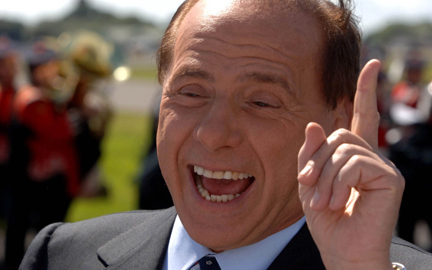
Yesterday, we found out that the video and the song will be hitting ITunes on September 13. I can’t share the song or the video just yet but here’s what I wrote, together with one of my favorite photos of Berlusca.

Bunga Bunga: Italian (and now international) slang for sex party, political corruption, and moral bankruptcy, probably from a European onomatopoeic approximation of the beating of drums (cfr. “bongo, bongo, bongo, I don’t wanna leave the Congo,” a line from the song “Civilization” as performed by the Andrew Sisters and Danny Kaye); also used to denote a dance craze created by the faux French rock band Nous Non Plus on their 2011 album Freudian Slip.

The story behind Nous Non Plus’ “Bunga Bunga” (Freudian Slip, Aeronaut, 2011).

“Silvio [Berlusconi] told me that he’d copied that expression — Bunga Bunga — from [Colonel Muammar El] Qaddafi,” says former pole dancer Ruby Rubacuore (Ruby the Heart Stealer aka Karima El Mahroug, a native of Morocco), “it’s a rite of his African harem.”

Today, Italy’s sitting prime minister stands accused of paying Ruby for sex while she was still a minor (she recently turned 18) and could face up to 3 years behind bars. In Italy, consensual sex is legal at 14 years of age but it’s illegal to pay for sex with a minor.

Since the Rubygate scandal broke in early 2011, the expression Bunga Bunga has become synonymous with Berlusconi’s legendary sex parties, held in his villa outside Milan. And as Italy and the rest of Western Civilization slide into seemingly inevitable decline, Bunga Bunga resonates with Europeans and their trans-Atlantic counterparts as a metaphor for the moral bankruptcy of the European Establishment. The sex-for-hire charge is the latest in a long series of indictments leveled at Berlusconi for tax evasion and bribery. He has never been convicted.

It’s unlikely that Berlusconi’s (formerly) close friend and confidant Qaddafi whispered Bunga Bunga into the prime minister’s ear. In fact, as the Atlantic Monthly recently reported, the expression was probably first uttered by “Berlusca” and his countrymen as a racial epithet mocking the tide of north African immigrants who have settled in Italy. It’s hardly a surprise that the prime minister, infamous for his greed and hedonist excesses, proudly uses the notion of Bunga Bunga in the art of seduction. He is well known for his overt racism and his myriad racial gaffes (when Obama was elected as president of the U.S., Berlusconi noted, “I like him. He’s handsome and tanned”).

In the band’s homage to the Motown classic “Dancing in the Streets,” singer Céline Dijon brilliantly weaves together the world’s capitals, including some you might not expect, reminding the listener with each chorus that on fait le Bunga Bunga (everyone is doing the Bunga Bunga). And from the opening stanza, it’s clear that Dijon’s ingenious conceit is laden with social and political subtext and allusions to current events:

Milan ou Tripoli
Vilnius ou Benghazi
Paris, Moscou on fait le Bunga Bunga

The song’s pulsing sequenced drums (created by Julien Galner of Paris-based electronica band Château Marmount) recall the alcohol-fueled discotheques of Europe and the drum beat of Mother Africa. And its anthemic chorus is a battle cry for disenfranchised and disillusioned youth across the world.

Nuns and wine (Coenobium) and a report from Montalcino

Above: “Decameron” by Waterhouse (1916). The countryside outside the city of Fiesole served as diegetic backdrop in Boccaccio’s Decameron. Fiesole lies in the hills above Florence.

If you’ve visited my blog before, you probably have already tasted Coenobium, a wine raised by Cistercian sisters in the Province of Viterbo and vinified by natural winemaker and co-founder of Vini Veri, one of Italy’s leading natural wine movements, Giampiero Bea. Most Italophile wine lovers have heard the tale of this wine many times before.

But when I posted about it today over at the Houston Press food and wine blog, I couldn’t resist making an allusion to Boccaccio’s Decameron, Third Day, Novella 1, “Masetto da Lamporecchio [who] feigns to be dumb, and obtains a gardener’s place at a convent of women, who with one accord make haste to lie with him.”

The funny, sexy tale is one of those depicted by Pasolini in his 1971 filmic version of the Decameron (which we watched the other night) and I’m always looking for excuses to talk about literature when writing about wine.

    Fairest ladies, not a few there are both of men and of women, who are so foolish as blindly to believe that, so soon as a young woman has been veiled in white and cowled in black, she ceases to be a woman, and is no more subject to the cravings proper to her sex, than if, in assuming the garb and profession of a nun, she had put on the nature of a stone: and if, perchance, they hear of aught that is counter to this their faith, they are no less vehement in their censure than if some most heinous and unnatural crime had been committed; neither bethinking them of themselves, whom unrestricted liberty avails not to satisfy, nor making due allowance for the prepotent forces of idleness and solitude. And likewise not a few there are that blindly believe that, what with the hoe and the spade and coarse fare and hardship, the carnal propensities are utterly eradicated from the tillers of the soil, and therewith all nimbleness of wit and understanding. But how gross is the error of such as so suppose, I, on whom the queen has laid her commands, am minded, without deviating from the theme prescribed by her, to make manifest to you by a little story…

Here’s the link to my post.

And here’s the link to the tale. Buona lettura!

In other news…

Above: My friends have begun harvesting their Pinot Grigio in Montalcino. As you can see in the image, Pinot Grigio is not a white grape.

I’ve been following my friends father and son Fabrizio and Alessandro Bindocci’s posts on the vegetative cycle and harvest 2011 over at their blog Montalcino Report.

They’ve been doing an amazing job of documenting the 2011 vintage and to my knowledge, they are the only Italian winemakers who have attempted a project like this.

Today they posted the above photo of Pinot Grigio grapes and reported “Heat Spikes But Grapes Are Healthy and Correctly Ripened.”

It takes a lot of courage to be so honest about the vintage but it also gives Italian wine enthusiasts an entirely new perspective into the vegetative cycle. It will be fascinating to taste the wines when they are released and compare our tasting notes with their documentation of the vintage.

Chapeau bas, gentlemen!

NC-17 ruminations on Berlusconi & other Euro pols

WARNING: CONTAINS PROFANITY AND HUMOR.

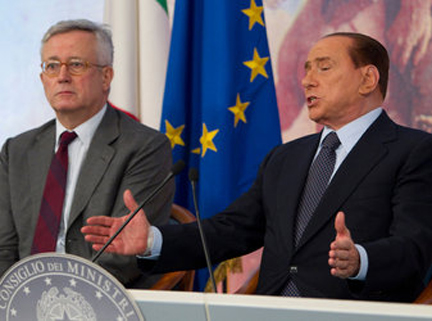
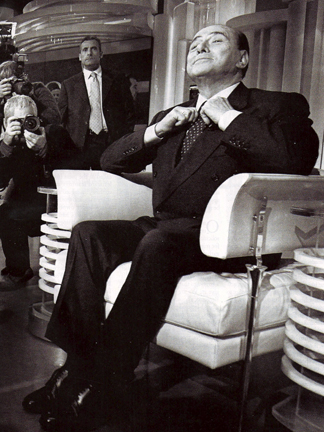
When I saw Italian prime minister Berlusconi’s photo on the (virtual) cover of The New York Times this morning (above), I couldn’t help myself from inserting my own caption: “Ma… La Merkel mi sta facendo un culo così!” Translation: “Merkel is really tearing me a new one!” (Note the gesture whereby Berlusconi illustrates the size of the new ass[hole] that Merkel is tearing for him.)

Surely I am not the only Italophone who fell victim to this overwhelming urge.

As we Americans awake from the stupor of our congressional budgetary crisis only to find that the debt crisis is about to topple Western Civilization as we know it (first Greece, now Italy, etc.), there is no small dose of irony in the fact that German prime minister Angela Merkel and her husband are enjoying their Alpine vacation in German speaking Italy, in the village of Solda to be precise.

Yesterday, in any event, it came as no surprise to me when my blogging colleague J.C. brought to my attention (on the Twitter) the news that Berlusca “took advantage of a government press conference last night to push his own shares. He said if he had savings he’d fill his boots with Mediaset, which was now ‘utterly undervalued'” (via The Guardian).

For the best blog coverage of Italy’s emerging and expanding debt crisis, I’ll be following Avvinare, who use to work as a financial reporter in Milan.

I’ve never met Berlusconi, although I did breath the same air as he when I was working as an interpreter at the United Nations and was called into a meeting between him and Kofi Anan.

In all fairness to Berlusconi (evviva la par condicio [the Italian fairness doctrine]!), he did get a bad rap in a recent New Yorker profile (although I did love the photo from the piece). As well intentioned as the young author, Ariel Levy, may have been, she probably should have brushed up on her Italian before filing her article (where are the cocaine-snorting fact checkers when you need them, Jay?).

She erroneously found irony in the fact that the Italian press refers to Berlusconi as il presidente. In fact, while we call him the prime minister, he is the president of the council (presidente del consiglio) that governs the two houses of the Italian parliament.

She also erroneously found hyperbole in the fact that the Italian press calls him il cavaliere (the knight). In fact, Berlusconi is a knight in the Italian Order of Merit for Labour. And because he is Italy’s richest man, he is — by antonomasia — the knight, i.e., the leading knight in the order.

Otherwise, I agree 100% with everything Ms. Levy said in her piece (and recommend it to you).

My band Nous Non Plus has recorded a song I wrote about Berlusconi. It’s called “Bunga Bunga” and will appear on our forthcoming album Freudian Slip.

I can’t play it for you yet but I can preview a line:

All over the world, on fait le Bunga Bunga.

Post script: check out this excellent article in the Atlantic about the origins of the expression Bunga Bunga. Philology at its best (and its funniest)!

Tarallucci e Vino (biscuits and wine), an attempt at documenting the proverb

From the “una faccia una razza (one face one race)” department…

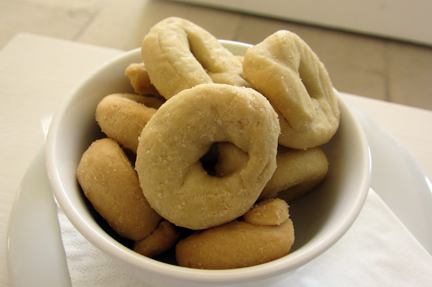
Above: Generic however delicious taralli served to us in Apulia at the Radici Wines tasting.

It all started back in June when Jancis tweeted: “Best inter-wine nibble ever: taralli from Puglia.” For three days, we had been sitting next to each other tasting and scoring Southern Italian wines at the Radici Wines festival in Apulia.

It was our last day of tasting together and one of our Italian counterparts (I can’t find the tweet) quipped back, tweeting “Finiamo a tarallucci e vino,” literally, “we finish [the tasting] with [small] taralli and wine.”

The irony in this context is owed to the proverbial meaning of the expression in Italian. To end with tarallucci [an affectionate diminutive of taralli] and wine means to resolve a dispute by pretending there were no dispute to begin with. In other words, we argued, we disagreed, but let’s have some savory biscuits and wine and pretend that there is no acrimony between us.

While the saying can be applied to express the sentiment that all’s well that end’s well, it can also be used ironically to denote that I believe you’re wrong but there’s no use fighting about it. (The sentiment and expression are by no means unfamiliar to Italians or those who frequent Italy and Italians; it’s often used in Italian journalistic parlance to allude to the hypocrisy of Italian politicians.)

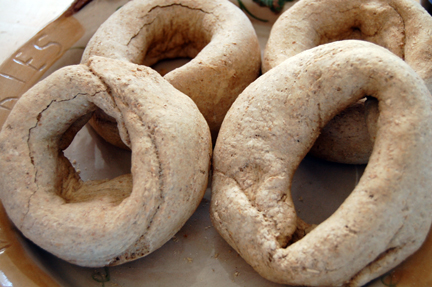
Above: Taralli probably share a kinship with Greek koulouri (I believe the unleavened biscuits in the photo, tasted at Boutari’s Santorini tasting room, fall in the category of koulouri in the Hellenic culinary canon).

Not much is known about the origins of the term tarallo. The Cortelazzo (Zanichelli) etymological dictionary notes that the etymology is obscure, possibly from the Latin torrere, to dry up, parch, roast, bake, scorch, burn. Some point to the Greek δάρατος (dàratos), a type of Thessalian bread.

I have yet to find any reliable source that addresses the origins of the expression tarallucci e vino but the tarallo’s significance as a gesture of hospitality clearly emerges in 19th century literature. It was one of the earliest street foods of pre- and post-Risorgimento Southern Italy (Pitré, Biblioteca delle tradizioni popolari siciliane, 1883) and was presented by and to travelers when they arrived. In The Bagel: the surprising history of a modest bread (Yale 2008), Maria Balińska suggests that the tarallo may be the predecessor of the bagel.

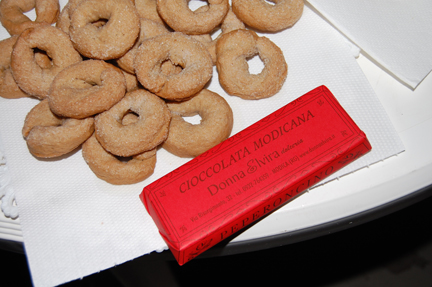
Above: Jancis and the rest of our group paired sweet taralli and spicy Sicilian chocolate with aged Primitivo at the Pichierri winery in Sava (Taranto, Apulia).

Browsing the Henry George Liddell, Robert Scott, A Greek-English Lexicon, I read that the Greek δάρατος (dàratos) was a type of unleavened bread “offered at marriage and registration ceremonies” in Hellenic Greece. And I cannot help but wonder if the tarallo’s circular, adjoined shape does not belie its use as a symbol of friendship (Balińska addresses the Italian ciambella, a similarly round unleavened bread, its relation to the bagel, and the ancient custom of presenting it to one’s host). There’s no doubt that the tarallo travels well and is easy to preserve (in Campania taralli are made with shortening and are often adorned with almonds; in Apulia, they are made with olive oil and adorned with fennel seeds).

If anyone has any insights to share, I’d greatly appreciate them. As a devout philologist, I will not rest until I get to the bottom of this conundrum and we will genuinely be able to conclude a tarallucci e vino.

Thanks for reading!