Nature doesn’t refine sugar. But refined sugar goes into your sparkling wine.

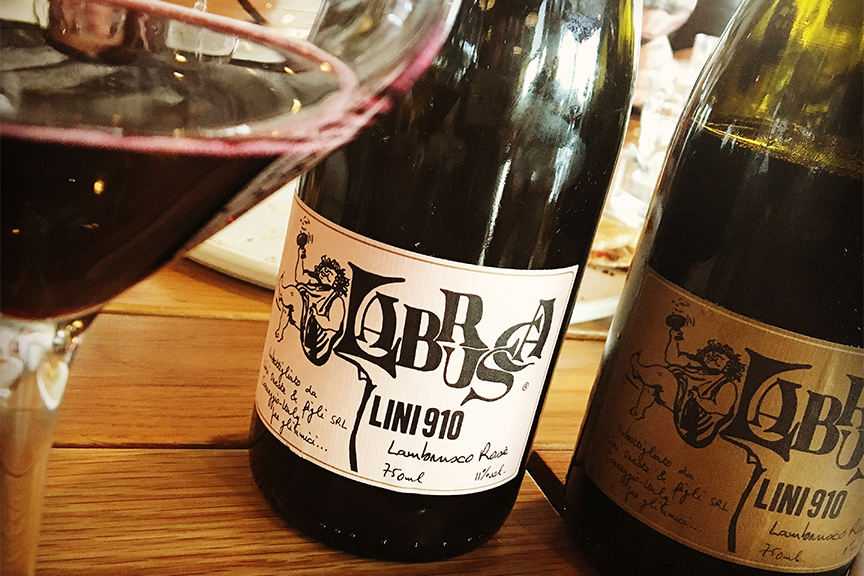
Earlier this month, a group of leading Italian wine writers sat down to taste a flight of nine wines, spanning 10 years, with my friends Nico Danesi, Andrea Rudelli, and Giovanni Arcari. Beyond their own wines (Arcari e Danesi, SoloUva, and Vezzoli Giuseppe, a 2008-2018 retrospective), the three Franciacorta growers and producers also included current-release wines from three marquee Franciacorta estates, covered in foil, to be tasted blind that evening.

The idea behind the tasting and selection of wines was to highlight the differences between wines made using the classic method and wines made using what the three 40-something franciacortini call the SoloUva (SOH-loh-OO-vah) method or Just Grapes method.

The classic method is analogous to the Champagne method (the fundamental difference is that only wines grown and vinified in Champagne can be rightly called “Champagne method” or méthode champenoise wines).

A “base” wine or wines are produced as still wine or wines (non-sparkling). A sweetener and yeast are added to the wine (or blended wines) to provoke a second fermentation (the tirage). The wine is sealed in bottle. The CO2 resulting from the pressurized second fermentation gives the wine its fizziness. The wine is then allowed to age “on its lees” (i.e., the dead yeast, a solid that results from fermentation). At the appropriate time, the wine is “disgorged” of its solids. It’s topped off with a sweetener if desired (the so-called liqueur d’expédition or dosage). And the wine is resealed and labeled for release.

(The above description of the classic method is a simplified one. For one of the best overviews of classic method winemaking, see the introduction to Tom Stevenson’s World Encyclopedia of Champagne and Sparkling Wine or the entry for “sparkling wine” in the Oxford Companion to Wine.)

The difference between the classic method and the SoloUva method (developed by my friends) is that the classic method calls for refined sugar to be added for the tirage and dosage (topping off) while the SoloUva method calls for reserved grape must to be used as the agent for the second fermentation and the topping off of the wines.

Among the wines that Nico, Andrea, and Giovanni selected from their own cellar for the tasting, there was a dichotomy: two of their wines had been produced using the classic method; the three “blind” wines from other producers were also made using the classic method; and the remaining seven wines were made using the SoloUva method.

As they tasted through the 12 wines before them, the Italian writers immediately noted the blaring difference between the two categories: the classic method wines had distinctive aromas of “brioche,” “yeast” (a canonical descriptor, however misleading), “toast” etc.; the SoloUva method wines had “fresh” fruit aromas.

The discussion that followed (on picking times, phenolic ripeness, and different approaches to sparkling wine production) was as interesting as it was provocative. But it was plainly clear to all present that the oxidative style of classic method wines was starkly contrasted by the fresh and ripe fruit style of the SoloUva method wines.

Nico, Andrea, and Giovanni are not the first to employ reserved grape must as a sweetener in sparkling wine production. But they may be the first to propose such a method as a “purer” expression of their appellation.

Why add exogenous (as opposed to autogenous) cane sugar from Brazil when you can use grape sugar from the very same appellation? they asked their interlocutors.

When they call into question the wisdom of centuries of classic method wines from France, they may be veering from the enological into the ontological. But over the course of the gathering, Nico changed the nature of the conversation when he pointed out that refined sugar doesn’t occur in nature. Only humankind produces refined sugar, he noted, and refined sugar is partly to blame for many of contemporary society’s health challenges.

Nearly all sparkling wine is produced with the addition of refined sugar (and not just classic method wines; Charmat, Martinotti, and even some ancestral method wines are made using refined sugar). Wines labeled dosage zero, brut nature, and pas dosé are also made with the addition of refined sugar (some may be surprised to learn this).

Only history will reveal whether or not Nico, Andrea, and Giovanni’s wines will represent a new era of sparkling wine production. I like their wines a lot. But take my opinion with a grain of salt spoonful of sugar because I am biased by our friendship. What I can tell you for certain is that their wines don’t contain anything that nature didn’t give them.

All they need is grapes…

Here’s a song I wrote for them a few years ago (MP3).

Mother nature is yours and she is mine
And the tender grapes she grows on the vine
She gives us the earth, the sun, the sky
But it takes humankind to make the wine so fine

Our children, our times…

Yesterday, our family attended a fund raiser for our children’s public elementary school in Houston, Texas. The day before, less than an hour car’s ride to the south, children and adults lost their lives in yet another unspeakable tragedy.

When the right to bear arms bests children dying in our schools…

When the right to wave a flag bests the dignity of those it offends…

When the right to wealth bests the neediest among us…

When the right to succeed bests others’ deliverance from despair…

When race bests community, when creed bests Moses’ law and Jesus’ word…

When complacency bests opposition to injustice…

When indifference bests love…

Who are we?

Happy Mother’s Day, Tracie P! I love you, we love you…

When I landed in Frankfurt, Germany a week ago last Tuesday, I turned on my phone to discover that Georgia P, age 6, had fallen from a hammock at our family’s favorite park and broken her collar bone.

“Should I turn around and come back home?” I asked Tracie who was rubbing the sleep from her eyes when we spoke around midnight Texas time.

“No, no, no, she’ll be fine,” she said. “The doctor at the urgent care said to be sure to go to a orthopedic specialist but she’ll be fine.”

Later that day, they had already seen a pediatrician who said she wouldn’t have any trouble healing.

By Friday, Georgia was back at school and her kindergarten class welcomed her with a necklace and pendant. She was proud to show off the badges Tracie had ironed on to her sling.

Tracie P, happy Mother’s Day! I love you, we love you… Georgia and Lila Jane are so lucky to have you as a mother, so caring, loving, and attentive. And I am blessed to call you my wife.

We have built such a wonderful life for our girls and ourselves in our little corner of Houston. It never would have happened had we not fallen in love and decided to grow a family. I love you, we love you… Happy Mother’s Day!

“We must see racism for what it is.” Honoring Dr. Martin Luther King 50 years after his death.

Dr. Martin Luther King, Jr., American civil rights leader and peace activist, was assassinated 50 years ago today in Memphis, Tennessee.

The following is an excerpt from his landmark speech “The Other America,” delivered less than three weeks before he was killed:

    There must be a recognition on the part of everybody in this nation that America is still a racist country. Now however unpleasant that sounds, it is the truth. And we will never solve the problem of racism until there is a recognition of the fact that racism still stands at the center of so much of our nation and we must see racism for what it is. It is the nymph of an inferior people. It is the notion that one group has all of the knowledge, all of the insights, all of the purity, all of the work, all of the dignity. And another group is worthless, on a lower level of humanity, inferior. To put it in philosophical language, racism is not based on some empirical generalization which, after some studies, would come to conclusion that these people are behind because of environmental conditions. Racism is based on an ontological affirmation. It is the notion that the very being of a people is inferior.

I can’t think of a better way to honor Dr. King today than by re-reading and studying his writings and speeches. I recommend the speech above, one of the last he gave before his death.

Tracie and I wept last night as we streamed “King in the Wilderness,” a new documentary about the latter part of his career.

As we watched the film, one of the things that struck both of us was how whites would use Confederate flags to taunt Dr. King and the marchers he led. I can’t repost the image here but this photograph was shot during the 1966 March Against Freedom: a young shirtless boy plays “Dixie” as a young woman waves the Confederate flag and the marchers approach. You see the hecklers (in motion picture footage with audio) in the documentary. It’s a chilling sight.

Scroll through this archive of photographs from the same march and you’ll find similarly disturbing images of white Americans menacing their black sisters and brothers with Confederate flags.

Today, on the anniversary of his death, we celebrate the life and work of Dr. King. His contribution to the historic fight for civil and equal rights for all Americans is unrivaled. And his legacy only grows as it continues to inspire a new generation of Americans to stand up for what is right and just in our country.

On Saturday, April 7, Tracie and I will be protesting the Confederate Memorial of the Wind in Orange, Texas. It was erected a few years ago on Martin Luther King Dr. where the thoroughfare meets Interstate 10, one of the busiest traffic hubs in the county. See this flier, distributed by the owner to raise funds for its construction.

We are not asking for the site to be torn down. We are asking the organizers to repurpose the site to reflect the values of the community — nearly 50 percent black.

Please join us. We have space in both of our cars available for Houstonians who want to participate.

G-d bless Dr. King and his family. G-d bless America.

See also this op-ed, “How Dr. King Lived Is Why He Died,” published by Rev. Jesse Jackson, in today’s New York Times.

Image via the National Park Service Flickr (Creative Commons).

A world without Trump (exists)…

Yesterday, on Easter morning around 7:30 a.m., President Trump wished his Twitter followers a “HAPPY EASTER!” in all caps.

An hour and a half later, the President tweeted “NO MORE DACA DEAL!” also in all caps.

Another two hours would pass before he, his wife, and one of his daughters attended church for Easter services.

I wasn’t the only one who noted the jarring juxtaposition and incongruity between the occasion and the sentiment.

Is this what my Christian sisters and brothers hoped for when they voted for him? Is this how George W. Bush, Richard Nixon, or Mitt Romney would have acted on one of the holiest days in the Christian calendar?

I ask the same of my Jewish sisters and brothers who support Trump. Sunday was the second day of the Passover, a remembrance of how we were all once immigrants in Egypt. Can any one of them say that their forbears — immediate or ancient — were not immigrants?

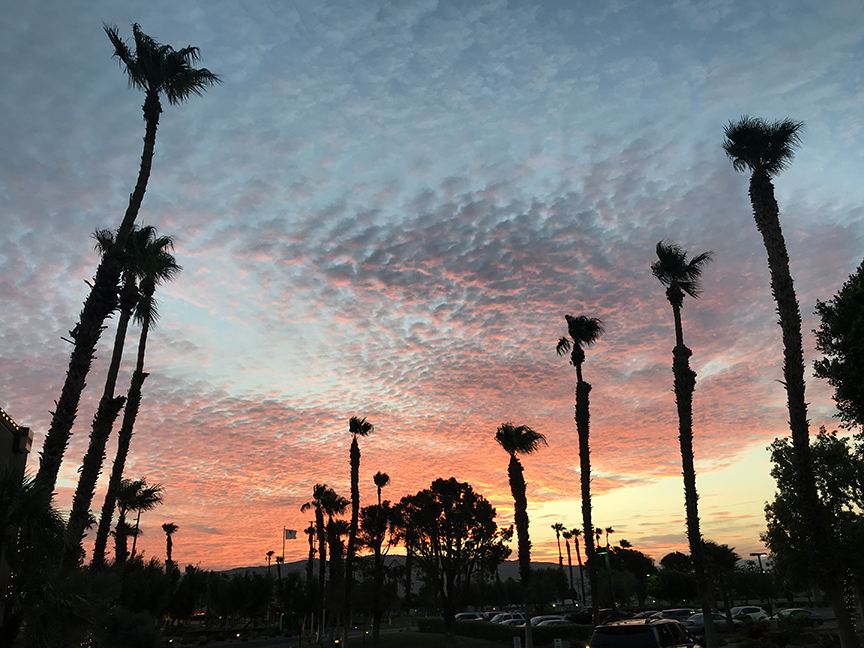
Tracie, our daughters, and I spent the Passover holiday with my brothers, their families, and our mother in San Diego. That was the view from my mom’s house above.

It was nice to be in a place like (mostly) liberal California where the majority opposes Trump, his willful degradation of civic discourse, and his continued efforts to use the children of immigrants — the DACA dreamers — as a political bargaining chip. Where I grew up in Southern California, it’s mostly socially awkward to speak favorably about Trump and his policies and dehumanization of immigrants. Mostly…

People call California a liberal bubble. I was reminded of this when one of my detractors recently wrote the following on my blog: “You dont know a godam thing about the south u bathroom swapping western bitch!!” [sic, sic, and sic]

But it’s actually not a bubble. In fact, one of my best friends from my childhood in San Diego, with whom I’m still very close, is an adamant and vehemently vocal Trump supporter. And so is one of my immediate family members, although not as loudly so.

My California family lives along the coast. But head inland and you’ll find plenty of Trump supporters. Similarly, you’ll find a predominance of liberals in blue-state Houston where we live. But move outside the urban area — north, east, south, or west — and you will find the political attitudes inverted.

As much as I enjoyed being home with my family and being in a place where we were mostly shielded from politics and political discussions, I also realized that California is not a world without Trump. That world exists in the future and in my mind. It exists in my hopes and dreams. But it is not a real world or real place. Yet…

In the meantime, Tracie and I will continue to teach our children that Easter and the Passover are holidays meant to make us reflect on our shared humanity — regardless of religion, ethnicity, or geography. The Resurrection of Jesus Christ and G-d’s redemption of the Jews in ancient Egypt remind us that we are all emigrants and immigrants, traveling between the physical and the spiritual. Between the real world and the one that awaits us.

Passover narrative: a story of refugees and immigrants

The Passover. The very name of the holiday implies movement.

The text it comes from, the Book of Exodus, tells the story of Hebrew refugees who migrate from Egypt to Israel as they flee persecution and bondage.

It’s a powerful narrative remembered and celebrated by Jews every year across the world. Even for secular Jews like me, the holiday and the retelling of the story have deep meaning.

That’s my maternal grandfather Maurice “Poppa” Bailie above (center left, with tie) with my great-uncle Ted Eder (center right, without tie). Both were children of immigrants who fled economic and religious persecution in Europe in the early 20th century.

When he arrived in this country, my Poppa and his family were seen as undesirables and potentially dangerous: impoverished Jews from countries where Bolshevism and Zionism were on the rise, unwanted immigrants who would take jobs away from Americans. After landing in New York at Ellis Island, they were shipped off to the midwest by the Hebrew Immigrant Aid Society.

In South Bend, Indiana, my great-grandparents scrimped and saved up to buy a small grocery store. When they ultimately achieved financial security, their children flourished and thrived. It’s a story not dissimilar from that told in Barry Levinson’s 1990 film “Avalon” (my paternal grandmother owned a “Radio-Television Mart” like the one owned by the characters in the movie). They went to college, they opened businesses, they saved money and speculated on the stock market.

They were the children of refugees. And my parents were the grandchildren of refugees. And I am the great-grandchild of refugees. And our children are the great-great-grandchildren of refugees.

In every Passover Seder (the symbolic meal and narrative that retell the story of the Passover), the Seder leader encourages the guests to see themselves as active participants in the story with the following exhortation: “in each generation, each person is obligated to see himself or herself as though he or she personally came forth from Egypt.”

The Seder’s invitation to the guests “to break the fourth wall” (and become themselves characters in the narrative) is based on a passage from Leviticus (19:33-34):

    And the Lord spoke to Moses, saying…
    When a stranger sojourns with you in your land, you shall not taunt him.
    The stranger who sojourns with you shall be as a native from among you, and you shall love him as yourself; for you were strangers in the land of Egypt. I am the Lord, your G-d.

Click here for Christian Bible versions of the same passage.

Our children are still too young to wrap their minds around its meaning. But as he leads the Seder tomorrow night, my older brother will remind them that they, too, were personally delivered from Egypt and from persecution by G-d. And every year, I’ll tell them the story again and again and again… until they can tell the story themselves.

Chag sameach, everyone! Happy Passover and happy Easter!

Their Love Is Here To Stay

From the department of “some people want to fill the world with silly love songs”…

Their Love Is Here To Stay

A girl who grew up in southeast Texas
A boy from California
She was born on the Louisiana border
He grew up somewhere outside of LA

Storms may blow
Sand and stone may crumble
Their love is here to stay

Folks back home they say she’s crazy
To love a spirit such as he
She’s been a around the world that lady
The only one who knows her mind is she

Storms may blow
Sand and stone may crumble
Their love is here to stay

The water’s surely rising
But they are not afraid

The cold may howl
The night may call from the shadows
But their love is here to stay

It’s been nearly 10 years since I first came to Texas to be with Tracie. “Their love is here to stay…” I love you, piccina!

“We Are The Bunnaroos,” NEW SINGLE from the Parzen Family Singers’ forthcoming album FREE DOWNLOAD (available fall 2018 on the Terrible Kids Music)

From the department of “play it loud”…

Here’s the title track from the Parzen Family Singers’ forthcoming studio album “We Are The Bunnnaroos” (available on the Terrible Kids Music label fall 2018). The band and I hope you enjoy it as much as we did recording it!

DOWNLOAD THE MP3 NOW!

“Bunnaroos” is our name for each other here at Ca’ dei Parzen. Sonny (a tiger) and Pandy (a panda) are two of the girls’ favorite stuffed animals. Shirley is Lila Jane’s favorite doll (her baby girl). Zoboomafoo is their favorite (vintage) animal show and the series’ lead character (a sifaka lemur).

We are the Bunnaroos
Georga, Lila, Sonny, too
Shirley, Pandy, Zoboomafoo
Mommy-roo and daddy-roo too

We want to sing
We want to dance
All night long

We are the Bunnaroos
We wear cowgirl boots
We like pink and purple too
We like to jump like kangaroos

We want to sing
We want to dance
All night long

We are the Bunnaroos

We can count to one we can count to twos
Cause you know we cannot lose
In case you haven’t heard the news
We are called The Bunnaroos

Confederate Memorial Protest TOMORROW: why I am speaking out and rising up

Tomorrow my wife Tracie and I will be protesting the Confederate Memorial of the Wind in Orange, Texas (Martin Luther King Dr. and Interstate 10) from 3 p.m. until sundown. (Please click here for protest details in case you would like join.)

We will be joined by members of Orange County Young Democrats and Southeast Texas Progressives. The last time we gathered at the site (on Martin Luther King, Jr. Day last month), we were also joined by passersby. We hope to have an even larger crowd tomorrow. I’ll have plenty of bottled water and extra signs for anyone who wants to join us.

Earlier this week, a friend of mine in Houston asked me why this particular Confederate monument concerns me so much. There are historic Confederate monuments in Houston, he pointed out. Why don’t I protest those? he asked.
Continue reading

Happy anniversary Tracie my love, look at what we’ve done…

Happy anniversary, Tracie, my love!

Our anniversary date was actually Wednesday, January 31. But we are celebrating and treating ourselves tonight, Friday, with a babysitter and Japanese dinner, one of our favorites.

It was eight years ago, this week, that you and I were married. You’ve given me, through your love and partnership, the best years of my life — the richest and the most wonderful of my 50 years. As your husband, partner, and father to our daughters, I have experienced a depth of emotion and fulfillment that I never could have without your faith, solidarity, and affection.

I love you and know that I am blessed to have found you — through wine blogging, no less! With barely any money in my pocket and a rickety old used Volvo filled with some clothes and a couple of guitars, I set out from Los Angeles nearly 10 years ago and drove across the country to start a life with you. It was the smartest thing I ever did.

As I put together your anniversary YouTubication together this week, I remembered the videos and songs we would send each other when were first writing to each other in 2008. By the time I got to Texas at the end of the year, our hearts and minds were filled with hopes and dreams of what we could build together.

Eight years since we were married, look what we have done! Our daughters are happy and healthy, they are loved and they know that they are loved. We are building a financial future together, day by day. And along the way, we are teaching our children the importance of community and learning, compassion and awareness of the world around us.

But the thing that I am most thankful for is our ability to face even the greatest challenge together. Man, what a year 2017 was! We literally feared for our lives as water lapped up against our home in Houston. And we spoke out, loudly and with conviction, against the rising tolerance of intolerance. Over the last 12 months, we reached deep down into the bottom of our souls and found the strength and courage to face the unimaginable.

I never would have become the man I am without you, picci wicci. I never would have known the joy we have shared without your faith and love.

I love you. Happy anniversary.