An acre of Prosecco worth more than Napa (equal time for the Prosecco consortium)

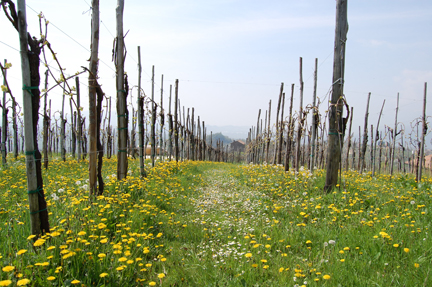
Above: I took this photo a few years ago on one of the highest peaks in Cartizze, the top growing zone for Prosecco.

According to Bloomberg.com (March 7, 2010), in California’s Napa Valley, “average prices are $150,000 to $200,000 an acre for a vineyard planted with red varietals such as Cabernet Sauvignon and $115,000 an acre for white grapes such as Chardonnay… The most desirable sites in Rutherford and Oakville can fetch $250,000 an acre.”

And that was in 2010 at the peak of the financial crisis (the title of the article is “Vineyard Defaults Surge as Lost Land Values Undermine Napa Wine”).

When I visited Cartizze in April 2009 with the scion of one Prosecco’s leading and oldest families, who owns more acreage in Cartizze — the top growing zone for Prosecco — than any other, he told me that the average price of an acre in Cartizze is greater than in Napa. And frankly, he would know: his family’s holding in Cartizze is the cornerstone of its winery and the wines produced from fruit grown there are among the highest priced Prosecco bottlings on the market today.

Whether accurate or not, these factoids give you a sense of the “big business” interests that have come to dominate the cultural and topographic landscape of Conegliano-Valdobbiadene — one of the most beautiful swaths of wine country and one of my favorite places in the world because of my deep connection to the land, people, and wines of Prosecco.

In the wake of last week’s post “Prosecco, lies, and videotape: the real story behind the new wave Prosecco,” I was contacted by public relations firm representing the consortium of Conegliano Valdobbiadene Prosecco superiore DOCG growers and bottlers.
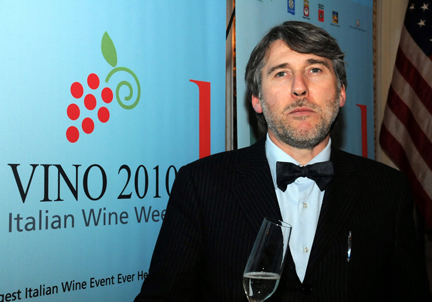
“We don’t agree with your position and we would like to explain to you why,” wrote the publcist. I wrote her back immediately and she set up a call between me and the consortium’s director, Giancarlo Vettorello (above, photo via Oggi a New York).

When we spoke the next morning, Giancarlo took issue with what I had written about the Prosecco DOCG:

    This DOCG was just one of many that were created before Common Market Organization reforms went into in 2009, shifting the power to create new designations from Rome to Brussels. It’s one of the many examples of political spoils that [then agriculture minister] Zaia lavished on his hometown…

“Does a humble wine like Prosecco — and by its very nature, Prosecco should be a humble wine — deserve to be elevated to the status of wines like Barolo and Brunello di Montalcino?” I asked paraphrasing a chorus of Italian wine writers who wrote disapprovingly of the new classification at the time (2009).

Giancarlo contended that while the origins of Prosecco may be humble, it has become one of the world’s most “recognizable wines” and is sold today in mind-boggling volume.

He also pointed out that the Centro di ricerca per la viticoltura (Center for Viticultural Research) was founded in Conegliano — Prosecco’s historic epicenter — in 1923, an innovative and ground-breaking institution and a leader in enology that predates the emergence of the sparkling wine industry in Franciacorta, Trentino, and Oltrepò Pavese. In particular, he noted, Professor Tullio De Rosa, who came to the center in 1966, developed techniques for the vinification of white and sparkling wines that reshaped Italian viticulture for the generation that followed (it’s also worth noting the pantheon of Italian wine luminaries who worked at the center, like Michele Giusti, Giovanni Dalmasso, and Luigi Manzoni).

In all fairness, he has a point. Prosecco is one of Italy’s leading brands and exports — like Campari, Perugina, Barilla, De Cecco. And in a relatively short arc of time, the architects of its success have created an interest and awareness of the brand that was unimaginable in the late 1990s when they began to market Prosecco aggressively to U.S. consumers. I think it’s safe to say that U.S. consumers are more likely to know the name of two Prosecco producers than they are to know the names of two wineries in Chianti (a brand that emerged three centuries ago).

Giancarlo was one of those architects. “I worked for fifteen years,” he said, “for the creation of the Prosecco superiore DOCG.”

Well, more power to him, I say. I was happy to share his point of view here and I appreciate that his office reached out to me.
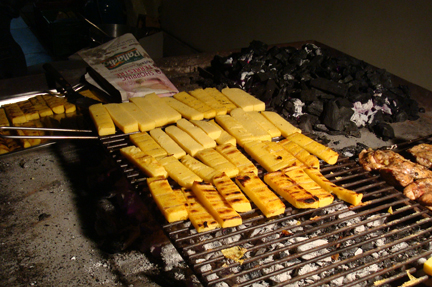
Me? I’ll leave the Prosecco brand to the powers that be.

Just give me some grilled polenta, maybe some grilled sausage or bacalà, and do prosechi colfondo — two glasses of salty, crunchy, cloudy lees-aged Prosecco… one for me and one for Tracie P

California Huevos Rancheros and Wine for Breakfast

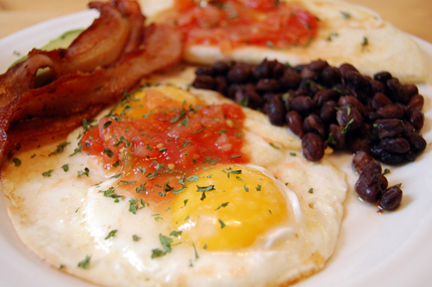
I had fun this morning with my Houston Press post, writing about my favorite breakfast — my take on California-style huevos rancheros — and wine for breakfast (in this case, Moscato d’Asti). Here’s the link…

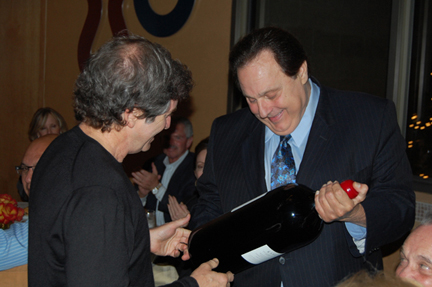
And, hey, it’s a tough job but someone’s got to do it… Here are a few recent posts I did for my friend Tony (above with screenwriter and winemaker Robert Kamen): an interview with Maximilian Riedel (where he discusses the art of decanting Champagne) and notes from the Kamen dinner at Tony’s this weekend.

Who’d have ever thought that you could make a living as a wine blogger?

Buona lettura e buon weekend, yall!

Best California Chardonnay I’ve ever tasted: Donkey & Goat Untended 2010

When my buddies Yelenosky, Erickson, and I tasted this wine together last week at Jaynes Gastropub, the three of us were simply floored by how friggin’ delicious it is.

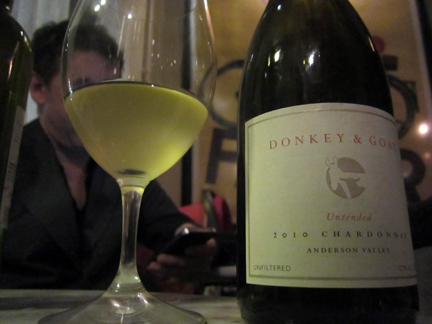
Donkey & Goat 2010 Untended Chardonnay, made from a 30-plus-year-old abandoned and “un-grafted” vineyard in Anderson Valley, California.

As you can see from the image, the wine — the product of spontaneous fermentation — is unfiltered. Beautiful, bright acidity, 12.7% alcohol (YES!), brilliant citrus notes, and a freshness and drinkability (as the Italians say) that made this wine disappear with extreme celerity.

But the thing I loved the most about this wine was how pure it is — ideologically and sensorially.

In a world where “California Chard” is a brand created through aggressive manipulation of the grape variety, this wine’s purity spoke to the true nature of Chardonnay as a relatively neutral medium for expressing the place where it is grown and the winemaker’s interpretation. In this case, the winemaker’s transparency — literal and figurative — allows the wine to express everything that has gone into it: just place and grapes. I can’t recommend it highly enough (especially for wine lovers and trade who are trying to wrap their mind around what Chardonnay really is).

Thank you Donkey & Goat for this wine and thank you Amy Atwood for turning me on to it. Love it…

The folks at Jaynes had flown me in for one night last week (my last plane ride of the year! yeah!) to lead a guided tasting of Italian wines for a corporate client. (I’ll post about an interesting experiment I conducted during the nearly 4-hour long tasting next week.)

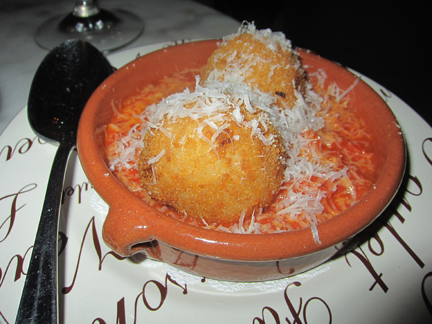
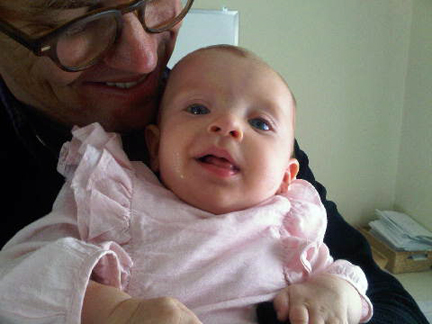
Jayne shared her excellent mozzarella-stuffed arancini with me. And their newborn daughter Romy shared her contagious smile…

Tracie P and I are in the final weeks of our pregnancy and I’m very happily grounded, with no more travel scheduled until 2012.

We’re so lucky to have so many friends and relatives who have recently had kids: the hand-me-downs are great and more than anything else, it’s wonderfully reassuring to share the experience with our friends as we deal with the discomforts and the anxiety that the last weeks of pregnancy can bring.

I’m so proud of my beautiful Mamma P: she’s such a great mother to Baby P and she’s so courageous (in our birthing classes, they give us a taste of what’s in store).

It’s so true what people say: having a child will change your perspectives in ways that you cannot imagine until it happens to you. We’re living that every day.

And just when I thought I couldn’t love Tracie (Mamma) P anymore, I find that my love continues to grow as she bravely and so graciously carries our little girl.

I wish yall could see her… she’s just so beautiful…

Our date with Willy Wonka: a staff training with the inimitable Randall Grahm

From the department of “so many great wines and so many great people and so little time”…

One of the best things about what I do for a living is the great wines I get to taste and the fascinating people I get to meet. And one of the most rewarding things about my career is getting to share those wines and those experiences with people I care about.

All of these elements came together week before last when the inimitable Randall Grahm — the Willy Wonka of wine in my view — graciously agreed to do a staff training with the servers at Sotto in Los Angeles where I curate the wine list.

When you work so closely with people as you do on the floor of a restaurant (often in extremely stressful situations), you develop a unique bond with them. And I was thrilled that Randall agreed to come talk to us and sprinkle some of his magic dust on us.

Of all the winemakers I’ve ever met, Randall — a polite and warm man — is perhaps the most erudite. I love the fact that he shares my love of words (philology!) and describes wines in terms of antipodian and podian (his neologism?). I love that he doesn’t mince words (I cannot repeat what he had to say about one antipodian wine). And I love his lyrical approach to describing winemaking and wine. At one point, when I asked him to address reduction in wine and why it’s not necessarily a bad thing. He replied using the follow simile: “Reduction is kind of like the male sex drive,” he said. “It can be ugly but it lets us know that everything’s working correctly and that the wine is alive.” (Reduction can be caused by wine being stored without any contact with oxygen, often the case with screw-cap wines. As a result, the wine may stink briefly when first opened. For the best definition of reduction in wine, see the entry on Jancis’s site — well worth the subscription fee, btw — or see her Oxford Companion to Wine.)

On the edges of our seats, the staff and I were entirely captivated by Randall’s spiel on the spectrum of organic, biodynamic, and Natural winemaking. And we tasted his Syrah Le Posseur together (by the glass at Sotto these days). Le posseur, the pusher in French, was inspired by the way great Syrah is like drug dealer who tempts you with his assortment of aromas and flavors. I love the analogy and I love the affordable and delicious wine (it only gets better with a day’s aeration, btw).

But dulcis in fundo, Randall also shared with us his new hope and faith in biochar — a newly developed form of charcoal that is used to restore balance to the soil. We live in such precarious times, these days (o tempora o mores!). “It is the future,” he said, referring not only to winemaking but also the survival of humankind.

Looking back on our encounter with the ineffably charming Randall, I cannot help but be reminded of the lyrics of one of favorite songs — from childhood to the present day.

If you want to view paradise
Simply look around and view it
Anything you want to, do it
Wanta change the world?
There’s nothing
To it…

Historically and with seemingly quotidian recurrence, Randall seems to seek and find beauty in the world around and in us, too.

This is one of my all-time favorite songs and cinematic moments. I’ll never forget seeing it for the first time and the emotion that filled my chest. It happens, to this very day, every single time…

Best fast food ever: delicious Vietnamese sandwiches at K Sandwiches (San Diego)

Tracie P and I had a wonderful week out here in “paradise” as the natives like to call it. A relaxing vacation of summer, sun, beach, good eating, and visiting with family and friends.

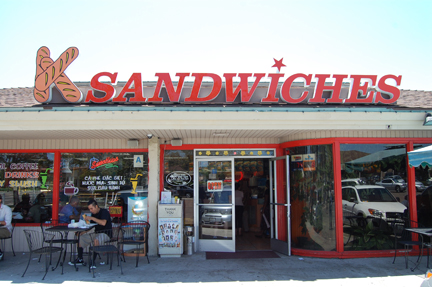
We’re about to board a plane back to Austin and I just had to share one more gem we discovered on this trip thanks to a few of the super nice doormen in Mama Judy’s building. On their recommendation we visited K Sandwiches in San Diego.

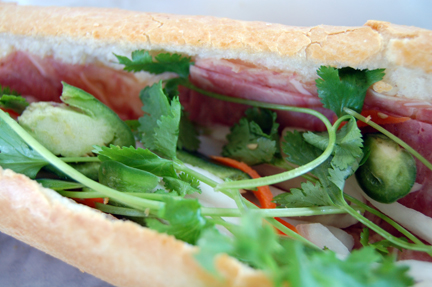
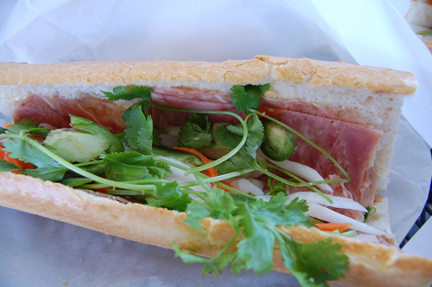
People, I am here to tell you: RUN DON’T WALK! The baguette was perfectly crusty on the outside and fluffy inside. I had the K Special (above and below), gently spread with pâté and stuffed with different types of cured ham and fresh cilantro, radish, carrot, and jalapeño.

My sandwich cost less than $3 and I didn’t even begin to peruse the many blended fruit and coffee drinks, not to mention the small grocery there.

At the peak of lunch, the place was packed the whole time we were there but the sandwiches were delivered with a celerity that old McDonald himself would envy.

Value, wholesome ingredients, superb service in a sparkling clean establishment? Could be the best fast food ever.

It’s been a great week in paradise but it’s time for us to go home with armadillo. As much as I love the place where I grew up, there’s nothing like waking up on a lazy Sunday in the Groover’s Paradise and rustling up some breakfast tacos for the most beautiful lady and mama-to-be I have ever seen…

Rebula and pulled pork quesadillas rock our world

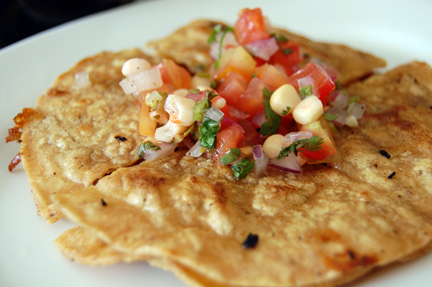
One of the most delicious things we ate during our week in Southern California was the happy hour pulled pork quesadilla at Jaynes Gastropub… delicious in part because it was one of the dishes we served at our wedding reception there.

The dish paired wonderfully with a glass of Kabaj 2008 Rebula (Ribolla), vinified with skin contact. Very elegant expression of Ribolla, with gentle tannin and a great balance of savory and fruit flavors.

Slovenia, meet Southern California… brilliant…

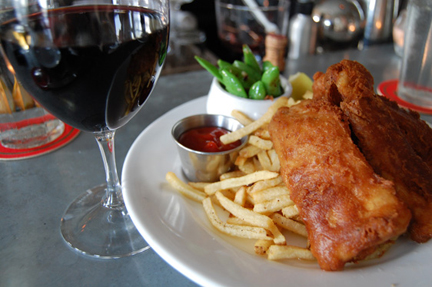
We’ve had a fun week of eating here in San Diego and our adventures inspired a post on pairing red wine and fish over at the Houston Press, including some food shots from Jaynes.

    ​Whenever I am faced with a conundrum like the age-old question of whether or not it is imperative to pair white wine exclusively with fish, I look to antiquity. Indeed, in more cases than not, the ancients were much wiser and more well informed than we are.

    And as I pore over (excuse the pun) centuries-old manuscripts and vellum-bound tomes, I discover that — lo and behold — the ancients did not have this problem because wine was predominantly white or rosé (at its darkest) in the days of yore…

Click here to read the rest of the post…

Thanks for reading and buon weekend, yall!

Yu Me Ya, the best little sake house this side of Osaka

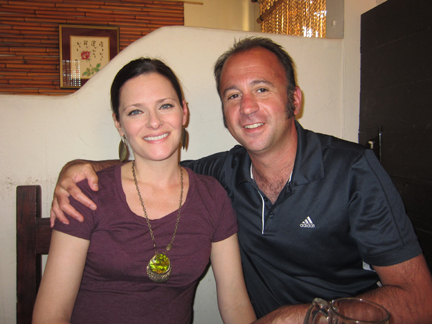
Tracie P and I finally made it to Yu Me Ya in Encinitas, California. It’s extremely difficult to get into this small joint without a long wait — it’s that good, folks. But our good friend John Rikkers (who took the photo above) managed to make us a reservation (they only take reservations Tues.-Thurs. btw).

Man, after a day at the beach, there’s nothing like some good Japanese pub grub and cold beer!

Recommendation? RUN DON’T WAlK, people. Thanks again, John!