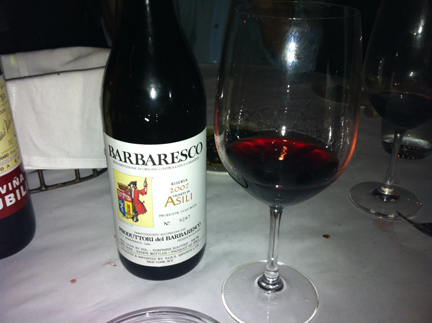
Ready or not: 07 Produttori del Barbaresco Asili vs. 07 Chiarlo Tortoniano

Unfortunately, it happens all the time: you find yourself at dinner with a good friend (in this case, a best childhood friend) who is new to the wine world and who insists on tasting you on a wine that they’ve discovered with no regard for your personal tastes or palate (how could she or he know?).

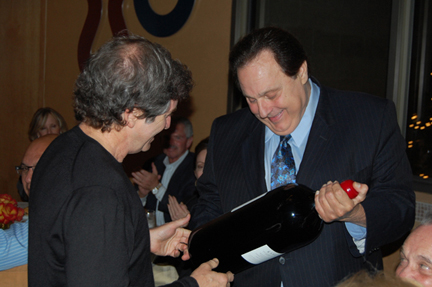
It’s exactly what happened when Yele and I visited a restaurant in La Jolla the other night with a close high school friend of ours (a Hebrew school friend for me; that’s how far we go back). I had a bottle of 2007 Produttori del Barbaresco Asili in my bag: however young in its evolution, I wanted to taste a bottle from my allocation just to check in with the wine, see where it’s at in its development, and indulge in one of my favorite wines of all time.

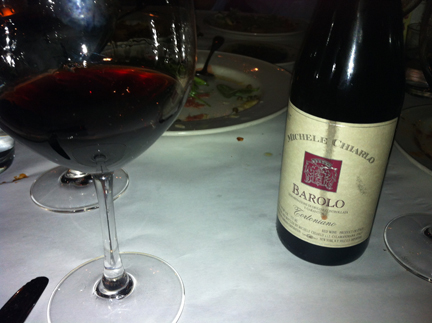
Said friend, who had eaten at said restaurant a few nights earlier, wouldn’t listen to our gentle admonitions and he insisted that he allow him to buy our table a bottle of Chiarlo 2007 Barolo Tortoniano in 375ml.
The 2007 Asili was extreme in its tannic expression and frugal with its fruit. California, where I maintain my cellar, gets a smaller allocation of Produttori del Barbaresco crus and I’m thrilled that I was able to get a case of this wine. I probably won’t revisit it for another few years but there’s no doubt in my mind that it’s going to become one of the gems of my collection. The practically winterless 2007 vintage in Langa has delivered some of the most muscular, opulent expressions of Barbaresco that I have ever tasted (remember when Tracie P and I tasted the 07 Asili with Bruno Giacosa on our honeymoon?).

My experience with Langaroli wines from 2007 was a stark counterpoint to the bright cherry cough-syrup fruit of the 2007 Tortoniano by Chiarlo. There’s no doubt that this is a well made wine but it’s just “not my speed,” as I like to tell folks when I politely decline to taste a given wine. The tannin was well-balanced in the wine but I just couldn’t get past its yeasted quality and its softness. It wasn’t bad (in fact it was very elegant). But it simply didn’t reflect the appellation or the vintage. It tasted more like a high-end Russian River Pinot Noir than it did Langa Nebbiolo — at least to me.

Having grown up in San Diego, I often find that my peers took paths in life widely divergent from mine — in wine tastes and ideology. Actually, I should say the opposite: I spent my entire adolescence leaving Las Vegas La Jolla, heading to Mexico, to Italy, to New York, and now Texas.

It’s often hard to taste wine with them. But ready or not, I love them just the same.
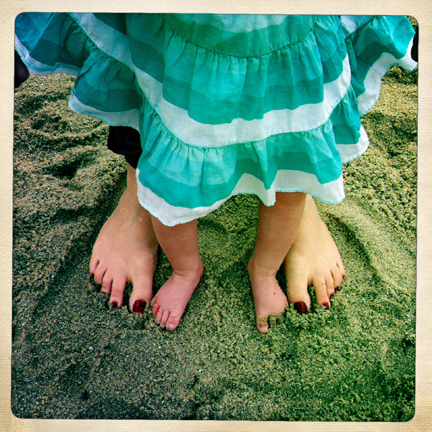
First kiss: Georgia P at the La Jolla Cove

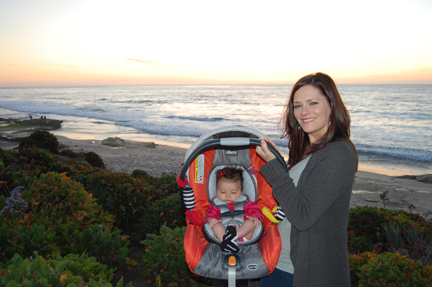
Yesterday afternoon, we took Georgia P down to the La Jolla Cove so that she could dip her little toes into the Pacific Ocean for the first time.

If you haven’t ever been and don’t know what a special place the Cove is, check out the Wiki entry.

“You can’t get a bad meal in Napa” and my favorite Napa wine blog

Above: The burger and fries at Grace’s Table in downtown Napa. The thing that took it over the top was the superb quality of the bun.

“You can’t get a bad meal in Napa these days,” said the waiter at Grace’s Table downtown as she insisted that I taste the baguette that the restaurant sources from a bakery down the street.

I hadn’t been to Napa for three years or so: there’s been an explosion of restaurants in the town and while competition is high, I was told, there’s plenty of high-quality materia prima to go around. Say what you will about the Napa style of wine, but there’s nowhere in the U.S. that can beat the quality of the produce that the farms here deliver. And the culture that once corralled the best restaurants in the villages to the north has now graciously populated its namesake township. Gauging from a stroll in the town center, there are many affordable options for dining: my “Hand Formed Burger, Meyers Ranch Chuck, House Made Pickles, Chili d’Espellette-Parmesan Fries” was just $12.

Above: Artichoke fritters at Grace’s were delicious.

After Giovanni and I finished an early repast in town, we headed back up north to Yountville to meet the author of my favorite Napa wine blog, Vinsanity, Vinogirl.

She was pouring wine at an exclusive private event but she managed to sneak Giovanni and me through the back of the venue so that we could taste her wine and chat with her and husband Vinomaker.

Above: In Yountville, Giovanni and I were impressed by this “transgenic” sage plant, as he called it. Note the size of the plant’s leaves.

On her excellent blog, Vinogirl chronicles the vegetative cycle of Napa with wonderful photographs and occasional scouser humor (she Liverpudlian). Her posts are peppered with viticultural knowledge and insights into what’s happening “on the ground,” including the recent cooling trend that has vexed growers here.

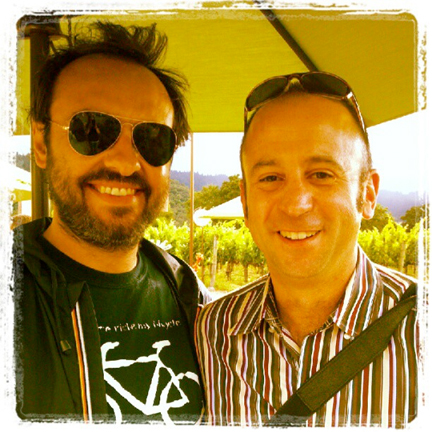
Above: “Did you know,” writes Vinogirl on her blog today, “that there’s no Italian word for ‘bromance’?” She snapped this photo of Giovanni and me, four days into the California leg of his visit to the U.S.

Why were Giovanni and I in Napa? You’ll be surprised to know the reason and I’ll explain all next week… stay tuned…

In the meantime… Thanks again, Vinogirl, for the photo! It was so great to finally meet you!

California sunset (heading back to Austin), 2010 Tempier, 2006 Vodopivec

Our trip to California has come to an end. Today we head back to Texas…

We’ve had a lot to celebrate out here in the land where I grew up: Georgia P met her grandma Judy and her Parzen cousins, my band Nous Non Plus had a super fun mini-tour, and it was great to get back to work at Sotto in Los Angeles (where I’ll be launching a new wine list early next month).

Last night, together with Jayne, Jon, and daughter Romy, we celebrated our BFF Yelenosky’s umpteenth award as “best Southern California sales person 2011” for Southern Wine and Spirits. Yele is the sweetest guy and the bestest friend and we love him a lot. Mazel tov, Yele! You rock…

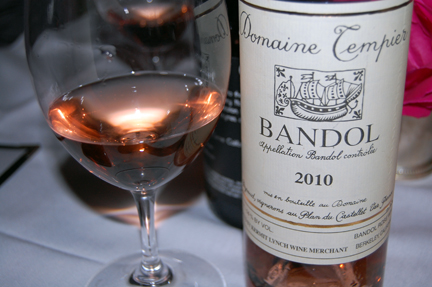
To commemorate the occasion and our trip Jayne and Jon opened one of our favorite wines from their awesome list at Jaynes Gastropub, the 2010 Tempier Bandol Rosé. Still so young and tannic but drinking gorgeously… so fresh and just slightly oxidative… delicious…

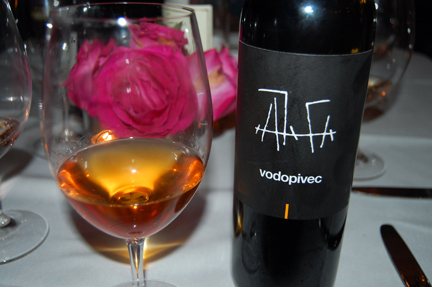
Yele treated our party to a bottle of 2006 Vitovska by Vodopivec, one of my favorite wines in the world. So tannic and so glorious and with so many layers of dried fruit and nutty nuance… An unforgettable treat for us…

And little Georgia held her daddy’s hand all through dinner… She’s such a miracle and we love her so much.

Arrivederci, California! We’ll miss you!

What rock bands eat on the road (in California)

Last night in San Diego was a blast at Soda Bar…

Come see Nous Non Plus in San Francisco at Rick Shaw Stop tonight!

Tomorrow night in LA…

Georgia P’s first plane ride

She slept through the whole flight and this morning she woke up to the sound of waves crashing on Seal Rock in La Jolla.

California, I’m coming home… @SottoLA @NousNonPlus

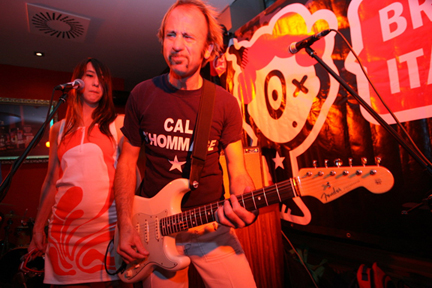
You can catch me as Dr. Jekyll tomorrow night (Weds. Feb. 8) at Sotto in Los Angeles where I’ll be working the floor pouring and talking about wine or you can catch me as Mr. Hyde (aka Cal d’Hommage) on guitar with Nous Non Plus on Thurs. in San Diego, Fri. in SF, or Sat. in LA.

Ever since I was a child (when I lived and grew in California), the song has had a profound meaning for me… Nostalgia and longing played out in falsetto and dulcimer… Will you take me as I am?

This time around the song has a whole new meaning as Tracie P bundle up our “little green” Georgia P for her first trip to meet her California family and see where her daddy grew up. Just the thought of her seeing the Pacific Ocean for the first time fills my heart with a joy that I could never have imagined before she came into our lives…

California I’m coming home
I’m going to see the folks I dig
I’ll even kiss a sunset pig
California I’m coming home

Oh California I’m coming home
Oh make me feel good rock n roll band
I’m your biggest fan
California, I’m coming home

Will you take me as I am?

Photo by the amazing Nichols family.

An acre of Prosecco worth more than Napa (equal time for the Prosecco consortium)

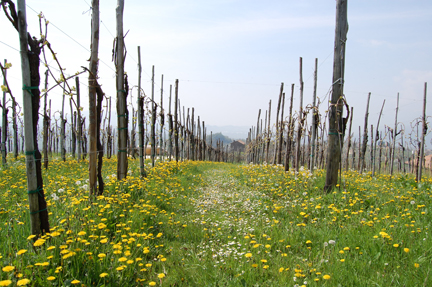
Above: I took this photo a few years ago on one of the highest peaks in Cartizze, the top growing zone for Prosecco.

According to Bloomberg.com (March 7, 2010), in California’s Napa Valley, “average prices are $150,000 to $200,000 an acre for a vineyard planted with red varietals such as Cabernet Sauvignon and $115,000 an acre for white grapes such as Chardonnay… The most desirable sites in Rutherford and Oakville can fetch $250,000 an acre.”

And that was in 2010 at the peak of the financial crisis (the title of the article is “Vineyard Defaults Surge as Lost Land Values Undermine Napa Wine”).

When I visited Cartizze in April 2009 with the scion of one Prosecco’s leading and oldest families, who owns more acreage in Cartizze — the top growing zone for Prosecco — than any other, he told me that the average price of an acre in Cartizze is greater than in Napa. And frankly, he would know: his family’s holding in Cartizze is the cornerstone of its winery and the wines produced from fruit grown there are among the highest priced Prosecco bottlings on the market today.

Whether accurate or not, these factoids give you a sense of the “big business” interests that have come to dominate the cultural and topographic landscape of Conegliano-Valdobbiadene — one of the most beautiful swaths of wine country and one of my favorite places in the world because of my deep connection to the land, people, and wines of Prosecco.

In the wake of last week’s post “Prosecco, lies, and videotape: the real story behind the new wave Prosecco,” I was contacted by public relations firm representing the consortium of Conegliano Valdobbiadene Prosecco superiore DOCG growers and bottlers.

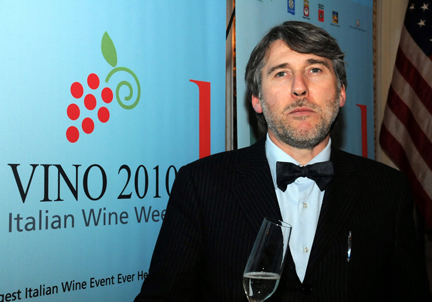
“We don’t agree with your position and we would like to explain to you why,” wrote the publcist. I wrote her back immediately and she set up a call between me and the consortium’s director, Giancarlo Vettorello (above, photo via Oggi a New York).

When we spoke the next morning, Giancarlo took issue with what I had written about the Prosecco DOCG:

    This DOCG was just one of many that were created before Common Market Organization reforms went into in 2009, shifting the power to create new designations from Rome to Brussels. It’s one of the many examples of political spoils that [then agriculture minister] Zaia lavished on his hometown…

“Does a humble wine like Prosecco — and by its very nature, Prosecco should be a humble wine — deserve to be elevated to the status of wines like Barolo and Brunello di Montalcino?” I asked paraphrasing a chorus of Italian wine writers who wrote disapprovingly of the new classification at the time (2009).

Giancarlo contended that while the origins of Prosecco may be humble, it has become one of the world’s most “recognizable wines” and is sold today in mind-boggling volume.

He also pointed out that the Centro di ricerca per la viticoltura (Center for Viticultural Research) was founded in Conegliano — Prosecco’s historic epicenter — in 1923, an innovative and ground-breaking institution and a leader in enology that predates the emergence of the sparkling wine industry in Franciacorta, Trentino, and Oltrepò Pavese. In particular, he noted, Professor Tullio De Rosa, who came to the center in 1966, developed techniques for the vinification of white and sparkling wines that reshaped Italian viticulture for the generation that followed (it’s also worth noting the pantheon of Italian wine luminaries who worked at the center, like Michele Giusti, Giovanni Dalmasso, and Luigi Manzoni).

In all fairness, he has a point. Prosecco is one of Italy’s leading brands and exports — like Campari, Perugina, Barilla, De Cecco. And in a relatively short arc of time, the architects of its success have created an interest and awareness of the brand that was unimaginable in the late 1990s when they began to market Prosecco aggressively to U.S. consumers. I think it’s safe to say that U.S. consumers are more likely to know the name of two Prosecco producers than they are to know the names of two wineries in Chianti (a brand that emerged three centuries ago).

Giancarlo was one of those architects. “I worked for fifteen years,” he said, “for the creation of the Prosecco superiore DOCG.”

Well, more power to him, I say. I was happy to share his point of view here and I appreciate that his office reached out to me.

Me? I’ll leave the Prosecco brand to the powers that be.

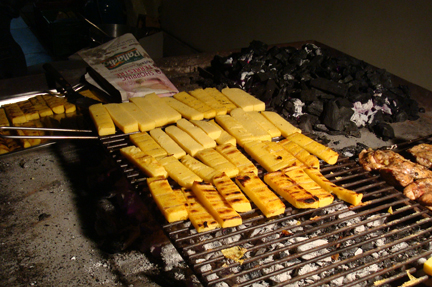
Just give me some grilled polenta, maybe some grilled sausage or bacalà, and do prosechi colfondo — two glasses of salty, crunchy, cloudy lees-aged Prosecco… one for me and one for Tracie P

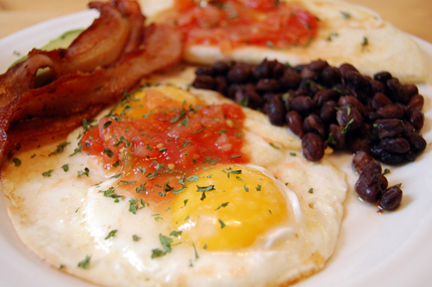
California Huevos Rancheros and Wine for Breakfast

I had fun this morning with my Houston Press post, writing about my favorite breakfast — my take on California-style huevos rancheros — and wine for breakfast (in this case, Moscato d’Asti). Here’s the link…

And, hey, it’s a tough job but someone’s got to do it… Here are a few recent posts I did for my friend Tony (above with screenwriter and winemaker Robert Kamen): an interview with Maximilian Riedel (where he discusses the art of decanting Champagne) and notes from the Kamen dinner at Tony’s this weekend.

Who’d have ever thought that you could make a living as a wine blogger?

Buona lettura e buon weekend, yall!

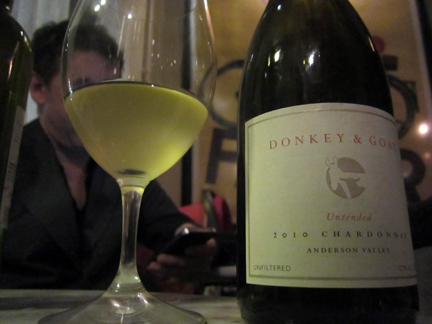
Best California Chardonnay I’ve ever tasted: Donkey & Goat Untended 2010

When my buddies Yelenosky, Erickson, and I tasted this wine together last week at Jaynes Gastropub, the three of us were simply floored by how friggin’ delicious it is.

Donkey & Goat 2010 Untended Chardonnay, made from a 30-plus-year-old abandoned and “un-grafted” vineyard in Anderson Valley, California.

As you can see from the image, the wine — the product of spontaneous fermentation — is unfiltered. Beautiful, bright acidity, 12.7% alcohol (YES!), brilliant citrus notes, and a freshness and drinkability (as the Italians say) that made this wine disappear with extreme celerity.

But the thing I loved the most about this wine was how pure it is — ideologically and sensorially.

In a world where “California Chard” is a brand created through aggressive manipulation of the grape variety, this wine’s purity spoke to the true nature of Chardonnay as a relatively neutral medium for expressing the place where it is grown and the winemaker’s interpretation. In this case, the winemaker’s transparency — literal and figurative — allows the wine to express everything that has gone into it: just place and grapes. I can’t recommend it highly enough (especially for wine lovers and trade who are trying to wrap their mind around what Chardonnay really is).

Thank you Donkey & Goat for this wine and thank you Amy Atwood for turning me on to it. Love it…

The folks at Jaynes had flown me in for one night last week (my last plane ride of the year! yeah!) to lead a guided tasting of Italian wines for a corporate client. (I’ll post about an interesting experiment I conducted during the nearly 4-hour long tasting next week.)

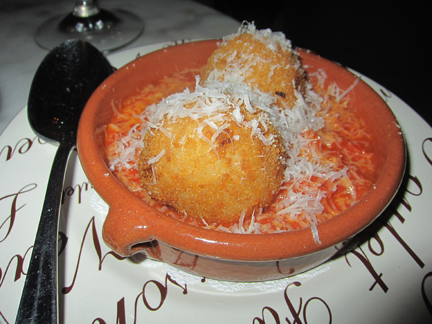
Jayne shared her excellent mozzarella-stuffed arancini with me. And their newborn daughter Romy shared her contagious smile…

Tracie P and I are in the final weeks of our pregnancy and I’m very happily grounded, with no more travel scheduled until 2012.

We’re so lucky to have so many friends and relatives who have recently had kids: the hand-me-downs are great and more than anything else, it’s wonderfully reassuring to share the experience with our friends as we deal with the discomforts and the anxiety that the last weeks of pregnancy can bring.

I’m so proud of my beautiful Mamma P: she’s such a great mother to Baby P and she’s so courageous (in our birthing classes, they give us a taste of what’s in store).

It’s so true what people say: having a child will change your perspectives in ways that you cannot imagine until it happens to you. We’re living that every day.

And just when I thought I couldn’t love Tracie (Mamma) P anymore, I find that my love continues to grow as she bravely and so graciously carries our little girl.

I wish yall could see her… she’s just so beautiful…