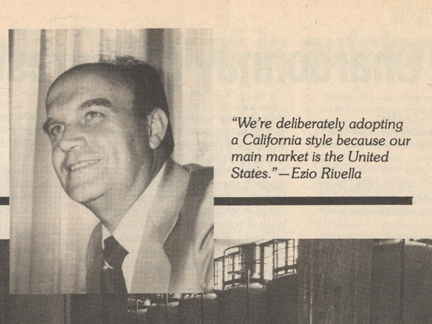
Ezio Rivella: “Tradition is a ball and chain.”

Above: Remember this image? Scanned from a 1982 edition of Wine Spectator (via Alfonso). I posted about it here.

On Monday, Ezio Rivella — Brunello’s deus ex machina and futurist of Italian wine, creator of the Brunello brand and propagator of the California dream — spoke before a group of Langa’s top winemakers in Piedmont. He had been invited their by the government-funded body Strada del Barolo (Barolo Wine Roads) to speak about the current crisis in Italian wine (the five-part series is entitled — and I’m not kidding here — “Feel Sorry for Yourself or React to the Crisis?”).

According to wine blogger Alessandro Morichetti, who attended the seminar, nearly the entire arc of Barolo was there: Maria Teresa Mascarello, Giuseppe Rinaldi, Angelo Gaja, Enzo and Oreste Brezza, Cristina Oddero, Federico Scarzello, Lorenzo Tablino, Eleonora Barale, Davide Rosso, Enrico Scavino, and Michele Chiarlo, among others.

I’ve translated the following quotes from Alessandro’s report on the talk…
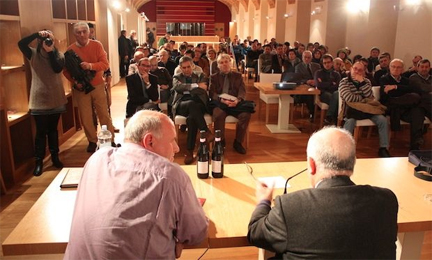
“Tradition is a ball and chain. At best, it serves as historical anchor.”

“The market fluctuations following Brunellogate? Rants by masturbating journalists.”

“Quality is what people like. Those who sell [their products] are right. There is nothing to learn from people who[se products] don’t sell.”

“Blogs are [a form of] self-flattery. The people behind them are incompetent.”

And all this time, I thought that Rivella didn’t read blogs! Go figure!

Reacting to Alessandro’s account of the event, Italy’s top wine blogger Franco Ziliani wrote: “Rivella chooses the path of insults…”

If you don’t know the backstory, here’s the thread of my posts devoted to Rivella and his self-appointed mission to refashion authentic Italian wines as expressions of Californian winemaking for the U.S. market.

As a manager and winemaker at Banfi from the 1960s through the 1990s, he credited Robert Mondavi as one of the inspirations for the behemoth Brunello brand that he created with the backing of the Mariani family, the Long Island-based importers who decided nearly 50 years ago that they would make Montalcino a household name in the U.S. (initially by producing sparkling white wine, btw).

Since returning to Montalcino to gerrymander his second coming as Brunello growers association president in 2010, he has patently conceded that “80% of Brunello was not pure Sangiovese” (an egregious transgression of appellation regulations and Italian law). And in doing so, he tacitly expressed his support for using “improvement” grapes like Merlot in traditional Italian wines made historically with indigenous varieties. He has repeatedly attempted, unsuccessfully, to lobby for the passage new appellation regulations that would allow for the blending of international grape varieties in Brunello and Rosso di Montalcino. Twice he has called votes and both times the body governed by him has remained unswayed by his industrial Brunello complex.

My friends who live and work in Montalcino tell me that he doesn’t even reside there. He lives full time in Rome, governing from afar, uninterested in the workaday lives of the homegrown montalcinesi.

He is also the author of Brunello, Montalcino and I: The Prince of Wines’ True Story (2010).

What will come of the legacy of the self-proclaimed Prince of Brunello?

Perhaps he should take the advice of a Tuscan, Niccolò Machiavelli, who wrote (chapter 3, “On Mixed Principalities”): “It is quite natural and ordinary for a Prince to want to expand his rule, and when [Princes] do, if they can, they are praised and not blamed. But when they are unsuccessful, but still want to do it, here lies the error and the fault.”

Flute elitism in this day & age? Assessments from Franciacorta

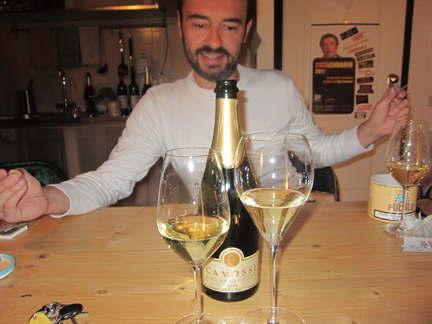
Above: Many late evenings tasting Franciacorta and kibitzing with my good friend and extreme life force Giovanni Arcari in Brescia…

Franciacorta lover Franco Ziliani’s post this week on “Which Glass for Our Bubbles?” got me thinking fondly about my visit to Brescia and Franciacorta in October of last year for the European Wine Bloggers Conference.

Over the course of five or so days that I spent there, I drank sparkling wine from Franciacorta at nearly every meal and it was never served to me in a conventional flute. Nor was the question of what glass to serve Champagne-method wines ever even posed.

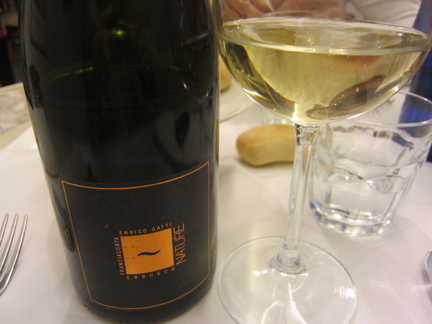
Above: At the restaurant Novecento in Brescia, our server — who wasn’t particularly wine savvy — poured Gatti’s Franciacorta Nature in Bordeaux glasses.

In Franco’s post, he quotes Champagne scion Pierre-Emmanuel Taittinger (in a passage culled from a pseudo-advertorial post on Drinks Business).

    “Champagne is not only a wine but a symbol of love and generosity and if we forget that we are dead, and I am fighting that,” [Taittinger] stated.

    Continuing, he referred to a battle with “marketers” who, he said, “want us to drink Champagne in a wine glass.”

    “But we have a specific glass…”

The Taittinger quote brought to mind the infamous statement by Frederic Rouzaud of Cristal from a few years ago: we can’t stop them from drinking it…

It’s been many years since I’ve served Champagne or any other sparkling wine in a flute. In fact, I don’t even own any flutes: in my view and experience, the flute is the worst possible glass to serve any wine in because it obstructs the wine’s aroma, especially when your drinking a Pinot Noir-based wine that can tend toward the tannic and tight (we’ve even begun decanting certain sparkling wines at our house).

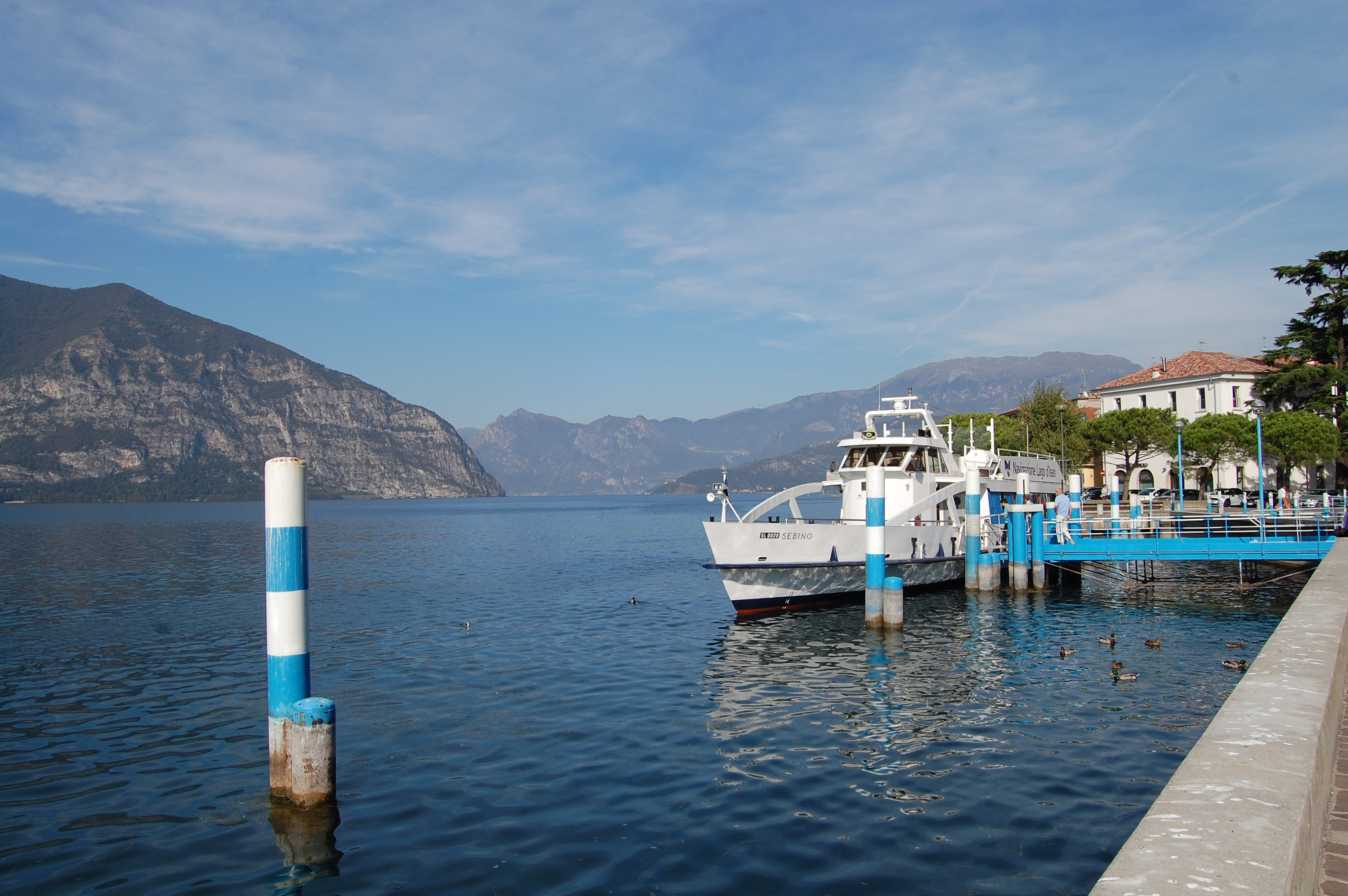
Above: The Lago d’Iseo in Franciacorta. I still need to post my notes from some of the interesting tastings I attended in Franciacorta in October. The photo, above, of the Lago d’Iseo gives you a sense of the Morainic subsoil and the maritime climate that give the wines their minerality and make them so fresh. Click the image for the hi-res version.

How do you serve sparkling wine at your house?

The Natural wine disconnect (the ideology and spirituality of wine and the importance of a good shit)

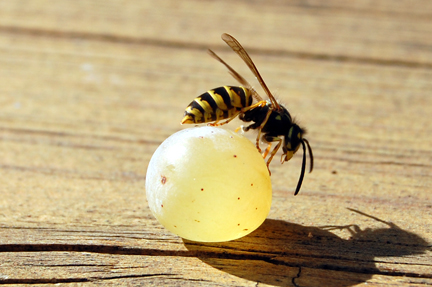
Above: The best things in life are free but you can’t leave them to the birds and bees. My good friend Giampaolo Venica employs chemical-free farming and vinifies his wines using ambient yeast exclusively. But he would never call his wine “Natural.” He just calls it “wine.” I took this photo of “Wasp with Ribolla Grape” at his winery in September 2010.

Who will ever know why Eric the Red (as Eric Asimov is known here) decided to write today about the “vitriol” and “hissy fits” that “Natural wine advocacy” can evoke and provoke among English-language wine bloggers and writers? Was it because he overheard some wine hipsters at The Ten Bells — my favorite wine bar in New York City — dissing someone for liking a “yeasted” wine? (Dagueneau or Bruno Giacosa, anyone?)

Or was he writing in response to top American wine blogger and marketer Tom Wark’s satire of the “denigration marketing” embraced by Natural wine proponents in a post this week entitled “Drink Natural Wine Or Get a Bad Rash”?

I like to call Eric the “Solomon” of wine writers (and am a big fan). And if he wrote today about the discord that Natural wine foments in this country, there must be a good reason.

Of course, the greatest denigrator of them all and the instigator of the Natural wine dialectic in this country — Joe Dressner — recently left our world. Joe attacked nearly everyone (myself included; click here for Eric’s pre-obit of Dressner who died in September 2011). But there are a number of people in line for his mantle, each vying — for their own self-interest, whether commercial or purely personal — to take his place as denigrator-in-chief. (Again, please read Tom’s post if you’re interested in that rigamarole.)

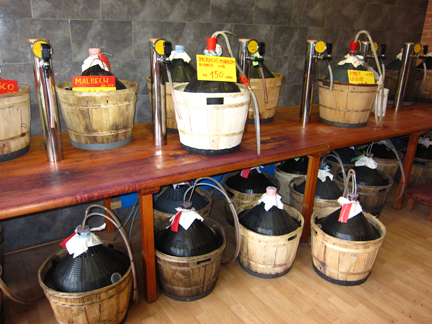
Above: A wine shop in peninsular Venice (Favaro Veneto), where Incrocio Manzoni and Malbech [sic] are sold for less than a handful of Euro per liter.

In my view, the misguided and misplaced vitriol of Natural wine advocacy in this country is due to a fundamental disconnect.

In North America, wine is a luxury product only recently embraced by consumerist hegemony. Many in the U.S. may see wine as a means to return to Nature but they rarely embrace it as a means of natural sustenance. Wine is a commodity, often a trophy, a conversation piece and “first world” amenity.

In Europe, wine is a daily nutriment and it remains imbued with ideological and spiritual meaning, at times visceral, at others intellectual. Its origins and roots (literal and figurative) touch the very heart of European society and ethos.

And while many English-language wine bloggers and writers (is there a difference or distinction between the two anymore?) have traveled to Europe and picked and stomped the grapes themselves, few touch upon the deep ideological and spiritual meaning and cultural value that European grape-growers and winemakers cherish so dearly.

Veneto winemaker Angiolino Maule makes Natural wine and stands apart as one of the Natural wine movement’s leading advocates because he believes that Natural wine can save the earth and our humanity by warding off the absolute denaturalization of our species through the inevitable, looming reification of our bodies through consumerism.

This is not stuff of marketing. It is a living, breathing, and often gasping attempt to fight what Marx called alienation or estrangement (please see my post Sensuous world: Marx, Gramsci, Pasolini, food and wine).

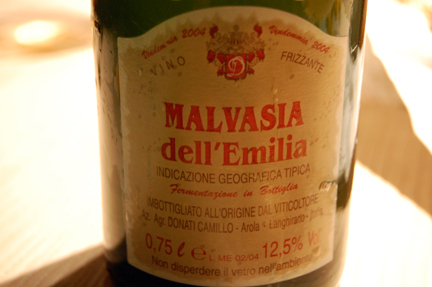
Above: The bottom line is that Natural wine helps you to shit good. Camillo Donati’s Malvasia Frizzante not only will help you take a good dump. It tastes friggin’ delicious.

The fact that it’s come to this — “vitriol,” “hissy fits,” and “denigration marketing” — is the very proof in the pudding that the English-language dialectic on Natural wine is misguided. Ultimately, the maliciousness that emerges from the English-language discourse on Natural wine is generated by commercial interests that counter the very nature of Natural wine. It’s important to note that the vitriolic exchange, btw, is unique to Anglophone vinography.

Why do Tracie P and I drink (and advocate) Natural wine? She would tell you that it’s because it aligns with the vino paesano — the country wine — that she discovered on one of her early trips to Europe after college graduation. No need to call it “natural.” To the folks who make it and drink it every day — as a nutrient, not a luxury — it’s simply wine.

Me? I drink and advocate it because it’s delicious and it helps me to shit good. Why does it make me shit good? No one really knows but it’s probably because there is still active yeast in Natural wine — a defect to some in the wine world, a miracle of nature to others.

Who doesn’t feel better after a good shit? It’s the greatest return to Nature and the best way to get the vitriol out…

An acre of Prosecco worth more than Napa (equal time for the Prosecco consortium)

Above: I took this photo a few years ago on one of the highest peaks in Cartizze, the top growing zone for Prosecco.

According to Bloomberg.com (March 7, 2010), in California’s Napa Valley, “average prices are $150,000 to $200,000 an acre for a vineyard planted with red varietals such as Cabernet Sauvignon and $115,000 an acre for white grapes such as Chardonnay… The most desirable sites in Rutherford and Oakville can fetch $250,000 an acre.”

And that was in 2010 at the peak of the financial crisis (the title of the article is “Vineyard Defaults Surge as Lost Land Values Undermine Napa Wine”).

When I visited Cartizze in April 2009 with the scion of one Prosecco’s leading and oldest families, who owns more acreage in Cartizze — the top growing zone for Prosecco — than any other, he told me that the average price of an acre in Cartizze is greater than in Napa. And frankly, he would know: his family’s holding in Cartizze is the cornerstone of its winery and the wines produced from fruit grown there are among the highest priced Prosecco bottlings on the market today.

Whether accurate or not, these factoids give you a sense of the “big business” interests that have come to dominate the cultural and topographic landscape of Conegliano-Valdobbiadene — one of the most beautiful swaths of wine country and one of my favorite places in the world because of my deep connection to the land, people, and wines of Prosecco.

In the wake of last week’s post “Prosecco, lies, and videotape: the real story behind the new wave Prosecco,” I was contacted by public relations firm representing the consortium of Conegliano Valdobbiadene Prosecco superiore DOCG growers and bottlers.

“We don’t agree with your position and we would like to explain to you why,” wrote the publcist. I wrote her back immediately and she set up a call between me and the consortium’s director, Giancarlo Vettorello (above, photo via Oggi a New York).

When we spoke the next morning, Giancarlo took issue with what I had written about the Prosecco DOCG:

    This DOCG was just one of many that were created before Common Market Organization reforms went into in 2009, shifting the power to create new designations from Rome to Brussels. It’s one of the many examples of political spoils that [then agriculture minister] Zaia lavished on his hometown…

“Does a humble wine like Prosecco — and by its very nature, Prosecco should be a humble wine — deserve to be elevated to the status of wines like Barolo and Brunello di Montalcino?” I asked paraphrasing a chorus of Italian wine writers who wrote disapprovingly of the new classification at the time (2009).

Giancarlo contended that while the origins of Prosecco may be humble, it has become one of the world’s most “recognizable wines” and is sold today in mind-boggling volume.

He also pointed out that the Centro di ricerca per la viticoltura (Center for Viticultural Research) was founded in Conegliano — Prosecco’s historic epicenter — in 1923, an innovative and ground-breaking institution and a leader in enology that predates the emergence of the sparkling wine industry in Franciacorta, Trentino, and Oltrepò Pavese. In particular, he noted, Professor Tullio De Rosa, who came to the center in 1966, developed techniques for the vinification of white and sparkling wines that reshaped Italian viticulture for the generation that followed (it’s also worth noting the pantheon of Italian wine luminaries who worked at the center, like Michele Giusti, Giovanni Dalmasso, and Luigi Manzoni).

In all fairness, he has a point. Prosecco is one of Italy’s leading brands and exports — like Campari, Perugina, Barilla, De Cecco. And in a relatively short arc of time, the architects of its success have created an interest and awareness of the brand that was unimaginable in the late 1990s when they began to market Prosecco aggressively to U.S. consumers. I think it’s safe to say that U.S. consumers are more likely to know the name of two Prosecco producers than they are to know the names of two wineries in Chianti (a brand that emerged three centuries ago).

Giancarlo was one of those architects. “I worked for fifteen years,” he said, “for the creation of the Prosecco superiore DOCG.”

Well, more power to him, I say. I was happy to share his point of view here and I appreciate that his office reached out to me.

Me? I’ll leave the Prosecco brand to the powers that be.

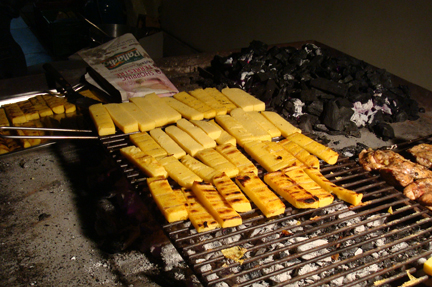
Just give me some grilled polenta, maybe some grilled sausage or bacalà, and do prosechi colfondo — two glasses of salty, crunchy, cloudy lees-aged Prosecco… one for me and one for Tracie P

Hemingway’s Valpolicella and the Quintarelli Legacy

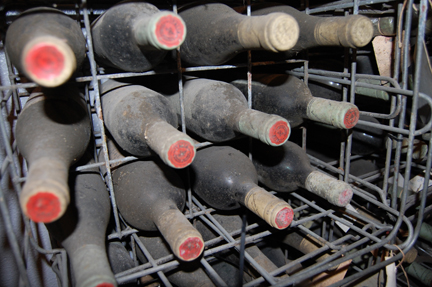
Except for the cover of Hemingway’s novel below, all the images here were captured when we tasted at the winery in January 2011.

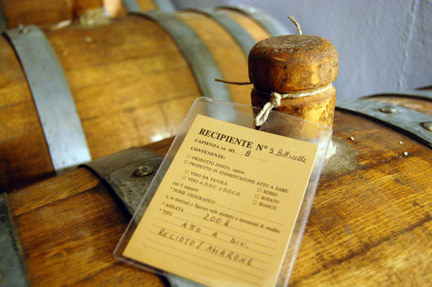
In 1949, as he lay dying (or convinced that he was about to die as the result of hunting accident) in Venice, Ernest Hemingway famously drank Valpolicella. His brush with death and his love of the wines of the Valpolicella are fictionalized in Across the River and into the Trees (Scribner 1950), a novel he thought would be his last. The main character, Colonel Cantwell (a lightly veiled autobiographical figure), always seems to have a bottle of Valpolicella at hand’s reach, even though the Colonel believes “that the Valpolicella is better when it is newer. It is not a grand vin and bottling it and putting years on it only adds sediment.”

Some 25 years later, in the landmark Vino al Vino, the great Italian wine writer Mario Soldati reluctantly called Quintarelli’s wine the “closest” to the wine that Hemingway loved, adding “I’m not saying it’s the best Valpolicella on the market” (Soldati’s preferred “artisanal” Valpolicella — yes, artisanal, that’s the term he used in 1975 — was Galtarossa).

Both texts open a window onto how Valpolicella and its wines were perceived in the post-war era — in Italy and abroad (in his 1950 review of Hemingway’s novel in The New Yorker, Alfred Kazin wrote, paraphrasing the novelist, that “Valpolicella is better poured from flasks than from bottles; it gets too dreggy in bottles”).

Giuseppe “Bepi” Quintarelli — the son of the man who made the wines that Soldati tasted — was born on March 16 19, 1927 and died yesterday at home in Negrar after succumbing to a long battle with Parkinson’s disease.* It wasn’t until the 1980s that he began to experiment in his family’s vineyards and cellar, ultimately creating some of the world’s most coveted, collected, and expensive wines.

“Bepi was a deeply religious man,” said winemaker Luca Fedrigo, 33, who spoke to me early this morning from Santa Maria di Negrar in the Valpolicella. Luca worked side-by-side with the maestro for 10 years, from age 17 to 27, from 1992 until 2002.

“All of his vacations were religious [in nature]: Rome to see pope Pius XII; Lourdes; and the Holy Land. But in the 1980s he also made a trip to Burgundy, where he discovered that the soils there were similar to the [Morainic] soils of the Valpolicella. That’s when he began to believe that we could make great wines here.”

“He was self-taught,” said Luca, “He learned early on that the priest of the village and the bishop of Verona were willing to pay well for quality wines. Priests always like the finest things in life. He was always experimenting, in the vineyard and the cellar, constantly looking for ways to make better wines.”

Leafing through the many tomes on Italian wine that inhabit our shelves at home, I discovered that Anderson (Vino, 1980) and Wasserman (Italy’s Noble Red Wines, 1985) both parsimoniously cite Quintarelli as one of the best “traditional” producers but do not give him the praise that Belfrage would later bestow in 1999 in Barolo to Valpolicella.

“One realizes in his presence,” wrote Belfrage, “as he draws samples from this barrel and that, intently studying your expression and your words as you taste and comment, that it is this attention to every detail which constitutes the difference between the great and the good in artisanal winemaking.” (Note the quasi-apologetic use of artisanal.)

Today, Quintarelli’s Amarone and Recioto, as well as half bottles of his rare white Amabile “Bandito”, command upward of $300 a bottle retail in the U.S.

In Negrar, Quintarelli was no mere artisan but rather a maestro and a patron saint and protector.

“Bepi departed with the same discretion with which he lived,” said Luca.

“He was one of the most generous persons in Valpolicella,” he recounted. “His gave generously to help children in Africa and he never hesitated to help people from the village who needed help. And he was always happy to share the secrets of his winemaking. For him, there were no secrets.”

Luca, who at Bepi’s encouragement launched his own winery some years ago and continues to make wines in the same style, was one of Bepi’s students. The other was Romano Dal Forno, considered by many the father of modern-style Valpolicella.

“Whatever the style, Bepi taught us how to reach for quality in winemaking. And as generous as he was, he could also be severe” in his criticism. “We both learned from him.”

“I think of him as the nonno dell’Amarone,” the grandfather of Amarone. “When [his daughter] Silvana called me yesterday to tell me that he had passed way, I had a long cry. I couldn’t help it,” said Luca, whose emotion was palpable over the intercontinental connection.

It’s been amazing to see the internet reaction to Quintarelli’s passing. Knowing the focus, beauty, and spiritual clarity that Bepi sought in his life on earth (and in his wines as an expression of that earth), it’s not surprising…

Prosecco, lies, and videotape: the real story behind the new wave Prosecco

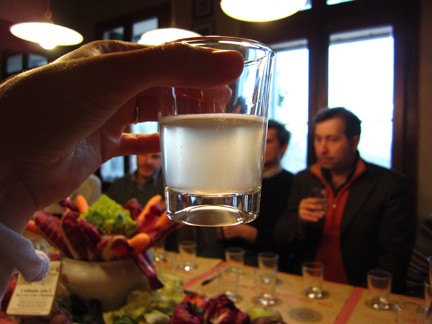
Above: Until the 1970s, before pressurized “autoclave” tanks were introduced into the appellation, most Prosecco was double-fermented in bottle “on its lees.” The resulting wine was gently sparkling, cloudy, and still had the “fondo” (sediment) in the bottom of the bottle. Even when I lived and worked in the Veneto in the 1990s, it was a lot easier to find Prosecco “col fondo” (with sediment) than it is today. The traditional glass for Prosecco is the one pictured above.

Alan Tardi is one of the great wine writers and restaurant professionals of our generation. I had the chance to meet him a few times when I lived and worked in New York and I’ve greatly appreciated and admired his work (especially this wonderful 2006 article on Asprinio).

But he gets it wrong in today’s New York Times article on Prosecco and its (relatively new) DOCG, “Prosecco Growers Act to Guard Its Pedigree.”

Maybe it was not Alan but his editor at the Dining section who hand-crafted the title (a “pedigree” for Prosecco?). But it was certainly Alan who wrote the oxymoron “sophisticated prosecco.”

The Italian wine writers scratched their head incredulously when then-agriculture minister and native of Treviso where Prosecco is made, Luca Zaia, effortlessly pushed through legislation creating the Prosecco DOCG.

Does a humble wine like Prosecco — and by its very nature, Prosecco should be a humble wine — deserve to be elevated to the status of wines like Barolo and Brunello di Montalcino? asked pundits like Italy’s top wine blogger, Franco Ziliani.

Yes, it’s true, as Alan notes, that the new DOCG (which went into effect in April 2010) gives the wines raised in Conegliano and Valdobbiadene a bureaucratic distinction that sets it apart from Prosecco grown in Friuli, Piedmont (yes, Piedmont), and Australia. But this DOCG was just one of many that were created before Common Market Organization reforms went into in 2009, shifting the power to create new designations from Rome to Brussels. It’s one of the many examples of political spoils that Zaia lavished on his hometown before his boss Berlusconi was forced out by the international community.

And yes, it’s true that the biggest names in commercial Prosecco — Adami and Ruggeri are among those that Alan tasted for the piece — are making “heirloom” vintage-dated and vineyard-designated wines, as well as low-sulfur and even lees-fermented wines.

But these products are the result of attempts by the Prosecco industrial complex to appeal to the hipster sommelier crowd.

In fact, excellent col fondo Prosecco has been produced for many years now by an ever expanding group of small growers (see this post on our col fondo tasting last year). This is the bona fide new wave of Prosecco.

Costadilà is one of those wines and has been available in the U.S. for a few years how. And Coste Piane, which has also been available here for many years, has been making and marketing true Prosecco for as long as anyone can remember. More recently, col fondo producer Bele Casel has shipped its wines to North American shores.

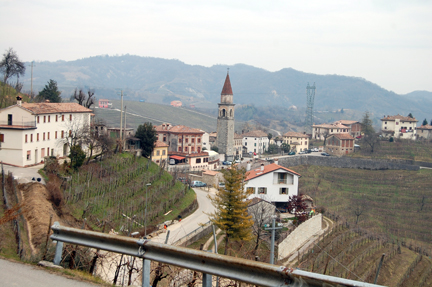
Above: The village of Rolle (not Passo Rolle, the mountain pass, btw) lies at the epicenter of the Prosecco appellation. Nearly equidistant from Conegliano and Valdobbiadene. Most locals would argue that Conegliano is where Prosecco was born as an appellation, even though Valdobbiadene has eclipsed its sister village.

And on a technical note, in Italian and Veneto dialect (including the dialect of Treviso), rive is the plural of riva, which does indeed denote hillside or slope (analogous to costa in Prosecco parlance). The rive system doesn’t denote a single growing site, as Alan implies: it denotes a series of slopes set apart for their topographical designation.

While I’m not a fan of Ruggeri, there’s nothing wrong with a glass of any of Adami’s wines. But they don’t represent real Prosecco. They are an expression of the consumerist hegemony that has choked my beloved trevigiano since the 1990s when Prosecco became a brand in the U.S.

I know I’m splitting hairs here and I remain Alan’s loyal admirer.

His oversights are harmless in the big (commercial) scheme of things and not nearly as bad as those in a Times piece this week in which Eric Pfanner ingenuously believes that a Paris wine shop owner is affected by Robert Parker’s “downgrade” of a 1998 Châteauneuf-du-Pape.

    I have no intention of second-guessing Mr. Parker, who has been tasting, and championing, the wines of Châteauneuf-du-Pape for decades. But the change in his score for the 1998 Beaucastel highlights the challenges of encapsulating something as complex, subtle and capricious as a fine wine in a single number.

The moment of truth has arrived: it’s high time that we begin questioning the wisdom of Robert Parker’s rating system! It’s enough to make you think that the editors at the Times Dining section only recently discovered bread and butter…

O, Eric the Red, where art thou? O, Solomon among wine writers!

Sexy girls and sommeliers: an Italian recipe for controversy

Anyone who has ever been to Italy (and especially anyone who’s ever watched an Italian primetime variety show) knows that sexy girls often appear there in the strangest places.
The models are called veline (a word that doesn’t come from velo or veil but rather the French vélin, akin to vellum, i.e. fine parchment obtained from calves’s skins; it was first used in its current meaning in the late 80s on the show Striscia la notizia where, by metonym, it was used to denote the models who presented cue cards, called veline in Italian editorial parlance, to the show’s stars).

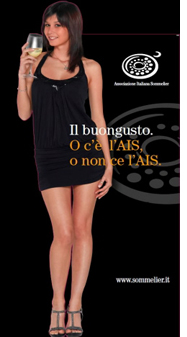
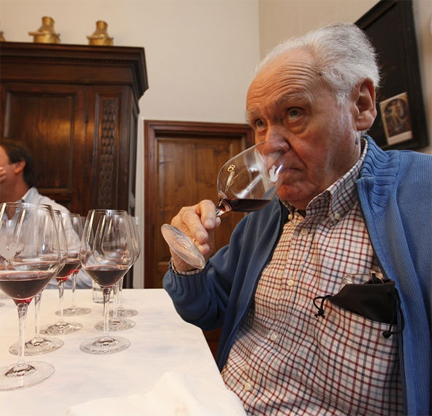
The Italian Sommelier Association’s (AIS) use of a velina (left) in one of its promotional campaigns stirred controversy late last year (December 27) when one of Italy’s top wine bloggers, Alessandro Morichetti, pointed out that the model is holding her glass incorrectly. The story was picked up on Monday of last week by Luciano Ferraro, a blogger for one of Italy’s leading newspapers, the Corriere della Sera. “The veline sommeliers have arrived,” he wrote.

Later in the day, in a post entitled “AIS, Good Taste, and Blow-Up Dolls,” Laura Rangoni, blogger for one of Italy’s leading glossy magazines, L’Espresso, wrote that she was offended by the campaign’s sexual and body-image implications, saying that she was going to cancel her membership in the body (no pun intended). The “good taste” of the association had sunk to new lows, she wrote, especially when the campaign centered around the slogan: good taste: either you have it or you don’t (playing on the assonance between the second personal singular of the verb avere, hai, and the association’s acronym AIS).

By Thursday, a spokesperson for the AIS issued a press release in which he reproached Morichetti for posting false information and Rangoni and Ferraro for alleged sloppy journalism.

It’s enough to drive you to drink!

Another AIS controversy unfolded late last year when the body ended its longstanding relationship with top Italian wine blogger Franco Ziliani, who, for more than three years, curated a recurring “WineWebNews” column for the association’s site, a monthly round up of wine blogging from Italy and around the world. It enjoyed a wide following in the Italian enoblogosphere, in part because it offered readers a view beyond Italy (Franco synopsized and translated salient quotes from English-language blogs). As southern Italian wine blogger Luciano Pignataro observed, the move came after the AIS hired ex-Gambero Rosso editor Daniele Cernilli as its head of marketing. (De gustibus non est disputandum.)

“An Aristotelian syllogism could be applicable in this case,” wrote Luciano. “Cernilli is named as director of marketing. Cernilli detests Franco Ziliani. Cernilli rubs out Franco Ziliani.”

Inspired by a tide of appeals from readers, Franco has relaunched the column on his own blog.

My goodness… It’s enough to drive you to drink… and blog…

The Saint of Sangiovese Gambelli

Yesterday, I received yet another round of remembrances of the great Giulio Gambelli (who passed away a few days ago), including one by my good friend Francesco Bonfio, president of Vinarius, the association of Italian wine shops.

    He was an exquisite, deeply humble person whose humility was rivaled only by his extraordinary knowledge of Montalcino and especially Chianti Classico. Every time I saw him at the presentations of new vintages he would whisper to me the names of two or three wines that I should taste. But he didn’t just say the name of the farm: he noted the vintage, category, and often the vineyard, specifying this one, yes and this one, no. And they were all his wines. But at the same time, being the great gentleman that he was, he would also point out wines from wineries that he had just tasted — wines, although not his own, that had piqued his interest. Honestly, I’d have to say that he was more apt to praise these than his own creations.

For all the bitter discord that inhabits Montalcino and Chianti Classic and the continuing acidic debate over the inclusion of international grape varieties in Montalcino and Chianti Classico, the hagiography of Gambelli has united the entire spectrum of Tuscan grape growers, winemakers, wine writers, and lovers.

If, in vita (in life), this man championed Sangiovese in purezza (in purity) as Tuscany’s greatest and ultimate vinous expression, let us hope that in morte (in death) his legacy will continue to inspire all of us to transcend our earthly weakness.

Sit tibi terra [tuscolana] levis Juli.

“Patiently and phlegmatically”: Giulio Gambelli, more remembrances…

Photo via Decanter.

A few more remembrances of Giulio Gambelli, whose transcendant personality galvanized a generation of Sangiovese growers, bottlers, shippers, and lovers…

From Lavinium, a passage quoted from Carlo Macchi’s hagiography of Gambelli (in Carlo’s voice; translation mine):

    A few years ago I was with Giulio at the Isvea Laboratory. A woman approached us with a printout of analysis results in one hand, a glass in the other.

    “Giulio,” she asked, “What’s the acidity [level] in this wine?”

    Giulio took a sip of the wine, spit (with his signature radial spitting technique), and then declared, “5… 5.2 at the most!”

    The girl read her results on the printout and then grumbled peevishly, “I must have done the analysis wrong!”

A heartfelt and very Tuscan tribute by friend and Montalcino great Fabrizio Bindocci:

    A highly capable man but at the same time a paragon of modesty who believed in the potential of Tuscan wines produced using only Sangiovese. He always said that winemakers are the ones who make the wines together with the land and the vine. He was a simple taster who gave his advice to winemakers on what to do in the cellar without forcing them to denaturalize their wines.

    He made his first visit to Montalcino in the early 1970s when the Consortium of Brunello di Montalcino asked him to visit all of the producers in the appellation. He drove his famous Renault 4 from winery to winery, tasted the wine from the barrel or vat, and then he would patiently and phlegmatically explain the importance of cleanliness in the cellar, precision in vinification, the importance of racking, etc. But always with the humility typical of the greats in the world of wine.

Patiently and phlegmatically… Words to live by…