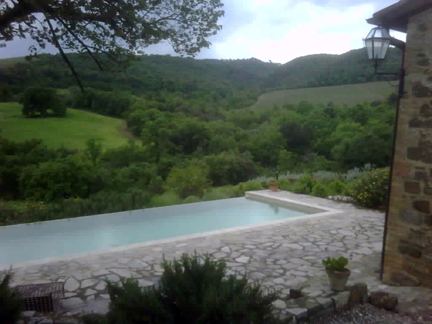
REALLY slow food at Michele and Charles Scicolone’s table

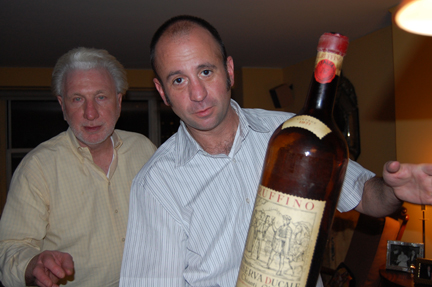
Above: Good friend Frank (not pictured) brought a 3-liter bottle of 1971 Chianti Classico by Ruffino to our “very slow” and excellent dinner the other night in the home of my long-time friends, the delightful Michele and Charles Scicolone — authors, bloggers, and legendary New York hosts. That’s me wielding the 3-liter with Charles in the background.

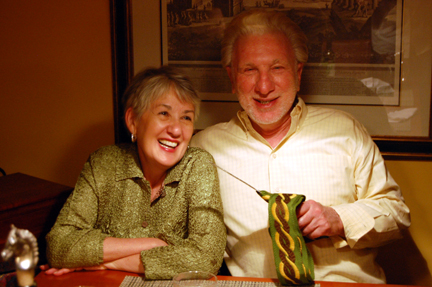
Michele and Charles Scicolone have a lot to celebrate these days.

Charles (check out his blog) was recently made a knight in the order of the Imperial Castellania di Suavia: a week ago Sunday, the “dames” of the confraternity presented him with his honorary sword and sash, in a ceremony replete with medieval pageantry and garb, at the historical Soave castle.

And New York Times best-seller author Michele (check out her blog) is basking (rightfully) in the glow of more than 50,000 copies printed of her latest book The Italian Slow Cooker (Houghton Mifflin Harcourt, 2010). (You may remember Tracie P’s post inspired by Michele’s book.)

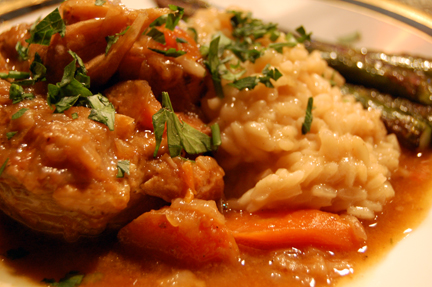
Above: On Saturday, Michele was testing recipes for her forthcoming The French Slow Cooker recipe book. Slow-cooked veal shank was served with slow-cooked risotto (and oven-roasted asparagus).

Tracie P and I had the good fortune to be invited to Michele and Charles’s home for dinner on Saturday night, where we got to sample some of the dishes that Michele is testing for the forthcoming French version of her slow-cooker success, like this chocolate cake:

Above: Yes, made with a slow-cooker!

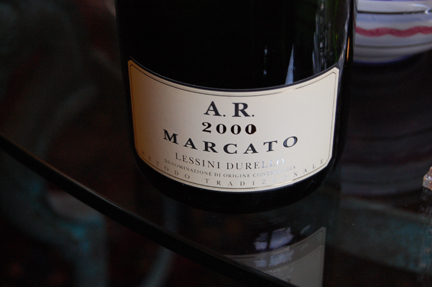
We also got to taste a champagne-method wine, a DOC from Italy I’d never seen before, a sparkling Lessini (place name) Durello (grape name).

Above: Anyone else have notes on this wine or other wines made from Durello grapes?

I was impressed by its richness, freshness, and unctuous mouthfeel, and it was a great accompaniment to Michele’s turkey, pork, and fig slow-cooker pâte. Charles had brought the wine back from his recent trip to Soave.

O, and the 1971 Chianti Classico? Old and dusty, earthy and grapey, crunchy and delicious… perfect with the veal and the ripened cheeses that followed…

Thanks so much, Michele and Charles, from both of us, Tracie P and me. Such success couldn’t have happened to more lovely people. You’ll always be the “first couple” of Italian food and wine in my book!

“Xinomavro is a punch in the face to globalisation. We don’t need Cabernet in Greece!”

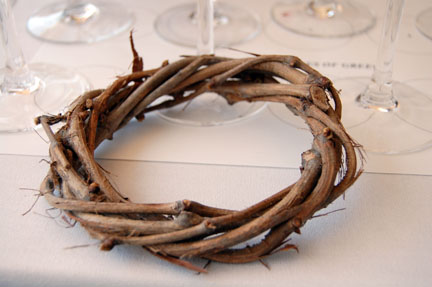
No, it’s not a crown of grape vines. It’s a sample of basket-trained vines from Santorini that was passed around at the New Wines of Greece seminar I attended this morning in New York.

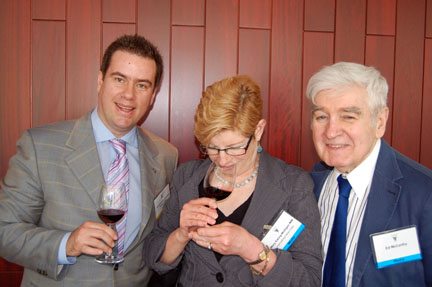
The highlight of the tasting came for me at the end of the morning seminar when Master of Wine Kostantinos Lazarkis (below, left) told the crowd of wine professionals, referring to the “diva” indigenous red grape of Greece, as he called it, “”Xinomavro is a punch in the face to globalisation. We don’t need Cabernet in Greece!”

Now, THAT’S MY KINDA LANGUAGE! If only MONTALCINO WERE LISTENING!!!

Getting to chat and taste with Kostantinos was a wonderful treat and it’s always great to taste with two of my favorite people in the wine writing world — who make ANY room feel glamorous — Master of Wine Mary Ewing-Mulligan and the inimitable Ed McCarthy (with Kostantinos, above). In the Xinomavro flight, Ed picked the two ringers blind: Nebbiolo from Piedmont and Sangiovese from Montalcino. There’s no two ways about it: the dude is a stud.

I’ve only been in New York for a morning and I’ve already tasted some amazing wines and met some amazingly interesting people. And the day is young!

Stay tuned…

Manufacturing consent (again) in Montalcino

Above: Could the results of elections in Montalcino yesterday lead to changes in appellation regulations for Brunello? For many years, the now elected advisory council member and front-runner for association president has advocated a change that would allow up to 15% of grapes other than Sangiovese (above).

The results of much-talked-about Brunello advisory council election came my way early this morning via my friend Ale’s feed. But as soon as they hit the Brunello producers association website, they were immediately blasted across the internets by observers of the Italian wine industry. I have posted the results at VinoWire together with the newly elected members’s professional affiliations (I cannot but applaud the Brunello producers association for posting the highly anticipated news promptly… for once!).

Above: Has a metaphorical hail storm crippled the sacred primacy of Sangiovese? Many, like top Italian wine blogger Mr. Franco Ziliani fear it has.

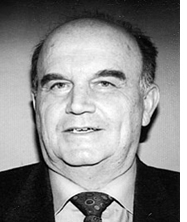
ezio rivellaMany believe that ex-director and eno-architect of behemoth Banfi, Ezio Rivella (left), will be the next president of the body (to be announced in the next three weeks).

For years, Rivella has advocated a change in appellation regulations that would allow up to 15% of grapes other than Sangiovese in Brunello di Montalcino.

In a genuine act of sixteenth-century “self fashioning,” ex-director of behemoth producer Banfi and the self-proclaimed architect of the Montalcino renaissance is about to publish an English translation of his memoir: Montalcino, Brunello, and I: the Prince of Wines’ True Story [sic and sick].

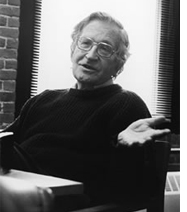
noam chomskyI’ll take the lead from my colleague Mr. Ziliani (who posted “no comment” this morning on his blog) and will leave you instead with the words of one of my linguistic and ideologic heroes, Noam Chomsky (left):

“The most effective way to restrict democracy is to transfer decision-making from the public arena to unaccountable institutions: kings and princes, priestly castes, military juntas, party dictatorships, or modern corporations.”

More Italian winery designation notes and a clarification from Banfi

declassified sagrantino

Above: I tasted Paolo Bea’s 2006 declassified Sagrantino the other night in Houston. Winemaker Giampiero Bea was not allowed to label the wine as “Sagrantino,” he told me, because the tasting committee said that the wine “lacked color” and had undergone “slight oxidation.” It was fantastic. Giampiero’s labels are among the most information and most difficult to understand for someone who doesn’t speak and/or read Italian.

This morning, I added the following terms to the May 5 post
A note on Italian winery designations: azienda, cascina, fattoria, podere, et cetera
. I thank everyone for the generous support and I hope people will continue to make suggestions/comments/clarifications etc. (special thanks to one of my favorite wine writers, Mitch Frank, for reminding me, via Facebook, about ca’ and casa!).

cantina, literally cellar or cool place to store perishable goods and by extension tavern (probably from the Italian canto meaning angle or corner from the Greek kampthos, bend or angle).

The word cantina has a wide variety of applications in Italy (often used for restaurants and food stores, as well as wineries) and can be found across Italy to denote wine cellar.

casa, literally, a building, house, or habitation (from the Latin casa, a small house, cottage, hut, cabin, shed).

The term casa is used throughout Italy as a winery designation and is often abbreviated as ca’, as in Ca’ del Bosco (it is important to note that it’s often erroneously abbreviated as [using the accent grave diacritic], when in fact the inverted comma [‘] denotes the elision of the final two letters, often derived from a dialectal locution). A casa vinicola (pronounced KAH-sah vee-NEE-koh-lah) is a winery/négociant.

vignaiolo (plural vignaioli), vine tender or grape grower (derived from the Italian vigna, meaning vine, from the Latin vinea, vineyard [from the Latin vinum, wine]).

Pronounced VEEN-y’eye-OH-loh (plural VEEN-y’eye-OH-lee), vignaiolo is used to denote a winery that uses estate-grown fruit in the production of its wines.

I’d also like to draw attention to a important clarification made, in the comment thread, by Fred and Ken Vastola.

An azienda agricola (ah-zee-EHN-dah ah-GREE-koh-lah) is a farming estate, where grapes may or may not be grown for wine production. An azienda vinicola is a winery (or wine business) where grapes are purchased from other farms for wine production. An azienda vinicola (ah-zee-EHN-dah vee-NEE-koh-lah) can also denote a business where wine is purchased and then bottled. As such, the latter designation can be used for a wide range of business models, from the artisanal to the purely commercial.

In other news…

As the world anxiously awaits the results of today’s election of the new advisory committee for the Brunello producers association, a spokesperson from Banfi wrote me yesterday asking me to make this clarification at VinoWire.

Barbaresco Pora 2001 Produttori del Barbaresco left me speechless

pora

Above: Every once in a while you open the right bottle at the right time with the right people on the right occasion. The 2001 Barbaresco Pora by Produttori del Barbaresco left me and Tracie P speechless last night.

Yesterday, on our way back from Orange, Texas (on the Louisiana border), where we visited with Tracie P’s family and celebrated most-likely-soon-to-be-family-member Clark Dean’s graduation from Sam Houston State University with home-smoked ribs and brisket (Clark’s dating cousin Katherine), we stopped in Houston for an impromptu wine tasting and spaghettata with the Levy clan and family friend Taylor Holladay.

Cousins Marty and Joanne and Neil and Dana (of the Levy clan) are so generous to me and Tracie P and have so warmly welcomed us into their lives: we wanted to do something special for them by means of a wine tasting and — by request — Tracie P’s spaghetti alla carbonara.

Five wonderful wines were opened and you can imagine which wines they were, since they often appear here at Do Bianchi (the theme was our favorite wines to drink at home). But the wine that eclipsed them all — the bottiglia signora — was the 2001 Barbaresco Pora by Produttori del Barbaresco.

pora

Above: After the tasting, the Pora was the wine that everyone wanted to drink for dinner. I just can’t begin to explain how much I love Produttori del Barbaresco — excellent price/quality ratio, honest and real wine, poop and fruit in a glass.

“Poop and fruit in a glass,” were Tracie P’s words: this nearly 10-year-old expression of old-school Nebbiolo, from one of the best vintages of our lifetime (delivered in a bottle I picked up at a close-out last year for $35!), left me (nearly) speechless (if you can imagine that!). A nearly perfect equilibrium of tannin, earth, fruit, and acidity, the right bottle, the right wine, opened with the right folks, at the very right moment.

Pora is arguably the “softest” of the Produttori del Barbaresco single-vineyard bottlings but this bottle surprised me with its impressive tannic structure, integrated nicely with the wine’s gorgeous fruit. I promise that one day soon, I’ll post my notes from tasting all of the winery’s crus with winemaker Aldo Vacca back in March.

In other news…

On Saturday, Taylor had been bamboozled by the behemoth of Texas wine retailers (and it’s not hard to guess who that is). He had visited the flagship store in Houston asking for a bottle of Produttori del Barbaresco (my recommendation) intended for his late-night date Sunday night. He was sold an under $30 blend of barriqued Cabernet Sauvignon and Sangiovese from Bolgheri (in a very “naughty” bottle, i.e., deep punt, thick glass, etc.) by a salesperson who told him, “this is very similar to Produttori del Barbaresco. If you like that, you’ll like this.” Wrong grape, wrong region, and wrong style… Tracie P and I just couldn’t send Taylor on his mission with a bottle of tricked-out Cabernet! Luckily, I had a bottle of 2004 Rosso del Veronese (a classic blend of Corvina, Molinara, and Rondinella, vinified in stainless-steel and aged in large cask) by one of Quintarelli’s protégés Luca Fedrigo, owner of L’Arco.

How did the wine work out? “Great… It got me a kiss!!”

Available at the Austin Wine Merchant, under $20 (the wine, not the kiss).

In other other news…

If you haven’t yet read Alice’s “Modern Love” column in the Times… run don’t walk!

Montalcino MADNESS! If Pirandello were a winemaker…

Above: Alfonso is on the wine trail in Italy today. He sent me this photo, taken with his blackberry, of his digs in Montalcino where he arrived this afternoon. Montalcino and the Orcia River Valley are among the most beautiful places I’ve ever been.

Life is full of infinite absurdities, which, strangely enough, do not even need to appear plausible, since they are true.
—Luigi Pirandello

Is it a enoic parable scribed by Karl Marx? Is it a dialectic on vinous hegemony by Antonio Gramsci? Are these winemaking characters searching for an author like Luigi Pirandello? Is this an engagé film made by Pietro Germi in the 1960s?

UGH! I’ve been tearing out what little hair I have left as I watch the MADNESS unfold in Montalcino from afar!!!

Yesterday, as I painfully stitched together this post on the pending election of a new administrative council and a new president of the Brunello di Montalcino producers association, I couldn’t help but think to myself that Giovanni Verga couldn’t have written it better!

Election procedures are secret and only certain candidates have revealed themselves. One presidential candidate is an aristocrat, Jacopo Biondi Santi the dashing and dandy son of traditionalist Franco Biondi Santi (the “father of Brunello”). Jacopo broke from his father and his father’s legacy many years ago only to stamp the family name on his international-style wines (from what I hear, father and son don’t speak).

One is an odious technocrat and bureaucrat, Ezio Rivella, who once produced “22 million bottles of wine a year” at the helm of Montalcino’s largest estate, according to his biography in his “order of the knights of Italian industry” bio.

Another is a lawyer, Bernardo Losappio, who represents flying enologist Carlo Ferrini (“Mr. Merlot,” as he is known locally) and Wine Spectator darling winery Casanova di Neri. Losappio wrote to Italy’s top wine blogger Mr. Franco Ziliani, assuring him that “My commitment will be focused on promotion of the appellation in all of its expressions, a broadening of media relations, preservation of Brunello’s typicity, and a rethinking of the Rosso [del Montalcino appellation].” He probably has some property in Brooklyn he wants to sell me, too.
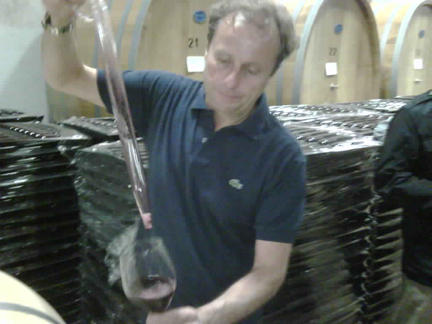
Above: Literally as I write this, Alfonso is tasting 2009 Brunello with a producer.

The backdrop for all of the above is the fact that of the 17 persons charged by authorities in the wake of the Brunello scandal (when producers were accused of adulterating their wines), 11 took plea bargains and 6 have now been indicted.

And as if it were a short story by Edmondo de Amicis, an absolutely heinous “anonymous letter” has been circulated, defaming some of the more notable candidates.

AND as if it were a novel by Giuseppe Tomasi di Lampedusa, the Piedmontese winemaker Angelo Gaja issued a statement two days ago admonishing the residents of Montalcino that tourism is the main issue they should be considering (not transparency or appellation regulation).

Reflecting on Gaja’s communiqué, another one of Italy’s top winebloggers, Antonio Tomacelli, observed: “There’s no question that tourists play their part, for goodness’s sake, but they come to shake hands with Brunello producers — a difficult operation, especially when they’re wearing handcuffs.”
There is one candidate whom I believe could really make a difference as the new president of the producers association. He’s a friend and he was born and bred in Montalcino. His wife grew up in the foothills of Mt. Amiata. He makes great wine… honest wine, true wine, and real wine. On the eve of the election, he — I believe — is Montalcino’s greatest hope.

I love Montalcino. I love Sangiovese Grosso. I love Brunello di Montalcino. It was there, more than 20 years ago now, that I first discovered my passion for wine. I remember meeting Giacomo Neri (of Casanova di Neri) in 1989. He had just finished his military service and he had just begun making wine on his father’s estate. Back then, he didn’t use Carlo Ferrini as his enologist. He just vinified the grapes grown in his families vineyards. He hadn’t yet built his state-of-the-art winery. He hadn’t yet received the top scores. His wines weren’t even available on the U.S. market. The wines were bright, light, and delicious, not opaque, dense, and woody. Back then, Brunello had yet to become a household word in the U.S.

The saga of Brunello is a Marxist parable: the socially enlightened ideals, mores, and ethos of post-war, “red state” Tuscany have been grubbed up and replaced by the insidious roots of capitalist greed. Tuesday’s election will undoubtedly determine the new trajectory of the wine, the land, the tradition, and the people. I hope that the members of the Brunello producers association will remember that that the legacy of Brunello di Montalcino belongs not only to them but also to the people of Tuscany, the people of Italy and of Europe and of the world.

I am a force of the Past.
My love lies only in tradition.
I come from the ruins, the churches,
the altarpieces, the villages
abandoned in the Appennines or foothills
of the Alps where my brothers once lived.

—Pier Paolo Pasolini

Had any good 03s from Italy lately?

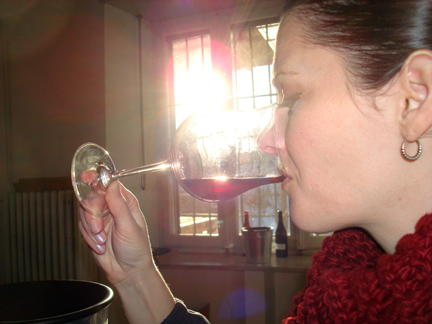
Above: Tracie P tasting at Giuseppe Mascarello with winemaker and owner Mauro Mascarello, on a crisp winter day in February 2010. We were invited to taste there with Italy’s inestimable wine blogger and wine pundit Mr. Franco Ziliani.

However lost in translation, my post on Monday led to an earthly discussion of who bottled good expressions of the 2003 vintage in Italy and a metaphysical dialectic on whether or not one should drink 2003 at all, when stellar vintages like 1999, 2001, or 2005 are within hand’s reach.

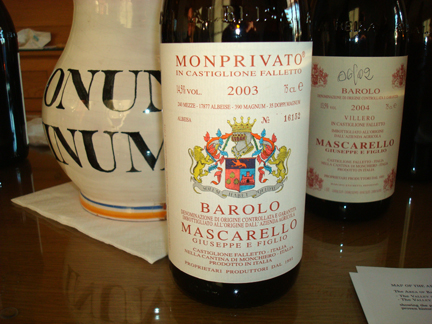
Above: Perhaps an anomaly, perhaps the child of a superior growing site and excellence in winemaking, Mauro Mascarello’s 2003 Barolo Monprivato was no fluke.

Was 2003 a forgettable vintage in Italy? Questions of taste literally aside, the wine punditry on both sides of the Atlantic has spent a lot of energy and time talking about the 2003 vintage (in part because of the controversy it stirred).

Above: Only a handful of winemakers made their top wines in 2003, but, man, what wines they were! Like this 2003 Brunello di Montalcino Paganelli by Tenuta Il Poggione (Tracie P and I tasted it over dinner with winemaker Fabrizio Bindocci in February).

Of course, 2003 was a poor vintage because of the aggressive heat that year, almost across the board throughout Europe. But that also means that many winemakers, who didn’t make their flagship wines, used their top fruit for their other wines. As Gary put it so well, “I think that 2003 presents an interesting opportunity to pick up some amazing bargains at the peak of their drinkability, but one must be very picky, and try before buy.”

I’m certainly not stocking my cellar with 03s but over the last months (and even the last few days), I have had some great 03s: like the Oddero Barolo the other night, 03 Barbaresco by Produttori del Barbaresco, 03 Barolo Monprivato by G. Mascarello, 03 Brunello di Montalcino Paganelli by Il Poggione, and 03 Barbera del Monferrato Perlydia by Valpane (the last three are all “flagship” wines, btw). While not all of these are going to cellar as well as 99, 01, and 05 (and 04 IMHO), they are by no means wines I’d turn down if someone happened to open one in my presence. In fact, they are more approachable and drinkable (as Gary points out) than their more cellar-worthy counterparts.

Have you had any good 03s lately from Italy? Please share so that I don’t have to feel so alone… ;-)

What do you serve the Pope when he visits Piedmont? Gaja of course!

I couldn’t help but marvel when I came across this story this morning in the feeds (thanks to Italy’s preeminent wine blogger Mr. Franco Ziliani).

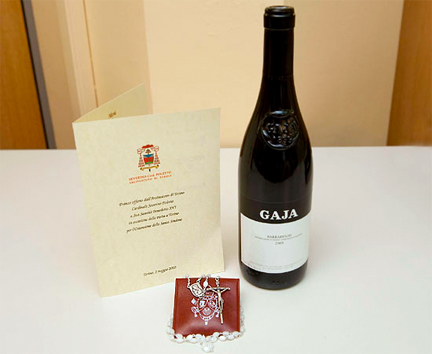
What do you serve Pope Benedict XVI when he visits Turin for the current showing of the Holy Shroud? Gaja, of course!

Actually, the Pope drank only some aranciata amara (bitter orangeade) and a glass of Moscato d’Asti. But the other 39 guests at lunch drank the Dean of the College Cardinals Cardinal Angelo Sodano’s “favorite” wines: 2007 Rossi Bass and 2005 Barbaresco by Gaja, “a limited edition of 130 bottles with a back label commemoration signed by the great Langa winemaker.”

The lunch was served at the restaurant Marco Polo, owned by the aptly named Carlo Nebiolo.

I have to confess that I am fascinated by the Papacy and I find the Holy Shroud of Turin to be one of the most intriguing “texts” of Western Civilization (more on that another time). The Shroud is on display until May 23 (check out the Shroud blog here).

In other news…

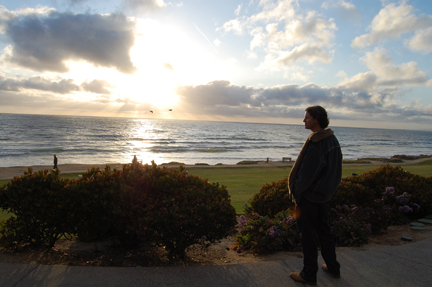
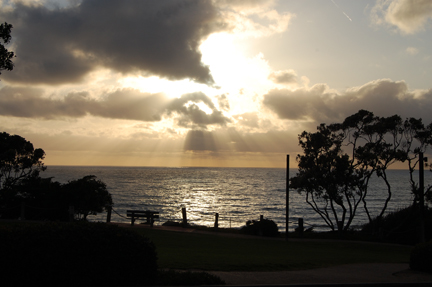
Check out these photos I snapped when I visited the beach in Del Mar, California yesterday with my buddies around sunset.

I’m just an amateur photographer but lady California is a natural beauty.

The beach at Del Mar (not far from where I grew up) is one of the most beautiful landscapes in the world IMHO.

2003 Oddero Barolo in magnum: that’s what friends are for

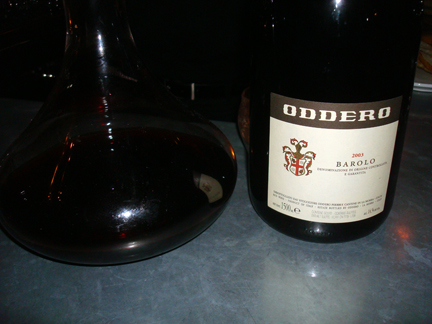
Above: Giacomo Oddero 2003 Barolo in magnum was fantastic last night.

What can I say? Being a wine blogger has its perks. My buddy John Rikkers (whom I met through wine blogging) brought in a bottle of 2003 Barolo by Giacomo Oddero (one of my favorite traditionalist producers) to drink last night at Jaynes Gastropub following the Mamma Mia! tasting at the restaurant.

NOTA BENE: Jaynes does allow corkage. For a great guide on corkage, check out Lettie Teague’s article from a few years back, “Corkage for Dummies.” It’s a great set of rules-of-thumb for bringing your own bottle.

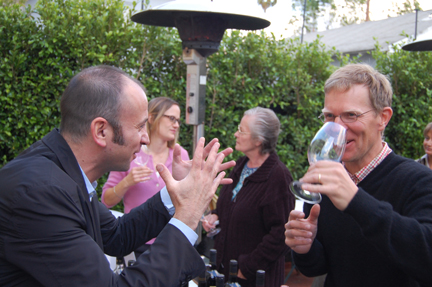
Above: John (right) and I met online through wine blogging and we always have a blast tasting together.

The 03 Oddero was simply singing last night: tar, goudron nose… earthy manure on the palate… mushroomy and elegantly tannic… Let me just go ahead and say it: cow shit in a glass and I loved it…

It’s a great example of how a lot of great wine was made in 2003, despite the challenging vintage, especially by those who take a traditional approach to Nebbiolo. It’s also a great example of how 2003 — an aggressively warm vintage — is drinking wonderfully right now. (I recently tasted 2003 Barbaresco by Produttori del Barbaresco and again, showing great right now.)

A propos wine blogging and folks I’ve met through the wine blogger community, check out this superb post by Gary Chevsky on his dinner with Mariacristina Oddero of Giacomo Oddero the other night at Donato Enoteca in Redwood, CA (a restaurant, I’m DYING to check out btw). Gary gives a great profile of the producer and the wines, definitely working checking out…

Thanks again, John. The 03 Oddero blew me away last night and was an awesome pairing for my Bangers and Mash. You R O C K!

Indictments arrive in Montalcino

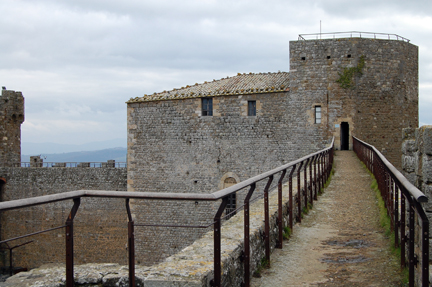
Above: A view from atop the Fortezza in Montalcino (taken in February 2010). Spring may have arrived there but skies are still dark. But bluer skies are on the horizon.

It’s been more than a week since the Italian media reported that six persons had been indicted in the Brunello controversy that gripped the appellation in 2008 and 2009. The news initially appeared in the Siena edition of national daily La Nazione but the names of those indicted were not published.

About a week ago, the names were revealed in a small article in the Florence edition of La Repubblica although they didn’t hit the mainstream feed until yesterday when Mr. Franco Ziliani broke the story on his blog.

Seventeen persons were ultimately indicted by Italian authorities for having made false statements to public officials and for having sold “adulterated” products that did not meet appellation regulations for Brunello (the wines had been allegedly with grapes not authorized for the appellation; Brunello must be made with 100% Sangiovese grapes). Of those, eleven took a plea bargain and were never officially named in the investigation. The six named in reports widely circulated today have chosen to fight the charges. Their court date is scheduled for September 17.

It’s the most unhappy form of wine writing and you can read it in English here.

The good news is that the Brunello controversy is behind us: authorities in the U.S. have lifted the requirement for Italian government certification and a string of fair-to-good-to-excellent vintages since the horrific 2002 (too rainy) and 2003 (too hot) have delivered some great wines from Montalcino — wines that most certainly deserve our attention, regardless of the style that we prefer.