Sangiovese: origins of the enonym (grape name)

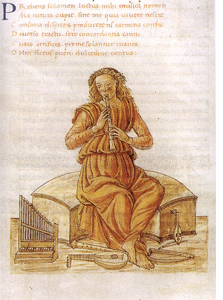
Yesterday on the Twitter, Alfonso asked me about the origins of the enonym Sangiovese. (I bet you’re wondering about the significance of the “allegory of music” from an illuminated Renaissance manuscript to the left but more on that below.)

First off, in all of my readings, I have found no one and nowhere that point to sangue di Giove (blood of Jupiter [Zeus]) as a philologically tenable origin of the grape name. This is what philologists call a folkloric etymology, most likely due to the quasi-homonymic (and Romantic) rapport between the enonym and purported etymon (the literal sense of a word according to its origin). While divine blood plays a central role in Christian myth and liturgy (another element that most likely contributes to the folkloric etymology), it is not found in the Roman or Italian cults that honored Jupiter during the vinaliae (wine festivals) of late antiquity. (For the record, blood does play a role in the myth of Zeus, when the “blood from the birth of Zeus begins to boil up” in a “sacred cave of bees… said to be found on Crete.” See this profile of Rhea, who gave birth to the deity.)

Most scholars believe the most plausible etymon to be sangiovannina, a term which denotes an early ripening grape in the dialect of Sarzana, a township that lies on the border of Liguria and Tuscany in northwestern Tuscany. (Hohnerleien-Buchinger, 1996, cited in Vitigni d’Italia, eds. A. Scienza et alia).
It’s also possible that Sangiovese comes from sangiovannese, an ethnonym denoting an inhabitant of San Giovanni Valdarno, a town in the province of Arezzo. (I actually think this is the most likely answer to the conundrum; here’s a link to the Sangiovannese soccer team website.)

Others yet point to the etymon jugalis (Latin yoke), giogo in Italian, possibly derived from a vine training system. (There is a precedent in the enonym Schiava but I believe this an unlikely linguistic kinship.)

In my research last night (conducted in the golden hour, when the day’s toil is through, and Tracie P and I relax before dinner), I came across a wonderful journal devoted to Romagnolo (the dialect of Romagna). It’s called Ludla (click to download the edition I found), or spark in Romagnolo. In it, I found an article on the origin of Sanzves, the Romagnolo inflection of Sangiovese. Here’s where it gets really interesting…

It’s important to remember that the enonym appears for the first time in Tuscany in the 16th century as Sangiogheto (Soderini, 1590) and today, most ampelographers concur that Sangiovgheto or Sangioveto are geographically aligned with Tuscany while Sangiovese is more closely related to Romagna (on the other side of the Apennines).

The author of the Ludla article proposes that Sanzves might be derived (however remotely) from Mons Jovis, a site near the town of Savignano (where the Romagnoli believe the grape to have originated, another possible linguistic kinship), today known as Giovedìa, where Jupiter (Giove, in Italian) was worshiped in late antiquity.

The bottom line? It’s very likely that we will never know the true origin of the enonym. But that’s not important.

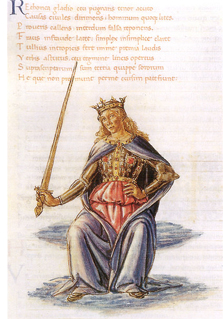
The images that adorn this post (allegories of musica and rehtorica) are culled from a Renaissance codex of De Nuptiis Philologiae et Mercurii (On the Marriage of Philology and Mercury) by Martianus Capella, a pagan writer of late antiquity whose work formed the basis for the study of the liberal arts in western civilization. Philology is literally the love of words and Mercury is the mythical embodiment of commerce or intelligent pursuit.

While we may never know the etymon of the enonym, the journey of discovery by the way offers rewards all the more satisfying to our intellectual curiosity, emboldening our knowledge and awareness of the world around us.

When we marry the love of words and intelligent pursuit, only good things are bound to happen. The same thing happens when we pair a great bottle of Brunello with a bistecca alla fiorentina (something I hope to do later this week).

Thanks for reading…
Eataly and Vinitaly in New York

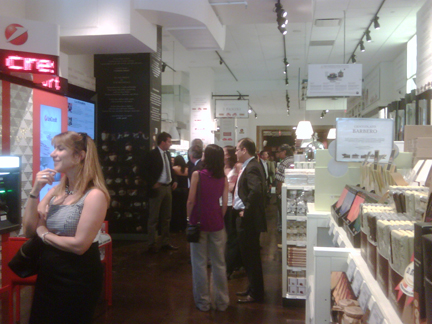
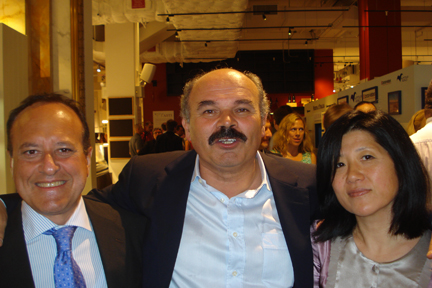
Above: Giovanni Mantovani (CEO VeronaFiere and Vinitaly), Oscar Farinetti (Italian retail, food, and wine tycoon, creator of Eataly), and Stevie Kim (senior adviser to Mr. Mantovani) yesterday at the opening of Bastianchi-Batali-Farinetti brainchild Eataly in New York.

Yesterday, mere moments after Mr. Franco Ziliani and I posted about the Italian agricultural minister’s claim that there is no crisis in the Italian wine industry, I spoke to Stevie Kim (above, right), senior adviser to Vinitaly’s CEO. She and her boss were attending the opening of the latest conquest in the ever-expanding Batali-Bastianich empire, Eataly, the “über-supermarket” conceived by retail tycoon Oscar Farinetti.

“As you know,” said Stevie, “production of Italian wines has increased dramatically in recent years and the Italian market is saturated. And so the international market has become more important for all producers.”

The Italian government, she told me, has asked her and her boss to “revamp” the Vinitaly road show, which has been coming to the U.S. for a decade (fyi Vinitaly is the top Italian wine industry annual trade fair, held each year in Verona in April). They plan to reconfigure the tasting this year, to be held at Eataly New York October 25, to accommodate trade and consumers.

“In the past, the presentation has been very fragmented. This year, we plan to restyle the tasting by transforming Eataly [New York] into Vinitaly,” said Stevie, who speaks impeccable Italian and has lived in Italy for more than 20 years. 50 producers will be attending this year’s road show, the maximum number Eataly New York can accommodate.

To Stevie I say, in bocca al lupo…

I’m not sure how I feel about Eataly (photo by Stevie). It seems to make more sense in New York than it does in Turin, where it started. It’s a sort of Disneyland for Italian food: a hyper-realistic food court, a recreation of an Italian food and wine street shopping scene. Surprisingly, in Piedmont, where “Italian food” is known simply as “food,” Eataly has been well received. At least, that’s my impression from talking to the Piedmontese. I’ve never visited Eataly, although Tracie P and I stopped once at the Eataly satellite on the road that leads from Alessandria to Asti.

There are Eataly franchises in Turin, Asti, Bologna, Milan, Tokyo, and now New York. Future expansion includes Genoa and Rome. Eataly enjoys the support of the SlowFood movement and its founder Carlo Petrini (however much the organization’s ethos would otherwise opposed globalization).

One thing you can say for certain about Eataly’s creator Mr. Farinetti: he’s no farniente!

Life after barrique: “I started to love my wines again”

Here’s what winemaker Gianpaolo Paglia (below) had to say about my post on his decision not to age his wines in barriques anymore.

Thank you very much Jeremy for translating part of Ziliani’s post on my decision. I’m very glad to see that this has stirred an interesting conversation on Italian blogs about the current state of the art of Italian wines and their future. I think that we are now in the position to devote our efforts to a better knowledge of our land, our vineyards, our techniques of production, or in other words, our terroir. For the last decade I’ve been on a learning curve, of which barriques and a certain style of wine were part, now I feel I have to move further to find the true expression of my land in my wines.

It’s going to take time, because nothing is fast when it comes to agriculture, but I’m sure I’m on the right path. How do I know it? Simply because I started to love my wines again.

Basta barriques: a conversion of Constantine?

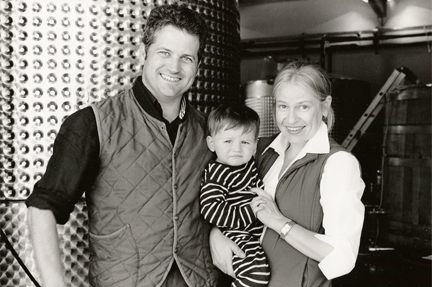
Earlier this month, Maremma producer of Morellino di Scansano and Syrah Gianpaolo Paglia (above, winemaker and owner of Poggio Argentiera, with his family) authored a short post on his blog entitled simply Basta barrqiues, enough with barriques.

In the post he informs his readers that he no longer intends to age his Sangiovese and Ciliegiolo in barriques, small new oak French barrels.

He explains: “In the last 10-15 years, the world of wine has changed. And, above all, my (and our) tastes have changed. This is no disavowal of the past, no repudiation. It’s very simple: one evolves, as a person and as a company.” (translation mine)

Yesterday, Italian wine blogger extraordinaire Mr. Franco Ziliani, who has long exhorted a more moderate use of barrique aging among Italian winemakers, posted an interview with Giampaolo.

Here are a few passages I found interesting and have translated from Gianpaolo’s answers:

    In certain wines produced with barriques, there is an excessive sweetness. However much this can be viewed in positive light, I find that it tires the palates. Complexity and nuance tend to be lost, trumped by a certain creaminess in the taste of the wine. Generally, I believe that it is more difficult draw out the character of grapes like Sangiovese and Ciliegiolo, where a certain angularity and backbone form the basis of their identity. And then there’s also the drinkability factor: I’m tired of drinking overly invasive wines.

    I can tell you that making wines that will be enjoyed by people who make wine makes much more commercial sense than trying to interpret the tastes of the market. My impression is that we tend not to fully appreciate people who buy wines and drink them. This is probably due partly to a lack of awareness and partly — and perhaps mostly — due to our lack of courage.

    There are wines that seem excellent to us but we consider them “difficult” for the market. But, then again, we discover that the market is very open to good wines, real wines, expressive wines. I see this every day, especially since I began to sell wines beyond the wines I produce.

I’m excited to taste the new vintages of Poggio Argentiera and I really admire Gianpaolo for the honesty and forthrightness of his blog and his words (he is, btw, probably the top Italian winemaker/blogger and his use of social media as a tool to promote his wines is world-class).

One of the most vocal opponents of barrique aging of Sangiovese I know is my friend Charles Scicolone, who began drinking Nebbiolo and Sangiovese in the 1970s. “They’ll crucify me on a cross made of barrique,” he likes to say humorously.

It’s too early to tell but could Gianpaolo’s declaration be an early sign of a conversion of Constantine? Let’s hope so… Chapeau bas, Gianpaolo!

In other good news…

It seems that Mr. Ziliani has returned from his blogging hiatus.

The story behind Nascetta (and Anascetta)

Romeo, doff thy name!

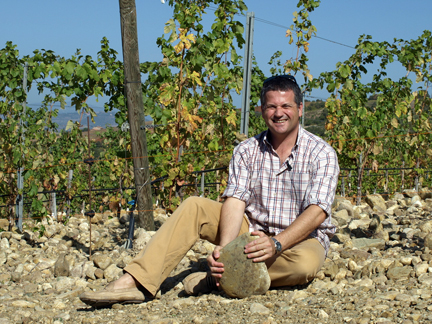
Above: Valter Fissore of Elvio Cogno (Novello) single-handedly delivered the Nascetta grape from oblivion after he tasted a wine made using this once highly praised grape in 1991. The wine had been bottled in 1986.

It’s regrettable that when I tasted the Nascetta grape for the first time last year, it was served to me ice cold and was described as a “light-bodied white wine.”

While in Piedmont in March of this year, I happily learned that Nascetta is actually a noble white grape variety that can produce long-lived, structured wines. And I had the great fortune to taste Valter Fissore’s excellent 2001 bottling — a nearly decade-old expression of this grape. In my notes, I wrote “rosemary, sage, petrol,” and was blown away by the structure of the wine, its lively acidity, and most of all its gorgeous, unctuous mouthfeel.

Yesterday, in a wonderful post on drinking the last extant bottling of a vintage, Cory nudged me to fulfill a promise to explore the origins of the name. And so here it is.

First of all, a little history.

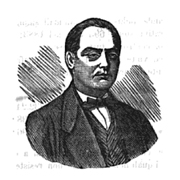
The name Nascetta was coined by 19th-century Piedmontese enologist Giovanni Gagna (left, 1833-1881), who believed erroneously that the grape was related to the Sardinian grape Nasco (from the Sardinian nuscu, from the Latin muscus, meaning moss). Remember: for the better part of the 18th and 19th centuries, Sardinia, Nice, Savoy, and Piedmont were ruled by the House of Savoy (the Kingdom of Sardinia), with its court in Turin and so commerce between Sardinia and Piedmont was fluid during that period.

In 1877, Count Giovanni di Rovasenda listed the grape using its dialectal name, Anascetta, in his landmark Saggio di una ampelografia universale (Essay on Universal Ampelography). The fact that he uses the dialectal inflection of Gagna’s name for the grape is an indication of how popular the grape was in Piedmont at that time, when it was commonly blended with Favorita (Vermentino) and Moscato. (In Piedmontese dialect, an initial a is added to certain words to compensate for syncopated, i.e., lost vowels; in this case, the acquisition of the initial a would appear hypercorrective, a phenomenon not uncommon in the morphology of Piedmontese.)

Here’s where it gets a little complicated.

Above: The confusion regarding the name of this grape was created in part by Valter’s frustration with labeling requirements. In 2001, he bottled the wine as a non-vintage vino da tavola (table wine) because the grape was not yet authorized for the Langhe Bianco DOC appellation.

Let’s start with some chronology:

1991 – Valter tastes a bottling of 1986 by farmer Francesco Marengo (Novello).
1994 – Valter produces 800 bottles from his own planting of the grape, labeled as Nas-cetta; following this vintage, Valter is forced to stop labeling the wine as Nas-cetta after he is fined for listing an unauthorized grape variety name on the label.
2000 – Nascetta (the grape) is added to the catalog of authorized grape varieties for Langhe.
2004 – Valter bottles the wine as Langhe Bianco DOC but cannot list the grape variety on the label; he labels the wine “Anas-cëtta” using a “fantasy” name because the grape is not authorized for the Langhe Bianco DOC labeling (it’s authorized for the blend but not the label).
2010 – After Valter’s successful lobbying, the 2010 vintage will be first labeled as Langhe Nascetta [sic] DOC.

Above: Valter’s Nascetta is an excellent value for a structured, age-worthy white. Be sure to serve it at cellar or room temperature.

When I asked Valter directly about his use of diacritics (in this case the umlaut and the hyphen), he told me flatly that he introduced them in the labeling for purely proprietary reasons. The mutation of the grape names Nascetta and Anascetta was inspired by his frustration with labeling requirements. The good news is that the confusion has been resolved and this noble white grape will be labeled as “Langhe Nascetta DOC” beginning with the 2010 vintage.

While in Piedmont in March, I also tasted another excellent bottling of Nascetta by Rivetto.

Be sure to read Cory’s post on the last bottle of 2001 and Whitney’s post, too.

… O, be some other name!
What’s in a name? that which we call a rose
By any other name would smell as sweet;
So Romeo would, were he not Romeo call’d,
Retain that dear perfection which he owes
Without that title. Romeo, doff thy name,
And for that name which is no part of thee
Take all myself.

Italy meets California circa 1982 (by Burton Anderson, Wine Spectator)

Source: Alfonso Cevola. Check out his truly stunning post on tasting Sangiovese in Tuscany in the 1970s, Our Sangiovese.

The above image of Ezio Rivella (now president of the Brunello producers association) has been culled from the December 1-15, 1982 issue of the Wine Spectator. The article, filed from Florence, was written by Burton Anderson and is entitled “Italian vintners look to Cabernet, Chardonnay for future wine styles; results mixed so far.”

“We’re deliberately adopting a California style because our main market is the United States and also because the technology is more suitable,” Rivella, then director of Banfi, told Anderson. “But we have an advantage. Conditions in our hill vineyards are not only better than in Napa or Sonoma, they’re the best I know of anywhere. We plan to fully exploit this advantage in our wines, which will be aged in barriques of split French oak.”

A picture’s worth a thousand words, isn’t it?

In other [Brunello] news…

Who knew that Gianfranco Soldera was a natural winemaker? Read what he had to say in an interview published last week, translated and posted by Mr. Franco Ziliani and me at VinoWire.

Sophie’s Choice: 06 Produttori del Barbaresco

This wine may be my favorite bottling yet, but not for the reason you think…

barbaresco

Above: Summertime isn’t exactly ideal for Nebbiolo but, after so much talk of this wine, I couldn’t resist opening a bottle of 2006 Barbaresco by Produttori del Barbaresco last night. Can you blame me? Dinner last night chez Parzen was cannellini dressed with extra-virgin olive oil, salt, pepper, and a kiss of red wine vinegar, wilted spinach and boiled potatoes also dressed with evoo, and some fresh feta.

Between Bruno Giacosa’s controversial decision not to bottle his 2006 vintage in Barolo and Barbaresco and Produttori del Barbaresco’s much misunderstood decision not to bottle its 2006 single-vineyard designated wines, the 2006 vintage may very well be one of the most talked-about vintages in Langa in recent years.

Let’s get one thing straight: most folks agree that 2006 was a classic, solid vintage, with a relatively balanced growing season (if not for rains in September). It wasn’t GREAT (in all caps) but it was good to very good. And while Giacosa’s decision appears outwardly based on the personal setbacks Bruno suffered that year, the decisions by Giacosa and Produttori del Barbaresco were probably based on economic reasoning: in a tough market, it’s easier to sell a more reasonably priced wine. In fact, Aldo Vacca (winemaker at Produttori del Barbaresco) said as much in a comment he left on Do Bianchi.

I tasted the 06 for the first time in New York in the spring: it was a ringer in one of the blind Greek tastings. But last night, after reading one too many blog posts about the 2006 Produttori del Barbaresco (which is now in the market), the mimetic desire kicked in and I caved and opened a bottle.

While I continue to kick myself for not cellaring more 2004 (especially) and 2005, my negligence has been rewarded by this amazing bottle of wine, which is a cuvée of all the Produttori del Barbareso crus.

barbaresco

Above: I tasted all of the 2005 single-vineyard (cru) designated wines in March at the winery with Aldo. I’ll post my notes on these, which have also just hit the market, next week.

I have always been a bigger fan of the cuvée, i.e., the classic Barbaresco blended mostly from the Ovello cru, with smaller amounts of other crus depending on the vintage. But the 2006 classic blended Barbaresco is something truly special.

Antonio Galloni, one of the top 3 palates for Nebbiolo in the world IMHO, was a fan of the otherwise “average” vintage when he tasted the first bottling of the 06 (before the decision was made not to bottle the crus): “If the regular Barbaresco holds this much power,” he wrote, “I can only wonder what the Riservas might have in store. Simply put, this is a marvelous effort.”

The wine we tasted last night was fantastic, with all the earth and all the red fruit I dream for, extremely powerful and rich, more so than other classic vintages like the winery’s 99, 01, 04, and 05.

My only misgiving about this wine is that it’s one of the few instances where I will tell you to let it age in your cellar for a few years before approaching it. I believe that with the addition of grapes from crus like Montestefano and Montefico (the most tannic), the wine has a tannic power that will only reward the patient collector.

It’s not that this wine is “better” because “better” fruit went into it, as many sales people are however earnestly but erroneously saying. The crus are not “better.” They are just different among one another.

What’s special about this wine is how it shows that terroir is also about people and where and how they decide to grow and raise things. This wine is a true collector’s item from Produttori del Barbaresco: it’s an anomaly, a rare occasion where Aldo had a better vintage than many, but decided not to bottle single-vineyard wines.

In some ways, this wine is the best bottling of my enosentient lifetime. Keep in mind that the cru system began in the late 1960s (and 1967, the year of my birth, to be exact), when Gaja, Vietti, and Produttori del Barbaresco were inspired by the French cru system to bottle single-vineyard designated wines. Ultimately, whether it’s Aldo’s cru vs. cuvée or Vajra’s Barolo Bricco delle Viole vs. Barolo Albe, or even Gaja’s Sorì-designated wines vs. its Barbaresco (to use three different stylistic examples), I always find that it’s the classic, blended wines (like Bartolo Mascarello, who has never made a cru) that keep calling me back. They don’t express a growing site: they express a vintage, an appellation, and a way of life.

So in a way, the 2006 Barbaresco by Produttori del Barbaresco is the financial crisis’s little gift to us: a wine that harks back to an era before the advent of Barbaresco’s Francophilia.

In essence, for survival’s sake (and the sake of all those who depend on him), winemaker Aldo had to make a “Sophie’s choice.” I’m glad that he chose well.

The Summer Winter of Our Disconnect: 12.5% Cabernet? And other good stuff we ate and drank in California

chino farms

Above: Both my buddy John Rikkers and I ordered the “Market Salad” at Market in Rancho Santa Fe. It’s no longer on the menu but they’ll make it for you on request. All the lightly blanched ingredients are sourced from San Diego’s legendary Chino Farms farmers market.

Everywhere you go in California, people are complaining about the cool summer weather. By most accounts, it’s the coolest summer we’ve had here for more than 70 years.

On Sunday, Vinogirl (who authors my all-time favorite California wine blog, Vinsanity) didn’t mince words: “Actually, I am very surprised that [veraison, i.e., ripening] is happening at all as it only managed a whopping high of 70F today,” she wrote plaintfully. “So far, the weather in 2010 has been pathetic!”

mea culpa

Above: I’d never had the Bouvier grape, known as Ranina in Slovenia, until last night at Market, where sommelier Brian Donegan always has something by the glass that will surprise and delight the adventurous wine lover, like this 2007 Mea Culpa by Kogl. I would have guessed it was a dry Muscat but it had some gentle orchard fruit notes seemed to speak a Slavic as opposed to Romance language.

Yesterday, in a fantastic post, one of America’s wine industry social media pioneers Tom Wark (and all-around nice dude) wrote and asked rhetorically, is this a bad thing?

    If this weather keeps up, it’s entirely likely that some winemakers are going to have to learn how to make good Napa or Sonoma Cabernet with an alcohol content of (brace yourself)…12.5%. […]

    Clearly 2010 is looking to be a better vintage for early ripening grapes like Pinot Noir. But even the Pinots are likely to suffer a diminishing alcohol content. The question is this: is that a bad thing? I think it might be for many winemakers, particularly those that tend to produce big, fat, huge unctuous Pinots with high alcohol content.

ettore germano

Above: The acidity in Ettore Germano’s Chardonnay was, as Tracie P likes to say, “tongue-splitting.” It’s not like me to order Chardonnay from Italy (outside of Friuli) but I must say that I dug this wine completely. Very mineral, very bright acidity. Always something good by the glass at Market.

Of course, the mystery of California’s unusually cool summer begs the question among its “red state” populace: with summer temperatures like these, how can the pinkos still cling to their claims of global warming?

seaweed salad

Above: Seaweed salad at Zenbu in La Jolla.

I’m sure I imagine that Tom would agree with me: anyone who works in the wine industry and spends times with grape growers will tell you that European winemakers — even the most conservative among them — believe that global warming is indeed taking place. In Tuscany, where the grapes used to ripen in October, grape growers will tell you that they now ripen as early as late August (although this year, at least in Sant’Angelo, grapes are ripening about a week behind schedule).

California roll

Above: One of the thing I love about Zenbu is the playful California creativity in the menu, with items like the “Jackie Chan” roll and the “Mexicali” roll. That’s the gorgeous sashimi roll (a contradiction in terms?). There’s nothing worse than boring sushi!

Once, when I interviewed a famous winemaker in Piedmont for a commercial writing gig of mine, he unabashedly told me, referring to the remarkable string of great vintages in Piedmont spanning 1996-2001, “global warming has made me a very rich man.”

Above: French Toast at Jaynes Gastropub in North Park (San Diego).

To those who claim and believe global warming is part of a secret left-wing conspiracy, I say: who cares whether it’s true or not? At 43 years of age, I’m old enough to remember the first “energy crisis” in the 70s: whether or not you believe in global warming, there’s no denying that it’s high-time to “clean up our act.”

bellyup tavern

Above: My childhood and a best friend Charlie George created this “White Trash” gift basket raffle item for a benefit for local musician Michael Muldoon last night at the Belly Up Tavern in Solana Beach, where Charlie and a bunch of other friends of mine performed.

So whether (weather) you’re sweating your nuts off in the rest of the country, wearing a sweater in Sonoma, or getting ready to pick grapes in Tuscany, don’t forget to turn off the lights! And be sure to eat your California leafy greens…

Thanks for reading!

Eating our way through California

california tomatoes

Above: Top Italian wine writer Mr. Franco Ziliani (possessor of a palate I admire immensely) likes to tease me (rightly) about how I’m so crazy for the wines of Piedmont, I’ll even drink Barolo in the middle of the “scorching hot” Texas summer (and believe me, it’s been a hot one in Texas this year!). Well, yesterday I quit the California dreaming and did me some serious California eating! Those are tomatoes from Chrissa and Dan’s garden.

grilled marlin

Grilled marlin, scallops, and shrimp for lunch with client and new friend Mike K at the classic ol’ San Diego downtown eatery Dobson’s. (Thanks again for lunch, man!)

baker and olive

Savory San Diego Bread and Cie bun with locally sourced olive oil from Baker and Olive, and Fra’ Mani salame at epicurean Chrissa and Dan’s place (a truly yummy locus amoenus their house is!).

california produce

Dan’s excellent heirloom tomato salad, sourced from their garden (what’s the name of the Polish cultivar?).

california sushi

Late-night sushi at Miso Harney sushi in Old Town (they serve until 12 a.m.!) after Tracie P got in from Austin (I got in the day before). Geared for a young crowd, Miso Harney is a great place for later-in-the-night super fresh San Diego sushi and an SD-restaurant-industry fav.

california traffic

Of course, there’s also the California summer traffic to contend with. Ugh… Not so bad though, considering the view!

I bet you’re gonna like where we’re headed today… Stay tuned… It’s a special one…

Rivella, barbarian at the gate: the Brunello debate goes mainstream (WARNING: POST CONTAINS POETRY)

Above: The grapes are ripening about a week late in Montalcino but conditions are excellent, says Alessandro Bindocci (Fabrizio Bindocci’s son) in his blog Montalcino Report. Alessandro has been updating the blog regularly with harvest and weather reports.

Yesterday a friend emailed me this article in Reuters online, “Battle of Brunello exposes row over purity vs blends,” by top wine writer Robert Whitley, my fellow San Diegan. In it he summarized the events that led up to Ezio Rivella’s controversial election as Brunello producers association president and Fabrizio Bindocci’s passionate if unsuccessful bid to stop Rivella’s march of progress. (For a more detailed account of what happened in recent months in Montalcino, you can scroll and leaf through this thread here at Do Bianchi.)

    The controversy over the election has put the spotlight on growing divisions in the wine world as some producers take a more global approach to their craft while others stick to tradition.

    Opponents such as Bindocci are passionate defenders of the status quo and are convinced that the 77-year-old Rivella as the modern face of Brunello could put the soul of Brunello at stake.

Has Montalcino become the frontline in the global battle (“growing divisions of the wine world”) of modernism vs. traditionalism?

In a “why didn’t I think of that” moment, I thoroughly enjoyed Robert’s superb allusion to the great poem “Waiting for the Barbarians” by Greek poet Cavafy wherein he implied that Rivella is a “barbarian at the gate.” It’s probably more a propos than Robert bargained for, especially in the light of the uncanny parallels. Poetry lovers read on…

    What are we waiting for, assembled in the forum?

    The barbarians are due here today.

    Why isn’t anything happening in the senate?
    Why do the senators sit there without legislating?

    Because the barbarians are coming today.
    What laws can the senators make now?
    Once the barbarians are here, they’ll do the legislating.

    Why did our emperor get up so early,
    and why is he sitting at the city’s main gate
    on his throne, in state, wearing the crown?

    Because the barbarians are coming today
    and the emperor is waiting to receive their leader.
    He has even prepared a scroll to give him,
    replete with titles, with imposing names.

    Why have our two consuls and praetors come out today
    wearing their embroidered, their scarlet togas?
    Why have they put on bracelets with so many amethysts,
    and rings sparkling with magnificent emeralds?
    Why are they carrying elegant canes
    beautifully worked in silver and gold?

    Because the barbarians are coming today
    and things like that dazzle the barbarians.

    Why don’t our distinguished orators come forward as usual
    to make their speeches, say what they have to say?

    Because the barbarians are coming today
    and they’re bored by rhetoric and public speaking.

    Why this sudden restlessness, this confusion?
    (How serious people’s faces have become.)
    Why are the streets and squares emptying so rapidly,
    everyone going home so lost in thought?

    Because night has fallen and the barbarians have not come.
    And some who have just returned from the border say
    there are no barbarians any longer.

    And now, what’s going to happen to us without barbarians?
    They were, those people, a kind of solution.

And some who have just returned from the border say/there are no barbarians any longer.

I’ll be visiting Montalcino in September and will try to catch up with Fabrizio (a friend) then (although I know he’ll be very busy with the harvest). Who knows? Maybe Rivella will grant me an appointment, too… Stay tuned and thanks for reading!