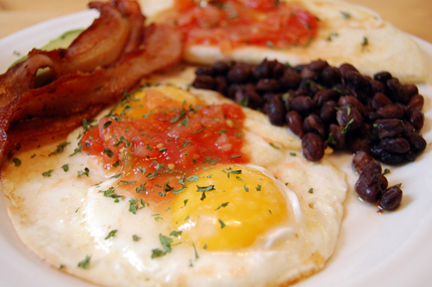
I had fun this morning with my Houston Press post, writing about my favorite breakfast — my take on California-style huevos rancheros — and wine for breakfast (in this case, Moscato d’Asti). Here’s the link…
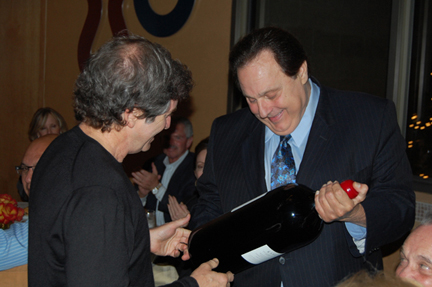
And, hey, it’s a tough job but someone’s got to do it… Here are a few recent posts I did for my friend Tony (above with screenwriter and winemaker Robert Kamen): an interview with Maximilian Riedel (where he discusses the art of decanting Champagne) and notes from the Kamen dinner at Tony’s this weekend.
Who’d have ever thought that you could make a living as a wine blogger?
Yesterday I called one of my favorite Campania producers, Paola Mustilli, and asked her if she’d contribute a few videos. Thanks, again, Paola, for the videos! They’re awesome!
Her Coda di Volpe entry is just the first in a series of Campania grape names she sent me and I decided to post it as the first because I’m still thinking about Coda di Volpe after reading Fringe Wine’s excellent post on the variety.
There’ll be others to come before the Christmas holiday. So please stay tuned and thanks again for speaking Italian grapes!
Tracie P and I won’t be heading to Orange, Texas for Thanksgiving this year because we’re about 5 weeks away from our due date! We’ll miss Thanksgiving with Mrs. and Rev. B but I made sure that they have some good wines for their holiday meal. Back here in Austin, this is what we’ll be drinking…
Earlier this year, when my friend, publisher, and wine industry insider Maurizio Gily suggested that we visit the village of Carema before heading to the European Wine Bloggers Conference, it was hard to contain my excitement. As a devout lover of Nebbiolo, I have sought out and drunk Carema whenever and wherever I could: known for its intensely tannic nature, the bottlings of 100% Nebbiolo grown in the hillsides of this pre-alpine village, with its morainic mountains that pop up in the landscape with a beautiful violence as you drive north from the freeway (moraine: “A mound, ridge, or other feature consisting of debris that has been carried and deposited by a glacier or ice sheet, usually at its sides or extremity; the till or similar material forming such a deposit.”—Oxford English Dictionary)
Before we headed to the Cantina dei Produttori Nebbiolo di Carema vinification facility and tasting room in the middle of the village, Maurizio, his colleague Monica, and Italian wine marketer Wineup and I hiked the trail that leads from the town up through the pergola-trained vineyards — yes, pergola-trained! (Check out Wineup’s excellent photos here.)
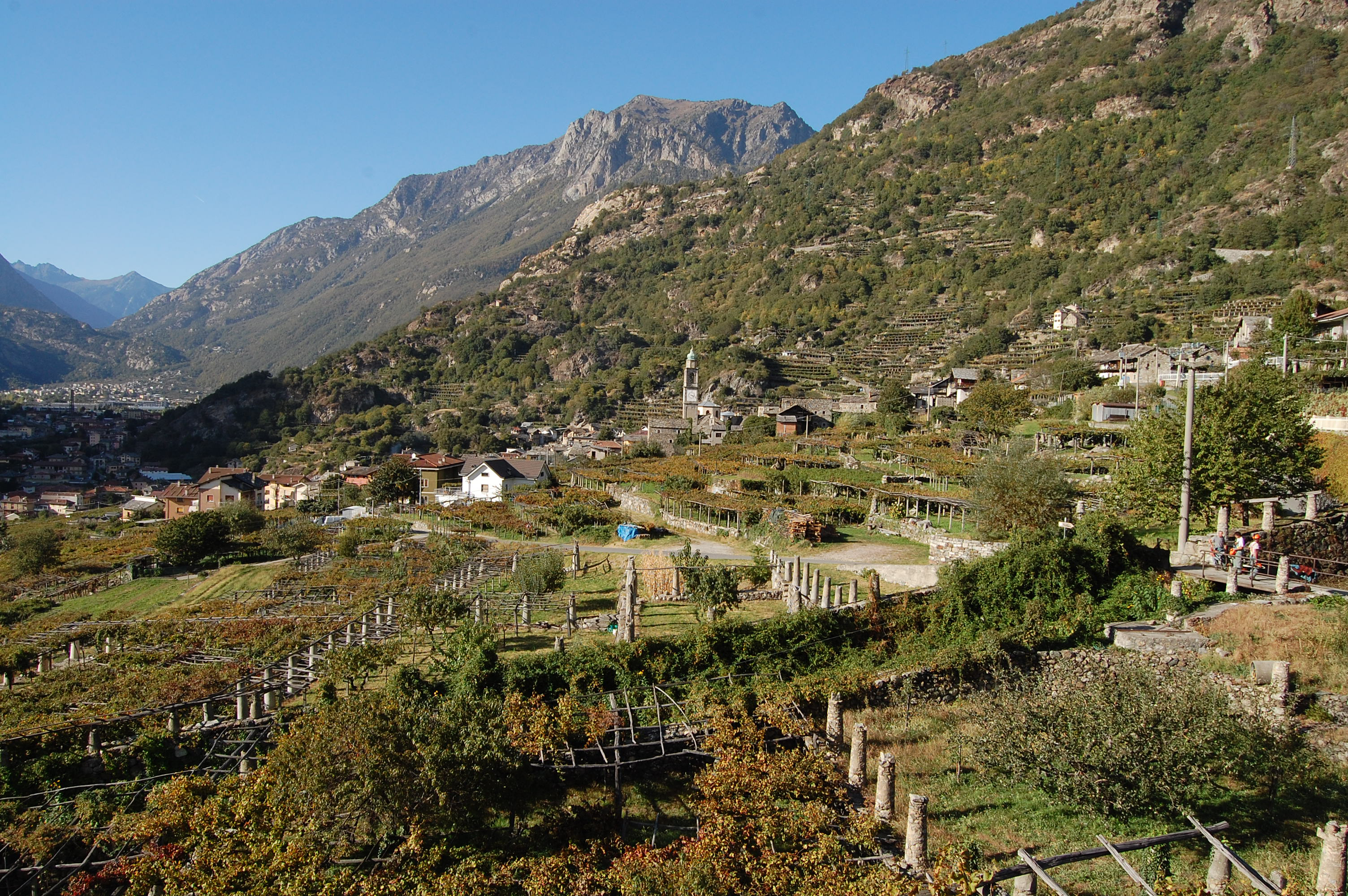
Pergola training has thrived here for a number of reasons, explained Maurizio. Because of the appellation’s unique geographic and topographic elements (i.e., elevation combined with violently steep slopes, extreme temperature variation, and healthy ventilation thanks to the morainic valley), the pergolas help to keep the fruit cool (thanks to shading) under the warm sun of summer and to keep the grapes warm in the case of early frost.
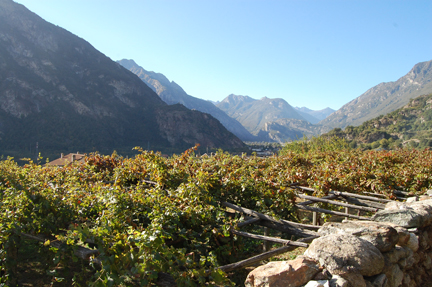
You really have to see the village and its vineyards to understand how it works…
You can click on the image above for a larger version: as you can see, the terraced, pergola-trained vineyards (planted exclusively to Nebbiolo) are situated on the eastern side of the valley, where the sun beats down in the late afternoon. This combination of the nutrient poor morainic soil, excellent exposure, good ventilation, and the local grape growing tradition is what delivers these incredible, age-worthy wines. (That’s the village of Donnas, Val d’Aosta, in the distance, btw.)
The other reason that pergola training has endured here is the fact that the terrain itself restricts the use of machinery: the vineyards are literally sculpted into the side of the mountains and the only way to work them is by hand. The pergola also allows the growers to employ integrated farming and it wasn’t uncommon to see other crops planted beneath the canopy. Italy’s top wine blogger Franco Ziliani calls the viticulture of Carema “heroic.” This is land where, until the advent of modernity (in the 1960s), life survival was extremely difficult and the terrain challenging. Every grower needs to exploit his vineyards, explained Maurizio, to the greatest extent possible.
Once we made it back to the village and the winery, I wasn’t surprised to find large-format, Slavonian oak casks (like this 1,550 liter beauty). Although the winery does age some wine in barriques (say it ain’t so!), the greater part of ever vintage is destined for large-cask and stainless steel aging.
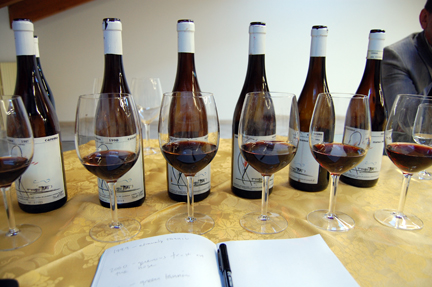
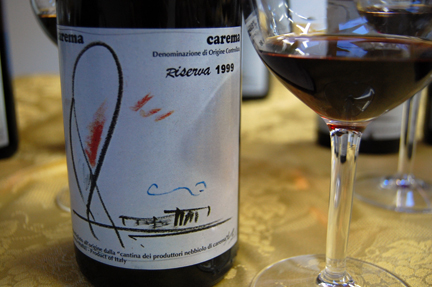
Growers association president Viviano Gassino had double-decanted an amazing flight of wines for us to taste: 87, 90, 95, 99, 00, 03, 06, and 07.
The 1987 was beautiful: A bit of disassociation, slightly browning (I wrote in my notes), but very alive and tannic; rich fruit but still very tight.
The 1999 stunning: Gorgeous acidity, really bright, with an amazing balance of body and tannin united around rich berry fruit. Maurizio and I both noted more focus in the winemaking style from 1999 onward.
The 2006 was another highlight for me and reminded me of the 1999 in a younger expression. This is what we’ll drink for Thanksgiving this year, at Aunt Holly and Uncle Terry’s house here in Austin.
Simply put, Carema is one of the most amazing appellations I’ve ever visited: for its violent beauty, for its unique confluence of geographic and topographic elements, for its perfectly viable anachronism, and for the outstanding wines it produces.
But the most incredible thing is that you can find the 2006 Carema by Produttori Nebbiolo di Carema in the U.S. for under $30 (2007 is the current release but there is still some 2006 in the market).
I love love LOVE these wines and they are my Thanksgiving pick for 2011 (even though they’re not available in Texas, I’ve managed to evade the authorities and sneak a few bottles in).
Thanks for reading! To get a better sense of the topography of Carema, here’s the slide show that I hurriedly created the week of my visit just over a month ago…
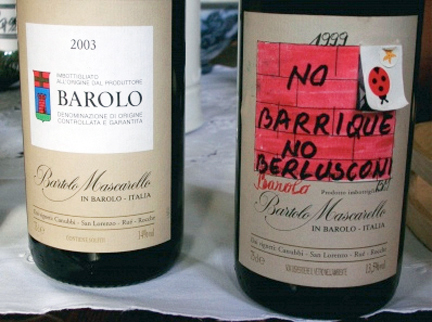
Bartolo Mascarello’s famous label, “No Barrique, No Berlusconi,” a now iconic image that empowered wine as an ideological expression. Photo via Spume.
The great 20th-century novelist, poet, essayist, and politician Leonardo Sciascia employed Sicily as synecdoche for Italy in his novels Il giorno della civetta (The Day of the Owl, 1961) and A ciascuno il suo (To Each His Own, 1966). The works were parables of what he would later call the “Sicilianization” of Italy: a phenomenon whereby the Sicilian model of bureaucratic and political bankruptcy and clannish self-interest had contaminated the entire Italic peninsula as the nation first tasted the sweetness of prosperity thanks to the “economic miracle” of that decade.
Today, as I joyously read the news that Berlusconi has pledged to resign, I am reminded of Sciascia’s parables. In many ways, Berlusconi’s 17-year tenure as Italy’s leading politician is a parable of the Italian nation’s overarching abandonment of the social ideals that emerged in the period immediately after the second world war, when social and economic equality, dignity, and liberty were paramount in the hearts and minds of Italians who had suffered through the tragedy of fascist and Nazi domination. The memory of those wounds was still vibrant in 1994 when Berlusconi first took power. Today, the generation that embraced the humanist ideals of Italian post-war communism has greyed. And the greed and moral bankruptcy embodied by Berlusconi will remain as the legacy that has reshaped Italy and swept away the renaissance of Italian greatness — in design, technology, fashion, cuisine, etc. — of the decade that preceded his reign.
His tenure corresponds neatly to the tragic Californianization of the Italian wine industry that took shape in the 1990s when scores of Italian producers abandoned the values of the generation that had made wine before them.
Berlusconi may be on his way out. But, sadly, barriques are here to stay.
When Ryan Opaz asked me to “defend the written word as a medium of wine blogging” for a panel at the European Wine Bloggers Conference, I have to admit I was nonplussed.
My short talk was to be part of a panel entitled “Defending Storytelling” (here’s the video, btw) and each participant was charged with “defending” a medium: photography, video, oral storytelling, and the written word (my medium).
Isn’t the written word, I thought to myself, a sine qua non of wine blogging? And even though we use all sorts of media to “blog” (not “write”) about wine, isn’t writing at the core — literally and historically — of what we do as wine bloggers?
It occurred to me that Brescia, the conference host city, was once part of the Most Serene Republic of Venice and that at the height of the Venetian state’s power, the late-15th- and early 16th-century humanist printer Aldus Manutius developed the octavo book format — the world’s first pocket-sized book, an innovation that reshaped the way knowledge was consumed in Renaissance Europe. (That’s Aldus’s “device,” above, a dolphin wrapped around an anchor, a visual representation of his oxymoronic motto, festina lente, meaning hurry slowly, in other words, hurry to achieve as much as you can but do so thoroughly.)
He also created a new typeface, a cursive font (also above) that would revolutionize printing and would soon come to be known as italics (because they were invented in Italy). His inspiration for the new character was the humanist cursive (hand-written) script that had brought new clarity, precision, and elegance to literature in Europe in the early Renaissance.
In many ways, the Aldine revolution is not dissimilar from the blogging revolution: like the Aldine octavo and italic font, the new blogging media have reshaped the way information and knowledge are syndicated. And just as Aldus’s tiny books unchained readers from the elitist lecterns of dimly light reading rooms, the blogging medium has unleashed wine writing and opened a new frontier for the everyman who enjoys wine.
The written word, I said in my address, represents a continuity between the past and future of vinography (the retelling of wine in any medium) just as the Aldine cursive font represented a cohesion between the writing that came before and the writing that would follow.
Another example I made was the @ sign. Did you know that the earliest known use of the @ sign was an elided abbreviation that denoted an amphora full of wine? And while a Florentine is credited with the first known written instance of the symbol, it was during the height of the Venetian empire and the Venetian printing industry that the @ sign took the shape that we know it today.
Just ask any blogger if she/he has ever used italics or the @ sign: without this continuity of the written word we wine bloggers would not be here today, nor would we be here tomorrow.
What a thrill to be here at the European Wine Bloggers Conference in Brescia! So amazing to meet so many wonderful folks whom I’ve know only virtually…
I snapped the above photo this morning when I took part in a panel in which each member “defended” one of the media that go into wine blogging. My assignment was “the written word.”
Pane per i miei denti!
This year’s theme is “story telling” and tomorrow I’ll be part of a round table on “stories that haven’t been told.”
As I type this I’m sitting next to Wink Lorch (!) and listening to George Taber give the keynote speech. Fantastico!
After I read an article in this week’s The New York Times reporting that the fast food chain Sonic has begun offering its guests wine, I was inspired to contemplate the pairing of fast food and fine wine for the Houston Press today.
I had a lot of fun with it and you might be surprised by what I came up with and the folks that appear in the post. Here it is…
And so it would seem that the Italian government has finally stopped handing out DOCGs to any and all who wish to participate in the age-old game of political spoils. But the news that Italian National Wine Committee has ended its despicable practice comes after scores and scores of wines have received the accolade while legions of other more deserving wines have been ignored and omitted.
The power to create new denominations has now passed from Rome to Brussels but the reform allowed a “grandfathering” of previously decreed DOCGs. The crush of new DOCGs was the result of hundreds of wineries lobbying to attain the classification before the application deadline passed in 2009.
The Italian agricultural minister essentially rubber stamped every application.
To commemorate this momentous legislative landmark, Fedagri-Confcooperative (the Italian confederation of farmers and farming cooperatives) issued the following statement: “with these deliberations, the National Wine Committee has fulfilled its two-year task of reviewing and approving nearly 300 applications to change existing DOs [Protected Designations of Origin] and the accreditation of new IGTs, DOCs, and DOCGs.”
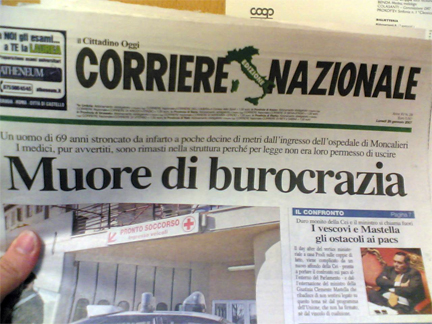
Never mind the fact that the Italian agriculture minister, Saverio Romano, (who oversees the committee and signs their recommendations into law) was appointed to his seat in the cabinet by Berlusconi so that he could avoid prosecution for organized crime association and corruption. (Over the course of his tenure, Berlusconi has shrewdly authored a series of laws that grant immunity to Italian politicians.)
And so with the baby and the bathwater: bureaucracy has skillfully annihilated any significance or impact that the DOCG system could have retained in a post-CMO-reform world.
As I prepare to head back to Italy for the European Wine Bloggers Conference (where Franco and I will both be speaking), it strikes me as one of the saddest forms of wine writing that I can imagine.
It’s the times we live in: connectivity and virtual media have leveled the playing field for wine pricing in our country.
Sommelier Rory and I see it all the time on the floor at Sotto in Los Angeles: a guest is seated, she/he looks at the wine list, and then immediately compares the prices of the wines with their retail price listings on WineSearcher.com.
Like combing your hair on the floor of a restaurant, comparing wine prices while out for dinner is one of those things that is regrettably tolerated in society today.
I’ve been spending a lot of time browsing WineSearcher these days (at home and not in restaurants) because I’ve been writing about mostly under-$25 wines for the Houston Press food and wine blog.
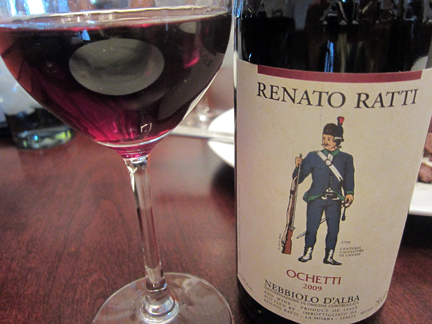
A quick search this morning for one of my favorite expressions of young Nebbiolo — Renato Ratti Nebbiolo d’Alba Ochetti — reveals that here in Texas I pay up to $10 more per bottle than my friends in California (my friend Ceri Smith, super cool Italian wine lady, sells it for $21 at her shop Biondivino in San Francisco; $28 is the lowest I can find it in Texas).
Other than the fact that the virtual monopoly of the big distributors and the greed of the Texas wine brokerage system often adds to the cost of favorite wines, there’s really no reason why we should have to pay more here in the Lone Star state. But I love this wine so much it’s well worth the extra ten bucks.
Nathan had marinated some skirt steak, giving the beef a tangy note that played beautifully with the earthy, salty undertones of the Ratti Nebbiolo, which made from 30-year-old vines grown in the sandy subsoils of Roero and macerated for under a week (according to the winery’s website), giving the wine gentle tannic structure.
Where Produttori del Barbaresco Nebbiolo d’Alba (a top under-$25 wine for me) tends toward bright fruit (especially for the 2009), Ratti’s always leans toward earth and mushroom. They’re both old school expressions of the variety but Produttori del Barbaresco’s can be more lean and show brighter red and berry fruit while Ratti’s digs in with a little more muscle and a lot more barnyard. I love them both…
These days, it’s hard to imagine the pre-WineSearcher world and it’s hard to resist the urge to compare prices around the country. But when it comes to Nebbiolo, I just can’t compromise for the sake of bargain hunting. Pork chops at half price still ain’t kosher…




 When
When 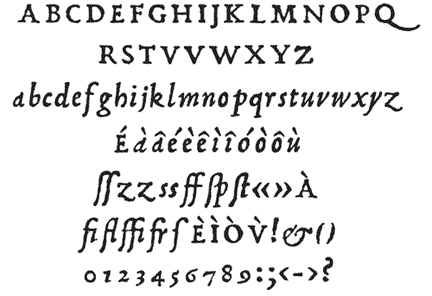


 Do Bianchi