The world of Italian wine mourns Giulio Gambelli, the great maestro of Sangiovese

Sit tibi terra [tuscolana] levis Juli.

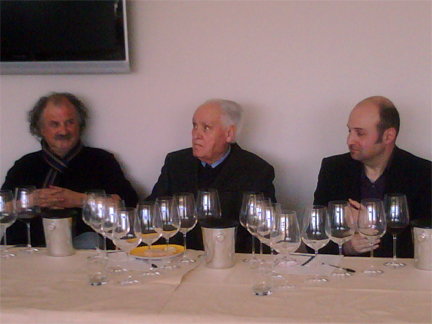
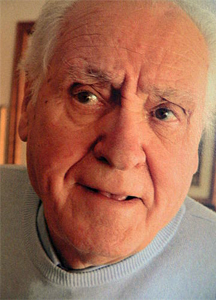
When Italy’s top wine blogger Franco Ziliani wrote me yesterday to share the news that the great Maestro of Sangiovese, Giulio Gambelli (left, photo by A. Pagliantini via Enoclub Siena) had left this world for another, the feeds were already overflowing with tributes for the man who shaped a generation of winemakers in Tuscany and helped to craft some of the world’s greatest wines (see below). As Tuscany continues to abandon the traditional-style Sangiovese (“translucent and profound” to borrow Aldo’s phrase) that he championed, it’s hard not to imagine that his passing will not be remembered as the end of an era…

I’ve translated a few passages below (with links to the orignal posts for Italophones).

A very sad new year for the world of Italian wine: Giulio Gambelli, 87, the great maestro of Sangiovese has died in Poggibonsi, Tuscany. Gambelli was not an enologist but rather a master taster and the world’s greatest expert on Sangiovese — the often challenging, supreme grape of Italy. He was a modest, unassuming person, wine’s humble servant, not an oversized personality but rather an anti-celebrity. To his friends, he was known affectionately as Bicchierino, the little glass.

—Franco Ziliani

He was the man who had taught all the producers in Montalcino how to make wine, not to mention a healthy slice of Chianti Classico. He was a (towering) piece of the history of the last 60 years in Tuscan winemaking. But if you told him so, he would start laughing and he would huff and puff, unamused because he didn’t want to carry the weight for something that he did out of pure passion and because he loved to do it.

—Carlo Macchi

For those who didn’t know him, the following are just some of the Sangiovese producers for whom he consulted: Montevertine, Poggio di Sotto, Soldera, Ormanni, Villa Rosa, Bibbiano, San Donatino…

Gambelli had taught winemaking to so many producers in Montalcino and Chianti Classico that the adjective gambelliano had come to denote true Sangiovese…

—Aldo Fiordelli

Decanter’s obit here.

Photo by Consumazione obbligatoria.

For our vines have tender grapes…

HAPPY NEW YEAR, EVERYONE! :)

For lo, the winter is past,
The rain is over and gone.
The flowers appear on the earth;
The time of singing has come,
And the voice of the turtledove
Is heard in our land.

The fig tree puts forth her green figs,
And the vines with the tender grapes
Give a good smell.
Rise up, my love, my fair one,
And come away!

O my dove, in the clefts of the rock,
In the secret places of the cliff,
Let me see your face,
Let me hear your voice;
For your voice is sweet,
And your face is lovely.”

Catch us the foxes,
The little foxes that spoil the vines,
For our vines have tender grapes.

Song of Solomon

Best meals 2011: Quintarelli and Mascarello at Tony’s (Houston)

Curating Tony’s website and serving as his media director has its perks. This dinner, in August, was one of them. It’s a tough job but someone has to do it!

From the department of “dreams do come true”…

When we sat down for dinner last week, Tony Vallone looked across the table at me and matter-of-factly said, “I have some special wines picked out for you tonight. I know you’re going to like them.” He wasn’t kidding.

I’ve been curating his blog since October 2010 and our weekly meeting has evolved into a familial kibitz where we talk about everything under the sun, alternating between English and Italian. (Long before Tracie P and I announced that we were pregnant, Tony had intuited that we were with child. “I can read it on your face,” he told me. And, all along, Tony said it was going to be a girl. He was right.)

The occasion for our dinner was an interview with one of the top wine writers in the country and Tony had asked me to join them.

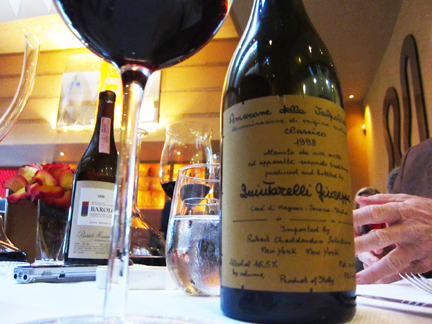
After an aperitif of light, bright Colle Massari Montecucco Vermentino, the first wine in the flight was 1998 Barolo by Bartolo Mascarello (above).

I’ve tasted this wine on a number of occasions and it’s extremely tight right now, favoring its tannin and jealously guarding its fruit.

But when the server arrived with a porcini risotto topped with Umbrian truffles shaved tableside, the wine started to open up and its delicate menthol note began to give way to wild berry fruit tempered by mushrooms and earth. The acidity in this wine was singing and I couldn’t help but be reminded of Angelo Gaja’s antithetical comparison of Cabernet Sauvignon and Nebbiolo. Cabernet Sauvignon is like John Wayne, I once heard Gaja say: he who stands in the center of the room and cannot help but be noticed. Nebbiolo is like Marcello Mastroianni: he enters the room and stands quietly in the corner, waiting for you to approach him. (There’s a punchline that cannot be repeated in polite company.)

The acidity in the 98 Amarone della Valpolicella Classico was equally vibrant and its melody played a counterpoint against the delicately marbled fat of a Kobi fillet. While I’m sure that the 98 Quintarelli has many, many years ahead of it, this wine is in a moment of grace. Generous fruit set against rich structure and mouthfeel. Here, I couldn’t help be reminded of Cassiodorus’s description of Acinaticum: “On the palate, it swells up in such a way that you say it was a meaty liquid, a beverage to be eaten rather than drunk.” In this wine, meaty ripe and overripe red fruit alternated with savory flavors. An unforgettable wine in one of the most remarkable moments of its life.

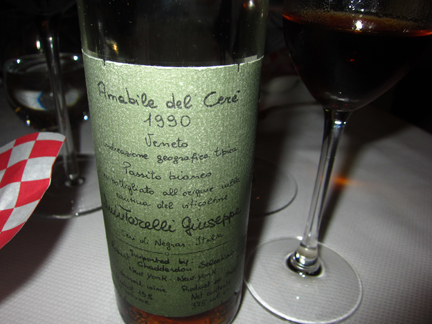
And dulcis in fundo, Tony had selected a wine that he had seen me covet. A few months ago, a collector and frequent guest of Tony’s poured me a taste of the rare 1990 Quintarelli Bandito (I wrote about it here). Knowing that I longed to “drink” this wine in the context of a meal, he surprised us at the end with a 375ml bottle. This wine — last bottled by Quintarelli for the 1990 vintage — is one of the greatest expressions of Garganega I’ve ever tasted: rocks and fruit, minerality and stone and white stone fruit, dancing around a “nervy backbone of acidity” as the Italian say.

This was paired with some housemade zeppole and a dose of playful nostalgia.

Carissimo Tony, ti ringrazio di cuore per questi vini straordinari!

Remembering Giorgio Bocca: Bartolo, pop open a bottle!

The following is my translation of Franco Ziliani’s tribute to the great Italian partisan, journalist, anti-globalizationist, lover and connoisseur of Nebbiolo, Giorgio Bocca, who died Sunday in Milan…

Photo via Il Journal.

He was allergic to any form of rhetoric and he was truly un-Italian in his respect: Italian journalist, partisan, and essayist Giorgio Bocca, 91 years old, died in Milan on Sunday. He deserves to be remembered with a dry eye and not without a touch of irony.

For this reason, I’ve decided to remember this surly, free-thinking, independent man from Piedmont not as a maestro of Italian journalism (which he was, indisputably, regardless of your political leanings) but rather as the great (and demanding) connoisseur of wine whom I had the pleasure to interview twice in his home on Via Bagutta in Milan.

One wine, above all others, was often cited in his books: Barolo, a wine for which he reserved great passion, a wine he drank only when produced by a few carefully selected and trusted producers.

And so, as I think of how Bocca has left us, it’s only natural to evoke the name of another great man from Langa, whose dry, ironic personality was intimately familiar to Bocca. When ever the writer was in the area, he’d go visit this man and they had much more in common than their love of wine: they shared a keen interest in culture, politics, and, of course, in Barolo.

I’m thinking of Bartolo Mascarello, an indisputable leftist like Giorgio Bocca, leftist but not sectarian, enlightened and enlightening, rigorous in his being in favor or against something or someone but not intolerant, perhaps not open to dialog with those whose ideas he opposed but always willing to listen.

And so as I reflect on this goodbye to the great journalist from Cuneo, Giorgio Bocca, I’d like to think that somewhere — in some corner of the imagination, I don’t know where — Bartolo Mascarello is waiting for Giorgio. He’s sporting one of his ironic, amused smiles and of course, he’s speaking in the noble dialect of Langa. He’s opening a buta — a bottle — of a special wine intended to welcome Giorgio to this truly special parlor…

Bartolo, pop open a buta! Giorgio is here!

—Franco Ziliani

The following profile appeared yesterday on the English-language version of the ANSA website.

(AGI) Milan – Giorgio Bocca died on Christmas day in Milan at 91 years of age. He had been a wartime partisan, journalist, founder of the newspaper ‘La Repubblica’ and a long-time collaborator of the Fininvest TV networks. News of his death was released by Feltrinelli, a publishing company who published several of his books and that recalled him as “a great journalist, a great combatant and a great friend”. “Since the partisan war of resistance up to these last few days of the Italian and global crisis – the publishing company continues in a note – he witnessed, observed and told the history of our Country through seven decades. Giorgio Bocca’s enquiries, short polemic articles and books have accompanied and nourished the building of civil society through many generations of Italians”. In January, Feltrinelli will pubish his latest book: ‘Grazie no, 7 idee che non dobbiamo piu’ accettare’ (‘No, thanks: 7 ideas we can no longer accept’). In the past, in addition to his journalistic activities, Bocca – who was born in Cuneo on the 28th of August 1920 – wrote several essays and his having fought with the “Giustizia e Liberta'” Partisan division often led him to tackle the issue of fascism and resistance although he also wrote books on terrorism during the ’70s, on journalism and on the problems of the South of Italy.

During the last few months, some of his comments on the ‘Meridione’ had placed him at the center of controversy after he defined Naples as ‘flea-bag’ with ‘unhealable areas’ or Palermo as a city “stinking rotten, with monstruous people gushing out of slums”. A skilled polemicist, during the last few years, he had often delved into the condition of journalism in Italy: in 2008, in an interview on the ‘Le invasioni barbariche’ TV show, he said that while the journalists of his generation “were driven by ethics” today “truth is no longer of interest” and “publishers are always on the payroll of advertisers”. Among the last recognitions awarded to him was the 2008 Ilaria Alpi Prize for his Life-Long Achievements: “All those that go into journalism do so because they hope they might reveal the truth: even if it’s difficult, I call on them and encourage them to continue along this road”.

Christmas Letter 2011

So many great things happened for Tracie P and me in 2011 but they are all eclipsed by the miracle of Georgia Ann Parzen, who arrived on Monday, December 12.

Around 3 a.m. this morning, as Tracie P and I cleaned the soiled linen in the bassinet and changed another dirty diaper, I couldn’t help but be reminded of the prayer that Jews say after going to the bathroom: Asher Yatzar ([Blessed Are You] Who Has Formed [Humankind]).

Blessed are You, HaShem, Our G-d, King of the universe, Who created the human with wisdom and created within him many openings and many cavities, exposed and known before Your Throne of Glory, that if one of them were to be ruptured or one of them were to be blocked it would be impossible to survive and to stand before You for even one hour. Blessed are You, HaShem, The physician of all flesh who acts wondrously.

Over the course of the year, Tracie P and I have been blessed with many miracles: the miracle of Georgia’s conception, the miracle of our healthy pregnancy, the miracle of Georgia’s delivery, and the miracle of our family, who supports us with their love and devotion.

This morning at 3 a.m., we paused again to reflect on the miracle of a dirty diaper and the health of our baby girl.

On this Christmas 2011, I’m happy to report my business has continued to expand and Tracie P’s been loving her new position selling fine wines. I launched a new wine column for the Houston Press and my band released a new record. My first wine list was well received in Los Angeles and I was invited to speak on Italian wine and wine writing at a number of conferences held this year in the U.S. and Italy. I’ll never forget my first Cretan sunrise on the day of the first European austerity vote, nor the Venetian sunshine on Tracie P’s face on a bright winter’s day on the Grand Canal.

This year’s blessings are too many to count and not a day goes by that I don’t look in the mirror without remembering the long and often challenging road that delivered me to this special moment in our lives.

And so, on this early December morning, as Georgia and Tracie P slumber, and I can hear the first birds begin to chirp with the Texas dawn, I’ll say a prayer for a dirty diaper and I’ll thank my lucky stars that it turned out so right for strangers in the night.

Why We Love to Hate the Texas Alcoholic Beverage Commission

In the wake of a recent post on the absurdity of wine shipping regulation in Texas, a cordial, however tense, dialogue (online and a voce) ensued between me and my friend and colleague Alfonso Cevola, a 30-year veteran of the Texas wine industry, a high-level manager for one of the state’s leading wine and spirits distributors, and a top wine blogger in the U.S.

As we debated the value and implications of the ban on out-of-state retailers in our state, I expressed my visceral observation that the fact that I cannot buy wine and have it shipped from a wine store in New York City just feels “un-American.”

Alfonso responded by pointing out that, “in fact, it is very American.” He was right.

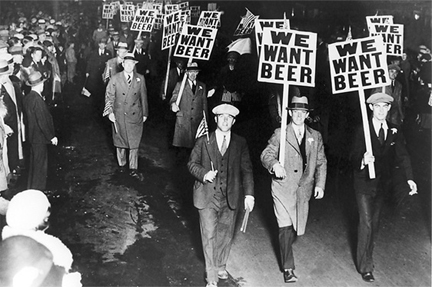
To understand our state’s (and nation’s) peculiar relationship with alcohol, we need to look back to the early post-Prohibition era, when the Twenty-First amendment made alcohol legal again in our country (national Repeal was passed in 1933; Repeal in Texas was not passed until 1935).

“The Twenty-first Amendment is a deeply contradictory instrument,” writes Thomas Pinney in A History of Wine in America: from Prohibition to the Present (vol. 2, University of California Press, Berkeley, 2005). “In its first part it enables the return of alcoholic drink, while in its second part it allows for the growth of an unprecedented tangle of restrictive and obstructive regulation. As one winemaker has put it, ‘Prohibition was never repealed, it was just amended.'”

Click here to read the rest of my post today over at the Houston Press.

Keeping the world Texas safe for Italian wine…

Above: the architects of Italian unification (1861). To the far left, Count Camillo Cavour, Italy’s first prime minister, a winemaker (Piedmont). To the far right, Baron Betting Ricasoli, Italy’s second prime minister, a winemaker (Tuscany). In the center, unified Italy’s first king, Vittorio Emanuele II, a winemaker (Piedmont). Ricasoli’s estate Brolio and Vittorio Emanuele’s Fontanafredda still produce wine today.

One the top wine professionals in Texas chided me yesterday on the Twitter. “Many other iconic Brunell(i?) are available” in Texas, he wrote. There’s “no great market demand” for Biondi Santi here, he Tweeted.

He was commenting on my post yesterday for the Houston Press (Absurdity of Texas Wine Shipping Law Reaches New Heights) and the heated dialog that followed on the Twitter. There was so much discussion that my editor at the paper asked me to write another, follow-up post today, which I playfully called Me and the TABC.

He had asked me to offer a few examples of iconic Italian wines that are not available in Texas (and I had been bemoaning the fact that I have to resort to unauthorized channels to obtain certain wines that I just cannot live without).

I responded with Biondi Santi and Castell’in Villa (the latter was also the subject of the post at the paper).

He responded nonchalantly, as if to say, well, if there’s no demand for those wines here in Texas, what does it matter?

Well, folks I’m here to tell you that in fact, it does matter.

It’s one thing to assume that if a wine isn’t available in Texas, it must not be “important.” And it’s another thing to take into account the fact that Italians consider Biondi Santi to be the greatest producer of Brunello di Montalcino, an icon, a benchmark, a historic domaine that reshaped the appellation. The same holds for Castell’in Villa in Chianti Classico. Or Bartolo Mascarello and Giuseppe Mascarello in Barolo. Or Emidio Pepe and Valentini in Abruzzo. Or Venica and Ronchi di Cialla in Friuli. I could go on and on: none of those wines are available in Texas.

But what’s worse is the fact that I cannot legally obtain them from an out-of-state retailer while in Texas (even though they’re readily available in the U.S.).

Of course, I travel to Italy 3 to 4 times a year, New York City 2 a year, and Los Angeles once a month: I can find and taste these wines whenever I want.

But young wine professionals in our state do not have access to these historic, not to mention delicious, wines.

My Texan colleagues and fellow wine educators can continue to base their course curricula on the Wine Spectator Top 100 list and the wines that score high with its editors and create “market demand”: Casanova di Neri is available here in Texas as is La Spinetta.

But a generation of young wine professionals in Texas will grow up without knowing the wines that the Italians consider to be the greatest expressions of their land, their history, and their (viti)culture.

It’s time for me to get off of my soap box. Thanks for reading… and thanks for loving Italian wine as much as I do…

Here’s a link to a post I wrote a few years ago: Why Italians are offended by our ratings and rankings. You might be surprised by some of the wine professionals who weighed in in the comment section.

I’m just trying to keep Texas (and the world) safe for Italian wine…

Best value Chianti (but sorry, fellow Texans, not available here)

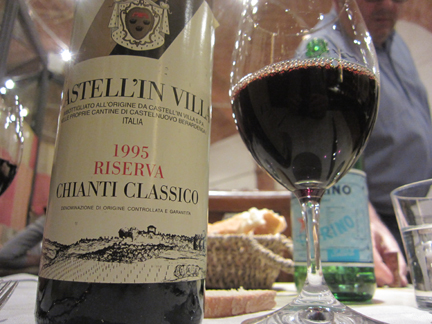
Above: My good friend Francesco treated me to a bottle of 1995 Chianti Classico by Castell’in Villa at the Enoteca I Terzi in Siena when I visited in October.

Castell’in Villa is one of my favorite producers of Chianti Classico. It’s actually one of my all-time favorite Italian producers: traditional-style, pure Sangiovese, grown in galestro-rich stony soils at excellent elevation and with superb exposure, and raised in large cask. The wines are remarkably affordable (I recently bought some of their entry-tier 2007 for under $25) and the winery continues to draw from what must be an astonishing cellar, offering importers library releases that stretch back to the 1970s (I’ve tasted back to 1979).

The only problem is that you can’t get the wines in Texas.

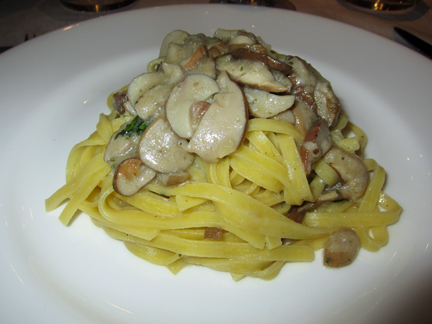
Above: We paired the 95 with housemade tagliatelle tossed with funghi porcini that night in Siena.

Well, actually, there’s another problem: the wine is readily available in the U.S. but Texas won’t allow out-of-state retailers to ship the wine here. It’s against the law. Unless, of course, you set up shop as a winery in Texas — even if you don’t make wine. Yes, a winery that doesn’t make wine…

I’ve already pissed off a lot of folks today with my post over at the Houston Press, “Absurdity of Texas Wine Shipping Law Reaches New Heights”, about Friday’s news that the Texas alcohol authority has granted a winery license to Wine.Com, eve though — in the TABC’s own words — Wine.com doesn’t produce wine. With the license, Wine.com will now be able to ship wine to retail customers within Texas.

I knew this issue would press some of Tom Wark’s buttons: he’s spent the last few years campaigning against the anachronistic, obsolete, gerrymandering laws that regulate retail shipping of wine in our country. I sent the link to Tom this afternoon and he responded immediately:

    But here’s what needs to be understood. Wine.com is actually only able to sell and ship wines to Texans that it first purchased form a Texas wholesaler. That means that the Castell’in Villa Chianti Classico you mentioned can not be sold by Wine.com and shipped to a Texas consumer unless wine.com buys that wine from a Texas wholesaler.

    What’s really interesting is that Wine.com set up a physical presence in Texas and got the wine producers license in stead of a retailers license. You know why? Because a few years ago, when SWRA was suing texas for discriminating against out of state retailers, the TX legislature passed a law that limited Texas retailers to only shipping wine into the county where the physical retail outlet was located. However, a Texas “WINERY” can ship ship throughout Texas.

Above: A San Francisco-based retailer shipped me the wine regardless of the TABC restriction. It’s a great value and one of my favorite wines.

For the record, I side with many of my colleagues in the trade when it comes to the three-tier system in the U.S. I believe, like them, that the three-tier system helps to keep costs down and it protects the consumer by making it difficult for importers and distributor to monopolize brands.

But what the hell, yo????!!!! Ain’t America a free country? As a U.S. citizen, shouldn’t I have the right to purchase a bottle of wine from a retailer in San Francisco or New York and have them ship it to me?

Most retailers ignore the TABC restrictions anyway. And I have a secret for you: the rich folks in Texas? They spend so much money at the high-end retailers in New York and Northern California that the sellers will always find a way to get them their high-cost wine.

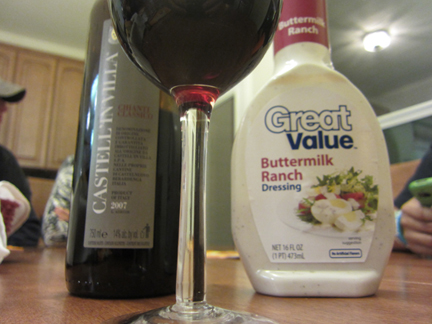
Me? I just want my under $25 bottle of Chianti Classico by Castell’in Villa! And by golly, it went great with a bottle of ranch dressing from Walmart! So there!

Here’s the link to my post over at the Houston Press.

Boccaccio and wine blogging

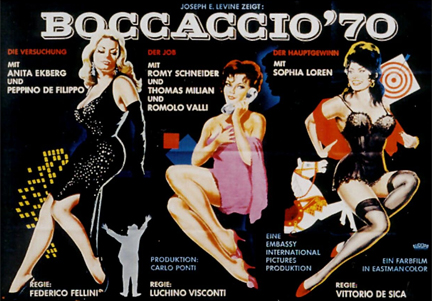
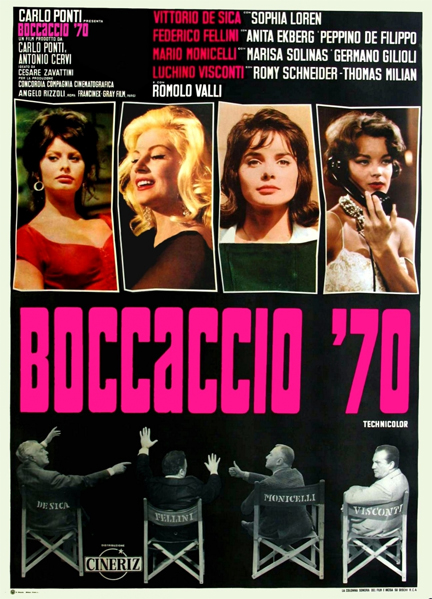
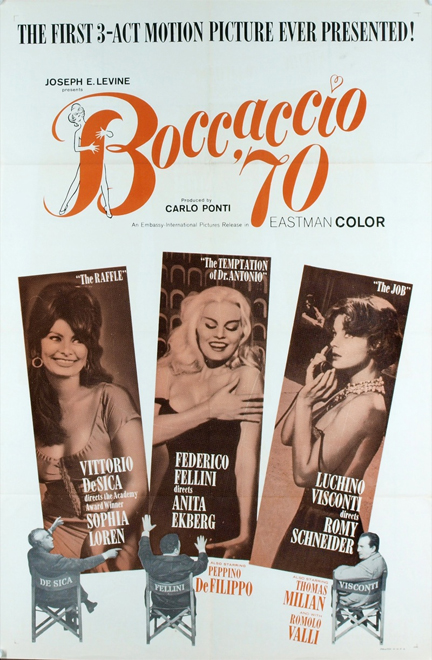
An allusion to Boccaccio in my post today for the Houston Press (on water and wine) was irresistible: citing the third novella, eighth day of the Decameron, I used a mention of wine in his description of Bengodi (the land of plenty) as an illustration of how water was commonly blended into wine in the middle ages. In the text, he describes a Vernaccia so good that no water was added to it.

Here’s the text in English (and here it is in Italian):

    Calandrino heard what passed between them, and witting that ’twas no secret, after a while got up, and joined them, to Maso’s no small delight. He therefore continued his discourse, and being asked by Calandrino, where these stones of such rare virtues were to be found, made answer: “Chiefly in Berlinzone, in the land of the Basques. The district is called Bengodi, and there they bind the vines with sausages, and a denier will buy a goose and a gosling into the bargain; and on a mountain, all of grated Parmesan cheese, dwell folk that do nought else but make macaroni and raviuoli, and boil them in capon’s broth, and then throw them down to be scrambled for; and hard by flows a rivulet of Vernaccia, the best that ever was drunk, and never a drop of water therein…”

The fact that he points out that never a drop of water was found in the wine is an indication that wine to which water wasn’t added was considered superior in quality.

There are so many wonderful mentions of wine in the Decamaron: ahimè, if I didn’t have to make a living, I could collate them into a neat little book with a critical apparatus (a little philological speak there for you).

In the meantime, any excuse to revisit Boccaccio is a good one!

The tale is one of my favorites and is a great (and funny) read: English and Italian.

Buona lettura e buon weekend yall!

Italy’s greatest rosé? Biondi Santi’s Rosato di Toscana

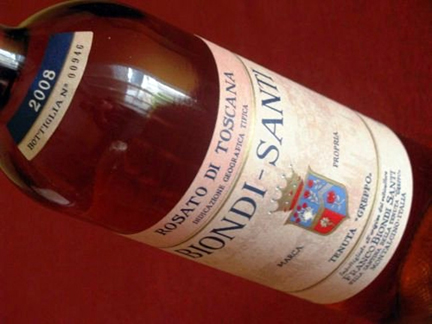
I couldn’t resist translating this post by Italy’s top wine blogger Mr. Franco Ziliani for VinoWire today. And the mimetic desire was so overwhelming that I was compelled to post my translation here as well. I haven’t yet tasted the 2008 Rosato by Biondi Santi but the 2006 was fantastic. Until I get back to Italy, I’ll just to live vicariously through Franco’s post… Buona lettura!

When my fifty-fifth birthday arrived this year, I didn’t reach for a powerful red, nor an elegant Champagne, nor a juicy Franciacorta. No, I drank a stunning rosé on my birthday, perhaps the most important and most celebrated of all the Italian rosés (and probably the most expensive, since more than one online wine store offer it at Euro 33). I’m talking about the Rosato di Toscano, 100% Sangiovese, created by the Gentleman of Brunello, Franco Biondi Santi on his Tenuta del Greppo estate in Montalcino.

On another occasion, I wrote the following about this wine: It is the youngest child of the Greppo estate, a wine obtain by vinifying estate-grown Sangiovese at 16-18° C. without skin contact, aged for 18 months in stainless steel. We could call it a youthful Sangiovese, a quasi Brunello… in pink, obtained from young vines roughly 5 to 10 years in age. The vineyards are located in zones rich with stony subsoil and galestro [schist], with exposition to the North-East, South, and North, and elevation ranging from 250-500 meters.

I drank the 2008 Rosato di Toscana by the great Franco Biondi Santi with a simple however delicious, everyday dish: exquisite beef meatballs braised in tomato sauce and paired with green beans that had been sautéed with bread crumbs. We’re talking about enthusiasm cubed here: a truly extraordinary rosé in every sense.

Light cherry in color, jus of squab with an orange hue. Dry and direct on the nose, very salty and focusedd, dominated by red cherry followed by a gradual evolution of citrus ranging from pink grapefruit to mandarin oranges and citron. Then came notes of multi-colored Mediterranean maquis, tomato leaf, flint, and hints of rose. Together, they created a weave of color and mosaic of aroma.

Ample in the mouth, juicy, overflowing with personality and refined, ample layers of texture. Well structured on the palate, with vertical depth, endowed with focus, an absolute release of magnificent vitality and complexity.

A stony, salty wine, with perfect balance of fruit, acidity, and tannin (the magnificent tannin of Sangiovese from Montalcino). Great harmony, extreme polish, aristocratic elegance, and absolute drinkability despite the 13.5% alcohol and richness of this highly enjoyable Rosato di Toscana.

It would be suited to a wide variety of dishes, from Caciucco alla Livornese to fish soup, to baby octopus cooked in red wine to braised calamari with peas. But it also could be paired with a roast beef, braised beef, or even veal… and even a well-stocked pizza. Why not?

The greatest of Italian rosés and one of the greatest rosés in the world, including France. Chapeau bas!

Franco Ziliani