Produttori del Barbaresco 89 (and Mafioso)

Every once in a while you come across one of those truly special bottles, like this 1989 classic Barbaresco by Produttori del Barbaresco,* at a price you can afford. I found it the other day in a wine shop in San Antonio (where I’ve been spending a lot of time these days) and although it gently pushed the envelope of my pricepoint ceiling (sorry for the mixed metaphors), I just couldn’t resist.

The 1989 harvest in Langa was one of the greatest in contemporary memory and I’ve had the great fortune to taste a lot of Nebbiolo from both 1989 (a classic, slow-ripening vintage) and 1990 (also a classic, but with slightly warmer temperatures). This gorgeous wine is still very young: the nobility of its tannin and earthy flavors were adorned by delicate notes of berry and red stone fruit, the way Laura’s noble, alpine beauty is dressed by her golden hair and her delicate veil as she sits by the stream in Petrarch’s songs.

Many would fetishize a wine like this but we always open them with food. After all, the people who made them intended them to be consumed with food.

At the urging of our friend Howard, Tracie B had Netflixed Alberto Lattuada’s 1962 social-commentary/thriller/comedy Mafioso, starring one of the all-time greatest Italian actors, Alberto Sordi.

Lattuada doesn’t make it as often into the syllabuses of Italian film studies in the U.S. as does, say, Pietro Germi (with 1960s classics like Sedotta e abbandonata), but he should. His Mafioso is 1960s social-commentary comedy at its best, at once poignant and hilarious, bridging the Messina Straits of the paradox of the country that never was — Italy. Alberto Sordi is a Sicilian who’s moved to the industrial north and has made a life for himself and his beautiful blond alpine wife. Lattuada’s camera follows him has he fulfills his peripeteia in a journey home to visit his family. The backdrop is the “economic miracle” of the 1960s in Italy, where the north flourished while the south continued to languish. I won’t spoil it for you but the final thriller scenes had us on the edge of our seats as we sipped the last drops of that gorgeous wine.

Here’s the great scene where Sordi’s character’s family welcomes him home with a classic Sicilian luncheon. Coppola ain’t got nothing on this baby!

* Many erroneously distinguish the “cru” or single-vineyard bottlings of Produttori del Barbaresco Barbaresco from the classic Barbaresco (made with fruit sourced from multiple vineyards) using the ignominious qualifier normale. Produttori del Barbaresco Barbaresco that has been made by blending wines sourced from different vineyards is classic Barbaresco or Barbaresco classico.

Another clarification on ripasso/ripassa

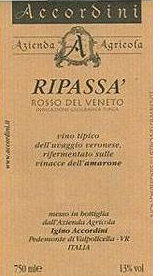
accordiniYesterday, I messaged the VinoWire group on Facebook, asking if anyone knew of a Valpolicella producer besides Zenato who used the term ripassa on its Valpolicella label. (Btw, if you’re not a member of the VinoWire FB group, please join!). Colleague, friend, and fellow blogger Tom Hyland weighed in with Accordini’s Ripassà (or Ripassa’ depending on whether your looking at the label or the winery’s website. Ripassa’ is a Veneto dialectal form of the Italian ripassato, literally passed again or refermented in this case. (I am reminded of Giacomo Leopardi’s famous observation that French is a language of terms while Italian is a language of paroles: like so many lemmae in the Italian lexicon, passare can assume a wide varieties of meanings depending on the context.) Thanks, Tom, for sharing the info and thanks also to Devon Broglie and Angelo Peretti who pointed out that Zenato’s “Ripassa” — without the accent grave or inverted comma — is indeed a trademarked proprietary name.

Has anyone tried the Accordini? Is it good?

In other news…

Just in the from the “unbelievable but true” department: Franco and James Suckling are in the midst of a cordial, collegial, and amiable exchange in a comment thread at James’s blog on the Wine Spectator site.

Here’s the link to the post and thread but since you have to subscribe (as I do) to view the blog, I’ve copied and pasted the exchange below.

User Name: James Suckling, Posted: 03:36 AM ET, May 28, 2009

    Guiseppe Mascarello & Figlio doesn’t send but we buy bottles normally for review. I find the wines very up and down. Some are amazing but others have flaws like volatile acidity.

User Name: Franco Ziliani, Italy Posted: 12:13 PM ET, May 29, 2009

    I know very well, and I’m a great fan, of Giuseppe (Mauro) Mascarello wines, but I confess that I don’t find any traces of “volatile acidity” that Mr. Suckling find…

User Name: James Suckling, Posted: 12:26 PM ET, May 29, 2009

    Franco. Some people have a high tolerance for VA. Have you ever been to their cellars? Anyway, it’s only been with a few wines. I generally like the wines as you do. Thanks for the comment.

User Name: Franco Ziliani, Italy Posted: 04:21 PM ET, May 29, 2009

    Mr. Suckling, apologies in advance for my poor English. I know very well the Giuseppe Mascarello cellars and I don’t think that is this kind of old, and very fresh in every season, cellar that create the problem of “volatile acidity” that you find in Giuseppe Mascarello wines. And I don’t think that a case of “high tolerance for VA” don’t allow me to find in Mascarello wines the “VA problem” that you find in few wines. Can you tell in what wines, Barolo, Barbera, Dolcetto (what vintages?) have you find VA “flaws like volatile acidity”? Thanks for your kind answer f.z.

We’ll have to wait for James’s next move!

1968 Monfortino I need say no more

From the “life could be worse” department…

The other night found me and Tracie B in the home of our dear friend Alfonso, who treated us to one of the best bottles of wine I’ve ever drunk in my life: 1968 Barolo Monfortino by Giacomo Conterno (steaks by Alfonso, photo by Tracie B). It was one of those truly life-changing wines, a miracle in a bottle and a wonder in the glass, at once light and lithe, powerful and awesome. I’ve tasted — tasted, mind you, not drunk — 55, 58, 61, and 71 (some of the greatest years for Langa in the 20th century). Martinelli calls the 1968 harvest “good” (not great) and the wine did have some vegetal notes that I believe were product of the vintage. But quality of the materia prima (there is superb fruit in nearly every vintage, sometimes less of it than more) and the winemaking approach (aged 10 years in botti before bottling according to the back label!) made for a wine that I will never forget.

Need I say more? Check out Tracie B’s tasting notes.

Carissimo Alfonso, grazie per una serata indimenticabile!

In other news…

The other day at Bistro Vatel in San Antonio, I enjoyed one of the best meals I’ve had since I moved to Texas (save for daily dining chez Tracie B!). Owner Damien Vatel is a descendant of legendary 17th-century French chef François Vatel.

The resulting photography is pretty darn sexy, if I do say so myself.

In other other news…

I’d like to mention two series of ampelographic posts that I’ve been following: the one by Alessandro Bindocci at Montalcino Report, who asks “Is Sangiovese Grosso really Grosso?” and the other by Susannah Gold at Avvinare, who is writing an English-language dictionary of Italian grape varieties.

Double-take: Italy, Texas

From the “double-take” department…

Given my chronic case of Italophilia, “my new life Texana,” and my philological (and toponomastic) leanings, it was inevitable that sooner or later I would have to investigate and address the origins of the toponym Italy, Texas (the “two boots” of Italy and Texas, left, reside side-by-side on a shop-window on main street, right next to the Uptown Café in Italy, Texas). Tracie B and I stopped there yesterday on our way back from Dallas (where our dear friend Alfonso hosted us for dinner and opened a few truly unforgettable bottles — but you’ll have to wait for Tracie B’s post for more detail). Italy lies about 40 minutes south of Dallas along I-35 (which leads south from Dallas to Waco, Waco to Austin).

In his lectures and essays on memory, the contemporary Italian philosopher Remo Bodei loves to cite another noted homonymous place name in Texas — Paris, Texas, celebrated in film by the great director Wim Wenders. Why, he asks in his lecture “The Traumas of Memory,” have European emigrants named their settlements in the New World after their place of origin? “To create a transitional object? A soft landing in the flight from the known to the unknown? I believe that something analogous happens even in traumas connected to loss. In effect, monuments and burial rituals are carried out to remember and forget simultaneously. When objectified, pain hurts less.”

Above: The water tower in Italy, Texas.

As it turns out, Italy — locally pronounced IT-lee — was not named after its settlers’s country of origin but rather — at least, according to local legend — by a late-nineteenth-century post master who believed the climate of Texas was similar to Italy’s.

Above: The picturesque main street of Italy, Texas has remained virtually unchanged since the 1930s.

One of the reasons we wanted to stop there was to eat at the Uptown Café, an eatery called one of the “best small town Texas cafés” by Texas Monthly Magazine. But when we got there the proprietor, a very nice lady, told us “Ever’ Tom, Dick, and Harry dun’ came in here and ate everythang.” So we ended up eating at the Texas Best Smokehouse, the flagship restaurant and novelty store of a small, locally owned chain. They smoke their own jerky there (for all of their locations, I was told) and they also make pistachio pudding. The Texas Best Smokehouse is located on Dale Evans Dr., in turn named after one of Italy’s most famous daughters.

Above: I couldn’t resist the pistachio pudding, which is made — I believe — with Cool Whip, Jello mix, and pistachios. Metabolically, it was probably a bad decision, as was the bbq sausage sandwich. But, what the hay? You only live twice, right?

Double-meanings, paronomasia, puns, and — in this case — a homonymous place name, are the source of endless fascination for me. (One of these days, I’ll do a post on the origins of the place name California. I know of at least two towns in Italy named California.)

The other day, Franco sent a wonderful photo, snapped in the Alps, of the Italian and Texan flags flying together. As it turns out, there’s a little bit of Italy in Texas, too.

Negro Amaro, false friends, and folkloric etymologies

Above: Paolo Cantele and I poured wine and spoke at an Italian wine dinner last night at Jimmy’s in Dallas, where Paolo’s wines were featured. I highly recommend Paolo’s wines and Jimmy’s for its Italian wine and Italian food selections.

For the last few days, I’ve been “riding” with Paolo Cantele (center) of the Cantele winery (Apulia) in Austin and Dallas. Every once in a while, the wine trade brings you in contact with folks you genuinely enjoy hanging out with. Beyond his wines (which are fantastic, btw, and very well priced; his family’s Fiano, Rosato, and Salice Salentino are my favorites), we discussed the Israeli-Palestinian conflict, Dario Fo and Pasolini, and he told me the funniest story about meeting Ninetto Davoli in New York in a food shop last week. (Paolo bears a striking resemblance to actors Gary Oldman and Edoardo Ballerini, the latter, a good friend of mine.)

One of the more interesting conversations that came up, was the origin of the grape name Negro Amaro. If you’ve followed my blog, you most likely have seen one of my posts where I marry my interest in philology with my passion for ampelography — the latter meaning, literally, the writing of grapes. (Check out my posts on Aglianico and Valpolicella, where I conjugate my love for philology and toponymy.)

Many believe that the origin of the grape name Negro Amaro derives from its literal meaning in contemporary Italian, black bitter.

While Calò, Scienza, and Costacurta (Vitigni d’Italia or Grape Varieties of Italy, Calderini, Bologna, 2006) concede that the origin of the name is unknown, they point the dialectal binomial niuru maru “due to the black coloring of the berries and its rich tannins which impart a bitter flavor to the wine or perhaps nero-mavro which could back [the theory that its name derives from] the black character of its skin” (p. 590).

Partisans of the nero-mavro camp believe that the name comes the Latin niger (black) and Greek mavros (black). The idea would be that the grape was named in Latin and Greek because of confluence of Greek and Roman culture in Salento (at the very tip of the heel of the Italian boot, at the top of the Mediterranean basin).

It’s important to note that mavros meant Moor in ancient Greek and that it denoted an inhabitant of North Africa and/or his language. As in other romance languages, moro in Italian ultimately came to denote the color black (probably by the 16th century, when many modern forms of grape names took shape in Italian).

But Paolo introduced a theory that I’d never heard before: that the binomial niger mavros could be due to the fact that Salento was a cross roads between the Byzantine (Greek-speaking) and Western (Latinate-speaking) empires.

The names of many grapes are early forms of wine marketing. For example, Primitivo (which was not cultivated until the modern era in Italy) is so-named because it is early-ripening (primitivus means simply early and was used to denote “first-fruits” in Latin). It’s likely that it was given that name by someone who wanted to encourage its use (i.e., this is a good grape because it ripens early, and hence, you will be able to harvest early avoiding potential bad weather during the later months of fall).

I don’t believe we’ve solved the conundrum of Negro Amaro’s etymon but I do think that its origins could lie in the fact that in antiquity it was cultivated in a place where Greek was the koiné or common language, adopted by all for expediency sake.

I have always thought that black bitter was what we call in linguistics a “false friend,” i.e., a reading based superficially on the immediately apparent meaning of word (for example, magazzino does not mean magazine in Italian in the sense of publication or weekly; it denotes a warehouse or store of military provisions). Why would anyone call a grape bitter? Historically, names were given to grapes for pneumonic or commercial value and not to encourage people not to grow them or consume them. My philological sensibility tells me that black bitter is a folkloric etymology and that the dialectal phrase noted by Calò et alia probably comes from a superficial reading of the grape name.

Either way, I’m happy to have found in Paolo a true friend and interlocutor.

Carissime Paule vale!

A propos good friends, Paolo and I have a good friend in common, Filena Ruppi, who produces a fantastic Aglianico del Vulture together with her husband Donato d’Angelo (for whom the winery is named). I caught up with Filena at Vinitaly, where she posed for my camera with her husband and an image of Mt. Vulture in the backdrop. Their Valle del Noce is one of my favorite expressions of Aglianico.

No vote on proposed Montalcino DOC

Above: I’ve tasted Il Poggione Brunello di Montalcino and Rosso di Montalcino going back to the 1970s. One of the greatest expressions of Sangiovese I’ve ever tasted was the 1979 Rosso (bottled before the existence of the Rosso di Montalcino DOC and labeled as “Rosso” from “Brunello vines”), which Alessandro Bindocci’s father Fabrizio shared with me last year over steak dinner at Keens in Manhattan.

My friend Alessandro Bindocci, son of Il Poggione winemaker Fabrizio Bindocci, posted today on the proposed creation of a Montalcino DOC: evidently, the vote was put to the floor but no vote was held. Read more here…

I’ll be tasting with Alessandro and his father later this week at Vinitaly.

On the eve of Vinitaly, a push to create a Montalcino DOC (and reflections on a year past)

Above: Franco Ziliani (left), my friend and co-editor of VinoWire, and Mauro Mascarello, winemaker and producer of one of the greatest expressions of Nebbiolo, Giuseppe Mascarello Barolo. We tasted at Vinitaly last year together. This year, Franco and I will be tasting together at Vini Veri.

Passover and Easter will shortly be upon us and the who’s who of Italian wine is preparing to descend on the province of Verona for our industry’s annual trade fairs: Vinitaly (the largest and most commercial), Vini Veri (a gathering of natural winemakers and the most interesting in my opinion), and VinNatur (an assembly of winemakers who broke away from Vini Veri some years back). I’m particularly excited for Vini Veri because this year’s tasting sees the unification of Vini Veri with the Nicolas Joly biodynamic and quasi-biodynamic tastings, Triple A and Renaissance du Terroir (Return to Terroir).

Above: The Banfi Castle at last year’s Vinitaly. There were rumors — unfounded and untrue — that Banfi’s wines were seized on the floor of the fair last year. I am looking forward to tasting the 2004 Brunello di Montalcino by Banfi. Charles Scicolone and Tom Hyland — whose palates I respect greatly — have both told me that it’s classic Brunello, 100% Sangiovese, and one of the best wines Banfi has ever produced.

It’s remarkable to think that at this time last year, the world of Italian wine was gripped by the breaking news of the Brunello scandal: at least five major producers were accused of adulterating their wines from the 2003 vintage. A year has passed, a large quantity of wine has reportedly been declassified, and no indictments have been issued by the Siena prosecutor who supposedly launched the investigation in September of 2007.

It’s not surprising, however, that there has been a new push — albeit weak — within the association of Brunello producers to create a Montalcino DOC. Last week, a proposal to create such an appellation was put to the floor at the consortium’s assembly. (I haven’t been able to find out the results of the vote but according to most observers, it was unlikely that it would be ratified.)

Above: I am always geeked to taste Paolo Bea Sagrantino with Giampiero Bea at Vini Veri (I snapped this photo at last year’s fair). Tracie B and I have been enjoying his Santa Chiara 2006. It’s radically different than his 2005 and I hope to ask him about the vintage variation. (Is it the result of climatic differences or differences in the cellar? I imagine — knowing Giampiero and his radical belief in natural winemaking — that the former is the case.)

Currently, Montalcino producers must label their wines as Toscana IGT or Sant’Antimo DOC if they contain grapes other than Sangiovese. If approved, a Montalcino DOC would allow them to exploit the Montalcino “brand” in their labeling of so-called Super Tuscan wines. The proposed DOC is part of a greater push to create new Italian appellations before OCM reforms take effect in August 2009 and the power to issue new DOCs shifts from Rome to Brussels.

Above: This year, the world of Italian wine mourns the loss of Teobaldo Cappellano (photo courtesy of Polaner). Baldo, as he was known fondly, was one of the founders of the Vini Veri movement and one of Italy’s most zealous defenders and promoters of terroir-driven wines and natural winemaking. He was a truly delightful man and is sorely missed.

There’s a reason why the fairs are held at this time of year: historically and traditionally, the spring marks the moment when winemakers unveil their cellared wines. Long before the hegemony of the Judeo-Christian canon, spring was observed as Mother Nature’s moment of renewal and rebirth.

The ancient allegory — and it is an allegory, not a metaphor — could not be more apt this year.

Is it spring yet? Rosso di Montalcino, tuna bruschette, and rock ‘n’ roll

Friday brought the spring equinox and so Sunday night, Tracie B decided to lift her yearly moratorium on fresh tomatoes and made us bruschette topped with chopped yellow and red tomatoes, cannellini beans, olive-oil-packed tuna, kosher salt, and extra-virgin olive oil (the oil courtesy of our friend Ginevra Pesciolini of the Ghizzano winery in the Colline Pisane).

A bruschetta (pronounced broo-SKEHT-tah, plural bruschette, broo-SKEHT-teh) is literally “burnt” or grilled bread, always dressed with olive oil and often topped with a combination of the above ingredients. Most believe the word and the preparation originated along the central Adriatic coast of Italy.

We paired with one of my favorite expressions of Sangiovese, 2006 Rosso di Montalcino by Canalicchio di Sopra. Canalicchio’s wine is traditional in style. It showed some of the stinky volatile acidity that you get on old-school Sangiovese like this but it quickly blew off, giving way to delicious, bright, food-friendly acidity and red, plummy fruit.

In other news…

Also on Friday, we managed to get into my friend Inara’s packed showcase with her band The Bird and the Bee at the SXSW festival. Inara rocked it! (picture taken with my phone.)

Holy cannolo (and Franco’s thoughts on EU reform of the Italian DOC system)

Miracles appear in the strangest of places…

It may be hard to believe but I had what was probably the best cannolo I’ve ever had in… yes, you won’t believe it… in Little Rock, Arkansas where I was traveling for business (cannolo is the singular of cannoli, btw). For me, the cannolo is all about the buccia, the shell. It needs to be firm but light, crunchy but consistent, sweet but not too much so, with just the right amount of savoriness to balance the richness of the cream filling.

I’m not quite sure how they got there, but Santo Sacca (left) from Messina (the front of the house) and chef Rosario Patti from Palermo run a fantastic little Italian restaurant in Little Rock. Some may come close, but their cannolo cannot be beat.

Rosario seasons his excellent pasta mari e monti (sea and mountain) with saffron. It was delicious.

Vesuvio Bistro
1501 Merrill Dr
Little Rock AR 72211
501-225-0500

Holy cannolo Bill Clinton! Now it’s time for me to get my butt back to Austin for some holy mole at Polvo’s.

In other news…

A lot of people have asked me about upcoming EU Common Market Organisation reforms whereby the Italian appellation system will be absorbed by the EU, to take effect on August 1. The names and classification of Italian appellations won’t change but the power to issue new appellations will pass from Rome to Brussels. I’ve translated and posted Franco’s editorial at VinoWire, including some useful links. Other alarmist bloggers have claimed erroneously that the CMO reform will wipe out the Italian system. The real question is how EU bureaucrats will deal with requests for new appellations starting in August.

My first crawfish boll (boil)

From the “ain’t this living?” department…

The weather’s still cold here in Texas but folks are already beginning to hold their annual crawfish bolls (boll is Texan for boil). The crawfish boll is a true convivium, in the etymologic sense of the word, a “feasting together” or “living together.” Although the crawfish are sometimes served on trays after being bolled (boiled), most folks spread them out on a table over newspaper and everybody eats standing, shelling and sucking the crawfish communally. Yesterday, I attended my first crawfish boll ever at the invitation of my new friends, wine professionals Craig Collins and his lovely wife April.

Baby onions, whole bunches of garlic, mushrooms, corn, sausage, and spices are set to boil in a large pot. Then, the crawfish are dumped live into the cooking water. Crawfish or crayfish are also called “mud bugs,” said Tracie B.

They simmer, covered, for about 20 minutes. When asked if it was okay that the pots were boiling over, Chef Drew Curren said, “actually, it’s preferred.”

The crawfish are strained and then seasoned again with hot spice.

The crawfish are then distributed over newspaper (we finally found a good use for Dorothy and John’s article on money-saving wine list tips!). As in a bollito misto, the flavors of all the ingredients intermingle. As the crawfish cool, they purge their savory juice, which is sopped up by the baguettes. So tasty…

You twist the crawfish at the top of their tails. You suck the head and then peel the tail.

That’s April and Craig in the foreground, right. What an awesome way to spend an afternoon. Tracie B and I brought Camillo Donati Lambrusco, which showed beautifully with the spicy flavors of the boll.

The wine cowboy drank beer, the lady sipped Riesling.