The salumi bar phenom: Roscioli, Rome

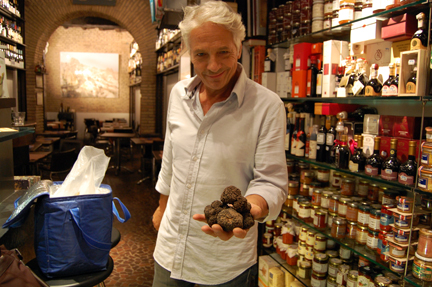
Dino Paolini, truffle “pusher,” stopped by the famous Forno Roscioli while I was there for a late lunch yesterday in Rome.

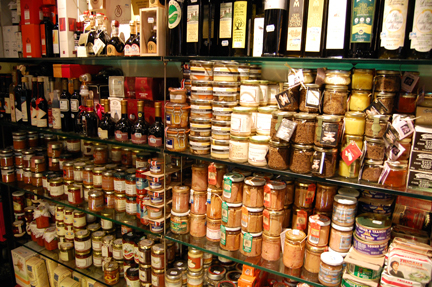
Although an ancient Roman instituion, Roscioli is part of a new and growing trend of “salumi bars” in major Italian cities, where a wine bar experience is enhanced by a focus on extreme cheese and charcuterie selections.

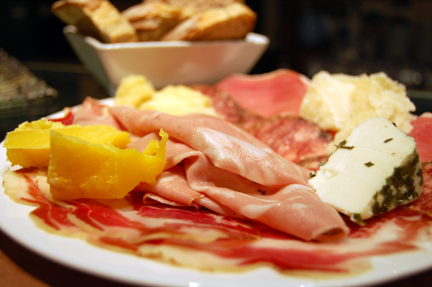
The cheese and salumi sampler featured pecorino from Etna infused with saffron and mortadella studded with black truffles. See what I mean by extreme? (More on the Roman love affair with mortadella later today if I have time.)

The prices were extreme, too, and the attitude precious.

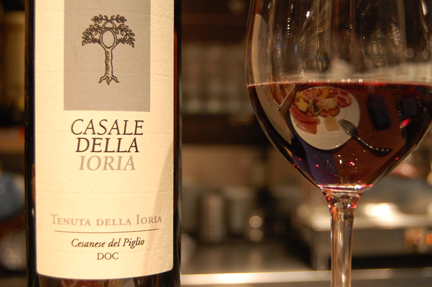
I was happy to get to drink at least one locally produced wine on its by-the-glass list (the only one), Cesanese del Piglio by Casale della Ioria, one of my favorite producers. In the hour or so that I was there, I heard retail customers ask for “heavily barriqued Merlot” (a Friulian man), “Ca’ Marcanda” (German tourists), and “Hofstätter” (a Venetian or otherwise Veneta lady, couldn’t quite place the exact cadence).

In other news…

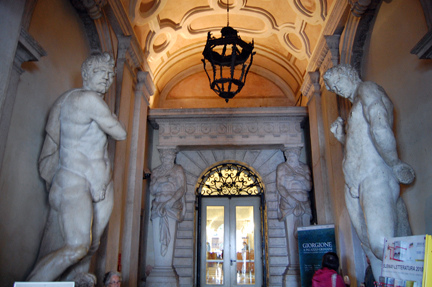
Please indulge me by checking out this photo, of which I am extremely proud, snapped yesterday at the amazing E.U.R. of Rome.

I thoroughly enjoyed my walking tour of the neighborhood (my first time there). James Taylor takes the prize for best pun, Sounds like EUR having a good time…

Thanks for reading, everyone, and for all the great comments… Please stay tuned… The next leg of the trip is going to be a whopper…

Sangiovese: origins of the enonym (grape name)

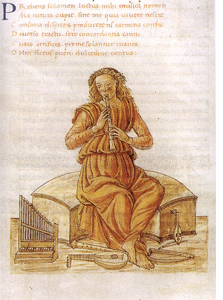
Yesterday on the Twitter, Alfonso asked me about the origins of the enonym Sangiovese. (I bet you’re wondering about the significance of the “allegory of music” from an illuminated Renaissance manuscript to the left but more on that below.)

First off, in all of my readings, I have found no one and nowhere that point to sangue di Giove (blood of Jupiter [Zeus]) as a philologically tenable origin of the grape name. This is what philologists call a folkloric etymology, most likely due to the quasi-homonymic (and Romantic) rapport between the enonym and purported etymon (the literal sense of a word according to its origin). While divine blood plays a central role in Christian myth and liturgy (another element that most likely contributes to the folkloric etymology), it is not found in the Roman or Italian cults that honored Jupiter during the vinaliae (wine festivals) of late antiquity. (For the record, blood does play a role in the myth of Zeus, when the “blood from the birth of Zeus begins to boil up” in a “sacred cave of bees… said to be found on Crete.” See this profile of Rhea, who gave birth to the deity.)

Most scholars believe the most plausible etymon to be sangiovannina, a term which denotes an early ripening grape in the dialect of Sarzana, a township that lies on the border of Liguria and Tuscany in northwestern Tuscany. (Hohnerleien-Buchinger, 1996, cited in Vitigni d’Italia, eds. A. Scienza et alia).

It’s also possible that Sangiovese comes from sangiovannese, an ethnonym denoting an inhabitant of San Giovanni Valdarno, a town in the province of Arezzo. (I actually think this is the most likely answer to the conundrum; here’s a link to the Sangiovannese soccer team website.)
Others yet point to the etymon jugalis (Latin yoke), giogo in Italian, possibly derived from a vine training system. (There is a precedent in the enonym Schiava but I believe this an unlikely linguistic kinship.)

In my research last night (conducted in the golden hour, when the day’s toil is through, and Tracie P and I relax before dinner), I came across a wonderful journal devoted to Romagnolo (the dialect of Romagna). It’s called Ludla (click to download the edition I found), or spark in Romagnolo. In it, I found an article on the origin of Sanzves, the Romagnolo inflection of Sangiovese. Here’s where it gets really interesting…

It’s important to remember that the enonym appears for the first time in Tuscany in the 16th century as Sangiogheto (Soderini, 1590) and today, most ampelographers concur that Sangiovgheto or Sangioveto are geographically aligned with Tuscany while Sangiovese is more closely related to Romagna (on the other side of the Apennines).

The author of the Ludla article proposes that Sanzves might be derived (however remotely) from Mons Jovis, a site near the town of Savignano (where the Romagnoli believe the grape to have originated, another possible linguistic kinship), today known as Giovedìa, where Jupiter (Giove, in Italian) was worshiped in late antiquity.

The bottom line? It’s very likely that we will never know the true origin of the enonym. But that’s not important.

The images that adorn this post (allegories of musica and rehtorica) are culled from a Renaissance codex of De Nuptiis Philologiae et Mercurii (On the Marriage of Philology and Mercury) by Martianus Capella, a pagan writer of late antiquity whose work formed the basis for the study of the liberal arts in western civilization. Philology is literally the love of words and Mercury is the mythical embodiment of commerce or intelligent pursuit.

While we may never know the etymon of the enonym, the journey of discovery by the way offers rewards all the more satisfying to our intellectual curiosity, emboldening our knowledge and awareness of the world around us.

When we marry the love of words and intelligent pursuit, only good things are bound to happen. The same thing happens when we pair a great bottle of Brunello with a bistecca alla fiorentina (something I hope to do later this week).

Thanks for reading…

95 Raveneau Monts Mains (!) and my guacamole recipe

From the department of “dreams do come true”…

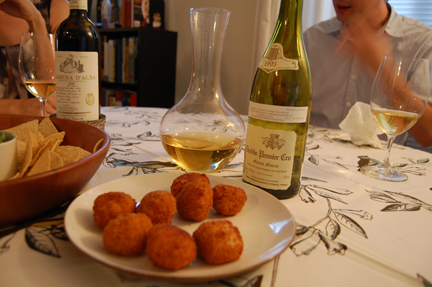
Our new friends Sonia and Steven came over for a school-night dinner last night and what a school-night it was! We were utterly floored by the bottle they brought over: 1995 Raveneau Monts Mains 1er Cru.

“I thought you might enjoy this,” said Steven wryly.

My goodness, what a bottle of wine! Such a nuanced nose of fruit and herbs, so steely and rich in the mouth. At 12.5% alcohol (according to the label), one of the most balanced and complete wine. Simply stunning. (Those are Tracie P’s rice balls in the photo btw.)

With Labor Day imminent, I’ve been wearing my Seersucker jacket all week and indulging in the foods of summer, including my guacamole (of which, I will admit it, I am extremely proud). The trick is to purge the tomato of its water before assembly. Check out the recipe below.

Steven’s from Texas originally and has recently returned to Austin: he and Sonia have a lot of big plans, culinary and otherwise… More on that later.

In the meantime, seems that Tracie P and me aren’t the only ones eating and drinking well this summer. Pastrami mia: I guess Alfonso gave up on his health kick when tempted with the pastrami of Shapiro’s in Indianapolis. I think I feel an acute case of pastrami envy coming on!

Happy Labor Day ya’ll!

Jar’s Guacamole*

American Spanish guacamole, adaptation of Nahuatl ahuacamolli, from ahuacatl avocado + molli sauce (OED online edition).

1 medium-sized tomato
1 bunch cilantro
½ white onion
1 jalapeño pepper
1 clove garlic
2 ripe avocados
2 limes
kosher salt
freshly ground pepper
chili flakes

Finely dice the tomato and transfer to a colander. Sprinkle lightly with kosher salt and allow the tomato to purge its water for about 30 minutes.

In the meantime, rinse the cilantro, dry well, and finely chop. Peel and mince the white onion. Deseed and finely chop the jalapeño. Peel and mince the garlic and combine all of the above ingredients, including the tomato (water purged), in a mixing bowl. Peel and finely dice the avocado and fold into the mixing bowl. Squeeze and strain the limes directly into the guacamole. Season with kosher salt and freshly ground pepper to taste. Add chili flakes to obtain desired heat (and/or use some of the discarded seeds from the jalapeño).

* Jar, my nickname from childhood, still used by my rock ‘n’ roll friends.

The basil of Salerno and Lisabetta’s tears

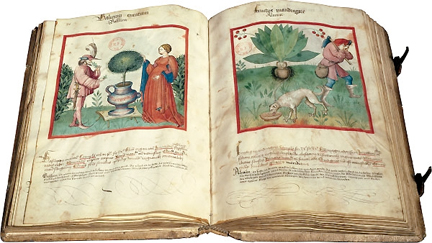
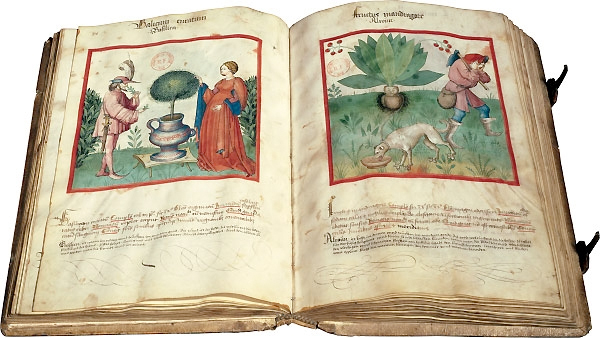
Above: Basil was prized for its healing properties for external wounds in the Middle Ages. The image of basil (note the presence of a woman and man) on the verso (left) is taken from the Tacuinum Sanitatis, in this case Codex Latinus 9333 from the Bibliothèque de France in Paris (click here to view a larger version). It was also a symbol of hate (read on).

I never imagined that my post the other day on Fake Pesto would lead to such a long comment thread here at the blog and over in the Facebook feed.

Here at the blog, Hande pointed out rightly that pesto, literally pestle, denotes the dressing for pasta made of ground basil, cheese, pine nuts, garlic, and olive oil. I was surprised to learn that the Genoese Pesto Consortium’s officially sanctioned recipe allows for walnuts (as a substitute for pine nuts) and Parmigiano Reggiano along with (the more traditional, in my view) Pecorino. As per Hande’s comment, when I wrote that pesto is traditionally served with boiled potatoes and green beans, I should have noted that the dish is properly called pesto avvantaggiato, literally, enriched pesto, whereby trenette or trofie (noodles) are tossed with the pesto, the boiled potatoes and green beans, and some of the cooking water from the vegetables. Thanks again, Hande, for keeping me on my toes!

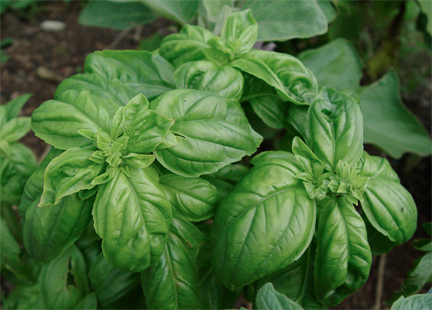
Image via SchoolGardenWeekly.

But when friend Leslie noted (over in the Facebook thread of the post) that basil is an anti-depressant, I began to think about one of my favorite novelle from Boccaccio’s Decameron, the Tale of Lisabetta da Messina.

    Lisabetta’s brothers slay her lover: he appears to her in a dream, and shews her where he is buried: she privily disinters the head, and sets it in a pot of basil, whereon she daily weeps a great while. The pot being taken from her by her brothers, she dies not long after.

    And so, saddest of women, knowing that she might not bewail him there, she would gladly, if she could, have carried away the body and given it more honourable sepulture elsewhere; but as she might not so do, she took a knife, and, as best she could, severed the head from the trunk, and wrapped it in a napkin and laid it in the lap of her maid; and having covered the rest of the corpse with earth, she left the spot, having been seen by none, and went home. There she shut herself up in her room with the head, and kissed it a thousand times in every part, and wept long and bitterly over it, till she had bathed it in her tears. She then wrapped it in a piece of fine cloth, and set it in a large and beautiful pot of the sort in which marjoram or basil is planted, and covered it with earth, and therein planted some roots of the goodliest basil of Salerno, and drenched them only with her tears, or water perfumed with roses or orange-blossoms. And ’twas her wont ever to sit beside this pot, and, all her soul one yearning, to pore upon it, as that which enshrined her Lorenzo, and when long time she had so done, she would bend over it, and weep a great while, until the basil was quite bathed in her tears.

    Fostered with such constant, unremitting care, and nourished by the richness given to the soil by the decaying head that lay therein, the basil burgeoned out in exceeding great beauty and fragrance.

There is so much I’d love to share about this truly fascinating (at least to me) story and the role that basil plays in it. Boccaccio’s Decameron has so many wonderful references to food and wine in it. (Read the entire tale in English here.) But, ahimè, professional duties call… I hope you enjoy it as much as I do.

In the meantime, here’s a scene from Pasolini’s version of the tale:

The story behind Nascetta (and Anascetta)

Romeo, doff thy name!

Above: Valter Fissore of Elvio Cogno (Novello) single-handedly delivered the Nascetta grape from oblivion after he tasted a wine made using this once highly praised grape in 1991. The wine had been bottled in 1986.

It’s regrettable that when I tasted the Nascetta grape for the first time last year, it was served to me ice cold and was described as a “light-bodied white wine.”

While in Piedmont in March of this year, I happily learned that Nascetta is actually a noble white grape variety that can produce long-lived, structured wines. And I had the great fortune to taste Valter Fissore’s excellent 2001 bottling — a nearly decade-old expression of this grape. In my notes, I wrote “rosemary, sage, petrol,” and was blown away by the structure of the wine, its lively acidity, and most of all its gorgeous, unctuous mouthfeel.

Yesterday, in a wonderful post on drinking the last extant bottling of a vintage, Cory nudged me to fulfill a promise to explore the origins of the name. And so here it is.

First of all, a little history.

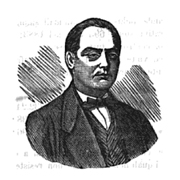
The name Nascetta was coined by 19th-century Piedmontese enologist Giovanni Gagna (left, 1833-1881), who believed erroneously that the grape was related to the Sardinian grape Nasco (from the Sardinian nuscu, from the Latin muscus, meaning moss). Remember: for the better part of the 18th and 19th centuries, Sardinia, Nice, Savoy, and Piedmont were ruled by the House of Savoy (the Kingdom of Sardinia), with its court in Turin and so commerce between Sardinia and Piedmont was fluid during that period.

In 1877, Count Giovanni di Rovasenda listed the grape using its dialectal name, Anascetta, in his landmark Saggio di una ampelografia universale (Essay on Universal Ampelography). The fact that he uses the dialectal inflection of Gagna’s name for the grape is an indication of how popular the grape was in Piedmont at that time, when it was commonly blended with Favorita (Vermentino) and Moscato. (In Piedmontese dialect, an initial a is added to certain words to compensate for syncopated, i.e., lost vowels; in this case, the acquisition of the initial a would appear hypercorrective, a phenomenon not uncommon in the morphology of Piedmontese.)

Here’s where it gets a little complicated.

Above: The confusion regarding the name of this grape was created in part by Valter’s frustration with labeling requirements. In 2001, he bottled the wine as a non-vintage vino da tavola (table wine) because the grape was not yet authorized for the Langhe Bianco DOC appellation.

Let’s start with some chronology:

1991 – Valter tastes a bottling of 1986 by farmer Francesco Marengo (Novello).
1994 – Valter produces 800 bottles from his own planting of the grape, labeled as Nas-cetta; following this vintage, Valter is forced to stop labeling the wine as Nas-cetta after he is fined for listing an unauthorized grape variety name on the label.
2000 – Nascetta (the grape) is added to the catalog of authorized grape varieties for Langhe.
2004 – Valter bottles the wine as Langhe Bianco DOC but cannot list the grape variety on the label; he labels the wine “Anas-cëtta” using a “fantasy” name because the grape is not authorized for the Langhe Bianco DOC labeling (it’s authorized for the blend but not the label).
2010 – After Valter’s successful lobbying, the 2010 vintage will be first labeled as Langhe Nascetta [sic] DOC.

Above: Valter’s Nascetta is an excellent value for a structured, age-worthy white. Be sure to serve it at cellar or room temperature.

When I asked Valter directly about his use of diacritics (in this case the umlaut and the hyphen), he told me flatly that he introduced them in the labeling for purely proprietary reasons. The mutation of the grape names Nascetta and Anascetta was inspired by his frustration with labeling requirements. The good news is that the confusion has been resolved and this noble white grape will be labeled as “Langhe Nascetta DOC” beginning with the 2010 vintage.

While in Piedmont in March, I also tasted another excellent bottling of Nascetta by Rivetto.

Be sure to read Cory’s post on the last bottle of 2001 and Whitney’s post, too.

… O, be some other name!
What’s in a name? that which we call a rose
By any other name would smell as sweet;
So Romeo would, were he not Romeo call’d,
Retain that dear perfection which he owes
Without that title. Romeo, doff thy name,
And for that name which is no part of thee
Take all myself.

Veraison wireless in Montalcino

My friend Ale at Il Poggione (Sant’Angelo in Colle, Montalcino) is not the only one who’s been posting about the 2010 vintage on his blog.

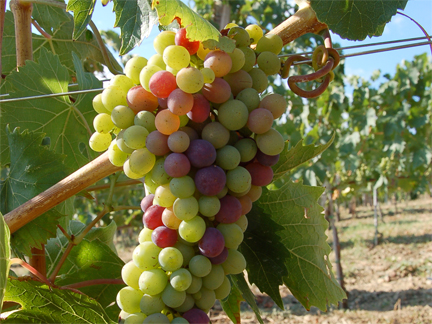
Another good friend, Laura, has been doing some amazing posts at the blog she authors for Il Palazzone. The photo above comes from a wonderful post she did showing the different ripening times in different growing zones of the winery’s estate.

One of things I’ve been enjoying about following Laura and Ale’s respective blogs is how it illustrates the subtle (and sometimes not so subtle) differences in the various subzones of the appellation.

In the case of Ale in the southwest subzone, the rate of ripening has accelerated slightly (80% of the grapes have changed color, he writes, catching up to the average) while Laura’s grapes are still about a week behind schedule. I love how she writes: “The ripening seems to be more than a week behind schedule, if it is appropriate to apply such concepts to nature.”

Check out Laura’s most recent post and Ale’s thread on the 2010 harvest in Montalcino.

In other news…

Another Brunello has been born with the 2010 vintage…

Over the weekend, Tracie P and I got to visit with our good friends Melanie and Noah, who have just welcomed Bruno into the world. Don’t they look angelic?

Noah and I grew up together (even attending Hebrew School together!) and luckily their stay in La Jolla overlapped with ours. Melanie has taken to calling the little one “Brunello.”

I still haven’t had a chance to pick up my copy but Melanie’s new book Eating for Beginners is now available.

Mazel tov, Melanie, Noah, and Bruno!

@Bruno I’ll be sure to put away some 2010 Brunello to drink with you when you turn 21!

Rewind: The origins of sugo alla puttanesca?

Taking a break today and reposting something from the days when Do Bianchi was just getting started. One of my favorite posts. Little did I know at the time that I would meet and marry a wonderful, beautiful lady who had lived on the island of Ischia and who makes the best puttanesca I’ve ever tasted… Thanks for reading! And happy Bastille Day!

Above: spaghetti alla puttanesca. There’s one thing we can all agree on: “sugo alla puttanesca” (literally “whoreish sauce”) is made with tomatoes, olives, capers, salt-cured anchovies, garlic, and chili flakes (give or take an ingredient or two). There’s no questioning that it tastes good.

In the wake of my post-new-year’s eve post “Taittinger alla puttanesca”, fellow bloger Marco wrote me, collegially questioning my belief that “sugo alla puttanesca” should not be attributed to prostitutes or their culinary preferences. I promised Marco that I would do some more research and another post. Here’s what I found:

1) the earliest text to reference pasta “alla puttanesca” cited by the Grande dizionario della lingua italiana (edited by Salvatore Battaglia) is Raffaele La Capria’s 1961 novel Ferito a morte (translated as The Mortal Wound, 1962).

2) according to a study commissioned by the Unione Industriali Pastai Italiani (Italian Pasta-Makers Union), pasta “alla puttanesca” first became popular in Italy during the 1960s.

3) a search in The New York Times electronic archive revealed that the first mention of “puttanesca” sauce in the paper was made on January 28, 1972 by restaurant reviewer Jean Hewitt in her review of Trattoria da Alfredo (then located at 90 Bank street): “spaghetti Puttanesca [sic], which has a tantalizing tomato, garlic, anchovy and black olive sauce.”

4) in her landmark tome on Neapoitan cuisine, La cucina napoletana (1977), Jeanne Carola Francesconi attributes the creation of sugo alla puttanesca to Ischian painter Eduardo Maria Colucci (1900-1975) who — according to Francesconi — concocted “vermicelli alla puttanesca” as an adaptation of alla marinara or “seaside-style” sauce.

But the definitive albeit anecdotal answer to this conundrum may lie in an article published by Annarita Cuomo in the Ischia daily, Il golfo, in February, 2005: “Il sugo ‘alla puttanesca’ nacque per caso ad Ischia, dall’estro culinario di Sandro Petti,” “Puttanesca sauce was born by accident in Ischia, the child of Sandro Petti’s culinary flair.”

According to Cuomo, sugo alla puttanesca was invented in the 1950s by Ischian jet-setter Sandro Petti, co-owner of Ischia’s famed restaurant and nightspot, the “Rancio Fellone.”* When asked by his friends to cook for them one evening, Petti found his pantry bare. When he told his friends that he had nothing to cook for them, they responded by saying “just make us a ‘puttanata qualsiasi,'” in other words, “just make us whatever crap” you have (see my original post for a definition of the Italian puttanata).

“All I had was four tomatoes, a couple of capers, and some olives,” Petti told Cuomo. “So I used them to make the sauce for the spaghetti.” Petti then decided to include the dish on the menu at the Rancio Fellone but “spaghetti alla puttanata didn’t sound right. So I called it [spaghetti] alla puttanesca.”**

Petti’s anecdote is probably tenable but is by no means exhaustive (from a philological point of view). To make matters worse, Colucci was Petti’s uncle and it’s unclear why Francesconi attributes the dish to the painter. But philology is an inexact science: the origin of sugo alla puttanesca probably lies some where between the isle of Ischia and the Amalfitan coast, where tomatoes, capers, olives, anchovies, and garlic are ingredients of choice. It’s clear that the dish emerged sometime after World War II when tomato-based sauces grew in popularity among the Italian middle class. My philological sensibility leads me to favor the “puttanata/puttanesca” theory over any other and there is no evidence — at least that I can find — that points to prostitution as the origin of the dish.***

There’s one thing we can all agree on: sugo alla puttanesca tastes good.

* A rancio fellone is a sea spider or spiny crab, a common ingredient in Mediterranean cuisine.

** Like the French à la, the Italian expression “alla” (the preposition a + the definite article la) denotes “in the style of” or “after the fashion of” and is always followed by an adjective (not a noun); alla puttanesca sounded better to Petti because puttanesca is an adjective (while puttanata is a noun).

*** In his Naples at Table (1998), the otherwise venerable but hardly philologically minded Arthur Schwartz reports a number of apocryphal etymologies whereby Neapolitan prostitutes are indicated — in one way or another — as the originators of this dish. He even goes as far as to write that a seemingly celebrated nineteenth-century courtesan, Yvette “La Francese” (Yvette the French [prostitute]), a native of Provence, may have created the dish to assuage her homesickness. The fact that the dish emerged during the 1950s would seem to dispel any romantic notions of pasta alla puttanesca in nineteenth-century Neapolitan bordellos. Brothels were outlawed in Italy in 1958.

Bricco, bric: origins of the word and why literature is so important to understanding Italian wine

bricco boschis

Above: A vineyard that produces one of my favorite wines, the Barolo Bricco Boschis by Cavallotto (photo taken in February on our honeymoon). Bricco Boschis means literally the “crag in/of the woods.” Note how the snow has melted at the very top of the crag. As the old (and young) folks in Langa will tell you, the best places to grow Nebbiolo for Barolo and Barbaresco are where the “snow melts first,” an indicator of ideal exposure to sun light.

While I haven’t had much time to work on my Italian Winery Designation Glossary, I did want to post my research on the vineyard designation term bricco and its origins (since so many people have written me asking me about its meaning and usage).

The best translation for the term bricco or bric is crag (“a steep or precipitous rugged rock,” Oxford English Dictionary, online edition), equivalent to the Italian dirupo.

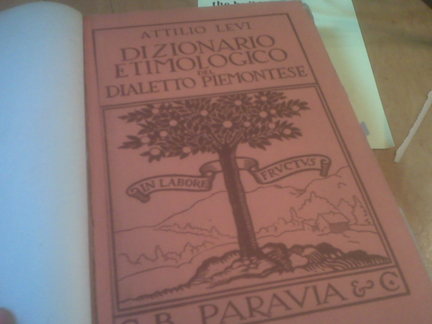
Above: I found this wonderful book at the New York Public Library.

Most etymologic dictionaries point to an unknown origin of the word but, while in NYC, I did find a wonderful (yet forgotten) fascist-era dictionary of Piedmontese dialect that reported the Provençal brich as the etymon.

But my most fascinating discovery was the eureka moment when I found one of the earliest known appearances of the term in print.

According to the Grande Dizionario della Lingua Italiana (the unabridged dictionary of the Italian language), the great 20th-century Piedmontese novelist and poet Cesare Pavese was probably the first to use it in a narrative, his masterwork no less, La luna e i falò (The Moon and the Bonfires), written in 1949 and first published a few months before his suicide in 1950.

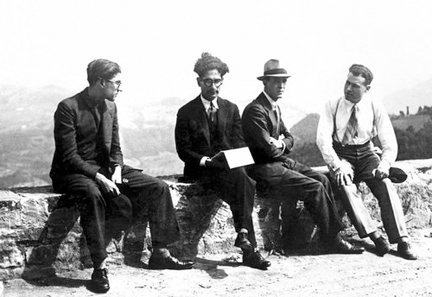
Above, from left: Cesare Pavese, Leone Ginzburg, Franco Antonicelli, and Augusto Frassinelli “in the 40s in the Langa hills.” (Source: Panorama.)

Here’s the passage (p. 30):

    fa un sole su questi bricchi, un riverbero di grillaia e di tufi che mi ero dimenticato.

As translated and published by R.W. Flint (a translator I admire greatly) in 2002:

    There’s a sun on these hills, a reflection from the dry soil and volcanic stone, that I’d forgotten.

It’s difficult for me to convey just how pregnant with signficance this line is, especially within the context of Pavese’s masterpiece. (See this synopsis of the novel and translation and profile of Pavese in The New York Review of Books.)

Flint renders an excellent translation of the line, perfectly aligned with the tone of the original and the translation as a whole. I like the way he has delivered grillaia into English: a grillaia is an ironic term that means literally a place where you’ll find only crickets (grilli), in other words, a barren or infertile place.

When the main character of the novel, Anguilla, returns from America after Italy’s Liberation from Fascism (but before the end of the Second World War), he is reminded of the barren nature of these hills — these infertile crags.

Let me offer an alternative, annotated translation:

    A sun beats down on these crags, reflecting off rocks fit only for crickets and the [nutrient-poor] volcanic soil — something I’d forgotten [while I was away in America, an Italian immigrant who fled fascism].

Is it not all the more remarkable that those very crags (bricchi) would ultimately deliver one of the greatest winemaking traditions of post-war Europe — Barolo and Barbaresco?

Post script: When I visited Langa in March 2010 with the Barbera 7, one of the wines that impressed me the most was the Lurëi by Il Falchetto in Santo Stefano Belbo, where Pavese was born in 1908.

Better than the Da Vinci Code: more Santorini sleuthing!

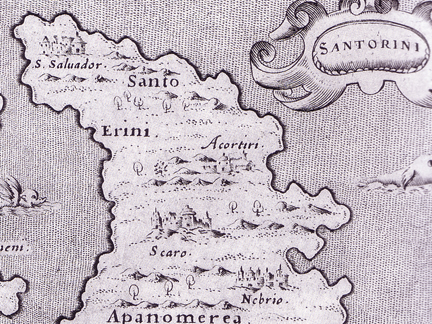
Posting in a hurry today but just had to get this up on the blog. After I posted the other day debunking the myth that Italian Vin Santo and Greek Vinsanto are related in any other way beyond a homonymical coincidence, the chief enologist at Boutari (whose social media project is managed by me), Yannis Voyatzis, express-mailed me a wonderful volume on the wines of Santorini, which (literally) just arrived. In it, I found this wonderful reproduction of a map, printed in 1576 by a Venetian printer. As you can see above and in the detail below, in late 16th-century Venice, the Venetian name of the island Santorini was already well-established.

But more importantly, you can see that the name Santo Erini was still prevalent.

I believe that this supports my theory that the Greek appellation name Vinsanto comes from Vin[o di] Santo[erini].

I’ll have a great deal to say about this in an upcoming post. Early Venetian printing was one of the subjects of my doctoral thesis and I think I’ll have some interesting insights for the philologically inclined among us.

I’m super slammed with work today but just had to share this find asap.

Is this better than the Da Vinci Code OR WHAT???!!!! :-)

Debunking the [Greek] Vinsanto and [Italian] Vin Santo myth

Map thanks to the Wiki.

Ok, so since I began working on the Boutari Social Media Project, I’ve been spending a lot of time thinking about Greek wine and trolling the internets for Greek wine tidbits. In the light of this and the fact that I am a self-proclaimed lover of Italian wine and a moonlighting Italian wine historiographer, I feel compelled today to address the forgivable yet undeniably erroneous assumption that the grand traditions of Vin Santo in Italy and Vinsanto in Santorini (Greece) are related in any other way than the homonymical resemblance of their respective designations.

In other words, I’m here today to tell you that the Italian wine is called Vin Santo and the Greek wine is called Vinsanto but the wines are highly distinct from one another in style and substance and history and their relation is purely linguistic. The names sound similar (and there’s a reason for that) but it has nothing to do with the wines themselves, ok?

Exhibit A is the map above. By 1450 The Most Serene Republic of Venice controlled areas highlighted in bright green in what is now modern-day Greece. (I could go on for hours on the Venetian control of Greece and its cultural implications at the time but that’s besides the point.)

Exhibit B is the name of the island of Santorini. The Venetians gave it this name when they controlled the island and its trade during the Renaissance and beyond. The toponym arises from a corruption of the expression agia eirini, ultimately Santa Irene, and subsequently Santorini in the parlance of the Venetian merchants of that era (up until when the Sultan came knocking again, but that’s another story).

(Nota bene: I could find no philologically credible source that pointed to xantos as the origin of the island’s name [as per the Bessarione myth]. All reliable sources point to a [pseudo] Santa Irene as the origin of the Venetians’s name and the contemporary name [Σαντορίνη in contemporary Greek] for the island.)

Above: In a politically aligned marriage that helped the Republic of Venice to secure trade routes in Greece, Venetian noblewoman Caterina Cornaro reigned as the queen of Cyprus in the late 15th century. Photo via Asolo.it.

The most likely explanation for the confusion is that Venetian merchants and perhaps their customers once called the wines they found on Santorini (as the island of Thera was known then and is known today) Vinsanto, an abbreviation of vin[o] santo[rini] (Italian readers of my blog will immediately recognize the important role that the term santo plays in the Venetians’s weakness for blasphemy and related wordplay [paranomasia]).

I don’t have time to document properly the sources I’ve consulted today and I can only beg your patience to trust that I’ve done the legwork (and I have, btw).

I will close today’s post, written in haste, with a passage from the inimitable Kostantinos Lazarakis’s The Wines of Greece (Mitchell Beazley Classic Wine Library series):

    It is difficult to compare vinsanto with Tuscany’s vin santo, especially since the latter can vary from fino sherry-like dryness to highly oxidized sweetness. Most of the volatility in vin santo comes from the barrel-ageing, while vinsanto develops it mainly through sun-drying. Vin santo is dried in the shade, more gently, but for longer. (p. 381)

In fact, the Vinsanto of Santorini is made from Assyrtico and Aidani grapes that “are left on the vine to reach high levels of ripeness… After drying, the grapes are crushed and fermented, mostly on their skins.” Vin Santo from Tuscany, the Veneto, and Trentino is made from grapes dried on mats in the attic of a farmhouse. (There are a number of other elements that make Vin Santo different: the Easter week vinficiation tradition — after the wines have dried slowly on the mats over the winter — and the use of a mother yeast culled from previously used aging cask, for example.)

And I’ll also share the following passage, a little nugget I found in my research, translated slavishly (by me), from the Dizionario del dialetto veneto [Dictionary of Venetian Dialect], compiled by Giuseppe Boerio and published by Giuseppe Cecchini in Venice in 1867, p. 527.

    Vin santo, noi chiamiamo quel vino, che in qualche luogo dello Stato ex Veneto si fa la settimana santa coll’uva appassita, ed è un eccellente liquore che chiamasi Vino santo per esser appunto fatto ne’ giorni prossimi alla Santa Pasqua.

    Vin santo [is what] we call the wine, which, in certain places of the Ex-Veneto State, is produced during Holy Week with dried grapes. And it is an excellent liquor that is called Vin santo for the very fact that it is made during the days close to Holy Easter.

This is the first credible source I’ve found so far where the name of the Italian wine is attributed to the tradition of vinification during Holy Week.

I’ll provide all the footnotes for wine geeks and the philologically inclined, I promise, soon! One lazy Sunday afternoon when Tracie P is busy in the kitchen. Thanks for reading!