Congratulations Kate and Dan! Mazel Tov ya’ll!

What a beautiful setting and gorgeous wedding in the Santa Ynez Valley!

This is just one of the amazing sunset photos that Tracie P took with our trusty Nikon.

Among other wedding duties, musical and otherwise, Dan enlisted me to play the hora.

I think it’s safe to say that I got the job done. ;-)

It was so great to see so many old friends, from NYC and LA, and to meet Kate’s family from Scotland.

Mazel tov, ya’ll!

Scenes from an East Texas 4th of July

Watermelon lady Maria gets her melons from Pitkin, Louisiana, where the sandy subsoil and high potassium content are ideal for the cultivation of tasty watermelons, she said.

This sweet lady made her patriotic vest herself.

We saw this license plate on our way over to Port Arthur. Translation: “Oklahoma University girl.”

Tracie P and I went bowling with nephew Brady to celebrate his birthday (4th of July).

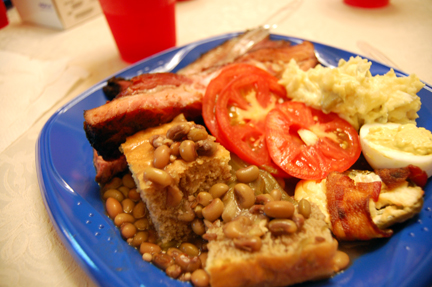
Purple hull peas, cooked with okra and served over crumbled cast-iron-skillet-fired corn bread was the highlight of dinner at Uncle Tim and aunt Ida Jean’s house on Cow Bayou. I had two servings of Tim’s award-winning potato salad.

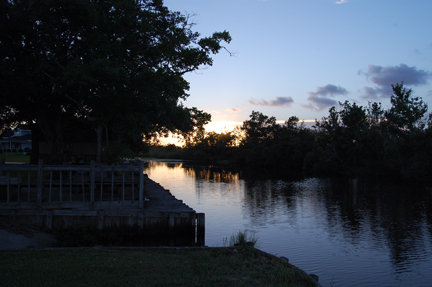
Sunset on Cow Bayou. I hope everyone had a fun and safe 4th!

On deck for tomorrow: the origins of the word “bric” and “bricco.” Stay tuned…

I’d make love to her in a New York minute…

and take my Texas time doing it…

You get the idea ;-)

New York City was a lot of fun, but, man, it’s good to be back in Texas and reunited with that super-fine lady of mine

Now playing chez Tracie and Jeremy P:

Ever since I’ve known ya you’ve belonged to someone else
So we’ve never talked about romance
But I think it’s time I told you the way I’ve always felt
And what I’d do if I got the chance

I’d make love to you in a New York minute
and take my Texas time doing it
I’d do you every way but wrong
I’d make love to you in a New York minute
and take my Texas time doing it
I’d prove to you that in my arms is where you belong

Don’t misunderstand me I wouldn’t steal you from your man
But if he’s ever fool enough to leave
Well you know how to reach me and you know where I am
And you know what I’d do if you were free

I’d make love to you in a New York minute
and take my Texas time doing it
I’d do you every way but wrong
I’d make love to you in a New York minute
and take my Texas time doing it
I’d prove to you that in my arms is where you belong

Italian old-school rope barometer

Sent to me by Italian-university-days roomate and super good friend, Steve Muench (scroll down for his self-portrait), who lives not far from the dorm where we first met in Padua, with his wife Sita and their beautiful daughters. He snapped this on their recent vacation in Umbria.

@Steve how long have we known each other? twenty-some odd years now? :-)

translation

Rope Barometer

Dry Rope
Good Weather

Wet Rope
Rain

Rigid Rope
Cold

Invisible Rope
Fog

Flapping Rope
Wind

My favorite is “invisible rope [=] fog.” If it ain’t broke, don’t fix it!

I hope everyone is having a relaxing Saturday like me and my Tracie P! :-)

Reunions and Indian Paintbrushes

Prodottori del Barbaresco 2005 Barbaresco was the wine that I ordered to share with the adults on Saturday night in Houston at the Levy-Parzen-Rosenberg family reunion, although not everyone cared to try my selection. That’s Aunt Lilian (from left), cousin Marty, and father Zane. I guess reunions like this are bound to be sweet and bitter — the glass shared and the glass refused. It seemed only fitting that my wine of choice would be Produttori del Barbaresco since its flavors and aromas, its terroir and its ethos are red threads woven into the fabric of my life with Tracie P. The glass offered, the glass received, the glass refused.

Marty did a great job of organizing the dinner on Saturday night and cousins Dana and Neil treated everyone to a beautiful brunch on Sunday morning.

It’d be untrue for me to say that I wasn’t a little bit melancholy on the drive back to Austin from Houston. The sky was gray and cloudy but the fields were full of brilliant colors, like these Indian Paintbrushes.

The Texas countryside is beautiful this time of year.

Tracie P and I took our time getting home, making a detour around Zionville to enjoy the beautiful springtime scenery and to talk about the history of my family and the many kinfolk she met over the weekend.

And to remember the sweet fruit of the wine and its balance with the bitterness of its tannin.

More chestnut-flour polenta and pork facial glands

polenta

Wow, thanks, everyone, for all the wonderful comments and emails about yesterday’s post on dinner in the home of the lovely Bindocci family in Sant’Angelo in Colle (Montalcino, Siena). I thought I’d post a few more photos from the dinner. And thanks, especially, to Stefania and Fabrizio, who so graciously welcomed us into their home. That’s Stefania, above, slicing the chestnut-flour polenta with a string.

polenta

The incredible sensual experience of the chestnut-flour polenta is its combination of its sweet, chestnut flavor combined with its inimitable texture. The night we were invited, Fabrizio’s niece was there with her husband. They had just returned from Libya, where they had been living (they’re agricultural engineers and they work to create sustainable farming in the third world). To celebrate their return, Stefania had created this traditional Mt. Amiata menu (she was born in the mountains, while Fabrizio was born on the Orcia River Valley floor).

polenta

@BrooklynGuy the delicate but firm-to-the-bite texture of the pork facial glands (almost like candy), which have imparted their flavor to their cooking liquid, combined with the pillowy softness of the polenta was an unforgettable sensorial event in our mouths. The porousness of the polenta proved an ideal receptacle and medium for the rich jus of the offal. The two worked in concert, in a dynamic dialectic that rewarded the senses with its seamless ingenuity.

polenta

In another era, the slaughter of a pig was an important event in the familial and societal rhythm of life. While most of the pork was “put up,” as they say here in Texas, in the form of cured thigh and sausage, the offal was consumed in celebration of the good fortune of avere le bestie, as they say in Italian, of having beasts (i.e., livestock) on your estate. One of the coolest things about Il Poggione is that it is a working, integrated farm, where livestock is raised and sent to pasture in fields adjacent to the vineyards and olive groves. The integrated approach, says Fabrizio, is an important element in creating the terroir-driven wines for which their winery is so famous. We paired the 2006 “owner-selection” Rosso di Montalcino with the chesnut-flour polenta and pork facial glands (we served the 07 Rosso di Montalcino by Il Poggione at our wedding reception).

polenta

Some of the most memorable meals I’ve had in Tuscany have been centered around pig and boar liver. It’s so important to experience the wines of Montalcino (and Sangiovese in general) in the context of food and pairing. The 2001 Brunello by Il Poggione was such a fantastic wine — a great vintage from a great producer. But the greatest treat was to taste it in the context and flavor “economy” of traditional pairings. The tannin, red fruit, and acidity of Il Poggione’s Brunello, paired with nearly impenetrable richness and deep flavor of the liver, assumed a new ontographical significance, by which, I mean our ability to describe the nature and essence of things.

We ate liver again on the next day of our trip in Bologna… and there was an important reason for that. More on that later…

Please stay tuned and thanks, again, for reading and for the thoughtful comments… :-)

Claude Lévi-Strauss and (not so natural) wine

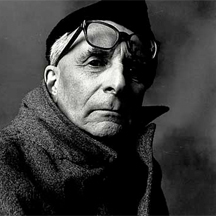
claudeReading over today’s obituary of that looming figure of the twentieth- (and twentieth-first-) century who seemed to watch over every discipline of critical theory, Claude Lévi-Strauss, I couldn’t help but apply my dusty knowledge of his structuralism to the hegemonic culture of wine today. After all, in some ways similar to Freud, Lévi-Strauss, who transpired over the weekend, will be remembered as much for his contribution to literary theory and epistemology as he is for his unapologetic transformation of the field of anthropology.

His fear of and subsequent predictions of a western behemoth “monoculture,” as it came to be known, have certainly taken shape in the evermore homologated contemporary world of wine today. The west, he wrote with words that seem to speak directly to the modern vs. traditional debate in European wine today, could destroy itself by “allowing itself to forget or destroy its own heritage.”

Lévi-Strauss wrote famously about wine: his treatment of the wine culture in southern France in his study The Elementary Structure of Kinship is often cited by scholars. (He also wrote about wine in The Origin of Table Manners.)

But wine, like bread, also held a special place in the lexicon of the great scholar and thinker. Like bread, wine represented for Lévi-Strauss a post-Neolithic technological transformation of the natural. Society (and the universal values that tie every expression of human experience together) is defined, according to Lévi-Strauss’s view, by a “rational” transformation of nature.

As Edward Rothstein wrote so ably in The New York Times today:

    Lévi-Strauss rejected Rousseau’s [historically romantic] idea that humankind’s problems derive from society’s distortions of nature. In Mr. Lévi-Strauss’s view, there is no alternative to such distortions. Each society must shape itself out of nature’s raw material, he believed, with law and reason as the essential tools.

Alas, we’ll never be able to ask Lévi-Strauss where he stands in the overarching dialectic of natural wine (and I can only imagine the ire this post will spark!). My own thought is that Lévi-Strauss and structuralism offer us a tool for understanding wine and its relationship to society. One can argue the finer points of ambient yeast, zero SO2, and minimal intervention vs. manipulation. But there is no denying that wine as an expression of society is shaped out of nature’s raw material by humankind — however minimal the intervention. Society by definition (and is there any wine that exists outside of society?) offers no alternative to the distortion of nature. Fermentation can occur spontaneously in nature. But the rational hand of humankind is what turns fermentation into wine.

What would Lévi-Strauss say? And who really cares? Probably no one but me.

What I can say for sure is that humankind has lost one of its greatest thinkers and one of the voices that helped to shape the very ideological dialectic from which the natural wine movement has culled its roots. If I only had a bottle of zero-SO2 Beaujolais for every night I spent cramming over the writings of Lévi-Strauss for my critical theory exams in grad school!

Lévi-Strauss, old man, you will be sorely missed…

Lucky to be alive and a lot to live for

The rain just didn’t want to stop falling as Étienne, John, and I made our way from Austin to Dallas yesterday for business meetings and a tasting of Étienne’s family’s wines. My friends and family know that I am a very cautious, prudent driver, even to the point that some will tease me. It was one of those bad Texas rain storms, a “white-knuckle” tempest as some would say, and so I maintained a pretty steady 60 mph as we headed north on I-35. It wasn’t long after my habitual pit-stop at Italy, Texas, about 30 minutes outside of Dallas, that a gold Mercedes spun out of control about 150 yards ahead of us, bouncing off the median divider and sliding lengthwise across the highway directly in our path. I swear, and John, who was in the front passenger seat, told me that he had the same experience: everything seemed to appear in slow motion, despite the celerity with which events unfolded. I didn’t want to break too hard because the road was wet. We were in the middle of three lanes. My instinct told me to swerve right to avoid the oncoming car but I glanced in my right-side mirror and saw there was an 18-wheeler behind me in the far-right lane. It seemed that we were going to collide with the Mercedes head-on.

In that moment, I thought I was going to die.

But then a miracle happened: the Mercedes seemed to bounce off of the front bumper of my Hyundai, like a billiard ball, and it kept moving, colliding with the truck that had passed me on the right. It then flew back across the freeway in front of us and finally stopped moving when it hit the median divider. By this point, I had managed to stop my car.

We were lucky to be alive. The driver of the Mercedes was alive and conscious and the emergency team arrived swiftly and took him away.

The right side of my bumper had been dislodged but a tap put it back into place. There’s barely a scratch on my car. A miracle.

Beyond the adrenaline rush, Étienne, John, and I were 100% fine.

Later, that night, following long meetings and a tasting, Alfonso hosted us all for dinner at his house. We paired his chipotle-chili-marinated, grill-fired pork and baked potatoes with the Étienne’s Domaine de Montille 2006 Volnay 1er cru Les Mitans and a Produttori del Barbaresco 2001 Barbaresco Pora. Étienne told me with a big smile, “you can write on your blog that I love Barbaresco!”

We were lucky to be alive.

We got back to our hotel around 10 p.m. and retired and I was finally able to call Tracie B, who shared the wonderful news that her childhood friend Jennifer had posted our engagement photos on her blog. (Click the photo above to see them all, if you like.)

I don’t know that everything happens for a reason, and even though I believe in God, I’m not sure there is a divine plan. I do know that I love Tracie B with all my heart and all my soul and the joy that she has brought into my life is the greatest miracle anyone could wish for. To imagine my life without her is to imagine a life without meaning, direction, or purpose. I can’t say that “my life passed before my eyes” in the moment of the crash. All I could think about was how I’ve finally arrived at this moment after a life that has certainly been interesting but never entirely fulfilled: I have the love of the sweetest, most beautiful woman I’ve ever known, I have my health and my mind, both of our families are with us and healthy and soon will share the joy of our union. And there was even one of Tracie B’s savory oatmeal cookies left in my wine bag for breakfast this morning…

A closer reading: “The vine is the greatest commodity of Tuscany, if not of Italy.”

This just in: taste old Australian Semillon with me at Jaynes Gastropub in San Diego on Saturday, September 26… yes, Australian wine, can you believe it?

Above: At the time of Dallington’s visit to Italy (1596), Bacchus was often depicted with Ariadne, his wife, as in this painting by Guido Reni (1557-1642). Today, we think of Bacchus (or Dionysus) as the god of wine. In fact, he was the god of luxuriant fertility, which was symbolized by the vine in antiquity, and so by association he became the god of wine. In ancient Italy, he was associated with the indigenous god Liber, who was celebrated with joyous abandon during the time of the grape harvest.

My post the other day on an “earlier Tuscan sun” and the description of grape growing and viticulture in late 16th-century Tuscany elicited some interesting comments and questions. Thanks, everyone, for taking the time to read and comment.

Simona, author of Briciole, brought up an important point: in the first line of the passage, Dallington uses the term Italy.

    The Vine.. without comparison is the greatest commodity of Tuscany, if not of Italy

Italy, as we know it today, was unified for the first time for a brief period in the modern era under Napoleon (1805-1814). Only in 1861 did Italy — as a nation — achieve independence from foreign domination. Until that time, the Italic peninsula was divided among its principalities or microstates, which often aligned themselves in league with foreign powers but never achieved a confederation defined by Italy’s natural geographical boundaries.

According to the OED, the toponym Italy begins to appear in the English language toward the end of the sixteenth-century, the same time that Dallington made his trip to Tuscany. (The terms Italy, Italian, and Italo, derive ultimately from the Latin Italia, in turn from the Latin Vitalia from vitulus, meaning calf; the ancient name Vitalia was owed to Italy’s abundant cattle.)

Even though the notion of the Italian nation and the term Italia had distinctly emerged by the 14th century (think of Petrarch’s song 126, Italia mia, ben che’l parlar sia indarno [My Italy, although speech does not aid]), the citizens of the Duke State of Tuscany encountered by Dallington would hardly have called themselves “Italians.”

Simona was right on: it’s truly remarkable that Dallington uses the term Italy and implicitly refers to an Italian nation. But what I find even more remarkable is the fact that he calls the vine the “greatest commodity of Tuscany, if not of Italy.”

More than two centuries had passed since Petrarch reproached the gluttonous cardinals of Avignon for their immovable love of Burgundian wine, asking them, “Is it not a puerile ambition to malign the many types of wines, so plentiful, found in all parts of Italy?” (See my post on this famous letter by Petrarch to Pope Urban V here.) The papacy was returned to Italy in 1378.

More than two centuries later, a foreigner arrived from Elizabethan England, and called the vine “Italy’s greatest commodity” — a preview of how viticulture would become a sine qua non of the Italian nation and Italian national identity.

This is the first in a series of “closer readings” of the Dallington text inspired by visitors’s comments. Next up: the origins of the term zibibbo. Stay tuned…

Yeaster me, yeaster you, yeaster day

Above: In some parts of the world, the “yeasting” of wines is common practice and is considered a genuinely positive aspect of human intervention, as evidenced in this post by Vinogirl. I don’t know much about Vinogirl but I love reading her blog and her posts about harvest in Napa are wonderful.

Ever the Solomon of wine bloggers, Eric posted Friday on the sometimes “strident” tones tossed about in the debate over natural wine and its definition.

I greatly appreciated Eric’s observation:

    I think that too much effort is spent coming up with a precise definition. Making wines “naturally,’’ after all, does not mean the wines are any good. All things considered, I prefer wine that would fit a rough definition of natural. But I don’t think the dividing line between natural and — what, unnatural? — is always that clear. Certainly, it is not if you are trying to characterize a winemaker.

Above: I tasted with Produttori del Barbaresco winemaker Aldo Vacca this year at Vinitaly. He is one of the most earnest and forthright winemakers I’ve ever met and I love his wines.

It does seem that the one thing that all natural wine lovers — from enthusiast to dogmatist — agree on is that “ambient” or “native” yeasts (i.e., naturally occurring yeasts) are a key if not the key element necessary to be allowed into the natural wine pantheon.

The delicate issue of yeast was illustrated Eric’s account of winemaker Roumier who “tries to make wine as naturally as he can, but he told a story once of having a batch of wine that had gotten stuck in mid-fermentation. The only way he could get it going again was to add yeast, a cardinal sin among many natural wine devotees.”

It made me think of what Produttori del Barbaresco winemaker Aldo Vacca recently told me when I called him to transact some other business but couldn’t resist asking him about the practice of “yeasting” at the winery.

“In a great vintage, we do not add yeast,” he said, “because the fermentation does not need any help. But in many vintages, we use a yeast called ‘Barolo strain’ that was developed based on yeasts that occur naturally in our terroir.”

According to the results of a quick Google search, the Barolo strain was “selected from 4 year study by University of Torino from over 600 isolates taken from 31 wineries of the Barolo region. The selection goal was to find a dominant natural yeast from Nebbiolo that is able to retain and enhance color.”

I never have and never would call Produttori del Barbaresco a “natural wine,” even though I believe the style of the wine jives with the wines of producers who subscribe to the natural wine movement. And I wonder if any of those winemakers have ever used a cultured yeast in a challenging vintage (like Roumier).

Throughout the debate, many have asked rhetorically, would the coinage of an expression other than natural wine offer an umbrella for those wines that aspire to the ideals of natural winemaking but don’t quite achieve its sanctity?

Founder Teobaldo Cappellano dubbed the Italian natural wine movement Vini Veri or Real Wines and added the epigram, wines as natural intended them.

Perhaps we should call these wines “humanist” wines. After all, all wine is made by humankind for consumption by humankind. In the end, I find that the wines I like the best are the ones that take into account not nature but rather “human scale,” as Guilhaume Gerard put it (in his remarks at the Symposium).

We can discuss natural wines and their definition until we’re blue in the face, but in the end, we are human — all too human.

Forget natural wine: the Texas weather will put the fear of G-d in you. I snapped this photo yesterday as Tracie B and I were strolling across the Colorado River. Click the photo for the full-sized image.