Super Texans: tasting Texas with the Austin Dream Team

Above: The Austin Dream Team. From left, Craig Collins (Central Texas Sales Manager for Prestige Cellars), Devon Broglie (Southwest Regional Wine Buyer for Whole Foods Markets, which was founded in Austin), and June Rodil (recently crowned “best sommelier in Texas,” sommelier at Uchi in Austin, a world-class and cutting-edge Japanese restaurant in land-locked central Texas).

This was no run-of-the-mill focus group. It was an Austin Texas USA dream-team of young sommeliers gathered by the PR firm that reps the Texas Department of Agriculture to taste some Texan wines blind.

Folks in Texas are serious about their wine (Texans love to drink locally) and when it comes to marketing of local products, they don’t kid around: these top young somms had been asked to give their honest no-holds-barred opinions of the wines (each flight included a ringer, not from Texas) to help gauge which wines to present to food and wine writers and pundits etc.

Frankly, I haven’t taken Texan wines very seriously since I moved here nearly 10 months ago but — as Franco rightly reminds me — rules are rules: when you taste blind and you taste something you like, you have to admit it (even when you weren’t expecting to like it) and frankly, I tasted more than one wine I liked in yesterday’s degustation.

And there was another surprise as well.

I had never heard the term Super Texan before and when I wondered out loud why so many Texan wineries are Italophilic as opposed to Francophilic (like their Californian counterparts), one of the more interesting theories was proposed by June, who noted that Texas is a predominantly Republican state and has a historic distaste for Francomania.

Above: Also in attendance was wine writer David Furer who came to town especially for the tasting and who was lucky enough to taste Tracie B’s farro salad the other day at our impromptu Labor Day picnic.

In the first flight of red, we tasted a number of wines made with Sangiovese (monovarietal or blended) and varietal expression was clearly evident. The wine that impressed me the most was the Llano Estate Newsome Vineyards High Plains Viviano, a “Super Texan” blend of Cabernet Sauvignon and Sangiovese. The wine was real, it was elegant, it had natural acidity, honest fruit, and genuine freshness (although I’m not sure I would reach for it at $40 a bottle).

In the same flight, however, was a wine that the panel didn’t seem to like because of a green, herbaceous quality. When asked my opinion (and frankly, I was out-classed by these top somms in their superior ability to taste and describe blind, ubi major minor cessat), I asked the other participants “to cut it some slack,” as it was also one of my favorites in the flight. Anyone who knows me wouldn’t be surprised at the laughter in the room (Devon and Craig and I have tasted a bunch of times together) when it was revealed that my ugly duckling was Italian.

But to my great surprise, it was a wine that I never would have thought I’d like, 2006 Chianti Classico by Badia a Coltibuono, a high-volume winery that has enjoyed wide success in the U.S. thanks to aggressive, intelligent marketing. According to the website, 170,000 bottles of this wine are produced every year, but, frankly, I could really taste place in this wine: it had that characteristic Sangiovese plum note and I liked its food-friendly herbaceousness. For $25, I like it. There you go: rules are rules and there’s a lot to be said for tasting locally.

In other news, another taste of Texas…

Tracie B snapped this slice of Texan life last night outside the Broken Spoke where I played a gig. I gotta say that I love living in Austin… not that the lovely Tracie B has anything to do with it… ;-)

The San Diego Kid’s First Texas Gunfight

I’ve played a lot of crazy gigs in my life and shared bills with some pretty unusual acts. But never — I repeat, never — have I played on the same bill as a Confederate-era re-enactment.

Yesterday, I played a set at the fair grounds in Johnson City, Texas, birthplace of Lyndon Baines Johnson, in the Texas Hill Country about an hour west of Austin.

We went on after the re-enactment and the San Diego Kid (that would be me) saw his first Texas gunfight.

Texans are known for their hospitality and the folks in Johnson City sure didn’t disappoint. They fed us as part of our compensation.

Happy Sunday y’all!

Vintage anti-Berlusconi propaganda and other relics

Above, from left clockwise: “I have to stay outside,” “You’re poor? It’s YOUR damn problem,” “We are voting for Berlusconi” (they’re dressed as Freemasons), and “this car has been de-Berlusconi-ized” (a play on denuclearized). These stickers were printed by Cuore (a magazine supplement to the leftist daily L’Unità) in the early 1990s during Berlusconi’s first campaign to become Prime Minister.

When I first traveled to Italy in 1987 for my junior year abroad as part of the University of California and Università di Padova exchange program, Italy and the outlook of Italians seemed much different than it does today. When I attended my first academic year there (and there would many years to follow, later at the Scuola Normal Superiore in Pisa, study at the Vatican Library, three summers in the Dolomite Alps where I earned my keep playing cover tunes, and summers in Montalcino where I first began to appreciate wine), the Italian Socialist Party still dominated Italian politics. In spite of the inconveniences posed by the legendarily lethargic Italian bureaucracy, health care was free for all (that first year, I badly sprained my ankle playing basketball and was amazed when I wasn’t even presented a bill at the emergency room) and a year’s tuition at the university cost roughly 300,000 lire, about $250 at the time (in 1989 I returned to Italy and re-enrolled at the Università di Padova).

Above: My junior year dorm room at Monte Cengio where I roomed with Steve Muench. We’re still close friends today (scroll to the bottom of this post).

That was before the Mani pulite investigation and the subsequent Tangentopoli scandal that brought the Socialists to their knees. And it was before the rise of Italy’s richest man Silvio Berlusconi as the most powerful politician to emerge in post-war Italy. Berlusconi famously told journalist and historian Enzo Biagi (think of him as our Walter Cronkite) that he entered politics because existing laws did not allow him to make even more money. If the law doesn’t allow me to grow richer, he decided one day, I’ll just rewrite the law.

Today in Italy, vigilante posses comb the streets at night harassing immigrants; doctors have been asked to report illegal immigrants (extra-communitarians, as they are called) to authorities when they request medical care; there have been cases where emergency health workers have allowed immigrants to die at the scene of accidents by delaying medical attention; Berlusconi’s agricultural minister has asked Italians to boycott Chinese restaurants; and Lucca has outlawed “ethnic” food in its center… The list goes on and on.

It’s a different Italy than the one first encountered by a bright-eyed U.C.L.A. junior who had a knack for languages in 1987.

Above: The last summer I played at the Birreria di Pedavena, my band and I stayed in the mountain pass village of Croce d’Aune.

I recently found the stickers and the photos in a shoebox that arrived last week in Austin from a storage space in Manhattan. They brought back memories of a time when the outlook of most Italians I knew didn’t seem rosy but was certainly instilled with a resilient humanitarian and humanist spirit. That attitude endures among most of the Italians I know but a dark cultural hegemony has taken hold there in the Berlusconi age.

Yesterday, an article in The New York Times reported how Berlusconi forced the resignation of the editor of the Italian Bishops’s Conference daily newspaper. He did so by publishing front page features in his own newspaper detailing the editor’s rumored sexual preferences. He did so because the editor had written an editorial about Berlusconi’s widely publicized (and in many instance self-propagandized) lasciviousness.

What’s this world coming to?

In other news, Agnelli heir and playboy Lapo Elkann has publicly announced that he is converting to Judaism.

What IS this world coming to?

Boccaccio’s tale of the conversion of Abraham comes to mind…

Kermit Lynch is coming to Austin and he’s bringing some damn good music with him…

Above: Tracie B and me met Kermit Lynch in real life for the first time in May in San Francisco. In case you don’t know, Tracie B would be the good-looking one on the right.

Like so many good things that have happened to me over the last year and a half thanks to the blog, I met Kermit Lynch back in April when he commented on my post Idol and Bandol. Who knew that Kermit read my blog?

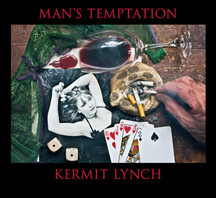
We’ve stayed in touch since then and a few months ago he asked me if I’d give him a hand organizing a listening party for his new release on Dualtone, Man’s Temptation. Needless to say, I was thrilled to get to work with him, in part because I love his palate and have always been a fan, in part because I’ve been digging his new disk and have become a new fan, and dulcis in fundo it’s just so cool to get to work with a luminary in the biz who loves country music as much as Tracie B and me.

In our trans-Atlantic conversations (he in Provence, me in Austin), he told me about how he grew up in the San Joaquin Valley, the son of an itinerant evangelist. The Grapes of Wrath was the backdrop: the souls his father saved were the same southern farmers who came to California in search of Merle Haggard’s “California Cotton Fields,” one of my favorite Merle tunes and one that Gram Parsons and Emmylou Harris both covered:

    My drifting memory goes back to the Spring of ’43
    When I was just a child in Mama’s arms
    My daddy ploughed the ground
    And prayed that someday he might leave
    This run down mortgaged Oklahoma farm

That’s some pretty serious country cred that Kermit’s got.

Here’s the info and the press release I composed to launch the event. I hope to see you there: if you’ve been planning a trip to Austin, this might be a fun time to make it out.

kermit_cover2Man’s Temptation: An Evening with Kermit Lynch

Monday, November 9 @ Vino Vino, Austin, Texas

listening party and wine tasting

singer, song-writer, and wine industry legend Kermit Lynch plays cuts from his new album Man’s Temptation (Dualtone) and talks about his music, his life, and his wines

Monday, November 9, 2009, 7 p.m.
$20 (ticket price includes 1 glass of wine)

Vino Vino
4119 Guadalupe St
Austin, TX 78751-4222
(512) 465-9282

with a menu inspired by the wines and travels of Kermit Lynch

All currently stocked Kermit Lynch wines will be available by the glass and available for sale retail.

Reservations required, space limited.

To reserve, please call (512) 465-9282 or email jeff@vinovinotx.com.

Rocker Interrupted: Kermit Lynch finally yields to temptation

Singer-Songwriter Kermit Lynch releases Man’s Temptation (Dualtone), a collection of ballads, rockers, and ditties, spanning forty years of faith, temptation, and musical salvation (produced by Ricky Fataar).

The only way to get rid of a temptation is to yield to it.
—Oscar Wilde

From the opening lines of Man’s Temptation, singer-songwriter Kermit Lynch cinematically sets the backdrop for the multi-layers of his life as a singer, writer, and wine Svengali:

    Paris and my mind is breaking
    Paris, I’m in a railway station
    Gare de Lyon…

But just when you think that the gravelly, smoky voice behind the old tube-driven microphone is about to head out to Lyon to taste wines with a Beaujolais producer, the melody of the track rises and steers the listener in another and entirely unexpected direction. The singer is in a railway station,

    Gare de Lyon, on my way to the next concert stage.

Man’s Temptation was recorded just last year in Nashville, Tennessee with some of the great country music players in the business today but the album represents a journey that began more than forty years ago in Berkeley, California.

Lynch was born in Bakersfield and grew up of the son of a teetotalling itinerant preacher who traveled the upper reaches of the San Joaquin Valley in search of souls to save. The setting was straight out of Steinbeck’s The Grapes of Wrath, as Lynch puts it, and the souls were southerners who had fled their native land and sought out the same “California Cotton Fields” that Merle Haggard’s father dreamed of as he tilled his rundown, mortgaged Oklahoma farm. It was there that Lynch discovered his first love of music (and grape juice, since no wine was to be had): Jimmy Rogers, Hank Williams, and the country recordings of Jerry Lee Lewis were the first cuts he would hear, the same music his father’s congregants listened to when not singing at church.

By 1966, Lynch had landed in Berkeley, at the height of the music scene. He began writing songs, started a band, and gigged around. But a first trip to Europe and a drummer’s cocaine habit interrupted and deferred the rockstar dream. Disillusioned by the flower power scene, Lynch decided to focus on making a living and turned to a second passion: wine.

Hit pause and fast forward: forty years later, Kermit Lynch is one of the most successful and respected names in the business and he is considered one of the world’s greatest wine writers, a pioneer in reshaping the American wine palate with wines that speak of place and the people who make them.

Hit play: forty years later, Lynch has delivered the album he lived and wrote all those years ago and in the lifetime that followed, a collection of ballads, rockers, and ditties that speak to the weaknesses and the strengths of man and his temptations.

From the original tracks like ballad “Gare de Lyon,” the Beggars Banquet-inspired country waltz “Backstreets of Moscow,” and the rocker “Buckle-Up Boogie” to covers of classic Dylan like “Girl from the North Country” and classic country like “Take These Chains from My Heart,” the verve, pathos, and fun of Lynch’s voice play counterpoint to some of the most bad-assed, finger-lickin’ pickin’ you’ve heard since the last time legendary session man George Marinelli (Bruce Hornsby, Bonnie Raitt) tuned up his git fiddle. The fresh analog-driven tones of the band provide an earthy palate of colors for the tableaux vivants painted by Lynch, whose face is probably slightly less wrinkled than his heart and whose voice is as gravelly and dusty as the vineyard roads of southern France that led this voice astray some forty years ago.

Kermit Lynch, rocker interrupted, is now waiting at the Gare de Lyon, getting ready to board a train on his way to the next concert stage.

Btw, I’ve taken a train from the Gare de Lyon to go play a gig in Lyon!

Savary Chablis and Tracie B’s enchilada casserole. Who knew? (also, Gramsci, Gaja, Israel Merlot in Italy, and natty wine in SF)

Above: Tracie B’s enchilada casserole may not be pretty but it’s shot to the top of my list of favorite things she cooks with meteoric celerity. And what better with the spicy and rich flavors of tomatillo sauce, cotija cheese, fresh peppers, corn, and cilantro, roast chicken, and corn tortilla than steely, mineral-driven (and affordable) Chablis? Who knew?

Seems we weren’t the only ones drinking Savary Chablis last night: a series of backs-and-forth on Facebook with Anthony on whether or not my silverface Princeton is a 69 or 71 was interrupted around dinner time because Savary 07 Chablis and Tracie B’s enchilada casserole were calling in my case, Savary Chablis Vieilles Vignes (I believe the 06) after his show last night (wherever he is!).

It’s Saturday and I’m working today (because I have a tight deadline on a hefty translation: a folio edition of twentieth-century Italian photography, pretty cool stuff actually). But before getting to work this morning, I did indulge in some Antonio Gramsci and his notion of cultural hegemony. I’d been thinking about Gramsci over the last week and how wine, in his era, was considered a luxury product in the eyes of the agrarian class (Italy was still in the early phases of its industrialization) and an important trading commodity by the landlords. How far the western world has come in such a short period of time! With the rise of globalization (unthinkable in Gramsci’s time when protectionism reigned) and the seemingly boundless exchange of wine today, Tracie B and I can enjoy an excellent and affordable (at our price point) Chablis that has traveled seemingly effortlessly across that misunderstanding otherwise known as the Atlantic Ocean. And we enjoyed it — no less! — with Mexican cooking spiced up by peppers grown in the farmland that stretches between Dallas and Austin in Texas (we still had some peppers left over from my stopped at the sorghum syrup and stuffed armadillo store).

My hankering for Gramsci was whetted in part by the soul searching that followed the wild exchanges this week but it was garnished by the news — which I read at Franco’s blog — that Angelo Gaja is importing Israeli Cabernet and Merlot to Italy. It seems that like the historic stockfish vendors of the Roman ghetto, Gaja saw an opportunity in bringing modern-style international grape varieties from the promised land and selling them to the “Israelite” communities (as they are called there) in Italy. Does Italy really need another international-style Merlot? From Israel?

Gramsci, where art thou?

In other news…

Above: I bet this guy knows his Gramsci. Guilhaume Gerard, one of the owners of Terroir in SF, pours great wine and writes a great blog with an emphasis on you know what.

I read at McDuff’s excellent blog that there is a now a site with information about the natural wine week event going on in San Francisco next week, hosted by different venues, including one of my favorite natural wine destinations, Terroir, with a symposium led by the inimitable Guilhaume (whose natural wine credentials, by all accounts, are impeccable and who has an amazing palate and writing style).

Just a guy in a band who likes wine…

From the “ain’t this living?” department…

It’s been a helluva week but it’s coming to an end.

I wish that everyone could feel what it’s like to play a solo on my Carruthers custom Johnny Rivers Tele (sunburst finish with mint green pick guard and Seymour Duncan ’52 reissues) through my Fender 1971 Silverface Princeton at the Broken Spoke and see Tracie B sitting in the audience and smiling.

It’ll wash all the troubles of the world away like a Texas rainstorm.

Played my first Austin gig last night and it was a blast. Took Tracie B for ceviche, tacos al pastor, and cold Bohemias after.

At the end of the day, I’m just a guy who plays in a rock country band and likes wine.

Have a good weekend ya’ll and thanks for reading.

A bratty sparkling Barbera for the summer of 09

Above: The inimitable Michael Housewright (right) with his Italian business partner Antonello Losito. Michael’s new wine bar and shop Block 7 in Houston is on the cutting edge of wine sales and marketing and has already proved a success in highly competitive market.

This dude knows what he’s doing. Michael Housewright’s aggressive pricing at the newly opened Block 7 in Houston is like nothing I’ve ever seen. Every bottle on his list can be ordered by the glass (at market price), by the bottle (at a competitive retail price), or by the case (with case discount) in which case you can open a bottle and drink it in the restaurant/wine bar.

Above: 07 Barbera Vivace (i.e., slightly sparkling) by Roagna Igino (not the other Roagna, producer of old-school Nebbiolo) is competing with Bisson Ciliegiolo as my official favorite wine of the summer of 09.

When Tracie B, her childhood friend Talina, and I dined there the other night, Michael turned me on to a vivace (i.e., slightly sparkling) Barbera by Clò di Roagna Igino. The proprietary name birichina means brat in Italian, in other words, someone who is excessively vivace. Served slightly chilled, the acidity and fruit in this wine was awesome with my burger and fries. We also shared a bottle of Produttori del Barbaresco 2005 Barbaresco with another party: the price was too alluring to resist.

In other news…

Budweiser (well actually Shiner Bock) instead of Barbera tomorrow night: I’m playing my first Austin gig tomorrow at the Broken Spoke with this guy. Not exactly the summer of 1969 (more like the summer of 2009) but I’m stoked to break out my Tele at the Spoke.

My new favorite cocktail, an aperitivo for a Manic Monday

Above: Lately, I’ve been drinking my Campari and Soda with a splash of orange juice. I’m sure this recipe has a name: does anyone know it? Photo by Tracie B.

It’s already been one helluva Monday morning and I’m still working on getting to the bottom of what happened over at Decanter.com on Friday.

I sure wish it were Sunday: yesterday Tracie B and I found ourselves in Houston where we had dined Saturday night at the newly opened winebar Block 7 (look for a post later this week) and we stayed overnight at the St. Regis (thanks to my nimble hand at Priceline).

Above: Tracie B and I love to photograph everything we eat and drink. The bartender at the St. Regis had fun with us and took this photo. She mixed our drinks perfectly to order.

It was fun to wake up to room service and swimming and we had great Mexican food for lunch with Tracie B’s childhood friend Talina at La Mexicana (highly recommended, super family friendly and just all around delicious).

Above: My eyes weren’t bigger than my stomach at La Mexicana. I couldn’t help but order à la carte: from 12 o’clock clockwise, 1 taco al pastor, 1 taco de carnitas (available only on weekends), 1 flauta (which I dipped liberally in creamy guacamole), and 1 cheese enchilada drowning in ranchero sauce.

Man, I wish it were Sunday. That was my fun day…

She wrote the book on chicken fried steak

From the “life could be worse” department…

jeremy parzen

Above: Despite Tom G’s admonitions, I went ahead and ate the Chicken Fried Steak on Sunday. After all, it’s not every day that you get to eat CFS made by the woman who wrote the Oxford Companion to American Food and Drink entry on CFS and it’s not every day that you get to pair it with Chateau Clerc-Milon 1990 (Pauillac, 5th growth). Thanks, Kim and Alfonso! Photo by Alfonso Cevola.

Sunday found me and Tracie B in the home of IWG where his SO (significant other), the lovely and immensely talented food writer Kim Pierce, shared a meal of chicken fried steak and yellow summer squash casserole (by Kim) and mashed potatoes (by Tracie B) with us. Food critic Leslie Brenner, her husband, and their son were also in attendance. Her son showed me how to play the intro to Aerosmith’s “Dream On” on guitar and Kim graciously shared the text of her entry in the Oxford Companion to American Food and Drink. Enjoy!

"Chicken Fried Steak"

By Kim Pierce

Chicken fried steak most likely developed as a way to make a tough cut of beef more palatable: The first step in preparation is pounding a cutlet to tenderize it. Then, mimicking the technique for Southern fried chicken, it is either dredged in flour or dipped in batter before being fried in hot oil in a cast-iron skillet. A cream, or milk, gravy made from the drippings is spooned on top.

Above: “Chicken fried steak most likely developed as a way to make a tough cut of beef more palatable” and is prepared by dredging cube steak in flour and then frying it. My good friend Jon Erickson and I both call our dads “cube steak”: they’re of the generation too young to have fought in the Second World War but old enough to remember it and as a result, they’re obsessed with WWII folklore and factoids. My dad was 12 when it ended (he turned 76 yesterday) and the one time he ate at Jaynes Gastropub (owned by Jon and his wife Jayne), he said it was good but that he preferred “cube steak” — a classic entrée for his generation. Photo by Tracie B.

There are several theories about chicken fried steak’s origins. One holds that it developed in cattle country — Texas and the Midwest — before beef was as tender as it is today. Another holds that it descended from Wienerschnitzel, courtesy of the Germans who settled in Central Texas starting in the 1830s. Recipes resembling chicken fried steak are not uncommon in historical cookbooks. In The Kentucky Housewife (1839), a recipe for frying beef steaks starts with cutlets from the tough chuck and rump. It instructs the cook to “beat them tender, but do not break them or beat them into rags.” The cutlets are then dredged in flour and fried in “boiling lard.” Instructions for making a cream gravy follow.

Above: I’ve seen other versions of chicken fried steak where the meat is soaked in milk and is breaded before frying. Kim’s version, simply dredged in flour, was superbly tender — thanks to how well the meat was tenderized and the frying temperature (I believe). Photo by Tracie B.

Whatever its origins, chicken fried steak was well established in home kitchens by 1932, when a reader submitted a menu featuring “Chicken Fried Steak With Cream Gravy” to The Dallas Morning News. In 1936, the year of the Texas centennial, the same newspaper reported that the president of the Dallas Restaurant Men’s Association had received cards and letters from out-of-towners praising his and other restaurants: “To them a chicken-fried steak, smothered in brown, creamy gravy is the tops in foods.” The first known recipe that refers to Chicken Fried Steak by name appears in the Household Searchlight Recipe Book (1949), published in Topeka, Kansas. Country fried steak and chicken fried steak are sometimes used interchangeably.

Above: Chicken fried steak and nearly-twenty-year-old 5th growth Bordeaux for lunch. Life could be worse.

BIBLIOGRAPHY
Bryan, Mrs. Lettice. The Kentucky Housewife. Cincinnati: Shepard & Stearns, 1839.

Gee, Denise. “Dueling Steaks.” In Cornbread Nation 1: The Best of Southern Food Writing, edited by John Egerton for the Southern Foodways Alliance. Chapel Hill: University of North Carolina Press, 2002.

Handbook of Texas Online, s.v. “GERMANS,” http://www.tsha.utexas.edu/handbook/online/articles/BB/dibgi.html

Household Searchlight Recipe Book. Topeka, Kansas, 1949.

“Today’s Menu and Recipe.” The Dallas Morning News, November 8, 1932.

“Waiters in Dallas Restaurants Easily Spot Visitors to Fair By Differences in Their Ways.” The Dallas Morning News, August 10, 1936.

Not everything coming up rosés in Montalcino

Above: I had fun pouring this flight of rosé, including the 1998 López de Heridia Viña Tondonia Rosado Reserva last night at Jaynes Gastropub in San Diego. I’ll be there on the floor (pouring not lying!) again tonight. Please come down to say hello if you’re in town (Comicon conventioneers receive a 10% discount for having monopolized all rental cars within a 100-mile radius! Just mention this ad…).

Franco and I have published an excerpted translation of a letter to Brunello association members from the body’s director today at VinoWire. For the first time — nearly 16 months after the Brunello investigation was first reported — the association director has begun to address the issue, not publicly, but internally… Click here to read… It just blows my mind that the association has waited so long to respond to accusations but I’m glad the truth — or at least some of it — is beginning to emerge. All I can say is, in vino veritas, the truth is in the wine.

For a reaction on this side of that misunderstanding otherwise known as the Atlantic Ocean, read Alfonso’s moving post here.

*****

From “Roses” by Outkast

I know you’d like to think your shit don’t stink
But lean a little bit closer
See that roses really smell like boo-boo
Yeah, roses really smell like boo-boo

I know you’d like to think your shit don’t stink
But lean a little bit closer
See that roses really smell like boo-boo
Yeah, roses really smell like boo-boo