Is marijuana the new wine? and a little raw sausage porn teaser

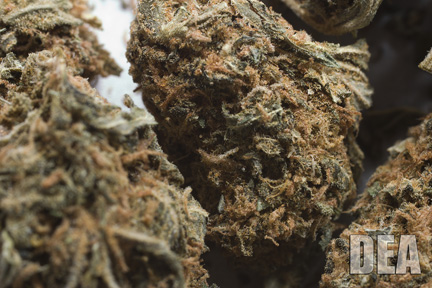
Above: A little marijuana porn, anyone? Click here for the big kahuna over at the U.S. DEA website.

It’s hard to believe that this is happening in my lifetime but it’s true. I had to pull over to the side of the road the other as I was driving home and heard a radio story on American Public Media Marketplace: the spokesperson for NORMAL was talking about the recent initiative to legalize recreational marijuana use in California and — get this! — turn Humboldt and Mendocino into Napa Valley-inspired marijuana tourism destinations.

I’m certainly not the only or the first to write about this is in the enoblogosphere: check out this post by Wolfgang, who asks wryly, “have I smoked too much Cabernet?”

As I head out (tomorrow) to my homestate of California, to speak about Piedmontese wines at Jaynes Gastropub on Saturday Sunday and to celebrate the Passover with my family on Monday night, I have to admit that I never thought legalized pot would happen in my lifetime (even though pot is woven deeply into the cultural fabric of my beloved California). But is weed the new wine? Humboldt County tasting rooms? Unbelievable!

In other news…

Above: I love the raw pork sausage that you typically eat as an appetizer in Piedmont. You eat it just like that, completely raw. We were served this excellent victual when we dined in the home of Giovanna Rizzolio.

I been showered by numerous requests to hurry up and post about the amazing private tastings that were organized for Tracie P and me by venerable Italian wine pundit Mr. Franzo Ziliani in Barolo and Barbaresco during our February trip there. One zealous fan of my blog writes of his “burning disappointment” that I still haven’t posted on our tastings at Vajra, G. Rinaldi, G. Mascarello, and Cascina delle Rose, “our lady of the deaf river,” as I will call the inimitable Giovanna Rizzolio, producer of one of Mr. Ziliani’s favorite Barbarescos and his close friend.

Frankly, I’m flattered by all the messages I’ve received and I promise to devote next week’s posts to my notes and impressions of these amazing wines and the truly amazing people who make them. And I can only reiterate my heartfelt thanks to Mr. Ziliani, as I wrote on Valentine’s day, in a post published not long after Tracie P and I returned from Italy: noble is the host… (the line comes from a stanza of an ode by 18th-century Italian poet Parini that I translated and dedicated to Mr. Ziliani).

Do Bianchi becomes VITELLO-TONNATO-WIRE!

Above: The best vitello tonnato of 2010 was prepared for Tracie P and me by our friend Giovanna Rizzolio of Cascina delle Rose in Tre Stelle (between Neive and Barbaresco). I’ve eaten a helluvalotta vitello tonnato over the last two months, with TWO (yes, TWO! COUNT ‘EM!) trips to Piedmont in as many months.

I love vitello tonnato. I could eat vitello tonnato every day. I’m not kidding. In fact, while I was in Piedmont with the Barbera 7, I literally ate vitello tonnato four times in four consecutive seatings, over three days. That’s 1.33333 servings of vitello tonnato per day.

Above: Getting to have dinner in someone’s home in Piedmont was a real treat for me. I’ve traveled to Piedmont so many times for wine but you always end up in Michelin-star this or Michelin-star that… Always great but nothing beats exceptional homecooking like Giovanna’s. Supper began with traditional Piedmont salame.

I am fascinated by vitello tonnato — culinarily and intellectually. And, gauging from all the comments here and on Facebook in the wake of the recent vitello tonnato pornography, you’re fascinated by vitello tonnato as well.

Above: And no Piedmontese meal is complete (lunch or dinner) without raw beef, in this case, homestyle.

That’s why I’ve decided to give up all the petty politics and ego-driven parochial bullshit of wine blogging to devote my blog exclusively to vitello tonnato and its epistemological implications. Veal with tuna and anchovies and capers. The basic ingredients alone and their highly unusual but thoroughly delicious combination will occupy volumes and volumes… The dissertation I delivered in 1997 was about Petrarch and Bembo, apostrophes (no shit!) and dipthongs (no double shit!) and episynaloepha (no triple shit! look that one up, Thor!). But this, ladies and gents, I assure you, will be a mother of all dissertations.

Above: But the true pièce de résistance of Giovanna’s superb repertoire was this sformato di spinaci, a spinach casserole topped with a fondue of Fontina and Parmigiano-Reggiano. I couldn’t resist a second helping. Simona, you would have LOVED this.

Seriously, back from Mars now, I don’t have time to blog today because I’m on my way to San Antonio to make a living. It won’t be long before I pick up the narration of our February trip to Piedmont again — the meals, the wines, the tastings, and most importantly the people. Giovanna runs a wonderful bed and breakfast in Barbaresco country and her wines are killer.

And all joking aside, I have a great deal to say about vitello tonnato (no kidding!).

Stay tuned…

On right health and good pleasure

Above: Pope Sixtus IV appoints Bartolomeo Platina prefect of the Vatican Library, fresco by Melozzo da Forlì, c. 1477 (Vatican Museums). That’s Platina kneeling. Click the image for the entire fresco.

The title of today’s post is a play-on-words, a riff on the canonical translation of Bartolomeo Platina’s De honesta voluptate et valetudine, On Right Pleasure and Good Health (as translated, superbly, by Mary Milham in 1998). Italian humanist, gastronome, and literary consultant to some of the most important cultural and political figures of his time, Platina authored a treatise considered by many the earliest printed work on gastronomy. It was overwhelmingly popular in Europe from the time of its initial publication in the late 15th century through the 17th century, by which time it appeared in myriad translations from the Latin. (I know a little about Platina and his book since I translated the 15th-century Italian recipe collection by Maestro Martino from which Platina drew heavily).

In the mind of the Renaissance humanist, good health and right pleasure were inexorably linked. As food historian Ken Albala illustrated so eloquently in his 2002 Eating Right in the Renaissance, inhabitants of 15th-century Italy believed — rightly — that everything you put into your body affected your health, emotionally, intellectually, and physically.

Sumus quales edamus: we are what we produce (äfere), we are what we eat (lèdere).

I’m no Renaissance man but I do believe that right pleasure and good health go hand in hand, so to speak.

That’s why I’m thinking today about “right health”: President Obama’s signing of the new health care legislation (however flawed, however riddled by political posturing) marks for me the fulfillment of a dream (both personal and civic). As David Leonhardt wrote in The New York Times today, “The bill that President Obama signed on Tuesday is the federal government’s biggest attack on economic inequality since inequality began rising more than three decades ago… Speaking to an ebullient audience of Democratic legislators and White House aides at the bill-signing ceremony on Tuesday, Mr. Obama claimed that health reform would ‘mark a new season in America.’ He added, ‘We have now just enshrined, as soon as I sign this bill, the core principle that everybody should have some basic security when it comes to their health care.'”

As a long-time self-employed translator, writer, copywriter, and musician/songwriter, health care has always been a primary issue for me. To my mind and in my heart as a member of American society, the inequality of health care in our country has always represented a tragedy in our affluent nation.

So today I ask you to consider a step forward in our country, toward an inalienable right that is guaranteed, however imperfectly, to citizens in most Western countries.

What’s next? Will we outlaw the death penalty? I’d certainly drink to that.

In other news…

Please read BrooklynGuy’s excellent post today, with its oxymoronic title, How to Buy Excellent Cheap Wine.

Stinky dirty wine I drank in Piedmont and a note about vitello tonnato

When in Piedmont, do as the Piedmontese do and drink Piedmontese wine. But when I saw the 2004 Trebež by Dario Prinčič (from Oslavia, Friuli) on the list at La Libera (probably the hippest, best see-and-be-seen place to dine in Langa), I couldn’t resist. After all, it was my turn to pick the wines the Barbera 7 was going to be drinking at dinner that night. I know it’s a shame to drink a Friulian wine in Piedmont (and for our red, we drank an a killer 2006 Dolcetto di Dogliani by one of my favorite producers, Cascina Corte), but the mimetic desire created by my browsing of the list simply overwhelmed me. I had to have it.

According to Divino Scrivere, the wine is a blend of Chardonnay, Pinot Grigio, and Sauvignon Blanc, obviously vinified with skin contact. (I believe that Trebež is a toponym that refers to a river by the same name, but I’m not sure.) Cloudy and practically brown in color, this is as real, natural, and orange as it gets… not for the refined palate but rather the folks who did real, groovy wines… Acid and gently astringent tannin, apricot and prune flavors, balanced by dirt and rocks. The man, Dario Prinčič, is dry and sour in person, perfectly polite, but never a smile on his face when I taste with him at Vini Veri. His wines, on the other hand, are full of joy and glorious flavor and they are among my all-time favorites.

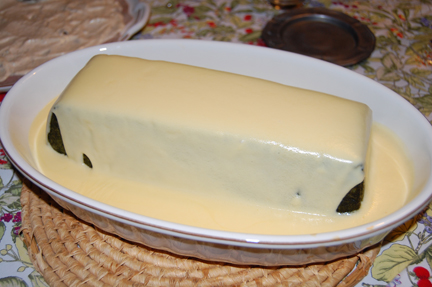
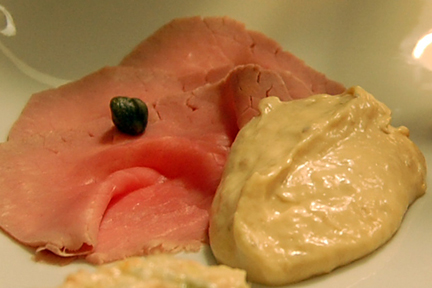
The night we ate at La Libera, I asked owner/chef Marco to feed us whatever he wanted (which is always the best way to go in any great restaurant, btw). Among other victuals, he made us a tetralogy of classic Piedmontese antipasti, including the sine qua non vitello tonnato (the photo above borders on the pornographic, no?). I love vitello tonnato and eat it whenever and wherever I know it’s good. Today, vitello tonnato is regularly made with mayonnaise but the addition of mayonnaise is a relatively recent adjustment to this recipe. In fact, the sauce prescribed by Artusi (1891) calls for tuna in olive oil, anchovies, lemon juice, and capers in vinegar.

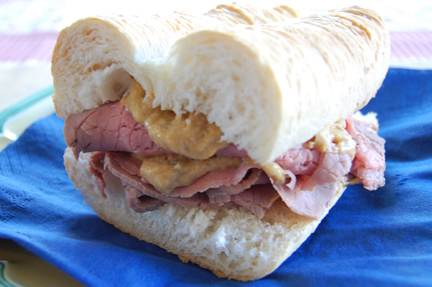
I enjoyed another excellent vitello tonnato, while Tracie P and I were in Barolo in February, at the Osteria Barolando, served on a roll of crusty bread (above).

I love vitello tonnato so much I could most certainly write a dissertation on it — its variants, its history, its epistemological implications… but, alas, I need to make a living…

Italy’s barrique stainless steel revolution

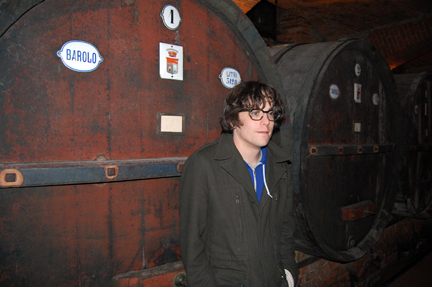
Above: Cory posed for me in front of an old large-format chestnut wood cask, once used to age Barolo at the historic Fontanafredda winery in Serralunga d’Alba. I highly recommend a visit there. The winery represents an important piece in the historical puzzle of the first Italian wine renaissance that began in 19th-century Italy.

One of the more interesting elements to emerge from my recent trip to Piedmont was one enologist’s observation that Italy did not undergo a “barrique revolution” in the 1980s but rather a “stainless steel revolution.” One of the results of the new trend of stainless steel aging introduced in Italy in the 1980s, he claimed, was that small-cask, French-oak aging soon followed as a natural and necessary corollary. Made from an impenetrable and inert substance, stainless steel vats do not allow for oxygenation of the wine. As a result, he claimed, the use of barrique aging expanded in Italy. The smaller cask size oxygenates the wine more rapidly and the more manageable format helps to maximize cellar space (among other efficacious aspects of the now overwhelming popular French format).

Above: Owner and winemaker Giovanni Rava at La Casaccia in Monferrato showed us this “vat,” carved into the tufaceous subsoil, once lined with glass tiles and used for vinification of Barbera (in the 18th century), now used to store barriques.

The day we visited the Marcarino winery and spoke with enologist Mauro de Paola, I was interpreting and so wasn’t able to take notes and photographs. And I will agree with colleague Fredric that beyond Thor’s account of the visit there couldn’t be “a more fair or thorough explication of our visit to this puzzling property.” (I will say, for the record, that I loved Paolo Marcarino’s wines, however manipulated the process to achieve no-sulfite-added expressions of Barbera and Cortese.)

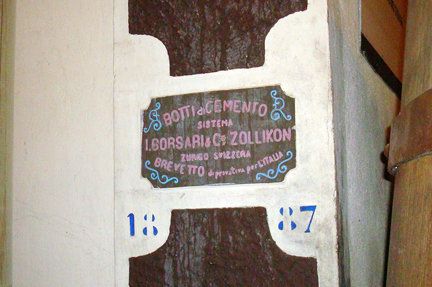
Above: This patent, for “botti di cemento [cement casks],” dated 1887, is believed to be evidence that Fontanafredda was the first to use concrete vats to age wine in Italy.

A 1982 visit to Napa by Giacomo Bologna, Maurizio Zanella, and Luigi Veronelli is widely considered the “eureka” moment that led many of Italy’s foremost producers to begin fermenting in barrique (Zanella) and aging in barrique (Bologna). (I have written about in one of my favorite posts here, and Eric wrote about it here.)

Above: Cement vats used to make one of my favorite wines in the world, Produttori del Barbaresco. Stainless steel is also used today at the winery, even for some of its top wines. In the 1980s, a lot of Italian winemakers shifted from glass-lined and varnish-lined cement aging and large cask aging to barrique aging (not at Produttori del Barbaresco, however).

I had always assumed that Angelo Gaja had begun using barrique aging around the same time as Bologna (whom many credit as the first to use new cask aging in Italy). But when we visited and tasted with Gaja on our recent trip, he told me that his winery began experimenting with new, small cask aging in 1978. (I have a long backlog of posts but I’ll get to our Gaja visit, which was, as you can imagine, immensely interesting.)

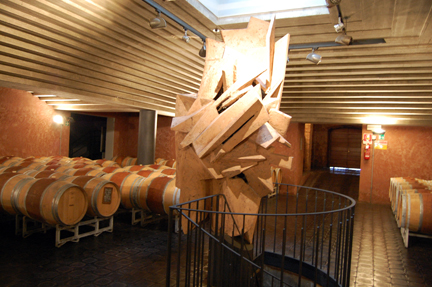
Above: One of Gaja’s barrique aging rooms is dominated by this fantastic Giovanni Bo sculpture, an extension of the well, no longer in use, in the courtyard of the winery.

Honestly, I can’t say that I wholeheartedly agree with De Paola’s assessment that the advent of stainless steel is what made barrique aging necessary in Italy. But I do think that the introduction of stainless steel and barrique, together with a California-inspired approach to cellar management (prompted by the emergence of the Napa Valley fine wine industry) are all elements in the current renaissance of Italian wine (whether you prefer traditional- or modern-style wine). His observation that “stainless steel was the true revolution,” in my opinion, is a fair if atypical assessment: it’s not that Italian producers decided one day that they should age their wines in barrique.

Barrique and stainless steel were both part of the new and contemporary era of Italian wine.

So much (too much, really) of the wine we tasted during Barbera Meeting was dominated by new oak but we also tasted some fantastic stainless-steel aged and large-cask aged Barbera that really turned me on.

In other news… Man and husband cannot live by Barbera alone…

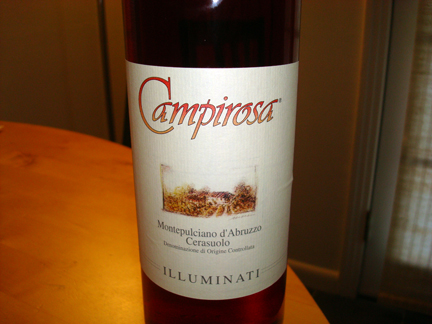
Last night we paired this wonderful Montepulciano d’Abruzzo Cerasuolo with Tracie P’s excellent slow-cooker braised pork chops smothered in cabbage. Check out the recipe and tasting notes here…

Our personal SXSW and why wine blogging is so cool

Tracie P and I take SXSW pretty easy. Since we live in Austin, Texas, the “live music capital of the world,” we’re treated to the good stuff year around. For me, SXSW is special mostly because so many of my good friends from the music world come to town. Here are some highlights from our personal SXSW…

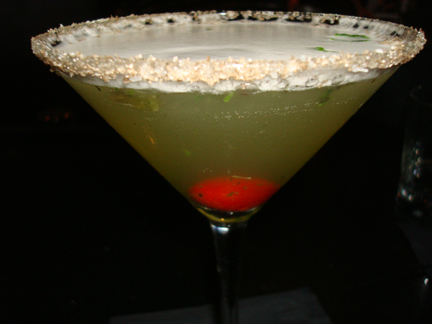
Tracie P had an heirloom martini (above) and I sipped some bourbon with my old bud Billy at the High Ball.

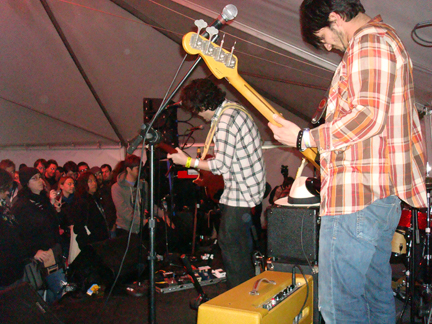
My friend and ex-label-mate Robert Francis put on a rocking show at the Atlantic Records showcase. Man, he’s going to be a huge star. The dude’s so friggin’ talented. Great show…

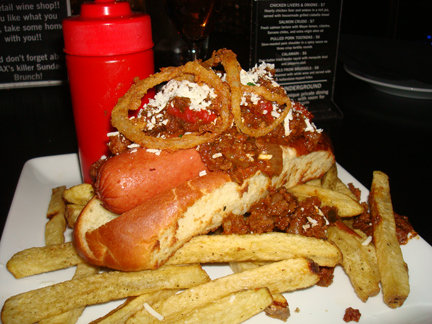
After the show, Tracie P and I snuck off to Max’s Wine Dive for a little Bollinger rosé and a chili dog. @TWG I know, I know! Tomorrow the diet begins again!

In other news…

There’s been a lot of chatter lately in the enoblogosphere about the futility of wine blogging. I haven’t really been following it, although I have enjoyed some of the reactions, intellectual here and visceral there.

Previously my virtual friend and only recently my real-life friend (after he and 5 other wine bloggers, nearly all of them COMPLETE STRANGERS, joined me in Asti for the Barbera-athon), Thor likes to tease me that I don’t write a wine blog but rather a relationship blog. He’s right. I don’t author a wine blog: I write a blog, a web log (as the etymon reveals) whereby I chronicle my life, my relationships, the music I like, the food I eat, and the wines I enjoy. It just so happens that a lot of my life is centered around wine. I make a living writing about, talking about, teaching, and selling wine. I also happen to be deeply in love, to enjoy music immensely, and to see poetry and inspiration in the world around me — sometimes in a glass of traditional-style Barbera, sometimes in a guitar solo played by a friend.

Wine blogging is really about sharing experiences and connecting with like-minded folks. After all, if it weren’t for wine blogging, I would have never met really cool folks (who are now part of the fabric of my life, even though I have very little real-time contact with most of them) like Alfonso, BrooklynGuy, McDuff… not to mention the LOVE OF MY LIFE.

It’s Sunday morning and Tracie P and are sitting around sipping coffee and listening to This American Life and we’re both “blogging away” (she’s working on a post about Lacryma Christi). I guess what I’m trying to say is I don’t care how useless it is… I wouldn’t give it up for the world…

Buona domenica, ya’ll…

If traditional Italian food can do it, why can’t traditional Italian wine?

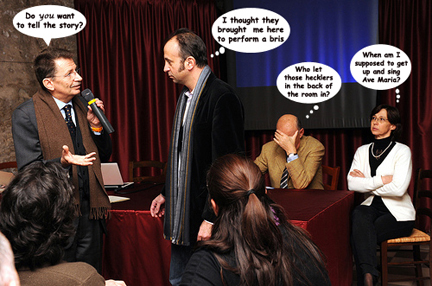
Above, from left: Professor Vincenzo Gerbi (enologist, U. of Turin), me, winemaker Michele Chiarlo, and unidentified woman, March 9, 2010, Tuesday morning in Canelli. Alfonso provided a caption and thought bubbles for the photograph, which he lifted from the Barbera Meeting Flickr feed. Alfonso’s captions are humorous, of course, but the tension was as thick as Australian Shiraz with added tannin extract. It’s never an easy to task to interpret in those situations. I was using a technique called chuchotage or whispered translation, where I would whisper translations of the questions into Professor Gerbi’s ear. Then I used consecutive translation to translate his answers. Ne nuntium necare!

The events of Tuesday, March 9, 2010, at the Barbera conference in Canelli and the heated debate that ensued have been the subject of much discussion. Perhaps the best account of the ideological arm wresting was rendered by fellow member of the Barbera 7 Cory here. (Leading Italian wine writer Franco Ziliani had high praise for Cory’s observations. And fellow Barbera 7 member Fredric chronicled the excellent luncheon here.)

Here’s what Cory had to say:

    The first event was a presentation on new research being done on pruning by a group funded by some of the bigger names that produce barbera. For those of you don’t know much about the farming of wine (i’m no expert myself) the way vines are pruned are central to the way grapes ripen, how much they produce, and how the wine comes out. Traditionally barbera has been pruned using the guyot system, (which i won’t get into in detail here). The research being done is on the spur cordon system. It’s one of those things that sounds innocuous to the outsider, but the effects on the wine were profound.

    We were told about the effects of the pruning on the acids, the tannins, the color of the wine.

    It was around this point that things began to become heated.
    Questions were asked as to why this was necessary. Do you really need to keep messing with the grape? Why would you need to control the acid in barbera?

    Isn’t acid essential to barbera?

    The answer we got was that they were making barbera… important.

Read the entire post here.

Above: During the morning and afternoon sessions, my good friend and blogger colleague Charles Scicolone challenged the winemakers directly, asking “Why don’t you make the same great, food-friendly wines you made 20 years ago?”

As the interpreter, I couldn’t jump into the debate. But as I listened and interpreted, interpreted and listened, the same thought kept rolling around my head: traditional Italian cuisine has conquered the world over; so why is it that Italians want to send modern-, international- (i.e., homogeneous-) style wine abroad? In other words, if traditional Italian cuisine can do it, why can’t traditional Italian wine?

After all, the thing that Tracie P and I love the most about real Italian wine is its food-friendliness. Whether old, regal Nebbiolo or young, bright Barbera, we look for three basic elements in the wines we like, the same three elements that make wine friendly to food: high acidity, low alcohol, and honest fruit aromas and flavors. At our house, we never serve food without wine and never serve wine without food (well, to be honest, we only rarely serve Champagne at breakfast!). Joking and clichés aside, our approach to wine can be distilled in the following chiastic aphorism (do you like that one, Thor?): never wine without food, never food without wine.

And what could go better with traditional Italian cuisine than traditional Italian wine?

In other food-friendly news…

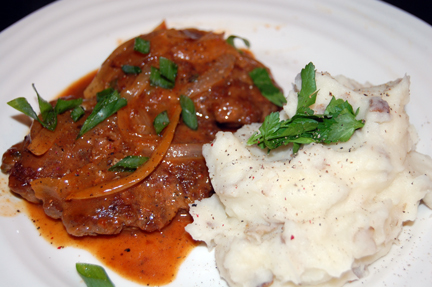
Tracie P and I FINALLY got to spend a quiet night at home alone last night. She treated me to Salisbury steak and mashed potatoes…

Did I mention that besides being jaw-droppingly gorgeous, the girl CAN COOK? ;-)

In other news…

Yesterday, I had the great pleasure of doing an online interview with Grappolo Rosso. I particularly enjoyed his request that I pair wines with songs. I really liked, if I do say so myself, my pairing for Australian Shiraz: a little Judas Priest, anyone? Thanks again, Jury! And complimenti per il tuo nuovo blog!

My date with the city (of Milan)

After a week of working myself to the bone in Asti and Langa, and a successful and happy epilogue to Barbera Meeting 2010 (and all the many blogilicious waves we surfed there), my little gift to myself was an afternoon of book shopping and strolling in Milan on a beautiful, crisp but not too chilly afternoon. That’s Milan’s famous gothic cathedral, the Duomo of Milan, above.

A visit to the original Feltrinelli book shop on Via Manzoni revealed a Massimo Montarari (Italian food historian) title that was missing from my collection. And a visit to one of the flagship Feltrinelli megastores in the Galleria (above) delivered the toponymic dictionary I’d been looking for.

When you exit the subway at the Duomo station, the stairs are rigged with midi triggers that play acoustic piano samples. As you walk up the stairs, if you land on each “white key” step, you play the C major scale. The eerily beautiful cacophony created by commuters and tourists reminded me of an angular Antonioni film score.

My Milan will always be a black and white movie from the 1960s but Milan is also the capital of haute couture and high design. I love the glamour and color of Milanese window shopping.

But the best part was dinner of Piave cheese, perfectly sliced Lombard bresaola (above), and Friulian Cabernet Franc in the home of my super good friends Stefano (from Treviso, Veneto) and Anna (from Ischia, Campania). None of us could stop marveling at the wonderful, uncanny counterpoints and parallels of life. This adoptive padovano has been away from his adoptive ischitana for way too long. Thank goodness the next stop is Austin, Texas, U.S. of A.

A great winebar in Asti and 3 wines that blew me away

Special thanks to Tom H, who hipped me to this place.

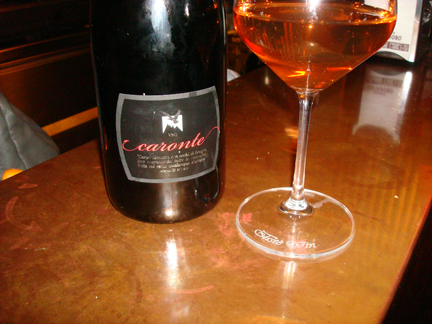
Above: Classic-method Petit Rouge “Caronte” by Morgex et de La Salle (Val d’Aosta)? Hell ya! Caronte is Dante’s Charon, as the label reveals with these lines: Charon the demon, with eyes of glowing coals/beckons to them, herds them all aboard/striking anyone who slackens with his oar (Inferno 3, 109-11). This wine had elegant structure and citrus fruit balanced by a savory minerality. One of those, I-could-drink-everyday-and-never-get-tired-of-it wines.

Posting hastily as I head out for meetings in Alba and Grinzane this morning and then to Milan to reconnect with friends, old and new, and hopefully to visit a bookshop or too before dinner.

Above: “Natural wine” is a touchy subject in Italy and the term “natural” really refers here, as Thor pointed out the other night, to a philosophy, loose but honest, rather than a rigorously enforced code. Owner Claudio called this a “natural” Barbera. 2006 Piemonte Barbera (although actually a Barbera d’Asti) by Hohler. It was earthy and savory, meaty but not over rich. I completely dug it.

After everyone left yesterday, I spent the day alone, catching up on correspondence, doing a little translating for a client, and resting. Tom H had mentioned TastéVin Vineria, a fantastic wine bar near Asti’s city walls, and so I headed out for a little walk and then took a seat at the tiny counter and chatted with owner Claudio, munching on charcuterie and cheese and tasting wines he recommended.

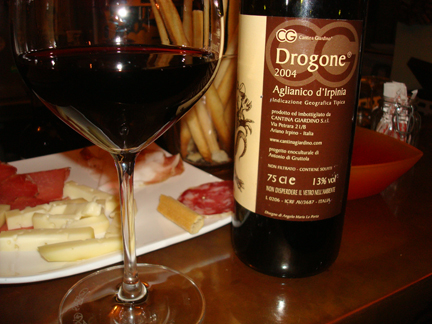
Above: I was completely floored by this wine. 2004 Aglianico d’Irpinia Drogone by Cantina Giardino. No sulfite added. Rich and savory, gorgeous tannin (slightly mellowed after having been opened the night before), rocks and red fruit, and impressive acidity. Definitely a great candidate for aging. My one word tasting note? Wow.

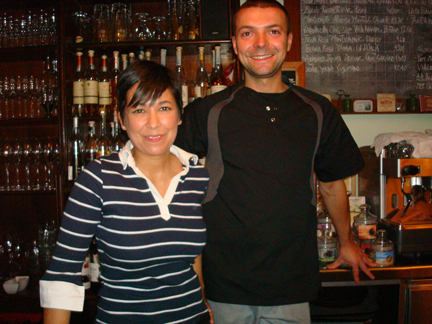
Okay. That’s all I have time for today. Gotta run. If you ever make it to Asti, please check out TastéVin Vineria. That’s a photo of owners Claudio and his fidanzata below (I’m so sorry, Claudio! I lost the card you gave me last night with your last names!).

TastéVin Vineria
Via Carlo Vassallo, 2
14100 Asti, Italy
0141 320017

In other news…

Only my love holds the other key to me…

The Marchioness of Monferrato

Above: Yesterday we “tasted” the terroir in a cellar in Monferrato at one of my new favorite wineries, La Casaccia. The unique, sandy tufaceous subsoil of Monferrato is what gives the wine its outstanding minerality and savory flavors. As per Monferrato’s tradition, La Casaccia’s cellar was literally excavated out of the subsoil. Remarkably, the crumbly walls need no support.

Long before I really knew much about Italian wine, other than the fact that I loved it, I was intrigued by the wines of Monferrato.

As Boccaccio recounts in the first day of his Decameron, when the king of France called on the Marchioness of Monferrato: “Many courses were served with no lack of excellent and rare wines, whereby the King was mightily pleased, as also by the extraordinary beauty of the Marchioness, on whom his eye from time to time rested.”

The wines of Monferrato were already famous by the middle ages and long before the current renaissance of Italian wines, Grignolino and Barbera grown in Monferrato enjoyed wide fame and graced the tables of nobility and clergy.

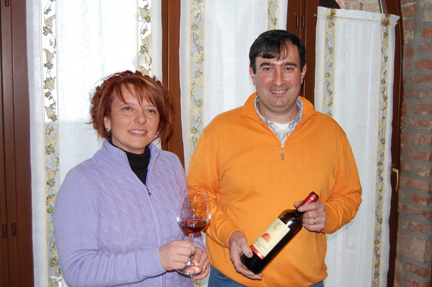
Above: I also really loved the wines of Marco and Giuseppina Canato, children of share croppers who now grow and vinify excellent Barbera and Grignolino and run a homey bed and breakfast. Just look at them! You can’t help but adore them.

I don’t have time this morning to post any further, as I have been re-posting vigorously over at Barbera2010. The Barbera 7 are a loquacious bunch!

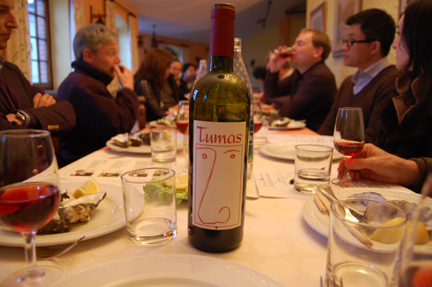
Above: I also loved this single-vineyard Grignolino “Tumas” by Scamuzza and the inimitable Laura Bertone, who paired her groovy, mineral-driven wine with oysters!

I’m exhausted after 3 days of interpreting and blogging and tasting. I miss Tracie P terribly, and in the spirit of honest blogging (something we’ve been talking about a great deal, here in Asti), I cannot conceal that a very good friend of mine has broken my heart… Yesterday was a tough day but the Barbera 7 rallied around me, with cheer and words of support, and sweet messages from my beautiful wife through the night assuaged the hurt…

How can you mend a broken heart?