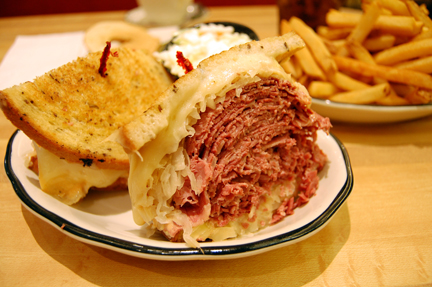
Now, that’s a Reuben

My first job in New York City (back in 1997) was nearly kitty-corner to Reuben’s Restaurant on Madison Avenue. So I feel confident when I say, I know from a Reuben sandwich… And as cousin Marty remarked to me last night, I come from a long line of fressers

Yesterday, I couldn’t resist a Reuben at the wonderful Kenny and Ziggy’s Deli in Houston. I love this place. It’s as good as New York (and sometimes better!).

Usually, I get the white fish salad appetizer but yesterday I was in the mood for something a little more substantial (how’s that for understatement?).

I do wish Ziggy wouldn’t pile so much meat on the sandwich (I removed about half of what you see in the photo). But, man, was it good…

There’s lots more to tell about good stuff (amazing, really) that we ate and drank while in Houston but Tracie P are about to say goodbye to cousins Joanne and Marty and make our way over to Brenham, Texas where we’re attending a dinner for 200 persons on the Jolie Vue farm.

Stay tuned…

Run don’t walk: the Greek Festival in Houston is AMAZING!

Above: Houston Greek Festival director Gus Economides, media coordinator Dana Kantalis, and Boutari sales manager Patrick Bennett. Both Gus and Dana told me that their respective families have been involved in the festival, now in its 44th year (!), for three generations. Great folks, GREAT festival.

I have to admit: I was skeptical. When my clients over at BoutariWines.com asked me to cover the Houston Greek Festival for their blog, I imagined one of those stereotypical affairs, like one I attended over the summer in Austin dubiously titled “Italian Festival,” where the raison d’être was that of profiting through the sale of booth space to vendors and not that of celebrating a community and a culture (Tracie P and I were so disappointed.)

Above: All of the food at the Houston Greek festival is prepared by volunteers. The recipes are decided upon by community committees, mostly community matriarchs, Dana told me). No commercial vendors have a presence there.

To my wonderful surprise, I found that this is an entirely homespun, homegrown, grassroots, and community-based festival intended to celebrate Greek culture and cuisine and to benefit the Annunciation Greek Orthodox Cathedral in Houston and its youth programs. EVERY volunteer (and I mean EVERYONE) told me that this is a family affair, with participation handed down from generation to generation (in many cases, the volunteers were fourth generation).

Above: In my capacity as Bloggeropolos (the non-Greek volunteers Hellenize their names for their laminates), I got to taste a lot of great food. The ingredients were fresh and wholesome and man, were they tasty! I’ve never experienced such good food at a large festival. Very cool stuff.

I’ll be heading back this afternoon to the festival with Tracie P, who’s joining me shortly. And we’re doing other fun food and wine stuff while in Houston and on our way back to Austin tomorrow. In the meantime, check out the slideshow I created from my photos yesterday.

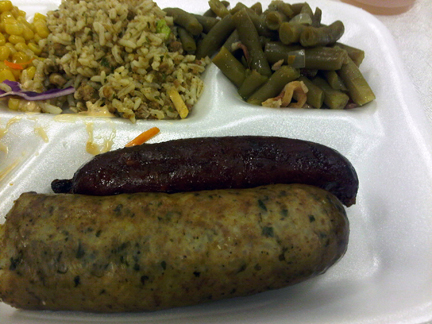
Cajun boudin and smoked sausage for Melvin

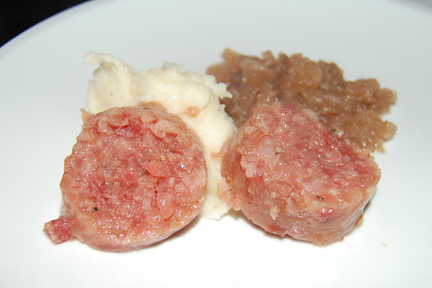
At my count, about 150 folks filed into the meeting hall at the Wesley United Methodist Church in Orange, Texas for a luncheon and celebration of Melvin following his beautiful memorial led by Rev. B. The lunch included delicious tender brisket by Melvin’s bbq team, creamy chicken spaghetti, Cajun boudin, and smoked sausage, and all the fixings.

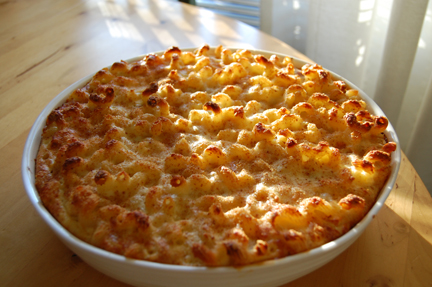
Maybe it’s the way she grates her cheese… Tracie P’s pastitsio, so good!

Just had to share these images of dishes that Tracie P made for us over the weekend, my first back at home from a trip too long…

That’s her pastitsio… unlike the Italians, the Greeks use egg in their béchamel, giving the crust of Tracie P’s pastitsio a custard-like texture… unbelievably good…

And last night, speckled butter beans that she had bought fresh and then froze, cooked with bacon and served with her homemade cornbread, made in her grandmother’s cast-iron skillet.

Watching our friend Edoardo Ballerini on Boardwalk Empire last night, munching on cornbread and sipping some 2008 Laurent Tribut Chablis, I felt criminally good…

Maybe its the way she grates her cheese,
Or just the freckles on her knees.
Maybe its the scallions. Maybe she’s Italian.

—Michael Franks, “Eggplant,” The Art of Tea, 1975

Fusion: Cos Cerasuolo di Vittoria and smoked Texas ribeye

Last night was a night of fusions and no one was taking sides at Trio at the Four Seasons (Austin).

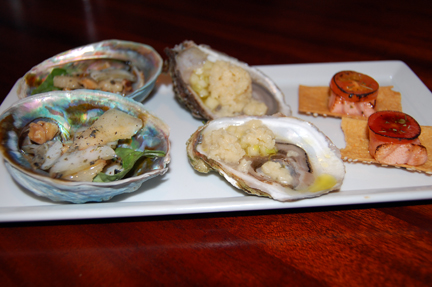
The first was Washington state abalone, oysters, and salmon, paired with Prosecco. Chef Todd was cooking for a Washington state wine event in one of the event spaces at the Four Seasons hotel and he sent down some of the pairings to our table at the restaurant downstairs where a friend and client had asked us to join him with a Prosecco producer.

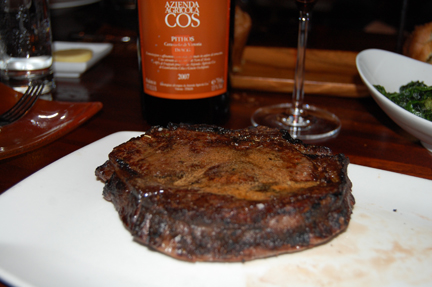
Perhaps the most extraordinary fusion came in the guise of a Texas smoked rib-eye paired with the Cos Cerasuolo di Vittoria. The Frappato character was powerful in the bottling we unstopped yesterday evening and the match between the bright fruit and the smokiness and fattiness of the beef was delicious.

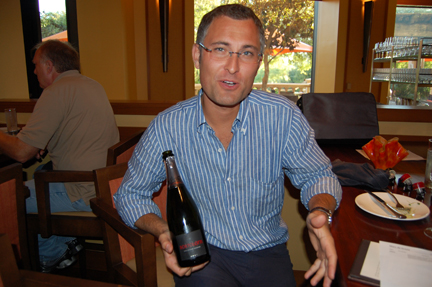
But the most intriguing fusion came with a smile and rimless glasses. Daniele d’Anna, the current generation of the Bortolotti family of Prosecco producers. Daniele is the product of a “mixed” marriage: his father is Neapolitan and his mother Veneta. I’ve never met anyone like him: he can switch between a thick Veneto accent (familiar to me) to Neapolitan (familiar to Tracie P) on the turn of a dime. I was curious to ask him about what it’s like to live in a Veneto now dominated by the Lega Nord, the xenophobe Separatist movement.

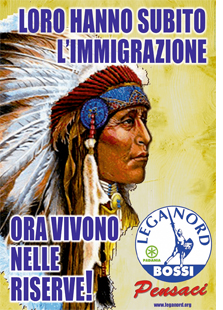
The Lega Nord wants to secede from the Italian republic and form its own country, severing ties with central and southern Italy. Let’s just say that the Lega doesn’t look so favorably on southern Italians, their customs, mores, and life rhythms. The image from the left is taken from a bizarre Lega campaign that I saw when I was in Italy recently. “They suffered immigration,” it says. “Now they live on reservations. Think about it.” Pretty scary, huh?

I liked Daniele very much and he struck me as a highly educated, cosmopolitan, and enlightened fellow. I doubt he shares the xenophobic sentiments of his Leghisti brethren. He made an interesting point: anyone who wants to get something done in Italian politics today, he observed, needs to take sides. His girlfriend, he told me, joined the Lega so that she could run for mayor of her small town in the Veneto, Asolo (one of my FAVORITE and one of the most beautiful and historically rich places in the world). Does she share the Lega’s racist platform? No, Daniele said. She just joined the Lega as a means to an end, he explained. Do they talk about politics when she comes over to the parentals’s for dinner? No, he said with a smile, they don’t. The 31-year-old woman won the election by the way and now serves as Asolo’s mayor.

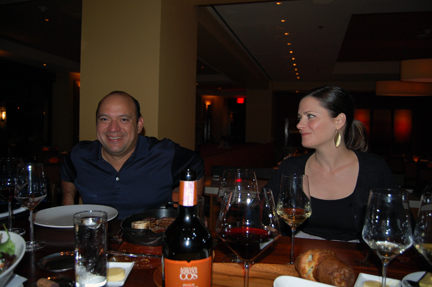
Only in Austin can a Salvadoreño (my friend and client Julio, above, left), a Methodist (Tracie P), a Jew (that’s me), and a Trevisan walk into a bar and order a Texas smoked rib-eye with a wine aged in amphora from Sicily. Sounds like a joke, but I’m here to tell you, people: it ain’t!

Buon weekend, ya’ll!

There’ll be more posts from my recent Italy trip coming up next week. Stay tuned…

The world according to Soldera

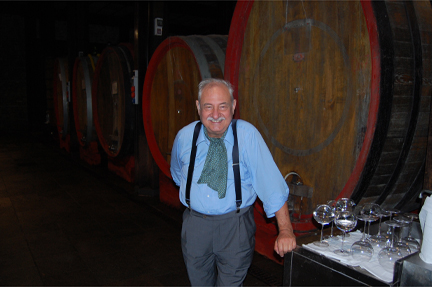
Above: Gianfranco Soldera, legendary, enigmatic, and paradigmatic winemaker, a Trevisan farmer turned Milanese industrialist turned Montalcinese winemaker.

Anyone who’s ever had the good fortune to be invited to visit Gianfranco Soldera’s estate, Case Basse, in the southwestern subzone of the Brunello appellation will surely share my impression that his winery, vineyards, and contiguous botanical garden come together to form what is undeniably one of the most impressive estates in the world.

When he began looking for an estate to purchase in the early 1970s, the Piedmontese wouldn’t sell him a decent plot of land, he told me the other day when we visited. So he decided to to buy a parcel in Montalcino on the advice of a friend who had told him you could pick up a piece of land there for a boccon di pan, a mouthful of bread, in those days.
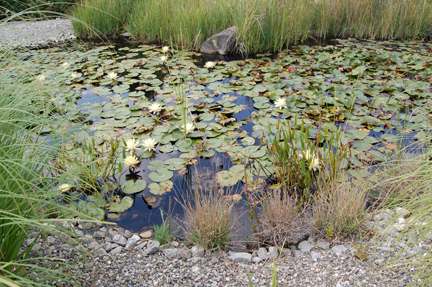
Above: The botanical gardens at Soldera’s Case Basse include a swamp (to create a maritime influence) and a white flower garden (to encourage nighttime pollination). “Ah, the white flower garden,” remembered wistfully my friend Dr. Lawrence O, the other day when he spied my visit on Facebook. Lawrence has visited there, of course.

When you talk to winemakers in Langa (Piedmont), many of the current generation still look to Soldera as a doktorvater (like Beppe Rinaldi, who told me that he often seeks advice and guidance from Soldera when the elder visits Barolo).

In many ways, it’s as if Soldera, when faced with the fact that he couldn’t make wine in Piedmont where he so obstinately desired to do so, decided to construct his own microclimate within the Brunello macroclimate. As he explains very openly, the remarkable botanical garden on his property (manicured by his wife) creates a unique ecological balance of plant and swamp life, including the “white flower garden,” so famous among wine insiders, intended to encourage pollination at night because the bright peddles attract the insects in darkness.
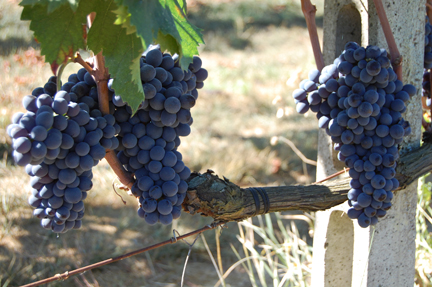
Above: “You find no vineyards with larger berries nor smaller clusters,” said Soldera proudly of his fruit. The attention to detail in his vineyard management is truly stunning.

Soldera has famously stated that he makes “natural wine.” Whether or not that’s the case is something I’ll leave that to the experts in the thorny field. He does seem to meet all the card-carrying members’s requirements: manual vineyard management, no chemicals in the vineyards, ambient yeasts in the cellar, no temperature control, lowest possible sulfuring. While I was in his presence a few weeks ago, he scolded one very famous winemaker in absentia for using cement vats for vinification, noting that wood is the natural vessel for winemaking. He also scolded another very famous winemaker for suggesting that it was okay to use a starter yeast when he had trouble initiating fermentation in his cellar.

But is it natural, I wonder, to build a botanical garden using mountains of manure (however organically prepared) in a place abandoned by sharecroppers because nothing would grow there anymore? I’ve leave that one to the exegetic forces of the rebbes and erstwhile Talmudic scholars in our field.

One thing we can all seem to agree on is that his wines are among the best in the world (and accordingly priced). I had the good fortune to taste the 2008 (extremely good) and 2006 (exceptional vintage, one of the best I’ve ever tasted) out of cask with him in the cellar. And at dinner we drank the 2003: an infamously and remarkably difficult vintage for any winemaker in Italy yet a harvest for which Soldera delivered lip-smacking acidity and gorgeously nuanced fruit aromas and flavors in his Sangiovese. These wines are simply life-changing, mind-blowing, awe-inspiring… It’s true…
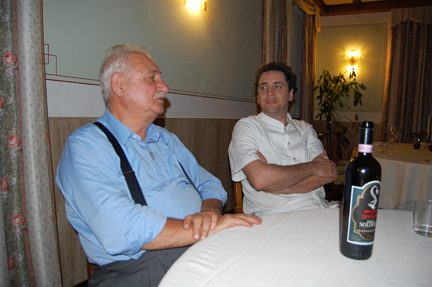
Above: Soldera with Roberto Rossi, chef/owner of Il Silene, arguably the best restaurant in southern Tuscany. The drive up to Seggiano is worth it if only to taste Roberto’s olive oil. The food and service were amazing.

Anyone who’s ever had the good fortune to be invited to visit Gianfranco Soldera’s estate, Case Basse, will tell you that Soldera keeps no secrets and he liberally shares his often salty opinions with those whom have been invited for an audience. (You’ll be surprised to find out that he has a website.)

Our conversation spanned many generations of Italian winemaking the other day when I visited him and you can imagine the controversial topics we covered. But the thing that stuck with me was what he said when I asked him what he saw for the future of winemaking in Italy.

“Commercial winemaking has come to an end in Italy,” he said referring to the recent Brunello controversy and rumors that the historic Barbi estate has plans to sell its property to Italian wine behemoth Zonin. “The nature of Italy cannot support industrial farming and commercial winemaking has run its course historically,” he told me. However many grains of salt there may be in the world according to Soldera, there’s certainly a grain of truth in this morsel of wisdom.
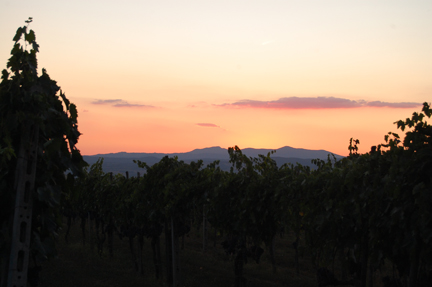
Above: Sunset at the Case Basse estate.

Another winemaker told me the same thing later on in my trip. Stay tuned to find out which one…

Tracie P’s pici

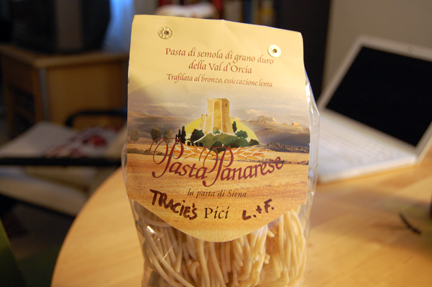
In the wake of a comment on this blog by Tracie P (while I was in Tuscany) sharing her yen for some Tuscan pici (long noodles made with only flour and water), my good friend Federico aka Fred (export director for one of my favorite Montalcino wineries, Le Presi) appeared one day with two bags of dried pici by Panarese for me to take home.

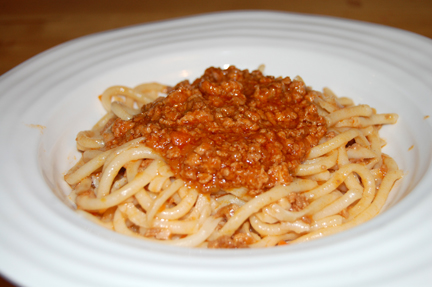
Last night for dinner, Tracie P defrosted some of her excellent ragù and used it to dress a few nidi (nests) of the pici (also called pinci).

On the back of the label, the only ingredients listed are durum wheat flour and water. There’s something about pici, even when dried (and not freshly rolled out), that makes them ideal for meat sauces (or mushrooms). For all of their humility, the purity of the saltless flour and the texture of the noodles create a sublime pairing with the richness of the sauce. Simply delicious. We paired with a grapey, bretty, easygoing Valle Reale Montepulciano d’Abruzzo that was remarkably fresh and bouncy for an 06. A perfect Tuesday night dinner, catching up on the TV shows we missed (Tracie P sacrificed herself and did NOT watch the season finales of True Blood and Mad Men so that we could watch them together… THAT’S how much she loves me, she says).

How did I manage to get the pasta back without any breakage?

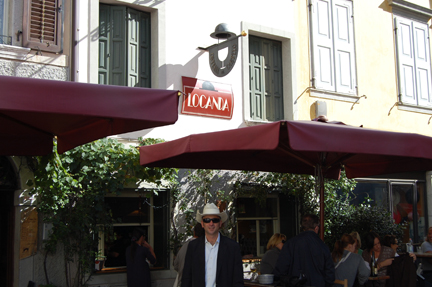
I used my cowboy hat, of course! I packed the bags of noodles on either side of the “crown” of the hat in my carry-on. It worked like a charm! That’s me, btw, above, outside the famous Osteria al Cappello in Udine, where hundreds of hats (cappelli) hang from the ceiling. (Photo by Joe Campanale.) The owner asked me if I’d give her my hat for her restaurant. “Un bel cappello,” she said. “A fine hat.”

“Naw,” I told her. “This hat will be riding home with the San Diego Kid back to Austin.” I’ll post more on the AMAZING MEAL I had at Osteria al Cappello in an upcoming post.

In the meantime, we’re sending lots of love to Pam and Melvin Croaker today. Melvin, you may remember, gave me my cowboy hat late last year.

Prosciutto bloggers unite!

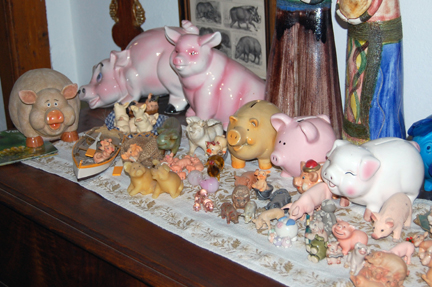
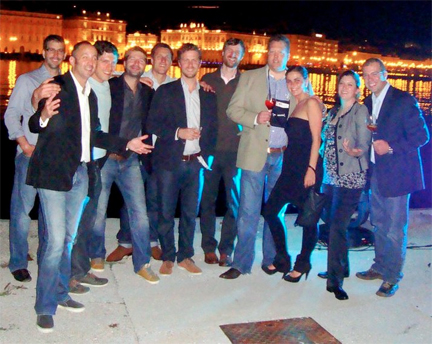
Just had to share this link and send some blog love over to the Prosciuttificio D’Osvaldo in Cormòns (Friuli). That’s a photo I snapped of the D’Osvaldo collection of pigs the other day when I visited with the Ponca 10 (below, later that evening on the Gulf of Trieste). I’ll be posting about D’Osvaldo and what I learned, saw, and tasted there in a few weeks (but first Tuscany and the Veneto!). Stay tuned…

How do you like those jazz hands? ;-)

Beauty (and ugly) in Italy

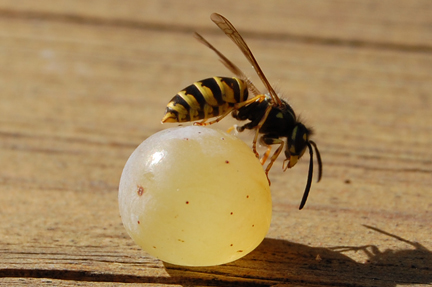
Above: A wasp feasts on newly picked Ribolla at Venica & Venica.

A quick post today, on this autumnal Monday back at my desk in Austin, comprised of photos from my trip, some of the most beautiful things I saw through my lens while in Italy. It was an incredible journey, replete with felicitous confluences, some serendipitous and delightfully unexpected, others grounded in epistemlogic contemplation and convex self-reflection.

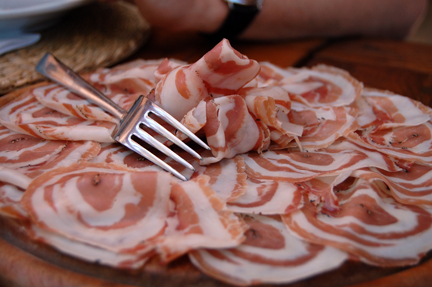
Above: Pancetta offered to weary travelers, also at Venica.

In the days that follow, I’ll begin posting in-depth accounts of my conversations and tastings with winemakers and restaurateurs in Tuscany, the Veneto, and Friuli. I am so grateful for all the comments, emails, Twitter mentions, and Facebook notes encouraging me and sharing insights into what I photographed, smelled, tasted, drank, and masticated over the course of the nearly three-week trip. And I am especially thankful for the incredible hospitality and generosity of spirit of my (literally) myriad hosts and guides.

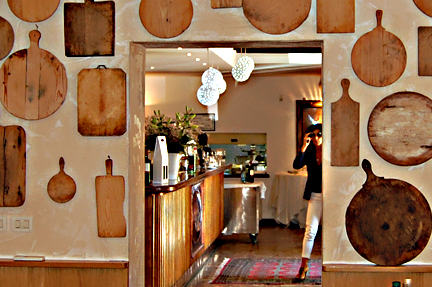
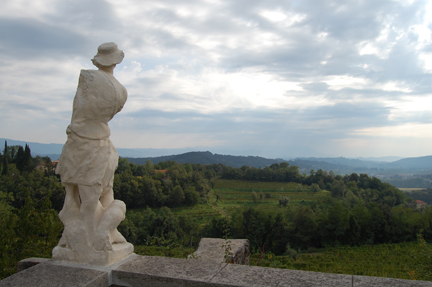
Above: A view from one of the dining rooms at Trattoria al Parco in Buttrio (Udine).

Immense and extreme beauty is offered to the willful traveler of the Italic peninsula: from her generous landscape to her innate and intrinsic humanity (both historical and topical), Italy continues to inspire me (and hopefully you) by revealing some of the mystery and joy of life through her topographic, aesthetic, and sensual pleasures.

Above: A view from the Abbazia di Rosazzo in the Colli Orientali del Fiuli.

While I thoroughly enjoyed her bountiful intellectual and sensorial gifts, I was however acutely aware of the seemingly insurmountable societal and cultural issues and turmoil faced by the inhabitants (Italian and otherwise) of this profoundly gorgeous land.

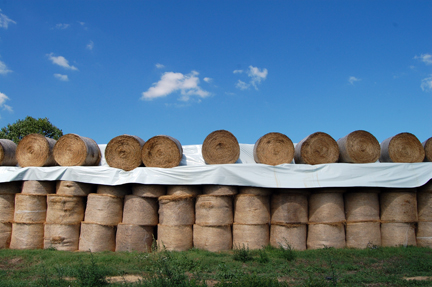
Above: Hay for Chianina cows near Pienza, Tuscany.

Whether it’s Berlusconi patently using one of his media outlets (in this case, Il Giornale, a top national daily) to sling mud at his rival Fini (now embroiled in a sticky familiar real-estate scandal) or the impending expulsion of Roma (following the highly controversial and contested model employed by Sarkozy), Italy and her peoples find themselves in circumstances eerily however distantly reminiscent of the “era between the two wars.” When I commented on the recent changing of the guard in the political regime of the region where she and her family make wine, one winemaker observed wryly but not inronically, “we were better off with the fascists in power than the [newly instated] separatists.”

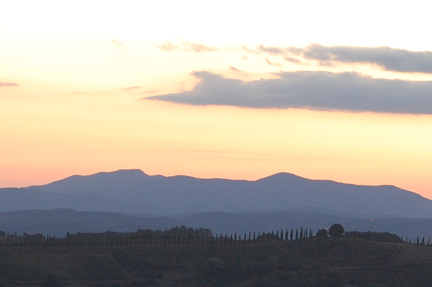
Above: Sunset in Montalcino (Tuscany), viewed from the estate of Il Palazzone.

Perhaps it’s this precarious balance of salt and sweet that makes Italy always taste so great and greatly on our tongues. Thanks for reading…

The Ponca 10 bid Friuli adieu

The Ponca 10* visited cult prosciuttificio D’Osvaldo yesterday in Cormòns: Matthew Turner (head sommlier, Michael Mina, San Francisco), Brent Karlicek (wine merchant, Postino, Phoenix), Jamie Garrett (sommelier, Sonnenalp, Vail), Bobby Stuckey (wine director, Frasca, Boulder), Steve Wildy (beverage director, Vetri, Philadelphia), Lachlan Mackinnon-Patterson (chef, Frasca, Boulder), Lara Persello (our handler, Turismo FVG), Shelley Lindgren (wine director, A16, San Francisco), Mario Nocifera (director of operations, Frasca, Boulder), Joe Campanale (beverage director, Dell’Anima, New York).

The group gave handler Lara a Hermès bracelet to thank her for her superb job herding cats.

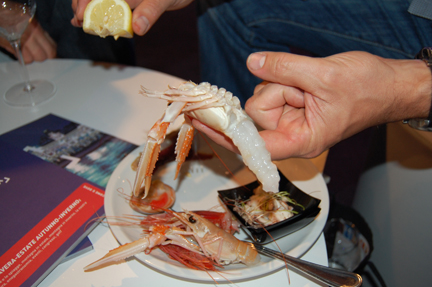
The crudo at the Regione Friuli good-bye discothèque party was extreme.

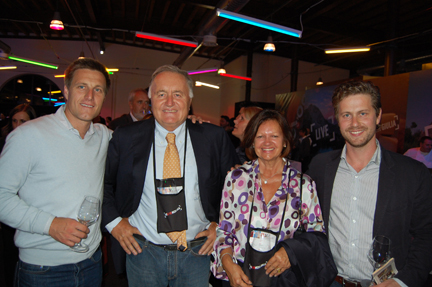
Bobby (left) and Lachlan (right) posed on the red carpet with Colli Orientali del Friuli consortium president Pierluigi Comelli and his lovely wife.

Do Bianchi dug the musetto.

Kristian Keber’s Edi Keber Collio ROCKED!

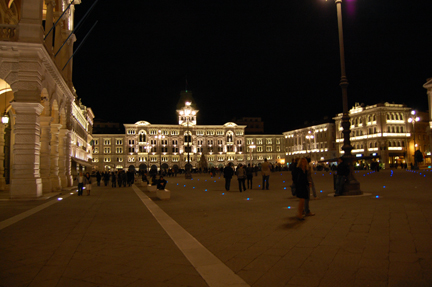
A stroll through Trieste on a Saturday night was magical, electric.

THANK YOU FRIULI FOR YOUR WONDERFUL HOSPITALITY AND THE GOOD VIBRATIONS!

*ponca, Friulian dialect, the unique sandy marl (flysch), Eocene seabed, typical of the Collio and Colli Orientali del Friuli appellations.