The new DOCG list and a killer Offida Pecorino

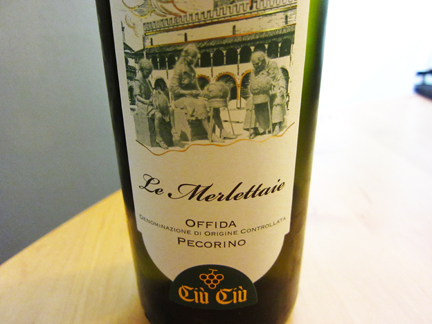
Above: The 2008 Offida Pecorino Le Merlettaie by Ciù Ciù is the best Pecorino I’ve ever tasted in the U.S. Really, really dug this wine.

“Official” is a relative qualifier in Italy. And I make that statement with all due respect and sans ironie. In the linear, Protestant thought processes of the Anglo-Saxon mindset, actors tend to see things in “black or white,” “day or night,” “yes or no”… In the non-linear, Catholic all-embracing Romance understanding of the world and the way it works, lines are blurred and absolutes are malleable. (Does anyone remember Bertolucci’s treatment of absolutes and Plato’s cave in Il conformista, 1970?)
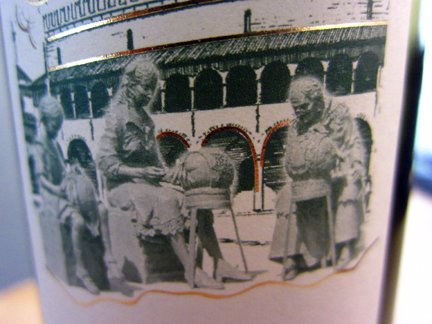
Above: Le Merlettaie is named after the famous lacemakers of Offida. The merletto a tombolo (tombolo is the pillow used to make the lace) is one of the great national treasures of Italy. I found this video showing how the lace is made.

In the wake of the publication of Alfonso Cevola’s update DOCG list, contentious emails have been hurled across the internets this morning debating the currency of the “official” number of DOCGs. I guess it depends what your definition of “is” is.

The only thing I know for certain is that Alfonso has done the wine world a service by compiling and diligently updating the list. Whether you’re a Master Sommelier candidate studying for your exam or your a server in a fine-dining establishment who wants to be able to discuss the Italian appellation system intelligently with your patrons, his list is an indispensable tool in deciphering the canon law of Italian wine.
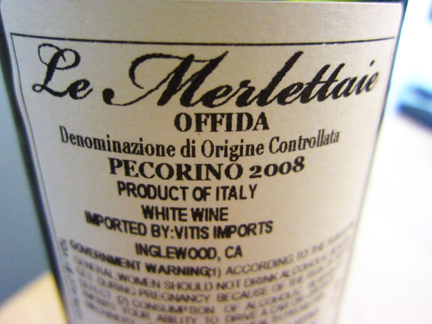
Above: To DOC or DOCG… I say “schlemiel, schlimazel!” Pecorino, when vinified in a traditional manner, is delicious (BTW, the schlemiel spills his soup on the schlimazel.)

I can also confirm that Offida Pecorino will be equally delicious when it attains its new “Terre di Offida” DOCG status. The one that we drank last night showed sturdy acidity and a wonderfully viscous mouthfeel, with nutty and stone fruit notes.

In other news…
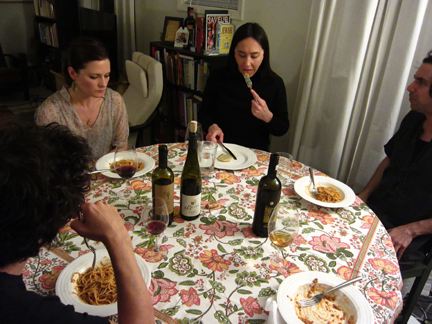
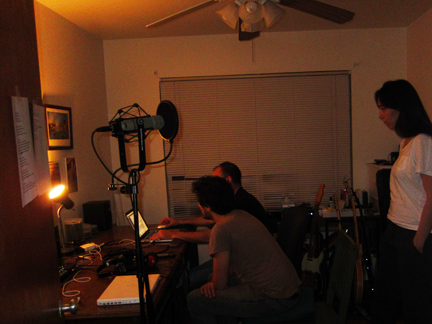
Last night, Tracie P made ragù alla bolognese for Nous Non Plus and the utterly inimitable and magical David Garza who came over to listen to our tracks and sprinkle some of his amazing gold dust on us. He brought a beautiful 1964 handmade nylon string guitar and it was amazing to hear him play and noodle on the patio before dinner. He’s performing the last concert of his residency at the Continental Club (gallery) in Austin on Monday night.
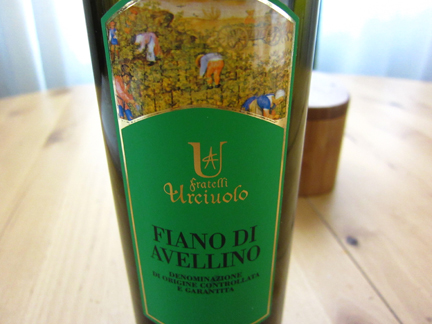
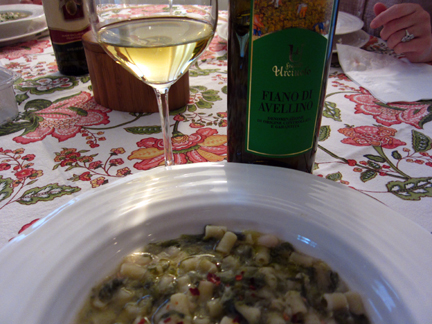
Oh yeah, THAT’s what Fiano d’Avellino tastes like!

If only you could have been a fly on the wall in our dining room at the moment that Tracie P drew that first drop of Fratelli Urciuolo 2008 Fiano d’Avellino to her lips last night. “Oh yeah,” she said with a joyous reverence, “THAT’s what Fiano d’Avellino tastes like.”

For all the blessings of our lives, there’s (almost) nothing that makes me happier than bringing home a wine that my super fine lady will enjoy. “This is the Fiano d’Avellino that I remember drinking in Naples and Ischia,” she said, speaking of the nearly five years she lived, worked, and cooked in Campania before returning to Texas.

With bright acidity, great minerality, and a characteristic “toasty” note that you often find in real Fiano d’Avellino (as Tracie P noted), the wine paired beautifully with another flavor system that she brought back with her from Campania: cannellini beans cooked with escarole and chicken stock and ditalini (tube-shaped pasta) — a southern Italian pasta e fagioli. Fanfriggin’ DELICIOUS people!

After being properly nourished, the band retreated once again into the Parzen studio, where we continue to write, record, and hash out the songs for the new album that we will begin “tracking” on Sunday here in Austin.

I’ll spare you the details of my digestive cycle, but the morning after a fantastic meal of real Fiano and Tracie P’s “greens and beans,” as she likes to call the dish, I AM READY TO MAKE MUSIC! :-)

Cooking for the band: Tracie P’ulled pork with chocolate and chiles

Yes, hell has frozen over and the band is getting back together.

Céline Dijon and Jean-Luc Retard and I (Cal d’Hommage) have begun recording our new album in the Groovers Paradise (otherwise known as Austin).

And Tracie P has been cooking up a storm.

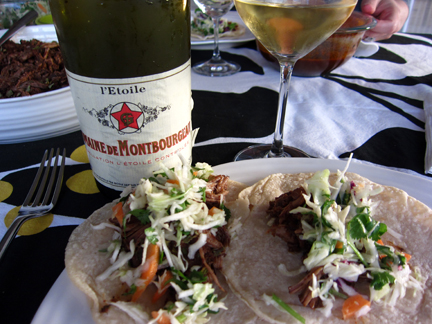
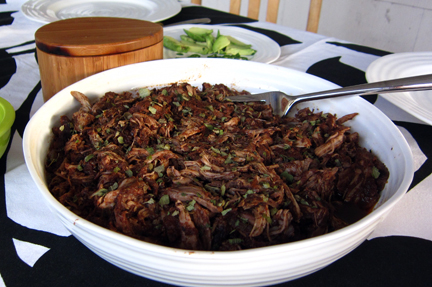
Yesterday, she cooked a pork shoulder for seven hours in our Crock-Pot with chiles and chocolate. They were served topped with homemade slaw, avocados, and fresh salsa and wrapped in corn tortillas from a local tortilleria. The 06 Montbourgeau made for a fantastic pairing.

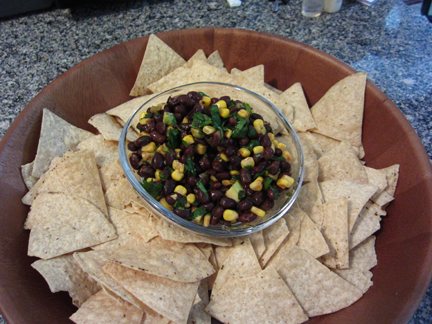
Chip and dip, anyone? Please pass the grooves…

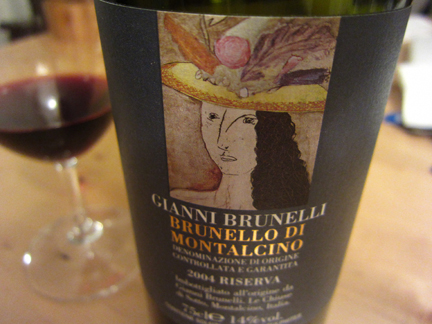
Want your wine to last? Drink good wine (Gianni Brunelli Brunello di Montalcino)

Above: The 2004 Gianni Brunelli Brunello di Montalcino Riserva is one of the most stunning and memorable wines that Tracie P and I have tasted so far this year.

One of the most frequent questions I get when I lead consumer and educational wine tastings (and I’m leading one next week in Houston, btw) is the following: what’s the secret for conserving wine in the bottle once you’ve opened it? (and the corollary how long is the wine good for?)

My number one answer and secret? DRINK GOOD WINE! And the most important element in the wine for its longevity once opened? ACIDITY! (I know that my wine sisters and brothers will agree with me on this one — just think of the 1978 Barbera by Angelo Gaja that we opened a few years ago at Alfonso’s pad).

As a whole, Americans have been trained by the Military-Industrial Complex to drink wines with LOW acidity, high alcohol, and concentrated jammy fruit — wines that have a short shelf life and wines that won’t last long once opened. (Sorry to sound like a broken record!)

But when you buy and spend some time with wines with healthy acidity, you’ll find that the wines will last longer — much longer — once opened. Wake up, America! It’s time to smell the coffee good wine!

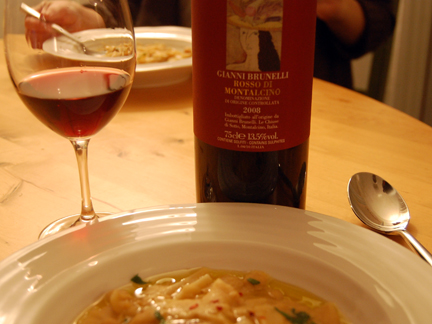
Above: With much lighter tannic structure and body, the acidity in the 2008 Rosso di Montalcino kept the wine alive for no fewer than 3 days — no refrigeration, no pumping, no nothing… just the cork that the bottle was born with.

Truth be told: when Tracie P and I opened a bottle of 2004 (not an easy vintage in Tuscany despite what some would have you believe) Gianni Brunelli Brunello di Montalcino Riserva the other night, we drank the whole bottle between the two of us at the dinner table. It was a Saturday night, we were staying in, and this bottle — with GORGEOUS, stunning acidity, brilliant fruit, and lusty alcohol held in check by pancratiast tannins — was simply irresistible. (This and the bottle below were given to us in Austin by the lovely Derryberry and Shaw families of Austin, the former bottling as a gift to thank us for Tuscany recommendations, the latter a gift from my virtual friend Simone whom they visited in Lucca.)

But when we opened a bottle of 2008 Rosso di Montalcino by Gianni Brunelli to pair with some ciceri e tria (chickpeas and long noodles) that Tracie P had prepared on weeknight/schoolnight, she had just one glass and I had two. Not only was the wine fantastic that night (and great with the creamy chickpea gravy) but a third glass was great even the next day… and a fourth and final glass vibrant and juicy even the following day.

Not rocket science… just common sense and great wine… :-)

Laura Brunelli recently visited the U.S. and Notable Wine wrote a great post about it here with video. Also, a must read: Avvinare’s remembrance of Brunelli is one of my favorite posts on her excellent blog.

Tortellini porn and a teaching again (this time in Houston)

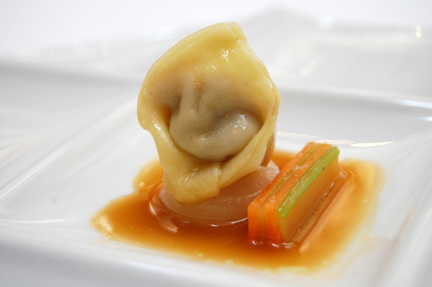
Above: Sometimes a tortellino is just a tortellino. Other times, a tortellino can be downright concupiscent.

Posting in a hurry today as I board a plane for Los Angeles where I’m working on a wine list for a new Italian restaurant there — a project I’m really excited about (more on that later).

In the meantime, I just had to share the above food porn, snapped recently at Tony’s in Houston. Tony, the Tony’s team, and I have been having a lot of fun with Tony’s blog.

And I’m thrilled to announce that they have asked me to teach a series of classes on Italian wine at Caffè Bello, the outfit’s location in “the Montrose,” Houston’s überhipster, artsy neighborhood.

The tastings/seminars should be a lot of fun and we’re launching Tuesday, March 29, with “Italian 101: major grapes, top regions.” (I haven’t finalized the syllabus but the weekly series will be similar to my “Italy: Birth of a Wine Nation” tastings.)

Gotta run… more later…

If that ain’t country, I’ll kiss your ass: Cooper’s BBQ in Llano

Above: At Cooper’s in Llano, Texas, the carver places your meat directly on the tray, to be wrapped in butcher paper later when they weigh it in. He dipped my pork loin in the sauce, saying that the sauce wouldn’t add any weight to it. He recommended adding sauce to the brisket later because the sauce would increase the weight (and cost), he said (and implied). Go figure!

Since I moved to Texas, many of my friends love to send me messages recounting their experiences with “Texas-style BBQ” (Comrade Howard and BrooklynGuy, I’m thinking of ya’ll here).

Well, I’m here to tell you that here in Texas, we don’t call it “Texas-style BBQ” or even “Texas BBQ.” We just call it “BBQ.” (Actually, some Texans just call it “food.”)

Above: Perhaps because of the distance from major cities and the fact that Llano is no longer a major transportation hub, the original Cooper’s feels like a truly homespun affair, free from the tidy marketese that adorns its web presence and satellite locations. Real deal food. The brisket melted in my mouth and the pork loin was tender and juicy. The sides were good… the beans, probably the best I’ve had so far.

On Monday night, I finally made it up to the legendary Cooper’s Pit BBQ in Llano, Texas, one of the most if not the most picturesque Texas Hill Country town I’ve visited (a veritable western movie set, really). I had spent the afternoon in Brady, Texas, the literal “heart” of Texas, as they call it. (Believe it or not, I’ve been asked to create some social media for a hunting compound up that way. Super nice folks, btw.)

As I drove past Cooper’s at around 1:30 p.m., it was still packed with the local lunchtime crowd. By the time I stopped in Llano on my way back around 7, the dinner crowd had already thinned, but even on a Monday night you could see that the place had been slammed as the staff was cleaning up most of the picnic tables inside. BBQ is always best, in my experience, when it’s prepared and served in large volume.

Comrade Howard and BrooklynGuy: when are ya’ll gonna get your asses to Texas for some real BBQ?

if that ain’t ‘Country’, I’ll kiss your ass.
If that ain’t ‘Country’, it’ll hair-lip the Pope.
If that ain’t ‘Country’, it’s a damn good joke.
I’ve seen the Grand Ol’ Opry, and I’ve met Johnny Cash.
If that ain’t ‘Country’, I’ll kiss your ass.

Signora Bilenchi remembers Pasta alla Puttanesca

Above: Mrs. and Mr. Bilenchi with their son Robert in Brooklyn in 1969.

When it comes to the origins of many of the classic Italian dishes that we all know and love, it’s nearly impossible to identity the etymon — the origin, the fons origo, the spring from which it sprang. Such is the case with Spaghetti alla Carbonara, for example: to my knowledge, no scholar has been able to trace its history with even the remotest semblance of certainty. In fact, as gastronomic philologists, all we know with certainty is what we don’t know about many of the great recipes of the Italian culinary canon.

Such is the case for Pasta alla Puttanesca: you may remember my post in which I traced all the historical data I could gather on the origins of this dish we all love so much.

The fact of the matter is that we live in a time of intensified awareness of the gastronomy that surrounds us. Not since the Italian Renaissance has Western Civilization devoted so much attention (and scholarship) to the foods that we eat. During the 20th century, when dishes like Carbonara and Puttanesca became so popular, we all lived in a culinary dark ages — when scholarship ignored the workaday aspects of our nutriment. BTW, for the record, neither Artusi (whose cookbook was compiled in 1891) nor Cavalcanti (1837) mention either Puttanesca or Carbonara.

The other day, a reader from Detroit — a Brooklyn native born to a Neapolitan mother, Robert Bilenchi — left the following comment on the post. I love his idea of trying to document the dish’s origins by interviewing folks who were living in Italy in the periods between the two wars and after the second world war. In the truest spirit of philology (the love of words), I asked Robert for some photographs of his mother and permission to post them here with his mother’s observations.

My mother is 93 and is still living. She was born in 1917. She remembers this dish, Spaghetti [alla] Puttanesca as a child and a young adult in Naples Italy. My parents made the dish when I was growing up in New York in the ’50s. So how then does this dish get to be invented in the ’50s? My parents were not well connected enough to have received the recipe from any Italian chef who might have been associated with the alleged inventor. Someone needs to do a survey of older Italians born prior to the ’30s to refute the ’50s story of the invention of Spaghetti [alla] Puttanesca. The Annarita Cuomo story appears to be erroneus. Sandro Petti did not invent the dish and though a study may have found the dishes popularity to have swelled in the ’60s, this does not show it was invented just prior to that time. Let’s do a study while these people are still alive.

Click here to read my original post.

In his own words, Robert is “a retired engineer living in Dearborn Michigan. I grew up in Brooklyn NY with my parents and 2 brothers. We all were spoiled on my mother’s cooking and we each learned to cook her specialties hanging onto her apron strings.”

Thanks for reading! Buona domenica, ya’ll!

Mexican wet dream: carnitas and Riesling

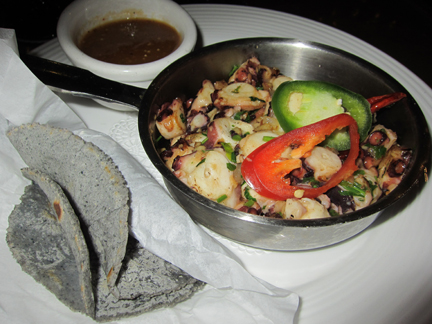
Above: Pulpo al Carbon at Hugo’s (Houston), grilled and marinated octopus with housemade salsa and three different kinds of peppers and warm pillowy blue corn tortillas. HIGHLY recommended.

The caliber and quality (and sheer fun) of Mexican food in Texas continues to blow me away (and this comes from a Southern California dude who grew up traveling in Mexico).

Wednesday night found me with cousins Joanne and Marty at Houston’s legendary Hugo’s, where my friend Sean Beck has put together what is IMHO the best Mexican restaurant wine list in the country. From an obscenely low-priced bottle of Taittinger La Française to cru Beaujolais (great with Mexican food, btw) and his hand-selected shortlist of German and domestic Riesling, I was like a Mississippi bullfrog on a hollow stump: I just didn’t know which way to jump! (who can name the song?)

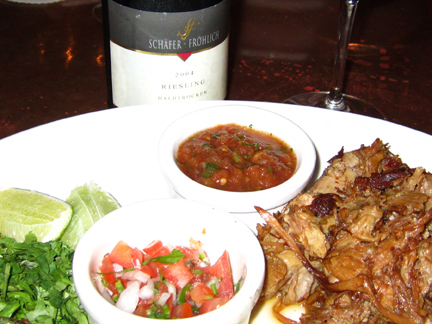
Above: Do you know of any Mexican restaurant with such an extensive and well-thought-out wine list? I had never seen anything like and Sean’s recommendation, Schäfer-Fröhlich 2004 Riesling Halbtrocken, was utterly brilliant with my carnitas. Chapeau bas, Sean. Fantastic pairing!

I’m dying to get to the famous Sunday brunch at Hugo’s and I’m sure we will soon. In the meantime, Hugo’s has now formed the triptych of what I consider to be the top high-concept Mexican restaurant in the U.S., together with Fonda San Miguel in Austin and La Serenata in LA (downtown, not westside).

(RdG+BarAnnie could be included in that list but it’s really a Southwestern as opposed to traditional Mexican cuisine restaurant.)

Even though California — from the Mission burritos of SF and the huevos rancheros of Half Moon Bay to the camaronillas of San Diego — is still the leader when it comes to down-and-dirty greasy hole-in-the-wall joints, Texas has the monopoly on the luxury, regionally themed Mexican restaurants in the U.S.

The carnitas — a litmus test for any self-respecting Mexican restaurant — were moist and perfectly seasoned, reminiscent of those I first experiences when I spent the summer of my sixteenth birthday in Mexico City so many moons ago.

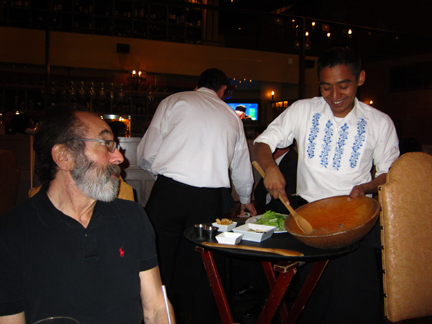
Above: Flirtatious nurses tell cousin Marty (left) that he has “excellent veins.” He is in great shape and is an amazing specimen of the human variety — for his fitness of body, mind, and heart.

If there was a somber note at our excellent dinner, it was because we discussed some of the very serious (although under-control) health issues that our beloved cousin Marty is facing right now. Technically, he’s my second cousin (Zane’s first cousin) but he’s more like an uncle to me and Tracie P. I never really had much contact with Joanne and him before I moved to Texas but since I got here, he and family have welcomed us into their homes and lives with immense generosity and love (it’s thanks to Marty that I know Tony!).

I wish all of you could experience Marty’s lusty appetite for great food and wine, engaging conversation, and intellectual pursuit (he’s a constitutional law scholar, btw). Tracie P is always tickled by his “potty mouth” and I hang on to every word and insight that he shares about our family’s history and evolution (I’m named after his father, Ira Levy, Jeremy Ira Parzen). More than anything else, we love to share meals together and some of the most memorable of my life Texana have been with him and company.

We just can’t imagine a world without him and we’re sending him lots of love and good thoughts in this trying time…

Magliocco, swordfish, and Gossip Girl

That’s the inimitable Shawnté Salabert, writer, voiceover artist, and song plugger for Sugaroo (my band NN+’s licensing agent). She’s the one who got our track “Catastrophe” (click to listen to preview) into Gossip Girl tonight. (Hey, I know it’s not Master Piece Theatre but if the teenage female American demographic digs my music, I ain’t complaining!)

“Catastrophe” is one of my favorite tracks: I wrote it in NYC with Céline Dijon back in 2007 (seems like a lifetime ago). Tonight’s episode also features another song I wrote and recorded with Céline in New York many years ago, when we played in another now unmentionable French band together. It’s called “Les Sauvages.”

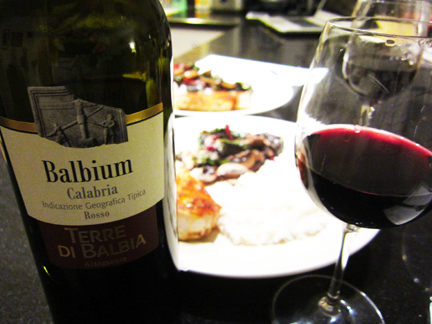
I got to meet and thank Shawnté in person on Thursday when I went to visit the mother office and have dinner with my old friend and music biz veteran Michael Nieves, who cooked up a delicious swordfish steak, which we paired with a bottle of 2009 Terre di Balbia Balbium (I had tasted it earlier that day at a trade tasting and swiped the bottle from the rep).

This 100% Magliocco from Calabria, raised by Venica & Venica, is one of the most exciting wines from Southern Italy that I’ve tasted this year (and I’ve been tasting a lot of southern Italian wines recently for a new consulting gig).

From what I understand, some (or all?) of the grapes are briefly dried in the vineyard before vinification. I was blown away by the freshness of this wine, its balanced alcohol (a little higher than I like but nicely settled in the wine), and its juicy cherry and plum flavors and bright acidity. Extremely yummy wine, excellent with Michael’s roast swordfish steak dusted with paprika.

Thanks again, Michael and Shwanté: for the placement and the rocking piece of fish!

Why does In-N-Out Burger taste so good when you’re depressed? (And please be nice to government workers.)

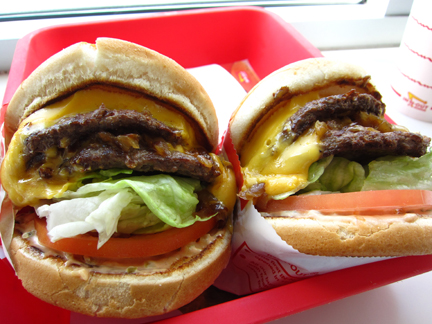
Missing Tracie P terribly and feeling down-in-the-dumps after discovering a boneheaded clerical error was going to cost me a pretty penny, I tumbled headfirst into the darkest depths of gastronomic moral nihilism and ate at one of California’s landmark In-N-Out Burgers. There’s no excuse for this aberration and abjuration of my culinary ethics. Even though folks often say that In-N-Out is the “less bad” of the fastfood franchies, it’s still junk food and it’s still bad for you. But, man, like a junkie putting that needle back into his arm, the first bite of that Double Double brought with it refuge and solace from my pain — however short-lived, false, and futile.

In the end Tracie P cheered me up with a phone call and the SUPER nice lady at above-mentioned government office emailed to say that she had managed to clear up the whole issue and that my penalty would be refunded.

We’ve all read about it in the news: government employees are under so much stress these days and who can blame them for not having a great day. In the midst of a budget crisis, California state employees are no stranger to the stresses of the current economic climate. I was very lucky to find a generous person who gave my case some extra attention and resolve my issue.

So please remember to be nice to our public servants. They deserve our support — now more than ever.