@ el pescador in la jolla today. Classic! And DELICIOUS! :)


@ el pescador in la jolla today. Classic! And DELICIOUS! :)

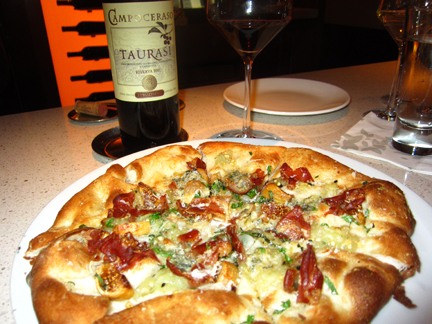
“Smells like horse shit,” said Tracie P last night with no small amount of satisfaction when she and I opened a bottle of 2001 Taurasi Riserva Campoceraso (field of the cherry tree) with our friends, sommelier Mark Sayre and chef Todd Duplechan at Trio in Austin. I bought the bottle, a current release for Taurasi, back in February from my friend and fellow champion of the wine proletariat Roberto when I was out in Los Angeles.
Whenever I teach a class or lead a tasting, the attendees are often surprised when I tell them that “I want my red wine to smell like horse shit and fruit and taste like fruit and rocks.” Smell like shit? Yes, and be glad you stepped in it!
Of course, the canonical descriptor for aromas like these is barnyard and you’ll often find it used for certain categories of Pinot Noir, most famously for example, from Burgundy.
The 01 Struzziero — probably my favorite producer of Taurasi — was meaty and salty, with bright acidity, and showed rich black fruit and savory flavors in the mouth. And as the barnyard and a little bit of Bret Michaels wore off, delicate notes of red berry fruit began to emerge on the nose.
When chef Todd tasted the wine, he ingeniously created a pizza inspired by the flavors of the wines: speck, eggplant, shallots, blue cheese and Parmigiano Reggiano, and dried fig… I loved the pairing and I thought about how wonderful it is to break the chains that bind so many of the world’s noble wines, like this Taurasi. Too often, in my experience, people insist on pairing a wine like this with braised meats. Yes, traditionally, that’s what you would pair this with. But the whimsical — capricciosa — pizza culled unexpected bright notes from this rich and intense wine.
In other Texas news…
I’m super stoked to see that Mark and Todd are tweeting these days. I’m following and you should, too. These guys perform magic nightly at the restaurant and they’re now sharing some of their enogastronomic insights with the world (Tracie P and I are hoping that Todd will write about some of the baby food he and his wife Jessica, an awesome pastry chef, are cooking up for their newborn).
In other other Texas news…
Did you see that Alfonso and I are leading a panel on wine blogging at this year’s TexSom conference? You think “horse shit” is outrageous? Wait ’til you hear what Alfonso and I are going to talk about! NC-17, for sure. Now, if we could only get young Texan wine professionals to stop saying “som”!
 Taste with me tomorrow evening at Ciao Bello in Houston, where I’ll be leading a tasting of Italian wines together with Chef Bobby Matos who will be preparing pasta table-side and sharing Italian cooking tips with guests. Should be a super fun event and evening…
Next Wednesday, I’ll be presenting one of my best friends in Italian winemaking today and producer of some of my favorite wines, Giampaolo Venica, who will be leading a wine dinner featuring five of his wines (including his Magliocco from Calabria and four of his family’s legendary white wines from Friuli) at Sotto in Los Angeles.
Hope to see you there!
Just as nature provides labor with the means of life in the sense that labor cannot live without objects on which to operate, on the other hand, it also provides the means of life in the more restricted sense, i.e., the means for the physical subsistence.
—Karl Marx, Economical and Philosophical Manuscripts, Paris, 1844
One of the things I couldn’t stop thinking about on this last trip to Italy (where I stayed at a 5-star resort, ate in a Michelin-starred restaurant, and tasted verticals of some of Southern Italy’s most famous wines) was Marx’s concept of alienation (estrangement), Gramsci’s concept of reification (objectification), and Pasolini’s “fear of naturalism” (“the natural being”) and the insight that they provide us in viewing the current global epicureanism as an expression of the bourgeoisie’s (and I count myself and you, my readers, as members of this privileged class) deep-seated yet unanswered yearning to cast off the yoke of consumerism.
Even though we know that sunlight is bad for us, we all know that wonderful feeling of feeling the sun on our skin, watching a sunset, or walking through a park on a bright summer day.
And even though we know it’s not bad for us, a view of verdant pastures or ancient olive groves somehow soothes us. The same way we enjoy reading Virgil’s Bucolics, viewing an 18th-century painting of a pastoral scene, or reading about “hardcore” natural winemaking in Spain on a favorite wine blog, food and wine writing allows us to escape the workaday din of the consumer-driven, globalized, and frighteningly reified world in which we live.
Sadly, in the post-second-world-war industrialized and globalized world, our bodies have become mere objects and the nutriments which give us life have become mere objects and we have lost touch with the pre-industrial expressions of the one and the other. Even as we consume “heirloom” food and wine products, as good and as healthy and as wholesome as they may taste, we cannot ignore (however much we would like to) the fact that the chain of supply that has delivered them to our dinner tables has rendered them into mere objects for consumption (it has reified them) by polluting the world with its carbon foot print as it couriers otherwise nutritious sustenance to consumers.
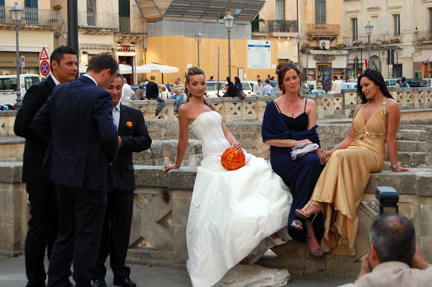
Marx would have called this “estrangement” (or “alienation” is some circles of Marxist parlance). There are very few among us who have any direct contact with the origins of the foods with which we nourish ourselves. As for Marx’s worker, food as become a mere object for us, even though it is the very substance that gives us life:

From his jail cell, as he witnessed Mussolini and the fascists industrialize Italy (“the trains ran on time,” etc.) and promote an exodus from the countryside and a migration to the great urban centers (because they needed humanpower to populate the factories), Gramsci distilled Marx’s estrangement into his notion of the cultural hegemony, whereby the capitalist cultural model drives humanity to negate its humanness.
Pasolini took this notion a step further, I believe, when he wrote of the bourgeoisie’s “fear of naturalism” and the “natural being.” As he witnessed Italy’s youth embrace the materialism and aesthetic models of middle-class America (in part thanks to the Marshall Plan and in part thanks to the emergence — for the first time — of globalized media), abandoning the values of the generation who had come before them, he recognized that this was a result of consumerism’s revulsion toward the natural being and the natural world (this theme pervades Pasolini’s work, from his early Friulian poetry to his last films; Pasolini was born in 1922, the year Mussolini marched on Rome and rose to power, and he was assassinated by a Roman prostitute in 1975, at the peak of the Christian Democrats’ hold on power and the hegemony of its capitalist model, both economic and ethical).

Now, more than ever, I am convinced that food and wine writing represents can represent, however powerless, a subversion of the hegemony of consumerism in the world today. Whether we take joy in reading or writing about a farmer who casts off chemicals to grow grapes and shuns industrial yeast to make wines that “taste of place,” we are subconsciously repelling the yoke of consumerism as we attempt, however unaware, to recoup, recuperate, and recover the humanness that has been negated by the human condition in the industrialized and globalized world.
Food and wine and food and wine writing offer us a historically unique confluence of the objectification of the sensuous natural world and the means for living. Unlike the natural substances transformed by Marx’s worker as she/he worked in a pre-world-war factory (like iron used to build arms, for example), food and wine as Marxist objects in today’s world are at once the transformed object and a source of nourishment. As such, it gives us a historically unique opportunity to express our humanity through its exegesis (and in many cases, its worship and fetishization).
This is the reason why I continue to post here on my blog and this is the reason — I hope — why you’re reading. Thanks for making it this far into the post.
And buona domenica…
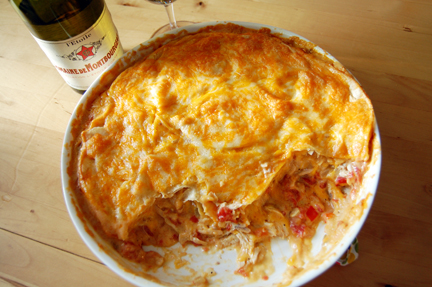
A lot of folks have been asking (here and on the Facebook) for Tracie P’s King Ranch Chicken recipe.
Man, I wish I could invite everyone over to taste how good it was and how well it paired with the Jura!
Buon appetito!

If some of yall never been down South too much,
I’m gonna tell you a little bit about this,
So that you’ll understand
What I’m talking about
Down there we have a casserole called King Ranch Chicken…
Posted today over at the Houston Press on a wonderful pairing of Tracie P’s off-the-charts good King Ranch Chicken, which she made a few nights before I left for Italy, and a bottle of Montbourgeau Savagnin.
Man, it’s good to be back home in Texas… :)
Eric the Red, I’ve got the Pearl beer on ice waiting for you…
(Who gets the song reference?)

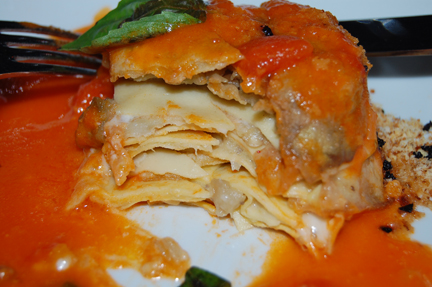
Last night, this dish at the famous Al Fornello da Ricci blew my mind: baked and fried eggplant layered with lasagne and drowned in a tomato sauce made from ciliegino, ramato, and macone tomatoes (I’d never heard of the latter and I’m guessing that it’s a local cultivar).

Amazing… Much more to tell about last night but now off to Ostuni — the “white city” for some sightseeing before tonight’s conference (where I’ll be speaking as well).
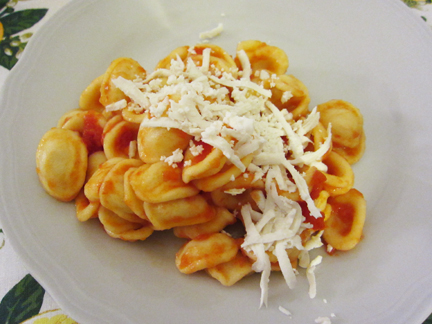
You really can’t eat too many orecchiette, can you? I LOVED the classic, homey orecchiette they served us last night at the beautiful Vallone winery after we tasted a vertical of Graticiaia — the Amarone-style Negroamaro that many Apulians call “the greatest wine” from their region. The hand-rolled dumplings were dressed with a fresh tomato sauce and freshly grated ricotta salata. Delicious…

The Castello di Serranova — home to the Vallone winery and a vibrant “living” castle — was in full bloom. Gorgeous.

It was fascinating to talk with Vallone enologist Graziana Grassini (above, second from left, photo by Jedi wine blogger Ryan) who is now — news to me — the enologist at Sassicaia (since last year). She was mentored by Giacomo Tachis and I was riveted by her anecdotes about him (more on that later).
Not much time for blogging today: we tasted 60 competing wines this morning and we have another 40 to taste this afternoon before we head out to dinner this afternoon…
Stay tuned!
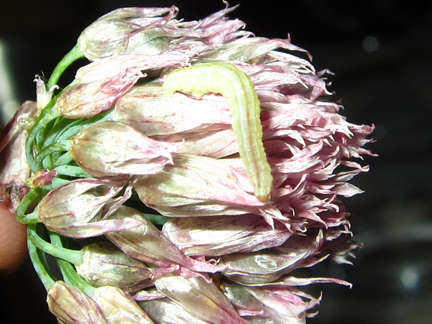
My dining companions were more alarmed by the worm in my chive flower than was I. The flower and worm arrived atop a truly fantastic dish of cavatelli with mussels and chickpeas at the Borgo Egnazia, a fancy schmancy resort on the eastern coast of Apulia where we’re staying for the judging.
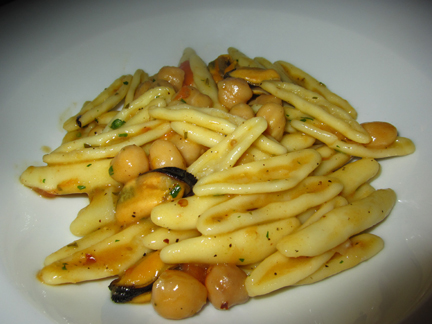
This was probably my favorite dish so far on this trip. I viewed the worm as a sign of nature and, frankly, I probably would have eaten it in the spirit of experiencing the terroir. But the however sweet lady seated to my right was thoroughly dismayed by its appearance and it was subsequently whisked away after being betrayed by her moan.

I also really loved the chef’s pistachio ice cream drizzled with extra-virgin olive oil.
 Do Bianchi