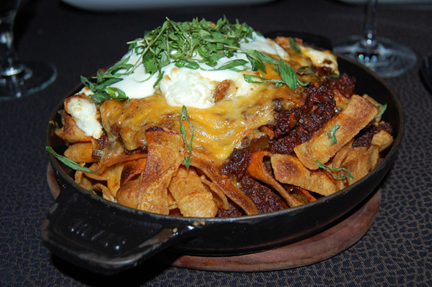
There is perhaps no dish that inspires connoisseurship among Texans as much as Frito Pie.
Shrouded in mystique and lore, this mighty staple of rigorously authentic Texas gastronomy, speaks to the citizens of our state like no other in our culinary canon. By combining indigenous ingredients and formulas — Fritos, invented in San Antonio, and chili con carne, actually known simply as chili in our state, as one adoptive Texan learned dutifully when he made the mistake of calling “turkey chili” chili — this supremely Texan of victuals marries all the things we love best: Fat and spice.
Every day while I was away in Italy, Georgia and Tracie P would send me a photo of them as soon as they woke up. Buon giorno, daddy was the subject line. It sure helped to assuage the loneliness that came with being away from them. But, man, there’s nothing like the real thing, baby…
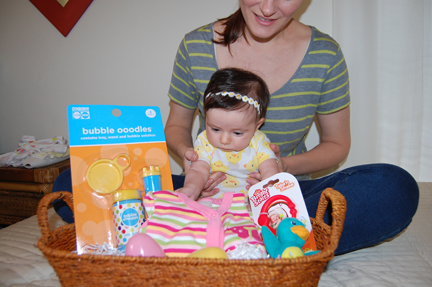
Yesterday, we celebrated Georgia P’s first Easter with an Easter basket.
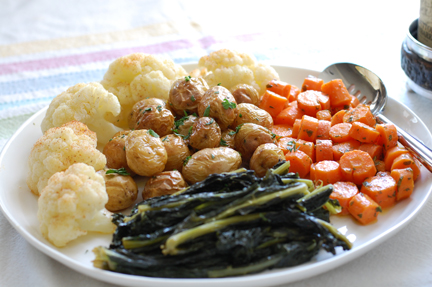
Dinner of steamed, roast, and sautéed vegetables…
and roast chicken for mommy and daddy…
paired with 2007 Produttori del Barbaresco classic Barbaresco…
and Irving Berlin’s 1948 Easter Parade, starring Fred Astaire and Judy Garland…
As I prepare to head up to Friuli today, there’s not enough time to post properly on the brilliant meal and stunning flight of wines. But here’s a “taste” of the “intellectual provocation”… THANK YOU, again, dear friends, Laura and Francesco, for opening your hearts to two weary Americans traveling along the wine trail in Italy…
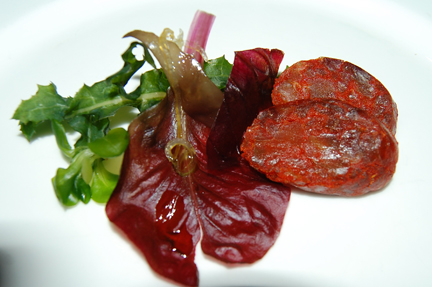
Atlantic croaker sausage with mineral-water-macerated lettuces sous-vide
Above: A repast of hard-boiled eggs, piada (savory Lombard flatbread, akin to Emilia’s piadina), housemade gardiniera, and “peperoni bresciani,” brined “peperoni lombardi” that have been tossed with extra-virgin olive oil and freshly grated Grana Padano.
It’s not easy to describe the utter fatigue that comes with Vinitaly — for the exhibitors and fair-goers alike. For folks like me and Alfonso (who’s been coming to the Italian wine trade fair for 30+ years), you make the trans-Atlantic journey and then you hit the ground running as you attempt to fit in as many meetings and tastings as possible from early in the morning through dinner and beyond.
On the eve of the last day of the fair, I headed with my good friend Giovanni (who showed his wines at the fair) to Brescia, where we decompressed over dinner at the Trattoria Gasparo and later back at Giovanni’s place with a bottle of Camossi Franciacorta (vinified and disgorged by him) paired with Francis Lai and Truffaut.
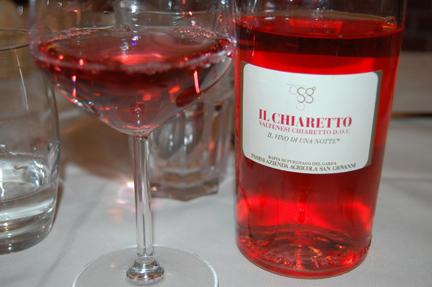
Above: Valtènesi (Garda) Chiaretto was one of the last DOCs to be approved by Italian authorities before the EU’s CMO reforms of the Italian appellation system went into effect. At dinner we drank Giovanni’s brother-in-law Luca Pasini’s Chiaretto, made primarily with Groppello and macerated with skin contact for “one night,” hence the wine’s subtitle, “vino di una notte.”
According to a press release issued by the fair’s organizer VeronaFiere, “Vinitaly won its gamble and earned the satisfaction of exhibitors, with an increase of professional visitors from abroad and especially from the Italian horeca (hotel/restaurant/catering) channel.”
There may be strength in record numbers but the truth is that the execution of the fair was thoroughly disastrous.
On Sunday and Monday, when attendance hit its peak, a mishap with the wifi network at the fair caused fair-goers to lose all cellular service. As a result, you couldn’t call, text, or message in any format.
And because, once again, the organizers failed to address parking and congestion issues, fair-goers and exhibitors spent up to 1.5 hours every night just trying to leave the grounds.
Nearly every producer I visited with told me privately, è stata una fiera di merda (it’s been a shitty fair).
But despite the logistical challenges, my personal Vinitaly was rewarding and I have many tales to tell.
And, thankfully, the aches and weariness of an American in Brescia were soothed by the bubbles and saltiness of Giovanni’s Franciacorta and a tune from the year that Vinitaly and I were born…
Today I’m in Tuscany for a few meetings and Saturday I head to Friuli for the COF2012 blogger project. Stay tuned…
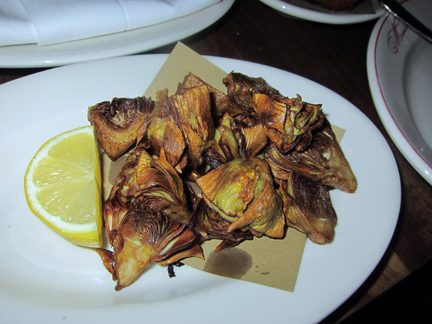
Above: I loved the fried artichokes at Danny Meyer’s Maialino.
It’s amazing to think that restaurant maven Jason Denton opened his Italian sandwich shop ‘Ino back in 1998 — the same year that Batali-Bastianich launched Babbo. Strolling around the West Village last week, I spotted two new (at least to me) “inos”: Gottino and Corsino.
It occurred to me that the Molto Mario paradigm is like al-Qaeda: it’s not just a working method or brand anymore; it’s a concept. And the rash of “inos” that have appeared across the City in the last fourteen years are akin to the self-appointed “cells” of the Jihad (perhaps modeled more after Lupa and Otto than his earlier successes).
I’m embarrassed to say that I still hadn’t been to Maialino (which opened in 2010), Danny Meyer’s Rome-inspired “ino”. And when Alice and I arrived there at 8 p.m. on Friday, the place was slamming packed.
I was geeked to reconnect with my good friend Nicolas, who works there. And we ended up having a nosh at the bar (including the awesome fried artichokes, above).
Nicolas treated us to a delicious bottle of Perella, one of Bruno De Conciliis’s expressions of Fiano. And I was psyched to see 2006 Produttori di Carema by the glass (!) and a truly courageous selection for the Pinot Grigio by the glass: Vie di Romans Pinot Grigio Dessimis — a vineyard designated, skin-contact, tannic expression of lees-aged Pinot Grigio. That’s a pretty gutsy choice for someone expecting Santa Margherita…
I tasted a 1997 Dessimis a few years ago in Friuli and was blown away by the elegance and power of the wine. And although I thought the 2009 offered at Maialino isn’t fully developed (the wood still resided atop the wine), I loved the fact that the wine director Liz Nicholson (whom I haven’t met) is prompting her guests to question the Pinot Grigio status quo in our nation.
OBut no matter how hard courageous and well informed wine directors like Liz try, you still can’t take the “ino” out of Pinot Grigio…
Up next: New York Stories III, Alice and I pay a visit to the “Wine Seer” uptown and “everything is beautiful at the ballet”…
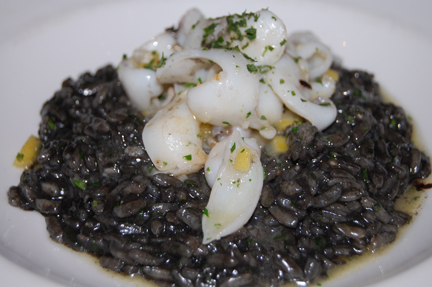
The Cuttlefish risotto at Ciao Bello in Houston the other night was so good that it nearly made me cry.
And it inspired a conversation about the “last taboo” of Italian gastronomy: the pairing of dairy and seafood.
I was at the restaurant doing a media dinner for my friend and client Tony Vallone, who shared the following anecdote about a luncheon in Naples a few years ago.
One of the guests, he said, an Italian-American, asked for grated Parimigiano Reggiano with his seafood pasta. The waiter politely responded that the restaurant didn’t serve cheese with seafood dishes. When the guest insisted, the waiter acquiesced, telling the patron that he would bring him the cheese. He disappeared, only to return after the gentleman had finished eating his pasta. “You see,” he said, “the dish didn’t need the cheese,” adding “in Italia si fa così,” this is how we do things in Italy.
The Italian taboo of mixing dairy and seafood stretches back to the Renaissance, when widely embraced Catholic customs required abstinence from dairy and meat on the numerous Lenten — di magro — days in the religious calendar. The bottom line: when seafood was consumed, dairy and meat were not. (I don’t have time to post about this today but this element of Renaissance cookery came to mind when I read Mark Bittman’s recent NY Times editorial on faux chicken; Renaissance cooks were obsessed with creating faux food, a gastronomic phenomenon that I called “culinary anamorphism” in a piece I wrote for Gastronomica some years ago.)
Of course, Tony’s cuttlefish risotto was made without the use of cheese (even though so many chefs in Italy and the U.S. discreetly fold some grated Parmigiano Reggiano into their seafood dishes). The secret to its creaminess? Tony had his chef caramelize and emulsify onions and then add them a few moments before the rice (Carnaroli) had cooked through. The viscous liquid gave the dish the all’onda texture that Tony likes in his risotto (whether sea- or landfood).
And it seems that we weren’t the only ones thinking about the “last taboo” of Italian gastronomy this week.
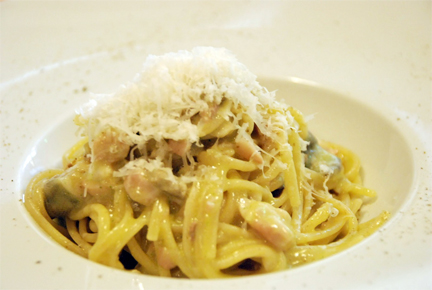
Today, Aldo Fiordelli, one of my favorite Italian-language food and wine bloggers and writers, posted this photo of “Linguine limone sgombro capperi essicati e parmigiano vacche rosse di Cristiano Tomei dell’Imbuto di Viareggio” (linguine tossed with lemon, mackerel, dried capers, and Red Cow Parmigiano Reggiano by Cristiano Tomei at the restaurant Imbuto in Viareggio).
Aldo notes that more and more Italian chefs are taking the bold step of using cheese in their seafood dishes, calling it their “last prejudice.”
Tony always says that for Italian cuisine to be authentic, it must also be creative. But I don’t think he would ever serve a dish like the one described by Aldo.
But hey, when in Viareggio, why not take a walk on the wildside?
From the department of “public service announcements”…
How’s this for a premise? [hipster Sicilian Natural wine producer] Arianna Occhipinti (above) and [legendary winemaker, master blender, and race car driver] Giorgio Grai walk into a winebar in Siena… The two winemakers represent the antipodes of Italian winemaking in nearly every way (including geographically!). And they are two of the nicest and most intelligent people in Italian wine today.
I probably won’t be getting up at 3 a.m. (10 a.m. Italian time) on March 16 to watch the streaming of a conversation between Arianna, Giorgio, the original Italian celebrity chef Gualtiero Marchesi, Giuseppe Vajra (one of our favorite winemakers), and a few other Italian food and wine luminaries. But I’m hoping that someone will have the good sense to post a YouTube somewhere. The icing on the cake: one of my favorite Italian food bloggers, Stefano Caffarri, curator of Appunti di Gola, will be moderating.
My good friend Francesco Bonfio, president of Vinarius (the association of Italian wine shops) is the organizer.
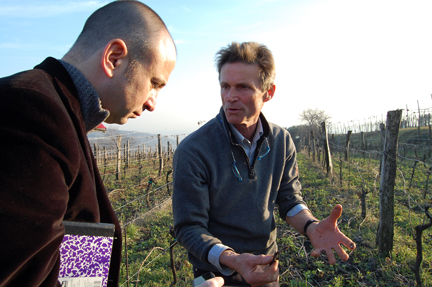
Of all the Natural and biodynamic wine fairs in Italy, VinNatur is perhaps the one that thrills me the most and its selection process is the most rigorous. Not only are producers required to practice chemical-free farming, but they are also required to submit soil samples to ascertain whether or not “residual” chemicals are present in their vineyards (resulting from runoff from their neighbors’s vineyards).
In past years, my very close friend and jazz guitar virtuoso Ruggero Robin has performed at the event (he and Angiolino — an accomplished musician in his previous life — are good friends, as well). I don’t know yet if Ruggero will be there but I hope so!