The power of food as history and memory…

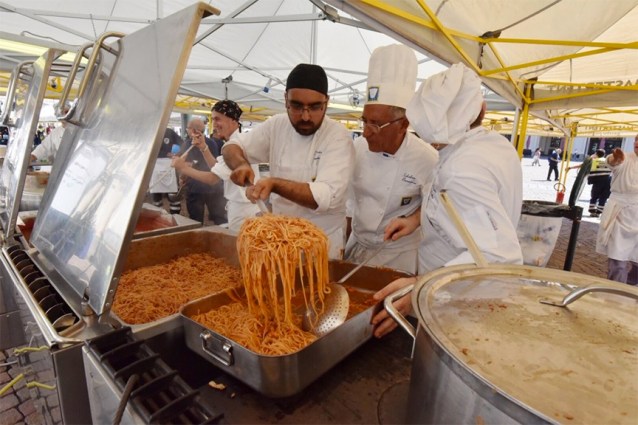
amatrciana torino turin earthquakeAbove: over the weekend in Turin, 7,000 servings of Amatriciana raised nearly €50,000 for victims of last week’s earthquake in central Italy (image via the popular Italian food blog Scatti di Gusto).

A couple of Italian food blogs (here and here) have posted about celebrity chef Antonino Cannavacciuolo’s op-ed on the front page of La Repubblica today.

There’s no link available online to non-subscribers but I wanted to post an excerpted translation of the piece. Like my Italian colleagues, I was moved by Cannavacciuolo’s take on the power of food and the way Amatriciana has become a symbol of recovery and hope in the wake of last week’s tragedy.

“Disasters destroy communities and they also destroy their symbols,” he wrote.

    They cause schools, hospitals, hotels, and churches to crumble. And once again, the earthquake that struck central Italy seems to have destroyed almost everything.
    But one symbol, however seemingly simple, has been spared: food.
    Today, Amatriciana, a dish that takes its name from one of the towns struck by the seismic event, sends a very powerful message.
    We all know that food is part of our daily lives. But it’s not just nourishment. It’s also history and memory.
    And that’s exactly what Amatriciana is: a simple dish of the people that carries forward the history of those who created it and the traditions of an ancient rural cuisine.

I was also really moved by my friend (and neo-Houstonian) Jeff Kralik’s post today, “Headed to Italy with a Heavy Heart.”

Before he left for a trip to Italy yesterday, he made his family an Amatriciana, which his sons devoured “with aplomb.”

Jeff’s planning to give blood during his stay.

As banal as it may sound to some, the legacy of a place and people lives on through an otherwise simple dish made from the humblest of ingredients. It’s the power of food as history and memory to inspire us…
Amatriciana for Amatrice: Slow Food founder calls for restaurateurs and diners across the world to support Amatrice in year-long campaign

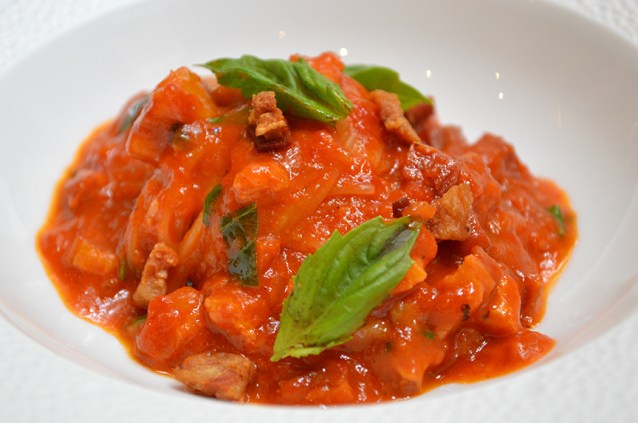
best amatriciana recipeAbove: my friend and client Tony Vallone’s Amatriciana here in Houston.
In Italy yesterday, Slow Food founder Carlo Petrini proposed that “every restaurant in the world” serve Amatriciana for the next 12 months and donate €2 for every dish served directly to the Amatrice municipal government (see bank info below).

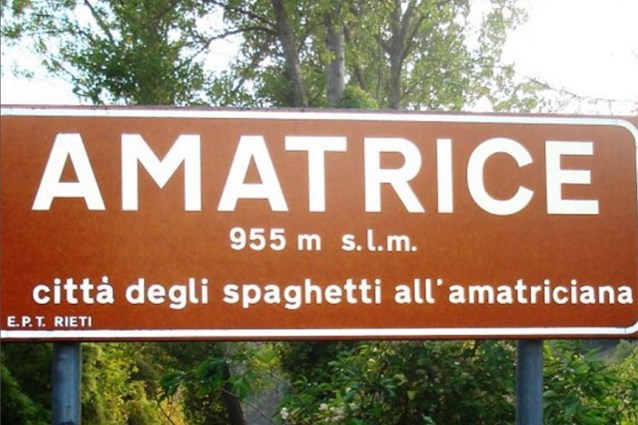
The village of Amatrice (AH-mah-TREE-cheh), known for its production of salumi and its celebrated Pasta all’Amatriciana (ah-MAH-tree-CHEE’AH-nah, long noodles dressed with tomato sauce and sautéed guanciale, cured pig’s jowl), was virtually destroyed in this week’s devastating earthquake in central Italy.

Petrini’s proposal, “A Future for Amatrice,” is a long-term fundraising initiative intended to provide sustained aid to Amatrice and its residents even after the “emotional wave of the moment has passed,” he wrote in a statement released to mainstream and social media.

Here in Houston, my friend and client Tony Vallone was already a step ahead of Petrini: yesterday, he began setting aside $2 for every dish of Amatriciana he serves (above) to be donated to Italian Red Cross relief efforts.

Ammado is the official micro-donation for the Italian Red Cross: here’s the link to donate.

You can also donate through the Italy-America Chamber of Commerce Texas (another client of mine). The Chamber is taking donations through PayPal and will donate funds collected to Italian Government relief efforts.

And if you want to send money directly to the Amatrice municipal government, here’s the bank code provided by Petrini in his statement: IT28M0832773470000000006000.

The destruction of Amatrice and a string of picturesque hilltop villages in this week’s catastrophe is a tragic loss for the Italian people and the world at large.

See the op-ed published this week by political commentator Beppe Severgnini in the New York Times.

“And in the space of just one summer’s night,” he writes, “Amatrice is all but gone.”

Earthquake recovery in Italy: how to donate to the Italian Red Cross

earthquake amatriceAmmado is the official micro-donation platform for the Italian Red Cross.

Here’s the link for donations to the Italian Red Cross and earthquake relief efforts. Donations can be made using a credit card and don’t require an Italian social security number (Italian micro-donation channels require one).

Here’s a link to information on what the International Federation of Red Cross and Red Crescent Societies is doing on the ground in central Italy to aid recovery.

I’m currently working on a couple of micro-donation campaigns here in Houston. More on those shortly…

Image via press_and_kitchen.

Earthquake in central Italy, 6.2 magnitude. Our hearts and prayers go out to our Italian sisters and brothers…

italy earthqake mapAbove: a 6.2 magnitude earthquake struck central Italy early this morning (image via the United States Geological Survey website).

Across social media this morning, I’ve been reading accounts of this morning’s devastating 6.2 magnitude earthquake in central Italy, which occurred at 3:36 a.m. local time.

The epicenter was 10 kilometers southeast of Norcia in Perugia province (Umbria).

But the most extensive damage seems to have occurred in small hill towns in Latium and the Marches. According to all reports I can find, Accumoli (Rieti province, Latium), Amatrice (Rieti), and Arquata del Tronto (Ascoli Piceno province, Marches) were among the hardest hit.

In a statement this morning, the mayor of Amatrice reported that the entire historic center was destroyed (New York Times).

Click here for La Repubblica coverage and images of the devastation. As of this posting, 63 lives have been claimed. Updated, Thursday, August 25: at least 241 lives have been claimed (La Repubblica).

From Rome to the Marches and even as far north as Parma, social media users I follow have been checking in and posting dispatches on relatives and friends living in the affected areas.

One of the most moving was by my friend Fabio Ciarla who lives and works in the wine industry outside of Rome.

“You wake up in the middle of nightmare and head back down the Via Salaria,” he wrote this morning, “the same road you would take when you were little with your family on a drive to Ascoli Piceno where [brother] Valentino studied enology. Not just through Amatrice but also towns like Posta, Sigillo, and Accumoli… Those were happy trips. Today it’s a Calvary.”*

Our hearts and prayers go out to our Italian sisters and brothers this morning. G-d bless them, G-d bless us all.

*Calvary: “the proper name of the place where Christ was crucified” (Oxford English Dictionary) and by extension a site of doom.

Goodbye California (a poem)

toes in the sandGoodbye California, goodbye beach, goodbye pool. 
Goodbye fish tacos, goodbye nigiri and sashimi, too.
Goodbye ocean, goodbye seal, seagull, and pelican.
Goodbye to some of our favorite things American.

parzen poolThank you San Diego, La Jolla, and thank you sweet friends.
Thanks for a week of paradise we wished would never end.
Thank you dear mother and thank you big brother.
Sister-in-law, niece, better family there is no other.

jeremy parzen wine blogBless you daughters and bless you wife.
Thank you for sharing the place where I came to life.
Sun, water, sand, and good things to eat.
This vacation will be a tough one to beat.

Thank you Sherman-Parzens, Yelenoskys, Battle-Ericksons, Georges, and Krylows for making this such a special week for the Texas Parzens in California!

And thank you, mom, for making this trip possible and for the great week at your apartment… What a wonderful experience for us. We’ll never forget it.

Happy Ferragosto! See you next week…

Taking a break this week for some serious downtime with family.

Buon Ferragosto a tutti! Happy Ferragosto, everyone!

(In case you’re wondering what Ferragosto is, check out this post I did for the Italy-America Chamber of Commerce last week.)

Wishing everyone a happy week, I’ll see you on the other side…

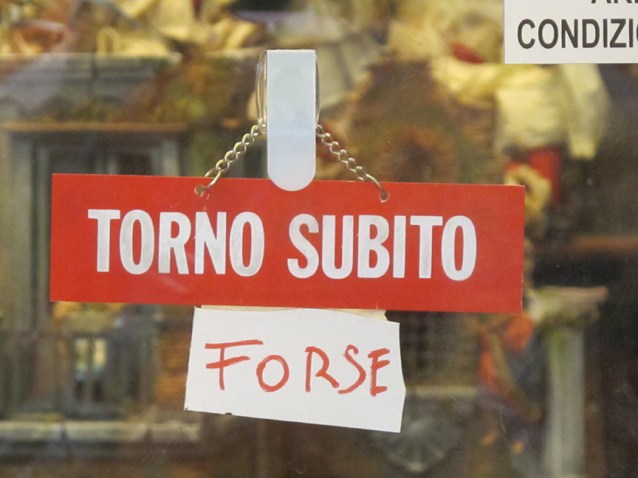
torno subito forse

Wine & Spirits features 3 Houstonians (and I’m one of them)

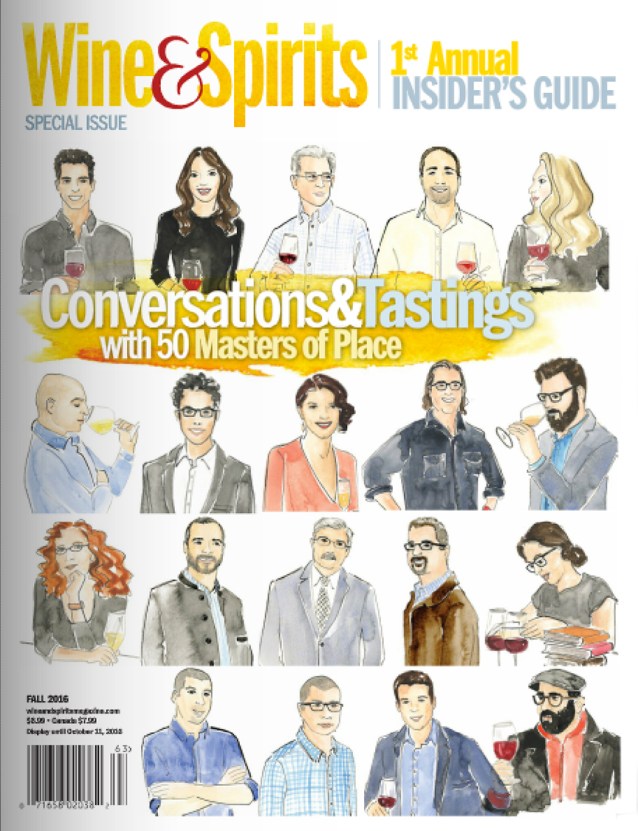
What a thrill for me to be included among the “50 masters of place” in the current issue of Wine & Spirits magazine!

But it was an even greater thrill for me to learn that I was just one of three Houstonians whose expertise was featured in the book (as they say in magazine publishing parlance).

Wine educator, writer, and buyer at one of the biggest retailers in the country (Spec’s), Bear Dalton wrote about Bordeaux.

And Evan Turner, owner and wine director at Helen (one of the best restaurants in Houston and one of the most original wine lists in the country), wrote on Xinomavro, the great red variety of Greece.

Present company excepted, the Houston-based media continues to slog away and along on its quixotic quest to portray our city as a bunch of air-conditioned hillbillies living on a land-filled swamp.

In fact, Houston is one of the most intellectually vibrant and culturally rich cities in the world and our groovy wine scene is a reflection of that. Three out of fifty, ain’t bad, Mimi!

It was also a thrill to see so many of my good friends among the contributors: Alice, Brett, Elaine, Shelley, Ceri, Pascaline…

What did I write about? Friulian white blends, of course. Check it out on newsstands now!

wine and spirits masters place

Natural wine group VinNatur releases controversial farming and production guidelines (English-language version)

angiolino mauleAbove: Angiolino Maule, right, founder of the VinNatur association for natural wine and one of the world’s leading advocates for pesticide-free wines (photo by Alfonso Cevola).

“I was beginning to feel like a sheriff,” said Angiolino Maule, founder of the Italian natural wine advocacy group VinNatur, when I met with him at his winery earlier this year.

He was referring to his group’s monitoring for the presence of chemical residue in the soils of its members’ vineyards.

When we met and tasted together this spring, he told me that the group is working on a new method for monitoring the health and biodiversity of the soils. The new system, he said, won’t be based on laboratory analyses of soil samples. Instead, it will focus on the presence of insects and other animal life among the vines.

“If there are insects in the vineyards,” he said, “it means that pesticides are not present.”

Maule and VinNatur have not yet revealed the criteria for the new monitoring system. But in a press release issued last month, they announced that they are in the process of developing the new protocol together with government-sanctioned certification groups and the Italian Ministry of Agriculture and Forestry.

In the meantime, the group has published its new guidelines for the production of natural wines.

As the wine world continues to wrestle with the definition of natural wine, VinNatur has presented its new checklist of permitted and forbidden practices as a new benchmark in defining the category.

“Those who choose to drink natural wine,” write the authors of the press released issued by the group (English), “have the right to receive tangible guarantees on what they will find in the bottle. Declaring oneself to be a ‘natural winemaker’ is not enough — one must be truly aware of the great responsibility that there is regarding the health of enthusiasts and clients, and act accordingly.”

The new guidelines haven’t been met by cheers in all corners of the natural wine movement. And more than one detractor has pointed to the fact that other similar “guidelines” have been published in the past.

“Whatever certificate, little medals, or badges… no, thanks. I’m beautiful the way I am,” wrote natural winemaker Corrado Dottori in a blog post. “Making natural wine is not a question of procedures. It’s a state of mind. VinNatur has got it wrong. Fuck the police. You have betrayed the revolution” (translation mine).

In a blog post entitled “Bla bla … natural wine … bla bla,” natural winemaker Alessandro Dettori contends that the focus should be on “agriculture… terroir, and the artisanal character” of winemaking (translation mine).

Click here for the English-language version of the guidelines.

Click here for the English-language version of the press release.

Riso (or Risotto) al Salto, a recipe

riso risotto al salto recipeOver the weekend on social media, a lot of people asked about the photo above.
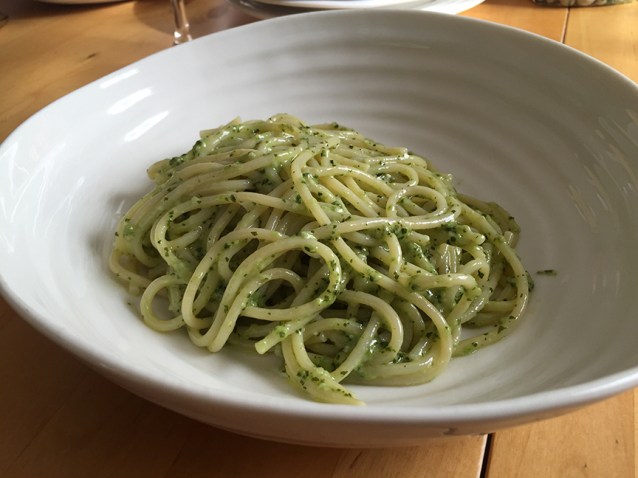

It’s a risotto al salto or riso al salto. Literally, it means a flipped or sautéed risotto and basically, it’s what you do with leftover risotto.

On Friday, I had made a risotto alla parmigiana and then on Saturday I made the “flipped” version.

For the risotto alla parmigiana, sauté some finely chopped onion in a broad pan with unsalted butter.

When the onions begin to become translucent, add the desired amount of rice and toast for a few minutes (being sure to stir constantly so that the rice doesn’t burn or stick to the pan).

Then add a few ladlefuls of chicken (or desired) stock and a half glass of white wine. Depending on the saltiness of the stock, add Kosher salt to taste (or not at all; between the stock and the Parmigiano Reggiano, you should have plenty of saltiness already).

Continue adding stock, stirring diligently all the while, until the rice has cooked through, 25-30 minutes depending on the grain.

A few minutes before the dish is ready to serve, fold in generously amounts of freshly grated Parmigiano Reggiano.

For the riso al salto, melt butter in a non-stick frying pan over medium heat and then add the leftover risotto. Gently pat and smooth it out until it’s uniformly round and flat in shape.

Brown the rice for 10 minutes or so and when ready to serve, turn it out of the pan by placing a large dish on top of the pan and flipping it over (I’ve seen professional chefs turn it out of the pan simply by flipping it, like an omelette; but it takes a deft hand for that).

Dust with freshly grated Parmigiano Reggiano.

On Saturday night, I also made a pesto (below).

It drew some criticism (and some praise) on social media.

“A me spiaza ma quer li i ni é pistü!” wrote StaticStrat on Instagram. “R’pistü ga le trenete der 7, patate e fazoin!”

“I’m sorry but that there ain’t pesto. Pesto is served over trenette” and “with potatoes and green beans” on the side.

A Texas-based chef also lamented that the pesto-to-pasta ratio was weak.

My pesto is by no means traditional. In fact, I make it with Parmigiano Reggiano and not pecorino. But it’s still delicious, I swear!

Seriously, isn’t that what’s so great about Italian gastronomy? It’s a canon and a blueprint that allows for infinite idiosyncratic variations.

Hoping everyone had a culinarily rewarding weekend and wishing everyone a tasty week ahead. Thanks for being here…

pesto recipe

Houston to Major Tom: a song for shipwrecked souls (new track by the Parzen Family Singers)

Above: the Parzen Family Singers covers David Bowie’s “Space Oddity” (for better audio quality, check out the SoundCloud below).

Every since the Parzen family moved to Houston nearly two and a half years ago, our daughters and I have been obsessed with astronauts (the “real astronauts,” as the girls call them) and NASA’s Johnson Space Center, which lies about 40 minutes away by car from the house where we live in southwest Houston.

The girls and I go there once or twice a month (Tracie P, not so much).

Somewhere along our journey into space, we came across this video-cover of David Bowie’s “Space Oddity” by Canadian astronaut Chris Hadfield, who recorded vocals and an acoustic guitar overdub for the track on the International Space Station.

That YouTube led us to our obsession (especially Georgia P’s) with this vintage David Bowie video version of the original song, shot on analog film.

Major Tom and our beloved “real astronauts” have become central to the Parzen family narrative.

Our daughters — ages 3 and 4.5 — don’t yet tap into the astronauts as metaphors for the unknown and unknowable. I’m not really sure where the appeal lies for them. I am certain however that like dinosaurs, astronauts are an interminable source of fascination for (our) children, perhaps because they innately intuit their significance in the unsignifiable.

For me, Major Tom and the real astronauts (like Ulysses) are allegories for our own shipwrecked souls and the human condition driven by our very real need and desire to face our aloneness (tell my wife, I love her very much, she knows…).

It’s so powerful to sit in the original gallery of the original Mission Control at the Johnson Space Center and hear the docent recount the 1969 moon landing.

“The first time words were heard from the moon,” she said on our most recent visit (with my bromance Giovanni), “they were heard in this room. That’s pretty cool.”

(Our dear friend Elaine also visited the real astronauts with us earlier this year.)

Like Columbus, like Magellan, like Ulysses, the real astronauts travel into the unknown so that we may know it, making the unknowable knowable. They haven’t unlocked the mystery of the universe and our existence. But with each step they take, they chip away at and assuage our aloneness.

And so on this sleepy Friday, the hottest day of summer so far, I offer you the Parzen Family Singers’ cover (SoundCloud follows below and the YouTube lies above).

One giant step for a middle-aged wine blogger… Thanks for listening.

girls in space