Dream flight: 98 B. Mascarello, 98 Quintarelli Amarone, 90 Quintarelli Bandito (white)

From the department of “dreams do come true”…

When we sat down for dinner last week, Tony Vallone looked across the table at me and matter-of-factly said, “I have some special wines picked out for you tonight. I know you’re going to like them.” He wasn’t kidding.

I’ve been curating his blog since October 2010 and our weekly meeting has evolved into a familial kibitz where we talk about everything under the sun, alternating between English and Italian. (Long before Tracie P and I announced that we were pregnant, Tony had intuited that we were with child. “I can read it on your face,” he told me. And, all along, Tony said it was going to be a girl. He was right.)

The occasion for our dinner was an interview with one of the top wine writers in the country and Tony had asked me to join them.

After an aperitif of light, bright Colle Massari Montecucco Vermentino, the first wine in the flight was 1998 Barolo by Bartolo Mascarello (above).

I’ve tasted this wine on a number of occasions and it’s extremely tight right now, favoring its tannin and jealously guarding its fruit.

But when the server arrived with a porcini risotto topped with Umbrian truffles shaved tableside, the wine started to open up and its delicate menthol note began to give way to wild berry fruit tempered by mushrooms and earth. The acidity in this wine was singing and I couldn’t help but be reminded of Angelo Gaja’s antithetical comparison of Cabernet Sauvignon and Nebbiolo. Cabernet Sauvignon is like John Wayne, I once heard Gaja say: he who stands in the center of the room and cannot help but be noticed. Nebbiolo is like Marcello Mastroianni: he enters the room and stands quietly in the corner, waiting for you to approach him. (There’s a punchline that cannot be repeated in polite company.)
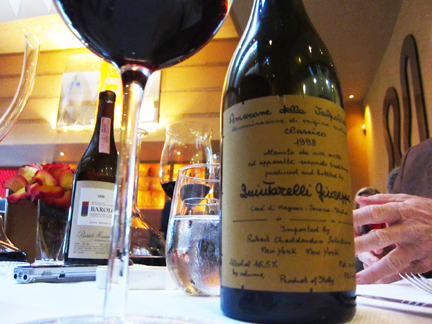
The acidity in the 98 Amarone della Valpolicella Classico was equally vibrant and its melody played a counterpoint against the delicately marbled fat of a Kobi fillet. While I’m sure that the 98 Quintarelli has many, many years ahead of it, this wine is in a moment of grace. Generous fruit set against rich structure and mouthfeel. Here, I couldn’t help be reminded of Cassiodorus’s description of Acinaticum: “On the palate, it swells up in such a way that you say it was a meaty liquid, a beverage to be eaten rather than drunk.” In this wine, meaty ripe and overripe red fruit alternated with savory flavors. An unforgettable wine in one of the most remarkable moments of its life.
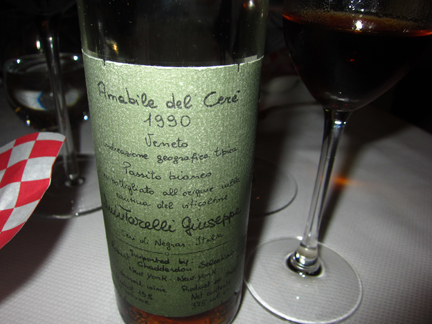
And dulcis in fundo, Tony had selected a wine that he had seen me covet. A few months ago, a collector and frequent guest of Tony’s poured me a taste of the rare 1990 Quintarelli Bandito (I wrote about it here). Knowing that I longed to “drink” this wine in the context of a meal, he surprised us at the end with a 375ml bottle. This wine — last bottled by Quintarelli for the 1990 vintage — is one of the greatest expressions of Garganega I’ve ever tasted: rocks and fruit, minerality and stone and white stone fruit, dancing around a “nervy backbone of acidity” as the Italian say.

This was paired with some housemade zeppole and a dose of playful nostalgia.

Carissimo Tony, ti ringrazio di cuore per questi vini straordinari!
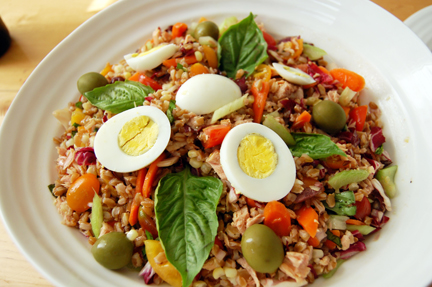
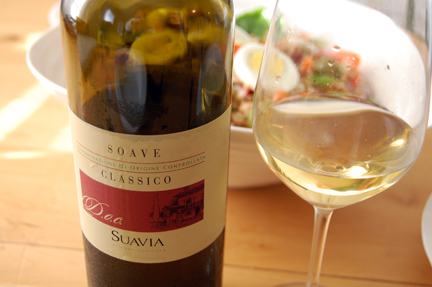
Soave and summer farro salad make a bleak world seem brighter

Tracie P really outdid herself yesterday night for our dinner, making a gorgeous summer farro salad with fresh and lightly blanched vegetables and fruits and hard-boiled egg. It’s a good thing she did because by the time dinner rolled around at our house, I was depressed.

After reading the dismal news about Italy, the economy, the fall of Western Civilization, and the riots and looting in London (one of my favorite cities on earth), I couldn’t help but think about the last market crash in 2008 and the days that followed the tragedy of the Twin Towers in 2001. Those were tough times for the wine (and restaurant) industry and I hope they are not returning in the wake of the current crisis.

But as Tracie P reminded me, no matter what happens, we’ll have each other and we’ll have Baby P when she arrives later this year. And for the first time in my life, as bleak as the world seems right now, my anxiety about the future is assuaged by Tracie P’s wonderful smile and her warm embrace — and a little girl growing inside her.

And as bad as things may look, we all found joy and solace in some of the simplest pleasure in life: a bright summer dish and a bright, fresh bottling of Garganega by Suavia.

We were also joined last night by Alfonso, who was in Austin on business. And it was great to be together, just the three four of us…

After dinner, we settled into the living room and watched Pasolini’s Decameron on Netflix streaming. And I think all of us thanked our lucky stars for the small pleasures that life delivers…

Here’s one of the most beautiful sequences from the film… Buona visione

BBQ Capital of Texas THE WORLD: Lockhart

To call Lockhart, Texas the bbq capital of the world is simply insufficient in describing its role in the gastronomic state of world bbq affairs.

Lockhart is a true Mecca — by antonomasia — the ultimate and supreme destination for bbq, where the German-Texan tradition of dry rub smoked meats has not only been institutionalized but has become a true religion.

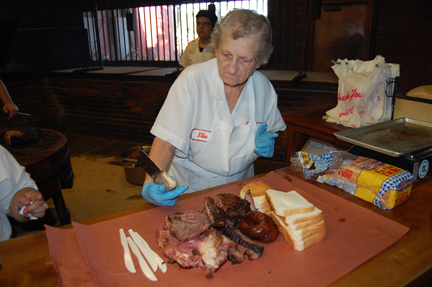
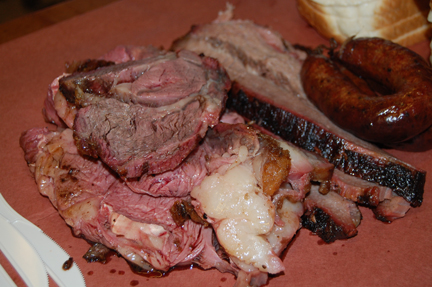
And Kreuz Market is the bbq religion’s pontiff and its most pure expression: no forks, no napkins… just butcher paper, paper towels on the tables, and plastic knives to cut through the tender bounty and plastic spoons for the sides. And most importantly: no sauce… Housemade hot sauce (in the style of Tabasco, to give you the idea) is sufficient to add the desired kick to this perfectly seasoned meat.

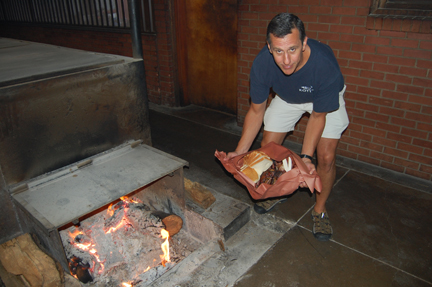
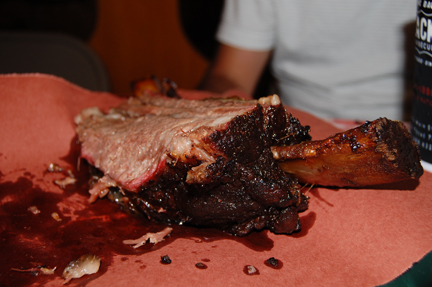
That’s cousin Ben in the photo above. He, cousin Marc, Marc’s children cousins Jessica and Jacob, Cousin Marty and I headed down to Lockhart early yesterday morning for a ‘cue crawl.

We did also make it to Black’s, where cousin Jessica took this excellent photo of the signature beef rib using my camera.

There are three destinations for bbq in Lockhart — Black’s, Kreuz, and Smitty’s. They are highly competitive, steeped in familial rivalry and intrigue, and each with its own particular and peculiar nuances and idiosyncratic signatures.

One man’s poison is another man’s meat. However much the families of Lockhart feud and vie with one another to claim the title of best in a village of champions, our family was surrounded by other happy families who come together everyday united by a common cause — great food…

Buona domenica, yall!

NC-17 ruminations on Berlusconi & other Euro pols

WARNING: CONTAINS PROFANITY AND HUMOR.

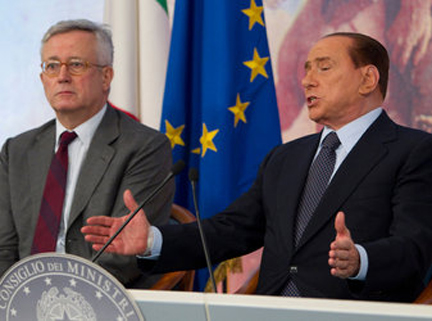
When I saw Italian prime minister Berlusconi’s photo on the (virtual) cover of The New York Times this morning (above), I couldn’t help myself from inserting my own caption: “Ma… La Merkel mi sta facendo un culo così!” Translation: “Merkel is really tearing me a new one!” (Note the gesture whereby Berlusconi illustrates the size of the new ass[hole] that Merkel is tearing for him.)

Surely I am not the only Italophone who fell victim to this overwhelming urge.

As we Americans awake from the stupor of our congressional budgetary crisis only to find that the debt crisis is about to topple Western Civilization as we know it (first Greece, now Italy, etc.), there is no small dose of irony in the fact that German prime minister Angela Merkel and her husband are enjoying their Alpine vacation in German speaking Italy, in the village of Solda to be precise.

Yesterday, in any event, it came as no surprise to me when my blogging colleague J.C. brought to my attention (on the Twitter) the news that Berlusca “took advantage of a government press conference last night to push his own shares. He said if he had savings he’d fill his boots with Mediaset, which was now ‘utterly undervalued'” (via The Guardian).

For the best blog coverage of Italy’s emerging and expanding debt crisis, I’ll be following Avvinare, who use to work as a financial reporter in Milan.

I’ve never met Berlusconi, although I did breath the same air as he when I was working as an interpreter at the United Nations and was called into a meeting between him and Kofi Anan.

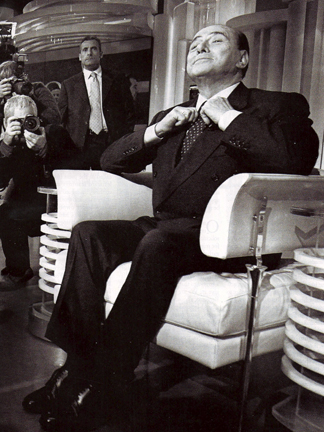
In all fairness to Berlusconi (evviva la par condicio [the Italian fairness doctrine]!), he did get a bad rap in a recent New Yorker profile (although I did love the photo from the piece). As well intentioned as the young author, Ariel Levy, may have been, she probably should have brushed up on her Italian before filing her article (where are the cocaine-snorting fact checkers when you need them, Jay?).

She erroneously found irony in the fact that the Italian press refers to Berlusconi as il presidente. In fact, while we call him the prime minister, he is the president of the council (presidente del consiglio) that governs the two houses of the Italian parliament.

She also erroneously found hyperbole in the fact that the Italian press calls him il cavaliere (the knight). In fact, Berlusconi is a knight in the Italian Order of Merit for Labour. And because he is Italy’s richest man, he is — by antonomasia — the knight, i.e., the leading knight in the order.

Otherwise, I agree 100% with everything Ms. Levy said in her piece (and recommend it to you).

My band Nous Non Plus has recorded a song I wrote about Berlusconi. It’s called “Bunga Bunga” and will appear on our forthcoming album Freudian Slip.

I can’t play it for you yet but I can preview a line:

All over the world, on fait le Bunga Bunga.

Post script: check out this excellent article in the Atlantic about the origins of the expression Bunga Bunga. Philology at its best (and its funniest)!

A first-kiss wine…

From the department of “somehow, some way, I just keep on getting to drink funky-assed wines like every single day”…

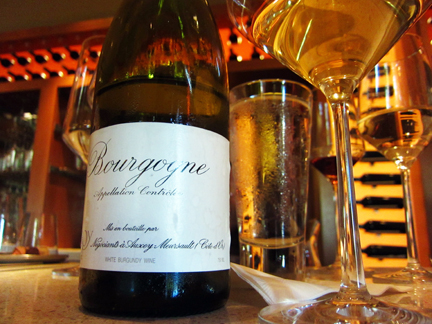
The incipit of last night’s flight — the overture, the prologue — was a deceivingly humble bottle of 1997 Bourgogne blanc by Leroy. Friend and collector Michael Byington (environmental consultant by day) was in Austin on business and we met up at the happy hour at Trio (half-priced by the glass, appetizer menu, and free valet parking!). While I had brought a bottle to share as well, ubi major, minor cessat: his flight was so impressive that I tucked mine in my wine bag and just stuck around and enjoyed the incredible ride.

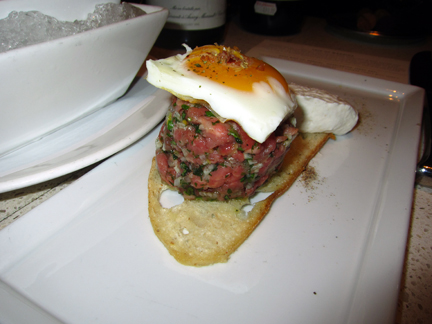
Not only did the Leroy reward us with nuanced dried fruit and chalky minerality, vibrant acidity and a slight unctuous mouthefeel that made it pair brilliantly with the steak tartare (ingeniously served with kren by chef Todd Duplechan)…

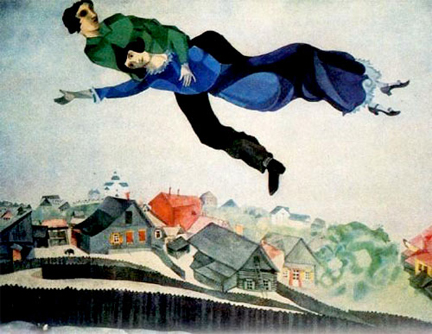
It also brought to mind a special moment in my love affair with Tracie P: nearly three years ago, when we were still in a long-distance romance, I brought a bottle of 1997 Leroy in my checked baggage to Austin. Then, the glow of our new love was wrapped around us tightly (and still is as Tracie P carries la piccola Parzen, as at least one friend on the Facebook called her), and every wine we tasted together was a new adventure. The 97 Leroy was perhaps the first “intellectual” bottle we shared and an unforgettable moment when our palates came together like lovers floating in a painting by Chagall. As soon as the wine touched my lips, I was transported to that moment and could see Tracie P before me, her blue eyes twinkling, her golden hair shining, and her lips inviting me to taste… Aroma and flavor have such remarkably potent mnemonic power… And this wine was a window onto one of the happiest and most thrilling moments of my life.

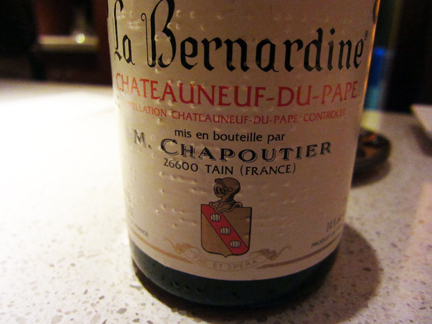
Michael had generously reached deep into his cellar before traveling down to Austin… Next, we opened a bottle of 1998 La Bernardine by Chapoutier. Crunchy red earth, chewy flavors of game and underbrush, ripe red fruit…

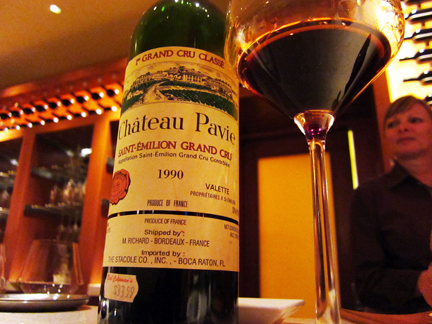
The 1990 Château Pavie was in fantastic shape… I couldn’t help but think of what Houston wine writer Dale Robertson had said to me the night before: to drink a wine too old can be a felony, but to drink too young is only a misdemeanor.

Bright, red and berry fruit, ethereal sand and pebbles, a powerful lightness and delicate muscularity. (Does anyone recognize the Petrarchan themes in this post?)

We made it an early night because I wanted to get home to Tracie P. Michael insisted that I take the last glass of the Leroy home. We tasted it together once I arrived… and we floated like lovers in a painting by Chagall…

We’re gonna have a girl! :-)

Tracie P and I just got back from our 20 weeks/5 months appointment with our doctor and WE ARE GOING TO HAVE A GIRL!

All the tests have come back negative and today’s ultrasound revealed that everything is A-OKAY! WE ARE SOOOOOOOOOO HAPPY!

It’s so nice not to say “it” anymore and it’s simply impossible to describe the joy in our hearts today…

Thanks for letting us share it with you… We are so happy…

Tarallucci e Vino (biscuits and wine), an attempt at documenting the proverb

From the “una faccia una razza (one face one race)” department…

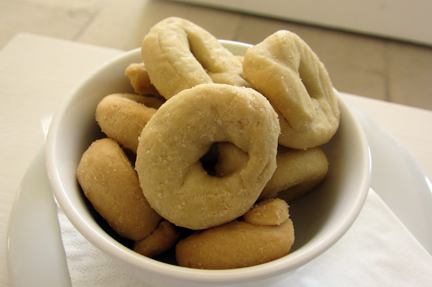
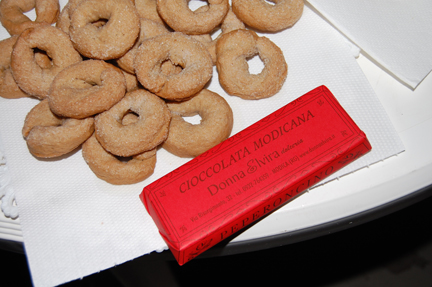
Above: Generic however delicious taralli served to us in Apulia at the Radici Wines tasting.

It all started back in June when Jancis tweeted: “Best inter-wine nibble ever: taralli from Puglia.” For three days, we had been sitting next to each other tasting and scoring Southern Italian wines at the Radici Wines festival in Apulia.

It was our last day of tasting together and one of our Italian counterparts (I can’t find the tweet) quipped back, tweeting “Finiamo a tarallucci e vino,” literally, “we finish [the tasting] with [small] taralli and wine.”

The irony in this context is owed to the proverbial meaning of the expression in Italian. To end with tarallucci [an affectionate diminutive of taralli] and wine means to resolve a dispute by pretending there were no dispute to begin with. In other words, we argued, we disagreed, but let’s have some savory biscuits and wine and pretend that there is no acrimony between us.

While the saying can be applied to express the sentiment that all’s well that end’s well, it can also be used ironically to denote that I believe you’re wrong but there’s no use fighting about it. (The sentiment and expression are by no means unfamiliar to Italians or those who frequent Italy and Italians; it’s often used in Italian journalistic parlance to allude to the hypocrisy of Italian politicians.)

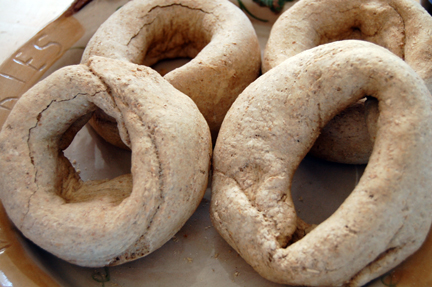
Above: Taralli probably share a kinship with Greek koulouri (I believe the unleavened biscuits in the photo, tasted at Boutari’s Santorini tasting room, fall in the category of koulouri in the Hellenic culinary canon).

Not much is known about the origins of the term tarallo. The Cortelazzo (Zanichelli) etymological dictionary notes that the etymology is obscure, possibly from the Latin torrere, to dry up, parch, roast, bake, scorch, burn. Some point to the Greek δάρατος (dàratos), a type of Thessalian bread.

I have yet to find any reliable source that addresses the origins of the expression tarallucci e vino but the tarallo’s significance as a gesture of hospitality clearly emerges in 19th century literature. It was one of the earliest street foods of pre- and post-Risorgimento Southern Italy (Pitré, Biblioteca delle tradizioni popolari siciliane, 1883) and was presented by and to travelers when they arrived. In The Bagel: the surprising history of a modest bread (Yale 2008), Maria Balińska suggests that the tarallo may be the predecessor of the bagel.

Above: Jancis and the rest of our group paired sweet taralli and spicy Sicilian chocolate with aged Primitivo at the Pichierri winery in Sava (Taranto, Apulia).

Browsing the Henry George Liddell, Robert Scott, A Greek-English Lexicon, I read that the Greek δάρατος (dàratos) was a type of unleavened bread “offered at marriage and registration ceremonies” in Hellenic Greece. And I cannot help but wonder if the tarallo’s circular, adjoined shape does not belie its use as a symbol of friendship (Balińska addresses the Italian ciambella, a similarly round unleavened bread, its relation to the bagel, and the ancient custom of presenting it to one’s host). There’s no doubt that the tarallo travels well and is easy to preserve (in Campania taralli are made with shortening and are often adorned with almonds; in Apulia, they are made with olive oil and adorned with fennel seeds).

If anyone has any insights to share, I’d greatly appreciate them. As a devout philologist, I will not rest until I get to the bottom of this conundrum and we will genuinely be able to conclude a tarallucci e vino.

Thanks for reading!

Our date with Willy Wonka: a staff training with the inimitable Randall Grahm

From the department of “so many great wines and so many great people and so little time”…

One of the best things about what I do for a living is the great wines I get to taste and the fascinating people I get to meet. And one of the most rewarding things about my career is getting to share those wines and those experiences with people I care about.

All of these elements came together week before last when the inimitable Randall Grahm — the Willy Wonka of wine in my view — graciously agreed to do a staff training with the servers at Sotto in Los Angeles where I curate the wine list.

When you work so closely with people as you do on the floor of a restaurant (often in extremely stressful situations), you develop a unique bond with them. And I was thrilled that Randall agreed to come talk to us and sprinkle some of his magic dust on us.

Of all the winemakers I’ve ever met, Randall — a polite and warm man — is perhaps the most erudite. I love the fact that he shares my love of words (philology!) and describes wines in terms of antipodian and podian (his neologism?). I love that he doesn’t mince words (I cannot repeat what he had to say about one antipodian wine). And I love his lyrical approach to describing winemaking and wine. At one point, when I asked him to address reduction in wine and why it’s not necessarily a bad thing. He replied using the follow simile: “Reduction is kind of like the male sex drive,” he said. “It can be ugly but it lets us know that everything’s working correctly and that the wine is alive.” (Reduction can be caused by wine being stored without any contact with oxygen, often the case with screw-cap wines. As a result, the wine may stink briefly when first opened. For the best definition of reduction in wine, see the entry on Jancis’s site — well worth the subscription fee, btw — or see her Oxford Companion to Wine.)

On the edges of our seats, the staff and I were entirely captivated by Randall’s spiel on the spectrum of organic, biodynamic, and Natural winemaking. And we tasted his Syrah Le Posseur together (by the glass at Sotto these days). Le posseur, the pusher in French, was inspired by the way great Syrah is like drug dealer who tempts you with his assortment of aromas and flavors. I love the analogy and I love the affordable and delicious wine (it only gets better with a day’s aeration, btw).

But dulcis in fundo, Randall also shared with us his new hope and faith in biochar — a newly developed form of charcoal that is used to restore balance to the soil. We live in such precarious times, these days (o tempora o mores!). “It is the future,” he said, referring not only to winemaking but also the survival of humankind.

Looking back on our encounter with the ineffably charming Randall, I cannot help but be reminded of the lyrics of one of favorite songs — from childhood to the present day.

If you want to view paradise
Simply look around and view it
Anything you want to, do it
Wanta change the world?
There’s nothing
To it…

Historically and with seemingly quotidian recurrence, Randall seems to seek and find beauty in the world around and in us, too.

This is one of my all-time favorite songs and cinematic moments. I’ll never forget seeing it for the first time and the emotion that filled my chest. It happens, to this very day, every single time…

Freudian Slip, my band’s new album

It’s official: Nous Non Plus’s new album “Freudian Slip” will hit the streets on October 11, 2011 on Aeronaut Records.

It’s never easy to put out a new record and this one was no exception… but I’m thrilled with the results and very proud of the music I wrote this time around.

If you like this kinda thing, please check out the new site and please follow along on Twitter and Facebook (not that you need another feed to follow!).

I’ll be updating the Nous Non Plus site every week and once I can share some of the music, I’ll also write about the genesis and meanings of each track.

As for the title, some of you already know the role that Freud and language play and have played in my life… I’ll be writing more about that as well as the release date approaches.

My music means so much to me and there’s nothing more rewarding than knowing that people enjoy it. So please have a look at the new site and learn about the more than 10-year history of the band (there’s a lot of music there, btw). It’s been a wild and wonderful ride. No regrets, Coyote!

In other news…

I’ll be speaking on Tuscan wines and breaking bread with guests tomorrow night at Vino Vino in Austin.

Click here for details.

Thanks for reading and listening…