The Italian DOC/G system is dying

Whenever my students, readers, or colleagues ask me about the Italian DOC and DOCG systems and what is the difference between the two, I always tell them: It’s important to keep in mind that the Italian appellation system was created not to protect the consumer or to enhance Italian producers’s capabilities in marketing their wines. It was created — as the dearly missed Teobaldo (Baldo) Cappellano pointed out in the Brunello Debate of October 2008 — to protect the territories where the wines are produced.

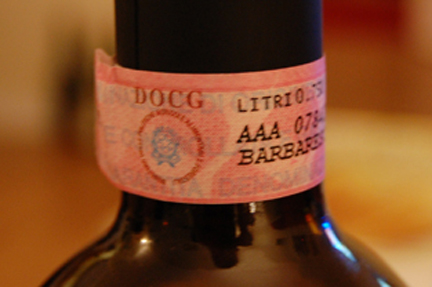
There is a widespread misconception of the system — for which Italian producers and North American educators are to blame — that the DOCG denoted a higher level of quality “controlled and guaranteed” by authorities for the protection of consumers. In fact, the DOCG represents more rigorous “monitoring” (as we would say in UN-speak) of practices “on the ground,” intended to protect the appellations themselves. In other words, these more stringent regulations were created and implemented to ensure that once a winemaking tradition was officially established, it would enjoy the support of the state when threatened by outside forces or internally unscrupulous producers.
Today, over at VinoWire, Italy’s A-number-1 wine blogger Franco Ziliani and I have posted his observations and commentary on the creation of Italy’s first-ever DOCG for rosé.

Salice Salentino Rosato, you wonder? Or a rosé from Nebbiolo or perhaps Sangiovese? No, Italy’s first rosé DOCG is Castel del Monte Bombino Nero, an appellation that allows for the following grape varieties:

Bombino Nero and/or Aglianico and/or Uva di Troia from 65-100%. Other grapes allowed in the production of this wine, by themselves or blended, include non-aromatic grape varieties recommended and/or authorized by the Province of Bari, provided they are grown locally, [for] up to 35% of the blend.

As they say in Italian, siamo arrivati alla frutta, in other words, it’s time for the [poison-laced] fruit at the end of the meal, a common technique for assassination in the Middle Ages.
The Italian DOCG system has been co-opted, colonized, and raped (there is no better word) by misguided and misinformed, greedy robber-baron Italian producers and money-grubbing politicians who have used lobbying and gerrymandering to create a false “luxury brand” for the sole purpose of lining their pockets with dollars of innocent North American consumers. How many times have you visited a wine store where some young and well-intentioned sales person has told you: See the DOCG label on the Chianti Classico? That means it’s a better wine than the DOC.

Today, the Italian DOCG system is the saddest form of wine writing (vinography) that I have ever encountered. It makes me want to heave.

For the most up-to-date and ever-growing list of Italian DOCGs, see Alfonso’s post here.
Judging southern Italian wines

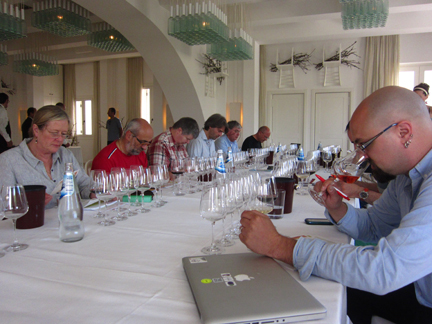
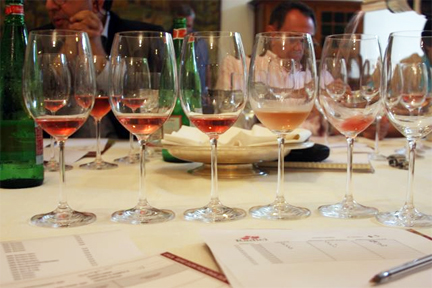
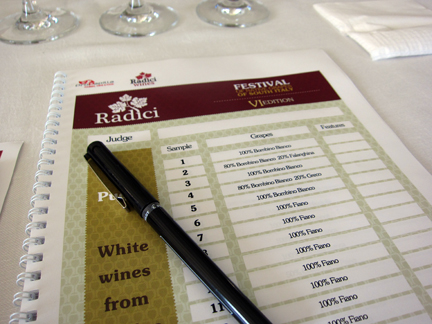
This morning we began tasting and scoring wines in the competitive sessions of the Radici Wines festival. We have to blind taste more than 200 labels between today and Wednesday, when the winners will be announced. All of the wines are made from indigenous grape varieties from Southern Italy.

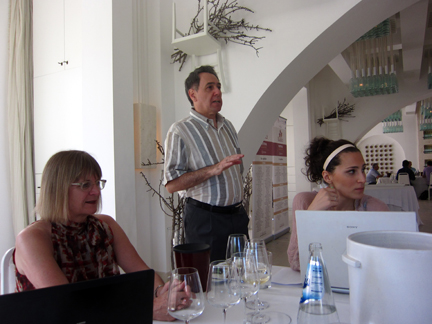
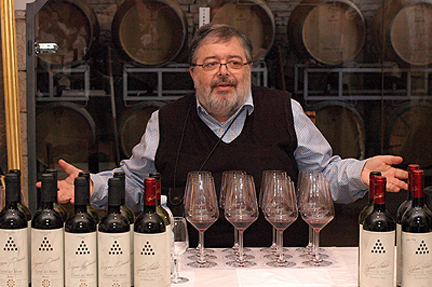
They’ve gathered a remarkable group of judges for the media jury — Italian and international (there’s also an Italian restaurant and wine professional jury). This morning I was seated next to Jancis Robinson (she’s “number 1” and I’m “number 2”; how cool is that???!!!). That’s Franco Ziliani center addressing the “jury” and our excellent interpreter, Marilena Balletta, who’s been doing a great job interpreting for the solely English speakers of our group (as a veteran interpreter at events like this, I can’t say that I envy her!).

It’s been great to rub shoulders with über-cool wine blogger Ryan Opaz (in the foreground, sitting to my right, “number 3”).

And I’ve also had a lot of fun horsing around with Jo Cooke, David Berry Green, and Kyle Philips. And I’ve also been enjoying sharing thoughts on Marxist ideology and Latin epithets with Maurzio Gily.

The Borgo Egnazia resort where we’re staying is pretty incredible but so far we haven’t had much time to enjoy it…

And as Alfonso can imagine, there’s no internet in the rooms…

But, honestly, life could be worse… :-)

A superb seafood risotto and fritto misto porn

When Franco saw me taking pictures of my food yesterday, he made that wide smile of his: “Food porn, no?”

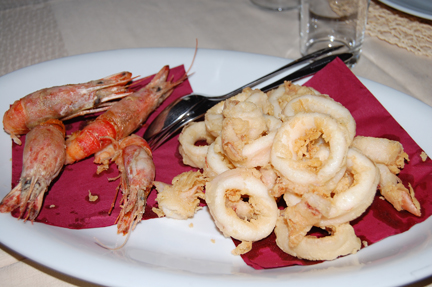
The seafood risotto at the Masseria Le Fabriche (just a few kilometers from the Ionian sea) was SENSATIONAL last night and the fried jumbo shrimp and calamari rings the best I’ve ever had…

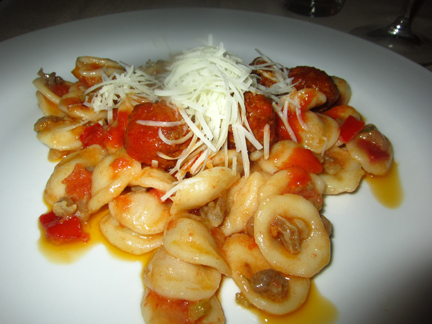
Orecchiette with meatballs… wonderful…

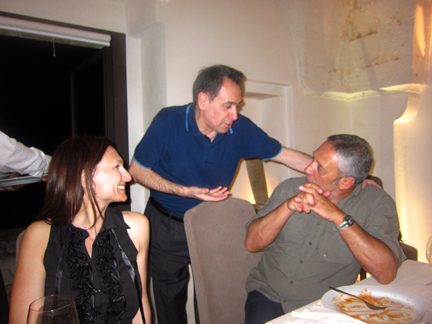
That’s the charismatic Alessia Perrucci (left), our host and owner of the agriturismo Masseria Le Fabriche, with Franco Ziliani (center), who’s one of the Radici Wines festival’s curators, and Nicola Campanile (right), festival organizer.

The food at last night’s welcome dinner was wonderful. I LOVED the handmade orecchiette (one of Puglia’s classic pastas) with veal meatballs and pecorino. The chef’s marretto — a loaf made of lamb offal — was also exceedingly delicious…

Dante Scaglione to return to Giacosa!

Above: Enologist Dante Scaglione, left, with Bruna and Bruno Giacosa (photo via Franco Ziliani).

Posting in a hurry this morning in Atlanta, Georgia, but just had to share the good news that enologist Dante Scaglione will be returning to Bruno Giacosa. My partner over at VinoWire Franco was able to confirm the rumors today. Here’s the link for the post at VinoWire.

Una gran bella notizia! Great news!

Looking for the ethos of southern Italian wine…

Above: A scene from last year’s Radici (Roots) Wine Festival in Apulia (photo by Brunellos Have More Fun).

My year in southern Italian wine continues as I prepare to head back to Apulia in a few weeks for the Radici (Roots) Wine Festival in the province of Bari, where I’ll be tasting literally hundreds of wines made from native southern Italian grape varieties.

I’m going to be seeing some old friends and making some new ones. And as tired as I am from too much travel and too much time away from the love of my life Tracie P, I accepted a spot on this trip because I believe in the festival’s mission of promoting awareness of native Italian grape varieties.

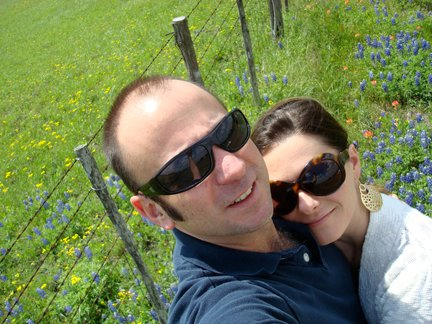
Above: I’d rather be here, holding Tracie P tight and smelling Texas springtime bluebonnets!

Believe me: as glamorous as these trips sound, they are a complete drag (ask Alfonso, a 30-year veteran of what we call “death marches” in the trade, and he will tell you the same thing). You begin tasting scores of wines at 9 in the morning and you taste all day with just a short break for lunch. You have to listen to every local fat cat bureaucrat give the same speech (and the subsequent poorly and slavishly translated version in English, “We wish to valorize the territory” etc.). The wifi never works (the Atlantic Monthly reports that “Internet penetration is only around 50 percent” in Italy, thank you very much Mr. Berlusconi). And ultimately, you are a prisoner of the festival organizers: you eat when and what they tell you to eat (although I have become a master of politely moving my food around my plate so that it looks like I have consumed some of it).

But when Italy’s top and most politically charged wine blogger Mr. Franco Ziliani asked me to join him and an international group of colleagues in Apulia later this month, I gladly accepted out of solidarity and camaraderie with those who share my belief that Italy’s greatest wines are made from native grape varieties by people who believe that wine is a cultural and ideological expression.

There will be foreign buyers there: they’re looking for new wines to import and distribute. There will be some of the usual suspects who continue to live on the gravy train of Italian wine press junkets: some of our older and hard-on-their-luck colleagues will be there looking for a meal ticket. But there will also be some of us — observers (writers/bloggers) and actors (winemakers/grape growers) — who are looking for the ethos of these wines: their characteristic spirit, prevalent tone of sentiment, of a people or community (definition from the OED online edition).

Stay tuned and I’ll let you know what I find (the trip begins in early June)… Thanks for reading…

The new Italian DOCGs, Derrida, and the moral bankruptcy of the Italian appellation system

I will speak, therefore, of a letter.

Of the first [seventh] letter, if the alphabet, and most of the speculations which have ventured into it, are to be believed.

Jacques Derrida, “Différance” (1968)

If the alphabet is to be believed, then I imagine we must seriously consider the three new DOCGs announced by the Italian government last week: Frascati Superiore, Cannellino di Frascati, and Montecucco Sangiovese. (See my paraphrase of the agricultural minister’s press release at VinoWire and see Alfonso’s wonderfully parodic treatment here.)

Of these — in an era when the Italian DOC/G system has been rendered essentially obsolete, save for its campanilian value, by the EU CMO reforms and adoption of the overarching PDO and PGI system — the most intriguing and least absurdist is the Montecucco Sangiovese.

Montecucco (in the Tuscan province of Grosseto) has grown significantly in the last 5 years, both in terms of quality and investment, and the wines raised there are aggressively marketed to the domestic and foreign markets. But the thought of a Montecucco DOCG remains laughable at best. When the DOCG was created (the first was awarded to Brunello di Montalcino in 1980), it was ostensibly intended to denote superior quality: the G in DOCG meant that the appellation had been controlled and guaranteed (in a second round of tasting after bottling) by Italian authorities before its release. Although I can find no official statement addressing the reasons for its creation, it was conceived and has been subsequently perceived as an elevated category reserved for Italy’s finest wines. As much as I wish the growers, producers, and bottlers of Montecucco well, I’d be hard-pressed to name a bottling of Montecucco that impressed me the way certain bottlings of Brunello di Montalcino, Barolo, Barbaresco, Aglianico di Vulture, Taurasi, or Amarone del Valpolicella have (for the record, among others, I’ve tasted scores of Montecucco in Paganico with the media director for the Montecucco growers association).

But the thought of a Frascati Superiore DOCG and its sister Cannellino di Frascati DOCG requires mental gymnastics too strenuous for my current state of mind. I, like my blogging colleague, Franco Ziliani, shook my head in disbelief and despair when I read the news. In an editorial posted today at VinoWire, Franco observes that “the Frascati DOC is made up of 800 grape growers who span 1,400 hectares of surface area and who produce 150,000 quintals of grapes destined to become 110,000 hectolitres of wine vinified by roughly 30 winemakers and bottled by roughly 40 bottlers.” A year ago, he points out, the Italian government applied to the EU for “emergency distillation” for Frascati bottlers so they could distill their unsold wine and reap EU subsidies. Today, Frascati has two new DOCGs. When’s the last time you tasted a Frascati that you would but in a class with Italy’s or Europe’s greatest fine wines?

Read Franco’s editorial, “The Letter G Is No Magic Wand,” translated to English by me, here.

“There is nothing outside the text,” said Derrida (in)famously. To which he often added, “everything is a text. This is a text,” as he gestured about. In the light of this observation, the G in DOCG must mean something within the (con)text… mustn’t it?

But the more closely we look at the G (borrowing from an aphorism by Karl Kraus), the more distant it appears. In fact, it has come to mean nothing beyond an insipid, vacant, morally bankrupt, and politically corrupt marketing conceit. (In the Veneto, for example, bureaucrats have created a DOCG ex novo, with no historic precedent, the Malanotte DOCG, a DOCG created before any wine labeled as Malanotte was ever released! Conceived in 2009 and awarded in 2010, the DOCG will be made available to consumers for the first time at the end of this year.)

But as Alfonso’s updated DOCG list reveals (as does the subsequent handwringing that reverberates throughout the blogosphere every time he updates the list), we recognize the signifier (the letter G) and our will to decipher its signified is so great that we are compelled to ascribe meaning. (Anyone familiar with the writings of Lacan will recognize the imagery in Alfonso’s post of biblical proportions.)

If Derrida were alive today to deconstruct the DOCG as text, he would illustrate how the différance created by the letter G is but a series of misunderstandings whereby its function is conceived, misconceived, perceived, and misperceived in its Atlantic crossing until its meaning no longer has any connection to its author.

Parodying Nietzsche, French semiotician Roland Barthes wrote famously that the author is dead. But it was Woody Allen who said, Marx is dead, Lenin is dead, and I don’t feel so good myself.

My thoughts exactly!

Bombe glacé and 2006 Brunello on my mind…

Just had to share this image of an incredible bombe glacé, captured last night at Tony’s in Houston where I had dinner with a colleague, newfound friend and fellow Italophile.

In other news…

Franco’s first impressions from Benvenuto Brunello, fresh off the presses and translated by yours truly…

Un amico ritrovato

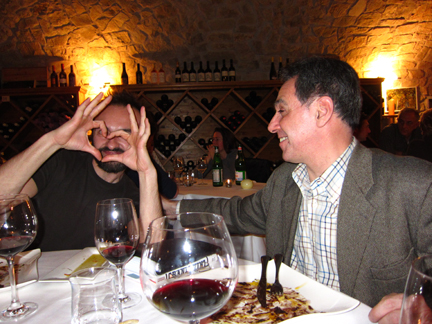
It was great to see Giovanni Arcari (left) and Franco Ziliani (right) last night in Valpolicella. They drove down from Brescia and Bergamo to visit with their friends from the U.S.

Italy recently adopted “zero tolerance” drunk driving legislation and enforcement. The legal limit is .015 g/dL, mass per volume of blood in the body. That means that just one glass of wine can put you over the legal limit! Compare with California where it’s .08! So Franco was their designated driver. Wine writers like Franco have be very careful: even when you spit and do not ingest any wine, the alcohol on your breath from tasting can deliver a false positive.

We all took it easy — especially since our host insisted on serving us barriqued Valpolicella… feh! — but it was great to see both of them and to spend some time with an amico ritrovato

Fat cat Cernilli leaves Gambero Rosso marking end (?) of an era

Above: Soon-to-be ex-editor of the Gambero Rosso Guide to the wines of Italy, Daniele Cernilli, as photographed by Christian Callec, who quotes Cernilli as asking “what is wrong with the use of new oak?”

Italy’s top wine blogger Mr. Franco Ziliani and I have posted the news over at VinoWire: Daniele Cernilli is stepping down as the editor-in-chief of the Gambero Rosso Guide to the Wines of Italy, the most influential rubric of Italian wines today (pun intended for the Italophone among you).

Rumors of his departure have circulated wildly in the Italian enoblogsphere for more than four weeks and while no one expects the editorial direction and ethos of the Gambero Rosso Guide to change for the better (actually, it will probably only get worse), the omega of his tenure there does mark the end of an era that saw the “international style” and international grape varieties dominate the worlds of commercial and fine winemaking in Italy.

I interviewed Daniele Cernilli in San Diego in 2008 when he came there to speak at the Gambero Rosso Road Show, traveling event. The event, originally scheduled for Las Vegas, was hastily detoured to San Diego that year. An insider told me that the sudden change of venue was due to the insistence of behemoth distributor Southern Wine and Spirits that Cernilli and his wife Marina Thompson present only wines distributed by Southern. Whether or not this is true (and I believe that it is), it does give you a sense of how Cernilli, his wife and publicist Thompson, and the Gambero Rosso Guide are perceived by observers of the Italian wine industry as a purely “pay-to-play” operation.

Here’s the video, directed by my childhood friend Charlie George and with music from Nous Non Plus: