Montepulciano: Italian grape name and appellation pronunciation project

CLICK HERE FOR ALL EPISODES.

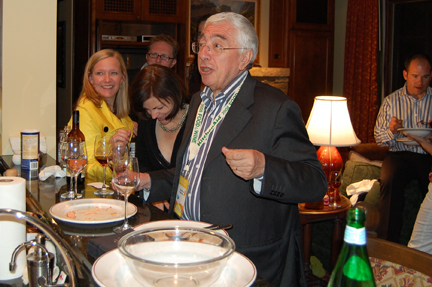
Above: Alfonso’s video camera captured winemaker Stefano Illuminati (of the Dino Illuminati winery, Abruzzo) speaking “Montepulciano” at Vinitaly a few weeks ago.

If Merlot (mehr-LOH) is the easiest European grape name for Anglophone consumers to pronounce (and is consequently America’s favorite variety), then Montepulciano (MOH-te-pool-CHEE’AH-noh) is the most confusing and one of the most challenging.

The last time you were on a date and you wanted to impress your dinner companion, did you impress him/her by ordering the Vino Nobile di Montepulciano (VEE-noh NOH-bee-leh dee MOHN-teh-pool-CHEE’AH-noh)? Or perhaps you eloquently illustrated how Montepulciano is at once a place name (the name of a township in Tuscany where Vino Nobile di Montepulciano is produced) and a grape name (the name of a variety grown and vinified primarily in Abruzzo but also elsewhere in Central Italy)?

I know that you didn’t order the Merlot!

Above: Dino Illuminati, Stefano’s father and the winery’s namesake, is one of the wonderful avuncular characters of the Italian wine world — larger than life and always bursting with life and energy. His 1998 Montepulciano d’Abruzzo blew me away when I tasted it a few months ago in Chicago (photo by Alfonso, Verona, April 2011).

The bivalence of the topo- and ampelonym Montepulciano often leads complacent wine directors to include bottlings of Montepulciano d’Abruzzo in their “Tuscany” and “Sangiovese” sections. This oversight often tragically eclipses the many wonderful expressions of Montepulciano that come from Abruzzo (anyone who has ever tasted the 1979 Montepulciano by Emidio Pepe knows just how incredible these wines can be!).

Do Bianchi isn’t exactly the blogosphere’s leading resource for dating advice. But, then again, Tracie P probably wouldn’t have given me the time of day if I didn’t know the difference between my Montepulciano d’Abruzzo and my Vino Nobile di Montepulciano!

The Italian Grape Name and Appellation Pronunciation Project got a greatly appreciated shoutout from Eric the Red last week on the Times dining blog. Thanks again, Eric! Remember: friends don’t let friends pronounce Italian grape names and appellations incorrectly! ;-)
Teroldego: Italian grape name pronunciation project

CLICK HERE FOR ALL EPISODES TO DATE.

After I read a — how can I put this gently? — not flawless transliteration of the ampelonym (grape name) Teroldego in Eric the Red’s recent article devoted to the grape variety, I felt that something needed to be done (and because Eric is a friend and a blogging colleague, I knew he wouldn’t mind).

My first thought was to record my own voice speaking the grape name and post shortly videos on YouTube. After all, I do possess a Ph.D. in Italian, I lived for many years in Italy, I travel there 3 or 4 times a year, and my Italian colleagues acknowledge that I speak Italian with native-speaker proficiency (however with a Padua accent).

But then it occurred to me: wouldn’t it be cool if I could get native Italian grape growers and winemakers to record themselves pronouncing the names of native grapes?

My first call was to Elisabetta Foradori, arguably the most famous producer of Teroldego and the subject of Eric’s article. I have never met her but she was kind enough to take my call and she laughed warmly when I described my idea to her. A few weeks later, she sent me a recording of her enunciating the ampelonym. The video above is the first in a series of the “Italian Grape Name Pronunciation Project” that I will post on YouTube and archive here at Do Bianchi.

I hope that this project will serve as a useful tool to wine professionals and wine lovers all over the world.

IF YOU ARE AN ITALIAN GRAPE GROWER OR WINEMAKER AND WOULD LIKE TO APPEAR IN THIS SERIES, PLEASE FEEL FREE TO EMAIL ME AN MP3 OR ANY OTHER KIND OF AUDIO FILE (OR VIDEO) OF YOU PRONOUNCING THE NAME(S) OF NATIVE GRAPE VARIETIES.

Mark does Madeira

It just doesn’t sound as good as “Debbie Does Dallas,” does it?

One of the sexiest new old wines of 2010 is Madeira. Ever since December of 2009, when Eric the Red reminded us that Madeira was historically served as a pairing for savory foods, to be consumed throughout the course of the meal, people have been paying attention (again) to this high-acidity, groovy, funky, nutty stuff.

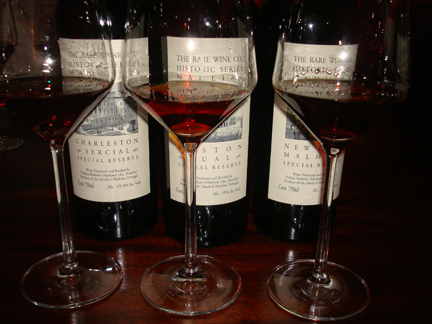
Down at Trio in the Four Seasons Hotel in Austin, where Austin’s sexiest sommelier Mark Sayre serves up “‘a voyage in a glass,’ poured nightly along the banks of Lady Bird Lake,” you can do a flight of the Rare Wine Company’s “historic Madeira series.”

Reasonably priced and utterly delicious. So perfect IMHO for Chef Todd Duplechan’s Texas smoked rib-eye there. How cool is that?

New York Stories 7: Beaujolais with Eric the Red

The final installment from my “dates with the City”…

Another highlight of my New York sojourn was my obligatory pilgrimage to The Ten Bells, my favorite wine bar in the U.S., where even the grouchiest among the grouchy wine bloggers would approve of owner Fifi’s selection of Natural Wines by the glass.

The weather had turned cold(er) and as Eric the Red noted on the Twitter, “at The Ten Bells. No place better on a chilly night, or any other.”

(You may remember how Eric got his name “the red” back in August 2008.)

Partly mocking the Beaujolais Nouveau marketing scam here in the U.S. and mostly celebrating how fantastic Beaujolais can be, for the last two years, Fifi has run a cru Beaujolais by-the-glass program concurrently with the advent of the consumerist collusion concocted by Georges Duboeuf in the 1970s. (Tracie P and I actually made the tail end of the festival last year.)

This year he offered 19 cru Beaujolais.

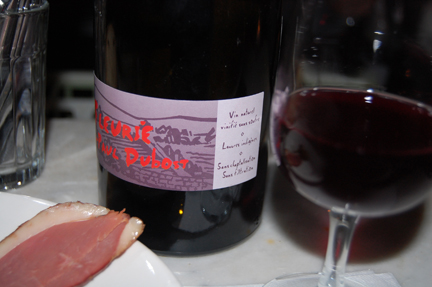
Eric and I tasted the Fleurie 09 Dubost Sans Souffre and the Morgon Descombes 07. Brilliantly savory and delicious…

Topics of conversations were wide and varied but I was thrilled to get a preview of Eric’s new book, “a manifesto and memoir,” in which he will dispel the notion that intellectualism is required to understand and enjoy wine. I’ll drink to that!

Talking about Eataly and the arc of the Italian food and wine renaissance, we remembered his 1993 review of Mario Batali’s Po on Cornelia St.

It took a little digging but I found it in the paper of record’s archive here.

“It turns out that the name Po refers neither to the Italian river nor to the Italian word for ‘little bit,’ but derives from a Polaroid photo taken of the site by a friend of the co-owners, Mario Batali and Steve Crane. The name, with its happy Italian resonances, stuck. The restaurant will, too.”

Mario’s father, said Eric, credits him with discovering the clogged one.

I had visited Eataly earlier in the day: how amazing to reflect on Batali’s legacy (like it or not) since 1993!

And I’d have to say that Eric the Red has done pretty well himself since then… Check out his article in today’s paper on tasting 2005 Barbaresco with Levi

Friuli! Day 1: Valter Scarbolo and how he reshaped the way Americans think about Italian cuisine

Today’s post is the first in a series on my recent trip to Friuli with sommelier Bobby Stuckey and chef Lachlan McKinnon-Patterson, owners of Frasca in Boulder.

Above: Valter Scarbolo (pronounced SKAR-boh-loh), right. His family’s landmark restaurant La Frasca in the province of Udine (Friuli) helped to create a new paradigm for Italian food in the U.S. That’s Shelley Lindgren of A16 (San Francisco) and Joe Campanale of Dell’Anima (New York) in the foreground. When Valter speaks, North American restaurateurs listen intently.

Few if any Italian food and wine insiders, I’m sure, would disagree with me: the first place you need to eat when you visit Friuli for food and wine tourism is Valter Scarbolo’s La Frasca in Lauzacco (not far from Udine).

When I arrived in Friuli in mid-September, the first place my good friend Wayne took me to eat was Valter’s place. (Here’s the post I did the next day on our amazing meal.)

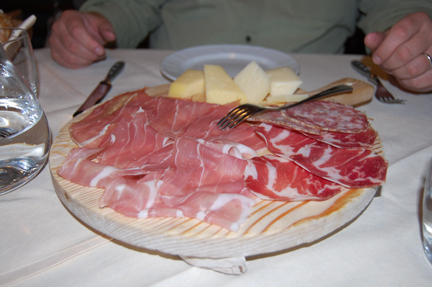
Above: Among other key elements to contemporary Italian cuisine in the U.S., Valter has introduced a generation of North American restaurateurs to the concept of “cult prosciutto,” in this case Prosciutto d’Osvaldo.

A note on the term frascafrasca (Italian) or frasčhe (Friulian) means simply branch. Linguistically and culinarily, it represents a wonderful instance of metonymy (“the action of substituting for a word or phrase denoting an object, action, institution, etc., a word or phrase denoting a property or something associated with it,” OED online edition). In Friuli, a frasca was a roadside stand where producers of cured meats, cheeses, and wines would set up shop to sell their wares. Some believe a branch was placed by the side of the road to draw attention to the stand, while others believe that the vendors would display their products under the shade of a branch. Of course, where wine, prosciutto, and cheese are sold, customers will want to taste with the producer. Ultimately, the term frasca began to denote (as a metonym) a place where patrons gathered to eat (there is a kinship here with the word trattoria). Today, the term is regularly used to denote a restaurant, although Valter’s venue, “La Frasca,” remains the frasca by antonomasia.

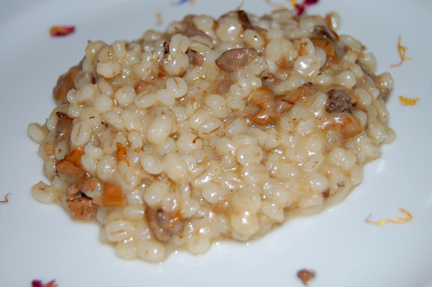
Above: One of the amazing dishes that didn’t make it into my post about dinner with Valter Scarbolo was this orzotto, a “risotto” made with barley instead of rice, chanterelle mushrooms and squab ragù.

We all (or at least some of us) remember the “Northern Italian Cuisine” revolution of the 1980s, when restaurants in New York, Los Angeles, and San Francisco seemed determined to expunge “Southern Italian Cuisine” from their menus. In fact, it would more properly be called “pseudo-Northern Italian Cuisine” because the true regional Italian cuisine shift toward the north didn’t take shape until the Bastianich-Batali powerhouse Babbo opened in New York City in the late 1990s.

With the rise of the Bastianich empire in the late 1990s, a new generation of high-end American diners were introduced to Friulian cuisine, first through the Istrian clan’s Frico bar in Manhattan, which I believe opened in 1996 and closed in 2007 (see Eric the Red’s 1996 review here), and then later through Frasca in Boulder, which was opened by Bobby and Lachlan in 2004 (IMHO, one of the top-five Italian restaurants in the U.S. today).

I can tell you from personal experience that both sets of restaurateurs view Valter and his restaurant (which can trace its origins back to the 1960s) as a paradigm for Italian cuisine and hospitality.

Above: The Tagliolini “San Daniele,” actually made at Valter’s using prosciutto by D’Osvaldo, which is made in Cormons, not San Daniele.

The Friulians are an industrious people. Valter is the apotheosis of that spirit and his bright personality and spirtuality express themselves in the metrics of his family’s wines, his superb cuisine, and his warm hospitality. Anyone who knows the man personally, I’m sure, would share my impression.

To know Valter is to know true Friulian gastronomy and I consider myself lucky to know both.

There are many places I’ll be taking Tracie P to dine when we go to Friuli for our vacation in February. But the first will be Valter’s Frasca.

Next up: Ronco del Gnemiz, one of my favorite Friulian wineries…

Italy is my first love (but Burgundy is my mistress)

Anyone who knows me via my blog knows that I am a bibliophile. I love books. All sorts of books. And there is a very special section of our library devoted to food and wine books.

While I can always find a way to justify my splurges on books Italianate in nature, books devoted to the cult of fine French wine are a true luxury in our home.

That’s just one of the reasons why a gift given to me yesterday by my clients Lisa and Stan Duchman has all the more meaning.

Stan recently attended a private tasting with Mr. Allen Meadows and had him inscribe the book personally.

Does anyone remember who called me “Dr. J’ so famously for the first time?

Words cannot express my thrill at receiving this truly excellent gift! Thank you, Lisa and Stan, Tracie P and I LOVE IT!

Stan and Lisa were featured in the Austin American Statesman last week (photo by Mike Sutter).

Check out Eric the Red’s review of the Meadows book (fresh off the press!).

Txakolina, Txakolina, Txakolina!

Above, from left: Importer of Basque, Spanish, and French wines André Tamers, Vino Vino owner Jeff Courington, and Tracie P at a Txakolina tasting in Austin on Saturday.

When I moved back to California from New York, a lot of concerned friends asked me, “what will you blog about? what will drink in California?” When I decided to move to Texas nearly two years ago, people admonished: “there won’t be anything interesting for you to drink there!”

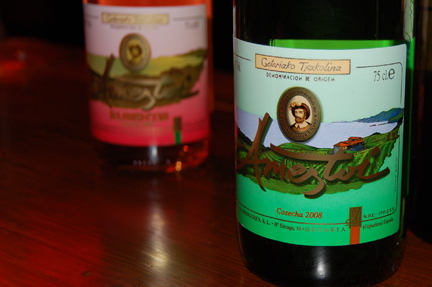
Above: My favorite in the flight was the Ameztoi Txakolina, so bright and fresh in the glass, with white fruit and spice on the nose and in the mouth. Low alcohol and gentle spritz. At under $20, the wine quickly shot up the charts to reach a top-five slot in my favorite wines of summer.

Well, folks, I’m here to tell you: I’m alive and well in Texas and drinking good juice!

Over the weekend, Tracie P and I attended a fantastic Txakolina tasting, hosted by André Tamers (the wine’s main proponent and Svengali in this country) and Jeff Courington, my client and friend, owner of the best little wine bar in Austin, Vino Vino.

Like manna from heaven, my sheer enjoyment of reading Eric the Red’s recent article on Txakolina was redoubled with a flight of the wines, poured personally for us by the dude who is making the synonymous Txakoli and Txakolina (pronounced CHAHK-oh-lee, CHAHK-oh-LEE-nah) household words here in the U.S.

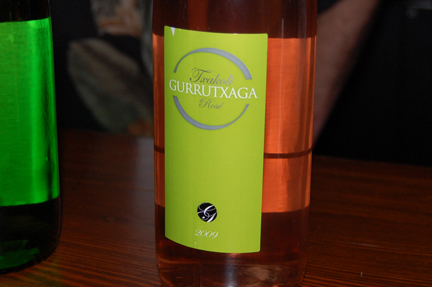
Above: I also really loved this rosé by Gurrutxaga. It had a crazy spicy note on the nose and was wholly sexy in the mouth. A truly and utterly “original” wine on my palate.

The world of wine is encyclopedic in breadth and I am constantly reminded that, beyond my love affair with Italian wine, there are so many fantastic wines to learn about, to taste, to pair with… now, more than ever, thanks to small importers like André, who launched his company more than 10 years ago when he was living with his wife and painting (oil on canvas) in Spain.

Txakolina is a truly “original” wine, to borrow a phrase I once heard Angelo Gaja use in a speech. Like Nebbiolo from Langa or Chardonnay from Chablis, it could be made in no other place in the world. It tastes of the place where it is raised and the people who make it. (Again, please see Eric the Red’s recent article on Txakolina for a great profile of the region, the people, and the wines.)

Being the self-appointed philologist of the enoblogosphere, I couldn’t help but nose around the interwebs in a search for the meaning and origins of the name Txakoli (Chacoli in Spanish, also spelled Sakoli). The lemma txak seems to denote small or little from what I can find in Basque language dictionaries available online. The editors of the Diccionario vasco-español-francés (Alfred Mame et Fils, Tour, 2 vol., 1905-1906) often translate the term (which appears in numerous instances in the two tomes) as vinaza (Spanish) or petit vin (French), literally, little wine, akin to the Italian vinello, an easy-drinking, light-bodied wine. According to the dictionary, the term also is used to denote wine must used to obtain distillate.

Above: Tracie P and I munched down an entire plate of Chef Esteban’s excellent fresh Manchego, dressed with basil, roast peppers, and olive oil. A sublime pairing with the Txakolina.

Beyond the great music and people here, the Texan lifestyle and the fact that the love of my life loves this town, Austin is such a great city because it attracts some of the brightest and best people I’ve ever met. Txakolina is sold in 26 states. Texas is one of them. When I asked André why he flies here especially to attend the tasting (now in its second year), he told me “because Jeff [owner of the venue] is a friend.”

The whole world may be talking about the wines of the Basque country these days. But here in Austin, we’re drinking it!

Chianti and Brunello, the brand names

Inspired by that Prince of Paronamasia, Thor, I was tempted to entitle this post, “Brand on the Run”… But have you ever known me to mince words?

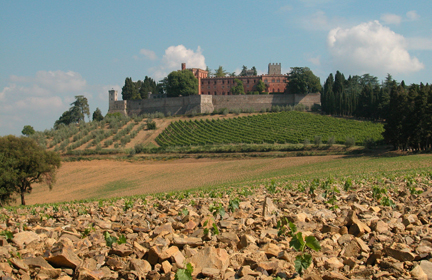
Above: The Castello di Brolio, site of the Ricasoli winery. The “Iron Baron” Ricasoli, winemaker and Italy’s second prime minister, re-branded Chianti in the late 19th century when he replanted his vineyards with Sangiovese. Would he recognize the wine his family makes today?

Reading Eric the Red’s brutally honest column on Chianti Classico yesterday, I couldn’t help but wonder out loud: would the “Iron Baron” Ricasoli, father of pre-industrial Chianti Classico, recognize the wines that his family makes today?

Even more chilling was the thought: in the light of Montalcino’s “vote for modernism,” as Ms. Robinson put it, is Brunello heading down the same path as Chianti Classico?

In other words, will we not recognize the wines that are going to be made there 20 or 30 years from now, leaving us as befuddled as Eric and his colleagues? “Of the 20 glasses before us,” wrote Eric, “many did not look like Chianti Classicos, the designation for Chiantis made in the Chianti region’s heartland in the hills of Tuscany. Or at least they did not look the way I expect a Chianti Classico to look.”

By the time Ricasoli was purchased by behemoth Seagram’s in the 1970s, Chianti had already achieved antonomastic status in the collective consciousness of the American consumer. In other words, it had become synonymous with “Italian wine.”

I cannot tell you how many times I come across the common misconception that Italians pair pizza with Chianti. The other day, a young Sicilian woman here in Austin told me that the traditional pairing for Parmigiano Reggiano was Chianti.

As the apologetic title of the column reveals (“Tasting Report: Chianti Classicos, So Dark and Oaky, but Still Recognizable”), the wines that Eric and colleagues tasted did not resemble the wines that they expected to uncork. In fact, “Many were densely colored and dark, almost impenetrable in their blackness.”

As rumors of corporate take-overs in Montalcino abound (reminiscent of the heady Seagram’s years), I fear I see a (literally) dark cloud in my wine horizon. To borrow a phrase, from Mel Brooks, “Let’s hope for the best…” You already know the next line…

Veronelli’s handwriting, Bartolo Mascarello’s backward thinking, and the “triumph” of barrique

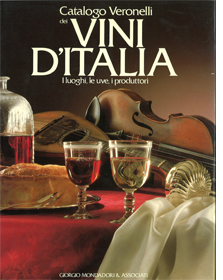
You may remember a post I did not long after I launched my blog on Luigi Veronelli as Poseidon and a Trident of New Oak (and Eric the Red’s subsequent post). In that post, I translated a passage from Luigi Veronelli’s landmark 1983 Catalog of the Wines of Italy.
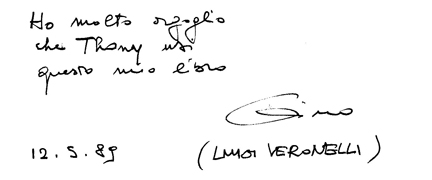
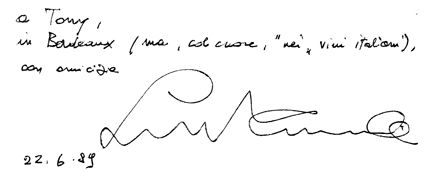
In my never-ending quest to apply the tools of textual bibliography* to wine writing, I chomped at the bit when I came across two subsequent editions of Veronelli’s almanac of Italian wine. After breaking away from the pack on a tour of the Tangley Oaks manor, where Terlato Wines International has its corporate offices, I found myself alone in the library: to my joyous surprise, when I opened the tomes to the title pages, I found Veronelli’s personal dedications to Tony Terlato.

I am very proud that Thony [sic] will use this book. Gino (LUIGI VERONELLI), May 12, 1989.

To Tony, in Bordeaux (but with my heart “in” Italian wine), with friendship, Luigi Veronelli, June, 22, 1989.

What a find! And what a wonderful document and example of handwriting! The “autograph” (or even better, the “idiograph”) as we call it in the study of textual bibliography reveals so much about the intentions of the author. In June of 1989, the renaissance of Italian wine in the U.S. had yet to take shape and both men played fundamental roles in the emergence of Italian wine as a fine wine category. The dedication in the second instance leads me to believe that the two men met in Bordeaux but their “hearts were in Italy.”

In Veronelli’s 1983 preface, he called the introduction of barrique aging a “provision” that “must not be delayed” in Italy. By 1986, only three short years later, he wrote of his dissatisfaction at the limited number of Italian wines he was able to include in the catalog due to space and time constraints. At the same rate, the increased number of wines “raised in barriques” marked his “triumph.”

He also writes of how he has lobbied for a single-vineyard (cru) system in Italy. He didn’t give his top rating (the Sun) to the “sublime” bottlers Bruno Giacosa or Beppe Colla in this catalog, he observes apologetically. But he did give it to Bartolo Mascarello, however reluctantly.

“Bartolo Mascarello,” he writes, [is an] “advocate of a theory that I’m forced, in his case, to accept: the best Barolo is composed by using different vineyard supplies.”

He also bemoans Violante Sobrero’s sale of his rows in Monprivato and Villero (to Mauro Mascarello?).

There’s so much more wonderful information to be culled from this bundle of sheets but that’s all I have time for today. In another lifetime, I hope to be employed by a royal court as a textual bibliographer of wine. In the meantime, I gotta make a living… thanks for reading!

* From the Bibliographical Society of America website: “Textual bibliography, the relationship between the printed text as we have it before us, and that text as conceived by its author. Handwriting is often difficult to decipher; compositors make occasional mistakes, and proofreaders sometimes fail to catch them; but (especially in the period before about 1800) we often have only the printed book itself to tell us what the author intended. Textual bibliography (sometimes called textual criticism) tries to provide us with the most accurate text of a writer’s work. The equipment of the textual bibliographer is both a profound knowledge of the work of the writer being edited (and of his or her period) and an equally profound knowledge of contemporary printing and publishing practices.”

A correction on white Musar and a Tracie P[olaroid] moment

Above: I met Serge Hochar, owner of Musar, a few years ago at a food and wine festival. Super nice guy and a lot of fun to be around. I’m not sure where he wrote or said this, but Georgios Hadjistylianou in Cyprus quotes him, “the harmony of nature is better than anything we could ever create. I believe it should be a priority to seek to drink what is ‘true’ rather than what is ‘good.'”

Reader Georgios Hadjistylianou in Cyprus was entirely right to write me, pointing out that Musar white is, in fact, made from Obeideh and Merwah, grapes indigenous to Mount Lebanon. (See a fact sheet on the wine here.)

He was writing me in reference to yesterday’s post on the super restaurant Marouch in Los Angeles. The restaurant listed the wine under “Chardonnay” but the other wine professionals with whom I dined were under the impression (as was I) that it was made from Sémillon.

Thanks, Georgios for the correction! :-) I can tell you — for certain — that the wine was delicious. ;-)

Obeideh and Merwah didn’t make it into Eric the Red’s (Eric the Green’s?) excellent post today on “a dozen obscure grapes that are the foundation of some wonderful wines and will reward intrepid explorers.” But I highly recomment both the wine (Musar) and Eric’s post to you.

In other news…

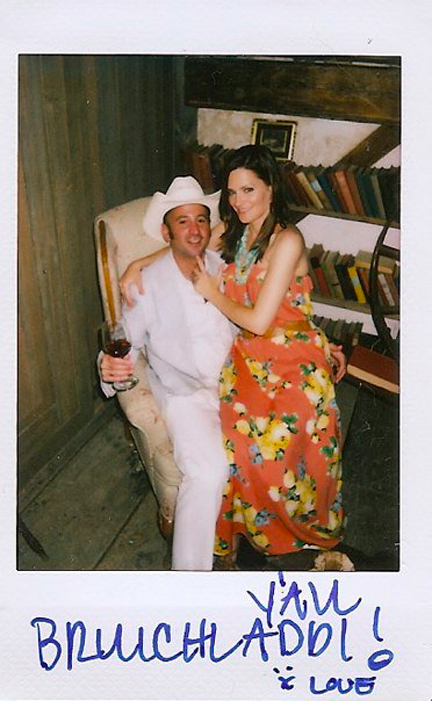
Couldn’t resist sharing this Polaroid moment from Kate and Dan’s wedding over the weekend. Among other fun activities, they had set up a Polaroid studio where you could take photos with some of the western artifacts lying around the Figueroa Mountain Farmhouse.

O my goodness, my Tracie P, you are the most mellifluous melody this singing cowboy has ever heard! I love you so! :-)