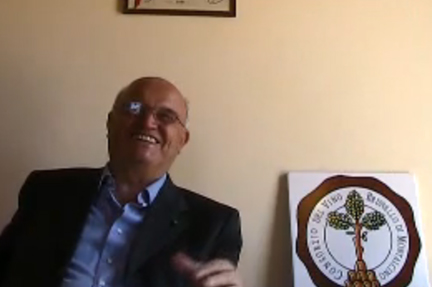
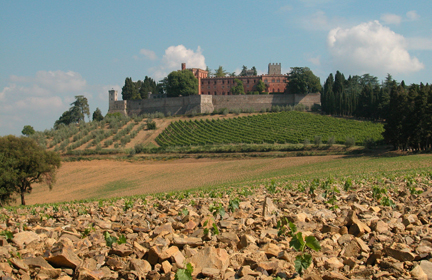
Gaja’s Santa Restituta restoration project fascinated me

This is the first in a series of posts culled from my recent trip to Tuscany, the Veneto, and Friuli. While on the road, I was only able to post short snippets and highlights from my visits. Starting today, and in the weeks that follow (as time permits), I’ll be posting in-depth accounts of my conversations with winemakers and restaurateurs and what I tasted. Thanks for reading…
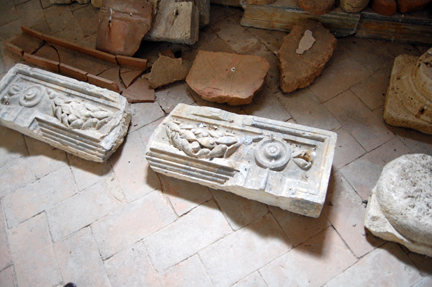
Above: Can you imagine my delight when I got to tour the Pieve di Santa Restituta restoration site in Tavernelle (Montalcino) a few weeks ago? The white bassi rilievi (bas-reliefs) are possible indications of the presence of a Romanic church on this site, i.e., a pagan temple that was converted and consecrated as a Catholic church in the Middle Ages.

When I tasted with Gaia Gaja back in the spring of this year in Chicago, one of the things I was most curious about was her family’s restoration of the Pieve di Santa Restituta and the church of the parish (pieve) in the Orcia River Valley, where her family makes Brunello di Montalcino.

I first visited the Orcia River Valley in Tuscany (perhaps the most photogenic and photographed swath of this beautiful land) in 1989 and have been fascinated ever since by the medieval hilltop towns and the rich ancient religious traditions that thrive here, like the Abbey of Sant’Antimo (in Castelnuovo) or the Madonna di Vitaleta (in San Quirico).
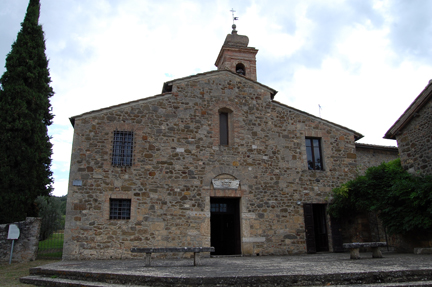
Above: The medieval façade of the Chiesa di Santa Restituta.

The pieve and church of Santa Restituta are particularly remarkable because the site represents an entirely unique and anomalous tradition in the context of the Orcia River Valley: the church is the only one in Tuscany devoted to Santa Restituta, the patron saint of Ischia, the island off the coast of Naples, where Tracie P lived for nearly 5 years before we met.

Since Gaia (the fifth-generation winemaker in one of Itay’s most famous winemaking families) first told me about the church and her family’s restoration project, I’ve also been absorbed by the powerful legend of Santa Restituta. During my recent visit with her in Tuscany, she very generously photocopied an essay entitled “Una madre vegliarda: la Pieve di Santa Restituta (Montalcino)” (“An Old Mother: the Parish of Santa Restituta”)* and published in 1978 in Arezzo by a gentleman named Angelo Tafi, who spent the better part of the second half of the twentieth century documenting the many small parishes that dot the Tuscan countryside. On the plane ride home from Europe, I devoured this wonderful piece of writing, so generously given to me by Gaia.
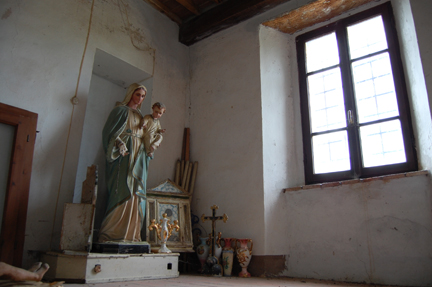
Above: Many of the relics currently being cataloged in the restoration process date are from the nineteenth century, when this parish was populated by a vibrant community of sharecroppers.

St. Restituta was born in Africa during the rule of Diocletian (284 to 305). She is believed to be one of the Martyrs of Abitina (modern-day Tunisia). When she refused to worship Jupiter, the Romans ordered that she be covered in tar and burned on a boat. Miraculously, her captors’s vessel caught fire and her boat drifted away before they could set it ablaze.

Most scholars believe that her relics were brought to Naples by African Christians who fled persecution in the sixth century. Today, the Cathedral of Naples now stands where the Church of Santa Restituta was established at that time. Ultimately, the relics were transferred to the village of Lacco Ameno on the island of Ischia where a church devoted to her still stands.
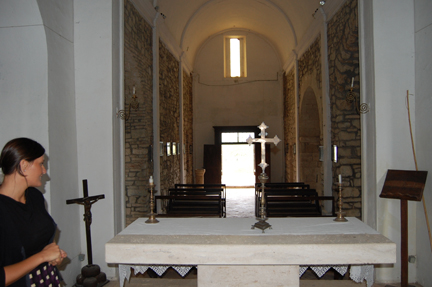
Above: I don’t know if she planned to do so, but Gaia’s handsome outfit was reminiscent of a nun’s habit that day. The parish and the church have a truly magical aura about them.

Her feast is celebrated in May on the island, where the legend is re-enacted each year in a colorful and widely popular pageant. In the contemporary version of her story, her boat finds its way to the bay of San Montano in Lacco Ameno, where her body is discovered by Lucina, a local matron, who proclaims that a virgin has been delivered by the hand of God. Her cult on the island is so powerful that many families still name their daughters Restituta (as Tracie P can attest!).

No one really knows why the church in Tavernelle was devoted to Santa Restituta, although — as Tafi demonstrates — it’s unlikely that there is a relation to Latium’s homonymous Santa Restituta di Sora. The site was a well established state-owned farming community in Roman times and it’s possible that Neapolitan merchants settled there in the late Middle Ages: anyone who knows the coastal road from Fiumicino airport in Rome to Sant’Angelo in Colle (the southern outpost of Montalcino) will immediately recognize the strategic location of the Pieve di Santa Restituta with relation to Naples.

I simply cannot convey the electric sensation of touring this beautiful property. A team of artisans buzzed around us, delicately chipping away at a stuccoed wall to reveal the classic brown limestone of the Orcia Rivery Valley underneath.
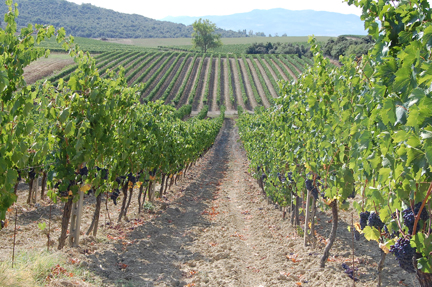
Above: Tafi’s research shows that the Sugarille vineyards were already devoted to the cultivation of grapes by the fifteenth century.

In his research, Tafi discovered that certain parcels were already devoted to viticulture by the fifteenth century. Today, Gaja uses those same growning sites for its flagship Brunello, the vineyard-designated Brunello Sugarille (the vineyard of the cork trees, sugheri in Italian).

Gaja’s vineyards lie adjacent to those of Soldera (who, together with his wines, will be the subject of an upcoming post). Many consider these historic growing sites to be among the best in the appellation. My guess is that centuries of sharecropping ultimately depleted the soil’s nutrients, making the white and brown earth ideal for the cultivation of fine wine grapes (but more on that later).
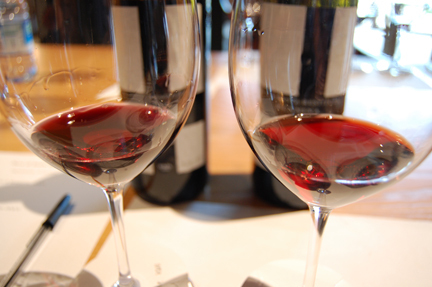
Above: Gaia poured me a flight of wines that spanned 1996 through 2008.

Of course, I was also there to taste Gaia’s family’s wines and I will not conceal that I was thoroughly impressed by the 2008 Brunello Sugarille (single vineyard) and the 2006 Brunello Rennina (which is sourced from three different vineyards on the estate). As you can see from the color in the image above, the wines were bright and transparent, and I found them to be excellent expressions of Sangiovese Grosso and the Brunello appellation. The red fruit was balanced by good acidity and powerful tannin (still very youthful in the case of the Sugarille) and there was none of the woodiness that I’ve found in earlier vintages of this wine. Here, in this most western subzone, elegance and purity trump the earthier expressions of Sangiovese that you find in the central, southwest, and southeast areas.

In my limited experience with Gaja’s bottlings of Brunello (since I can hardly afford them), I’ve seen an evolution (and I think that Gaia would agree) bringing them more into line with the classic profile of great Brunello. I thought the most recent vintages were great.

But, most of all, I was impressed by this fascinating restoration project, adding yet another destination to the many sites on my list of places to take Tracie P the next time we’re there. Truly exciting stuff for geeks like me!

*The reference to the madre vegliarda is culled from the great nineteenth-century Italian poet Giosué Carducci’s poem “La chiesa di Polenta” (“The Church of Polenta”). The title alone is worthy of a stand-alone blog post but it will have to wait.
Strange hues of the Middle Ages

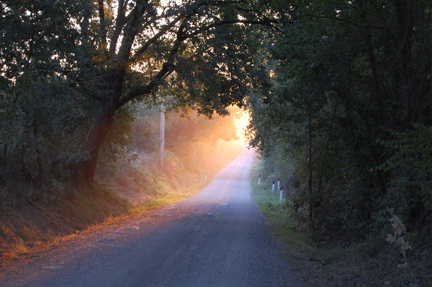
This morning, my last in Montalcino, I enjoyed a daybreak drive through the vineyards of Il Poggione with winemaker Fabrizio Bindocci as my guide (I’ve been staying at the estate’s farmhouse).

The vision above made me think of Dante, Inferno, 34, 132-33:

    Into that hidden passage my guide and I
    entered, to find again the world of light

I remembered my years as a grad student, often spent imagining the quality of light as perceived by humankind in the Middle Ages.

I remembered the famous passage from Burckhardt:

    In the Middle Ages both sides of human consciousness—that which was turned within as that which was turned without—lay dreaming or half awake beneath a common veil. The veil was woven of faith, illusion, and childish prepossession, through which the world and history were seen clad in strange hues.

And I realized that those strange hues often reveal truths lost on those inebriated by the glow of rationalism.

Porcini porn: how Tuscan men eat

Lunch today with the Bindocci men at Trattoria il Pozzo (Sant’Angelo in Colle)… Keep in mind they are approaching “piena vendemmia” (nearly the peak of harvest) here in Tuscany and this was a quick, working lunch… a 45 minute affair… giusto, giusto so that we could “break bread” together…

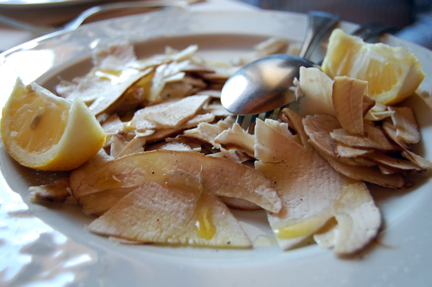
Raw porcini salad.

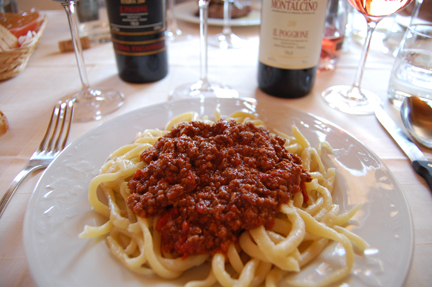
Pici al ragù (di manzo, beef ragù). Normally I’d have the wild boar ragù but I didn’t want to get carried away (literally).

The 2004 Brunello Riserva Paganelli (cru) by Il Poggione was INSANE! Such bright acidity, such chewy red fruit, equine tannins, indomitable but delicious nonetheless!

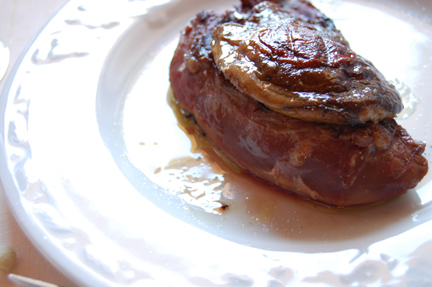
Normally we’d have the bistecca alla fiorentina but today it was a mere beef filet (blood rare, of course) topped with a grilled mushroom cap.

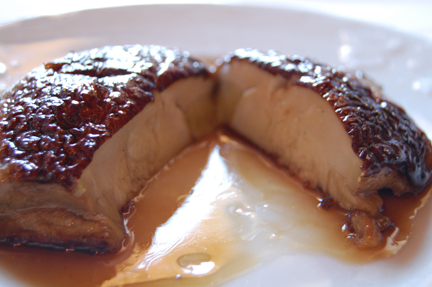
Just in case, we also had a roast mushroom cap.

Wherever I lay my hat these days, I am reminded that Texas is my home (for MELVIN CROAKER).

Video of Soldera’s vineyards

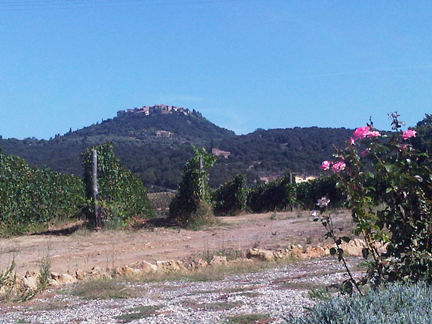
Above: A shot of Sant’Angelo Colle taken from Il Poggione’s farmhouse at 10:30 a.m., September 15, 2010 (using my Blackberry).

It rained heavily in Tuscany on Monday night while I was in the Maremma (on the coast), although according to accounts from Montalcino, the vineyards in Sant’Angelo in Colle emerged unscathed.

Last night, I slept at Il Poggione’s farmhouse and watched the sun rise: at daybreak, when I went outside to take some photos, it was so chilly that I had to wear my Adidas jacket and cowboy hat.

At 10:30 a.m., as I write this, it’s 61° F. and the weather is fantastic, clear skies and sunshine.

Here’s what it looked like on Sunday, in the vineyards of Gianfranco Soldera, in Santa Restituta, not far from Sant’Angelo, also in the southwestern subzone of the Brunello di Montalcino appellation.

Soldera 03 Riserva and dinner at Il Silene

Had the opportunity to chat and to taste some amazing wines with Gianfranco Soldera yesterday (but more on that later) and then was treated to dinner at what many consider the best restaurant in this neck of the Tuscan woods, Il Silene. Utterly delicious all around and a truly remarkable pairing (especially considering the balance in the wine from the otherwise-difficult-to-tame 2003 vintage).

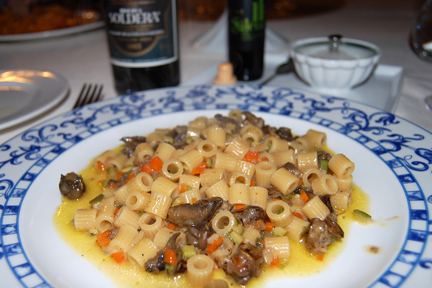
That’s chef Roberto Rossi’s snail and vegetable soup paired with 2003 Soldera Brunello di Montalcino Riserva.

That’s Chef Rossi’s tagliatelle al ragù (evidently Soldera had eaten there at lunch as well yesterday, making the 1-hour drive 4 times in one day just to dine there!). Fantastic wines, stupendous dinner…

Posting in a hurry as sunlight, landscape, vines, and my camera have a date this morning… then to lunch with friends…

Italy meets California circa 1982 (by Burton Anderson, Wine Spectator)

Source: Alfonso Cevola. Check out his truly stunning post on tasting Sangiovese in Tuscany in the 1970s, Our Sangiovese.

The above image of Ezio Rivella (now president of the Brunello producers association) has been culled from the December 1-15, 1982 issue of the Wine Spectator. The article, filed from Florence, was written by Burton Anderson and is entitled “Italian vintners look to Cabernet, Chardonnay for future wine styles; results mixed so far.”

“We’re deliberately adopting a California style because our main market is the United States and also because the technology is more suitable,” Rivella, then director of Banfi, told Anderson. “But we have an advantage. Conditions in our hill vineyards are not only better than in Napa or Sonoma, they’re the best I know of anywhere. We plan to fully exploit this advantage in our wines, which will be aged in barriques of split French oak.”

A picture’s worth a thousand words, isn’t it?

In other [Brunello] news…

Who knew that Gianfranco Soldera was a natural winemaker? Read what he had to say in an interview published last week, translated and posted by Mr. Franco Ziliani and me at VinoWire.

Rivella, barbarian at the gate: the Brunello debate goes mainstream (WARNING: POST CONTAINS POETRY)

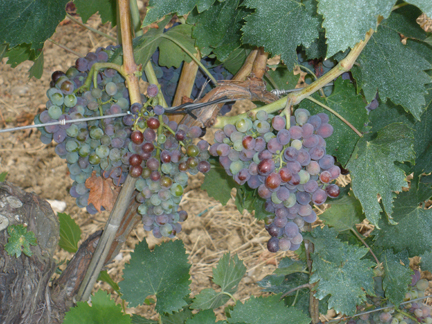
Above: The grapes are ripening about a week late in Montalcino but conditions are excellent, says Alessandro Bindocci (Fabrizio Bindocci’s son) in his blog Montalcino Report. Alessandro has been updating the blog regularly with harvest and weather reports.

Yesterday a friend emailed me this article in Reuters online, “Battle of Brunello exposes row over purity vs blends,” by top wine writer Robert Whitley, my fellow San Diegan. In it he summarized the events that led up to Ezio Rivella’s controversial election as Brunello producers association president and Fabrizio Bindocci’s passionate if unsuccessful bid to stop Rivella’s march of progress. (For a more detailed account of what happened in recent months in Montalcino, you can scroll and leaf through this thread here at Do Bianchi.)

    The controversy over the election has put the spotlight on growing divisions in the wine world as some producers take a more global approach to their craft while others stick to tradition.

    Opponents such as Bindocci are passionate defenders of the status quo and are convinced that the 77-year-old Rivella as the modern face of Brunello could put the soul of Brunello at stake.

Has Montalcino become the frontline in the global battle (“growing divisions of the wine world”) of modernism vs. traditionalism?

In a “why didn’t I think of that” moment, I thoroughly enjoyed Robert’s superb allusion to the great poem “Waiting for the Barbarians” by Greek poet Cavafy wherein he implied that Rivella is a “barbarian at the gate.” It’s probably more a propos than Robert bargained for, especially in the light of the uncanny parallels. Poetry lovers read on…

    What are we waiting for, assembled in the forum?

    The barbarians are due here today.

    Why isn’t anything happening in the senate?
    Why do the senators sit there without legislating?

    Because the barbarians are coming today.
    What laws can the senators make now?
    Once the barbarians are here, they’ll do the legislating.

    Why did our emperor get up so early,
    and why is he sitting at the city’s main gate
    on his throne, in state, wearing the crown?

    Because the barbarians are coming today
    and the emperor is waiting to receive their leader.
    He has even prepared a scroll to give him,
    replete with titles, with imposing names.

    Why have our two consuls and praetors come out today
    wearing their embroidered, their scarlet togas?
    Why have they put on bracelets with so many amethysts,
    and rings sparkling with magnificent emeralds?
    Why are they carrying elegant canes
    beautifully worked in silver and gold?

    Because the barbarians are coming today
    and things like that dazzle the barbarians.

    Why don’t our distinguished orators come forward as usual
    to make their speeches, say what they have to say?

    Because the barbarians are coming today
    and they’re bored by rhetoric and public speaking.

    Why this sudden restlessness, this confusion?
    (How serious people’s faces have become.)
    Why are the streets and squares emptying so rapidly,
    everyone going home so lost in thought?

    Because night has fallen and the barbarians have not come.
    And some who have just returned from the border say
    there are no barbarians any longer.

    And now, what’s going to happen to us without barbarians?
    They were, those people, a kind of solution.

And some who have just returned from the border say/there are no barbarians any longer.

I’ll be visiting Montalcino in September and will try to catch up with Fabrizio (a friend) then (although I know he’ll be very busy with the harvest). Who knows? Maybe Rivella will grant me an appointment, too… Stay tuned and thanks for reading!

Wine blogs you should and can’t read react to Brunello “rivellation”

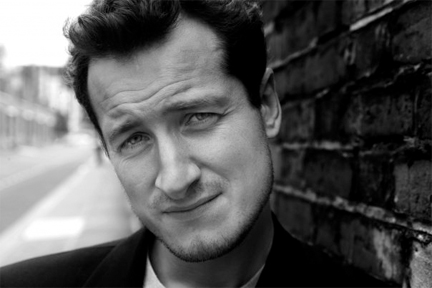
Regretfully, I don’t have a subscription to Jancis Robinson’s subscription-only blog but a friend cut, pasted, and sent me a post on Jancis’s blog by British wine writer Monty Waldin (above), who commented on the Rivellation that “80% of Brunello was not pure Sangiovese.”

    By saying that most pre-2008 Brunello was fraudulently blended, Dott. Rivella implicitly accepts that journalists such as Franco Ziliani, myself and a number of others who have consistently and publicly claimed that all Brunellos were not 100% Brunello, as they should have been, deserve at least some credit – and that we don’t ‘deserve to have our tyres slashed’, as one irate ‘Brunello’ producer told me to my face.

    We didn’t say what we said because we are anti-Brunello. Far from it. We said it because it was obvious to any wine drinker with half a brain that certain wines labelled Brunello did not always look, smell or taste as though they were 100% Brunello (Sangiovese). This was not fair to consumers, but just as importantly it was not fair to those Brunello producers – both big and small – who played by the rules, the vast majority of whom actually succeeded in making red wines with the inherent quality to reinforce the fully justified claim of real Brunello to sit in Italy’s vinous pantheon.

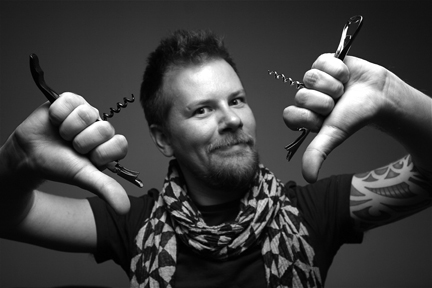
Another interesting pingback came from a truly dynamic wine blogger in Finland, Arto Koskelo (above), who was gracious enough to translate a post in which he reflects on Rivella’s statements (since I, for one, cannot read Finnish!).

    Don’t get me wrong, the wines may very well be excellent. But in the end the most crucial point isn’t the style of the wines nor even their quality but integrity and lack of it. If one exploits the very historical legacy the regions reputation is based on and at the same time sells it short, wine lover finds that if he gives this kind of fashion the thumbs up he ends up with one stinky finger.

Arto’s a 30-something freelance writer and wine blogger and videographer. “As you might know,” he wrote me in an email, “Finland as a Nordic country has traditionally been a beer drinking country, so we are super happy about the small impact we are making on the cultural landscape.”

Ezio Rivella: “80% of Brunello was not pure Sangiovese.”

Above: I hope that Tuscan wine writer and internet-based interviewer Carlo Macchi doesn’t quit his day job. I certainly wouldn’t call him the next Antonioni. Although he might give Dario Argento a run for his money. Last week, the newly elected president of the Brunello producers association, Ezio Rivella, told Macchi that “80% of Brunello was not pure Sangiovese.”

You can imagine my utter and profound astonishment when I watched a recently taped interview with the new president of the Brunello producers association in which he stated the following: at least up until the time of the Brunello controversy that broke in March 2008, “80 of Brunello was not pure Sangiovese” and that the practice of adding “3-5% of grapes other than Sangiovese” was “widespread” and “commonly accepted” among the 250 or so bottlers of Brunello di Montalcino. (The interview was filmed in two parts: the above statements were made in the second segment, and here’s a link to the first.)

The interviews were conducted last week by Italian (Tuscan) wine writer Carlo Macchi, editor of the online wine magazine WineSurf. The videos came to my attention via the weekly web news roundup published on the Italian Sommelier Association website by Mr. Franco Ziliani (who, btw, is not currently blogging right now).

I’m only partly astonished by the figure. In fact, most people whom I’ve spoken to on the ground would arrive at the same figure more or less through guesstimation. As Gian Franco Soldera told me when I visited with him in September 2008 (at the height of the crisis), “the tanker trucks come in weighted down, their load riding low to the ground, and they leave riding high.”

No, what amazed me was the nonchalance with which Rivella brandished this astounding figure. But at the same rate, considering the fact that he spent four decades (the majority of those at the helm) at the largest producer in the appellation (you don’t need me to tell you who that is), I’m not surprised that he would so unabashedly utter these words. And in all fairness and in honesty, I must applaud Rivella for sharing this insight (so often spoken sotto voce, under one’s breath in Montalcino) in a public forum.

What alarmed me was the fact that Rivella also told his interviewer that “for the moment were not going to be talking about changing the appellation to allow for grapes other than Sangiovese.” The law states that the producers get to decide the rules, he explains, and the producers have voted for 100% Sangiovese. But — ugh and here it comes — “we will discuss changing it in future because it needs to be changed.”

When asked the wine figure that impressed him the most, he replied Robert Mondavi. Are you surprised?

I translated and paraphrased some other highlights (?) here at VinoWire.

Chianti and Brunello, the brand names

Inspired by that Prince of Paronamasia, Thor, I was tempted to entitle this post, “Brand on the Run”… But have you ever known me to mince words?

Above: The Castello di Brolio, site of the Ricasoli winery. The “Iron Baron” Ricasoli, winemaker and Italy’s second prime minister, re-branded Chianti in the late 19th century when he replanted his vineyards with Sangiovese. Would he recognize the wine his family makes today?

Reading Eric the Red’s brutally honest column on Chianti Classico yesterday, I couldn’t help but wonder out loud: would the “Iron Baron” Ricasoli, father of pre-industrial Chianti Classico, recognize the wines that his family makes today?

Even more chilling was the thought: in the light of Montalcino’s “vote for modernism,” as Ms. Robinson put it, is Brunello heading down the same path as Chianti Classico?

In other words, will we not recognize the wines that are going to be made there 20 or 30 years from now, leaving us as befuddled as Eric and his colleagues? “Of the 20 glasses before us,” wrote Eric, “many did not look like Chianti Classicos, the designation for Chiantis made in the Chianti region’s heartland in the hills of Tuscany. Or at least they did not look the way I expect a Chianti Classico to look.”

By the time Ricasoli was purchased by behemoth Seagram’s in the 1970s, Chianti had already achieved antonomastic status in the collective consciousness of the American consumer. In other words, it had become synonymous with “Italian wine.”

I cannot tell you how many times I come across the common misconception that Italians pair pizza with Chianti. The other day, a young Sicilian woman here in Austin told me that the traditional pairing for Parmigiano Reggiano was Chianti.

As the apologetic title of the column reveals (“Tasting Report: Chianti Classicos, So Dark and Oaky, but Still Recognizable”), the wines that Eric and colleagues tasted did not resemble the wines that they expected to uncork. In fact, “Many were densely colored and dark, almost impenetrable in their blackness.”

As rumors of corporate take-overs in Montalcino abound (reminiscent of the heady Seagram’s years), I fear I see a (literally) dark cloud in my wine horizon. To borrow a phrase, from Mel Brooks, “Let’s hope for the best…” You already know the next line…