
Please consider giving to Unicef’s Ukraine child refugee fund. This link takes you straight to the donation page.
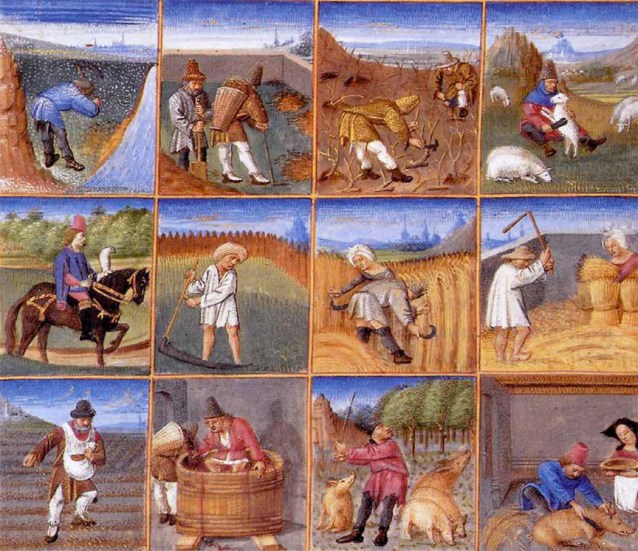 Above: an agricultural calendar from a “painted book” (circa 1309) of Pietro de Crescenzi’s treatise on farming, possibly executed in his lifetime. There numerous extant 13th and 14th century manuscripts of his book Ruralia Commoda and translations of his work became instant best sellers in the 15th and 16th centuries in Europe. Note the October panel where the figure is crushing grapes. Image via Wikipedia.
As Nietzsche famously wrote in the Twilight of the Idols (1889), the philologist must look beyond the “sacred texts.”
In today’s world of wine, the spiritually focused writings of early-20th century critical theorist Rudolf Steiner have become one of those pillars — a sacred text — of our shared “constitution of knowledge.”
But if we look beyond his writings on agriculture (which represent a small part of his critical output; just think of his many titles devoted to Christ), it doesn’t take long to realize that he was merely repackaging knowledge and know-how that had been around for a long, long time.
In my recent close reading of the 13th century Bolognese jurist and agronomist Pietro de Crescenzi, whose Ruralia Commoda was an ante litteram best seller from the time of its first circulation in the late 1200s to the height of the Italian Renaissance and beyond, I’ve discovered some important antecedents for our current understanding of biodynamics.
The most striking of these is Crescenzi’s detailed instructions on how to follow the lunar calendar for planting, sowing, and winemaking.
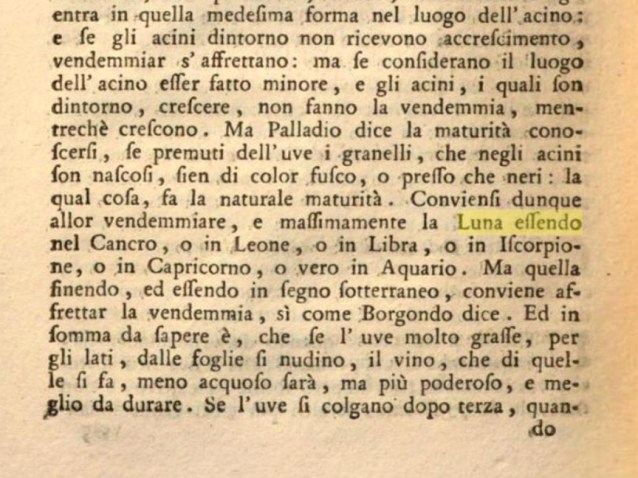 Above: a folio from a 1784 Italian translation of the Ruralia. The work’s popularity only began to wane in the modern era.
Among the descriptions of lunar cycles and the best moments to carry out work in the fields, some of the most compelling recommendations are in reference to winemaking and more specifically in reference to obtaining the highest quality in wine.
In the passage highlighted in the image immediately above, he explains the exact, ideal moment in the lunar cycle to pick. Wines made from grapes picked at the right time will be less “watery,” more “powerful” (alcoholic), and better for aging.
Wow, sound vaguely familiar? The language is different. But the concept, based on observations made during Crescenzi’s constant and extensive travels throughout Italy, is the same.
Crescenzi’s work would ultimately be neglected as farmers in the modern age began to abandon what had come to be considered outdated observational agricultural science. By the 1930s, an effort by Italian agricultural historians to revive interest in his opus would ultimately fail.
But isn’t it incredible to think that today thoughtful and highly informed people are growing grapes and making wine according to the same practices that Crescenzi prescribed in the 13th century?
Forget Steiner, let’s read Crescenzi! And when we’re done reading the Bolognese jurist, let’s reach back even further and browse the Γεωπονικά.
Week after next, I’ll be pitching a translation and critical apparatus of Crescenzi’s book on viticulture to an academic publisher. So whatever you do — poo, poo, poo! — don’t wish me luck! Seriously, thanks for being here and thanks for reading. See the Unicef link at the beginning of this post.
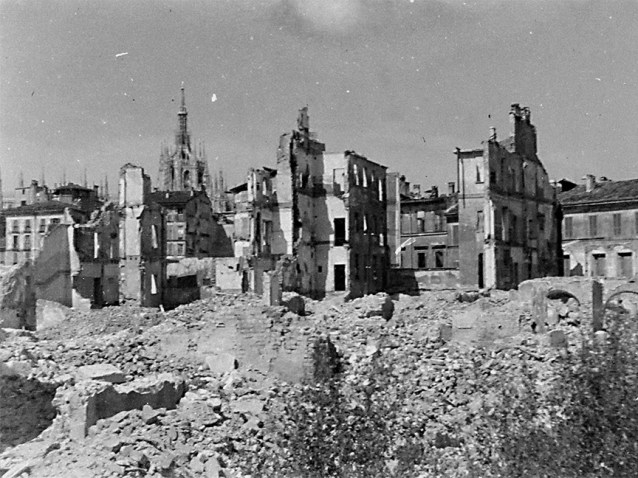 Above: an image captured in Milan in 1943. Note the Duomo in the background. Image via
 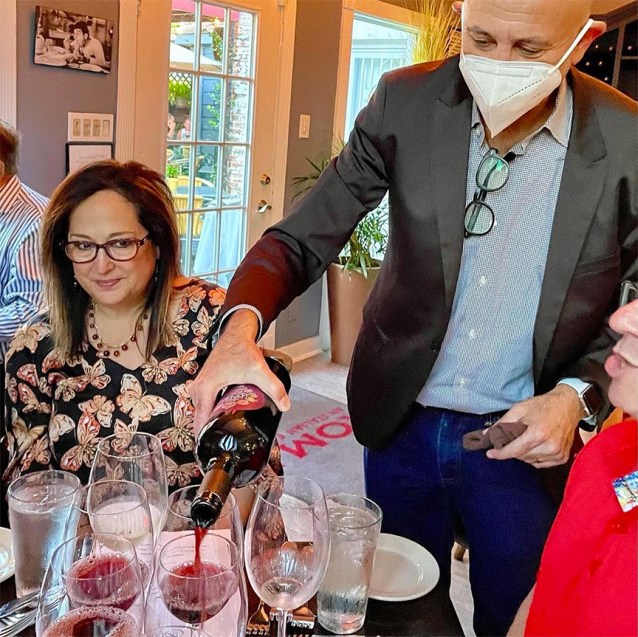 It meant a lot to me when my longtime friend and colleague
 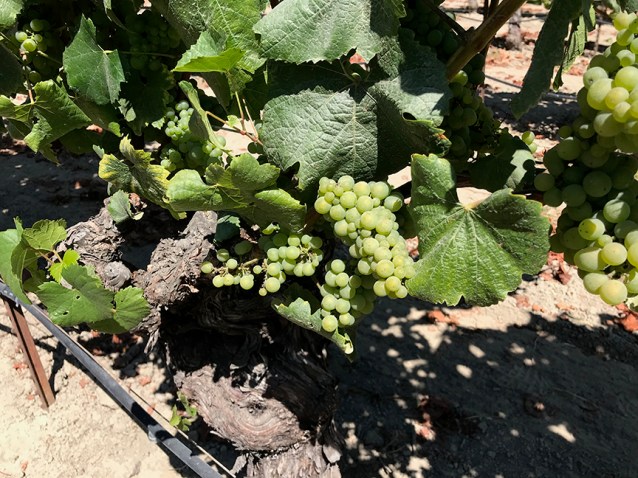 Back in the late aughts following the big bang of the enoblogosphere, there was probably no word more maligned, no term more associated with the wine establishment as “Chardonnay.”
 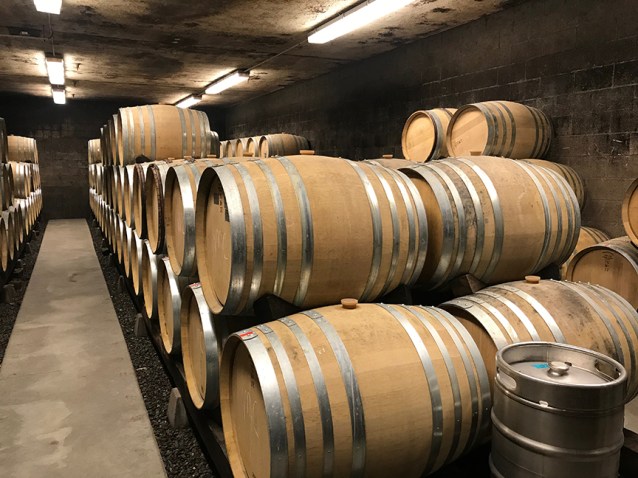 One of the key moments in my own personal Chardonnay sea change was my repeated visits in pre-pandemic years to northern California wine country where the opportunity to taste a broader spectrum of Chardonnay entirely reshaped my perception of the category. By my September 2019 trip for the Slow Wine guide, my third for the imprint, I had discovered so many expressions of Chardonnay that we both loved. From Santa Ynez to west Sonoma coast, there were myriad winemakers — many of them négociants — that had never found their way into our glass along our überhipster wine route.
  Another seismic shift was also happening: we were becoming more experienced wine drinkers. As we strived for many years to birth our “cool palates,” we began to realize that a great lacuna had formed in our wine tastes. And ten years into that arc, we became aware of that gap because we had started to taste some of the great expressions of Chardonnay with more finely honed tasting chops.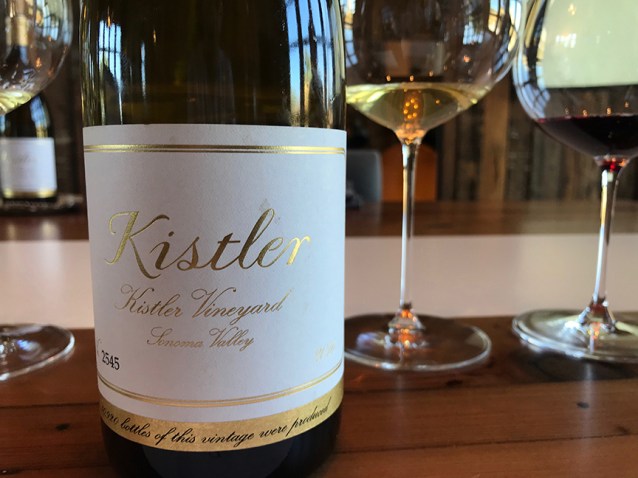
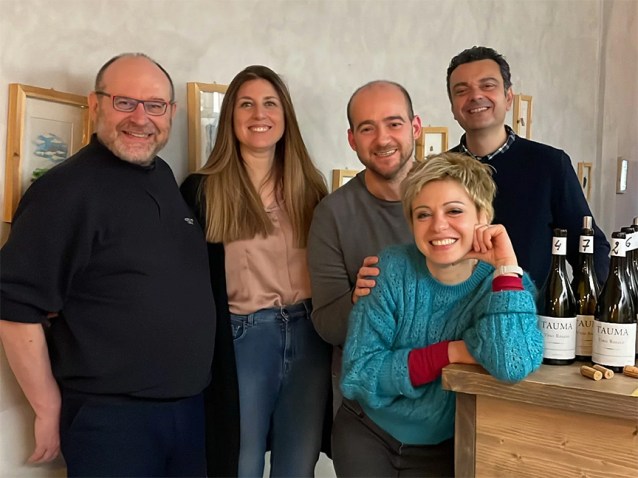 Above, far left: Sandro Sangiorgi, one of the authors of the recently published Vini Veri manifesto that squarely criticizes a new wave of natural producers who consider “technical ability an obstacle” to making their wines. A top wine writer and taster, Sangiorgi is widely considered one of Italy’s leading experts on and advocates for natural wine (image via
  This year as we prepare to celebrate the Passover, our family knows how fortunate we are to enjoy good health and security. With everything going on in the world today, we take time each and every day to tell each other that we love each other and to let each other know that we support one another.
 Georgia and Lila Jane have both been doing well in school. And we all enjoy their music.
 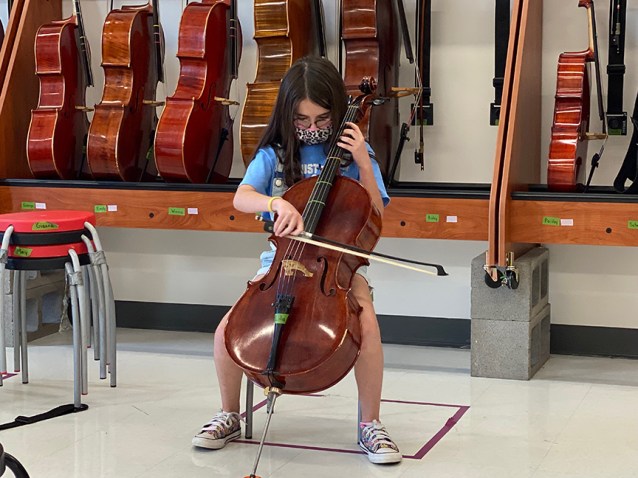 Georgia plays violin and piano and is in advanced choir at school. Lila Jane plays cello and piano and is in beginning choir.
  Tracie’s work is going really well (poo poo poo!). And now that the wine business is back in full swing, my work is also going well.
  We are much closer to our financial goals than we could have ever imagined in 2022. The light is appearing at the end of the tunnel, which is great.
 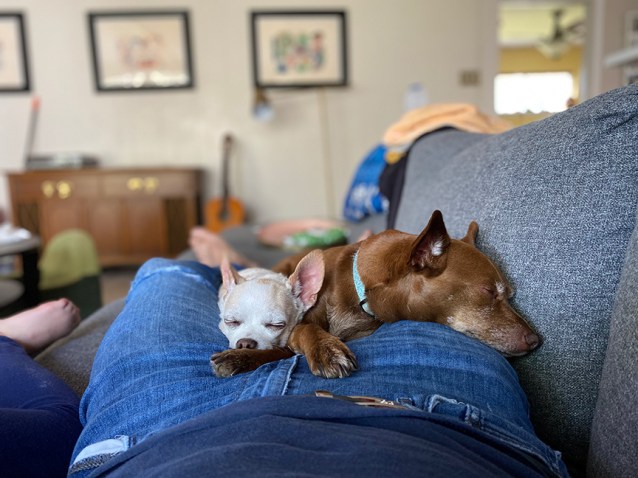 Tracie has done an amazing job and there’s not a day that goes by that I don’t remind her that she makes our lives whole.
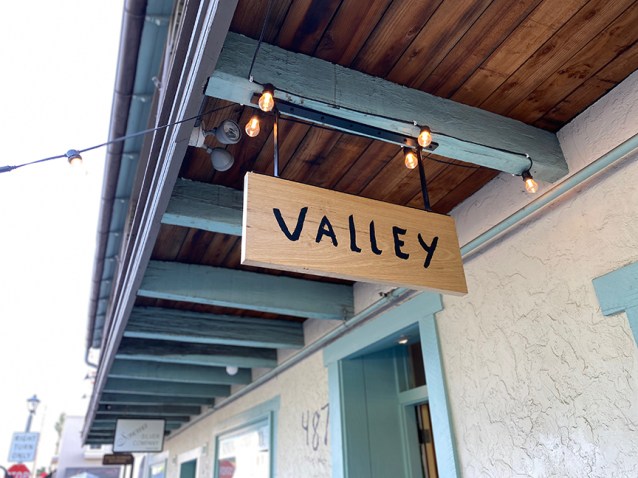 The sun shone through the trees on an unusually warm Sonoma valley early evening as kids played in the park and tourists milled about the shops and tasting rooms.
 Since the late 1980s, Italian cuisine in the U.S. has been shaped by a tension between traditional- and creative-leaning forces.
 Making my way over to Cotogna from my hotel in San Francisco the other night, I couldn’t help but remember a chilly winter evening in the late 80s when I stopped a man on the street and asked him if he knew the way to a certain “trattoria,” a name for pseudo-Italian restaurants that had become popular in the second half of the decade.
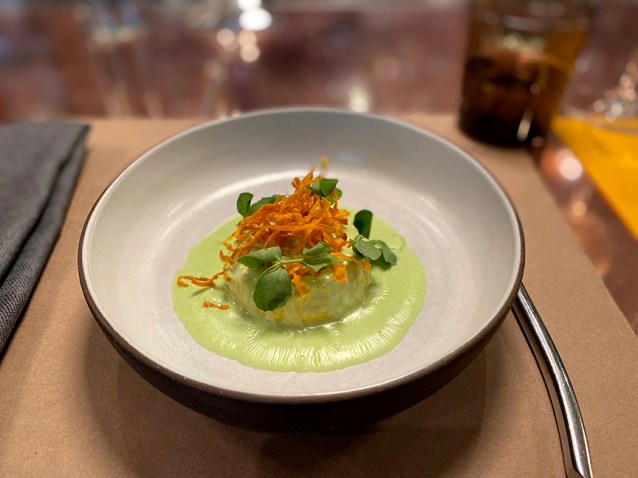
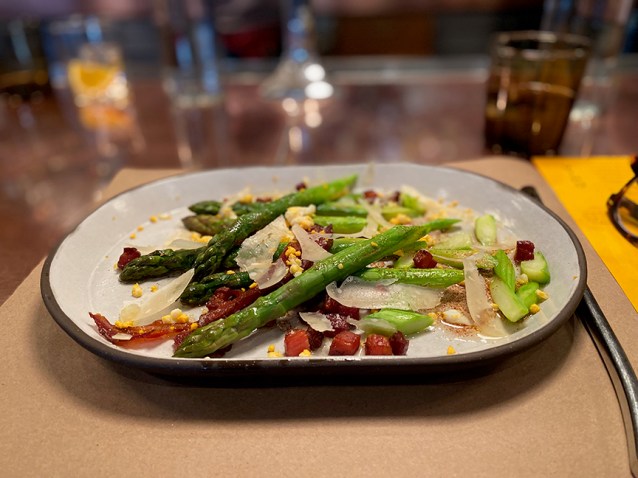
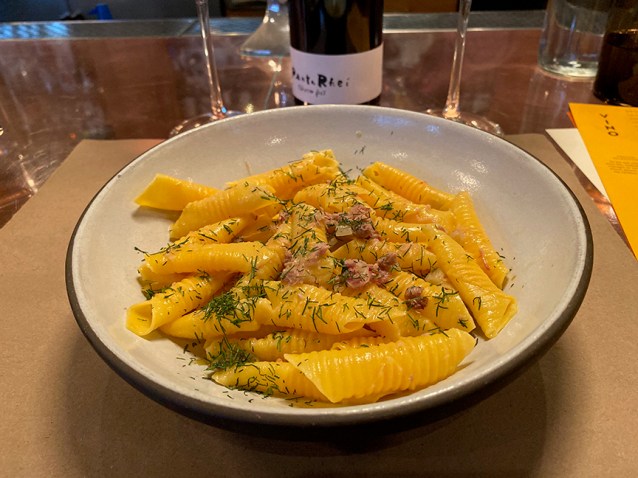 The carrot sformato (first photo) blew me away with its ethereal texture and subtle dance of bold but elegant flavors. Sformato — properly called a savory custard in English — is all about the texture. It should be firm but light, rich but buoyant. I know already from my Instagram that people agree with me: this dish was nothing short of show-stopping. I loved it.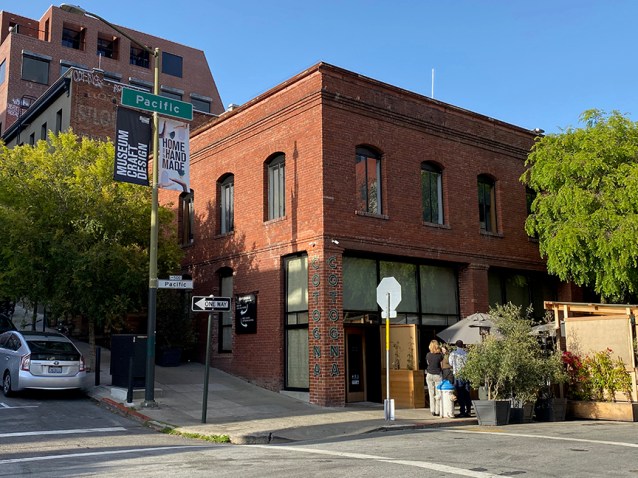
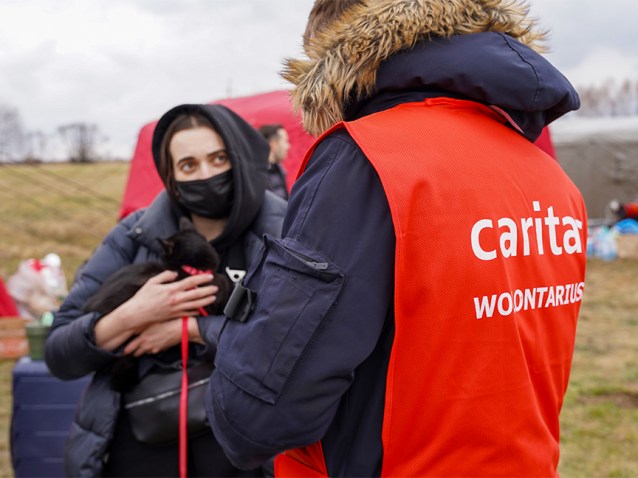 Image via
 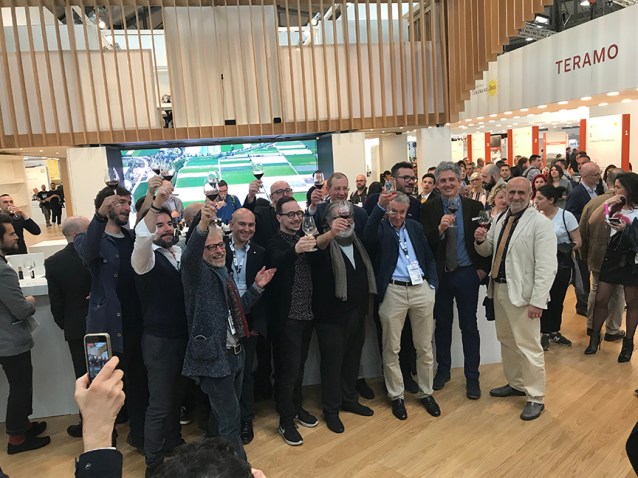 Every year at my Vinitaly, there’s a first-day toast organized by a loosely knit group of Italian wine bloggers and social media users at the Abruzzo region stand.
 Do Bianchi
