Barely any Italian (wine) spoken, some French, but Californian is extreme in San Diego

Above: Jon Erickson and Jayne Battle, owners of Jaynes Gastropub in University Hts., San Diego.

The old timers will tell you that before WWII, there wasn’t much in San Diego. In those days, it was the last stop before your Tijuana divorce, a border town, a place to seek refuge from Los Angeles oil fields and Hollywood tinsel. The city has come a long way and even though there’s not a lot of great wine to be found here, a number of new and interesting places have sprung up in recent years.

Jaynes Gastropub
4677 30th St (at Adams)
University Hts. (San Diego), CA 92116
(619) 563-1011

The atmosphere at Jaynes Gastropub is that of a chic London… well, gastropub. I went on a Saturday night with my friend Patrick Ballow (who runs the wine shop at Jonathan’s in La Jolla, one of San Diego’s best, and the only place I’ve been able to find any natural wine). The restaurant was packed and patrons seemed to relish the haute-pub-food menu. The gambas al ajillo were excellent and the crispy calamari were melt-in-your-mouth tender. “We fry them very quickly at a really high temperature,” said Jayne. “That’s the secret.” At my waiter’s recommendation, I also had a Jayne Burger, topped with red onions that are brined in clove- and star-anise-infused cider vinegar with a touch of cinnamon. I ordered it rare and it arrived perfectly cooked.

Above: the gambas al ajillo at Jaynes were tender and the grilled bread was drizzled oh-so-lightly with extra-virgin olive oil.

The beer selection at Jaynes is fantastic, the mostly new world wine list small but with some real gems, like an Olivier Leflaive St. Aubin en Remilly 1er Cru 2004, which Jon serves by the glass, a traditional mineral-driven classic Burgundian white. Patrick and I also really dug the Vignobles Brisebarre Vouvray Demi-Sec 1989 that he poured with dessert.

Above: the secret ingredient in the Jayne Burger? Brined red onion rings.

Corkage is only $15: we drank a Lòpez de Heredia Viña Tondonia Rosado 1997 (mine) and a Château Branaire (Duluc-Ducru) St. Julien 1995 (Patrick’s… I know, I know… what am I doing drinking Bordeaux? But this judiciously made thirteen-year-old wine — lip-smacking without being too fruit-forward — was showing beautifully, with great goudron notes and it was a great match for my tasty burger).

Above: Tastes wine bar and shop is shaped like a porter house steak. The space was built out as a steakhouse in the 1940s.

Tastes
641 S Highway 101
(just south of West E)
Encinitas, CA 92024
(760) 942-9549

My friend Robin Starck, who runs a successful wine appraisal and brokerage firm, took me to Tastes in Encinitas (in North County, San Diego).

Even though it has nearly no Italian to speak of, the list at Tastes was probably the best French I’ve seen in San Diego. I really liked the Jean-Luc Côtes du Rhône Blanc 2006, unctuous with gorgeous fruit. Tastes is also a wine shop and serves 50 wine-by-the-glass. Chef/owner Sean Fisher’s food is very elegant (although a bit precious for my tastes), the space warm, and the wine service top-notch.

The outgoing Robin also leads wine-cycling trips through Italy.

Above: owner Mike Kallay loops the movie Mondovino in his off-the-beaten-track downtown wine bar, The Cask Room.

The Cask Room
550 Park Boulevard
(btwn Market and Island)
Downtown San Diego, CA 92101
(619) 822-1606

“Big and obnoxious or feminine and delicate” are the extreme degrees of Mike Kallay’s palate at the The Cask Room in downtown San Diego, where he serves roughly twenty-five wines, nearly all of them Californian. The wine bar is also a wine shop and the prices for his mostly-under-$25 bottles are retail, with $10 added across the board if you consume the bottle on premise. I can’t say there was much for an old-world palate like mine to drink but I admire Mike for his vehement anti-Parker and “no points” stance (he looped the movie Mondovino on a flat-screen throughout the evening I was there). I did enjoy a Domaine Paul Autard Côtes du Rhône 2006 that he poured, made from vineyards that lie just outside of Châteauneuf-de-Pape. Mike is a musician and his wine bar features live music on the weekends (mostly blues, from what I could gather). The outspoken Mike also writes a wine column for The San Diego Downtown News (a monthly rag). You gotta hand it to a guy who can describe wine as “obnoxious.”

The weather’s beautiful in San Diego (and I’m headed back to NYC unfortunately), the burritos are cheap but the ingredients fresh, and there’s a cozy wine bar downtown where they play blues on the weekend. Too bad most of the wine tastes like “chocolate.” Maybe I’ll come back to stay anyway…

I know a pretty little place in Southern California down San Diego way
There’s a little cafe where they play guitars all night and day

*****

Rosalita

Spread out now Rosie doctor come cut loose her mama’s reins
You know playin’ blind man’s bluff is a little baby’s game
You pick up Little Dynamite I’m gonna pick up Little Gun
And together we’re gonna go out tonight and make that highway run
You don’t have to call me lieutenant Rosie and I don’t want to be your son
The only lover I’m ever gonna need’s your soft sweet little girl’s tongue and Rosie you’re the one
Dynamite’s in the belfry playin’ with the bats
Little Gun’s downtown in front of Woolworth’s tryin’ out his attitude on all the cats
Papa’s on the corner waitin’ for the bus
Mama she’s home in the window waitin’ up for us
She’ll be there in that chair when they wrestle her upstairs ’cause you know we ain’t gonna come
I ain’t here on business
I’m only here for fun

Rosalita jump a little lighter
Senorita come sit by my fire
I just want to be your lover ain’t no liar
Rosalita you’re my stone desire

Jack the Rabbit and Weak Knees Willie you know they’re gonna be there
Ah Sloppy Sue and Big Bones Billy they’ll be comin’ up for air
We’re gonna play some pool skip some school act real cool
Stay out all night it’s gonna feel all right
Rosie come out tonight Rosie come out tonight
Windows are for cheaters chimneys for the poor
Closets are for hangers winners use the door

Rosalita jump a little lighter
Senorita come sit by my fire
I just want to be your lover ain’t no liar
Rosalita you’re my stone desire

Now I know your mama she don’t like me ’cause I play in a rock and roll band
And I know your daddy he don’t dig me but he never did understand
Papa lowered the boom he locked you in your room
I’m comin’ to lend a hand
I’m comin’ to liberate you confiscate you I want to be your man
Someday we’ll look back on this and it will all seem funny
But now you’re sad your mama’s mad
And your papa says he knows that I don’t have any money
Tell him this is his last chance to get his daughter in a fine romance
Because a record company Rosie just gave me big bucks

My tires were slashed and I almost crashed but the Lord had mercy
My machine she’s a dud out stuck in the mud somewhere in the swamps of Jersey
Hold on tight stay up all night ’cause Rosie I’m comin’ on strong
By the time we meet the morning light I will hold you in my arms
I know a pretty little place in Southern California down San Diego way
There’s a little cafe where they play guitars all night and day
You can hear them in the back room strummin’
So hold tight baby ’cause don’t you know daddy’s comin’

Rosalita jump a little lighter
Senorita come sit by my fire
I just want to be your lover ain’t no liar
Rosalita you’re my stone desire

— Bruce Springsteen

A Shot Heard Round the (Wine) World

Above: Josh Greene at the Unified Wine and Grape Symposium.

Over the last few days, wine writers, bloggers, and pundits have published a number of posts and articles about Wine & Spirits ed-in-chief Josh Greene’s “State of the Industry” talk last Wednesday morning at the Unified Wine and Grape Symposium in Sacramento, CA.

Some, like Sacramento Bee writer Jim Downing, seemed to interpret it almost as an affront to the California wine world.

Others, like Alice Feiring, were enthused by Josh’s “bravery” in suggesting that Californians consider natural winemaking.

Some took a more clinical approach to the much-talked-about talk, like this round-up in Pressing Matters (clever name for a wine blog, no?).

One of the more controversial points of Josh’s talk was his observation — based on hard data collected by his publication — that Californian wine is lagging behind European imports in “on premise” (restaurant) sales. He attributed this to the new generation of twenty-something sommeliers who are looking for wines “with a story” and made an analogy to the recent green-market phenomenon, whereby sommeliers — like chefs — want artisanal as opposed to commercial products. He also noted that for the first time you have “25-year-old sommeliers selling wine to 55-year-olds,” where in the past, sommeliers were generally 40+ in age. This younger generation, he said, looks for unusual, exotic wines to “hand-sell” to patrons. (The previous day, Food and Wine chief wine writer Lettie Teague — who moderated a panel on European imports — pointed out that steakhouse wine lists are invariably dominated by Californian wine.)

The polite 800+ crowd seemed to react positively to the presentation but I didn’t see anyone running out the door to shut down their reverse osmosis machines.

Check out Pressing Matters for a number of quotes from the talk.

Click here to read Josh’s notes from his address.

Here’s my post on Josh’s (and Darrell Corti’s) talk.

Ugly Beauty: more Mexican from the road

Above: It wasn’t pretty but this ugly beauty* sure tasted good… Huevos Rancheros with chile verde sauce and beef at Vallejo’s in Sacramento.

No better cure for the after-effects of an epic wine dinner than a piping-hot plate of huevos rancheros, ranch-style eggs. I had never seen the dish prepared with a chile verde or green chili sauce (typically, it is drowned in red chili sauce), nor had I seen it topped with chicken or beef (the latter option above). Vallejo’s also offers “vegetarian” huevos rancheros (I guess the qualifier vegetarian reflects an attitude that eggs do not belong to the realm of carnivory).

Above: a carnitas (roast pork) burrito from Don Carlos in La Jolla.

Whoever parked the domain name “eataburrito.com” is a genius.

A surfboard painted like a Mexican flag at Don Carlos. The restaurant lost its license to sell beer (which is too bad) but it’s still a So Cal classic burrito joint.

* I believe that “Ugly Beauty” was Thelonious Monk’s only waltz.

Calls in California for Balance and Nature (and dinner with a “national treasure”)

Above: dinner with “national treasure” Darrell Corti (right) and Josh Greene, editor-in-chief, Wine & Spirits Magazine at Sacramento’s Waterboy.*

Tuesday morning I headed up from La Jolla to Sacramento to attend the opening sessions of the Unified Wine & Grape Symposium. The convention represents California’s largest gathering of winemakers and wine-grape growers and I was lucky enough to receive an invitation to the 34th annual meet of CAWG (the California Association of Winegrape Growers) where Darrell Corti — one of the nation’s foremost authorities on American and European wine — was guest speaker.

Earlier in the day I ran into Napa Valley public relations legend Pamela Hunter, who had just come from Corti Brothers, Darrell’s grocery and wine shop. We were introduced by another wine professional and when we made the connection that he was our mutual friend, she pointed out rightly that Darrell ought to be considered a “national treasure”: his worldly erudition, encyclopedic wine and food knowledge, and unwavering graciousness are matched only by the cornucopia of foods and wines he has introduced to the U.S. through his taste-making however modest store. Ruth Reichl and Colman Andrews have called him the man “who knows more about food and wine than anyone else in the world.”

Above: Unified Wine & Grape Symposium participants.

In his address, Darrell asked the CAWG members to reflect on the “tradition” of California winemaking, warning them not to become complacent. In California, he said, “we can make whatever we want wherever we want”: he urged them to consider replacing ubiquitous Chardonnay and Cabernet Sauvignon plantings with other international grape varieties that will show better in the warm Californian climate. Aglianico, he suggested, might represent an alternative to Cabernet.

He reminded the group of wine-grape growers and winemakers of the “concept of 10.5 – 13.5% alcohol table wines” and the era before “overripeness and terroir became confused” (in an episode now dubbed “Zingate,” Darrell made headlines last year when he announced that he would no longer sell wines with an alcohol content over 14.5%).

“Have we abrogated the quality of wine to the wine press?” he asked, urging growers to reel in brix levels (the brix scale is used to measure the sugar content of grapes; simply put, the more sugar in the fruit, the higher the potential alcohol content of the wine). “You have to grow good grapes to make good wine,” he told them. And “as they say in Italian, buon vino fa buon sangue,” literally, “good wine makes good blood,” in other words, good grapes and good wine make us healthy.

Above: our unforgettable repast began with a Webb and Farinas 1970-1998 Sherry, “Blended Fino and Baked Fino Solera,” one of the last bottles ever made by the University of California at Davis, Darrell told us.

Before I caught a plane back to San Diego the next morning, I managed to find a seat among the 800+ audience at Wine & Spirits ed-in-chief Josh Greene’s “State of the Industry” talk. Josh spoke of the new trend of younger sommeliers who are “hand-selling” once exotic international grape varieties to the Cabernet-Merlot-and-Chardonnay set. The Loire Valley, he said, represents the most alluring wine-producing region for this new generation of restaurant professionals. Naturally made, food-friendly wine from Italy and France, he told the group, is becoming more and more popular among America’s wine directors and he urged producers to consider natural winemaking.

“It’s a risky way to make wine,” he noted. “You can’t always make wine commercially like this, but there’s a growing market for it. The question is how to make a wine that’s balanced, has concentrated flavors, and a distinct expression of its place… and then figure out how to make money doing it,” he added, drawing a chuckle from the packed house.

Gauging from the positive reception of Josh’s excellent talk, there might be hope for Californian wine after all.

Click here to read Josh’s notes from his address.

Above: this 1986 Mount Pleasant Semillon from Darrell’s cellar blew me away. It was full of life, brilliant acidity, and vibrant minerality. But the show-stopper was a magnum of 1983 Cepparello by Isole e Olena, a great bottling of (pre-barrique) Sangiovese from a vintage overshadowed unjustly by 1985.

I loved the session title ““How to Have a Mostly Worry-Free Interaction with TTB Resources” (the TTB or Alcohol and Tobacco Tax and Trade Bureau regulates wine sales in the U.S.).

Grass-roots organizers were also in attendance.

I can’t reveal whose car this is (but I bet you can guess). I really dig the old-school blue California plates.

* On my way out, one of the waiters told me that the restaurant was named after the band The Waterboys, but I’m not sure I believe her.

Who says penguins don’t fly?

Above: this penguin flies high in friendly skies (click image for animation).

Traveling sometimes make me blue (Doesn’t anybody stay in one place anymore?).

Those of you who know me personally know that 2007 was not a great year for me. Things have been better lately but I still have some pretty rough days (and there are more ahead).

I had a great time yesterday in Sacramento where I attended the Unified Wine & Grape Symposium (look for my post tomorrow). But as I got on the plane this morning, the blues caught up with me once again.

But then… smiles and laughter were brought to everyone’s face when a penguin — I kid you not — came strolling down the aisle. He was on his way to Sea World in San Diego (I was on my way to my family’s place, not the zoo, for the record). Even when the twists and turns of life make you feel like you’re about to break into a million pieces, a close encounter with a happy little penguin somehow makes it all worthwhile again.

Above: the penguin’s mommy.

Above: this sweet lady was flying for the first time in her life and so the in-flight crew made her a “peanut crown” out of airline peanut bags.

Above: they don’t have electronic in-flight maps on Southwest Airlines so they use this one. Listen, after seeing the flying penguin, I’ll believe anything…

Above: the baggage claim at the Sacramento airport has these crazy sculptures. It takes you a minute to figure out that they’re works of art.

Look for my post tomorrow on my dinner with “national treasure” Darrell Corti and notes from Josh Greene’s excellent talk on “the state of the industry.”

Back to food and wine tomorrow, I promise… But a flying penguin? I had to blog it… An antidote to the blues, let me tell you…

*****

So far Away
Doesn’t anybody stay in one place anymore?
It would be so fine to see your face at my door
Doesn’t help to know that you’re just time away
Long ago I reached for you, and there you stood
Holding you again could only do me good
How I wish I could, but you’re so far away

One more song about moving along the highway
Can’t say much of anything that’s new
If I could only work this life out my way
I’d rather spend it being close to you
But you’re so far away
Doesn’t anybody stay in one place anymore?
It would be so fine to see your face at my door
Doesn’t help to know you’re so far away
Yeah, you’re so far away

Traveling around sure gets me down and lonely
Nothing else to do but close my mind
I sure hope the road don’t come to own me
There are so many dreams I have yet to find
But you’re so far away
Doesn’t anybody stay in one place anymore?
It would be so fine to see your face at my door
And it doesn’t help to know you’re so far away
You’re so far away
Yeah, you’re so far away
You’re so far away

— Carol King

Aglianico ≠ Ellenico?

Does the grape name Aglianico come from ellenico or Hellenic as so many claim? A look at the earliest references leads me to believe that it probably doesn’t. May the philologically curious please read on…

Above: the frontespiece of Giambattista della Porta’s Villae or On Country Houses (Frankfurt, 1592) in the rare books collection at the Brooklyn Botanical Garden.

“As philologist, one sees behind the sacred texts,” wrote Friedrich Nietzsche in The Twilight of the Idols.* While most think of Nietzsche as a philosopher, few remember that his early training was in philology, the (inexact) science of the history and development of language and literature, literally the “love” (Greek philo-) of the “word” (Greek logos).

My philological curiosity recently led me to the Brooklyn Botanical Garden where I hoped to get to the bottom of a a etymological conundrum that has bothered me for a long time: does the grape name Aglianico come from the word ellenico or Hellenic as so many oenophiles claim or does it come from Aleatico (literally, a grape that ripens in July, from the Italian lugliatico or of the month of July) as many Italian philologists believe?

The excellent rare-book collection at the BBG includes a rare copy of Villae (On Country Houses, 1592, Frankfurt), an almanac of farming, vine-tending, and winemaking in sixteenth-century Campania by Giambattista della Porta (1535? – 1615), the great Neapolitan scientist, agriculturist, and viticulturist. Most ampelographers agree that Della Porta’s book was earliest to refer to the Aglianico grape as hellanico or Hellenic (ampelography is the study of grapes, from the Greek ampelos or “vine” and graphê or “writing”).

Above: folio 501 and a detail highlighting the line, “Ergo nostras hellanicas helvcolas [sic] antiquorum dicerem.”

The reference is found in the chapter on grape varieties and wines (folio 501): “Ergo nostras hellanicas helvcolas [sic] antiquorum dicerem.” “Therefore, I would say that the helvola [yellowish] grapes of the ancients are our Hellenic grapes.” He is referring to a passage from the Historia Naturalis (14.29) where Pliny (23 – 79) describes grapes that grow in the shadow of Mt. Vesuvius (it’s not clear that Della Porta and Pliny were describing the grape we know today as Aglianico because both of them refer to it as helvola or yellowish in color).

The earliest known occurrences of the word Aglianico in print occur around the same time as Della Porta’s Villae (Andrea Bacci, De naturali historia vinorum, 1596, and Jean Liébault, L’agriculture et maison rustique, 1586 [I’ve been able to verify the mention in Bacci but — to date — I haven’t been able to get my hands on a copy of Liébault]).

There is no question that the Aglianico grape has been called hellenico, hellanico, and ellenico since the sixteenth century. But is there really a reason to believe that Aglianico comes from ellenico (besides the fact that the words sound somewhat similar)?

It is unlikely that Aglianico comes from ellenico because the the terms Hellenic and ellenico were coined around the same time Aglianico first began to emerge as a grape name.

According to the Grande Dizionario della Lingua Italiana (The [Unabridged] Dictionary of the Italian Language, edited by the great twentieth-century philologist Salvatore Battaglia), ellenico and ellenismo were coined in Italian after the French hellénisme, for which the earliest known reference dates to 1580 in France. It is a term derived from Hellenes (a tribe of ancient Greece) and came into use during the Renaissance to denote the Grecian realm and Grecian culture (according to the Oxford English Dictionary, the earliest occurrence in English is 1609). Pliny and his Roman contemporaries wouldn’t have recognized the word hellenicus because it did not exist in their time (they used graecus).

Della Porta did not claim that Aglianico comes from ellenico. He simply speculated that the grape described by Pliny (helvolas antiquorum, the yellowish grapes of the ancients) was called hellanico (hellanicas nostras, our Hellanico grapes) in his day (i.e., as of 1592).

Does Aglianico come from Aleatico and/or lugliatico? Most Italian etymologic dictionaries report that it does (and my research won’t stop here). What’s clear is that Aglianico and ellenico first appeared at roughly the same time and are related historically but probably not etymologically.

Pardon the pun: when I look “behind the text,” I find it’s not all Greek to me.

Above: the Rare Books reading room at the Brooklyn Botanical Garden. In another lifetime, I worked many nights as a guitar player in a wedding band in the Garden’s atrium, a popular NYC wedding venue.

* The Twilight of the Idols/The Anti-Christ, trans. R.J. Hollindale, New York, Penguin, 1990, p. 175.

Una (vera) pizza napoletana (o newyorchese)?* The debate continues…

Above: Anthony Mangieri, polarizing pizzaiolo at Una Pizza Napoletana (photos by Kelli).

Following my post last week on pizza in New York City, I received a number of recommendations. Here are some of the most passionate…

Una Pizza Napoletana
349 E 12th St (btwn 1st and 2nd)
New York, NY 10003
(212) 477-9950

New Yorkers love their pizza and they love to share their opinions. No NYC pizzeria seems to be as polarizing as Una Pizza Napoletana in the East Village: there are those who swear it is the most authentic Neapolitan pizza in the city and there are others who claim it is just a would-be hipster cult destination.

Pizzaiolo Anthony Mangieri makes only four pizzas: Margherita, Marinara (above, left), Bianca, and Filetti (topped with cherry tomatoes), all of them meatless. Anthony uses sawdust to “bump the oven temp up about 70 degrees for a few seconds to add a little crunch without drying the crust out,” writes Scott. “Worked like a charm on 2 of the 3 pies we had: Marinara was suitable for the Last Supper, Bianca was on its heels and the Margherita was a little soggy which texture-wise is to obvious effect but it also washed out the flavor a bit. The keys to the flavor (for me) are the explosions of different flavors from bite to bite: a hit of salt here, olive oil there and in the case of the Marinara the beautiful oregano.”

Bleeker Street Pizza
69 7th Ave S (at Bleeker St)
New York, NY 10014
(212) 924-4466

“This slice joint stands above. I challenge you to find a better stand-up slice in town than its Nonna Maria — marinara, mozzarella, basta. With just a few tables, I’m not sure how they’d respond to wine from the outside, but it would be worth trying to smuggle in a ’61 Cheval Blanc.”

— Jeff

Di Fara
1424 Avenue J (at 14th St)
Brooklyn, NY 11230
(718) 258-1367

“Di Fara Pizza should definitely be in the top tier. It is an awesome only in NY experience. It is totally chaotic with no order there are 5-6 people deep at a counter and every once in a while the owner looks up and takes and order so you have to be proactive/aggressive. We had a simple cheese pie – it was amazing fresh basil and cheese.”

— Robert

Luzzo’s
211 1st Ave (btwn 12th and 13th Sts)
New York, NY 10003
(212) 473-7447

“That’s amore… warm coals and crusty pizza.”

Alfonso

Stromboli
83 Saint Marks Pl (at 1st)
New York, NY 10003
(212) 673-3691

“In the drunk pizza category there’s nothing finer than Stromboli on St. Marks and 1st Ave. It’s a block from the Tile Bar (which is my favorite bar in the East Village and possibly all of the city) which makes it perfect in every way.”

— Dana

Totonno’s Pizzeria Napolitano [sic]
1524 Neptune Ave (at West 15th St)
Brooklyn, NY 11224
(718) 372-8606

“Totonno’s out on Coney Island is my favorite. Every time I go there with friends, we order one, and then, after we eat it, we order another and eat that. Thin crust, and more sauce than cheese.”

— Dana (bis)

* A (true) Neapolitan pizza (or New Yorker)?

Oscar Riles Parzen

oscar.jpg

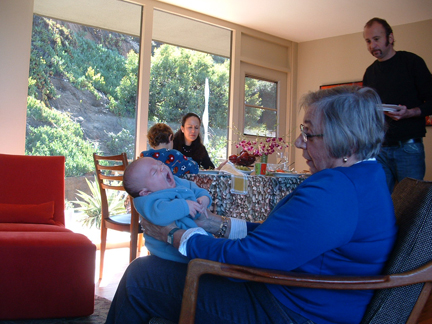
My nephew Oscar Riles Parzen was born January 18, 2008. I saw him for the first time this morning at Micah and Marguerite’s (in Sunset Cliffs, San Diego). He’s a beauty…

That’s my mom Judy holding him, Marguerite and Abner (his brother) in the background. To the right, his no-good rock n’ roller uncle from New York.

The bottle that started it all…

Above: the bottle that started it all… a 1968 Barolo by Scanavino got Alice Feiring interested in wine more than twenty years ago. She’s kept it all this time…

Wednesday evening of last week led me to the home of wine writer and blogger Alice Feiring for a preview party for her new book, The Battle for Wine and Love: or How I Saved the World from Parkerization (Harcourt). A group of magazine editors and other guests tasted ten wines blind and Alice talked about the genesis of her book and her fierce love for natural wine.

In the second flight of wines (five bottlings, each made with Syrah), she included a Yellow Tail Shiraz: it was striking to see the guests — most of them lifestyle as opposed to wine writers — experience that moment of enlightenment when they tasted naturally made Syrah side-by-side with one of the most industrial wines available on the market today.

Alice is known by many in the wine world as one of the most skeptical and cynical writers on the scene but she spoke that evening of what she calls “the golden age of wine making.”

“There’s a lot of bad, spoofilated wine out there,” she told the group, emphasizing the term that wine-folks use to denote “spoofed” or “tricked out” wine. “But there is also more good wine produced than at any other time in history.”

Let’s hope she’s right…

Look for the book in May, 2008…

Attached Cork Bottle Presentation

A picture is worth a thousand words…

Chris wrote in yesterday asking: “Do you have directions for how to bind a cork to the side of the bottle using foil…? I work at a restaurant and would like to do the same for my customers.” I promised Chris I’d get on the case right away.

Last night I went to Falai to visit my friend, the inimitable Alberto Taddei, ex-sommelier at Ristorante Enoteca Pinchiorri in Florence (one of Italy’s greatest wine destinations) and one of NYC’s most beloved wine directors. He allowed me to create this slide show:

Step 1: carefully cut a disk out of the very top of the capsule, leaving enough attached so that it can be folded back (the disk’s diameter should be equivalent to that of the cork).

Step 2: gently fold the top back.

Step 3: cut the capsule above the top lip of the neck, leaving a piece attached below the top flap.

Step 4: gently fold the ring back.

Step 5: gently slide the cork up through the ring (be sure to slide it up from the bottom); gently pinch the center of the ring to fasten the cork securely; then gently fold the pinched foil to one side to make the ring appear smooth.

Pretty cool, huh? That’s a bottle of 2003 Castell’in Villa Chianti Classico, one of my all-time favorites, done into a 100% traditional style.

Above: toasty focaccine at Falai.